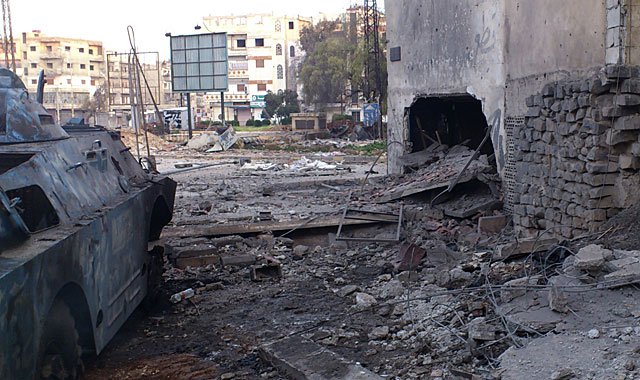
Syrian government forces have renewed their attack on the city of Homs, one of the focal points of the uprising against President Bashar al-Assad.
Video published on the internet purportedly from Homs showed intermittent shelling and black smoke.
UN mediator Kofi Annan is concerned civilians have been trapped in Homs and al-Haffa, a town in Latakia province also said to be under attack.
The US says it fears the government may be planning “another massacre”.
Kofi Annan’s spokesman, Ahmad Fawzi, said civilians had been trapped in both Homs and al-Haffa.
Kofi Annan was demanding immediate entry to al-Haffa for UN military observers be allowed, he added.
Syrian government forces have renewed their attack on the city of Homs, one of the focal points of the uprising against President Bashar al-Assad
As joint envoy for the UN and the Arab League, Kofi Annan brokered a six-point peace plan, including a ceasefire which came into nominal effect two months ago but has now been virtually abandoned.
Syrian army appeared to be using an unmanned surveillance drone to select buildings as targets for shelling.
A steady stream of mortar rounds landing in the old city of Homs at a rate of about one a minute.
The UN team – which has been trying for two days to gain access to the old city – has still not succeeded.
All the UN can do is stand by and watch.
US state department spokeswoman Victoria Nuland said it was “deeply alarmed” at “reports from inside Syria that the regime may be organizing another massacre”.
Such an attack could happen, it suggested, in al-Haffa or the towns of Deir el-Zour, Homs or Hama, or in the suburbs of the capital, Damascus.
According to the London-based Syrian Observatory for Human Rights, at least 74 people were killed across Syria on Monday.
An activist website, the Violations Documenting Centre, said there had been 29 deaths in the past week from bombardment in al-Haffa. All but three of the dead were civilians, it added.
These reports cannot be confirmed independently because Syria heavily restricts journalists’ freedom of movement.
The Syrian government blames the violence on foreign-backed armed terrorist gangs.
Separately, UN monitors and human rights activists said Syrian government forces had used helicopters to bombard the town of Rastan, in Homs province.
The town has been under intermittent army shelling “for months”, the Observatory said.
UN spokeswoman Sausan Ghosheh said monitors had seen Syrian helicopters firing on Rastan and another rebel stronghold, Talbisa.
In Talbisa, rebels from the Free Syrian Army captured soldiers from government forces, she added.
Yad Vashem Holocaust memorial in Jerusalem has been defaced with graffiti by vandals denouncing Zionism.
One of the slogans daubed in paint on the walls of the memorial read: “If Hitler had not existed, the Zionists would have invented him.”
“This unprecedented act crosses a red line,” Yad Vashem chairman Avner Shalev said in a statement.
Suspicion for the attack has fallen on radical ultra-Orthodox Jews who oppose the creation of the state of Israel.
Avner Shalev pointed out in comments to local media that one of the slogans was signed “world ultra-Orthodox Jewry”.
“We are shocked and dazed by this callous expression of burning hatred against the Zionists and Zionism,” Avner Shalev said.
Yad Vashem Holocaust memorial in Jerusalem has been defaced with graffiti by vandals denouncing Zionism
Photos of some of the other slogans have been published in the Israeli press, including one reading: “Thanks Hitler for the wonderful Holocaust you organized for us. Only thanks to you we got a state from the UN.“
Another reads: “Honorable government of Poland, stop allowing the Zionists to hold manipulative <<memorial>> ceremonies in Auschwitz.”
Education Minister Gideon Saar condemned the graffiti, saying: “Whoever desecrated and soiled Yad Vashem with these disturbed slogans did it with the aim of harming public sensibilities.”
Police spokesman Micky Rosenfeld said an investigation was under way.
Some ultra-Orthodox Jews believe that a Jewish state can be established only after the coming of the Messiah, and that the state of Israel is therefore illegitimate.
Yad Vashem was established in 1953 and commemorates the six million Jews murdered by the Nazis during World War II.
Madagascar 3 has beaten Ridley Scott’s Alien offshoot Prometheus to top the US box office.
Madagascar 3: Europe’s Most Wanted took nearly $60.4 million over the weekend, according to studio estimates.
Sci-fi thriller Prometheus, starring Noomi Rapace, Michael Fassbender and Charlize Theron, debuted in second place with $50 million.
The film is rated R in the US, meaning under-17s must see it with an adult.
Madagascar 3, which premiered at Cannes Film Festival last month, reunites voice stars Ben Stiller, Chris Rock, Jada Pinkett Smith and David Schwimmer.
Madagascar 3 has beaten Ridley Scott's Alien offshoot Prometheus to top the US box office
The Dreamworks Animation outperformed the $47.2 million debut of the 2005 original, but fell short of Madagascar: Escape 2 Africa, which took $63.1 million in its opening weekend.
The third instalment, which has been a bigger hit with the critics, benefited from higher ticket prices and more expensive 3D shows.
Prometheus, telling the story of a team of explorers who discover a clue to the origins of mankind, was also screened in 3D.
Last weekend’s US number one Snow White & the Huntsman slipped to third-place, with Men in Black 3 at number four.
Fifth place went to The Avengers, which has now taken $571.9 million at the US box office – making it the highest-grossing film of the year so far.
Researchers have found that the teams responsible for the Flame and Stuxnet cyber-attacks worked together in the early stages of each threat’s development.
Flame, revealed last month, attacked targets in Iran, as did Stuxnet which was discovered in 2010.
Kaspersky Lab said they co-operated “at least once” to share source code.
“What we have found is very strong evidence that Stuxnet/Duqu and Flame cyber-weapons are connected,” Kaspersky Lab said.
Alexander Gostev, chief security expert at the Russian-based security company added: “The new findings that reveal how the teams shared source code of at least one module in the early stages of development prove that the groups co-operated at least once.”
Researchers have found that the teams responsible for the Flame and Stuxnet cyber-attacks worked together in the early stages of each threat's development
Vitaly Kamluk, the firm’s chief malware expert, said: “There is a link proven – it’s not just copycats.
“We think that these teams are different, two different teams working with each other, helping each other at different stages.”
The findings relate to the discovery of “Resource 207”, a module found in early versions of the Stuxnet malware.
It bears a “striking resemblance” to code used in Flame, Kaspersky said.
“The list includes the names of mutually exclusive objects, the algorithm used to decrypt strings, and the similar approaches to file naming,” Alexander Gostev said.
Recently, a New York Times investigation – based on an upcoming book – singled out the US as being responsible for Stuxnet, under the direct orders of President Barack Obama.
The report said the threat had been developed in co-operation with Israel.
No country is yet to publicly take responsibility for the attack.
Speaking about Flame, a spokesman for the Israeli government distanced the country from involvement following an interview in which a minister seemed to back the attacks.
“There was no part of the interview where the minister has said anything to imply that Israel was responsible for the virus,” the spokesman said.
Last week, the UN’s telecommunications head Dr. Hamadoun Toure said he did not believe the US was behind Flame, and that reports regarding the country’s involvement in Stuxnet were “speculation”.
Prof. Alan Woodward, a security expert from the University of Surrey, described the findings as interesting – but not yet a clear indicator of who was behind the attacks.
“The fact that they shared source code further suggests that it wasn’t just someone copying or reusing one bit of Stuxnet or Flame that they had found in the wild, but rather those that wrote the code passed it over,” he said.
“However, everything else still indicates that Flame and Stuxnet were written designed and built by a completely separate group of developers.
“At the very least it suggests there are two groups capable of building this type of code but they are somehow collaborating, albeit only in a minor way.”
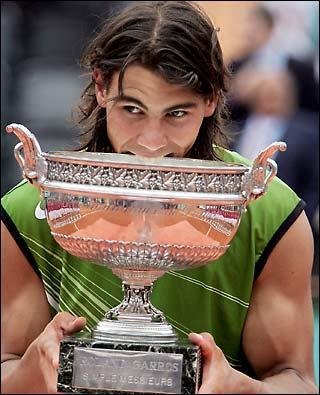
Rafael Nadal won a record seventh French Open title after beating Novak Djokovic with 6-4 6-3 2-6 7-5 in a rain-affected final.
Rafael Nadal, 26, resumed leading 6-4 6-3 2-6 1-2, but his uncharacteristic wobble late on Sunday had fuelled Novak Djokovic’s belief.
The Spaniard broke back in the first game of the day however, and then piled pressure on an unsettled Novak Djokovic.
The Serb finally folded with a double fault to hand Rafael Nadal an 11th Grand Slam.
Having drawn level with Bjorn Borg on six Roland Garros titles last year, the victory gave Rafael Nadal sole ownership of the landmark, and he is likely to have plenty of opportunities to stretch further clear.
Rafael Nadal won a record seventh French Open title after beating Novak Djokovic with in a rain-affected final
The only three men to have more Grand Slam victories – Roger Federer with 16, Pete Sampras on 14 and Roy Emerson on 12 – are now in his sights.
The crowd had returned to Court Philippe Chatrier entertaining the possibility that they may witness a different piece of tennis history.
Novak Djokovic, aiming to become only the third man in history to hold all four Grand Slam titles simultaneously, seemed to have the upper hand on his rival when Parisian drizzle had forced them off on Sunday.
Rafael Nadal led a precariously-poised contest 6-4 6-3 2-6 1-2 overnight, but, having been broken early in the fourth, he had looked ill at ease on the court he has made his own.
The Spaniard had surrendered eight successive games and grew increasingly irritated by the wet conditions underfoot before tournament officials called an end to proceedings.
With the chance to reassess his position and resume in dry, if cloudy, conditions the world number two emerged reenergized.
Novak Djokovic’s hopes of becoming the first man to beat Rafael Nadal on clay after losing the opening two sets immediately dimmed as Nadal toppled his serve in the opening game.
Rafael Nadal’s body language had spoken volumes on Sunday and, after the Serb’s forehand down the line was snagged by the tape to bring up 2-2 , it was Novak Djokovic who allowed his frustration to show.
The world number one pounded his head with his racquet strings, but the brutal treatment he was receiving from the opposite end of the net proved harder to halt.
Twice Rafael Nadal held to love, while Novak Djokovic’s serve continued to look vulnerable.
Novak Djokovic’s resolve and fight had seem him haul back four match points to beat Jo-Wilfried Tsonga earlier in the tournament, but he appeared drained as he gifted Rafael Nadal the championship without forcing him to play a return.
The Serb’s second serve was long to signal an end of three successive Grand Slam final wins over Rafael Nadal and continue his rival’s extraordinary record of just one defeat in the tournament since making his debut in 2005.
Rihanna is said to have used a body double for the sexy Armani advertisement which she filmed earlier this year.
However, Rihanna, 24, may not be so forthcoming about this revelation and no doubt wants fans to believe she features throughout the minute-long video.
According to The Sun, Irish model Jahnassa Aicken is the other woman who bares her body in a pair of designer knickers.
However, Rihanna’s management allegedly made her sign an order banning her from speaking about the fact that she was used as a double.
“Jahnassa’s torso, body and bum appear in parts of the ad,” a source told The Sun.
“It’s shocking Rihanna wanted one considering she loves posing with no clothes, plus she’s in great shape.”
Rihanna is said to have used model Jahnassa Aicken as a body double for the sexy Armani advertisement which she filmed earlier this year
The advert shows Rihanna laying in a large double bed on her own wearing black lace underwear as she appears to have a nightmare.
It then cuts to her getting out of bed as she picks up the telephone and then slips into a pair of Armani jeans and a leather jacket.
The close-up shots of the singer’s derrière and of her bust are said to be Jahnassa Aicken – not Rihanna.
Jahnassa Aiken is said to have acted as Rihanna's body double in Armani Jeans commercial
Rihanna – who first stated that she would be collaborating with Armani late last year – clearly wasn’t feeling over-confident about her own figure.
Jahnassa Aicken is said to have received a “modest sum” for the job, and was first spotted by Rihanna’s people in a crowd during the filming of her We Found Love music video in Northern Ireland.
“If we have complaints consumers have been misled by the use of a body double, we will investigate,” an Advertising Standards Authority spokesman told The Sun.
British Prime Minister David Cameron and his wife, Samantha, left their eight-year-old daughter, Nancy, in a pub after having Sunday lunch, Downing Street has confirmed.
Nancy Cameron is reported to have spent about 15 minutes at the Plough Inn at Cadsden in Buckinghamshire, before David Cameron returned to collect her.
Number 10 says the couple were “distraught” when they realized Nancy was not with them.
It said it happened “a couple of months ago”.
Prime Minister David Cameron and his wife, Samantha, left their eight-year-old daughter, Nancy, in a pub after having Sunday lunch, Downing Street has confirmed
The pub is near David Cameron’s country residence at Chequers.
The Camerons were at the pub with Nancy and their other children Arthur, six, and 22-month-old Florence, as well as two other families.
After leaving, David Cameron went home in one car with his bodyguards and thought Nancy was with his wife and their other children in another car.
Samantha Cameron had assumed her eldest daughter was with her father. The mistake was discovered when they got home. When the prime minister returned to collect Nancy he found her helping staff.
A Downing Street spokesman said: “The prime minister and Samantha were distraught when they realized Nancy wasn’t with them.
“Thankfully when they phoned the pub she was there safe and well. The prime minister went down straight away to get her.”
In a newly revealed legal filing that asked a court to prohibit Mary Kennedy from threatening suicide in front of their children Robert Kennedy claimed that his estranged wife abused his children from an earlier marriage and violently attacked him on numerous occasions.
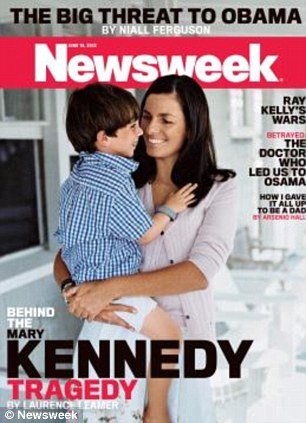
Portions of the 60-page confidential divorce affidavit filed in 2011, which includes shocking claims that Mary Kennedy was physically abusive towards Robert and – on one occasion – his daughter, were disclosed in Newsweek magazine’s cover story about her troubled life.
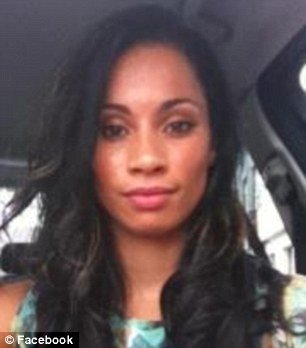
Struggling with debt, depression and drinking heavily, Mary Kennedy searched on the Internet for how to make a noose and asked her housekeeper’s husband to buy some rope, saying it was for a sofa she was making.
Mary Kennedy committed suicide last month at the family’s estate in Bedford, New York, two years after Robert filed for divorce.
Sworn on September 16 2011, Robert Kennedy’s affidavit paints a desperately sad picture of a woman who, experts told Newsweek‘s Laurence Leamer, was suffering from a psychiatric disorder – Borderline Personality Disorder.
The couple, who had four children together, married in April 1994 when Mary was six-months pregnant.
And, according to the affidavit, Mary Kennedy became violent towards Robert shortly before they were married.
“Soon after Mary became pregnant with our first son, Mary, in a sudden rage about my continued friendship with [my ex-wife] Emily, hit me in the face with her fist,” Robert Kennedy said in the documents.
“She was a trained boxer and I got a shiner. Her engagement ring crushed my tear duct causing permanent damage … Mary asked me to lie to her family about the cause of my shiner.”
Robert Kennedy alleges in the affidavit that Mary’s physical abuse frequently reduced him to tears.
Years after that first alleged attack, in May 2011, shortly after the couple separated, Mary Kennedy ran over the family dog Portia, the affidavit claims.
With their children devastated, Mary Kennedy persuaded Robert to come and stay the night to console them – promising that if he visited she would not harass him.
Robert Kennedy duly went over to the estate where a drunken Mary launched a vicious attack on him.
“She […] hit me with a roundhouse punch that, had I not blocked it, would have undoubtedly broken my face. Pointing to Aidan [their youngest son], she screamed, <<You told this child you didn’t love me?>> and hit me again, raining blows down on me as I backed down the hall.
“She struck me maybe 30 times or more,” he alleged in the documents.
Portions of the 60-page confidential divorce affidavit filed in 2011, which includes shocking claims that Mary Kennedy was physically abusive towards Robert, were disclosed in Newsweek magazine’s cover story
In this particular incident, Mary Kennedy allegedly yelled at a crying Aiden that his father was “the most evil kind of man in the world”. Robert Kennedy escaped her continued raining blows by ducking out the kitchen door.
The couple’s housekeeper, who worked for the Kennedys throughout their marriage and was with Robert when he found Mary’s body, remembers an incident where Mary allegedly attacked her husband with a pair of scissors while he was in the bath.
As the couple’s marriage fell apart, their finances dwindled with legal bills soaring to over $1 million, on top of the monthly $40,000 cost to maintain the staffed estate.
Their famously tumultuous relationship began in 1993 while Robert Kennedy’s marriage to Emily was coming to an end after 10 years and having two children, Bobby III and Kathleen “Kick”, together.
Both regulars at AA, Robert and Mary Kennedy each suffered from addictive personalities, the Newsweek article highlighted.
Robert Kennedy had infamously battled a drug addiction while Mary had suffered from anorexia since she attended Putney School in Vermont, where she shared a room with Robert’s younger sister, Kerry.
But, according to Chris Bartle, a godfather to the couple’s youngest son, the couple could not resist one another.
“They couldn’t take their eyes off each other, couldn’t keep their hands off each other. She was glowing and he was repeatedly saying how much he loved her and how glad he was they had gotten together,” Chris Bartle told Newsweek.
However, the marriage soon ran into trouble, according to the affidavit, with the first major incident involving Mary Kenendy’s treatment of Kick, Robert’s daughter from his first marriage.
Visiting her father three weekends a month Kick seemed to lose something at the end of each stay, once it was a plane ticket another time her wallet disappeared.
After being chided by her father, Kick confided to him that she thought Mary Kennedy was stealing from her.
Robert Kennedy immediately dismissed the suggestion.
“She looked me in the eye and said, <<No, Daddy, Mary hates me.>>
“A few weeks later, looking for something in Mary’s bureau, I found a collection of Kick’s lost items concealed beneath a layer of Mary’s clothing,” Robert Kennedy recalls in the documents.
According to the affidavit, it was the first time that Robert Kennedy considered divorce although, on the surface at least, he brushed the incident aside.
Five years later, the affidavit states, Robert Kennedy “learned from Kick and many others who had witnessed Mary’s conduct, the heartbreaking story of Mary’s long campaign of cruelty and abuse directed toward Kick”.
Kick said that her step-mother would take her into a closed room where she would berate her for her apparent faults, Robert Kennedy alleges.
On one occasion Mary slapped Kick for arguing with one of the other children, the affidavit says.
Remaining stoically composed after the deaths of his brothers, Michael and David, Robert Kennedy broke down crying when he discovered Mary’s body hanging from the rafters in a barn at her estate on May 16.
Before Mary Kennedy’s death, he had taken to appearing at public events with their four children, who he had full temporary custody of, and his new girlfriend, 46-year-old actress Cheryl Hines.
Documents showed Mary Kennedy was facing a $32,000 lawsuit from American Express, though this was dropped following her death.
Speaking after Mary Kennedy’s funeral, her old school friend Kerry Kennedy said that Mary had suffered from mental illness the entire 37 years they had known one another.
“She struggled so hard, for so long, with mental illness, which so many Americans suffer with,” Kerry Kennedy said after her death.
“She fought with dignity, and in the end, the demons won.”
The domestic turmoil extended into preparations for her funeral. One of Mary Kennedy’s brothers went to court in an attempt to get custody of her body, while the Kennedys planned to bury her near the family’s seaside compound in Hyannisport, Massachusetts.
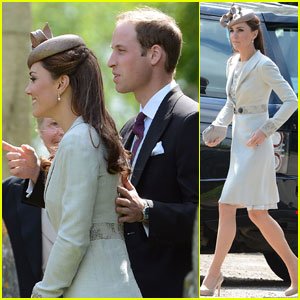
Kate Middleton has come in for some rare sartorial criticism over her fondness for her favorite LK Bennett nude heels.
It seems the fashion police will have to try a little harder if they hope to part the Duchess of Cambridge from those trusty LK Bennett court shoes.
Kate Middleton was once again sporting the £185 ($296) heels on Saturday, when she attended the wedding of Prince William’s cousin, Emily McCorquodale – Princess Diana’s niece.
Duchess of Cambridge, 30, was joined by her husband and her brother-in-law, Prince Harry, for the ceremony in Stoke Rochford, Lincolnshire.
While some observers have criticized Kate’s safe choices, she seems happy to be building up a reputation for thrift.
Kate Middleton was once again sporting the $296 LK Bennett nude shoes on Saturday, when she attended the wedding of Prince William’s cousin, Emily McCorquodale, Princess Diana’s niece
Kate wore her faithful court shoes to two events over the Diamond Jubilee weekend, and was seen in them six times during her tour of Canada and the US last summer.
Indeed, her entire outfit for the wedding had been recycled.
She wore the floral Jenny Packham dress at a polo match in the US last year, the dove grey coat at the Order of the Garter service and the hat at last June’s Epsom Derby.
The court shoes are such a favorite that in the last year the Duchess has worn them to the Epsom Derby, to Prince Philip’s 90th birthday at Windsor, to attend Zara Phillips’s wedding and on a visit to the Royal Marsden Hospital, London.
On last summer’s tour of Canada and the U.S. Kate was photographed in them no fewer than six times. On Sunday’s Jubilee River Pageant, they were given another outing on the Royal Barge.
And on Tuesday she got them out of the closet to attend the service of thanksgiving at St Paul’s cathedral.
The high street platforms have also of late been adopted by Princesses Eugenie, who wore a similar black version at the Jubilee River Pageant.
With every outfit coming under the microscope Kate’ support has given a welcome boost to the British brand.
The pumps have become such a success that LK Bennett brought out a Sledge 2 patent version.
Lady Gaga was left stunned by an unexpected mishap while in the middle of her hit song Judas at Sunday’s show in New Zealand.
Lady Gaga, 26, is in the middle of a world tour but was brought back to earth with a bump when she was hit on the head with a giant pole by one of her backing dancers.
The controversial singer had been dancing attached to the pole by a rope but later left the podium and ducked down to pick up a prop gun
Her backing dancer then immediately picked the pole up and was turning it from its vertical position to carry it off horizontally.
It was at this moment that as Lady Gaga raised her head, the pole came crashing down on her.
She immediately carried on but later mentioned the incident to the audience.
“I want to apologize,” she told fans according to TMZ.
“I did hit my head and I think I may have concussion. But don’t you worry, I will finish this show.”
Lady Gaga was left stunned by an unexpected mishap while in the middle of her hit song Judas at Sunday's show in New Zealand
Lady Gaga is playing three concerts at the Vector Arena.
During the shows she, unsurprisingly, underwent numerous costume changes.
She also appeared as a hologram and later thanked a 78-year-old male fan for turning up, telling him “you’re lovely”.
During the two-hour sellout show she also played guitar, rode a motorbike and fell into a “meat grinder”.
Lady Gaga also appeared onstage riding what resembled a giant louse.
The singer made for a bright sight as she arrived in Auckland last week clad in a neon orange dress.
She got a lively welcome from crowds of fans packed outside her hotel.
Her appearance came amid reports she has rekindled her romance with Vampire Diaries actor Taylor Kinney.
Lady Gaga sparked rumors of a reunion after she was joined by the 30-year-old actor in Thailand and then continued on to Singapore with her.
A source told Us Weekly: “They sure looked like they were back together – holding hands and being cute everywhere they went. They were seen kissing right as they got into the [hotel] elevator.”
The insiders confirmed that they were dating once again back on and trying to make things work despite her demanding lifestyle.
They said: “They are going to try and make it work even with her crazy schedule. Gaga realized she missed him.”
Taylor Kinney and Lady Gaga initially split in early May after ten months together. At the time, sources said the Grammy winner’s hectic calendar was to blame.
The informant explained: “She will be touring nonstop until next year. There’s just no room for anything else. Her work is all-consuming.”
A second source admitted last month that things between Lady Gaga and the screen star were still complicated.
“They may still be trying to make it work. She feels like having him keeps her grounded. Obviously she thinks he’s hot… She says he’s ‘really cool.”
Meanwhile, Lady Gaga was forced to cancel her June 3 concert in Jakarta during the Asian leg of her tour following protests from a local hardline Islamist group.
People who regularly get fewer than six hours of sleep a night are at significantly increased risk of stroke, a study suggests.
Researchers found that those in middle age who skimped on sleep were more likely to suffer stroke symptoms than those who got at least nine hours of shut-eye – even if they were a healthy weight and with no family history of stroke.
More than 5,000 participants, who were between 45 and retirement age, were monitored for three years as part of the US study.
Those who slept for fewer than six hours were most likely to experience symptoms such as numbness or weakness down one side of their body, dizziness, loss of vision or a sudden inability to express themselves verbally or in writing.
People who regularly get fewer than six hours of sleep a night are at significantly increased risk of stroke, a study suggests
Scientists at the University of Alabama said the impact of sleep deprivation was a major one, even after taking into account age, weight and other known risks such as high blood pressure.
The participants were divided into five groups according to how many hours a night they slept. They were asked to report their symptoms every six months.
Co-author Virginia Howard, a professor of epidemiology, said: “Many people can have these symptoms and not recognize them as a precursor to having a stroke, and perhaps not even mention them to their doctor.
“Sleeping habits can exacerbate the potential for these symptoms, which are internationally recognized as putting people at extraordinary risk of subsequent stroke.”
It is already known that sleep apnea – a breathing problem which produces poor quality sleep – is linked to strokes.
A study of hundreds of thousands of participants by Warwick University last year also linked lack of sleep to increased incidence of both strokes and heart disease.
But the latest study focuses on the early symptoms of strokes, which are often ignored.
Prof. Virginia Howard’s team plans to continue monitoring the participants for several more years. She said: “It will be very interesting to see what the stroke rate is, and whether early detection may have helped.”
Dr. Megan Ruiter, lead author of the study, which will be presented today at the American Association of Sleep Medicine’s annual conference, speculated that lack of sleep could be a precursor to more traditional stroke risk factors.
The Euro and stock markets have boosted in Asia after a deal to shore up Spain’s troubled banks eased concerns about a European currency break up.
In Asian trade, the euro rose 1% versus the US dollar and Japanese yen. Stock indexes in Japan and Hong Kong rose 2%.
On Saturday, eurozone ministers agreed to lend Spain up to 100 billion Euros ($125 billion) to help its banks.
Analysts said the deal would buy time for policymakers to solve other problems facing the 17-nation eurozone.
The biggest issue now looming on the horizon is the 17 June elections in Greece, and the worry that an anti-eurozone party may end up in a position of power.
“All eyes are still on Greece’s upcoming elections but investors’ worries over the eurozone have eased in the short term,” said Andy Du of Orient Futures Derivatives.
According to Stephen Davies of Javelin Wealth Management, the fact that the Spanish banking bailout was bigger than many people had expected pointed to a continuing “degree of strain within the European banking system”.
The Euro and stock markets have boosted in Asia after a deal to shore up Spain's troubled banks eased concerns about a European currency break up
“It reflects the fairly dire straits within which Europe continues to find itself,” he added.
Spain’s weakest banks were left with billions of Euros of bad loans following the collapse of a property boom and the recession that followed.
Currently Spain is in its second recession in three years and the economy is expected to shrink by 1.7% this year.
Its economic problems have become so acute, and its borrowing costs in the international markets so high, that there have been concerns that the government would not be able to service its debts.
At the same time, there were fears that some of its banks would not be able to find enough capital to continue to operate.
The exact amount of emergency funding that Spain will receive will be decided after two audits of its banks are completed within the next few days.
Spain’s loan was welcomed by the International Monetary Fund (IMF) as well as the US and Japan.
Spanish Prime Minister Mariano Rajoy hailed the decision as a victory for the single currency.
European Union economic affairs commissioner Olli Rehn said the deal was a clear signal to the markets that the euro area was ready to take decisive action to calm markets and contain contagion.
Spain is the eurozone’s fourth-biggest economy – twice the size combined of those of Greece, Ireland and Portugal, the countries bailed out so far.
However, tensions over the euro remain high with another election to be held in Greece next weekend.
If voters elect a government that refuses to abide by the terms of the country’s bailout deal, Athens faces a possible exit from the bloc.
Analysts said that in the days leading up to the election it was likely that a low-risk appetite from investors would return.
There are fears that a Greek exit could trigger a run on the banks, not only there but in other eurozone countries.
Greece has been in recession for five years, crippled by huge debts, high unemployment and labor unrest.
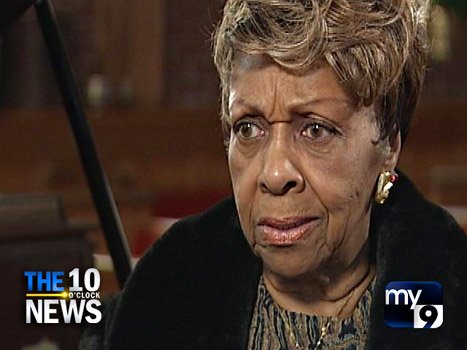
Cissy Houston, mother of late star Whitney Houston, is cashing in on her child’s tragic death, that’s what some family members think of her plans to write a tell-all book, new reports have claimed.
Sources close to the Houston family told TMZ that Cissy Houston’s new publishing deal with Harper-Collins for a memoir is merely a lame attempt to make money – since Whitney Houston left everything to her daughter Bobbi Kristina Brown – and not at all about honoring the late singer.
Cissy Houston is cashing in on Whitney Houston's tragic death, that's what some family members think of her plans to write a tell-all book
One source said the book, which is slated for release in 2013, could also be a PR move for Cissy Houston, claiming: “She will try to come out looking like the world’s greatest mom, when in actuality, she wasn’t.”
French exit polls suggest that Francois Hollande’s Socialists and their allies are set for a majority following the first round of legislative elections.
The Socialists appear tied with the right-wing UMP party on about 35% of the vote, but the support of Green allies gives them closer to 40%.
The outcome of the polls is expected to determine the extent and pace of reform under the newly-elected French leader.
Run-offs are to be held a week later.
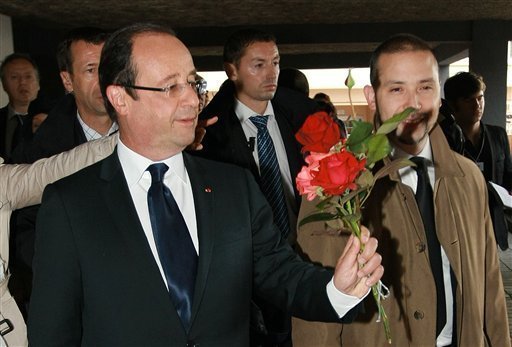
French exit polls suggest that Francois Hollande's Socialists and their allies are set for a majority following the first round of legislative elections
The early indications are that turnout has been much lower than in the presidential elections in April, at about 60%.
France’s 46 million eligible voters are picking representatives for 577 seats in the National Assembly.
TNS Sofres, Ipsos and OpinonWay pollsters all agreed that the political left, including the Communist-backed Left Front, would win at least 289 seats in the 577-seat Assembly and possibly as many as 368 seats.
These are predictions rather than hard results and it is hard to predict accurately what the final tallies will be before next week’s decisive round of voting.
But with the Senate already under the control of the Socialists, it appears that Francois Hollande will have a majority in the lower house – even if only with the support of allies – which would give him unprecedented power to force through his reform programme.
Francois Hollande’s government is due to present a revised budget plan to parliament next month.
The result of the parliamentary election will determine the pace of reform and how radical it becomes.
“It’s a good result tonight… but we have to remain mobilized for the second round,” Foreign Minister Laurent Fabius, an influential Socialist, was quoted by news agency AP as saying.
The election also saw a surge in support for Marine Le Pen’s far right National Front, which won almost 14% of votes, according to the exit polls – well above the 4% it got in the 2007 parliamentary elections.
Krystle Marie Reyes from Salem, Oregon, who was given a $2.1 million tax refund after filing a false claim went on a massive spending spree until she was caught.
Krystle Marie Reyes, 25, was only caught after she reported the Visa card containing the seven figure sum had been lost.
By that time she had already spent more than $150,000, including buying a car and other household items.
Krystle Marie Reyes had used Turbo Tax to file her income tax return for 2011.
She claimed earnings of $3 million but used the tax calculator programme to claim a refund of $2.1 million, Oregon Live reported.
Due to the size of the refund, her electronic claim was examined by several people within the Oregon Revenue Department.
Incredibly they approved the payout and Krystle Marie Reyes was sent a visa card by the tax preparation computer programme containing a balance of $2.1 million.
Krystle Marie Reyes from Salem, Oregon, who was given a $2.1 million tax refund after filing a false claim went on a massive spending spree until she was caught
Prosecutors said she went on a spending spree and spent more than $150,000.
She later reported the card missing prompting an investigation which uncovered the massive fraud which is believed to be the biggest in the history of the state of Oregon.
Krystle Marie Reyes, according to an arrest affidavit, paid $2,000 in cash for a 1999 Dodge Caravan and used the card to buy $800 worth of tires and wheels.
She was also caught on CCTV cameras using the card at various outlets.
According to the probable cause statement, Krystle Marie Reyes spent $13,000 in Marion County over two days in February, $26,000 in March and more than $35,000 in April.
The statement says the fraud was discovered on May 7 by the issuer of the debit card after Krystle Marie Reyes reported a “second card” as lost or stolen.
Oregon Department of Justice agents arrested Krystle Marie Reyes on Wednesday at a Northeast Salem address.
The apparent ease with which Krystle Marie Reyes was allegedly able to defraud the state revenue department has stunned officials.
“They’ve got some explaining to do to restore the confidence of Oregonians,” Rep. Vicki Berger, R-Salem, who serves as co-chair of the House Revenue Committee told the OregonLive.com.
“Is this is an anomaly? If so, let’s make sure it never happens again. Or do we have a systematic problem in the way the Department of Revenue treats this and other transactions?”
The revenue department processes about $7 billion in tax returns each year on computer systems designed in the 1980s.
In January, the state’s chief operating officer, Michael Jordan, pulled the plug on a $100 million computer upgrade that the department said would pay for itself by finding tax cheats.
In 2010, the state reported $559 million in delinquent taxes, mostly from unpaid personal and corporate income taxes.
Revenue officials estimate that, in 2006, Oregon’s personal income tax compliance rate was 81.5% – far lower than other states – and translating to $1.2 billion in unreported or uncollected taxes that year.
Krystle Marie Reyes has been charged with aggravated theft and computer crime.
She was released from Marion County jail and is due in court on July 5th.
After last weekend Kris Humphries was enjoying the company of his rumored new girlfriend Fatima “Myla” Sinanaj on Miami Beach, he has now got his focus back – and was yesterday seen with his nutritionist and sometimes-trainer.
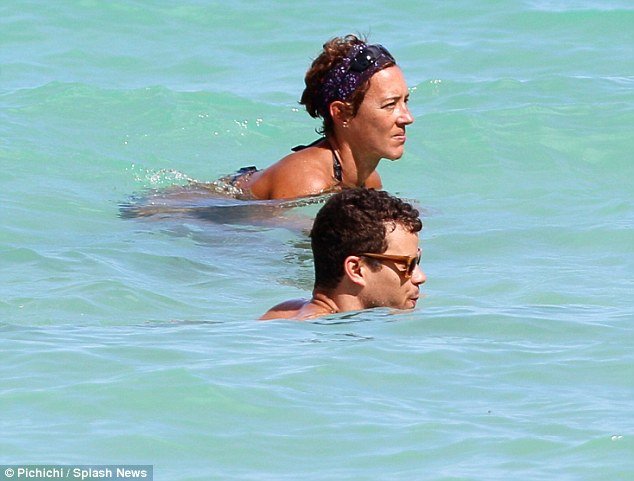
Kris Humphries, 27, was photographed in the turquoise blue Florida waters with the woman – who TMZ has identified as Tracy Paradise.
Sources told TMZ there is nothing romantic going on between the pair – and things are strictly professional.
The sighting comes as Kris Humphries’ lawyers are trying to keep his rumored relationship with Myla Sinanaj on the quiet.
His legal team want the basketball star to walk into his divorce depositions at the end of June looking like a heartbroken and very single man.
Kris Humphries’ lawyers are going to great lengths to keep his new rumored girlfriend Myla Sinanaj quiet about her supposed relationship with the basketball player, as they aim to prove that his 72-day marriage to reality TV star Kim Kardashian was indeed fraud.
Kris Humphries was photographed in the turquoise blue Florida waters with the woman, who TMZ has identified as Tracy Paradise
According to TMZ, Kris Humphries’ lawyer reached out to Myla Sinanaj’s lawyer to negotiate a non-disclosure agreement in order to get a lockdown on any sensitive texts, emails, or other documents the 25-year-old Kardashian-lookalike has relating to their relationship.
Kris Humphries is demanding millions from Kim Kardashian, and Kris doesn’t want anything to jeopardize his case that their union should be annulled rather than granted a divorce.
His lawyers are willing to pay a price in order to get Myla Sinanaj’s signature on a joint statement as well.
RadarOnline first reported that Kris Humphries had no plans to publicly date anyone until after his divorce was finalized, but TMZ claimed that Kris has been dating Myla Sinanaj since January, even flying her to Miami for a romantic beach holiday last weekend.
They have apparently been seeing each other regularly, meeting at various basketball games where Kris Humphries provided her and family members with courtside seats.
The pair met at a prominent five star hotel in New York, TMZ claims.
“Kris is expecting to be asked if he has a girlfriend, or has had one since Kim filed for divorce,” an insider told RadarOnline.
“Kris will answer under oath that he hasn’t had a girlfriend and that he is very single. Kris doesn’t care that Kim is dating Kanye West, he has truly moved on with his life.
“Kris is going to be in Minnesota for the summer getting in the best shape possible for the upcoming basketball season, end of story. Kris’ primary focus has been basketball, and that is it.”
Myla Sinanaj’s Twitter page, which has since been deleted, had a number of interesting posts related to Kardashian patriarch Bruce Jenner and Kim Kardashian’s new boyfriend rapper Kanye West.
“Say my name, say my name. When no one is around, you say baby I love you. Why the sudden change?” Myla Sinanaj tweeted, quoting a Destiny’s Child song.
Myla Sinanaj also shared: “Bruce Jenner’s face scares me – it should be on the <<Why not to get plastic surgery>> poster.”
“[Kanye should be] bigger than taking petty shots at s**t that got nothing to do with him. Lost respect,” read another post by Myla Sinanaj, commenting on his new song Theraflu.
Kim Kardashian began dating Kanye West in April, and the pair are reportedly discussing moving in together, so Kris Humphries most likely wants to look single by comparison to his famous ex.
“Myla is very upset with Kris for not wanting an exclusive relationship,” a source told RadarOnline.
“Kris was honest with her from the beginning and it’s very likely that he won’t be seeing her anymore now. There are always going to be girls that are looking for their 15 minutes of fame and say they are dating Kris. It just comes along with the territory.”
A new study suggests that an “early and aggressive” approach to people on the cusp of developing Type 2 diabetes is justified to reduce cases of the disease.
People with “pre-diabetes” have higher than normal blood sugar which has not yet reached diabetic levels.
A US study, published in the Lancet, showed restoring normal sugar levels more than halved the numbers going on to Type 2 diabetes.
Experts said the findings were clinically important.
It is thought that 7 million people have pre-diabetes in the UK and 79 million in the US. They are at heightened risk of Type 2 diabetes, heart attack and stroke. Many are undiagnosed.
A new study suggests that an "early and aggressive" approach to people on the cusp of developing Type 2 diabetes is justified to reduce cases of the disease
Some measures, such as weight loss and more exercise, can reverse pre-diabetes. The study, by the US Diabetes Prevention Program Research Group, tried to determine how effective the treatment was at preventing Type 2 diabetes.
It followed 1,990 people with pre-diabetes. Some were being treated through drugs or lifestyle change, others were not.
It showed patients who reduced their blood sugar levels to normal, even briefly, were 56% less likely to develop Type 2 diabetes during the six years of the study.
Lead author Dr. Leigh Perreault, from the University of Colorado, said: “This analysis draws attention to the significant long-term reduction in diabetes risk when someone with pre-diabetes returns to normal glucose regulation, supporting a shift in the standard of care to early and aggressive glucose-lowering treatment in patients at highest risk.”
Dr. Natalia Yakubovich, from McMaster University in Ontario, Canada, said the “findings clearly suggest” that restoring normal blood sugar levels was “of clinical relevance”.
She added: “Identification of regression to normal glucose regulation could be an important way to stratify people into those at higher and lower risk of progression to diabetes.
“Such stratification could therefore identify individuals for whom additional treatment might be needed to prevent diabetes or to slow down disease progression.”
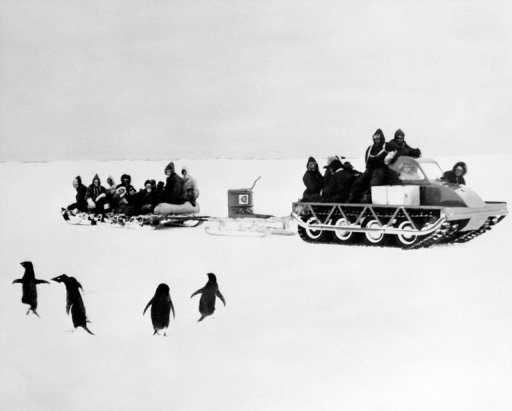
Accounts of unusual sexual activities among Adelie penguins, observed a century ago by Dr. George Murray Levick, a member of Captain Scott’s polar team, are finally being made public.
Details, including “sexual coercion”, recorded by Dr. George Murray Levick were considered so shocking that they were removed from official accounts.
However, scientists now understand the biological reasons behind the acts that Dr. George Murray Levick considered “depraved”.
The Natural History Museum in UK has published his unedited papers.
Dr. George Murray Levick, an avid biologist, was the medical officer on Captain Scott’s ill-fated Terra Nova expedition to the South Pole in 1910. He was a pioneer in the study of penguins and was the first person to stay for an entire breeding season with a colony on Cape Adare.
He recorded many details of the lives of Adelie penguins, but some of their activities were just too much for the Edwardian sensibilities of the good doctor.
He was shocked by what he described as the “depraved” sexual acts of “hooligan” males who were mating with dead females. So distressed was he that he recorded the “perverted” activities in Greek in his notebook.
Accounts of unusual sexual activities among Adelie penguins, observed a century ago by Dr. George Murray Levick, a member of Captain Scott's polar team, are finally being made public
On his return to Britain, Dr. George Murray Levick attempted to publish a paper entitled “the natural history of the Adelie penguin”, but according to Douglas Russell, curator of eggs and nests at the Natural History Museum, it was too much for the times.
“He submitted this extraordinary and graphic account of sexual behaviour of the Adelie penguins, which the academic world of the post-Edwardian era found a little too difficult to publish,” Douglas Russell said.
The sexual behavior section was not included in the official paper, but the then keeper of zoology at the museum, Sidney Harmer, decided that 100 copies of the graphic account should be circulated to a select group of scientists.
Douglas Russell said they simply did not have the scientific knowledge at that time to explain Dr. George Murray Levick’s accounts of what he termed necrophilia.
“What is happening there is not in any way analogous to necrophilia in the human context,” Douglas Russell said.
“It is the males seeing the positioning that is causing them to have a sexual reaction.
“They are not distinguishing between live females who are awaiting congress in the colony, and dead penguins from the previous year which just happen to be in the same position.”
Only two of the original 100 copies of Dr. George Murray Levick’s account survive. Douglas Russell and colleagues have now published a re-interpretation of Dr. George Murray Levick’s findings in the journal Polar Record.
Douglas Russell described how he had discovered one of the copies by accident.
“I just happened to be going through the file on George Murray Levick when I shifted some papers and found underneath them this extraordinary paper which was headed <<the sexual habits of the adelie penguin, not for publication>> in large black type.
“It’s just full of accounts of sexual coercion, sexual and physical abuse of chicks, non-procreative sex, and finishes with an account of what he considers homosexual behaviour, and it was fascinating.”
The report and Dr. George Murray Levick’s handwritten notes are now on display at the Natural History Museum for the first time. Douglas Russell believes they show a man who struggled to understand penguins as they really are.
“He’s just completely shocked. He, to a certain extent, falls into the same trap as an awful lot of people in seeing penguins as bipedal birds and seeing them as little people. They’re not. They are birds and should be interpreted as such.”
Kenyan Internal Security Minister George Saitoti has died in a helicopter crash, officials say.
Officials say George Saitoti and his deputy, Orwa Ojode, have been killed when the aircraft went down west of Nairobi, bursting into flames as it hit the ground.
There is no word on the cause of the crash, in which six people were killed, including bodyguards and pilots.
George Saitoti, 66, a former vice-president, had been planning to run in a forthcoming presidential poll.
He was on his way to a security meeting when his helicopter crashed on Sunday morning.
An AFP agency news journalist saw six charred bodies being removed from the wreckage.
Officials say George Saitoti and his deputy, Orwa Ojode, have been killed when the aircraft went down west of Nairobi, bursting into flames as it hit the ground
Another reporter at the scene says debris of the burnt-out police helicopter were strewn in the brush.
George Saitoti had been a key figure in Kenyan politics, holding a number of senior ministerial posts over the last 30 years.
The professor of mathematics joined Daniel Arap Moi’s government as a finance minister in 1983, going on to become his vice-president in 1988.
He briefly stepped down as education minister in 1996 over accusations he was involved in the Goldenberg financial scandal, but was reinstated when a Kenyan court ruled he should not be charged.
After years as a senior member in the long-dominant Kanu party, George Saitoti joined the current president Mwai Kibaki’s National Alliance of Kenya in 2002.
As Internal Security Minister under Mwai Kibaki, he was a leading government voice against the Somali militant group al-Shabab.
Kenyan troops have been fighting al-Shabab in Somalia since they sent troops into the country last October.
The militants have killed several people in a string of grenade attacks in various parts of Kenya, including Nairobi.
George Saitoti announced he would stand for the presidency last November.
No date for the presidential election has so far been set. Mwai Kibaki’s mandate ends in January 2013.
Prime Minister Raila Odinga – a rival of both Mwai Kibaki and George Saitoti – has also announced he was standing for president.
The last presidential election, in December 2007, was followed by a wave of ethnic and political violence in which about 1,500 were killed.
Raila Odinga has warned about the emergence of ethnically-based political groups in the run-up to the next poll.
A US scientific team is embarking on a mission to capture a 3D image of every ant species known to science.
The scientists are visiting museums around the world to photograph all of the ant specimens in their collections.
They are using a technique that, for the first time, allows microscopic anatomical detail of the insects’ bodies to be photographed.
The aim is to make an online catalogue called Antweb, providing a unique tool for scientists who study the insects.
It will also allow anyone with access to the internet a detailed glimpse of the diverse world of ants.
Brian Fisher from the California Academy of Sciences is leading the study. He and his colleagues have started their “world ant tour” at the Natural History Museum (NHM) in London.
The team has already used the imaging technique on ant collections in the US, capturing snapshots of 8,000 ant species so far.
But there are approximately 15,000 species that have been “formally described” in science, and about 30,000 species in total.
Each named and described species has a specimen – an ant that provides the reference for what this species looks like – housed in a museum collection.
A US scientific team is embarking on a mission to capture a 3D image of every ant species known to science
Dr. Brian Fisher and his team plan to capture a snapshot of every single one of these specimens.
“Our goal is to image 10,000 a year,” he said.
And for the database to be complete, the team is taking several images of each species, including examples of all the different ant castes – queens, soldiers, minor workers – and the different sexes.
To achieve this, they need to find the museums with the most complete ant collections, and the NHM is the first one outside of the US that the team has targeted.
Dr. Brian Fisher says it has “one of the best ant collections in the world”, with more than 6,000 species pinned into display cases in the museum’s carefully curated store rooms.
The team will systematically work its way through every one of these boxes of long-dead and preserved ants, and use a special technique that takes dozens of highly magnified pictures all on a different plane of focus.
Combining all of these images into one final picture reveals each insect in unprecedented detail.
“You can zoom in and see fine hairs, the eyes, all of this detail,” Dr. Brian Fisher explains.
“And all of this, under a microscope, is not in focus.
“So this is actually the first time, as a scientist, I get to see this ant in 3D. It’s very useful for scientists.”
The researcher and his team hope to bring the ant world out of museum cupboards, not just for researchers studying the insects, but also to reveal the diversity of ants to the public.
“Many people don’t know the amazing creatures that live in their back yards,” he said.
“This project will mean that anybody, anywhere at any time will have access to these specimens that we hide in museums.”
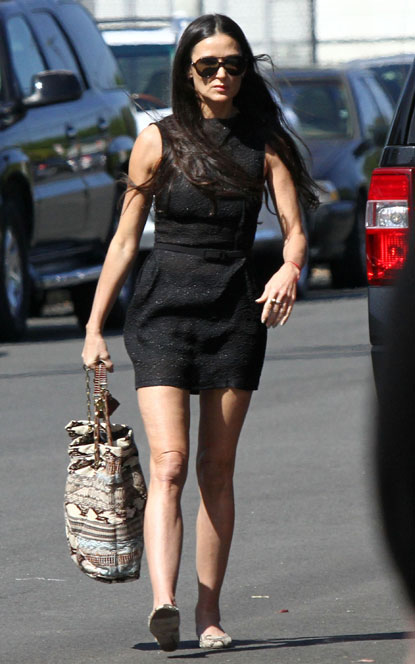
Demi Moore put on a brave front at the high school graduation for 18-year-old daughter Tallulah on Thursday and looked in great shape.
Although still slim, Demi Moore, 49, looked like she had put on a few healthy pounds and wore a black mini dress to show off her legs.
Keeping her long dark hair in a simple style and wearing flats, Demi Moore, who turns 50 in November, seemed to be focused on just being there for her teen.
The actress was reunited with ex-husband Bruce Willis who was also there to support Tallulah and their other daughters Rumer, 23, and Scout, 20, were along for the family occasion too.
Rumer showed off her toned stomach in a belly baring grey top which she paired with a see-through white summer skirt and her orange bag matched her flaming locks.
Meanwhile, middle girl Scout flew in to Los Angeles from New York to face all the family after recently being arrested for underage drinking and having an open alcohol container on the street.
Demi Moore put on a brave front at the high school graduation for 18-year-old daughter Tallulah on Thursday and looked in great shape
Scout is studying at Brown University and is also an aspiring singer.
It’s not the first time she has been at the centre of controversy. Earlier this year she took to Twitter and ranted about how much she hated her parents and how she tried the drug MDMA.
She later claimed the tweets were a ‘hoax’ and that she did it for a class project at school.
One person who was noticeably absent was Demi Moore’s estranged husband Ashton Kutcher.
The clan had always prided themselves on attending special events together but it seems now that Demi Moore and Ashton Kutcher have split it may not be as comfortable a situation as it once was.
Ashton Kutcher, who is currently filming the Steve Jobs biopic, is apparently still close to his stepdaughters but stayed away.
There have been recent rumors swirling that Demi Moore and Ashton Kutcher may reunite after calling it quits on their marriage following allegations the actor cheated on Demi on their six-year anniversary
RadarOnline said that they have met up on several occasions are “still desperately in love and could be on for a reconciliation”.
No divorce papers have yet been filed.
Meanwhile, Bruce Willis became a father for the fourth time in April when his new wife Emma Heming gave birth to a girl, Mabel Ray.
He was all smiles for the graduation and beamed proudly as he got to spend time with his daughters.
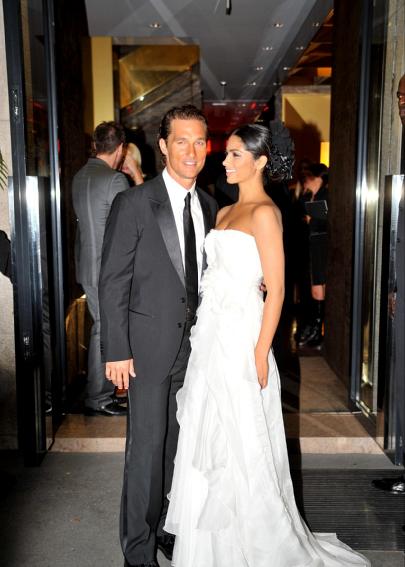
Matthew McConaughey wed the mother of his two children, Camila Alves, in an intimate Saturday evening ceremony at his Austin, Texas property, according to People magazine.
The couple, who got engaged last Christmas Day after almost five years together, tied the knot in front of their close friends and family.
Also witnessing the ceremony was their two children, Levi, who turns 4 next month, and daughter Vida, 2½.
Camila Alves has taken Matthew McConayghey’s surname and has officially become Camila McConaughey, the actor’s representation told the publication.
It is said that the couple kept the nuptials a secret from some guests up until the very last minute.
Yesterday, plans were well underway for the nuptials with a sea of camping equipment acting as accommodation for their guests.
The couple is believed to have provided guests with the state-of-the art tents which line the back yard.
Matthew McConaughey wed the mother of his two children, Camila Alves, in an intimate Saturday evening ceremony at his Austin, Texas property
The luxury temporary abodes, numbered 1-47, are in four rows in the garden and are said to be kitted out with beds, cosy white fur rugs on the floor, and outdoor seating with doormats at the front.
They have also been equipped with what appears to be high-tech air-conditioning units.
Yesterday Matthew McConaughey, 42, appeared to be relaxing in a hammock as preparations went on around him, with a giant white marquis erected – no doubt where the happy couple walked down the aisle this evening.
Also visible from the bird’s eye view were seven long, wooden dinner tables, that seat 18 people each.
There were boxes of candles that also looked set to provide extra romance for this evening spectacular event.
Security was on hand at the three-story, seven-bedroom mansion, called Old Oak Estate.
Just two dozen close friends and relatives are thought to have been invited to the “cosy” celebration, with those working at the event signing a nondisclosure contract, according to E! News.
Camila Alves, 29, was due to be honored at the Step Up Women’s Network event in Beverly Hills yesterday but instead sent a video message so she could remain close to the wedding plans.
The Brazilian model recently said she didn’t expect marriage to alter their relationship.
“We’ve been living a married life for over six years now,” she says.
“We have homes together, we have family together, we have kids, we’ve built a life together. So, we’ve been living a married life this whole time.”
Matthew McConaughey recently moved his family back to Austin, Texas because he loves the laid-back vibe of the city and enjoys a level of anonymity he cannot achieve elsewhere.
The actor said: “No one recognizes you and no one asks you, <<Hey, what do you do?>>, because I don’t think anyone cares.
“Fridays show up sooner here. You want to get along in Austin, you want to get along in Texas, all you have to do is be yourself.”
Matthew McConaughey previously dated Penélope Cruz and Ashley Judd.
German Development Minister Dirk Niebel who sent home a big Afghan carpet free of charge aboard an intelligence service plane has drawn criticism from opposition politicians.
A spokesman for Minister Dirk Niebel says the customs duty required for the carpet will be paid.
Dirk Niebel bought the 30 kg (66-pound) carpet for himself in the Afghan capital Kabul, the Spiegel news website reports. It cost about $1,400.
Import duty was not paid when it arrived in Berlin last month.
German Development Minister Dirk Niebel who sent home a big Afghan carpet free of charge aboard an intelligence service plane has drawn criticism from opposition politicians
The opposition Social Democrats (SPD) have demanded an explanation from the minister. He is a member of the liberal Free Democrats (FDP), junior coalition partners with Chancellor Angela Merkel’s conservative Christian Democrats.
Dirk Niebel had left the 9 sq m (97 sq ft) carpet at the German embassy because he could not get it on a scheduled flight. Then the German foreign intelligence service (BND) offered to fly it back to Berlin as a favor, German media report.
Spain’s decision to request a loan of up to 100 billion Euros ($125 billion) from eurozone funds to help shore up its struggling banks has won broad support.
The International Monetary Fund (IMF) said the bailout was big enough to restore credibility to Spain’s banks.
Washington welcomed the measure as a vital step towards the “financial union” of the eurozone.
The move was agreed during emergency talks between eurozone finance ministers on Saturday.
IMF managing director Christine Lagarde said the plan for Spain should provide “assurance that the financing needs of Spain’s banking system will be fully met”.
“I strongly welcome the statement by the Eurogroup, which complements the measures taken by the Spanish authorities in recent weeks to strengthen the banking system,” she said.
“The IMF stands ready, at the invitation of the Eurogroup members, to support the implementation and monitoring of this financial assistance through regular reporting.”
Spain's decision to request a loan of up to 100 billion Euros ($125 billion) from eurozone funds to help shore up its struggling banks has won broad support
US Treasury Secretary Timothy Geithner welcomed the latest moves as “important for the health of Spain’s economy and as concrete steps on the path to financial union, which is vital to the resilience of the euro area”.
France’s Finance Minister Pierre Moscovici said the deal would “contribute to restoring confidence in the eurozone”.
The president of the European Commission, Jose Manuel Barroso, said he was confident that through bank restructuring and other reforms, Spain could gradually regain the confidence of investors and create the conditions needed for sustainable growth and job creation.
Earlier, Spanish Economy Minister Luis de Guindos announced that his country would shortly make a formal request for assistance.
Luis de Guindos said the help would be for the financial system, not the economy as a whole.
“This is not a rescue,” he said.
He also said the aid would not come with new austerity measures attached to the economy. Spain has already imposed strict economic reforms in a bid to tackle its debt problems.
The loan will bolster Spain’s weakest banks, left with billions of Euros worth of bad loans following the collapse of a property boom and the recession that followed.
Some banks borrowed large amounts on the international markets to lend to developers and homebuyers, a riskier strategy than funding it with deposits from savings.
The exact amount that Spain will receive will be decided after the completion of two audits of its banks, due to be completed by the end of June.
The money will come from two funds created to help eurozone members in financial distress – the European Financial Stability Facility (EFSF) and the European Stability Mechanism (ESM), which enters into force next month.
Investors have recently demanded higher and higher costs to lend to Spain, making it too expensive for the country to borrow the money needed for a bank rescue from the markets.
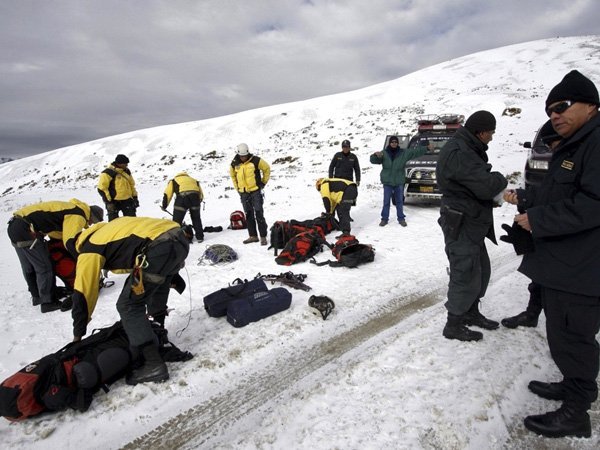
Peruvian police officials say they have found the wreckage of a helicopter missing in the south of the country, and all 14 on board are dead.
The helicopter had left the Amazon region of Madre de Dios on Wednesday bound for Cusco.
The 12 passengers were mostly South Korean but included a Dutchman, a Czech, a Swede and a Peruvian, police said. The two members of the crew were Peruvian.
The wreckage was at 4,900 m (16,000 ft) near Mount Mamarosa, police said.
Peruvian police officials say they have found the wreckage of a helicopter missing in the south of the country, and all 14 on board are dead
Police commander Raul Aybar, who visited the scene, said the helicopter had “crashed and exploded”.
“Everyone died in the initial impact because everything is burned and scattered,” Raul Aybar told AP news agency.
Peru’s police chief, General Raul Salazar, said that some parts of the helicopter had been thrown up to 200m by the force of impact.
Officials said bodies were being recovered from the crash site, although rain and snow have hampered the team’s efforts.
The South Korean embassy in the Peruvian capital, Lima, said its nationals had been part of a team exploring a potential hydro-electric project near Puno, in southern Peru.
Samsung C&T and the Korea Water Resources Corporation, which employed some of those on board, had sent teams to assist in the search.
The helicopter went missing in a mountainous area that is regularly covered in clouds.
Thousands of tourists travel to the Cusco region each year to visit Machu Picchu, a 15th Century Incan city on a mountain above the town of Aguas Calientes.