UEFA has initiated disciplinary proceedings against the Football Union of Russia for “improper conduct of supporters” during Friday’s Euro 2012 game against the Czech Republic in Wroclaw.
Four stewards needed hospital treatment after being attacked by fans in the Municipal Stadium in Poland.
And claims of racist abuse directed at Czech defender Theodor Gebre Selassie, who is black, are being investigated.
The Control and Disciplinary Body will review the case on Wednesday, 13 June.
A UEFA statement read: “Having looked at the security reports and available images, UEFA has today announced that disciplinary proceedings have been opened against the Football Union of Russia [RFS] for the improper conduct of its supporters, the setting off and throwing of fireworks, and the display of illicit banners at Friday’s UEFA match.”
UEFA has initiated disciplinary proceedings against the Football Union of Russia for "improper conduct of supporters" during Friday's Euro 2012 game against the Czech Republic in Wroclaw
Anti-racism campaigners claimed Czech defender Theodor Gebre Selassie was the victim of monkey chants during Russia’s 4-1 victory, while footage seemingly shows Russian supporters attacking stewards in a walkway of the stadium.
The FARE (Football Against Racism in Europe) network confirmed one of their observers at the match heard “fleeting” racist abuse of Gebre Selassie.
Asked if it included monkey chants, FARE chief executive Piara Powar said: “Our observer reported descriptions of that nature.
“It was directed at the Czech Republic’s only black player,” Piara Powar added.
Footage of the incident involving the stewards has emerged online, with UEFA releasing a statement saying they are aware of “a brief and isolated incident involving a small group of around 30 fans who attacked a handful of stewards”.
The statement continued: “The situation was quickly and efficiently brought under control. The local police are aware of the incident and investigating.
“The cause of the incident is not currently known but we are studying the security reports and available images. UEFA remains entirely committed to the safety and security of all fans and spectators at all matches of Euro 2012.”
The tournament has already been beset with problems of racism, with UEFA confirming on Friday there were “isolated incidents of racist chanting” aimed at Netherlands players during an open training session.
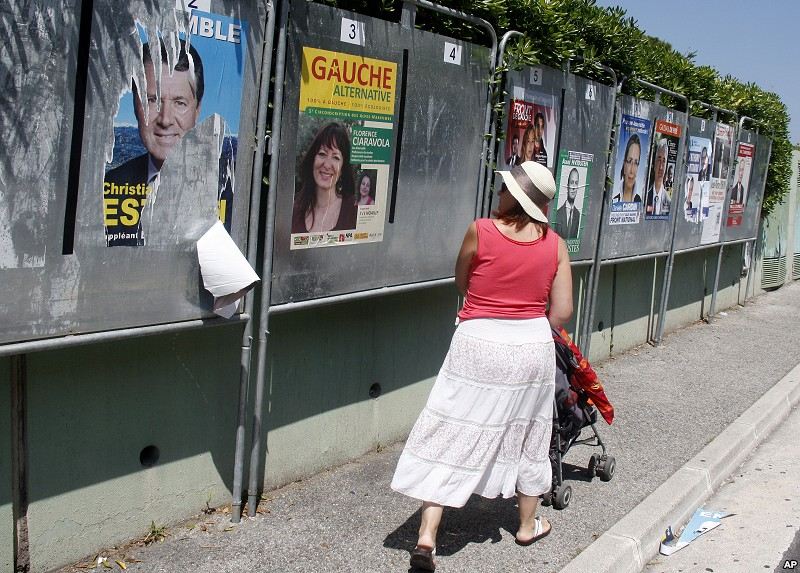
France is voting in parliamentary elections expected to determine the extent and pace of reform under new President Francois Hollande.
Voting for the lower house is beginning with a first round, followed by run-offs a week later.
Correspondents say if Francois Hollande’s Socialist Party can win a majority, he will have the mandate to push through bold tax and spend policies.
There is also a closely watched battle between the far right and the far left.
The far-right National Front is hoping to follow up a strong performance in the recent presidential election by gaining its first presence in the 577-seat National Assembly since the 1980s.
France is voting in parliamentary elections expected to determine the extent and pace of reform under new President Francois Hollande
With the senate already under the control of the Socialists, a majority in the lower house would give Francois Hollande unprecedented power to force through his reform programme.
Francois Hollande’s government is due to present a revised budget plan to parliament next month.
The result of the parliamentary election will determine the pace of reform and how radical it becomes.
If the left fails to win, France would enter into a period of “cohabitation”, in which the presidency and the lower house are controlled by political rivals.
The right-wing Union for a Popular Movement (UMP) – the party of former President Nicolas Sarkozy – is defending an absolute majority in the current National Assembly.
The party has concluded an electoral agreement with its centrist Radical Party and New Centre allies.
With the parliamentary polls coming hot on the heels of April’s presidential election, there have been concerns over voter turnout.
Speaking on Thursday, Francois Hollande said: “I call on the French to vote. I call on them to give a large majority, a solid and coherent one.”
One of the main stories of the presidential election was the third place finish of the National Front’s Marine Le Pen.
The far right’s strongest chances of success in this poll are in a string of constituencies in the north and southeast.
The key battle is in the northern industrial town of Henin Beaumont where Marine Le Pen faces the flamboyant leader of the far left, Jean Luc Melenchon.
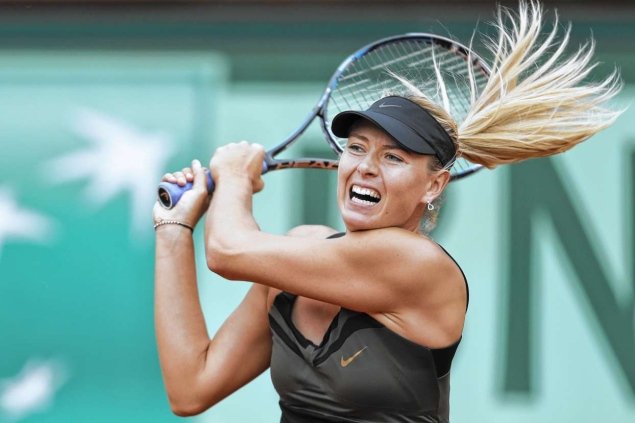
Maria Sharapova blasted her way to victory over Italian Sara Errani in the French Open final to become only the 10th woman to complete a career Grand Slam.
Maria Sharapova, 25, claimed a one-sided 6-3 6-2 win to add to the Wimbledon, US Open and Australian Open titles from earlier in her career.
The Russian overwhelmed her Italian opponent, who was playing in her first Grand Slam singles final.
Maria Sharapova’s run in Paris has also moved her top of the women’s rankings.
At a time when the women’s game is lacking a dominant and consistent figure, Maria Sharapova provided more evidence that she is capable of filling that vacuum.
Since she was last world number one in June 2008, the top ranking has been held by eight different players and changed hands on 15 occasions, while the last six Grand Slams have been won by six different women.
Maria Sharapova blasted her way to victory over Italian Sara Errani in the French Open final to become only the 10th woman to complete a career Grand Slam
Maria Sharapova, who has battled back from shoulder surgery that threatened her career and severely disrupted her serve, produced a display of power and precision which will now see her head into Wimbledon as a strong favourite.
She and Sara Errani had never met before and, while the Russian was the clear favourite, her opponent posed a threat having won three clay court tournaments coming into the French Open.
But the Italian had her first two service games broken and struggled to handle the power of her opponent’s game.
The Russian had lost her last two Grand Slam finals at Wimbledon and the Australian Open but was clearly determined not to slip up again.
Sara Errani engineered a break back to register her first game but it was a temporary reprieve as Maria Sharapova claimed a third set point with a backhand down the line.
Maria Sharapova broke to love at the start of the second set and despite Sara Errani drawing cheers from the crowd with some adventurous shotmaking, it was not enough to disrupt the second seed.
Sara Errani had won the women’s doubles title with Roberta Vinci on Friday and, after her semi-final win over Samantha Stosur, said she had to start showing greater belief against more illustrious opponents.
But the Bologna-born right-hander rarely looked like she thought she could overcome Maria Sharapova and after wasting a break point in game four, she was broken again in game five.
Maria Sharapova set up her third match point with a magnificent running forehand winner up the line, and converted it when Sara Errani sliced a tame backhand into the net.
It was her first Grand Slam title since the 2008 Australian Open and she sunk to her knees in celebration.
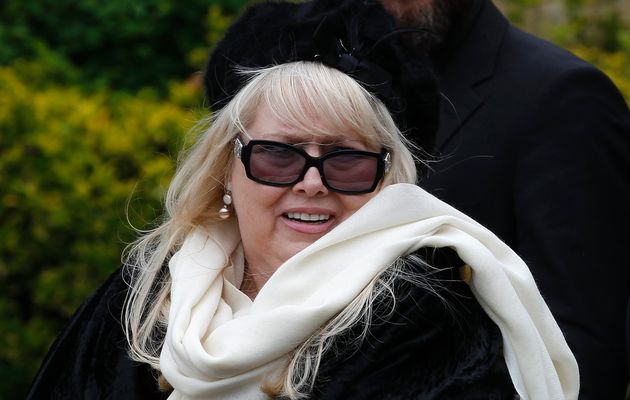
Dwina Gibb was adamant the mother of Robin Gibb’s love child did not attend his funeral today and Claire Yang respectfully granted her wish.
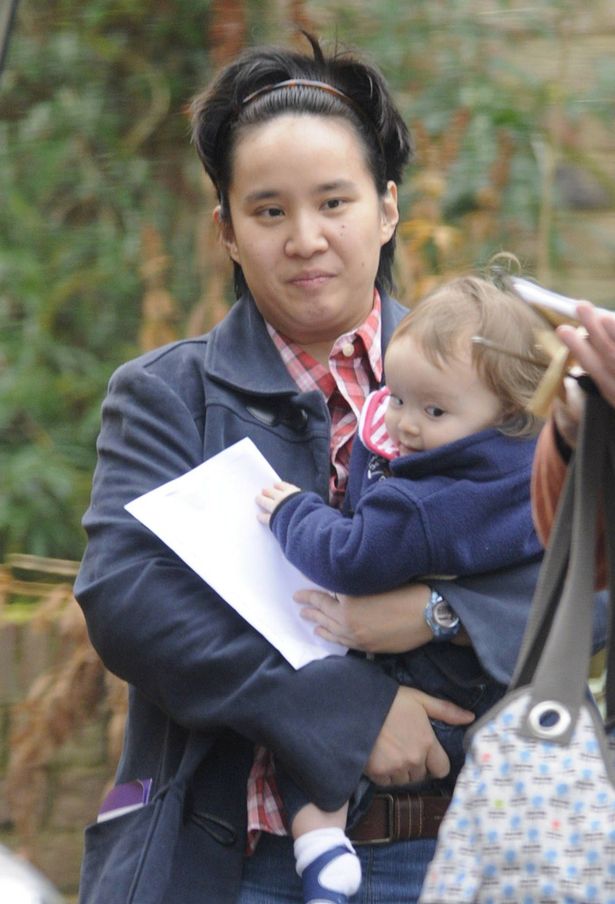
Claire Yang, a former housekeeper of robin Gibb, with whom he fathered Snow Robin three years ago, instead spent the day with the tot and a close friend.
While Robin Gibb’s casket was being brought through the streets of his hometown of Thame, Oxfordshire, the trio were out and about, returning home at around 3:00 p.m., as the rest of the star’s grieving family were attending the private service at St Mary’s church.
The group got out of the silver 4×4, with Claire Yang’s friend walking around the back of the car to get the little girl out.
They then rushed into the former housekeeper’s large house.
Claire Yang refused to speak about her decision not to attend the funeral.
Dwina Gibb was adamant the mother of Robin Gibb’s love child did not attend his funeral today and Claire Yang respectfully granted her wish
When reporters pressed the entry phone system and asked to talk to her, a woman with an oriental accent said she would not speak.
“She’s not available,” said the woman.
“She’s not at home, goodbye.”
According to reports, Dwina Gibb told friends that she would absolutely hate Claire Yang to attend, but wouldn’t turn her away if she did, although no doubt she will have been relieved it didn’t come to that.
A close friend told the Daily Mirror: “Dwina has said that she would loathe her to be there but there won’t be any scene whatsoever if she came along to pay her respects.”
Robin Gibb, 62, who died from liver and colon cancer on May 20, had a long-term affair with Claire Yang but was asked to leave the house by bisexual Dwina, 59, when she became pregnant.
Despite having an open relationship it is thought Dwina Gibb “hit the roof” when she discovered Claire Yang was pregnant.
It was revealed last week that Robin Gibb had paid out £4 million ($6.5 million) to Claire Yang and their three-year-old daughter Snow Robin.
A source told the Sunday Mirror: “If Claire does go to the funeral she will be -keeping her distance from Dwina and it will be awkward.
“Robin never walked away from his responsibilities and always made sure the child was fully provided for.”
Robin Gibb’s fans got the chance to pay their respects to the singer when his horse-drawn glass carriage was taken through his home town of Thame, Oxon.
The carriage left from his home before heading along the town’s high street and then making its way to the church.
At the service Dwina Gibb read a poem that she wrote especially for today and a song written by Robin Gibb was also debuted.
Don’t Cry Alone is thought to be his final composition taken from his Titanic Requiem.
The touching song features the opening lines: “If your heart is breaking, I’m yours whatever, I will not forsake you ever, don’t cry alone.”
Karen Marley, a divorced woman and a self-confessed serial mistress from UK, has had affairs with 50 married men over the past six years – and has no plans to change her habit.
“Married men are better trained,” she said in an interview with the Mirror.
“They have had all their rough edges sanded off by their wives and know how to behave around a lady. And married men are better in bed.”
Karen Marley says she has learned that a man who is still single into his 40s is single for a reason: either he has no social etiquette whatsoever or he’s a player, just looking for his next wrestle.
“A single guy I was on a date with licked his plate in a restaurant,” Karen Marley, 45, says.
“A married man would never do that because his wife would knock his head off his shoulders.”
Karen Marley is one of a growing number of women signing up to IllicitEncounters.com, a dating site for married people.
Women can join for free but men are charged £134 ($215) a month to find a mistress having consciously made a decision to have an affair.
Karen Marley, a divorced woman and a self-confessed serial mistress from UK, has had affairs with 50 married men over the past six years -
Karen Marley justifies her behavior by saying she doesn’t want to steal the husbands away from their wives – she simply wants to “borrow” them.
“Their wives should be grateful when it’s me their husbands choose,” she says.
“I’m the perfect mistress. I am never going to ask them to leave their wives for me. Most mistresses do, but not me. If I asked him to leave his wife, in every argument from then on he would say: <<Do you know what I gave up for you?>> I don’t ever want to be part of that.
“In fact, when one of my men confessed about me to his wife and told me his marriage was over, I finished our affair. I was horrified. I don’t want to steal someone’s else husband for good, just borrow him for a while.
“I know how to behave as a mistress – and I don’t just mean in bed. I would never ring one of my married men at home at 2am or the weekend because that’s their time with their family.
“I would never throw a hissy fit if they don’t spend Valentine’s, Easter or Christmas with me. We both know exactly what the goalposts are. That’s the beauty of it all.”
Karen Marley has been confronted by a couple of angry wives who suspected she was sleeping with their husbands.
She insisted that she was merely friends with the men and stopped seeing them immediately. She feels no guilt about her behaviou because she says the men on the site have already made a conscious decision to have an affair before meeting her.
“I am not the reason for their marital problems,” she says.
“Also it costs so much to join, so you get a certain quality of man.”
Indeed, despite the current economic slump in the UK, Illicit Encounters have reported that business is booming – with the number of new members up by 27,000 in the last two months.
Experts say that that cheating websites are popular because many unhappily married couples simply cannot afford to get divorced in the current economic climate.
The stagnant housing market, growing family debt – up 58% to an average of £9,314 ($15,000) per family this year – and the average cost of divorce – £13,000 ($21,000) – are forces behind the wide-spread shift to infidelity.
Many new Illicit Encounters members stated on their application forms that they were joining because they were in unhappy marriages that they were unable to get out of in what is now a “double-dip” recession.
Illicit Encounters spokesperson Rosie Freeman-Jones said: “Many couples are now finding themselves trapped in unhappy marriages because they simply cannot afford to divorce.
“It’s not just legal fees. It’s the fact they can’t sell their houses since the market is so stagnant. Worse, some are in a position of negative equity. A surprisingly high number of people who have recently joined have said that they count their marriages as over already and would have already got a divorce by now if they could only afford it. Having an affair is treated almost as a practical, rather than a romantic, decision.”
Mistresses like Karen Marley are reaping the benefit from this boom in cheating. Karen Marley insists it is not money she is after. She makes her own living as a writer, and most of her relationships with men on Illicit Encounters are nothing more than short flings.
She says: “When husbands are on loan to me they almost revert back to being in their 20s because that’s often the last time they dated. We go to the theatre and do all the things married couple no longer do because they’ve already done it.
“I get the good bits of married men. During our time together, it’s the wife who is the other woman.”
Karen Marley divorced her husband 11 years ago, but says she is happier flitting from one man to the next rather than finding Mr. Right.
“I know married life isn’t for me. But I know that married men have the qualities I am looking for.”
Jaw-dropping pictures posted on social networks reveal the devastation caused by massive hail storms which have swept through Colorado and Wyoming this week.
Destructive hailstones coated the ground so thickly that the landscape appeared to be covered in snow, KOAA reported.
Stunned residents took to Facebook and Twitter to share their photos of the bizarre weather, which blocked roads and left some cars almost totally submerged.
One picture in particular tugged at many heartstrings when it was posted by KDVR – a touching snapshot of a dog which sought shelter from the torrential downpour in a trash can.
Jaw-dropping pictures posted on social networks reveal the devastation caused by massive hail storms which have swept through Colorado and Wyoming this week
The hail downpour was part of a powerful storm system that rolled through parts of Colorado and Wyoming on Thursday, packing heavy rains, high winds and hail.
The storms followed a round of nasty late spring weather that pummeled the region.
Preliminary reports show Colorado was hit by 10 tornadoes during the past two days.
The storms came at the peak time for such severe weather in the state. Severe thunderstorms normally become less common later in the month and in early July until summer monsoons start developing.
At least seven homes were damaged in Elbert County on the plains southeast of Denver.
County officials said two homes lost roofs and others had broken windows but the total damage was still being assessed.
Laura Van Why said she and her husband Dennis, their 2-year-old son and two dogs hid under the stairs of their basement while the storm passed near Kiowa, Colorado.
“It felt like forever,” Laura Van Why said.
“It was like, <<Black out the windows>>.”
Forecaster Jerry Claycomb, from the National Weather Service in Cheyenne, said the same factors created the storms in both states.
A low-pressure system stalled over northern Colorado and against the Laramie Range mountains southeast of Casper. That pulled up low-level moisture from the Gulf of Mexico from the southeast.
High-level westerly winds combined with low-level southeasterly winds to create what Jerry Claycomb called “shear”, which he said amounts to a turning in the atmosphere.
“It created these super cell thunderstorms over us, and those super cells created some tornadoes,” he said.
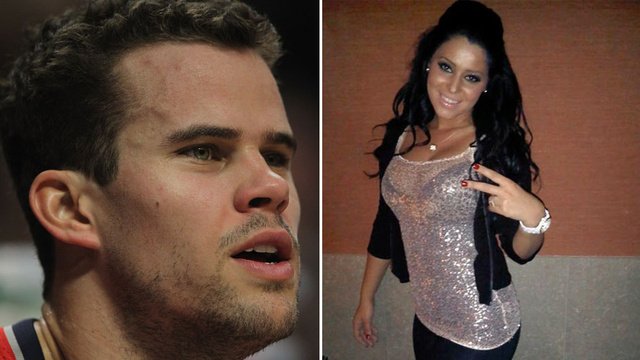
Kris Humphries’ lawyers want him to walk into his divorce depositions at the end of June looking like a heartbroken, and very single, man.
And they are going to great lengths to keep his new rumored girlfriend Fatima “Myla” Sinanaj quiet about her supposed relationship with Kris Humphries, as they aim to prove that his 72-day marriage to reality TV star Kim Kardashian was indeed fraud.
According to TMZ, Kris Humphries’ lawyer reached out to Myla Sinanaj’s lawyer to negotiate a non-disclosure agreement in order to get a lockdown on any sensitive texts, emails, or other documents she has relating to their relationship.
Kris Humphries, 27, is demanding millions from Kim Kardashian, 31, and Kris doesn’t want anything to jeopardize his case that their union should be annulled rather than granted a divorce.
His lawyers are willing to pay a price in order to get Myla Sinanaj’s signature on a joint statement as well.
Kris Humphries' lawyer reached out to Myla Sinanaj's lawyer to negotiate a non-disclosure agreement in order to get a lockdown on any sensitive texts, emails, or other documents she has relating to their relationship
RadarOnline first reported that Kris Humphries had no plans to publicly date anyone until after his divorce was finalized, but TMZ claimed that Kris has been dating Myla Sinanaj, 25, since January, even flying her to Miami for a romantic beach holiday last weekend.
They have apparently been seeing each other regularly, meeting at various basketball games where Kris Humphries provided her and family members with courtside seats.
The pair met at a prominent five star hotel in New York, TMZ claims.
“Kris is expecting to be asked if he has a girlfriend, or has had one since Kim filed for divorce,” an insider told RadarOnline.
“Kris will answer under oath that he hasn’t had a girlfriend and that he is very single. Kris doesn’t care that Kim is dating Kanye West, he has truly moved on with his life.
“Kris is going to be in Minnesota for the summer getting in the best shape possible for the upcoming basketball season, end of story. Kris’ primary focus has been basketball, and that is it.”
Myla Sinanaj’s Twitter page, which has since been deleted, had a number of interesting posts related to Kardashian patriarch Bruce Jenner and Kim’s new boyfriend rapper Kanye West.
“Say my name, say my name. When no one is around, you say baby I love you. Why the sudden change?” Myla Sinanaj tweeted, quoting a Destiny’s Child song.
She also shared: “Bruce Jenner’s face scares me – it should be on the <<Why not to get plastic surgery>> poster.”
“Myla is very upset with Kris for not wanting an exclusive relationship,” a source told RadarOnline.
“Kris was honest with her from the beginning and it’s very likely that he won’t be seeing her anymore now. There are always going to be girls that are looking for their 15 minutes of fame and say they are dating Kris. It just comes along with the territory.”
Irish football fan Oliver Coughlan is the target of a worldwide web hunt after he left his tickets for Ireland’s three Euro 2012 matches in a Champion Sports shop in Dublin Airport.
“The tickets are for Ireland’s games against Croatia, Italy and Spain,” said Paul O’Kane at Dublin Airport.
“I can only think that somewhere in Poland, the poor man is putting his hand in his pocket for his tickets and figuring out that they’re gone.”
The tickets were found in the airport shop at 10:00 BST on Friday.
The authorities think that Oliver Coughlan must have flown out without them.
But thanks to the honesty of staff at Champion Sports and the quick thinking of the airport media department, the hunt for Oliver has taken to Twitter and Facebook. His story has featured on Irish radio and on news websites.
Irish football fan Oliver Coughlan is the target of a worldwide web hunt after he left his tickets for Ireland's three Euro 2012 matches in a Champion Sports shop in Dublin Airport
His story has gone viral.
“We have tweeted and Champion Sports have posted messages on their Facebook,” said Paul O’Kane, director of public affairs at the airport.
“The story has been picked up by RTE and local radio stations.
“I can only think that the first game is on Sunday evening so we have a bit of time to find him. Ten years ago, trying to track him down would have been very difficult. Now, thanks to new media and social networks we have a chance of reuniting him with his tickets before Sunday’s match.”
The airport lines have been buzzing with people wondering about those tickets – some of them have even offered to buy them.
But the airport is keen to do the right thing by Oliver Coughlan – they are trying their best to reunite him with his tickets and have asked the public to help them find him.
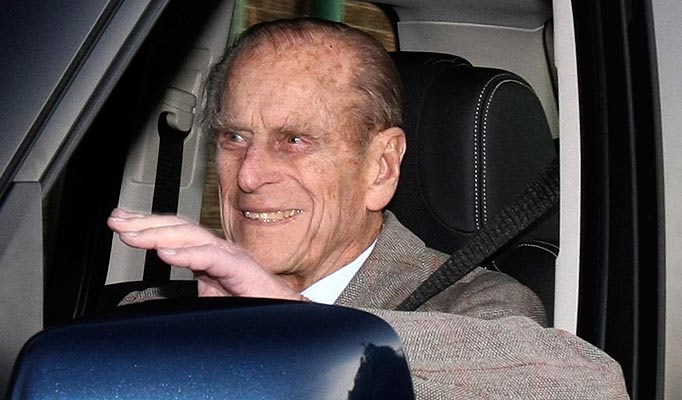
Prince Philip has left London’s King Edward VII hospital after a five-night stay receiving treatment for a bladder infection.
He was admitted to London’s King Edward VII hospital on Monday, a day after attending the rain-drenched Jubilee river pageant with the Queen.
On Friday, the Duke of Edinburgh was visited by the Duke of Cambridge and Prince Harry, the latest in a series of visits from his family.
Prince Philip will celebrate his 91st birthday on Sunday.
Prince Philip has left London's King Edward VII hospital after a five-night stay receiving treatment for a bladder infection
Earlier this week, Buckingham Palace said the duke’s condition had “improved considerably” and that he was being treated with antibiotics and was in “good spirits”.
Clarence House said Prince William and Prince Harry paid a “short private visit” to see their grandfather on Friday.
They made no comment to reporters outside as they left after 20 minutes.
Prince William visited the duke while on leave from his RAF search and rescue duties.
On Thursday, it was announced that he had qualified as a Royal Air Force search and rescue captain, after passing his tests on 29 May.
Meanwhile, his brother Prince Harry – a captain in the Army – has spent this week on pre-deployment training at RAF Wattisham in Suffolk.
The Queen and the Duke of York visited Prince Philip on Wednesday. Prince Andrew said that his father was “mending very well”.
Prince Philip had appeared to be in good health when he accompanied the Queen on Sunday on the royal barge the Spirit of Chartwell, which formed part of the Jubilee river pageant.
His admission to hospital meant that he could not join the Queen at the final Diamond Jubilee events to mark her 60 years on the throne.
Prince Philip is not due to attend his next scheduled engagement until Tuesday, when the Queen hosts a garden party at the Sandringham Estate as part of Jubilee celebrations.
Eurozone finance ministers are to hold a conference call to discuss a bailout for Spanish banks.
EU sources say Madrid could formally request financial assistance for its troubled banks this weekend.
So far Spain has denied reports that an announcement on a European rescue plan for its banks is close.
The International Monetary Fund (IMF) is estimating that Spain’s banks need a cash injection of at least 40 billion Euros ($50 billion).
The IMF said on Friday that a “stress test” showed Spain’s financial sector was well managed but “vulnerable”.
The eurozone finance ministers’ conference call is expected early on Saturday afternoon.
In an interview on Portuguese radio, European Central Bank Vice-President Vitor Constancio said: “It is expected that Spain will formulate a request for aid exclusively for banks recapitalization.
“There has to be an expression of will to have such a programme for Spanish banks, and one may hope it happens rather swiftly.”
Eurozone finance ministers are to hold a conference call to discuss a bailout for Spanish banks
Spain is under pressure from Brussels to act, possibly before the feared uncertainty that could follow next weekend’s Greek elections.
However on Saturday morning, the Spanish government restated its position that it does not need outside help to shore up its banks.
“There has been no change,” a spokeswoman from the economy ministry in Madrid told AFP news agency.
Spanish Prime Minister Prime Minister Mariano Rajoy has insisted that any decision will come after the results of an independent audit on the Spanish banking system, which are due out within two weeks.
The audit will produce a figure of how much money, in total, is needed to prop-up Spain’s banks.
A rescue deal would see money passed first to the Spanish government and then to the troubled banks.
Because Madrid has already announced tough financial reforms it is likely that a deal would only carry limited conditions, our correspondent says, unlike the full-blown bailouts for Greece, Portugal and Ireland.
Reuters reported that eurozone deputy finance ministers would first hold a conference call on Saturday morning to discuss a Spanish request for aid.
The Eurogroup of finance ministers would then discuss the issue on another conference call, the news agency said, citing unnamed EU and German officials.
A downgrade of Spain’s creditworthiness by rating agency Fitch earlier this week has been seen by some as adding to the urgency of shoring up Spain’s finances.
European leaders have to make difficult decisions to steer the eurozone away from crisis, US President Obama said on Friday.
He said the US would support Europe as it implemented the hard solutions needed to solve the ongoing debt crisis.
He said a deep new recession in Europe would have an impact on the US economy.
Greece’s future in the eurozone was a matter for the Greek people, he said, but “further hardship” must be expected if the country chose to leave the euro.
Greeks will go to the polls on 17 June to try and end a political impasse that eurozone leaders say is harming Greece’s ability to tackle its economic crisis.
China announces it will carry out manned space flight Shenzhou 9 at some point in the middle of June.
A rocket carrying the Shenzhou 9 spacecraft has been moved to a launch pad in the north-west of the country.
According to state news agency Xinhua, it will carry three astronauts – possibly including a woman – to the Taingong 1 space station module.
This will be China’s fourth manned space flight and its first since 2008.
It became only the third country to independently send a man into space in 2003.
Last year, China completed a complicated space docking manoeuvre when an unmanned craft docked with the Taingong 1, or “Heavenly Body”, by remote control.
China announces it will carry out manned space flight Shenzhou 9 at some point in the middle of June
The astronauts onboard the Shenzhou 9 spacecraft will also dock with the Taingong 1 – an experimental module currently orbiting Earth – and carry out scientific experiments on board.
Xinhua reported that Niu Hongguang, deputy commander-in-chief of China’s manned space programme, said the crew “might include female astronauts”.
The mission is part of China’s programme to develop a full orbiting space station.
Beijing is planning to complete the 60-tonne manned space station by 2020.
China was previously turned away from the International Space Station, a much bigger project run by 16 nations, reportedly after objections from the United States.
Thousands of people have protested in Greece against the far-right Golden Dawn party after its spokesman Ilias Kasidiaris assaulted Liana Kanelli of the Greek Communist party on live TV.
Demonstrators shouted “Neo-Nazis out” in rallies called by left-wing and anti-racism groups in Athens.
On Thursday, Ilias Kasidiaris, a Golden Dawn MP, was filmed hitting a left-wing politician during a chatshow.
The rally comes nine days before elections which could result in a Greek exit from the Eurozone.
In polls a month ago, Golden Dawn surprised many by winning 21 seats in Greece’s 300-seat parliament.
A second election is taking place as no party was able to forge a coalition.
Prosecutors said an arrest warrant has been issued for Ilias Kasidiaris, whose whereabouts remain unknown after he fled the television studio on Thursday.
The assault took place during a live debate on a daily morning political show on the private Antenna television.
It started after Rena Dourou of the radical left-wing Syriza party mentioned Ilias Kasidiaris’s alleged involvement in an armed robbery in 2007.
He jumped up and threw a glass of water across the table at her, a You Tube clip of the Antenna television channel showed.
When Liana Kanelli of the Greek Communist party, the KKE, apparently threw a newspaper at him, he responded by slapping her around the face with three right-left blows.
Speaking to a TV station from an undisclosed location on Friday, Ilias Kasidiaris said he had been provoked.
“She [Communist party member Liana Kanelli] raised her hand and hit me first and since I respect my honor and my name, I had to defend myself. The police ought to arrest her,” he told Star TV, according to Reuters news agency.
The government and other political parties have condemned the attack.
“The government condemns in the most categorical way the attack by Golden Dawn spokesman Ilias Kasidiaris against Liana Kanelli and Rena Dourou,” government spokesman Dimitris Tsiodras said.
“This attack is an attack against every democratic citizen.”
Ilias Kasidiaris is already facing charges of theft and bodily harm, which he denies.
Golden Dawn campaigned on an anti-immigrant platform, and has even proposed planting mines along Greek borders to prevent the entry of migrants. It has been accused of violent attacks against immigrants in Athens, but denies the claims.
Lindsay Lohan’s dramatic car crash pictures have emerged yesterday.
The accident happened after Lindsay Lohan ran into the back of a heavy goods vehicle in Los Angeles this morning while driving to a movie set.
Lindsay Lohan, 25, was taken to hospital as a precaution, but was later released after a check-up revealed she was uninjured.
Luckily for the actress she will not be left with a massive repair bill as she was renting the high-end black Porsche sports car.
Lindsay Lohan, who is currently shooting her movie return as the late screen icon Elizabeth Taylor in Liz & Dick, was driving the car on Pacific Coast Highway in Santa Monica when she hit the big rig, and according to TMZ she is claiming she was cut off by the 18-wheeler.
According to police, detectives are still trying to determine the cause of the crash, but they said there was no immediate evidence of wrongdoing.
They confirmed the actress was behind the wheel but showed no signs of intoxication.
Her spokesman Steve Honig said: “Lindsay was involved in an automobile accident today on her way to the set.
“She was brought to Santa Monica UCLA hospital as a precaution.
“She is fine and was released less than two hours later and is already headed back to the set to resume work.
“Fortunately, no one was seriously injured in the accident.”
The accident happened after Lindsay Lohan ran into the back of a heavy goods vehicle in Los Angeles this morning while driving to a movie set
The car bumper was mangled car and the passenger window was smashed, and as the vehicle was towed away debris was still scattered on the road.
An ambulance was called to the scene but Lindsay Lohan did not appear to use it and made her own way to an the hospital.
Her assistant was in the car at the time of the incident, but was also uninjured in the crash.
The star had been seen socializing the night before at the upmarket Chateau Marmont, but it is understood she was not under the influence of alcohol at the time of the crash.
Lindsay Lohan has been trying to get her life back on track after a series of medical and legal wrangles in recent years.
She has been on probation since a 2007 conviction for driving under the influence, and since then was convicted of shoplifting. She is currently on probation for both offenses.
Lindsay Lohan recently pulled out of negotiations to star in a biopic about mobster John Gotti, with publicist Steve Honig confirming no agreement could be made.
He said: “I can confirm that Lindsay has not signed on to be a part of the John Gotti movie, nor is she in talks to join the cast.
“It does not look like an agreement can be made. Lindsay’s representatives and film producers were unable to come to an agreement.
“Lindsay has the utmost respect for Barry Levinson [the director of the movie] and the producers and hopes to work with them in the future and wishes them all the best.”
Two computer scientists have developed a depth-camera based system that keeps track of household objects as they are moved around a building.
The project – dubbed Kinsight – relies on several of Microsoft’s Kinect sensors attached to a computer running the team’s software.
Although the project is still at an experimental stage, it has been shown to work in a “real-world scenario”.
Details of the system were recently outlined at a conference in China and were subsequently reported by New Scientist.
“Imagine if we had a system that could keep account of all the objects that we interact with in our daily lives,” the researchers said.
“By keeping track of the locations of the objects, we could build a smart search engine for our home that could answer queries like – where are my eye glasses, or my TV-remote, or my wallet?”
Two computer scientists have developed a depth-camera based system that keeps track of household objects as they are moved around a building
Although alternative solutions, such as the use of radio-frequency identification chips already exists, the men said their system was many times cheaper due to the high cost of RFID readers.
The researchers noted that running a computer program that simultaneously tracked all the owner’s objects in real-time would be too processor-intensive.
So they based their design around the principle that objects only change locations when humans move them.
As a result the system focuses on tracking human figures and then looking for objects that have changed position in their vicinity.
Although the Kinect sensor’s capabilities are limited – it only sees objects up to 11 feet (3.4 m) away and only provides “skeleton data” at 15 frames/second – the Kinsight program has commonsense notions built into it to improve accuracy: so it knows that a coffee cup is most likely to be found at a study desk, or kitchen sink, but not inside a bath.
“This means that, when in doubt, an object recognition algorithm can use this knowledge to identify an object by analyzing the likelihood of it being at some location, or looking for the candidate objects in their other locations,” the researchers said.
Algorithms were also created to help the computer learn the appearance of objects and the context they were likely to be used in by analyzing the data gathered.
To prove the system worked the two scientists labeled 48 objects – including knives, forks, keys and a Rubik’s cube – and identified 80 possible locations around a house.
They then asked volunteers to move the items around according to randomly generated patterns.
The results suggested room for improvement – errors were more likely if the objects were very small, far away, transparent or placed too closely together – but the team said these problems should be addressed by using more sensors per room and adopting more sensitive depth-cameras.
In the meantime, they say that even when the program does lose track of possessions, it can still say were they were last seen which may still prove helpful.
Barry Gibb yesterday revealed the solace he finds in knowing that his siblings, twins Robin and Maurice, have now been reunited – and that he will join them both one day too.
“They were both beautiful. And now they’re together,” said Barry Gibb, his voice trembling with emotion, as he addressed the congregation at Robin’s funeral.
Barry Gibb, 65, the only remaining member of the group he formed with his younger siblings in 1958 which went on to sell more than 200 million records worldwide, told mourners: “When you’re twins, you’re twins all your life. You go through every emotion.”
Robin Gibb died last month aged 62 after a long battle with colon cancer.
Maurice Gibb died of complications resulting from a twisted intestine in 2003 aged 53.
At yesterday’s service at St Mary’s Church in Thame, Oxfordshire, Barry Gibb spoke of Robin’s “magnificent mind and beautiful heart”.
Barry Gibb also read a poem he had written called Ode To Rob, which included the lines: “We will all be together one day. So fly away Rob, fly away.”
Among the 300-strong congregation were celebrities including Sir Tim Rice, Uri Geller, DJs Mike Read, Paul Gambaccini and David “Kid” Jensen, singer Peter Andre, actress Susan George and 88-year-old actor Leslie Phillips.
Robin Gibb’s widow Dwina, 59, an author and artist, read a poem called My Songbird Has Flown, including the words: “No music can be heard that is sweeter than the language of his love, no diamond is more precious than the memory of his twinkling eyes.”
Dwina and Robin Gibb’s son Robin-John, 28, kissed his father’s white coffin after telling mourners his “best friend and daddy” is “always only a song away”.
Absent from the service, however, was Claire Yang, the former housekeeper with whom Robin Gibb fathered a daughter, Snow, aged four.
Claire Yang was reportedly “unwelcome” and spent the day a few miles away at her home in Amersham, Buckinghamshire.
A source said that security guards had been briefed “to keep an eye out for her”.
However, Snow was mentioned by Barry Gibb at the end of his eulogy as “little Snow” in a list of close family members.
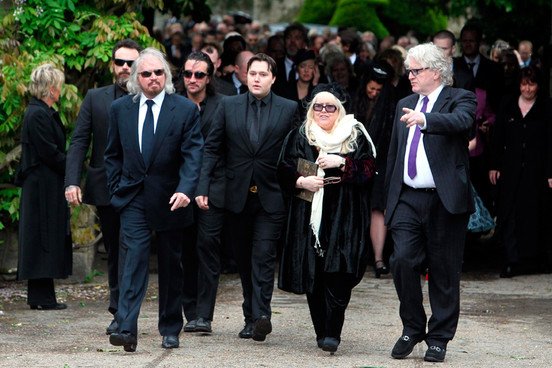
At yesterday’s service at St Mary’s Church in Thame, Oxfordshire, Barry Gibb spoke of Robin’s “magnificent mind and beautiful heart”
Barry Gibb also referred to the fourth Gibb brother, Andy, also a singer, who died aged 30 in 1988, saying that to have lost three siblings was “a very strange experience”.
And referring to the Bee Gees’ days of packing out arenas to adoring audiences across the globe, Barry Gibb said: “The three of us have seen a lot of crowds but I’ve never seen so much love in one crowd as I’m looking at today.”
The coffin was taken to the church in a glass-sided, horse-drawn carriage topped with red roses.
The coffin itself was draped with the flag of the Isle of Man, where all three Bee Gees were born.
Robin and Dwina Gibb’s home, a converted 13th century monastery, is opposite the church but the carriage travelled along the market town’s high street first as it was among Robin’s last wishes that he could “say a final goodbye to fans and his home town”.
The cortege was followed by Robin Gibb’s two Irish wolfhounds, Ollie and Missy.
The coffin entered the church to the sound of the Bee Gees’ hit How Deep Is Your Love.
Barry Gibb also spoke of his brother’s sense of humor: “There was no funnier man than Spike Milligan – apart from Robin.
“And his sharp, intuitive wit will live with us forever.
“You could stand Robin next to Spike Milligan and it would be a competition.”
He hinted at recent tensions between himself and Robin, however, saying: “We were laughing all the way. Sometimes crying. God knows how much we argued.
“Even right up to the end we found conflict with each other, which now means nothing. It just means nothing. If there’s conflict in your lives – get rid of it.”
Robin Gibb’s elderly mother, Barbara, left the church just before Barry gave his eulogy.
He told the congregation: “This is a very strange experience, having already lost two brothers and now Rob.
“I think there are an awful lot of things happening right now that maybe you won’t be aware of. And one is how many people came on such a terrible day. It is staggering.
“So many people loved this boy, so many illustrious people are here that loved him. And that is such a pleasure to witness.
“The three of us have seen a lot of crowds but I’ve never seen so much love in one crowd as I’m looking at today – for Rob, you know, for the music. And it’s an intense experience for me.
“I think it’s an experience none of us will forget. We will keep him in our hearts and minds forever.”
Robin Gibb’s family and friends were joined by hundreds of fans, who lined the streets as a glass horse-drawn carriage covered in red roses made its way down the town’s high street on the way to the funeral.
Family members including Robin Gibb’s wife Dwina, his children Spencer, Melissa and RJ, Barry, his wife Linda and his son Stevie, were pictured leading the procession on foot from the gate house of their estate to St Mary’s Church.
It had been Robin Gibb’s wish to “say a final goodbye to fans and his home town of Thame”, according to his family.
Robin Gibb died from kidney failure last month after fighting colon cancer and pneumonia.
Peter Andre, who was a close friend of the musician, was front and centre to place a rose on the coffin at the burial.
He announced last week that he plans to release a tribute single using music written for him by Robin Gibb shortly before his death.
“He very kindly wrote a song for me recently and I’m determined to finish working on it when I get back to the UK,” he said.
“I’m going to release it and make sure all the proceeds go to his favorite charity.”
St Mary’s church is opposite the home which the musician had shared with wife Dwina for 19 years.
Two candles flickered at the front of the church as some guests entered in tears, to take their places on wooden seats surrounded by pink and white flowers.
They were issued with an order of service printed with a black and white picture of Robin Gibb on the front cover, and images of red roses throughout.
An image of the three members of the Bee Gees – Robin, Maurice and Barry – was on the back.
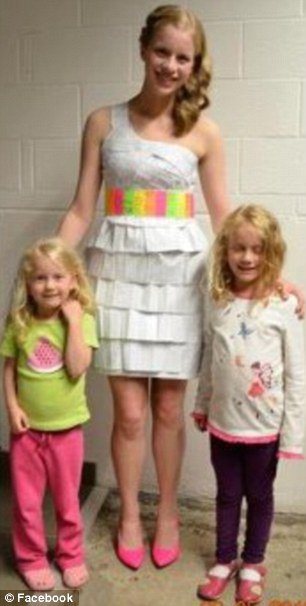
Kara Koskowich, a 17-year-old student from Canada, decided she would recycle unwanted paper, making her own prom dress using old maths homework.
Kara Koskowich cut, sewed, glued, and eventually tailored a one-shouldered dress out of 75 pieces of algebra formulas.
She told CBC News: “For me, [prom] is not a big, spend your money, you have to look this nice, you have to fit into this mould of grad.”
While most graduates never want to look at their homework again, Kara Koskowich found a way to look good in it.
She sculpted the dress sewing in darts and even a zipper, also adding colorful post-it notes circling the waist to give it a cinched-in effect.
Kara Koskowich decided she would recycle unwanted paper, making her own prom dress using old maths homework
The student began making her dress in March, but said she didn’t finish it until the night before prom.
“I did most of it the last week because I’m that kind of person. I procrastinate,” she said.
Kara Koskowich’s date was her friend Dorothy Graham, who was wearing a dress she made out of plastic bags.
According to Dorothy Graham, the dresses made the pair the most popular people at prom.
Dorothy Graham explained: “It was actually funny because everyone was wearing these elegant dresses, and we’re in dresses that cost nothing, and we were the most popular people there.”
Miss Pennsylvania Sheena Monnin has said she stands by her accusations that the Miss USA 2012 competition was rigged and will take on Donald Trump if he sues her, as he has claimed.
Earlier this week, Sheena Monnin resigned from her position claiming one of her fellow contestants – later revealed as Miss Florida – had seen a list of the top five girls before the show had even begun.
Sheena Monnin branded the competition “fraudulent”, “trashy” and “lacking in morals”, which led Donald Trump, the co-owner of Miss Universe Organization, to threaten her with a lawsuit.
But speaking to the Today show, Sheena Monnin said she is standing by her claims and knows Miss Florida was serious as she has had “years of psychological training”.
Miss Pennsylvania Sheena Monnin has said she stands by her accusations that the Miss USA 2012 competition was rigged and will take on Donald Trump if he sues her
“I feel disappointed that [Trump] has made some of the statements that he said about me, and I feel prepared to continue to pursue the truth,” Sheena Monnin said on the Today show.
“I know what I heard, and I know what I in turn witnessed… so I’m prepared to continue to march forward.”
Florida’s Karina Brez has since said mentioning the list was “a throwaway comment” that was “never meant as fact”, but Sheena Monnin rubbished this defense.
“There’s no doubt in my mind that the contestant was serious when she laid out what she said she saw, and I believe her to be true,” Sheena Monnin, who hold a master’s degree in psychology, said.
“I have many years of psychological training. I know when someone’s telling a joke, I know when someone’s scared and when someone’s serious, and in my opinion her body language was very serious.
“She looked a little bit scared because she had just seen something that would potentially, drastically change the reputation of the Miss Universe Organization. This is a big deal.”
Donald Trump said on Wednesday that her claims were a case of sour grapes, adding: “I did see her for about a second. I never felt that she had a chance, and all this is buyer’s remorse.”
He added that an investigation into Sheena Monnin’s “disgraceful” claims has been carried out, and there is no evidence that there was a list of the five top girls before the show.
In her Facebook posts, Sheena Monnin, who had not placed in the top 16, had claimed Miss Florida went on to name all five women correctly before they were announced on the show.
Famous gymnast Dominique Moceanu, part of the “Magnificent Seven” who won gold at the 1996 Olympics, has revealed how she discovered her parents gave up for adoption a secret sister who had no legs.
Dominique Moceanu, now 30 and living in Cleveland, Ohio, only found out about her younger sister two decades later when the woman wrote to her to say she had learned her birth name was Moceanu.
“It was the biggest bombshell of my life,” Dominique Moceanu told ABC’s 20/20.
“I had this sister that was born who was given up for adoption, and I never knew it.”
The gymnast had a famously fraught relationship with her parents, divorcing them when she was 17. She was also granted a restraining order against her father, after she accused him of stalking her.
When the 20-year-old woman contacted her with a letter and photographs of herself just over five years ago, Dominique Moceanu contacted her parents with questions, ABC News reported.
Dimitry and Camelia Moceanu, who moved from their native Romania in the 1980s and had both been keen athletes, told her the baby girl was born the day after her sixth birthday.
They added that the baby had medical problems that would require expensive care that they could not afford, so they gave her up for adoption. The woman confirmed this story.
“Oh by the way, I have no legs,” she told Dominique Moceanu.
“But people forget that within minutes of meeting me.”
Gymnast Dominique Moceanu has revealed how she discovered her parents gave up for adoption a secret sister who had no legs
The women now meet regularly and have noticed similarities, such as their love of gymnastics.
“The tones in our voices, our handwriting, the way we laugh and chuckle. It’s mind-blowing,” Dominique Moceanu said.
The revelation is just one of many made by the Olympic gold medalist in her autobiography Off Balance and in an interview with 20/20, which will air on Friday evening.
Dominique Moceanu recounts her struggle to reach the top – and how she was plagued by her over-bearing parents, who had both been athletes and wanted their child to have an interest in the same.
“I think [my dad] wanted me to do something that he didn’t get a chance to do,” Dominique Moceanu said.
They enrolled their daughter in a gymnastics class when she was three, and she took to it at once.
Focusing on the 1996 Olympics in Atlanta, her parents took her to try out for famous Olympic gymnastics coaches Bela and Marta Karolyi when she was nine and she was accepted.
After winning the 1995 U.S. National Championships aged just 13, she was accepted for the U.S. Olympics team, despite suffering a stress fracture in her leg.
At the Games, Dominique Moceanu’s first three rounds went off perfectly, but she fell twice during her final event – the vault – and she knew she would be punished for it.
As the team collected their gold medals, Dominique Moceanu said she knew her father would berate her following the ceremony.
“I have this gold medal around my neck. I wanted to take it off. I was devastated. It was heartbreaking,” she said.
A few years later, Dominique Moceanu successfully filed for emancipation from her parents. She claimed they had repressed her and squandered her fortune.
She was also granted a restraining order against her father, who had stalked her. She also feared he had hired someone to kill two of her close friends.
Dominique Moceanu eventually reconciled with both of her parents. Her father died in 2008 from cancer.
An injury kept her from the 2000 Olympics and she went to college and married a fellow gymnast, Mike Canales, in 2006. They have two children.
After retiring from the sport twice – in 2000 and 2006 – Dominique Moceanu now works as a gymnastics coach in the Cleveland area and holds private clinics around the country.
She has continued to make headlines; in 2008, she claimed her coaches, the Karolyis, had abused her during practices as a child.
Speaking to the Los Angeles Times, she claimed Martha Karolyi had grabbed her neck and slammed her face into a phone, while Bela Karolyi had twice chided her about her weight in front of national teammates.
“I never, ever objected to hard work,” Dominique Moceanu said in the interview.
“What I objected to was Martha grabbing me by the neck, shoving my face into the phone and telling me to call my parents when I hurt my neck in practice.
“I objected to being told to jump onto a scale in front of the 1995 world championship team, of being forced to do 16 uneven bars routines in a row by Martha.
“I was completely embarrassed by Bela in front of the 2000 national training team at camp.
“He completely belittled me and my weight, singled me out and made me feel very small.
“It was unfair treatment. Martha’s logic is so false but no one would listen to a 14-year-old. I was never allowed to speak out.”
Martha Karolyi responded that the comments made her feel “sad” that Dominique Moceanu only appeared to remember the hard days of work, rather than the championship wins.
The coaches are credited for the young girl’s success.
“Bela Karolyi is the greatest kingmaker we have seen in gymnastics,” said USA sports columnist Christine Brennan.
“And Dominique Moceanu had to have Bela Karolyi to become the gymnast that she was to become.”
Usain Bolt crashed into a flower girl at the end of his 100 m sprint last night in Oslo where he ran the second fastest time this year – he holds first and third place too.
Crossing the line at about 40 mph, it takes Usain Bolt a few metres to slow to a stop. It was during this slowdown that the world’s fastest man clashed with a girl who was there to present flowers to runners.
Video footage shows Usain Bolt avoids one of the girls on the track but fails to see a second just behind her.
He then appears to try and jump over her but, resigned to his fate, grabs hold of her and runs along with her.
She falls backwards but Usain Bolt manages to stop her from actually hitting the ground, pulling her upwards and eventually gives her a hug once he comes to a halt.
Usain Bolt crashed into a flower girl at the end of his 100 m sprint last night in Oslo where he ran the second fastest time this year
World champion Yohan Blake’s challenge awaits Usain Bolt in Kingston – Blake races in New York on Saturday – but in his present form Bolt is a shoo-in for the team his island will send to London.
The collision occurred after Usain Bolt ran 9.79 sec in Oslo on Thursday, he owns the year’s three fastest 100 metres times.
“I am not yet in the shape where I can say, <<Nobody can beat me>>. My start is letting me down slightly still,” said Usain Bolt.
“I can’t complain but the execution of my race was not perfect.”
For that he blamed shorter starting blocks, introduced by Omega this year to Diamond League meetings. They will be used in the Olympic Games.
US President Barack Obama says European leaders must make difficult decisions to steer the eurozone away from crisis.
Speaking at the White House, Barack Obama said the US would support Europe implement the hard solutions needed to solve the ongoing debt crisis.
He said a deep new recession in Europe would have an impact on the US economy.
Greece’s future in the eurozone was a matter for the Greek people, he said, but “further hardship” must be expected if it choose to leave the euro.
Barack Obama says European leaders must make difficult decisions to steer the eurozone away from crisis
Outlining a series of “specific steps” Europe needed to take to ensure stability within the eurozone, the president was at pains to say he would not “scold” Europe.
Barack Obama said European leaders needed to stabilize the continent’s financial system and inject capital into weak banks “as soon as possible”.
“The solutions are hard, but there are solutions,” Barack Obama said, saying the US was offering advice, but that “these decisions are fundamentally in the hands of Europe’s leaders”.
Barack Obama also reprised his calls for the US Congress to pass the remaining parts of his own jobs plan, in order to strengthen the US economy against possible shocks from Europe.
UEFA confirms there were “isolated incidents of racist chanting” aimed at Netherlands players during an open training session at Euro 2012.
But the governing body has not revealed whether it is investigating the incident in Krakow, Poland.
Dutch captain Mark van Bommel said monkey chants were directed at players.
“Should such behaviour happen at further training sessions, UEFA would evaluate the operational measures to be taken to protect players,” UEFA said.
“UEFA has now been made aware that there were some isolated incidents of racist chanting that occurred at the open training session of the Dutch team yesterday in Krakow.
“UEFA has a zero tolerance policy when it comes to discriminatory behaviour and has given the power to referees to stop matches in case of any repeated racist behaviour.”
UEFA confirms there were "isolated incidents of racist chanting" aimed at Netherlands players during an open training session at Euro 2012
The Dutch FA said in a statement that it would not be making an official complaint but was “more than willing to answer [the] questions of UEFA in this respect”.
Outlining the incident, the statement added: “As at one moment there was a lot of noise coming from a specific stand, the team decided to train at the other side of the stadium, which was much quieter.
“A few players have heard sounds, which could be described as possible monkey chants. However, the training staff on the pitch were not aware of this.”
While Mark Van Bommel complained specifically of racist abuse, the Dutch FA had earlier said this was mixed with anti-Euro 2012 chanting believed to have been prompted by the fact the city has not been given any matches in the tournament.
When this was put to Mark Van Bommel on Thursday, he said: “Open your ears. If you did hear it and don’t want to hear it, that is even worse.”
The claims emerged on the opening day of the tournament, which is being co-hosted by Poland and Ukraine.
Around 20,000 fans had turned up to watch the training session at the Stadion Miejski on Wednesday.
Journalist Marcel van der Kraan, who writes for Dutch newspaper De Telegraaf, said he heard the racist abuse.
He said: “As the Dutch players did their warm-up, during the first lap of the pitch they could hear monkey noises from one end of the crowd.
“When the players heard this they said they would do another lap and if they heard monkey noises again they would stop.
“The Dutch coach moved all the cones and started training on the pitch as far away from these people as possible. It was considerably more than two or three people.”
The day before the alleged abuse, the Netherlands players had visited Nazi concentration camp Auschwitz, which is nearby.
Mark Van Bommel said: “It is a real disgrace, especially after getting back from Auschwitz, that you are confronted with this.
“We will take it up with UEFA and if it happens at a match we will talk to the referee and ask him to take us off the field.”
Earlier this week, UEFA president Michel Platini said the issue was one for wider society, not simply football. But he added that referees had the power to stop games if there was racist abuse from the stands.
The tournament kicks off at 17:00 BST on Friday with hosts Poland playing Greece in the opening match in Warsaw.
Flame malware’s makers have sent a “suicide” command that removes it from some infected computers.
Security firm Symantec caught the command using booby-trapped computers set up to watch Flame’s actions.
Flame came to light after the UN’s telecoms body asked for help with identifying a virus found stealing data from many PCs in the Middle East.
New analysis of Flame reveals how sophisticated the program is and gives hints about who created it.
Like many other security firms Symantec has kept an eye on Flame using so-called “honeypot” computers that report what happens when they are infected with a malicious program.
Described as a very sophisticated cyber-attack, Flame targeted countries such as Iran and Israel and sought to steal large amounts of sensitive data.
Flame malware’s makers have sent a "suicide" command that removes it from some infected computers
Earlier this week Symantec noticed that some Flame command and control (C&C) computers sent an urgent command to the infected PCs they were overseeing.
Flame’s creators do not have access to all their C&C computers as security firms have won control of some of them.
The “suicide” command was “designed to completely remove Flame from the compromised computer”, said Symantec.
The command located every Flame file sitting on a PC, removed it and then overwrote memory locations with gibberish to thwart forensic examination.
“It tries to leave no traces of the infection behind,” wrote the firm on its blog.
Analysis of the clean-up routine suggested it was written in early May, said Symantec.
At the same time, analysis of the inner workings of Flame reveal just how sophisticated it is.
According to cryptographic experts, Flame is the first malicious program to use an obscure cryptographic technique known as “prefix collision attack”. This allowed the virus to fake digital credentials that had helped it to spread.
The exact method of carrying out such an attack was only demonstrated in 2008 and the creators of Flame came up with their own variant.
“The design of this new variant required world-class cryptanalysis,” said cryptoexpert Marc Stevens from the Centrum Wiskunde & Informatica (CWI) in Amsterdam in a statement.
The finding gives support to claims that Flame must have been built by a nation state rather than cybercriminals. It is not clear yet which nation created the program.
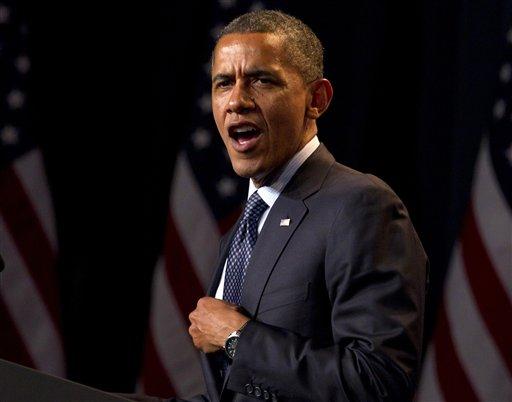
It appears that President Barack Obama made a rude joke about First Lady Michelle Obama and oral sex at a Beverly Hills fundraiser for the Lesbian Gay Bisexual and Transgender (LGBT) Leadership Council.
Talking to some 600 supporters at the event on Wednesday night, Barack Obama referred to Ellen DeGeneres, the stand-up comedian and television host and a lesbian.
“I want to thank my wonderful friend who accepts a little bit of teasing about Michelle beating her in push-ups but I think she claims Michelle didn’t go all the way down,” he said.
The crowd erupted into what the Los Angeles Times described as “bawdy laughter”.
In the pool report of the event, Todd Gillman of the Dallas Morning News, wrote that this was a line that Barack Obama “let hang, naughtily, provoking laughter from the crowd”.
It remained unclear, however, whether Barack Obama uttered a deliberate double entendre about his wife having oral sex with a lesbian or whether he simply stumbled into using a phrase that was misinterpreted.
Barack Obama made a rude joke about First Lady Michelle Obama and oral sex at a Beverly Hills fundraiser for the LGBT Leadership Council
The LA Times plumped for the latter interpretation, reporting that “the president seemed briefly caught off-stride when the audience interpreted as off-color a joke he made about a push-up competition between DeGeneres and his wife, initiated by the talk show host in February”.
After the bawdy laughter, the newspaper continued: “Obama kept a straight face. <<That’s what I heard>>, he added. <<I just want to set the record straight. Michelle outdoes me in push-ups as well. You shouldn’t feel bad>>.”
Political reporters immediately picked up on the obscene reference.
“I hope @MichelleObama yells at @BarackObama tonight. Or at least withholds pushups,” twteeted Meredith Shiner, a reporter for Roll Call.
Barack Obama was very much amongst friends at the Beverly Wilshire Hotel event, part of a two-day fundraising swing through California and Nevada during which he is expected to raise more than $15 million for his re-election bid.
At a similar event in New York this year Barack Obama was heckled by people shouting: “Marriage!”
After recently coming out in favor of gay marriage, however, this time he was greeted with chants of: “Four more years!”
Ellen DeGeneres, whose decision to come out of the closet in 1997 prompted headlines and predictions that her career was over, introduced Barack Obama at what was a who’s who of gay Hollywood and those whose work had taken gay themes into the mainstream.
Max Mutchnik, creator of Will and Grace was a co-host. Lance Black, Oscar-winning screenwriter of Milk and the singer Cher attended.
Barack Obama spoke for 30 minutes and highlighted measures that have been applauded by the gay lobby, including his repeal of the military’s “don’t ask, don’t tell” rule banning open homosexuality.
He equated gay rights with civil rights struggles for equality of treatment based on sex and race, stating that his achievements had been part of “this constant progression to include more and more people in the possibility of the America dream”.