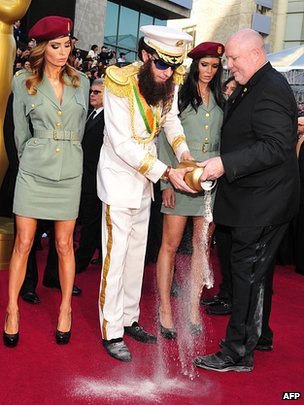
British comedy actor Sacha Baron Cohen was escorted off the Oscars red carpet after a publicity stunt for his new film, The Dictator.
Sacha Baron Cohen arrived in character as a middle eastern leader and claimed to be carrying the ashes of former North Korean leader Kim Jong-Il.
In an interview with US TV host Ryan Seacrest, Sacha Baron Cohen said it was Kim Jong-Il’s dying wish “to be sprinkled over the red carpet and over Halle Berry’s chest”.
He then tipped the urn over the host, covering his tuxedo in white dust.
Sacha Baron Cohen, who is known for outrageous publicity stunts in films like Borat and Bruno, was bundled off the red carpet by security guards.
Turning to the camera, Ryan Seacrest said: “Anything can happen and it most certainly did, all over my lapel.”
Sacha Baron Cohen stopped by security to pour the ashes on the red carpet at Oscars 2012
Sacha Baron Cohen’s film, The Dictator, is expected to be released in March. He was invited to the Oscars as a cast member of Martin Scorsese’s multiple award nominee Hugo.
There had been reports during the week that he had been forbidden to attend the ceremony after asking to arrive in character as Admiral General Aladeen – which the Academy denied.
In response, Sacha Baron Cohen posted a statement to General Aladeen’s Twitter account.
“VICTORY IS OURS! Today the Mighty Nation of Wadiya triumphed over the Zionist snakes of Hollywood.
“Evil and all those who made Satan their protector were vanquished and driven into the Pacific Sea. What I am trying to say here is that the Academy have surrendered and sent over two tickets and a parking pass! TODAY OSCAR, TOMORROW OBAMA!”
After the red carpet stunt, Moneyball actor Jonah Hill, who was up for best supporting actor, said: “I guess the Oscars isn’t the best place to sell your movie. I think he’s a funny guy, though.”
“Ryan’s mouth dropped open on live TV,” laughed Jackie Collins.
“But that’s what makes live TV good.
“I don’t think Ryan was very pleased, but I don’t think I’d be very pleased.”
Piers Morgan commented it was “just another day in Hollywood”.
30 Rock actress Tina Fey saw the funny side, and crossed herself over the ashes as she walked past.
Speaking to BBC 5 live, Jay Leno said: “Only in Hollywood does that dictator override Libya” as a major news story.
“And somehow that’s more shocking.
“It’s certainly worse than anything Gadaffi or Assad could possibly have done.”
Comedian Steve Martin said: “I love Sacha Baron Cohen”, and joked that the red carpet shouldn’t be sacred ground.
“It should be 12% respect, 23% levity and 13% joy.”
It is not the first time Sacha Baron Cohen has used industry events to promote his movies.
In 2006, Sacha Baron Cohen arrived at the Toronto International Film Festival dressed as Borat, the main character from the hit comedy.
In 2009, Sacha Baron Cohen went to the MTV Video Music Awards as flamboyant fashion critic Bruno, to promote his movie of the same name.
During the show Sacha Baron Cohen was launched into the air wearing a harness and landed in the lap of US rap star Eminem, who stormed out – although it was later reported that the musician had been in on the joke.
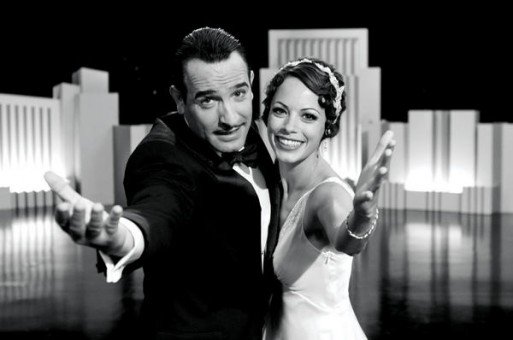
Black and white film The Artist has triumphed at the Oscars, winning five awards including best picture, best director and best actor for Jean Dujardin.
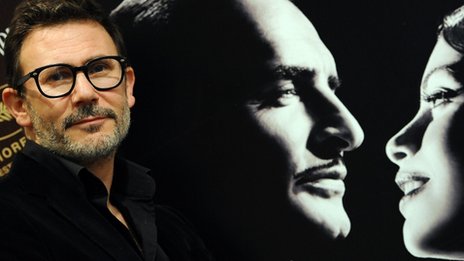
Michel Hazanavicius , The Artist director- winning on his first ever nomination – thanked the dog, Uggie, who appears in the film but added: “I don’t think he cares.”
Jean Dujardin said of his character: “If George Valentin could speak, he would say <<Wow! Victorie! Genial! Merci!>>”
The Artist also won the Oscars for best original score and best costumes.
Martin Scorsese’s Hugo also won five Oscars, mainly in technical categories.
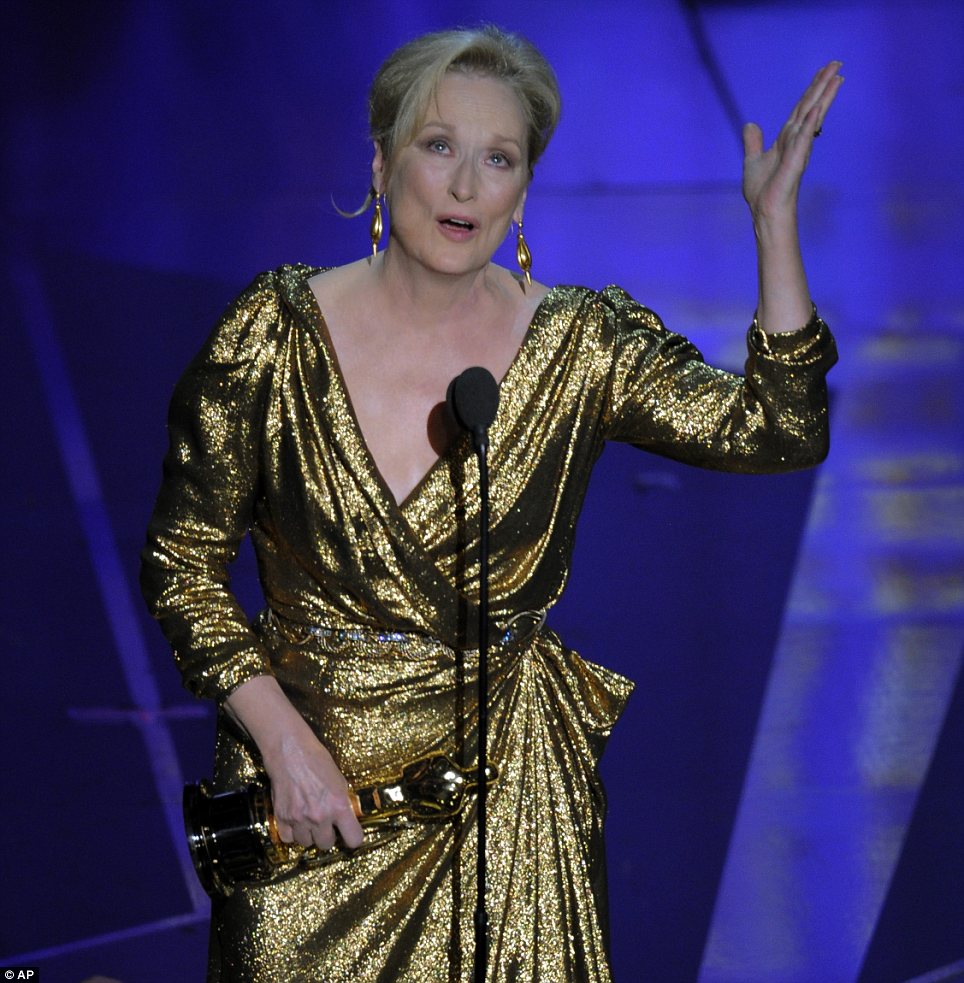
Meryl Streep won best actress for her portrayal of former British Prime Minister Margaret Thatcher in The Iron Lady – her 17th Oscar nomination and third Oscar win.
The actress thanked the Academy “for this inexplicably wonderful career”.
“When they called my name I had this feeling I could hear half of America going: <<Aww no. Not her again>>. But, you know, whatever.
“I look out here and I see my life before my eyes. My old friends, my new friends. This is such a great honor but the thing that counts the most for me is the friendships… Thank you. All of you, departed and here.”
Meryl Streep won best actress for her portrayal of former British Prime Minister Margaret Thatcher in The Iron Lady - her 17th Oscar nomination and third Oscar win
Jean Dujardin broke into his native French language in celebration shouting: “Wow, victory!”
“Thank you to the Academy. It’s funny because in 1929, it wasn’t Billy Crystal but Douglas Fairbanks who hosted the first Oscars ceremony. Tickets cost $5 and it lasted 15 minutes. Times have changed.”
1929 was the last year that a silent movie won an Oscar.
Canadian actor Christopher Plummer became the oldest Oscar winner at 82 by taking the best supporting actor prize.
He was widely tipped to win for his portrayal of a father who comes out as a gay man after his wife dies in Beginners.
Christopher Plummer thanked his real-life wife who, he said, deserved “the Nobel Peace Prize for coming to my rescue every day”.
The Help‘s Octavia Spencer won the best supporting actress Oscar and gave an emotional acceptance speech, receiving a standing ovation from the audience.
“Thank you Steven Spielberg for changing my life…oh my God, thank you… I’m freaking out,” Octavia Spencer told the audience, after struggling up to the stage in a floor-length gown.
Best adapted screenplay went to Alexander Payne, Nat Faxon and Jim Rash for The Descendants, starring George Clooney.
Veteran screenwriter and director Woody Allen won best original screenplay for Midnight in Paris but was not there to collect the award.
The first two awards of the night went to Hugo for cinematography and art direction.
Robert Richardson was cinematographer on Martin Scorsese’s 3D film and Francesca Lo Schiavo was art director.
And later, the film about an orphan who lives in a train station picked up a further three Oscars, all in technical categories.
Best sound editing was won by Philip Stockton and Eugene Gearty.
Hugo’s Tom Fleishman and John Midgley won the Oscar for sound mixing and the film also picked up the award for best visual effects.
Rango won best animation, a first Academy award and nomination for director Gore Verbinski, who said it was “made by grown-ups acting like a bunch of children”.
The film features the voice of Johnny Depp, who plays a chameleon.
Best animated short film was The Fantastic Flying Books of Mr. Morris Lessmore.
The Oscar for costume design went to Mark Bridges for The Artist, who thanked the Academy “for making a lifelong dream come true”.
The best make-up prize went to J Roy Helland and British artist Mark Coulier for The Iron Lady.
Iran’s A Separation became the first Iranian film to win an Oscar when Sandra Bullock presented director Asghar Farhadi with best foreign language film.
Set in contemporary Iran, it tells the story of a marriage break-down.
Best film editing went to Kirk Baxter and Angus Wall for Girl with the Dragon Tattoo – the pair also won last year for The Social Network. Both films were directed by David Fincher.
The Oscar for best original song was won by Bret Mackenzie for Man or Muppet from the soundtrack to The Muppets.
Best documentary went to Undefeated, a film about an inner city American football team whose fortunes are turned around by a new coach.
The executive producer of the film was rapper Sean “P Diddy” Combs.
Northern Ireland film The Shore won the best live action short film.
Saving Face, about a British-Pakastani doctor who helps women who have been injured in acid attacks, won best documentary short.
Earlier, Morgan Freeman introduced the evening before a comic video was shown of George Clooney waking up host Billy Crystal with a kiss – in a parody of his nominated film The Descendants.
Freeman said: “All of us are mesmerized by the magic of the movies. This magnificent event allows us to celebrate the present and look back at its magnificent past”.
Billy Crystal hosted the 84th Oscars ceremony at the Kodak theatre in Los Angeles.
He joked: “This is my ninth time – just call me War Horse.”
On the red carpet, British comedy actor Sacha Baron Cohen turned up dressed in a white military uniform and sporting a beard and sunglasses, promoting his upcoming film The Dictator.
Sacha Baron Cohen arrived holding an urn he jokingly claimed contained the ashes of Kim Jong Il, the late leader of North Korea.
He then tipped the container on to American Idol host Ryan Seacrest.
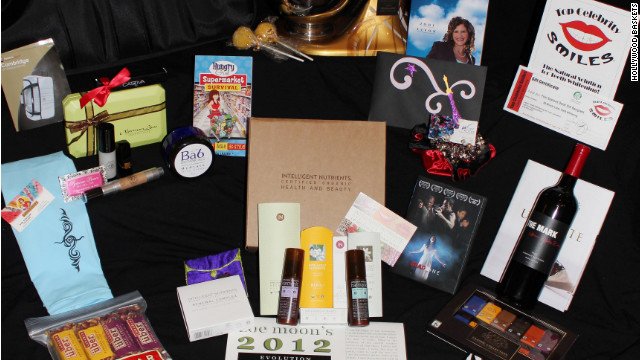
A-list Oscar nominees get thousands of dollars in gifts from companies hoping to associate their products with their celebrity, while D-listers get bags of swag valued in the hundreds of dollars.
“It’s something they anticipate from year to year,” said Lisa Gal of Hollywood Baskets, who puts together a high-end gift bag that goes to 30 Oscar nominees and presenters who stay at the Four Seasons Hotel in Beverly Hills.
Stars checking into the Four Seasons will find a KitchenAid mixer set up in their room, customized with 22K gold paint and Swarovski crystal by Nicole Dinardo and valued at $1,500, Lisa Gal said.
A Traveler’s Choice luggage bag sits nearby, filled with 20 other gifts valued at $7,000, ranging from a $25 pack of Sunny Sleevz — to protect their arms at the beach — to $500 worth of Intelligent Nutrients, a line of certified organic beauty products.
Some products come from established companies – such as the high-end Norman Love chocolates – while younger, smaller ones get into Lisa Gal’s bag – including Symone Prince Beauty.
“They can be in there with the big guys,” Lisa Gal said.
“The key to being selected for the bag is quality,” she added.
“We have to make sure this is up to par on the celebrity’s level, so it’s very exclusive.”
A-list Oscar nominees get thousands of dollars in gifts from companies hoping to associate their products with their celebrity, while D-listers get bags of swag valued in the hundreds of dollars
Getting in the Oscar bag can be a big boost for a product, said Asha Blake, whose Goldenheart Media partners with Lisa Gal.
“It’s great exposure for the companies in media press releases, not just about being in front of celebrities,” Asha Blake said.
“It’s a different way of doing advertising in this day and age.”
Lisa Gal can’t reveal which stars get her bags until they check out of the hotel Monday, but her SAG Award and Golden Globe gift list included Glenn Close, Colin Firth, Michelle Williams, Morgan Freeman and Ryan Seacrest.
“Only the most recognizable, important people staying at the hotel” get her gift bag, but sometimes there are more big stars than bags.
Lisa Gal scrambled to put together an extra bag one year when “Avatar” director James Cameron was left out.
One gift bag is set aside for donation to a charity, which can then auction it off, Lisa Gal said.
Publicist Roger Neal pioneered the practice of connecting the gifting with charities with his beauty and couture suite at the L’Ermitage Hotel before the Oscars 16 years ago.
“Just to give celebs free stuff is meaningless, but when there’s a purpose with it, then I feel good about gifting them,” Roger Neal said.
The 200 celebrities, including 10 Oscar nominees, who attended his four-day suite event this week autographed items that will help an organ transplant foundation and a foster children’s charity.
Two teens who live in foster homes were pampered with facials, massages and other beauty treatments, Roger Neal said. They also left with suits, he said.
A-listers visting Roger Neal’s suite included “The Artist” actress Penelope Ann Miller, “Bridesmaids” actress Wendi McLendon-Covey, Annie Mumolo, nominated for writing “Bridesmaids,” and actors Joe Mantegna, Eric Roberts and Quintin Aaron.
Richard Middleton, executive producer of “The Artist,” brought his wife with him Tuesday, Roger Neal said. She was given a Shekhar Rahate designed gown to wear on the red carpet. Seamstresses worked overnight to resize it for her, he said.
Eimear O’Kane, whose “Pentecost” is nominated for best live action short film, was gifted a handbag and jewels by designer Timmy Woods of Beverly Hills to carry on the red carpet Sunday.
Kari Feinstein’s Oscar Style Lounge in West Hollywood’s Mondrian Hotel offers something for everyone, with companies handing out gifts “based on the caliber of celebrities,” Kari Feinstein said.
Best supporting actress nominee Octavia Spencer would likely be offered a $1,000 piece of jewelry from Devora Libin Jewels and a week at the Capella Hotel in Cabo San Lucas, Mexico.
But some reality TV stars, who show up may have to settle for a year supply of popcorn from Popcorn Indiana.
“We try and make sure that everyone that comes is someone who is recognizable with a lead part in a movie or TV show,” Kari Feinstein said.
But this year’s D-lister could be next year’s A-lister.
Images of babies as young as two weeks old being flung around a wacky Russian therapist’s head have shocked millions around the world.
The therapist Lena Fokina filmed spinning and somersaulting the babies by their wrists and ankles has confirmed she hopes to bring the craze to the UK.
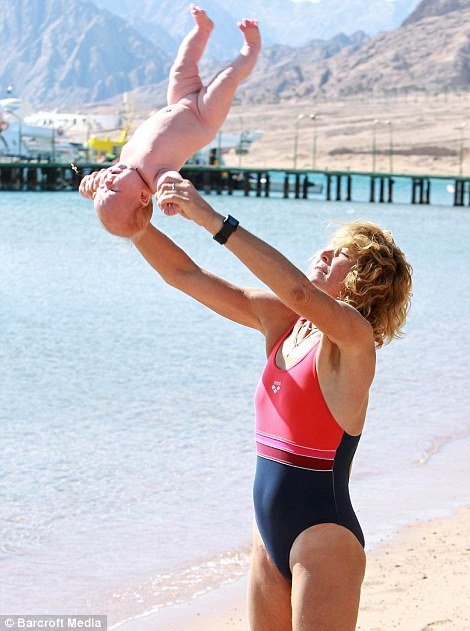
Lena Fokina, 51, can be seen flipping a baby over her head in her bizarre “baby yoga” routine which has been banned from a number of websites for fear that it glorifies child abuse.
Many viewers believed the moves must have been performed on dolls but Lena Fokina says they are definitely real babies and she has been practicing the techniques for the past 30 years.
The Russian therapist was tracked down at a seminar called “Parenting the Deliberate Way” in Dahab, Egypt, where parents from across Europe were paying her to perform the same moves on their infants, some just months old.
And while most of the babies were left screaming in tears or vomited during or after their session of “baby dynamics”, Lena Fokina insists it is for their benefit.
She said: “It’s very good for babies and not dangerous at all. Some babies cry at first, but they begin to enjoy it.
“Most people think young babies can only lie on a bed, eat, and cry. But babies are born with natural reflexes, which we can use to help them develop physically and intellectually.
“I work with parents from across Europe. I hope soon I will be working with a family in England. I think there are a number of open-minded parents there whose babies could benefit from my work.”
Lena Fokina can be seen flipping a baby over her head in her bizarre “baby yoga” routine which has been banned from a number of websites for fear that it glorifies child abuse
According to Lena Fokina, baby yoga was first practiced by ancient African tribes – but the modern incarnation was developed by fellow Russian Dr. Igor Charkovsky, who was also present at the seminar.
Lena Fokina, a mother-of-five and grandmother, does sessions that can last up to five minutes, during which babies are spun, swung and flipped, often by a single limb.
The actions are performed on babies from a few weeks old up to around age two.
Lena Fokina added: “The method was originally developed to cure and correct the health of children having muscular or skeletal problems but it is also suitable for healthy children.
“The movements are designed to improve their muscular abilities and development.
“And the children often turn out to be early readers, singers, talkers, swimmers. It also makes their hands stronger. We are humanists and we don’t do anything wrong.”
At the camp, the parents, hailing mainly from Russia and the Ukraine, also seemed entirely satisfied as they stood by and watched Lena Fokina treat their babies, usually above a gravel floor.
Each day at 8:00 a.m., parents would bring their tots to the Mirage Village Hotel in Dahab. Around 20 parents had signed up for Lena Fokina’s latest 12-day seminar, which costs $400 per family.
Parents smiled and chatted as the infants were left dangling for long periods by their arms or legs. But in almost every case the babies began crying just seconds into the bizarre routine.
And another vomited mid-air after undergoing several minutes of swinging. Yet Lena Fokina refused to acknowledge any dangers.
The therapist said: “From the moment of its birth a child can grasp, step, support itself and swim.
“The Charkovsky method uses these natural reflexes for child training. The amount of time it takes to train an adult to do it on a child depends on the sensibility of the child’s parent. Sometimes it only takes one training session.”
For years, doctors around the world have warned that “dramatic and unnatural movements” inflicted on a young baby can lead to brain bleeding, retinal hemorrhaging and brain swelling – commonly known as Shaken Baby Syndrome (SBS).
And some researchers have suggested that SBS can occur at much lower levels of head movement than had been previously thought.
But Lena Fokina, who has been practicing baby yoga for more than 30 years, tells clients it is harmless even for newborn babies, as long as a child is eased into the movements gradually.
She is also not worried about any strain on the babies’ joints and limbs.
Lena Fokina said: “Even a tiny baby’s body can adapt to the process easily if you take it gradually.
“As long as the parent or instructor has practiced and studied the teachings of Dr. Charkovsky the child will be fine.
“People tend to get upset when they see it because they are not aware of children’s real abilities – but these abilities are much wider than it is traditionally thought.”
The Dahab seminar offered participants the opportunity to “learn the method of Igor Charkovsky and techniques for working with pregnant women, newborns and children”.
As well as morning seminars in “baby dynamics” parents were also instructed in “water rebirthing”, which involves repeatedly dunking children’s heads underwater.
The practice is designed to address “repressed trauma from birth”.
According to literature about the practice on Lena Fokina’s website, rebirthing “allows the mind and body to gently restructure itself so as to increase the feeling of happiness, efficiency, be healthy and to feel the inner harmony of the individual”.
However, there seemed to be little of this on display in the children being forced under the water by Dr. Igor Charkovsky, a Russian midwife whose research includes the effect dolphins can have on a mother’s calm during childbirth.
Again, many ended up in tears.
Also on offer at the seminar were more traditional pursuits such as baby massage, swimming lessons and gymnastics.
Lena Fokina has also conducted workshops in Thailand and India where she has worked on children from all over the world.
She said: “Baby dynamics is quite well known in Russia but up to now all the literature about it has only been in Russian.
“However, it is becoming increasingly popular throughout the world and we want to teach parents by bringing our methods to where they live.
“Although I don’t know anybody practicing in the UK yet I will be very proud when I see my methods applied there.”
Lena Fokina studied physical education at the University of Physical Culture in Moscow, achieving a Master’s degree.
She later went on to study under Dr. Igor Charkovsky.
Now, divorced Lena Fokina has five children, Alexandra, 30, Tatyana, 27, Timur, 23, Maria, 16 and 13-year-old Pavel.
Lena Fokina is also grandmother to Christian, 3, and Petrik, 4, and it was on her own children that she started refining the worrying methods.
The therapist said: “I first tried baby dynamics 30 years ago after my oldest daughter Alexandra was born. At first I was worried, but then I realized how my children enjoyed it and it inspired me.
“People criticize our methods out of ignorance – if only they tried to understand what we were doing, they would change their attitudes. If by doing it I give children an advantage, why wouldn’t I?
“I was aware of the practices but it was only later when I was introduced to Dr. Charkovsky that I became a teacher in it. It’s something I am very proud of and have believed in for a very long time.”
Lena Fokina lives in Russia but frequently visits Dahab where her two eldest daughters live. She works full-time giving seminars all over the world, but insists her work is not done for profit.
She said: “What I do is not a commercial project. I earn enough money just to live here and work with children. What I do is not part of my life, it is my life.”
Despite being relatively common in Russia, Lena Fokina says she prefers to hold her seminars in Egypt.
Lena Fokina said: “I love Egypt for many reasons. The climate is favorable with lots of sun and warm sea.
“There are also good conditions for free diving, yoga and sports and the people here have a good attitude to what I am doing.
“All my children have grown up according to the Charkovsky method and they have all gone on to achieve outstanding results in life – they are Russian champions in parachuting, free diving and horse riding.
“Now my children are practicing those same methods on their own children. It’s the best proof.”
At least three people have been killed in a suicide car attack at a church in the troubled central Nigerian city of Jos, sparking reprisals by Christian youths.
Witnesses said the suicide bomber drove his car into the prominent Church of Christ during morning prayers.
No group has claimed responsibility, but suspicion will fall on the radical Islamist sect Boko Haram.
The attack sparked a riot by Christian youths, with reports that at least two Muslims were killed in the violence.
The two men were dragged off their bikes after being stopped at a roadblock set up by the rioters, police said.
A row of Muslim-owned shops was also burned, an AFP reporter at the scene said.
Earlier, the suicide bomber smashed his car through unmanned gates towards the packed church, killing a woman in the process, witnesses said.
The explosives detonated close to where members of the congregation were attending a Sunday service, killing a father and his child.
At least 38 people had to be taken to hospital for treatment, the National Emergency Management Agency said.
The attack sparked immediate anger among Christian youths in the city.
They “were very angry and mobilized… and I overheard them saying they were going to avenge the attack,” one witness was quoted by the APF as saying.
Ethnic and religious tensions run high in Jos, the capital of Plateau state. Hundreds of people have died in bouts of sectarian clashes over the last few years.
But Christian human rights activists suspect Boko Haram of carrying out Sunday’s attack, which they say is the deadliest on a church in Jos.
The group has carried out a number of bloody attacks across Nigeria in its quest to overthrow the government and create an Islamic state.
Boko Haram has admitted attacking several churches across the country on Christmas Day 2011, killing nearly 40 people at one church outside the capital, Abuja, alone.
It has also claimed responsibility for a string of bomb blasts around Jos on Christmas Eve 2010 that killed at least 80 people.
The men behind the Meryl Streep’s transformation into Margaret Thatcher in The Iron Lady are about to find out if they have won an Oscar tonight.
Mark Coulier is one half of the team that transformed one of the world’s most recognisable actresses into one of the most famous faces in British political history.
“You can never tell how the Academy is going to vote,” says Mark Coulier, when we meet at a reception for British nominees in Los Angeles two days ahead of Sunday’s Oscars ceremony.
“Somebody said to me before we started on The Iron Lady that it’s a career maker or a career breaker. Hopefully it’ll make mine.”
Mark Coulier and American J Roy Helland are both up for an Oscar for their work on the film. J Roy Helland has been doing Meryl Streep’s hair and make-up for more than 35 years.
During the course of The Iron Lady, Meryl Streep’s Thatcher is seen both in her political prime and as a woman in her mid 80’s, struggling with dementia.
For the younger version, Mark Coulier used a small nose piece to alter the bridge of Meryl Streep’s nose.
“We tried to keep it as subtle as we could,” he says.
But some things had to be toned down. “Meryl’s got great cheekbones and Thatcher’s got a fuller face.”
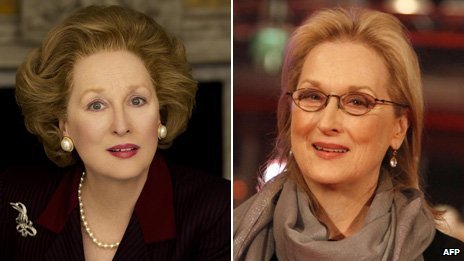
The men behind the Meryl Streep's transformation into Margaret Thatcher in The Iron Lady are about to find out if they have won an Oscar tonight
The biggest challenge came when the team had to turn Meryl Streep into a woman in her mid 80’s.
That was a job for prosthetics and paint work. But the team wanted to avoid using a full face mask.
“We started off with a plaster cast of Meryl’s head,” explains Mark Coulier.
“We also did computer designs and took Margaret Thatcher’s picture and Meryl’s picture and fused them together.”
Mark Coulier then crafted latex strips from the head that were then applied to Meryl Streep’s face.
Damian Jones, producer of The Iron Lady, recalls the moment he first saw Meryl Streep in full make-up.
“It was haunting, I was speechless. It was pretty eerie because there was the old lady of Margaret Thatcher in front of us – and it was Meryl Streep.”
The film’s director Phyllida Lloyd says that getting the makeup right was one of the most crucial elements of the film.
“We worked so hard in the preparation and the planning of that. We didn’t want the makeup to be <<eggy>> and a barrier for the audience.
“It comes down to Roy, Mark and Meryl’s painstaking attention to detail.”
And what of the distinctive Margaret Thatcher hairstyle?
“Those wigs were personalities themselves, and there were many of them. And the teeth!”
Phyllida Lloyd adds: “Roy’s worked with Meryl for over 35 years – it’s an amazing relationship and an important part of her preparation and process. It would be very moving if he gets the Oscar.”
A preliminary toxicology report indicates Whitney Houston died due to a mix of prescription drugs, Valium and Xanax, and alcohol.
Final toxicology results will pinpoint the exact cause of death but the coroner confirms that the sedatives and alcohol combined is most likely the cause of death, not drowning.
The combination of Valium, Xanax and alcohol is said to have most likely caused Whitney Houston’s heart to stop beating due to the substances in her system inhibiting her breathing.
Thus, Whitney Houston’s death was not from drowning, although she was discovered submerged in a bathtub.
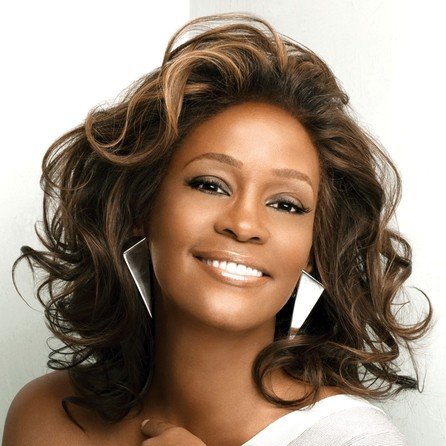
A preliminary toxicology report indicates Whitney Houston died due to a mix of prescription drugs, Valium and Xanax, and alcohol
Whitney Houston was found submerged in the bathtub in her suite at the Beverly Hilton in Los Angeles, just hours before she was to perform for Clive Davis’ pre-Grammy party.
The final report will definitively determine exactly what amounts of substances and which drugs killed her.
Whitney Houston, 48, was found in the bathtub of her guest room at the Beverly Hilton Hotel on the eve of the 54th Grammy Awards, February 11, 2012. She was pronounced dead at about 4:00 p.m. that afternoon.
Just few days after Whitney Houston’s funeral it was emerged that some of Hollywood’s biggest female names are scrambling to win the role of the legendary star in a life story movie.
It appears that Rihanna, 24, is among the shortlist of talent who are being considered for a biopic of the late singer.
Whitney Houston’s record label boss and close friend Clive Davis is at the helm of the project and he reportedly wants to get a script finalized as soon as possible so filming can begin.
Rihanna is in the running for the lead role as is Dreamgirls star Jennifer Hudson, 30.
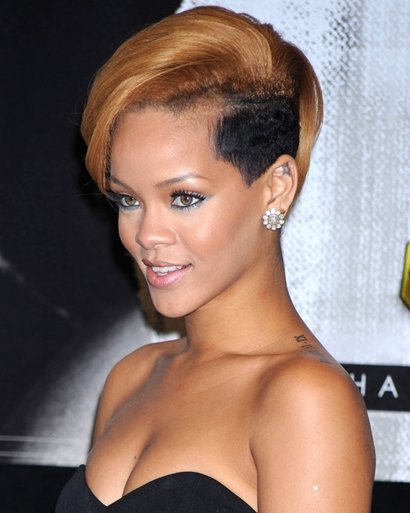
Rihanna is shortlisted to star as Whitney Houston in a movie biopic of the late singer
Actress Vivica Fox, 47, and American Idol singer Jordin Sparks, 22, are also being considered for the movie and Will Smith’s 11-year-old daughter Willow is thought to be portraying the actress as a child.
Although movie executives are hoping Rihanna will sign up for the film, it was reported that she already turned down the chance to remake Whitney Houston’s The Bodyguard last year.
Rihanna told OK! magazine: “I hate it when singers do singing movies all the time, because you can never look at them as anybody else. I want to play a character. My whole life is playing Rihanna; being a singer won’t be a stretch for me.”
Whitney Houston’s life story had been discussed before her death and she was excited about the project.
A source told the People newspaper: “Whitney knew about the project and was excited to see where it would lead.
“It’s hoped the biopic will be as successful as Tina Turner movie What’s Love Got To Do With It, which landed two Oscar nominations for Angela Bassett and Laurence Fishburne who played Tina and Ike Turner.”
Smoking marijuana is tied to less motivation at work, a new study finding suggests.
The author of the study said it can’t prove whether that’s due to the drug’s effects, the social environment in which it’s used or whether pot smokers are just more likely to be laid-back from the get-go.
Christer Hyggen, researcher at the Oslo-based social research institute NOVA, suspects pot is the culprit, another possible explanation is that people who aren’t so happy with their work situation or motivated on the job are more likely turn to drugs.
“There’s a popular belief that people who smoke cannabis are slackers and that they don’t want to work,” Christer Hyggen told Reuters Health.
To see how well that perception held up, Christer Hyggen analyzed data from a 25-year-long study of close to 1,500 Norwegians. Starting in 1987, when they were in their late teens and early 20’s, participants filled out surveys that included questions on their recent pot use on five different occasions, into their 40’s.
They also rated their attitudes on statements that reflected work commitment, such as “It is very important for me to have a job” and “I feel restless when I have no work to do”, ranked on a scale of 1 to 5, with 5 reflecting the most commitment.
Smoking marijuana is tied to less motivation at work, a new study finding suggests
People who reported smoking in the past year generally reported less dedication to work than abstainers, according to findings published in the journal Addiction.
The pattern held after Christer Hyggen took into account their mental health, satisfaction with their work environment, their economic background and how much alcohol they drank.
Christer Hyggen also found that those who only reported recent smoking on one survey – “the experimenters” – tended to be as committed as abstainers as they got older. That wasn’t the case for participants who repeatedly acknowledged marijuana use: their work commitment continued to decline into adulthood, and remained significantly below that of never-smokers.
By the last survey, in 2010, the 63 repeat users had an average score of 3.9 on questions of work commitment. That compared to scores between 4.2 and 4.3 in participants who had only experimented with marijuana or never tried it, including those who said their friends used the drug but they didn’t.
The findings suggested that over time “people who quit smoking cannabis increase their work commitment and people who take up smoking cannabis reduce their work commitment”.
While the results can’t prove a cause-and-effect relationship, “we were able to at least close in on this association”.
Such a link fits logically, according to another researcher not involved in the study.
“For adolescents who are engaged in marijuana use and substance use, to the extent that that decreases or limits the academic achievement they would have achieved otherwise, that would limit their employment opportunities,” said Kimberly Henry, from Colorado State University in Fort Collins, who has studied marijuana and truancy in adolescents.
“I think like many of these kinds of behaviors, there is kind of a spiral cycle where one reinforces the other,” she said.
Christer Hyggen said that it’s not a bad idea to stay away from drugs including marijuana.
“At the same time I don’t think we should be overly afraid of people experimenting with drugs in youth,” he said, as young people with that type of marijuana use didn’t end up with a diminished work ethic as adults.
Kimberly Henry agreed that heavier marijuana use is what’s worrisome when it comes to school and work performance.
“This idea that makes sense from theory and just conventional wisdom is that it’s the higher-level use that’s probably causing the most problems,” she said.
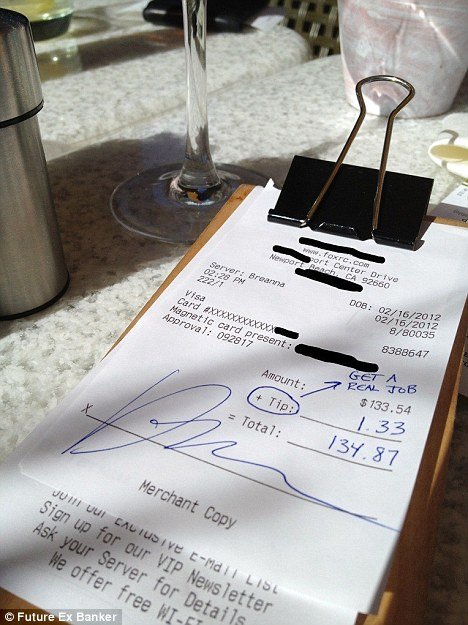
A banker dining at True Food Kitchen restaurant in Newport Beach, California, left only $1.33 on a $133.54 tab, enforcing his position as the “one per cent”.
In addition, the arrogant banker gave the server, Breanna, another tip: “Get a real job.”
His belligerent behavior at the restaurant was documented by his dining companion, who posted a photo of the receipt to Twitter, alerting Eater’s Receiprocity blog.
The post – and corresponding blog – was later deleted.
FutureExBanker wrote in a now-deleted post: “I work in the corporate office of a major bank for a boss who represents everything wrong with the financial industry.”
He said that his boss will tip exactly one per cent of the bill “every time he feels the server doesn’t sufficiently bow down to his Holiness.”
The disgruntled employee continued: “[My boss] has blatant disregard and outright contempt for everyone and everything he deems beneath him.
“On top of that, he’s a complete and utter tool.”
A banker dining at True Food Kitchen restaurant in Newport Beach, California, left only $1.33 on a $133.54 tab, enforcing his position as the “one per cent”.
While servers often receive the brunt of a diner’s anger in form of a low or non-existent tip, it is customary to tip a minimum of 15% for good service.
A hostess for True Food Kitchen told LAList.com that she had heard about the receipt but could neither confirm nor deny if it was real, nor if she remembered the customer.
“We have no statement on the issue,” the hostess said.
Vice President of operations for True Food Kitchen told the Huffington Post that the receipt in question is real, but they’re in the process of tracking him down.
He added the restaurant will do “everything they can to make it up to (Breanna) somehow.”
“We are the 99 per cent” was runner up to “occupy” for 2011’s word of the year. The phrase is closely tied to the Occupy Wall Street movement, and states that one per cent of Americans have a disproportionate amount of wealth.
The Wall Street Journal states that someone must be making at least $506,000 before joining the elite one per cent of top American earners.
The A-listers are currently sweeping into Hollywood as the biggest event in the movie industry calendar looms tonight, Oscars 2012.
For all the star quality brought to the red carpet by the likes of Angelina Jolie, Kate Winslet, Rooney Mara and Halle Berry, it is the enduring icons of the golden age that still show the A-listers how it should be done.
The golden generations’ pictures capture the sophistication and allure of stars on awards nights more than half a century ago.
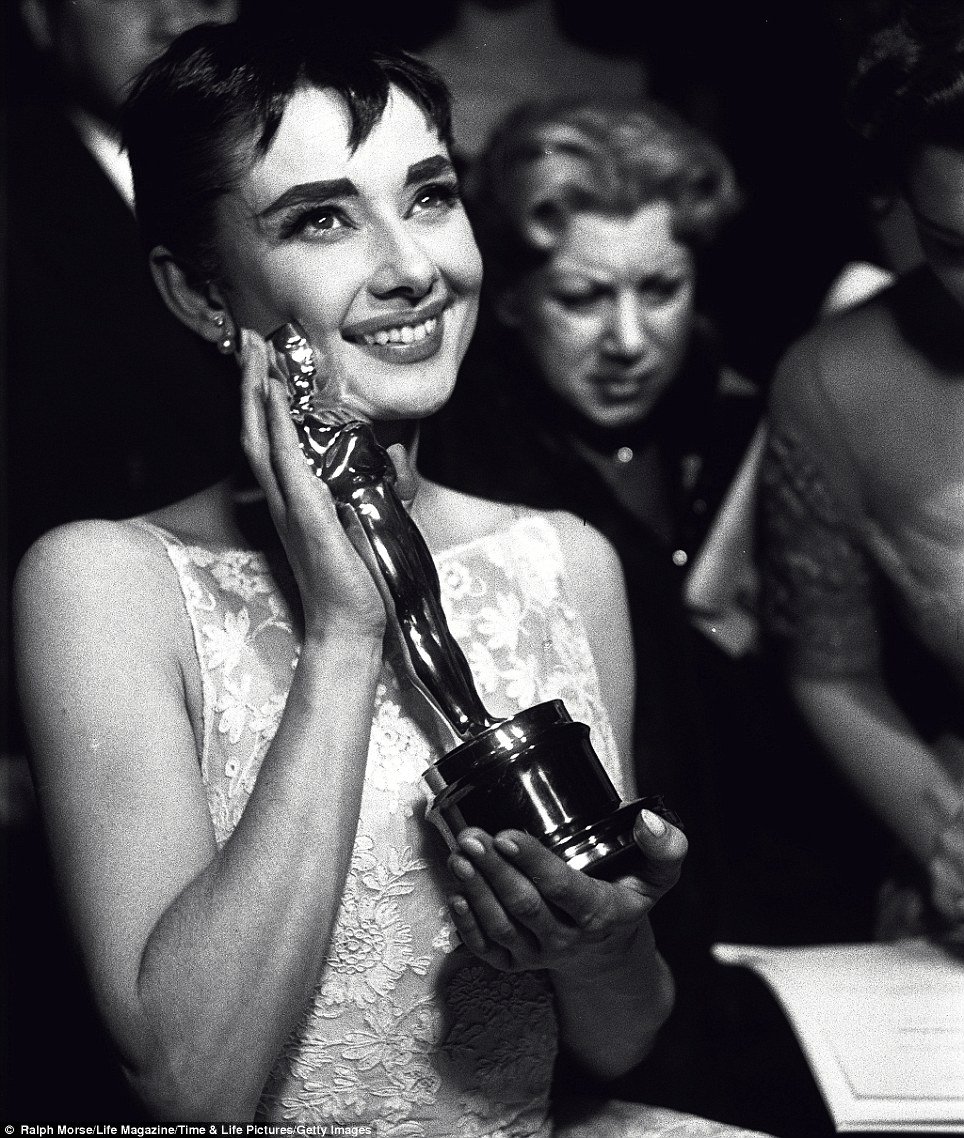
In one, Audrey Hepburn grins and sports an elfin haircut while clutching her Oscar in 1953, for her breakout role in Roman Holiday alongside Gregory Peck.
Frank Sinatra’s career was on the wane when he won the Best Supporting Actor award in the same year for the wartime drama From Here To Eternity.
Audrey Hepburn grins and sports an elfin haircut while clutching her Oscar in 1953, for her breakout role in Roman Holiday alongside Gregory Peck
After Marlon Brando won the Academy Award for On The Waterfront it was stolen, finally turning up in a London auction house who contacted the actor and informed him that they had it. Before that the two-time Best Actor winner had been using it to help hold his front door open.
A teenage Natalie Wood glances excitedly in the mirror as she is primped and preened in preparation for the Oscars in a Warner Brothers studio dressing room – the night she won a Best Supporting Actress Award for her role in the 1955 film Rebel Without A Cause.
Kirk Douglas is seen charming the crowd in 1954 as he enters the Academy Awards ceremony. He was nominated three times for Best Actor but never won. Kirk Douglas received a Honorary award in 1996 for “50 years as a moral and creative force in the motion picture community”.
In other pictures, Audrey Hepburn and Grace Kelly wait with apparent nerves backstage to present an award. They are both dressed in full-skirted gowns with evening gloves and hair in elegant chignons.
A dashing Clark Gable arrives with Kelly, wrapped in a fur stole, at another ceremony while one of Tinseltown’s greatest romances – Lauren Bacall and Humphrey Bogart radiate glamour.
Audrey Hepburn and Grace Kelly wait with apparent nerves backstage to present an award
The first awards were handed out to a select 15 in front of a crowd of 270 on May 16, 1929, at a private brunch in the Hollywood Roosevelt Hotel.
The root of where the name Oscar comes has become a highly contested Hollywood legend. One biography of Bette Davis claims that she named the Oscar after her first husband – band leader Harmon Oscar Nelson.
Another claimed origin is that the Academy’s secretary, Margaret Herrick, first saw the award in 1931 and made reference to the statuette reminding her of her “Uncle Oscar”. The trophy was officially dubbed the Oscar in 1939 by the Academy of Motion Pictures Arts and Sciences.
The 84th Academy Awards will be hosted by Billy Crystal at the Kodak theatre tonight. It is televised live across the U.S. and is watched by around 40 million Americans.
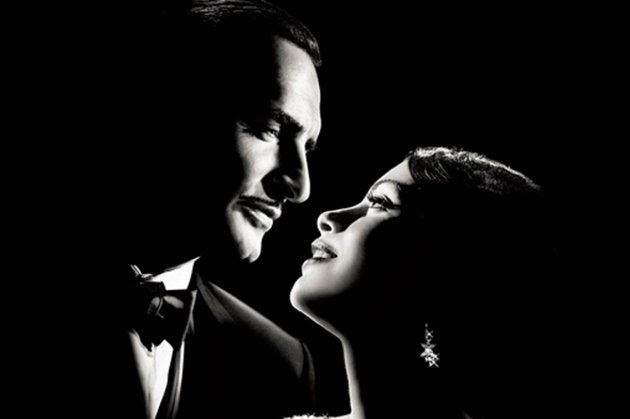
The silent black and white French film The Artist is the clear favorite to take the coveted best picture prize as the final countdown to the 2012 Oscars has begun.
The Artist has won most of the major pre-Oscar honors during awards season.
The film has 10 nominations in total, while Martin Scorsese’s 3D family film Hugo leads the race with 11, including best film and director.
The 84th Academy Awards takes place on Sunday and will be hosted by Billy Crystal.
Billy Crystal is back for his ninth stint as host, with Oscar-watchers predicting lots of silent film gags and jibes about the recent legal wrangle over the Kodak-branded theatre where the Oscars is held.
Billy Crystal himself is giving nothing away, but tweeted this week: “First rehearsal: They said keep it <<fresh and new>>. This from an industry that just brought us Fast & Furious 5 and Harry Potter 7, part 2.”
The final round of voting by the Academy’s 5,783 members ended on Tuesday. Outside the venue, a section of Hollywood Boulevard has been sealed off and the red carpet is in place.
Industry newspaper The Hollywood Reporter says The Artist’s predicted win for best picture follows its victory in the two strongest “Oscar bellwethers”, the Producers Guild of America and the Directors Guild of America awards.
“This French-financed, Hollywood-shot, Harvey Weinstein-distributed love letter to the movies has gone on to seduce Hollywood since being unveiled at Cannes in May.
“It is now poised to become the first silent film in 83 years and the first black-and-white film in 18 years to win the top Oscar.”
The silent black and white French film The Artist is the clear favorite to take the coveted best picture prize at Oscars 2012
A change in the Academy voting rules means that there are nine films in the best picture race this year.
Alongside The Artist and Hugo, those in the running include War Horse, Moneyball, The Tree Of Life, Midnight In Paris, The Help, The Descendants, and Extremely Loud and Incredibly Close.
George Clooney and Brad Pitt are both up for best actor, and Meryl Streep has her 17th Oscar nomination for her portrayal of former British Prime Minister Margaret Thatcher in The Iron Lady.
Meryl Streep has won two Oscars – best supporting actress for 1979’s Kramer vs Kramer and best actress for 1982’s Sophie’s Choice – but has been overlooked on her last 12 attempts.
Oscar pundits predict a close race between Meryl Streep and Viola Davies, for her performance as maid Aibileen Clark in civil rights drama The Help.
In the supporting actress category, The Help’s Octavia Spencer is the frontrunner, ahead of fellow cast member Jessica Chastain, and Melissa McCarthy and Britain’s Janet McTeer – for Bridesmaids and Albert Nobbs respectively.
Unusually, this year’s race for best supporting actor boasts two octogenarians: Christopher Plummer for Beginners and Max von Sydow for Extremely Loud and Incredibly Close.
Both are 82, and if either win they would become the oldest recipient of an acting award. The record is currently held by Jessica Tandy, who won for Driving Miss Daisy, aged 80.
Christopher Plummer is widely predicted to take the statuette for his role as an elderly father who comes out as gay after his wife dies.
The others in the category are Nick Nolte, for Warrior; Kenneth Branagh, for My Week with Marilyn; and 28-year-old Jonah Hill, for Moneyball.
Things are less clear-cut in the race for best actor.
Hollywood heart-throbs George Clooney and Brad Pitt face a stiff challenge from The Artist’s Jean Dujardin, who beat them – and British star Gary Oldman – at the BAFTAs earlier this month.
It’s Oldman’s first Oscar nomination, which recognizes his quietly powerful performance as mole-catcher George Smiley in Tinker Tailor Soldier Spy.
The outsider in this category is Mexican actor Demian Bichir for his role as a Los Angeles gardener, struggling to keep his son out of gang culture, in A Better Life.
Earlier this week, an investigation by the Los Angeles Times revealed that the Academy demographic is much less diverse than the movie-going public.
Oscar voters, it said, are nearly 94% Caucasian and 77% male. They have a median age of 62, and under 50’s constitute just 14% of the membership. All of which, puts The Artist in pole position.
Mike Goodridge, editor of Screen International, said: “You’re looking at a group that are going to vote for The King’s Speech over The Social Network, for The Hurt Locker over Avatar, and this year it’s going to go for this portrait of days gone by.”
Carolyn Whigham, the owner of the funeral home that handled Whitney Houston’s remains is said to be “devastated” that a photo showing the legendary singer’s body in an open casket was leaked to the National Enquirer.
It is believed the picture was taken inside the Whigham Funeral Home in Newark, New Jersey, where Whitney Houston’s family attended a private wake last Friday on the eve of her funeral.
Carolyn Whigham says neither she nor her staff is responsible.
“We did not take that photo. We did not sell the photo. We would never do something like that,” Carolyn Whigham told the New York Daily News.
Carolyn Whigham, who is a second-generation owner of the Whigham Funeral Home said she had a long-standing relationship with Whitney Houston.
“Whitney was a friend,” the business owner said.
“I’m the one who flew to Los Angeles and got Whitney from the coroner’s office. I did everything to protect her.”
Carolyn Whigham, the owner of the funeral home that handled Whitney Houston's remains is said to be “devastated” that a photo showing the legendary singer's body in an open casket was leaked to the National Enquirer
The image shows the singer’s body resting inside her partially open casket.
The National Enquirer has run the snap alongside a bold headline proclaiming: “Whitney: The last photo!”
When the picture of Whitney Houston in open casket hit newstands, Carolyn Whigham said she received a number of distressing emails from irate Houston fans and she now fears for her staff’s safety.
“One email said that if the person owned a dog, and the dog died, they would not come to my funeral home,” Carolyn Whigham said.
“I’m worried about my employees, worried about me. I’ve been in business since 1943. This is my name, my character. Honestly, this is my life’s work. We would never do something like this.”
Whitney Houston’s mother Cissy and daughter Bobbi Kristina are said to be outraged about the photo.
“Their heart broken all over again” sources close to the family told TMZ.
One source said: “The family could tell from the photo that it was taken from inside the funeral home, but they have no idea who would have snapped the pic.”
Whitney Houston, 48, died in a hotel suite in Beverly Hilton Hotel in Los Angeles on 11 February.
A spokesman for the Los Angeles county coroner said multiple bottles of prescription medication were recovered from Whitney Houston’s room, but the official cause of her death has not been revealed.
The shocking National Enquirer cover photo shows Whitney Houston wearing a deep purple dress, a sparkling brooch and diamond earrings.
Carolyn Whigham disputed the tabloid’s claim that Whitney Houston was buried with $500,000 worth of precious stones.
“That’s crazy. It’s not true,” Carolyn Whigham told The Daily News.
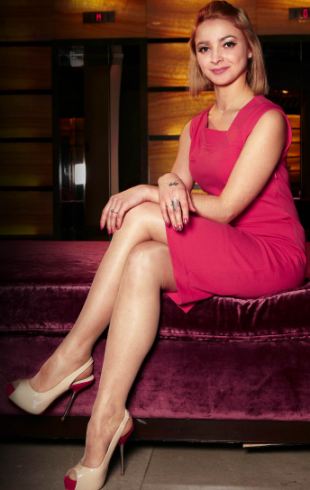
Domnica Cemortan, the Moldovan blonde tour rep who was accused of causing the sinking of the Costa Concordia by romantically distracting Captain Francesco Schettino has given her first full newspaper interview “to set the record straight”.
Domnica Cemortan, 25, had been dining and flirting with Captain Francesco Schettino, 52, before the disaster and was with him on the bridge when the ship struck rocks on January 13.
It was widely reported that Francesco Schettino, now known universally as Captain Coward, may have been trying to impress Domnica Cemortan when his ship sailed off course.
For the past six weeks the Moldovan young woman has been at the centre of worldwide attempts to uncover precisely what happened on the night that up to 32 people lost their lives off the Italian coastline.
Rumors about the nature of her relationship with Francesco Schettino have led to her being called a siren, a woman of loose morals, and everything in between.
Through it all Domnica Cemortan has repeatedly denied any romance between her and the married captain. Even after her luggage and bikinis were discovered in the captain’s submerged cabin, she insisted it was “all lies”.
Last week, after The Mail on Sunday tracked her down in her homeland, where she lives with her mother and 2-year-old daughter, Domnica Cemortan finally revealed her true feelings for the discredited Captain Francesco Schettino.
The Costa Concordia captain is currently under house arrest on suspicion of multiple manslaughter, abandoning ship and causing shipwreck. If convicted, Francesco Schattino faces 15 years in jail.
Domnica Cemortan admits that not only had she been alone with the captain in his cabin earlier during the evening of the tragedy, but that they had shared a passionate kiss, which she suspects was a prelude to them becoming lovers.
The Moldovan woman had previously worked on the ship for three weeks translating for Russian passengers and it was then that she got to know Francesco Schettino. When her contract ended the month before the tragedy, Domnica Cemortan returned as a paying passenger on the ill-fated cruise.
Domnica Cemortan says that although she had a serious “crush” on Francesco Schettino, she was never “in love” with him and their affair never really got started.
She admits that her luggage had been left in the captain’s cabin, but says it was only a temporary arrangement while she waited for a cabin to become available.
Domnica Cemortan has given her own eyewitness account of what happened on the bridge of the vessel in the minutes before it ran aground with more than 4,000 people on board.
Swathed in black fur against the biting cold and with her face devoid of make-up, Domnica Cemortan appears even more youthful than she actually is.
Domnica Cemortan says: “So much rubbish has been written about me that I think I must now defend my reputation. They are acting as if I’m some sort of femme fatale, but I don’t sleep around.
“Yes, I was very attracted to Captain Schettino and he was clearly interested in me. I admit that I had a big crush on him because he was very good-looking and very charming.”
She adds: “He once told me that I had both beauty and brains. What woman would not want to hear such words – especially when there were many women much more beautiful than me on board the ship? I knew he liked me and I was very flattered by his attention.
“When I worked on the ship he had made it clear that he thought me special. I’m a woman and I know these things. I could tell by the way he laughed at my jokes and how he looked at me; there was always a twinkle in his eyes when we spoke.
“I admit that I was attracted to him, but honestly, we did not have sex.
“He was always respectful when I was a member of his staff, but once I was a passenger then it was different. I think we probably would have ended up in bed, eventually, but I never found out because of the crash.
“Of course, I’m very sorry that so many people died or were hurt that night. It was a tragic accident and people are looking to find someone to blame. Maybe there was human error, maybe the captain was in some way responsible; I don’t know. For me, it was more a case of being in the wrong place at the wrong time.”
This is the second time that an ocean tragedy has wrecked Domnica Cemortan’s life. She was only eight when her father drowned while swimming in the Black Sea during a family holiday in Ukraine. A relative has suggested that Francesco Schettino’s resemblance to her late father may have been part of his attraction.
Domnica Cemortan grew up with her older brother and their mother Vera, a doctor, in Chisinau, the capital of Moldova. She trained as a dancer, winning scholarships to study first in Romania and then France, where she lived from 2006 to 2009. She stopped performing because of injuries.
Domnica Cemortan’s daughter, the result of a long-term relationship with a fellow Moldovan, was born in Paris in January 2010.
By the end of 2010, Domnica Cemortan and her daughter were living back in her home country.
“I was a single mother and I decided it was best to get back out to work,” she says.
“A friend who worked for the cruise company saw a vacancy and told me about it.
“I speak four languages, so I applied and got the job as an international hostess for Russian passengers on the Costa Magica cruise ship, sailing around the Mediterranean.”
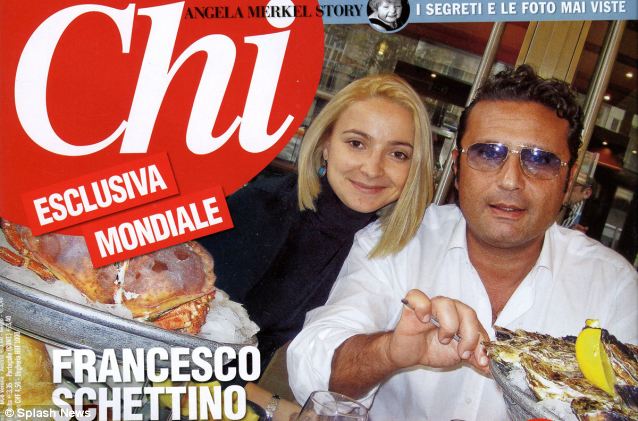
Domnica Cemortan’s initial contract was for October to December 2011. Then on December 6 she was asked to cover for a colleague on the Costa Concordia, the Costa Magica’s sister ship. Although she says the Costa Concordia’s dashing captain barely noticed her at first, it is clear from a photograph taken of them in a restaurant on the Cote d’Azur on December 13, which was published in Italian magazine Chi, that she was already smitten.
Although Domnica Cemortan says Francesco Schettino barely noticed her at first, it is clear from a photograph taken of them in a restaurant on the Cote d’Azur on December 13, which was published in Italian magazine Chi, that she was already smitten
The woman says: “Once or twice he bought me a drink in the ship’s bar, but it was always in a group situation. It was the same when we went for a seafood dinner at Villefranche-sur-Mer on the Cote d’Azur in December. There was a big party of us and I was not the only one who had a photo taken with him.”
Domnica Cemortan has admitted that by her second week on the ship, colleagues were teasing her about the “spark” they noticed between her and the captain but she denies that they ever “crossed the line”.
Domnica Cemortan says: “He offered me a drink one night when I was in one of the lounges with a friend and on at least another occasion. But the only time we were alone on that trip was once in his office, when I went to give him a report. He told me that I was not only beautiful, but smart as well. It was a nice feeling, but neither of us did anything wrong.”
It is difficult to believe that a man of the world such as Francesco Schettino, who some former colleagues claim has an eye for the ladies, would not have acted on his attraction. It’s also hard to believe Domnica Cemortan’s claim that he knew nothing about her decision to buy a ticket for a cruise on the ship, after her three weeks’ work ended.
Domnica Cemortan was given a 50% discount, even though she had not officially been with the company long enough to qualify for the staff’s cheap rates, and boarded the ship at 5:00 p.m. on the day of the tragedy in the Italian port of Civitavecchia.
She says: “I don’t think he knew I was coming back because I didn’t tell anyone except the entertainment director, who was my immediate boss. Because of the discount I was able to find out which cabin I had only once we had set sail. So the first thing I did was call my boss, who said that he was in the captain’s office and I should come up.
“When I arrived, the captain looked surprised to see me. My boss said I still had to wait for a cabin and the captain said that I could leave my luggage in his cabin. I then went to see my friends on board. When I called my boss later, he suggested I should go to the restaurant at 9:00 p.m. to get a cabin key.”
During the interview Domnica Cemortan produced the card key for the cabin she had been allocated.
She initially denies a passenger’s account that she was dining with Francesco Schettino in the last hours before the crash.
“How does this person know it was me? They have some grainy picture of a woman, but it could have been anyone,” she says.
Then Domnica Cemortan offers a sanitized version of being with Francesco Schettino in his cabin before dinner.
“After saying hello to my friends on the ship I returned to change for dinner at about 8:00 p.m. – that was the practice when I was a part of the crew. The captain was there but he politely left me to change.
“He came back in as I was leaving and said that I looked stunning. He took my hand and kissed it.”
Domnica Cemortan coyly admits that he had grasped her in a passionate embrace and, to her surprise, kissed her hard on the mouth. But she insists the intimacy stopped there.
“I didn’t want people to know this because they might get the wrong idea,” Domnica Cemortan explains, then refuses to say any more about the incident.
As for dining with the captain, she says she joined Francesco Schettino and her (male) boss only for dessert and coffee.
Domnica Cemortan says: “Afterwards, the captain invited me to the bridge, to <<see a beautiful panorama of the island>> and we left the restaurant at about 9:30 p.m.” The island was Giglio, off the Tuscan coast, and tragedy was about to unfold.
It is clear that Francesco Schettino was enthralled by the vivacious young woman and she was equally smitten. Did the excitement affect his judgment? Domnica Cemortan says it did not. She watched the drama from a corner of the bridge.
“I was there for about ten minutes. I could see the lights of the island; I thought it was normal to go so close. The captain issued orders to about a dozen officers on the glass-fronted deck. They were speaking in Italian and marine terms, so I didn’t really understand.
“The crash happened about 15 seconds afterwards. It was all very sudden. There was no bang.
“We didn’t feel the collision because we were at the front and it happened at the back. But the sirens came on and warning lights were flashing on the console and alarms blaring.
“It seemed as if they were in control, but there was a bit of rushing about and shouting. Other hostesses arrived on the bridge to make announcements in the different languages. It was a full-scale emergency, but we had all been well trained in preparation for such a disaster.”
Domnica Cemortan had been dining and flirting with Captain Francesco Schettino before the Costa Concordia disaster and was with him on the bridge when the ship struck rocks on January 13
No one could have expected the huge vessel to sink, in relatively shallow waters, off the island within hours of leaving port.
To compound matters, Francesco Schettino delayed ordering an evacuation of the 4,200 passengers and crew for about an hour. The death toll stands at 25, with seven people still unaccounted for.
Domnica Cemortan has defended Francesco Schettino from the outset and continues to do so. She argues that it would have taken time to ascertain the damage, which is why she didn’t make a dash for the lifeboats.
“The ship very quickly turned 60 degrees on its side and the sirens indicated that it was leaking, so I knew that I needed warm clothes,” Domnica Cemortan says.
The woman went into the captain’s cabin to change back into trousers, a jumper and jacket, grabbing her handbag along the way.
“When I returned to the bridge I saw the captain looking very much in control. I watched as the boat listed to one side. He asked me to stay because I speak four languages, while colleagues were told to get to their muster stations.
“At the end I saw the captain there with just two officers. He was co-ordinating the evacuation. Then he saw me and said I should go to deck three where people were getting into lifeboats. He said, <<Save yourself>>. I thought he looked very calm so it made me feel confident that it would be OK. I checked my watch and it was about 11:50 p.m. when I left him on the bridge.
“People say he’s a coward and that he didn’t act to save people, but it’s not true. He steered the ship into shallow water and made it easier for people to either swim or be rescued. I think he saved a lot of lives that night and was very courageous.”
Domnica Cemortan made her way gingerly down five decks on the listing vessel, in virtual darkness.
“If I didn’t know the ship I might never have made it.
“It was cold and I could hear things falling and people shouting. It was terrible. I think that some passengers got confused and maybe forgot where to go in an emergency.”
She waited about 15 minutes for a place in a lifeboat.
The next time Domnica Cemortan saw Francesco Schettino was about 5:00 a.m., on land.
“He looked absolutely shattered,” the woman says.
“Of course I felt sorry for him. He was always kind to me and I think he’s a good person.”
Domnica Cemortan and Francesco Schettino have not been in contact since the accident, though their names are now intrinsically entwined in a naval disaster that may have been the result of their attraction for each other, but she still seems to harbor deep affection for the captain.
“I would dearly love to speak with him again,” Domnica Cemortan says with a wistful smile.
“I want to know what went wrong and how he’s coping.
“It’s not that I miss him, but he was a nice man and I think they are making him into a kind of monster.
“Everyone is blaming him for what happened, but I don’t think he did anything wrong. It was just a terrible accident.”
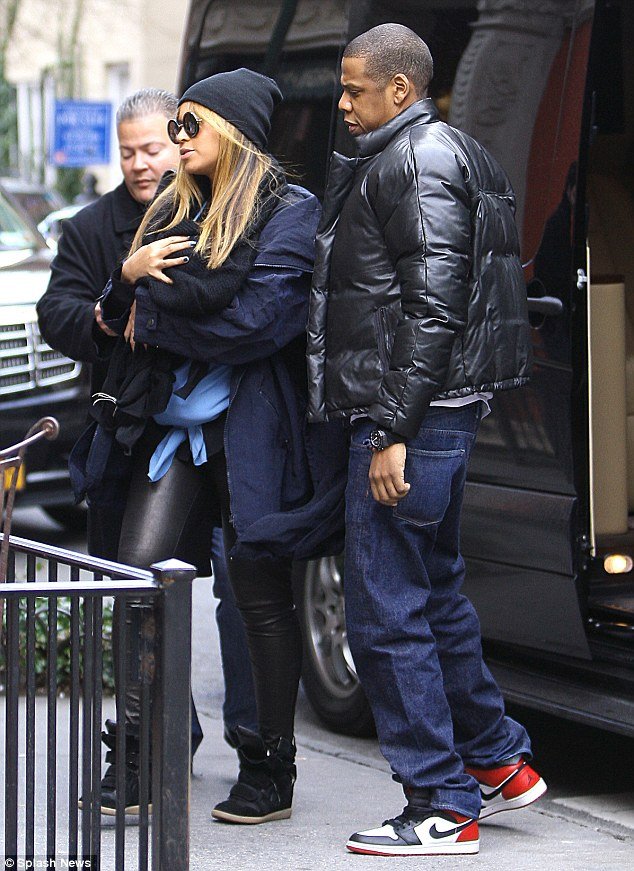
Blue Ivy Carter, Beyoncé’s newborn, has been seen in public for the first time during a lunch outing today in New York.
Blue Ivy was wrapped in a black baby blanket, with what appeared to be a black scarf covering her face and Beyoncé made sure to protectively wrap her arms around the infant.
Beyoncé, 30, dressed casually in black leather trousers, sunglasses and boots. She wore a black cap on her head to keep warm.
The singer was accompanied by husband Jay-Z and a team of bodyguards who kept close watch over the family as they emerged from Sant Ambroeus cafe and espresso bar in the West Village.
Eyewitnesses say the new mother wasn’t feeling well and the family left after only 30 minutes.
Blue Ivy Carter, Beyoncé’s newborn, has been seen in public for the first time during a lunch outing today in New York
Beyoncé and Jay-Z surprised fans earlier this month by sharing the first pictures of their daughter Blue Ivy on the internet.
The proud parents posted a series of intimate portraits of their beloved daughter, who was born just over a month ago.
Instead of selling their first baby pictures to a glossy magazine for millions of dollars, the music megastar couple decided to take control posting snaps of Blue Ivy to a tumblr blog.
Surgeons at Hacettepe University Hospital in Ankara, Turkey, have today performed the world’s first ever quadruple limb transplant, attaching two arms and two legs to a young man.
The operation took 20 hours to complete and required 50 doctors to help attach the limbs.
Head physician Dr. Murat Tuncer today appealed for blood donations to overcome possible complications following the surgery.
Dr. Murat Tuncer did not provide any details about the patient.
The operation comes after a failed triple limb transplant two months ago at another hospital in the southern city of Antalya.
The doctors there were forced to remove a leg from a patient due to tissue incompatibility. The same patient also received two arms.
Surgeons at Hacettepe University Hospital in Ankara, Turkey, have today performed the world's first ever quadruple limb transplant, attaching two arms and two legs to a young man
Dr. Murat Tuncer says his team also performed a separate face transplant on another patient yesterday – the second in Turkey this year.
The first in the country was performed on Turkish teenager Ugur Acar, who lost 70% of his face when he was just two-years-old in a TV tube explosion, at Akdeniz University’s School of Medicine in Antalya.
Doctors successfully transplanted tissue from the face of a 45-year-old donor to 19-year-old Ugur Acar in January but doctors have said he will not be able to make facial expressions for another six months.
Connie Culp, from America, was the first ever successful recipient of a face transplant, performed at the Cleveland Clinic in December 2008.
She was shot in the face by her husband Thomas Culp in a failed murder-suicide in September 2004 outside a bar in Hopedale, Ohio.
A new study shows that grieving men who have lost their wives to cancer cope better mentally if they meet a new partner within 5 years.
Researchers found that those men who are single four or five years after the death are at a far greater risk of mental illness.
Previous work has shown that the relatives of cancer victims are at greater risk of dying themselves or developing mental or physical illness.
However, these studies have largely focused on widows and the short term risks, say researchers from Sweden’s University of Gothenburg.
They looked at long term data from 691 widowers and found that those who had met a new partner within 5 years had dealt with the loss relatively well.
Those who remained single were at far greater risk of developing depression, anxiety, sleep disorders and emotional blunting, and were also more likely to use sleeping pills and antidepressants.
Prof. Gunnar Steineck said: “Previous studies have shown that people who lose their partner are at greater short-term poor mental health.
“Our study is the first to show that the risk of poor mental health last for many years but, on the average, the risk is restricted to those who don’t find a new partner.
“We need more research to understand the underlying mechanisms, but emotional support from a new partner does probably help to process grief and protect against mental illness.
“But it could also be the case that those men who cope best with their loss are more likely to show an interest in finding a new partner.”
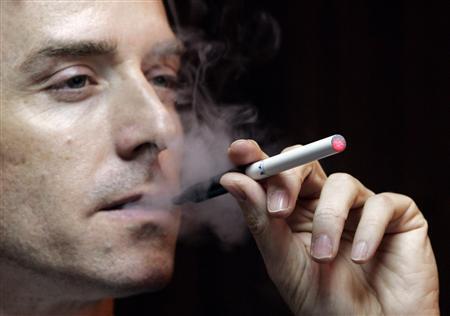
The town of Rocklin in California is proposing to ban smoking outside, even for residents lighting up on their own property.
Smoking is already banned indoors in public places in most of the country, and in California it is illegal to smoke in parks and playgrounds too.
The town of Rocklin, near Sacramento, could take the draconian regulations further by extending them to private property as well.
The unusual legislation was prompted by a local family annoyed with their neighbor smoking outside and causing smoke to waft near their house.
The family claimed their children’s health had been jeopardized by second-hand smoke, according to CBS 13.
The town of Rocklin in California is proposing to ban smoking outside, even for residents lighting up on their own property
However, while cigarettes may be considered a dirty habit, some people say that a ban could interfere with constitutional property rights.
And other worry that the proposal could actually cause health problems, with smokers forced to light up within the confines of their home – particularly damaging for those with young children.
But supporters of the plan say a blanket ban is the only way to keep cigarette smoke away from non-smokers.
Rocklin resident Ryan Malonson said he doubted the measure would pass, describing the proposal as “unacceptable”.
However, Rocklin officials insist they are actively considering the idea of a ban.
While smoking used to be universally common and socially acceptable throughout the U.S., it has become increasingly controversial over the years.
There are now very few public places where it is legal to smoke, and to crack down on lighting up on private property would be extremely restricting.
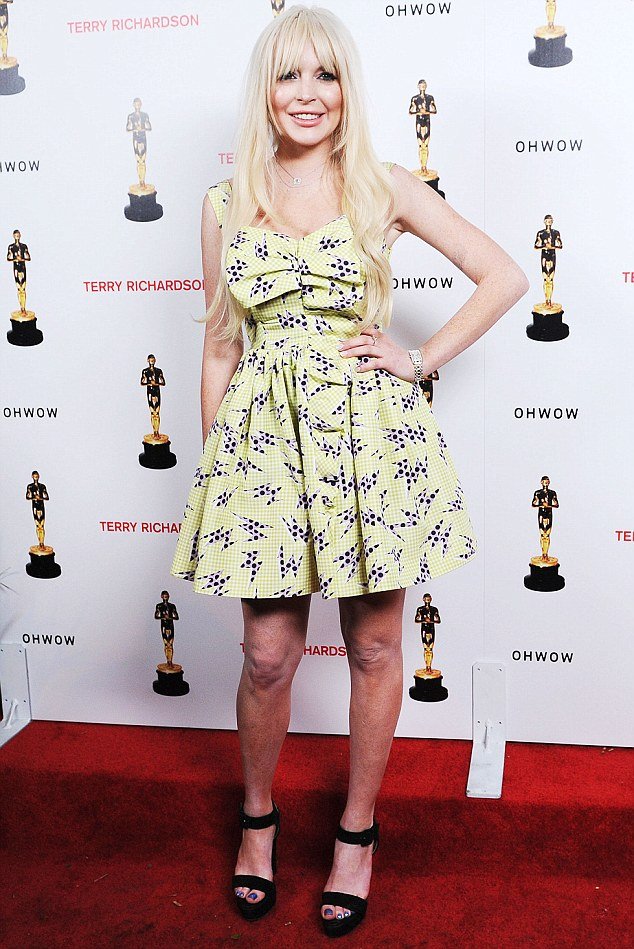
Lindsay Lohan, who is a former tanning product endorser, stepped out with blotchy orange skin as she attended the opening of Terry Richardson’s art exhibition Terrywood in Los Angeles last night.
The patchy tan clashed with the Lindsay Lohan’s fluorescent yellow party dress, which featured a light bolt pattern.
It appeared that Lindsay Lohan’s fake tan had been on for several nights and either required another application or perhaps a slight exfoliation.
She also appeared to have overdone it on the blush, her cheeks sporting a heavy application of bronzer.
Lindsay Lohan, 25, continues to keep tongues wagging and people guessing about her increasingly puffed up face.
Lilo’s lips and face first appeared plumper when she arrived at the Domingo Zapata exhibition in Beverly Hills on Wednesday night.
Lindsay Lohan stepped out with blotchy orange skin as she attended the opening of Terry Richardson's art exhibition Terrywood in LA last night
Lindsay Lohan’s puffy face first came under speculation at Kim Kardashian’s wedding in August, and at the time, The New York Post spoke to two plastic surgeons who confirmed she had all the signs of fillers.
They both said it appeared she had lip and cheek injections only days before the wedding.
“Her face has been plumped beyond all recognition,” Dr. Anthony Youn told the Post.
“Lindsay, who’s 25, looks like a 50-year-old <<Real Housewife>> trying to look 20.”
Dr. Anthony Youn said her injectable of choice was like Restalyne, which could have resulted in a look Lindsay Lohan has become famous for, the oft-seen trout pout.
“Lindsay’s a very pretty gal,” Dr. Anthony Youn added.
“When young people get these types of treatments, there’s got to be a concern.”
Another doctor, Toby Mayer, lamented Lindsay Lohan’s reported decision to alter her face at such a young age.
“Women in their 20’s don’t need filler,” he said.
Lindsay Lohan arrived late last night a Richardson’s exhibition and was accompanied by her mother Dina and her younger sister Ali.
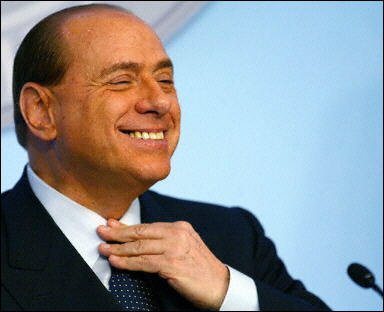
Italian judges have thrown out a bribery case against former Prime Minister Silvio Berlusconi, because it expired under the statute of limitations.
Silvio Berlusconi was accused of paying his former British tax lawyer, David Mills, to lie in court to protect his interests.
The case dates back to the 1990’s.
Silvio Berlusconi, who denies wrongdoing, says this and other court cases against him are all part of a politically-motivated smear campaign.
Italian judges have thrown out a bribery case against former Prime Minister Silvio Berlusconi, because it expired under the statute of limitations
He is on trial separately on charges of tax fraud and sex with an under-age prostitute.
The prosecution alleged David Mills was given $600,000 to lie in court about Silvio Berlusconi’s business interests.
David Mills, who was not on trial, denies that any such payment was made.
In December David Mills told a court he was “deeply ashamed” for falsely claiming that Silvio Berlusconi had given him $600,000.
David Mills said the money had actually come from an associate he had not wanted to admit dealing with.
Of the other three cases Silvio Berlusconi still faces, potentially the most damaging for the former Italian leader involves Moroccan nightclub dancer Karima El Mahroug, also known as Ruby.
Prosecutors allege Karima El Mahroug attended several parties at Silvio Berlusconi’s residence last year and was paid for sex while she was still 17, an offence according to Italian law. Both she and the prime minister deny having sex. She says she did receive 7,000 Euros, but it was as a gift after a party.
Osama Bin Laden’s compound in the Pakistani city of Abbottabad, where US forces killed him, is being demolished, residents and police say.
Osama Bin Laden was shot dead at the compound in the north-western city near the capital Islamabad in May 2011.
Security forces brought in bulldozers and began destroying the tall outer walls of the compound after sunset, reports say.
They set up floodlights to carry out the work.
In May 2011, a team of US Special Forces flew from Afghanistan to Osama Bin Laden’s hiding place during the night in stealth helicopters.
They swept through the buildings within the high-walled enclosure and shot dead a total of five people, including Osama Bin Laden.
Osama Bin Laden’s compound in the Pakistani city of Abbottabad, where US forces killed him, is being demolished
Some 40 minutes later, they left, taking with them Osama Bin Laden’s body and a hoard of computer data devices and other information containing intelligence about al-Qaeda and Bin Laden’s activities.
The compound has been a painful reminder for Pakistan, which was embarrassed by the unilateral US operation that killed Osama Bin Laden.
There were worldwide reactions of disgust to the National Enquirer’s decision to publish a photo of Whitney Houston’s body in an open casket on its front page this week, but the magazine has stood by its decision.
Publisher Mary Beth Wright refused to name her source, but called the picture a “work of art”.
Speaking to Fox News, Mary Beth Wright said: “I thought it was beautiful”.
The decision to run the snap has been slammed by media outlets, fans of the star, and social media users around the world.
The executive editor of HollywoodLife also told Fox: “It’s just another disgusting display of how low celebrity obsession can stoop. Regardless of how they obtained the picture – and the likely exorbitant price they paid for it, the Enquirer should have thought twice about this post-mortem portrait.”
Whitney Houston open casket photo is a work of art, says National Enquirer
Also among those condemning the magazine has been funeral director Carolyn Whigham, of the Whigham Funeral Home. She has strongly denied leaking the picture, telling the LA Times: “We have no comment. But it was not the funeral home… Whitney was a personal friend to me and my family.
“We would not do that… I am very angry, very upset, just like the family, just like the fans.”
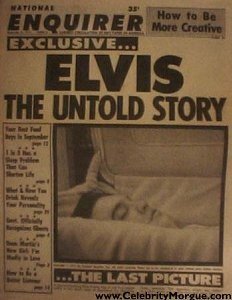
There’s some precedent for the National Enquirer’s ghoulish glimpse at Whitney Houston’s wake. The tabloid ran similar open casket shots of Elvis Presley after the King of Rock died in 1977.
National Enquirer ran similar open casket shots of Elvis Presley after the King of Rock died in 1977
Just as it did with Elvis Presley, the headline loudly proclaims that it is “the last photo” taken of Whitney Houston.
The National Enquirer also teases some other tawdry details about the Whitney Houston viewing.
Whitney Houston was reportedly outfitted in her favorite purple dress, $500,000 worth of jewelry, and had gold slippers on her feet.
US tabloid Star has alleged that Whitney Houston tried to take her own life just two days before being found dead in Beverly Hilton hotel room in LA.
The publication, Star, is the sister magazine of the National Enquirer, which controversially printed a photograph of dead Whitney Houston in her coffin on its front cover.
It is alleged that Whitney Houston “tried to slit her wrists in the bathroom of LA’s Tru Hollywood nightclub on February 9”, following her row with X Factor star Stacy Francis.
US tabloid Star has alleged that Whitney Houston tried to take her own life just two days before being found dead
A source is quoted as saying: “There was blood all over her, from her hands, wrists and legs, and there was a blade in her hand.”
It is further suggested that the so-called suicide attempt was intended as “ultimate revenge” on Clive Davis, who was apparently planning to cut her off financially.
The report has been flatly denied by a member of Whitney Houston’s entourage, who tells Gossip Cop that the whole thing is “definitely not true”.