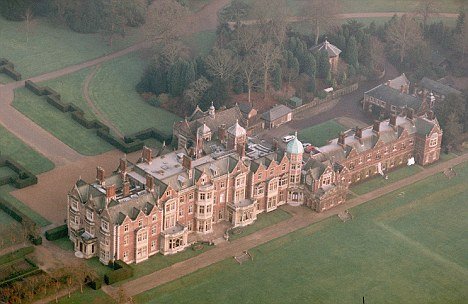
Queen Elizabeth II is to give Prince William and his wife one of the cottages on her beloved Sandringham estate to mark his 30th birthday.
The property will be made available to the couple later this year.
Prince William, who reached the milestone last Thursday, is said to be celebrating privately with family and friends this weekend.
It is understood that he is particularly delighted about the house because he and Kate spent their first Christmas as husband and wife at Sandringham last year.
The 20,000-acre Sandringham estate near King’s Lynn in Norfolk has been owned by the Queen since her accession in 1952 and by the Royal Family since 1862.
The Queen and the Duke of Edinburgh stay in the main house, an Edwardian mansion, every Christmas with the rest of the Royal Family.
Although much of the land is open to the public, the paparazzi are no longer allowed to photograph the Royal Family relaxing there.
New laws were introduced after pictures of Prince Philip were published overseas and Prince Edward was photographed apparently striking his two gun dogs with a wooden stick during a pheasant shoot.
Queen Elizabeth II is to give Prince William and his wife one of the cottages on her beloved Sandringham estate to mark his 30th birthday
It is not known which of the 150 residential, commercial and agricultural properties on the estate that the Queen intends to give to the Duke and Duchess of Cambridge.
Among the options are York Cottage, which is currently used as an estate office.
Built by Edward VII soon after he moved to Sandringham, it was the first home of King George V and Queen Mary after their marriage in 1893.
Sandringham was a favorite of George V, who declared it “the place I love better than anywhere in the world” and Prince William’s great-grandfather, King George VI, was born there in 1895.
Kate and William have also previously stayed at Wood Farm Cottage in Wolferton, a modest cottage set in a secluded part of the estate that is often used as an informal weekend retreat by the Royals.
William and Prince Harry regularly host shooting parties at the cottage, while Kate and William have treated friends to a weekend there. Prince Harry also stayed at the cottage with his former girlfriend, Chelsy Davy.
The cottage is often used by the Royals when there is not enough accommodation in the main house.
Previously, Wood Farm was used by the Duke of Edinburgh to host private parties during shooting weekends, and the Duchess of York stayed there following her divorce from Prince Andrew.
Prince William already has several properties across the country. When he was a student at St Andrews University, the Queen handed him a cottage called Tam-na-Ghar on the Balmoral estate in Scotland, where he used to take Kate for romantic weekends.
The Duke and Duchess currently live on Anglesey in Wales, where Prince William works as an RAF search-and-rescue pilot. The Prince has previously spoken of how he and the Duchess, 30, can live “normal lives” on Anglesey. However, he has been told that he must decide by the end of the year whether he wants to continue with his flying career.
Turkish Foreign Minister Ahmet Davutoglu has said the fighter jet shot down by Syrian air defense forces on Friday was in international airspace when it was hit.
Ahmet Davutoglu said the unarmed plane was not on a secret mission related to Syria, but had mistakenly entered Syrian airspace before the incident.
Syria maintains that it engaged the aircraft in its airspace “according to the laws that govern such situations”.
The Turkish and Syrian navies are still searching for the two crew members.
Ankara has promised its response will be strong, decisive and legitimate once it has ascertained all the circumstances surrounding the incident.
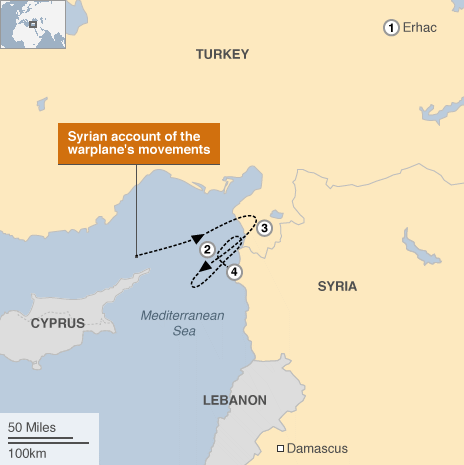
Turkish Foreign Minister Ahmet Davutoglu has said the fighter jet shot down by Syrian air defense forces on Friday was in international airspace when it was hit
1.F-4 Phantom takes off from Erhac airbase, Turkey, at approximately 10:28 local time (07:28 GMT), on 22 June
2. Syria says the jet enters its airspace at 11:40 (08:40 GMT)
3. Turkish military loses contact with the plane at 11:58 (08:58 GMT), while it is over Hatay province
4. Syria says its air defenses engaged aircraft about 1 km (0.6 miles) from the coast and that it crashed into the sea 10 km (6 miles) west of Om al-Tuyour
Egypt is awaiting the delayed results of the presidential run-off election held last weekend.
The results are due in the coming hours, after the election commission heard appeals by the two candidates.
Mohammed Mursi of the Muslim Brotherhood and former Prime Minister Ahmed Shafiq have both claimed victory and vowed to form unity governments.
Thousands of their supporters spent the night in the centre of Cairo amid increasing political polarization.
Correspondents say the atmosphere has been peaceful, but tense.
Many people are still apprehensive about the intentions of the ruling generals, who gave themselves sweeping new powers last week after the Supreme Constitutional Court ruled that the Islamist-dominated parliament should be dissolved.
On Friday, the Supreme Council of Armed Forces (SCAF) called on supporters of both candidates to accept the result when it came.
Results from last weekend’s run-off were originally due out on Thursday.
The Higher Presidential Election Commission (HPEC) has said that it will announce the official results at 15:00 local time (13:00 GMT) on Sunday.
Muslim Brotherhood supporters are maintaining a vigil in the capital’s Tahrir Square, where on Friday tens of thousands of protesters gathered to denounce a series of decrees and appointments by the SCAF designed to reduce or constrain the power of the president, and entrench the power of the military.
Egypt is awaiting the delayed results of the presidential run-off election held last weekend
On 13 June, the military-controlled government gave soldiers the right to arrest civilians for trial in military courts until the ratification of a new constitution.
Four days later, just as the polls were closing in the presidential run-off, the generals issued an interim constitutional declaration that granted them all legislative powers and reinforced their role in the drafting of a permanent constitution. The document also exempted the military from civilian oversight.
Then on Monday, the head of the SCAF, Field Marshal Mohammed Hussein Tantawi, announced the re-establishment of a National Defence Council, putting the generals in charge of Egypt’s national security policy.
Islamists, liberals and secularists said the moves amounted to a coup.
“The military must leave its political role and go back to its basic role which is protecting the country, not continuing to ruin the country and people’s affairs – this will not be accepted by the Egyptian people,” Abdel Nasser Hijab, a demonstrator in Tahrir Square, told the Associated Press.
There are fears that in the current atmosphere, the announcement of the presidential election results might only make matters worse.
A pro-Ahmed Shafiq demonstration took place on Saturday in the Nasser City neighborhood of Cairo.
“When we decided to take to the streets, we’re not just one, two or three million, we’re 80 million. The only difference is that we’re waiting for the military council to give its final word,” one Shafiq supporter, Doaa, told the Reuters news agency.
Hundreds of supporters held up pictures of Ahmed Shafiq and Field Marshal Tantawi while chanting slogans in support of the army and against the Brotherhood.
Correspondents say that there was less enthusiasm in the run-off election than there was for previous rounds of voting, and some called for a boycott or spoiled ballots.
On Tuesday, the Brotherhood’s Freedom and Justice Party announced that Mohammed Mursi, its chairman, had won with 51.74% of the vote, citing official figures from the HPEC.
Mohammed Mursi has also secured the support of several leading liberal figures and youth activists in Egypt, including Wael Ghonim, who played a key role in the uprising that forced Hosni Mubarak to step down in February 2011.
Ahmed Shafiq came second to Mohammed Mursi in last month’s first round, in which turnout among the 52 million eligible voters was only 46%.
But the former air force commander, who served briefly as former President Hosni Mubarak’s last prime minister, said on Thursday at his first public appearance since the run-off that he was confident of victory.
Governments in Latin America have reacted angrily to the impeachment of Paraguayan President Fernando Lugo in the wake of a land dispute scandal.
Argentina, Brazil and Uruguay have condemned the move and recalled their ambassadors for consultations.
But Federico Franco, who replaced Fernando Lugo as president, denied that Lugo’s removal from office was a coup.
In his first news conference, Federico Franco said there had been no break with democracy.
A 39-4 vote in the Senate on Friday saw Fernando Lugo impeached, in a case stemming from his handling of clashes between farmers and police last week in which at least 17 people died.
Earlier, Argentine President Cristina Fernandez had said her country “would not validate the coup” in Paraguay.
Governments in Latin America have reacted angrily to the impeachment of Paraguayan President Fernando Lugo in the wake of a land dispute scandal
President Cristina Fernandez also said that the South American trade bloc, Mercosur, would take “appropriate measures” at next week’s summit in Argentina.
Brazilian Foreign Minister Antonio Patriota condemned the impeachment as a “backward step” liable to be sanctioned by regional institutions such as Mercosur, Reuters news agency reports.
Federico Franco, who had been serving as Fernando Lugo’s vice-president, was sworn in as president immediately after the impeachment.
He insisted the proceedings had been conducted in line with Paraguay constitution.
“What was carried out was a political trial in accordance with the constitution and the laws,” he said.
Federico Franco acknowledged the impeachment had caused tensions with Paraguay neighbors.
“I am calm, we are going to organize the house, we are going to contact our neighboring countries in due time and I’m absolutely certain that they are going to understand the situation in Paraguay,” Federico Franco said.
The presidents of Ecuador and Venezuela, Rafael Correa and Hugo Chavez, were also outspoken in their criticism of the move.
“The Ecuadorian government will not recognize any president that isn’t Fernando Lugo,” Rafael Correa said.
“We will not lend ourselves to these tales of alleged legal formalities, which clearly attack democracy,” he added.
Venezuelan President Hugo Chavez displayed a similar sentiment: “In the name of the people of Venezuela and in the name of the Venezuelan government and as commander-in-chief, I’ll say it.
“We, the Venezuelan government, the Venezuelan state, do not recognize this illegitimate and illegal government that has been installed.”
The governments of Colombia, Mexico and Chile have said they regretted the fact that Fernando Lugo had not been “given reasonable time to prepare his defense”.
The Inter-American Commission on Human Rights said Fernando Lugo’s removal from office was an “attack on the legal foundation of the state”.
The United States and Spain have avoided publicly opposing or supporting the move, instead pressing the principle of democracy in Paraguay.
A statement from the Spanish foreign ministry said: “Spain defends full respect for democratic institutions and the state of law and trusts that Paraguay, in respect for its constitution and international commitments, will manage to handle this political crisis and safeguard the peaceful coexistence of the Paraguayan people.”
The United States took a similar stance.
US State Department spokeswoman Darla Jordan was quoted as saying: “We urge all Paraguayans to act peacefully, with calm and responsibility, in the spirit of Paraguay democratic principles.”
China has successfully completed its first ever manual docking of a spacecraft with another space module as astronauts on the Shenzhou-9 spacecraft docked with the Tiangong-1 lab module without relying on an automated system.
State television broadcast images of Jing Haipeng, Liu Wang and China’s first female astronaut, Liu Yang, smiling after completing the exercise.
The docking is seen as a key step in the building of a space station, which China hopes to finish by 2020.
A manual docking procedure would be used in the event of a failure with the automated system.
Astronauts on the Shenzhou-9 spacecraft docked with the Tiangong-1 lab module without relying on an automated system
It is regarded as a difficult manoeuvre, bringing gently together two orbiting vessels travelling at thousands of miles an hour.
Liu Wang had been expected to take charge of the operation, while Liu Yang was to conduct aerospace experiments, according to Agence France-Presse news agency.
Manual docking was mastered by the USSR and US in the 1960s.
The Shenzhou-9 spacecraft was launched on 16 June.
It carried out a successful automatic docking when it reached the Tiangong-1 module on 18 June.
Every move of the mission has been watched with patriotic pride by China’s state media.
Even the astronauts’ first space meal – rice, pickled pork, barbecue sauce and tea – was reported, our correspondent says.
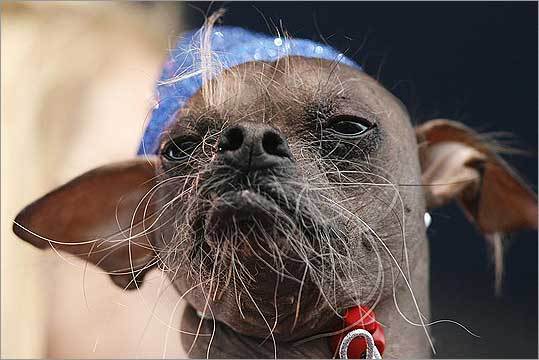
Mugly, an 8-year-old Chinese Crested with a short snout, beady eyes and a large number of unkempt white whiskers, has won the rather unflattering title of Ugliest Dog in a competition held in the United States.
The 2012 winner Mugly is owned by Bev Nicholson of Peterborough, UK.
The 24th annual World’s Ugliest Dog contest, held at the Sonoma-Marin Fair, pitched 29 canines against each other.
Mugly, an 8-year-old Chinese Crested, has won the rather unflattering title of Ugliest Dog in 2012
World’s Ugliest Dog Contest is an annual contest held in Petaluma, California, as part of the Sonoma-Marin Fair, to decide which of the dogs entered in the contest is the ugliest. Along with the title of “The World’s Ugliest Dog”, the winner’s owner receives a check for $1,000, and both dog and owner receive significant publicity for winning the contest, appearing on talk shows and in newspapers around the world.
Dogs come from across the United States generally but are welcome to enter from around the world. In contrast to conformation shows (which are restricted to purebreds), mutts are allowed to participate.
Daniel Shak, a wealthy New York hedge fund manager, has filed a lawsuit against his ex-wife Beth Shak for a portion of her luxury shoe collection, which he claims he knew nothing about at the time of their divorce.
Daniel Shak, 52, claimed that Beth Shak, a well-known professional poker player, never told him about her 1,200 pairs of designer shoes when they parted ways three years ago.
The finance titan, who had shared a $7.5 million apartment on Fifth Avenue with his then-wife, said that she kept her enormous stockpile of shoes hidden from him possibly in a “secret room”, the New York Post reported.
Daniel Shak now wants to get his hands on his ex-wife’s pricey pumps, which he says would entitle him to hundreds of thousands of dollars more in their divorce settlement.
However, Daniel Shak’s claim that his ex-wife had successfully kept him in the dark about her footwear obsession is highly questionable considering the fact that her collection has been featured in numerous TV shows, from MTV’s Cribs to the Today Show.
Beth Shak’s Facebook page is plastered with images of glittering sky-high stilettos by Christian Louboutin – her favorite shoe designer – and in April she launched her own website dedicated to her obsession called Shoes R Forever, where she offers her picks and writes about the hottest trends in footwear.
Daniel Shak has filed a lawsuit against his ex-wife Beth Shak for a portion of her luxury shoe collection, which he claims he knew nothing about at the time of their divorce
Beth Shak, 43, a mother of three, even has an image of a Christian Louboutin stiletto tattooed on a private area of her body, the Post reported.
She renowned shoe aficionado was featured in a recently released documentary called God Save My Shoes about women’s relationship with their heels, and according to a recent post on her Facebook page, Beth Shak plans to start her own shoe line soon.
The World Series of Poker player told the Post that Daniel Shak would have to have been the most unobservant husband in history to be unaware of her passion for shoes that would have made the fictional Sex & the City shoe maven Carrie Bradshaw blush.
“I’m shaking my head over this whole thing,” Beth Shak said.
“He is saying he didn’t know the closet in our master bedroom existed.”
Daniel Shak, however, insists that he discovered his ex-wife’s “secret” only last year, according to his lawsuit.
“Dan trusted his wife and was not inspecting his home to try to find inventory or <<secret rooms>>,” the suit claims.
A source told the Post that Daniel Shak is asking a court near their old family home in suburban Philadelphia for an accounting of his ex-wife’s footwear.
He estimates her collection at $1 million and says he is due at least 35% of that.
Daniel Shak, an avid poker player himself, reportedly lost millions of dollars in the gold market last year.
In 2011, Beth Shak brought a film crew from NBC’s Today Show into her three cavernous closets to put on display her pricey size-seven acquisitions, sheepishly admitting to a reporter that some of her fancy footwear cost her as much as $4,000 a pair.
Beth Shak said her collection includes 700 pairs of Christian Louboutin shoes, which she compared to “fine art” in an interview with the Post last year.
Still, Beth Shak has ways to go if she wants to catch up with the world’s most notorious shoe fiend Imelda Marcos, the wife of former Philippine dictator, who caused worldwide outrage in 1986 when a U.S. diplomat revealed that she owned 3,000 pairs of shoes.
Ann Curry will get her walking papers from the Today Show next week, and NBC will pay $10 million for its blunder.
NBC sources told TMZ that Ann Curry was under a contract that guarantees her $10 million a year.
The sources also said Ann Curry signed a new contract almost a year ago, when she took over as co-anchor of Today Show. Under the deal, Ann Curry gets a cool $10 million, and it’s a long-term contract.
Ann Curry will get her walking papers from the Today Show next week, and NBC will pay $10 million for its blunder
According to TMZ, Ann Curry was guaranteed that amount for 3 years.
The sources said the likely scenario is that Ann Curry will become a foreign correspondent for NBC News.
Ann Curry will be the first foreign correspondent who will rake in an amount equal to the gross national product of some of the countries she will cover.
Two people were found dead Friday night at the Beverly Hilton Hotel where the 39th Daytime Entertainment Emmy Awards are scheduled to take place on Saturday in what police believe to be a murder-suicide.
Police responded to a shooting at the hotel at around 11:00 p.m. on Friday and found a man and a woman dead from gunshot wounds. The victims were described as “elderly”.
Two people were found dead Friday night at the Beverly Hilton Hotel where the 39th Daytime Entertainment Emmy Awards are scheduled to take place on Saturday
The bodies were picked up from the hotel early Saturday by the coroner’s office.
The Beverly Hilton is also where Whitney Houston was found dead back on February 11.
Kris Jenner came under fire this week after Kim Kardashian told Oprah Winfrey her mother put her on birth control at the tender age of 14.
Kris Jenner is now defending her actions, saying her liberal parenting ways were a strategy to “protect” her kids.
She admits she felt no hesitation putting “all” of her girls on the birth control pill as soon as they expressed an interest in sex.
“You want to protect your kids,” Kris Jenner tells TV personality Bethenny Frankel, in an interview which will air on Monday.
“Kim came to me and you know, was very honest with me and said: <<Mummy I think I’m feeling, you know, sexual>>,” Kris Jenner tells Bethenny Frankel on the new Fox daytime talk show Bethenny.
“What I did as a parent with all my girls, when I felt like it was that time in their life that they were going to that step… I drove as fast as I could to the gynecologist’s office,” she says.
Dressed in a demur white lace dress, Kris Jenner is defiant in the interview.
“You can try and talk your kids out of [having sex], but unless you lock your child in the closet and throw the key away, they’re going to do what they feel,” she says.
“So my philosophy has also been make sure your kids are healthy, well taken care of and educated.”
Kris Jenner admits during interview with Bethenny Frankel she felt no hesitation putting “all” of her girls on the birth control pill as soon as they expressed an interest in sex
Kris Jenner, 56, reveals the doctor who gave “all” her daughters birth control was the same doctor who delivered them as babies, and that her older girls were “different ages” when they went on the pill.
Kris Jenner is mother to three daughters – Kourtney, Kim and Khloe – by her first husband, celebrity lawyer Robert Kardashian.
Her youngest daughters with current husband Bruce Jenner are Kylie, 14, and Kendell, 16.
Kris Jenner covers a lot of ground in the interview.
In addition to the controversial issue of birth control, which emerged this week with Kim kardashian’s much-publicized interview with Oprah Winfrey, Kris Jenner also alludes to Kim’s brief marriage to Kris Humphries.
“She’s really good with her intuition… Well, she hasn’t been so right lately,” says Kris Jenner, making a none-too-subtle jab at Kris Humphries.
Kim Kardashian has since moved on to date Kanye West and Kris Jenner doesn’t think it’s too soon.
”I tell all of my children, follow your heart … Do what you feel and what you want,” Kris Jenner tells Bethenny Frankel.
Kris Jenner also talks about Kim Kardashian’s expensive Lamborghini gift to current boyfriend Kanye West: “Well, she bought him a very beautiful gift, but I don’t have any idea how much it cost.”
She also reveals that daughter Kourtney’s boyfriend Scott Disick dines with the Kardashian clan “every night” when Kourtney is out of town.
Kim Kardashian’s reveal to Oprah Winfrey earlier this week came as a surprise to the veteran broadcaster, who failed to follow up the question with little more than a “wow” before moving onto the next question.
Kim Kardashian’s sexual past featured heavily in the interview – as the question of Kim’s notoriety loomed.
Five years since her sex tape with ex-boyfriend Ray J was released, the reality star said she understands the impact it’s had on her career.
“Would you be where you are had there not been a sex tape?” Oprah Winfrey asked Kim kardashian.
And she was forced to admit: “You know, I think that’s how I was definitely introduced to the world.”
“It was a negative way, so I felt like I really had to work ten times harder to get people to see the real me.”
General Motors has decided recall almost half a million Chevrolet Cruze to reduce the risk of fire.
It plans to modify Chevrolet Cruze sedans, a popular model, so that flammable liquids are not caught in the engine, General Motors said.
The recall affects 475,418 cars sold in the US, Canada and Israel that were assembled in Lordstown, Ohio, between September 2010 and May 2012.
General Motors has decided recall almost half a million Chevrolet Cruze to reduce the risk of fire
GM said no crashes or injuries have been reported over the issue.
Recall notices are due to be sent out to Cruze owners in mid-July and the company estimates it will take about half-an-hour at a Chevrolet dealership to fix the problem, which has to do with the car’s engine shield.
Cars of the same model built at other GM plants are not thought to have the same problem, the spokesman added, although its unit in Australia is investigating whether 10,000 cars sold there could be affected.
Jennifer Lopez looked in high spirits as she flashed her stomach in a crop top when she arrived in Rio de Janeiro with her beau Casper Smart yesterday.
Her composure was admirable considering the day before she had been robbed almost immediately before going into concert.
Jennifer Lopez, 42, looked completely relaxed, dressed down in pale jeans, sandals, a loose knitted cardigan, and a scarf.
She accessorized with her trademark gold hoop earrings, sunglasses and a chunky red studded bracelet, while Casper Smart kept things simple in jeans and a white t-shirt.
J Lo was certainly shown a warm welcome, and was showered with gifts including a t-shirt and flowers as she arrived.
The reception must to have come as some comfort to Jennifer Lopez, who has had a difficult few days in South America.
Jennifer Lopez ran into a spot of trouble on Thursday when she was robbed just after leaving a clinic where she was being treated for a stabbing pain in her back.
During her concert a few hours later at the GEBA stadium in Buenos Aires a thief reportedly stole personal items including computer, a camera and a bag with personal documents from her dressing room.
J Lo’s manager Benny Medina is now apparently unable to leave the country, since he has lost all forms of identification.
It seems J Lo’s back pain was related to her children.
Jennifer Lopez took to Twitter to explain, writing: “Got an xray this morning…all good…pulled back muscle.’
“Coconuts getting to big to carry both at once. Awww… #timeflies 🙁 “
Ever the professional, Jennifer Lopez still performed her two-hour concert the same evening, belting out hits such as Get Right, Let’s Get Loud, Waiting for Tonight and Jenny From the Block.
Meanwhile the singer has been warned off her toyboy beau- by none other than Casper Smart’s “best friend”.
Back-up dancer Josh Ayers says J Lo shouldn’t trust him as far as she can throw him.
“He’s willing to do whatever Jennifer wants as long as it furthers his own career,” Josh Ayers told In Touch Weekly.
Josh Ayers was reportedly close to Casper Smart for years, and claims he has seen first hand how the heartthrob manipulates women to get what he wants.
Before Casper Smart hooked up with Jennifer Lopez, he was with steady girlfriend Aisha Francis for two years.
According to Josh Ayers, it was Aisha Francis who helped land Casper Smart a dance gig on Jennifer Lopez’s music video, Dance Again – where the pair first met.
Casper Smart, who has been reportedly showered with gifts by the mother-of-twins, said in an interview last month the relationship he has with Jen “just spontaneously happened”.
Australian Genevieve Cook first met Barack Obama in 1983 in the kitchen of a mutual friend’s New York flat.
In those days most Americans, even supposedly cosmopolitan New Yorkers, couldn’t tell a Cockney from a Kiwi.
But Barack Obama had met many Aussies while living in Indonesia as a young boy with his mother and stepfather, and it turned out he and Genevieve Cook – the daughter of a prominent diplomat – had lived in the country at the same time.
As the night wore on, they sat close together on an orange beanbag in the hall while Genevieve Cook swigged Baileys Irish Cream straight from the bottle.
They were amazed at how much they had in common: both were children of divorced parents, both had lived all over the world and had never felt truly at home anywhere.
They exchanged phone numbers and the self-assured Barack Obama didn’t waste time. Within days, he was cooking her dinner at his apartment.
“Then we went and talked in his bedroom,” Genevieve Cook recalled.
“And then I spent the night with him.
“It all felt very inevitable.”
Barack Obama and his First Lady sometimes seem so well-suited to each other that it’s hard to imagine there ever having been any woman in his life other than the formidable Michelle, whom he met while working for a Chicago law firm in 1989.
The US president has reinforced this notion by making only fleeting mention of ex-girlfriends in his carefully calibrated memoirs, Dreams From My Father: A Story of Race and Inheritance.
Barack Obama gives the impression of a man in such a hurry to save the world that he had no time for such distractions as romance.
But now, in a blistering new biography, Pulitzer-prize-winning journalist David Maraniss has pulled his exes out of the shadows.
In so doing, David Maraniss has revealed an unflattering picture of a president so desperate to sell an image of himself as a pioneering race warrior that he has air-brushed many of the “white” elements from his life – including that string of well-heeled, well-educated white girlfriends.
Barack Obama’s version of events, in his autobiography, is a moving story of a mixed-race child struggling to find his black identity after being deserted as a young child by his Kenyan father.
It tells how his grandfather was imprisoned by the British for helping the Mau Mau rebels in Kenya – an assertion that Barack Obama’s step-grandmother later embellished with claims he was also tortured – for which David Maraniss found no evidence.
Delighted Republican opponents are picking over the inconsistencies (38 at the last count) between Barack Obama’s own memoirs – published in 1995 as he prepared to launch his political career – and the facts uncovered by David Maraniss.
Time and again, Barack Obama, who has had to fight hard to convince other African Americans of his “black credibility”, appears to have burnished his radical credentials, not least by playing up the roles of black people in his life and playing down the roles of the white.
And nowhere is this more apparent than in his romantic life.
For Genevieve Cook – to whom admittedly the President alludes in his memoirs – wasn’t the first white girlfriend in his life, nor the last.
As a young student in the early Eighties at Occidental College, a small arts university in Los Angeles, Barack Obama developed a serious crush on another student Alexandra McNear, who was co-editor of a college literary magazine which published two of his poems.
Australian Genevieve Cook first met Barack Obama in 1983 in the kitchen of a mutual friend’s New York flat
Alexandra McNear, described by David Maraniss as “lithe and mysterious, with the face of a young Meryl Streep and a literary bohemian air”, had just the sort of rarefied upbringing that might impress an ambitious young man.
Both her parents were established writers and her father, Erskine McNear, was the scion of a property empire. In the summer of 1981, Barack Obama and Alexandra McNear moved to New York, she to do a theatre course, he to finish his degree at Columbia University, so he could explore his black identity in a more African American city.
Far away from family and friends, Barack Obama’s first summer in New York in 1981 might have been lonely but, suggests David Maraniss, for the presence of Alexandra McNear.
She recalls admiring his intellect, his sense of humor and his good looks.
After a first date at a dimly lit Italian restaurant on Manhattan’s Upper East Side, they embarked on a two-month affair.
Alexandra McNear remembers it as a “summer of walking miles in the city, lingering over meals at restaurants, hanging out at the apartments, visiting art museums and talking about life”.
When she went back to Los Angeles, their relationship continued, largely through an exchange of passionate if pompously intellectual letters.
They discussed everything from T.S. Eliot to German philosopher Friedrich Nietzsche – but mainly they discussed Barack Obama.
Supremely self-absorbed, Barack Obama forever harped on about his search for meaning and identity.
He seemed oblivious to her feelings, once remarking that, tempting as it would be to run off with her when he finished his degree in New York, it would mean living “in some sense of compromise and retreat”.
Barack Obama’s self-obsession would have left many women cold, if not bored to death, but Alexandra McNear persevered.
Perhaps she appreciated his toe-curlingly pretentious notes on literature, like his observation that T.S. Elliot’s poem The Waste Land “contains the same ecstatic vision which runs from Munzer [a somewhat obscure Reformation theologian] to Yeats”.
Alexandra McNear told her diary that Barack Obama was “the closest friend I had, and that I really loved him but didn’t know if we could sustain a relationship”.
Her instincts were correct.
A few months later, while Barack Obama was visiting his mother in Honolulu, he wrote to inform Alexandra McNear with cold detachment that he felt their relationship was changing from romantic love to “the more quotidian, but finer bonds of friendship”.
Alexandra McNear went on to scandalize her family by marrying a former Serbian boxer and convicted bank robber called Bob Bozic.
Next for Barack Obama was Genevieve Cook, whom he met at that mutual friend’s flat at a Christmas Party in 1983.
Barack Obama had graduated and was in a dull office job as he worked out what he wanted to do with his life.
Genevieve Cook was three years older than him, and an assistant teacher at a private school in Brooklyn.
As David Maraniss observes, “there had been girlfriends before her but none quite like Genevieve”, who “engaged him in the deepest romantic relationship of his young life”.
Genevieve Cook is mentioned in Barack Obama’s memoirs as a mystery woman.
While never naming her, Barack Obama wrote: “There was a woman in New York that I loved. She was white. She had dark hair with specks of green in her eyes.
“Her voice sounded like a wind chime. We saw each other for almost a year.”
Genevieve Cook shared many of Barack Obama’s obsessions. The daughter of a former Australian ambassador to the U.S., and a moneyed art historian who later remarried into a prominent American family, Genevieve Cook, too, religiously kept a diary.
And, like Barack Obama, she had a burning passion to save the world.
Within two months of meeting, they were seeing each other every Thursday night and at weekends.
On Sundays, Barack Obama would lounge around in his cheap, cockroach-infested flat in the less salubrious end of the Upper West Side, bare-chested in a blue and white sarong as he drank coffee and did the New York Times crossword.
His bedroom, Genevieve Cook recalls, smelt of “running sweat, Brut spray deodorant and smoking”.
Barack Obama loved to cook and they would read together and discuss writers into the night.
Like Alexandra McNear, Genevieve Cook was attracted by the “mental exhilaration” of his intellect, marveling at how mature he was at 22, but dismayed by his remoteness and wariness about commitment.
Needless to say, Barack Obama was as self-obsessed as ever.
When Genevieve Cook told him that she loved him, Barack Obama’s response was not “I love you, too”, but “thank you”.
Genevieve Cook described him as “an uncommon, earnest young man” and confided to her diary: “He is very beautiful – more than he thinks himself to be.”
But there was another side to him she found unsettling.
“The sexual warmth is definitely there – but the rest of it has sharp edges and I’m finding it all unsettling,” she wrote.
“His warmth can be deceptive. Though he speaks sweet words and can be open and trusting, there is also that coolness.”
They often talked about race and Barack Obama would confide that he felt like an “imposter” as there was “hardly a black bone in his body”.
Genevieve Cook eventually told him he “needed to go black” (to date a black woman), whereas he countered that he would never find a black woman “he would feel truly comfortable with”.
They moved into a flat together but their intellectual discussions eventually turned into fights over issues like the washing-up.
In the end, Genevieve Cook tired of his emotional “withheld-ness, his lack of spontaneity”, and broke up with him in 1985.
Genevieve Cook insists she couldn’t have been more sympathetic about his confusion over his racial identity but that’s not how Barack Obama portrayed it in his memoirs.
He recounts taking his New York girlfriend to see a black play after which she “started talking about why black people are so angry all the time”.
They had a “big fight” in front of the theatre and she burst into tears and said she couldn’t be black.
All very dramatic but Genevieve Cook insisted to David Maraniss that it never happened.
The only play she saw with Barack Obama was entirely different – British actress Billie Whitelaw performing a monologue written by Samuel Beckett. And there had been no row over race, she said.
Barack Obama had to admit to David Maraniss the incident happened not with Genevieve Cook in New York but with someone else, though he wouldn’t elaborate.
Did it really happen? He mixed dates and places to protect former girlfriends’ identities, he said.
Soon after that period, Barack Obama made strides in his career, moving to Chicago to work as a community organizer.
In a moment of acute foresight, Genevieve Cook had told her diary that while she was not the woman for Barack Obama, “that lithe, bubbly, strong black lady is waiting somewhere”.
She may or may not be “bubbly”, but “strong” certainly sums up Michelle Obama.
However, before Barack Obama met Michelle, he went on to have a relationship with another white woman in Chicago.
The woman, who like Genevieve Cook was an anthropology graduate, was barely mentioned in Barack Obama’s memoirs, but by then he was trying to establish his African-American credentials by toiling in an impoverished and predominantly black area of Chicago.
David Maraniss does not identify this new woman either, but says the relationship was “serious” and “ended much like the one with Genevieve, when Obama was ready to make his next career move”.
Within four years, Barack Obama had met Michelle in Chicago and the rest we know. He finally had the partnership he wanted history to record – with a strong black woman, a descendant of slaves who had pushed her way up from humble roots.
But Michelle Obama, at least, is not a “dream”, unlike some of the other fantasies in his own autobiography.
Salvador Dali’s painting Cartel des Don Juan Tenorio has been stolen from an art gallery in Manhattan, by a man who took it off the wall and carried it out in a bag.
Valued at $150,000, the Cartel des Don Juan Tenorio, was taken from the Venus Over Manhattan art gallery.
Police said a man posed as a gallery visitor before removing the painting and fleeing.
The theft was captured on CCTV.
Valued at $150,000, the Cartel des Don Juan Tenorio, was taken from the Venus Over Manhattan art gallery
The Venus Over Manhattan Gallery, which only opened its doors for the first time in May, is owned by art collector Adam Lindemann.
The Salvador Dali painting, created in 1949, was part of its first exhibition.
Radiohead have decided to postpone part of their European tour, following a stage collapse in Toronto which killed a crew member and injured three others.
A statement on the band’s website said the group was still “dealing with the grief and shock” from the accident which killed technician Scott Johnson.
The collapse caused serious damage to equipment which would “take many weeks to replace”, the statement continued.
Seven shows in Italy, Germany and Switzerland have been postponed.
Radiohead have decided to postpone part of their European tour, following a stage collapse in Toronto which killed a crew member and injured three others
Radiohead will resume their tour on 10 July in Nimes. New dates for the cancelled shows are expected to be announced on 27 June.
“Whilst we all are dealing with the grief and shock ensuing from this terrible accident, there are also many practical considerations to deal with,” the statement said.
“The collapse also destroyed the light show – this show was unique and will take many weeks to replace.”
Radiohead said its backline set-up – a term that refers to amplifiers that typically sit at the back of the stage – had also been seriously damaged “some elements of which are decades old and therefore hard to replace”.
Canadian authorities have launched an investigation into the collapse at Downsview Park, which happened last weekend approximately an hour before the band was due on stage.
A woman had to be rescued from a Kentucky Walmart restroom last week after found super glued to a toilet seat.
Stuck for at least an hour, the unidentified woman was removed by Emergency Medical Services inside the store’s restroom in Monticello, Kentucky.
“We are looking at it. Right now I wouldn’t be prepared to say if it was accidental or intentional,” Chief Ralph Miniard of the Monticello Police Department told WAVE.
The woman was taken to a local hospital to be checked out.
Police said an investigation was underway with no reported suspects.
Chief Ralph Miniard said police is investigating the incident that left the woman stuck on the toilet seat for an hour
Chief Ralph Miniard said that the incident was suspected as more than curious for one bonding reason: “From the simple fact that the superglue or that type of adhesive is very fast drying. If it had been there very long it wouldn’t have stuck,” he told LEX 18.
The adhesive, a single square-inch of which can hold more than a ton in weight depending on the brand, can also cause burns to skin if a large amount of the glue is in contact.
Not the first Walmart seat to find itself lined in super glue, however, just over a year ago a man was also caught with his pants down in a restroom in Maryland.
That 48-year-old escaped the store with the toilet seat still stuck to him after a 15-minute rescue by EMS.
It was later that day removed at a local hospital.
Police in that case reported the offender could face second-degree assault charges.
That man received minor injuries to his buttocks, officers told CNN.
Acetone, a chemical commonly found in nail polish remover, is advised as a common method – along with warm, soapy water, of unbinding the sticky glue.
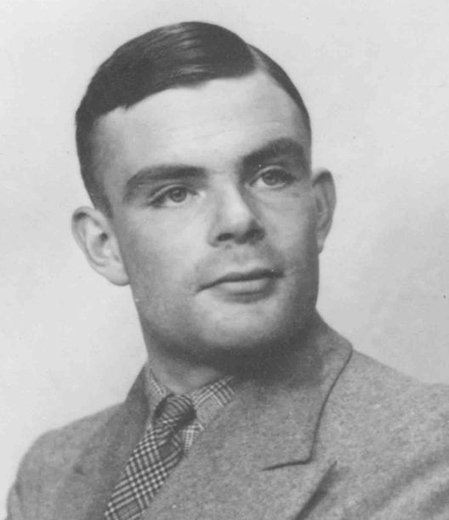
Alan Turing, the British mathematical genius and codebreaker born on June 23, 1912, may not have committed suicide, as is widely believed.
At a conference in Oxford on Saturday, Alan Turing expert Prof. Jack Copeland will question the evidence that was presented at the 1954 inquest.
Prof. Jack Copeland believes the evidence would not today be accepted as sufficient to establish a suicide verdict.
Indeed, he argues, Alan Turing’s death may equally probably have been an accident.
What is well known and accepted is that Alan Turing died of cyanide poisoning.
His housekeeper famously found the 41-year-old mathematician dead in his bed, with a half-eaten apple on his bedside table.
It is widely said that Alan Turing had been haunted by the story of the poisoned apple in the fairy tale of Snow White and the Seven Dwarves, and had resorted to the same desperate measure to end the persecution he was suffering as a result of his homosexuality.
But according to Prof. Jack Copeland, it was Alan Turing’s habit to take an apple at bedtime, and that it was quite usual for him not to finish it; the half-eaten remains found near his body cannot be seen as an indication of a deliberate act.
Indeed, the police never tested the apple for the presence of cyanide.
Moreover, Prof. Jack Copeland emphasizes, a coroner these days would demand evidence of pre-meditation before announcing a verdict of suicide, yet nothing in the accounts of Alan Turing’s last days suggest he was in anything but a cheerful mood.
Alan Turing, the British mathematical genius and codebreaker born on June 23, 1912, may not have committed suicide, as is widely believed
Alan Turing had left a note on his office desk, as was his practice, the previous Friday to remind himself of the tasks to be done on his return after the Bank Holiday weekend.
Nevertheless, at the inquest, the coroner, JAK Ferns declared: “In a man of his type, one never knows what his mental processes are going to do next.”
What he meant by “of this type” is unclear.
The motive for suicide is easy to imagine. In 1952, after he had reported a petty burglary, Alan Turing found himself being investigated for “acts of gross indecency” after he revealed he had had a male lover in his house.
Faced with the prospect of imprisonment, and perhaps with it the loss of the mathematics post he held at Manchester University, which gave him access to one of the world’s only computers, Alan Turing accepted the alternative of “chemical castration” – hormone treatment that was supposed to suppress his sexual urges.
It is often repeated that the chemicals caused him to grow breasts, though Alan Turing is only known to have mentioned this once.
The authorities’ continuing interest in alan Turing became apparent in 1953 when a gay Norwegian acquaintance, Kjell, announced by postcard his intention to visit him at his Wilmslow home, but mysteriously never arrived.
Alan Turing told a friend, by way of explanation: “At one stage, the police over the north of England were out searching for him.”
With six decades of hindsight, these oppressive attentions, the nation’s failure to appreciate his wartime contributions, his apparent sidelining at the Manchester computer department, have led to a tragic picture of Alan Turing being hounded during his last years, and suicide being a natural outcome.
But Prof. Jack Copeland argues that on the contrary, Alan Turing’s career was at an intellectual high, and that he had borne his treatment “with good humor”.
Of the Kjell affair, Alan Turing had written that “for sheer incident, it rivaled the Arnold [gross-indecency] story”; and immediately after his conviction had told a friend: “The day of the trial was by no means disagreeable.
“Whilst in custody with the other criminals, I had a very agreeable sense of irresponsibility, rather like being back at school.”
On the face of it, these are not the expressions of someone ground down by adversity.
What is more, Alan Turing had tolerated the year-long hormone treatment and the terms of his probation (“my shining virtue was terrific”) with amused fortitude, and another year had since passed seemingly without incident.
In statements to the coroner, friends had attested to his good humor in the days before his death.
His neighbor described him throwing “such a jolly [tea] party” for her and her son four days before he died.
His close friend Robin Gandy, who had stayed with him the weekend before, said that Alan Turing “seemed, if anything, happier than usual”.
Yet the coroner recorded a verdict of suicide “while the balance of his mind was disturbed”.
Prof. Jack Copeland believes the alternative explanation made at the time by Alan Turing’s mother is equally likely.
Alan Turing had cyanide in his house for chemical experiments he conducted in his tiny spare room – the nightmare room he had dubbed it.
He had been electrolyzing solutions of the poison, and electroplating spoons with gold, a process that requires potassium cyanide. Although famed for his cerebral powers, Turing had also always shown an experimental bent, and these activities were not unusual for him.
But Alan Turing was careless, Prof. Jack Copeland argues.
The electrolysis experiment was wired into the ceiling light socket.
On another occasion, an experiment had resulted in severe electric shocks.
And he was known for tasting chemicals to identify them.
Perhaps he had accidentally put his apple into a puddle of cyanide.
Or perhaps, more likely, he had accidentally inhaled cyanide vapors from the bubbling liquid.
Prof. Jack Copeland notes that the nightmare room had a “strong smell” of cyanide after Turing’s death; that inhalation leads to a slower death than ingestion; and that the distribution of the poison in Alan Turing’s organs was more consistent with inhalation than with ingestion.
In his authoritative biography, Andrew Hodges suggests that the experiment was a ruse to disguise suicide, a scenario Alan Turing had apparently mentioned to a friend in the past.
But Jack Copeland argues the evidence should be taken at face value – that an accidental death is certainly consistent with all the currently known circumstances.
The problem, he complains, is that the investigation was conducted so poorly that even murder cannot be ruled out. An “open verdict”, recognizing this degree of ignorance, would be his preferred position.
None of this excuses the treatment of Alan Turing during his final years, says Prof. Jack Copeland.
“Turing was hounded,” he said.
Adding: “Yet he remained cheerful and humorous.”
“The thing is to tell the truth in so far as we know it, and not to speculate.
“In a way we have in modern times been recreating the narrative of Turing’s life, and we have recreated him as an unhappy young man who committed suicide. But the evidence is not there.
“The exact circumstances of Turing’s death will probably always be unclear,” Prof. Jack Copeland concludes.
“Perhaps we should just shrug our shoulders, and focus on Turing’s life and extraordinary work.”
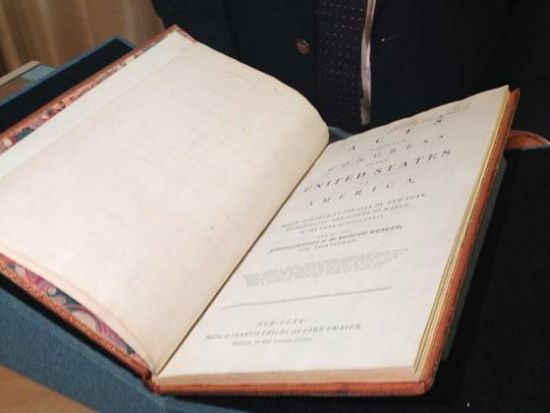
George Washington’s personal copy of the US constitution has sold for almost $10 million, Christie’s auction house says.
The book, with the first US president’s own annotations, was printed in 1789 – his first year in office.
It had an estimated price of $2 million to $3 million but bidding boosted the price of the 223-year-old book.
Historians say George Washington’s notes are what make the book so valuable, as the president was keenly aware of the precedents he would set in office.
The leather-bound book is described as in nearly pristine condition and is stamped with the Washington family crest.
George Washington's personal copy of the US constitution has sold for almost $10 million
It also contains the first acts of Congress, which included legislation to establish state, judiciary, defense and treasury departments of government.
The book was fought over between two bidders who remained anonymous during the auction. The new owner is the Mount Vernon Ladies’ Association, which paid a final price of $9,826,500, Christie’s later revealed.
“It’s an exciting day. We are thrilled to be able to bring this extraordinary book back to Mount Vernon where it belongs,” spokeswoman Ann Bookout told reporters.
The private, non-profit group, owns and maintains Mount Vernon, Washington’s historic Virginia estate, and has said the book will become part of a new presidential library due to open in 2013.
The book was bound especially for the president by Thomas Allen, a New York bookbinder. He also created similar copies for Thomas Jefferson, the first secretary of state, and Attorney General John Jay.
The book sold by Christie’s on Friday had been in the library at Mount Vernon for many years after Washington’s death.
In 1876 it was sold at auction to a private collection, and was sold again in 1964 to Richard Dietrich, a notable collector of early Americana.
George Washington acted as commander in chief of the Continental Army in the War of Independence and was later unanimously elected as the first president of the US.
After serving two terms as president, George Washington spent three years in retirement at Mount Vernon before he died in 1799.
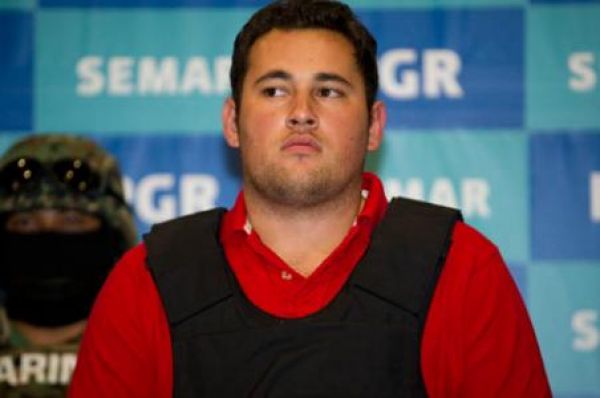
Mexican government has admitted that it mistakenly identified Felix Beltran Leon as the son of the country’s most-wanted drugs lord, Joaquin “El Chapo” Guzman.
On Thursday officials paraded before the media a man they said was Jesus Alfredo Guzman, whose father leads the powerful Sinaloa cartel.
But the arrested man was in fact Felix Beltran Leon, a car salesman, the attorney general’s office said.
The authorities had hailed the arrest as the most important in years.
Known as El Chapo” or “Shorty”, Joaquin Guzman has been in hiding ever since he escaped from prison in 2001.
The Sinaloa cartel controls much of the flow of cocaine, marijuana and methamphetamine to the United States.
Within hours of the high-profile arrest, doubts had started to be cast on the official version of events.
A lawyer proclaiming to speak for the Guzman family released a statement denying that the suspect in custody was the drug boss’s son.
Mexican government has admitted that it mistakenly identified Felix Beltran Leon as the son of the country's most-wanted drugs lord, Joaquin "El Chapo" Guzman
Felix Beltran Leon’s mother then spoke to journalists and denied any link to Joaquin Guzman or the Sinaloa cartel.
It took another few hours, while identity tests were carried out, before the government admitted it had made a huge mistake.
In less than a day, the episode has transformed from an apparent coup against one of Mexico’s biggest drug cartels to a major embarrassment for President Felipe Calderon’s administration, our reporter says.
US agencies, such as the Drug Enforcement Administration, were among those that had applauded the arrest.
On Thursday, the Mexican Navy had said that Jesus Guzman – known as “El Gordo”, or “The Fat One” – was a growing force within his father’s cartel and controlled most of its trade between Mexico and the US, where he was indicted in 2009.
El Chapo was jailed in 1993, but escaped from his maximum-security prison in a laundry basket eight years later.
The US state department has offered a reward of up to $5 million for information leading to his arrest.
If nothing else, the debacle goes to underscore how murky and confused the world of drug cartel arrests and government intelligence has become in Mexico.
With few recent photos of the main players in the drug world available, there may be more such cases of mistaken identity to come for the Mexican armed forces.
More than 55,000 people have died in Mexico in drug-related violence since President Felipe Calderon declared war on the cartels nearly six years ago.
The Syrian military has confirmed that it shot down Turkish warplane F-4 Phantom “flying in airspace over Syrian waters”.
A spokesman said the plane was dealt with “according to the laws that govern such situations”, the state news agency Sana said.
Turkish Prime Minister Recep Tayyip Erdogan said his country would “take the necessary steps” once all the facts were known.
The Turkish and Syrian navies are meanwhile engaged in a joint search for the two missing crew members.
The F-4 Phantom disappeared over the Mediterranean, south-west of Turkey’s Hatay province, near the Syrian coast.
The Turkish military said it lost radio contact with the F-4 at 11:58 local time while it was flying over Hatay, about 90 minutes after it took off from Erhac airbase in the province of Malatya, to the north-west.
A Syrian military statement said that an “unidentified air target” had penetrated Syrian airspace from the west at 11:40 local time, travelling at very low altitude and at high speed.
It said that in line with the laws prevailing in such cases, Syrian air defenses engaged the craft, and scored a direct hit about 1km (0.6 miles) from its coastline.
It burst into flames, and crashed into the sea at a point 10 km (6 miles) from the village of Om al-Tuyour, off the coast of Latakia province, well within Syrian territorial waters, the statement added.
The Syrian military has confirmed that it shot down Turkish warplane F-4 Phantom "flying in airspace over Syrian waters
Syrian television showed a map charting the aircraft’s movements, coming in from over the sea near northern Cyprus.
The statement said that after it “became clear the target was a Turkish military plane which had entered our airspace”, the naval commands of the two countries were in touch, and a joint operation was going on to find the missing crew members.
Earlier on Friday evening, Turkish Prime Minister Recep Tayyip Erdogan held a two-hour emergency meeting with his interior, defense and foreign ministers and the Chief of the General Staff, Gen Necdet Ozel.
“As a result of information obtained from the evaluation of our concerned institutions and from within the joint search and rescue operations with Syria, it is understood that our plane was brought down by Syria,” Recep Tayyip Erdogan’s office said in a statement afterwards.
“Turkey will present its final stance after the incident has been fully brought to light and decisively take the necessary steps.”
A spokesman for the UN Secretary General, Ban Ki-moon, said he was following the situation closely.
“He hopes this serious incident can be handled with restraint by both sides through diplomatic channels,” Martin Nesirky told reporters.
Given the breakdown in relations between the two countries over the Syrian conflict, this incident has the potential to provoke a serious crisis.
Much will depend on whether or not the Turkish pilots have survived.
If not, public anger might push the government into some kind of punitive action against Syria, he adds.
Relations between NATO-member Turkey and Syria, once close allies, have deteriorated sharply since the uprising against Syrian President Bashar al-Assad began in March 2011.
Tens of thousands of Syrian refugees have fled the violence across the border into Turkey.
Inside Syria, the violence continued on Thursday with state media reporting that “armed terrorist groups” had abducted and massacred 25 villagers in Aleppo province.
Activists said that rebels had shot dead 26 government supporters who were believed to be militiamen.
In Aleppo city, activists said a number of people died when security forces opened fire on a demonstration after Friday prayers.
Meanwhile, international envoy Kofi Annan has said it is time for the world to exert greater pressure to help bring the violence in Syria to an end.
Kofi Annan called for Iran to be involved in attempts to end the violence, a proposal put forward by Russia but rejected by the US.
In a separate development, UK government officials have decided to prevent the head of the Syrian Olympic Committee, Gen Mowaffak Joumaa, from travelling to London for the Games.
The visa ban is believed to be linked to his relationship to President Bashar al-Assad’s government.
Rio+20, the UN sustainable development summit in Brazil, has ended with world leaders adopting a political declaration hammered out a few days previously.
Environment and development charities say the Rio+20 agreement is too weak to tackle social and environmental crises.
Gro Harlem Brundtland, author of a major UN sustainable development report 25 years ago, said corporate power was one reason for lack of progress.
Nations will spend three years drawing up sustainable development goals.
They will also work towards better protection for marine life on the high seas.
But moves to eliminate subsidies on fossil fuels – recommended in a number of authoritative reports as likely to boost economies and curb CO2 emissions – came to naught.
Plans to enshrine the right of poor people to have clean water, adequate food and modern forms of energy also foundered or were seriously weakened during the six days of preparatory talks.
And many governments were bitter that text enshrining women’s reproductive rights was removed from the declaration over opposition from the Vatican backed by Russia and nations from the Middle East and Latin America.
Rio+20, the UN sustainable development summit in Brazil, has ended with world leaders adopting a political declaration hammered out a few days previously
The UN had billed the summit as a “once in a generation chance” to turn the global economy onto a sustainable track.
“It absolutely did not do that,” said Barbara Stocking, chief executive of Oxfam GB.
“We had the leaders of the world here, but they really did not take decisions that will take us forward,” she said.
“It was a real lack of action that is very worrying, because we know how difficult the situation is in much of the world in terms of environment and poverty, and they did not show the leadership we needed them to bring.”
The president of the most impoverished country in the western hemisphere, Haiti’s President Michel Martelly, said the summit could have delivered more.
“I feel like these poor countries, these countries that are always being hit by catastrophe – things have not changed much,” he said.
“So on this summit I will say that much more effort needs to be done so we can correctly and precisely come out with resolutions that will have an impact on the lives of people being affected.”
Developing countries had argued that they needed financial assistance in order to meet the costs of switching onto a green development path.
But with the US in an election year and the EU deep in eurozone mire, any mention of specific sums was blocked.
As a consequence, developing countries refused to let the declaration endorse green economics as the definitive sustainable development path.
Prof. Jeffrey Sachs, the Columbia University economist and special adviser to UN Secretary-General Ban Ki-moon, said support was needed.
“Those of us who look at this day in, day out know that many poor countries need that kind of help,” he said.
“And it does not do any good to cite large ambitious promises many years out, and then behind the scenes to say <<we’re not going to talk about how they’re going to be fulfilled>>.”
But Lisa Jackson, Administrator of the US Environmental Protection Agency (EPA) and deputy head of the US delegation here, said the US was fully behind the “green economy” – and that the summit could help deliver the vision.
“The negotiated document, which is really the first time we have a multilateral document that talks about the green economy that has broad-based support – that is a big push,” she said.
“But probably more important are the connections that are being made between businesses large and small, civil society, academia and of course governments at the national and sub-national level – all those things are pushing the green economy forwards.”
The need to put the world on a sustainable track, and the perils of not doing so, were outlined most influentially in a 1987 commission chaired by Gro Harlem Brundtland, then Prime Minister of Norway.
“Obviously when you look back 25 years now, less than one would have expected has happened – that’s clear – but you can’t think you can turn the world round in 25 years,” she said.
She said there were “complex reasons” why governments had been unable to take the vision further – including the power of corporations.
“I think [the allegation] is justified – it’s not the whole truth but it certainly is a big part of it,” she said.
“In our political system, corporations, businesses and people who have economic power influence political decision-makers – that’s a fact, and so it’s part of the analysis.”
The next key date on the sustainable development journey is 2015.
The sustainable development goals should be decided and declared by then; also, the UN climate convention will have what some, with trepidation, are calling its “next Copenhagen” – the summit that should in theory usher in a new global agreement with some legal force to tackle global warming.
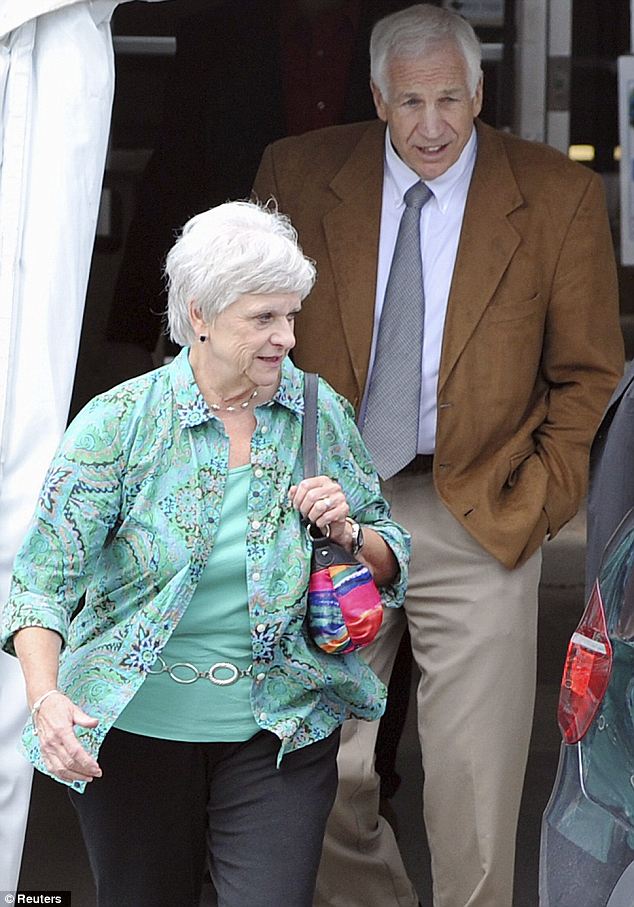
Jerry Sandusky has been found guilty of sexually abusing young boys while he was an assistant coach of the Penn State football team.
Jerry Sandusky, 68, was convicted of 45 of the counts against him, and acquitted of a further three.
He is now headed to jail where he will be placed on suicide watch and could face a total sentence of up to 442 years in prison.
Jurors were sequestered for just two days while they deliberated the verdict.
The conviction of Jerry Sandusky finally brings an end to a horrific saga which has trashed the reputation of a leading public university and ended the career of its president as well as its legendary head coach, Joe Paterno, who died of cancer in January.
After the verdict was announced in the courtroom in Bellefonte, Pennsylvania, Jerry Sandusky’s bail was revoked and he was taken to the Center County Correctional Facility.
Jerry Sandusky plans to appeal against his conviction, according to one of his defense lawyers.
He showed little emotion as the verdict was read. The judge ordered him to be taken to the county jail to await sentencing in about three months.
In court, Jerry Sandusky half-waved toward family as the sheriff led him away. Outside, he calmly walked to a sheriff’s car with his hands cuffed in front of him.
As he was placed in the car, someone yelled at him to “rot in hell”. Others hurled insults and he shook his head in response.
Jerry Sandusky was accompanied by his wife Dottie as they took a break from the courthouse during deliberations on Friday
Defense attorney Joe Amendola said Jerry Sandusky was disappointed by the verdict.
Meanwhile, Pennsylvania Attorney General Linda Kelly thanked the accusers who testified, calling them “brave men”.
She says the trial was forced on them and that she hoped the verdict “helps these victims heal… and helps other victims of abuse to come forward”.
Almost immediately after the judge adjourned, loud cheers could be heard from at least a couple of hundred people gathered outside the courthouse as word quickly spread that Jerry Sandusky had been convicted.
Eight young men testified in a central Pennsylvania courtroom about a range of abuse.
For two other alleged victims, prosecutors relied on testimony from a university janitor and then-graduate assistant Mike McQueary.
Jerry Sandusky did not take the stand in his own defense.
After the verdict was announced, defense attorney Karl Rominger said it was “a tough case” with a lot of charges and that an appeal was certain. He said the defense team “didn’t exactly have a lot of time to prepare”.
Jerry Sandusky’s former employer, Penn State, which has been dealt a damaging blow to its reputation by the scandal, released a statement after his conviction was announced.
“The legal process has spoken and we have tremendous respect for the men who came forward to tell their stories publicly,” the university said.
“No verdict can undo the pain and suffering caused by Mr. Sandusky, but we do hope this judgment helps the victims and their families along their path to healing.”
The statement added that Penn State had “established a confidential counseling process for victims of Mr. Sandusky’s conduct” and taken other steps to stamp out sexual abuse on campus.
In an apparent attempt to limit the institution’s legal liabilities in the light of the verdict, the statement continued: “The University plans to invite victims of Mr. Sandusky’s abuse to participate in a programme to facilitate the resolution of claims against the University arising out of Mr. Sandusky’s conduct.”
The ex-coach had repeatedly denied the allegations, and his defense suggested that his accusers had a financial motive to make up stories, years after the fact.
His attorney also painted Jerry Sandusky as the victim of overzealous police investigators who coached the alleged victims into giving accusatory statements.
Jerry Sandusky had initially faced 52 counts of sex abuse. The judge dropped four counts during the trial, saying two were unproven, one was brought under a statute that didn’t apply and another was duplicative.
Earlier on Friday, his lead defense attorney told reporters that he would be stunned and “probably die of a heart attac” if his client were acquitted of all 48 counts.
The impromptu remarks by Joe Amendola lasted about 15 minutes inside the courtroom and opened a wide window into the defendant’s state of mind as he and Dottie Sandusky anxiously awaited a verdict.
Joe Amendola said that in anticipation of a verdict, the Sanduskys were spending a lot of time praying. He described the atmosphere at their home as funereal.
On Friday, jurors listened again to testimony from a key prosecution witness against the former Penn State assistant football coach, then went back behind closed doors for a second day of deliberations.
The jury had talked for more than eight hours on Thursday before adjourning at the end of a long session that featured dueling portrayals of Jerry Sandusky as either a “predatory pedophile” or the victim of a conspiracy between investigators and his accusers.
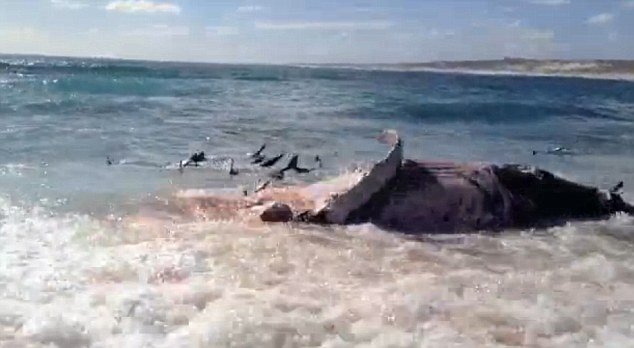
Rachel Campbell and her friends filmed an amazing scene with more than 100 tiger sharks furiously feeding over the carcass of a dead whale on the beach near Warroora Station in northwestern Australia.
Then the surfers wandered a kilometre or so up the beach and went for a surf anyway.
Writing on her blog Rachel Campbell said: “I was collecting shells along the beach with my mum. Searching the white sand while crystal water lapped at my ankles.
“I was shocked to find my worst nightmare dominating the shoreline a mere 400 m ahead.
“Picture about thirty sharks, most of which seemed to be tiger sharks, all destroying a whale laying only a few feet from the shore.”
Rachel Campbell and her friends filmed an amazing scene with more than 100 tiger sharks furiously feeding over the carcass of a dead whale on the beach near Warroora Station
“The nightmare part was the mass of sharks devouring the one victim.
“Before long I realized there were about 100 sharks in total, some as long as, all in a frenzy over fresh whale flesh.
“I have to say that I felt pretty massive playing chicken with waves barely the height of my ankle. You only had to get knee deep and suddenly you’re sharing the same square meter of Indian Ocean with a tiger shark.
“I am well aware of those beasts outside my control. I will still surf here though, because it’s not about merely surviving this ocean, it’s about living and breathing everything that this crazy place has to offer.
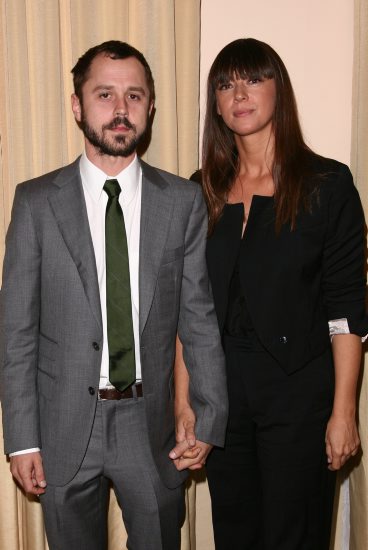
Cat Power, the longtime ex-girlfriend of Giovanni Ribisi, has revealed that their relationship ended just two months before his surprise wedding to model Agyness Deyn.
The 40-year-old indie singer, who lived with Giovanni Ribisi, 37, in his Los Angeles home with his 14-year-old daughter Lucia until their recent split, told The Stool Pigeon that she had been finishing her new album “around the time” they broke up.
Cat Power, who has suffered a nervous breakdown in the past, tweeted on April 20: “I HAVE FINISHED MY RECORD.”
She told the music blog: “The timing couldn’t have been more distracting, to say the least. It was down to the wire and [I was] really suffering, in the end. It hurts.”
Cat Power added that Sun, the new album which is due to be released on September 4, is “this gift I’m lucky I finished” amid “great loss personally in my life right now”.
Cat Power, the longtime ex-girlfriend of Giovanni Ribisi, has revealed that their relationship ended just two months before his surprise wedding to model Agyness Deyn
Cat Power, whose real name is Chan Marshall, also revealed that she chopped off her trademark long brunette locks as a result of the split, which she said “wasn’t really out of left-field, but it kinda was”.
“I cut my hair off three days later, got on a plane to France and I finished the s**t [the album],” she said.
Cat Power, whose album of new material is her first since 2006, admitted that she still loves Giovanni Ribisi.
“It’s all good, you know,” she said.
“I love the person very much. I actually love this record very much too.”
Cat Power also revealed that she had become something of a second mother to Lucia, who is the daughter of Giovanni Ribisi’s previous wife, actress Mariah O’Brien.
“I entered a long relationship which I really wanted to be successful,” she said.
“You know that thing we’re all raised to want: a beautiful life with children? There’s this part of me who wants to be a mother…I was trying to grow my personal life in a way I never did before.”
No doubt a fragile woman, Cat Power once suffered from severe stage fright as a performer.
After a history of substance abuse, she was often seen on stage literally crippled by her anxiety as she attempted to perform her music.
The past two years have seen a more confident performer, which was said to be thanks to her stable relationship with Giovanni Ribisi.
She added that time off-stage helped her re-gather steam as a performer.
“[It] was usually cured by like six days in New Mexico on a beach, topless with my best friend,” she said.
“That usually cures it [anxiety] really quick.”
Giovanni Ribisi’s wedding to model Agyness Deyn, 29, came as a surprise to many, as it was not widely known that the pair was dating.
The news was confirmed yesterday in a statement from Giovanni Ribisi’s publicist after Crown City News snapped a photograph of the couple moments before they tied the knot at Los Angeles County Registrar.
Turkish government has called an emergency security meeting amid reports that one of its fighter jets was shot down by Syrian security forces.
The Turkish military earlier said it had lost contact with an F-4 Phantom over the Mediterranean Sea on Friday morning, south-west of Hatay province.
It did not confirm reports that Syrian air defense forces were responsible.
But local media are quoting Prime Minister Recep Tayyip Erdogan as saying “the other side has expressed regret”.
Recep Tayyip Erdogan also revealed that the two crew members were safe.
Turkish government has called an emergency security meeting amid reports that one of its fighter jets was shot down by Syrian security forces
Relations between Turkey and Syria, once close allies, have deteriorated sharply since the uprising against Syrian President Bashar al-Assad began in March 2011.
The Turkish military said it lost radio contact with the F-4 at 11:58 local time on Friday while it was flying over Hatay, about 90 minutes after it took off from Erhac airbase in the province of Malatya, to the north-west.
“Search-and-rescue efforts have started immediately,” a statement said.
The private news channel, NTV, later cited unnamed military sources as saying that the plane had crashed off Hatay’s Mediterranean coast, in Syrian territorial waters, but that there had been no border violation.
The Turkish and Syrian coast guards were collaborating in the search for the two crew members and the plane, NTV reported.
Witnesses in the Syrian coastal city of Latakia meanwhile said Syrian air defenses had shot down an unidentified aircraft near the town of Ras al-Basit.
Lebanon’s al-Manar television channel – controlled by Lebanon’s Hezbollah Shia movement, an ally of the Syrian government – also reported that Syrian security sources had said that “Syrian air defenses shot down a Turkish warplane and hit another in Syrian airspace”.
There was no immediate confirmation from Turkish officials, but later it was announced that Recep Tayyip Erdogan would be holding an emergency meeting with his top military and intelligence chiefs to discuss the missing plane.
Recep Tayyip Erdogan was also said to have told Turkish reporters on a flight back from Brazil that “the other side have expressed regret” over the downing of the F-4, and also that the pilots had been recovered.