British researchers have developed a porous material that can preferentially soak up CO2 from the atmosphere.
NOTT-202 is a “metal-organic framework” that works like a sponge, absorbing a number of gases at high pressures.
But as the pressure is reduced, CO2 is retained as other gases are released.
The development, reported in Nature Materials, holds promise for carbon capture and storage, or even for removing CO2 from the exhaust gases of power plants and factories.
Metal-organic frameworks have been considered promising structures to trap gases for a number of years. They are so named because they comprise atoms of a metallic element at their core, surrounded by scaffolds of longer, carbon-containing chains.
These complex molecules can be made to join together in frameworks that leave gaps suitable for capturing gases.
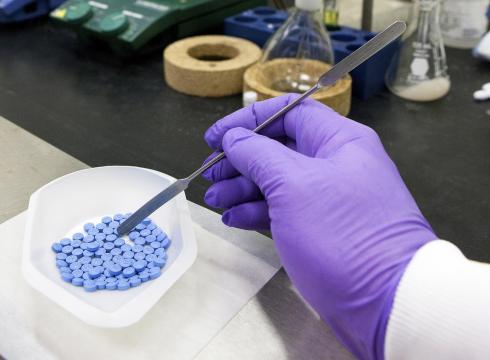
NOTT-202 is a "metal-organic framework" that works like a sponge, absorbing a number of gases at high pressures
However, until now, such frameworks have been good primarily at gathering any gas passing through them; those that were selective for CO2 have proven to have a low capacity for storing the gas.
“Increasing the selectivity for CO2 in the presence of gaseous mixtures represents a major challenge if these systems are to find practical applications under dynamic conditions,” the authors wrote.
The research started at the universities of Nottingham and Newcastle, where scientists discovered a chemical system that seemed to solve this problem of selectively storing a significant amount of CO2.
But to be sure of just what they had, they collaborated with a team at the Diamond Light Source in Oxfordshire and the Science and Technology Facilities Council’s Daresbury Laboratory to get a microscopic look at what they had created.
Using X-ray diffraction and detailed computer models, the researchers found that NOTT-202 is made up of two different frameworks that slot together incompletely, leaving “nanopore” gaps particularly suited to gathering up CO2.
This two-part structure, the researchers claim, is an entirely new class of porous material.
As such, research into just how similarly paired frameworks can be created may help researchers find a range of materials suited to soaking up specific gases.
Snooki and her fiancé Jionni LaValle are expecting a baby boy in September this year and she has revealed in an interview with Good Morning America today what they are going to name their pride and joy.
Snooki, 24, told JuJu Chang that they will be calling their little guido, Lorenzo.
“I think we’re going to do Lorenzo,” she revealed.
“Because then you can call him Enzo.”
She added that if the couple were going to have a girl, they would have called her Giada.
In her hit reality series Jersey Shore, Snooki has long been known as a hard-partying guidette, fond of drinking, “smushing” and tanning.
But now that she is expecting her first child, Snooki has only motherhood on the brain and that includes making big decisions such as whether to breastfeed her firstborn or not.
In the interview Snooki also revealed that she will not be breastfeeding her son when he arrives later this year.
Snooki said that she will be reaching for the breast pump instead.
“It just looks so painful,” she told JuJuChang.
“…But I definitely want to pump, because it has the best nutrients for your baby.”
Snooki, 24, told JuJu Chang that they will be calling their little guido, Lorenzo
Snooki, who did the interview alongside her fiancé Jionni LaValle, also discussed the recent controversial Time cover, which featured the headline Are You Mom Enough?, showing Jamie Lynne Grumet, a 26-year-old mother from Los Angeles, breastfeeding her almost four-year-old son.
“That freaks me out. I mean just drink regular milk,” she said.
When JuJu Chang showed the reality star a breast pump in a New York children’s store, Snooki likened the process to milking a cow.
“It is kind like your cow, you just milk it,” she said.
Meanwhile, Jionni LaValle admitted that a lot had changed since the couple found out that they were expecting.
“Last year it was <<Let’s go to Vegas for New Years>>… Now were going to Disney with the family,” he said.
Snooki, who admittedly loves to have a drink, insisted that not a drop of alcohol has passed her lips since finding out that she was pregnant.
“Obviously no drinking. None whatsoever. Like I am scared to even have caffeine,” she explained.
“All my friends are like <<You can have a glass of wine>>. I’m like <<No I refuse>> because I am going to be that person who has a glass of wine and it will come out with three legs.”
She said that she prefers to stay away from people who drink because it is tempting. This perhaps the reason why she recently moved out of the Jersey Shore house whilst filming the sixth season of the series.
“I don’t like to be around people that drink because then I will miss it,” she admitted to JuJu Chang.
As well as the booze, Snooki has also given up on her beloved tanning regime, but said she is embracing the new paler version of herself.
“I use bronzer on my legs but I didn’t today and look really pale,” she explained.
“I am actually embracing the paleness that comes along with it. It’s a new look.”
One thing that she will not be giving up anytime soon though is the sky-high heels that she has regularly been stepping out in throughout her pregnancy.
“I feel confident in them and I know I am not going to fall,” she said.
“So until it feels really uncomfortable, I am still going to rock them because I am only 24 and I am pregnant, but that doesn’t mean I have to wear flat and ugly shoes.”
Snooki also revealed that she will be upfront with her children when it comes to her controversial past.
“They’re going to Google it no matter what I say,” she said.
“So I’m just going to show them myself and say, <<This is what mommy did. Learn from her mistakes>>.”
Meanwhile Snooki’s ex-boyfriend Emilio Masella has denied that he leaked recent nude pictures that are allegedly of the reality star.
Last week photos which appear to be of the Jersey Shore star disrobing were circulating online.
Emilio Masella, who dated Snooki briefly at the start of 2010, told TMZ that he hadn’t even viewed the pictures until they emerged on the web.
He also insisted that he could not have had access to them in the first place because he believes the snaps were taken more recently, before the reality star got pregnant, judging by her slimmer figure.
Regardless, he said he simply does not care.
“I honestly don’t care. I’m trying to get rid of trash in my life … I’m done with her and moving on with my own career,” he said.
While the alleged pictures certainly looked like the brunette at first glance, it’s still unconfirmed if they’re legitimate or not.
In one photo a woman, who appears to be Snooki, is wearing a white robe.
The grainy photo is of the girl, wearing bright green nail polish, looking seductively into her own mobile device, as if she’s taking a self-portrait.
The next shot shows the robe being opened to reveal private parts, which have been crossed out by black bars.
The photos appear to have been taken in a hotel room as the sheets look like hotel-issued linens and there is a room service tray on the bed.
The third picture in the series is a close up of a girl’s full nude body. Again, the private parts have been black-boxed out.
According to scientists, mother gorillas use a type of “baby talk” when communicating with infants.
The team studied captive western lowland gorillas, watching and filming the animals as they interacted.
These animals have a wide repertoire of communication gestures, so the team focused on facial expressions and hand signals used in play.
They published their findings in the American Journal of Primatology.
Eva Maria Luef from the Max Planck Institute for Evolutionary Anthropology in Leipzig, Germany, led the research.
She and her colleague Katja Liebal filmed 120 hours of footage of the gorillas at Leipzig Zoo and Howletts and Port Lympne Wild Animal Parks in the UK.
Gorillas have a wide repertoire of communication gestures, so the team focused on facial expressions and hand signals used in play
Analyzing this footage revealed that, when they played with infants, adult females used more tactile gestures than they used with other adults; they would “touch, stroke and lightly slap” the youngsters.
“The infants also received more repetition,” explained Dr. Eva Maria Luef.
She described one particularly motherly gesture which the researchers call “hand-on”.
“This is where mothers put the flat hand of their hand on top of the [infant’s] head,” she said.
“It means ‘stop it.”
Gorillas often use this gesture with one another; it is a signal that appears to mean that an animal has “had enough”. But with an infant, the female would repeat the action several times.
The researchers describe this motherly communication as “non-vocal motherese”.
They say that it helps infants to build the repertoire of signals they will use as adults, in order to communicate with the rest of the gorilla group.
“It also shows that older animals possess a certain awareness of the infants’ immature communication skills,” said Dr. Eva Maria Luef.
Prof. Richard Byrne from the University of St Andrews said that he doubted the research shed any light on the evolution of human “babytalk”.
The researcher explained the importance of the way in which adults talk to babies, describing it as a “natural but very smart way of conveying the details of how we construct complex grammar”.
But he added that, since gorillas do not acquire language, they have “no need of such an adaptation”.
“So I suspect this is not the same at all,” he said.
“[But] it is interesting that the adults gesture in a different way to babies than among each other.
“This suggest that adults understand that communicating to infants is going to be tricky, and plan their gesturing accordingly.”
Anti-Putin protesters have begun marching in Russia’s capital Moscow, ahead of a major rally to demand fresh elections and a new president.
The protest, on a national holiday, comes a day after police raided the homes of several prominent activists.
They were all ordered to report for questioning on Tuesday, and so were likely to miss the march.
Last week, President Vladimir Putin signed a new law increasing fines for those who violate protest laws.
Vladimir Putin won a third presidential term in March amid protests over alleged fraud in December’s parliamentary vote.
This is the first big anti-government rally in Russia since Vladimir Putin returned to the Kremlin.
There are tens of thousands of protesters, a sea of flags, banners and placards flowing through the centre of Moscow.
Anti-Putin protesters have begun marching in Russia's capital Moscow, ahead of a major rally to demand fresh elections and a new president
The demonstrators have been chanting “Putin is a thief” and “Russia without Putin”.
Vladimir Putin appears to be taking a harder line against the opposition.
Shortly before the rally, independent media websites went down with news agencies reported difficulty reaching that of the Novaya Gazeta newspaper.
Mikhail Zygar, editor-in-chief of the Dozhd (Rain) TV channel, said its website had come under attack by hackers.
“We’re trying to get back on track. The attack started at 11:00,” he told the Interfax news agency.
Those targeted by police on Monday included leading opposition activists Alexei Navalny, Sergei Udaltsov and his wife Anastasia.
They all arrived for questioning at the headquarters of the Russian investigative committee on Tuesday morning.
It is a rather unsubtle attempt by the authorities to stop them from participating in the protest, our correspondent says.
Police also searched the home of Ksenia Sobchak – a well-known TV presenter and daughter of Vladimir Putin’s late mentor and St Petersburg mayor Anatoly Sobchak – who has joined the protest movement.
“People barged in at 8:00 a.m., gave me no chance to get dressed, robbed the apartment, humiliated me,” Anatoly Sobchak said in a Twitter post.
“I never thought we would return to such repression in this country.”
Sergei Udaltsov told reporters that police had “rifled through everything, every wardrobe, in the toilet, in the refrigerator. They searched under the beds”.
Alexei Navalny said police seized computer disks containing photos of his children, along with clothes including a sweatshirt bearing an opposition slogan.
Federal investigators have summoned the opposition leaders to appear for questioning just one hour before the scheduled start of the rally.
Following the raids, US State Department spokeswoman Victoria Nuland said Washington was “deeply concerned by the apparent harassment of Russian political opposition figures on the eve of the planned demonstrations on June 12”.
“Taken together, these measures raise serious questions about the arbitrary use of law enforcement to stifle free speech and free assembly,” she said.
The searches also triggered a wave of protest from Russian bloggers, who compared the actions to those of Stalin’s secret police in the 1930s.
The raids may draw new supporters to the anti-Putin cause.
In a separate development in Warsaw, thousands of Russian fans are due to mark their national holiday with a march through the city ahead of their Euro 2012 match against co-host Poland.
It will be heavily policed in what the authorities say is the “greatest ever” security challenge.
When many people hear the word creatine, they may think of a supplement used to improve various functions of the body. However, many do not realize that it is actually already found in the body. In fact about 95% of all creatine in the human body is stored in the muscle tissue. As a supplement, creatine can be taken to increase the levels of creatine found in the muscle tissue. As a result you will gain muscle lose fat.
There are three amino acids that make up creatine. These include arginine, glycine and methionine. When these amino acids are joined in the liver, creatine is produced. Creatine can be found natural in sources of meat. However to get large amounts of creatine, large amounts of meat will need to be eaten. Creatine supplements sold in stores are not from meat. They are actually made in laboratories today. The three amino acids are joined to make creatine in a powder.
Creatine supplements are especially useful for vegetarians who get no creatine from their diet. Their creatine is produced only in their liver by using amino acids. By taking creatine supplements, people are able to get a large dose of creatine without needing to eat meat. Creatine supplements also work as a weight gainer for those people who need to gain some pounds.
When purchasing creatine, it can come in some different forms. One of these is known as creatine monohydrate. This is the most common form. Typically it is purchased as a white powder than can be mixed into protein powder shakes or other beverages. Not only is creatine monohydrate the most commonly used version of creatine, it is also the most economical. Another form is creatine-ethyl-ester. This form of creatine allows more creatine to actually go into the muscle tissue without any being wasted.
Creatine may protect liver from high-fat diets
A collaborative study involving researchers at the University of Alberta, the University of São Paulo in Brazil, and the Memorial University of Newfoundland has shown that creatine, a naturally occurring amino acid in the human body, may contain properties that help fight the onset of non-alcoholic fatty liver disease caused by a high fats diet.
René Jacobs, assistant professor with the Department of Agricultural, Food and Nutritional Science, was co-author of a research paper recently published in The Journal of Nutrition. The research indicates that taking creatine as a supplement can help prevent non-alcoholic fatty liver disease, as well as numerous other negative health effects associated with high fat intake, such as inflammation and oxidative stress.
“Creatine occurs naturally in the human body,” said Jacobs, “and can also be obtained through dietary means from things like meat, fish and dairy products. However, it’s also available as a supplement in any health-food store, and it’s reasonably inexpensive.[…] This is, by no means, some kind of silver bullet that allows people to eat excessive amounts of saturated fat without any health risks,” he said. “High-fat diets lead to issues like heart disease and stroke. This does suggest, however, that supplemental creatine, combined with a healthy lifestyle, could lead to some significant improvements in people’s overall liver health.”
The Olympic Stadium will be transformed “into the British countryside” for the opening ceremony of the Games on 27 July, which has a £27 million ($43.2 million) budget.
A cast of 10,000 volunteers will help recreate country scenes, against a backdrop featuring farmyard animals and landmarks like Glastonbury Tor.
The opening scene will be called Green and Pleasant, artistic director Danny Boyle revealed.
He added the ceremony would create “a picture of ourselves as a nation.”
The Olympic Stadium will be transformed "into the British countryside" for the opening ceremony of the Games on 27 July
“The best way to tell that story is through working with real people,” said Danny Boyle, who has reserved a role for NHS nurses in proceedings.
There have already been 157 cast rehearsals and Danny Boyle added: “I’ve been astounded by the selfless dedication of the volunteers, they are the pure embodiment of the Olympic spirit and represent the best of who we are as a nation.”
Europe’s largest bell will ring inside the stadium to start the Shakespeare-inspired spectacle, featuring 900 children.
One billion people are expected to watch the opening ceremony.
Danny Boyle, best known for directing Oscar-winning film Slumdog Millionaire and Trainspotting, said the show was inspired by The Tempest and would be about a land recovering from its industrial legacy.
The Stadium’s 27-ton bell was cast at London’s Whitechapel Foundry, where 13.5-ton Big Ben was cast in 1856, and is inscribed with a quote from The Tempest’s Caliban: “Be not afeard, the isle is full of noises.”
It will hang at one end of the stadium, and Danny Boyle said he wanted people to hear it “for hundreds of years”.
A full dress rehearsal will be held for a capacity crowd of 80,000 in the Olympic Stadium, which will be fitted with a million-watt sound system.
Young Iranians must adopt complicated and creative behavior to navigate around restrictions on their private lives, says journalist Kamin Mohammadi, writer, journalist and broadcaster specializing in Iran.
Iran, in her long history, has been no stranger to repression and dictatorship, mostly from invaders. Iranians quickly developed the habit of thriving when times are tough, of somehow finding a way around the obstacles.
“We are long used to not being direct, to never approaching things straight. We have learnt to shimmy our ways around obstacles, and to approach fulfilling the simplest desires of life with creativity and imagination,” Kamin Mohammadi says.
Nowhere is this creativity and imagination more obvious that in the relations governing men and women.
“Before I returned to Iran after nearly 20 years away, a very well-informed and well-travelled friend said to me: <<But they don’t drink or have sex before marriage in Iran>>.
“When I arrived in Iran, and especially after I had travelled back there often enough to be absorbed into the fabric of Iranian life like a local, I realised that statement could not be further from the truth.
“Everywhere I went I was offered <<a real drink>> by Iranians who had become specialist home brewers, so good at turning hops into beer or grapes into wine in their basements that some still carry on these home-brewing concerns now that branded alcohol is easily available on the black market,” Kamin Mohammadi says.
Young Iranians must adopt complicated and creative behavior to navigate around restrictions on their private lives, says journalist Kamin Mohammadi
As for dating and sex – well, what would you expect of a population that is overwhelmingly young? Some 70% of Iranians are under the age of 35 and this army of young people has grown up under the restrictions – and its curious contradictions – and they are used to bending the rules. The state runs to keep up.
“When I first visited Iran in 1996, and I wanted to walk down the street with a male family friend my mother considered it judicious to come with us, in case we were stopped and asked to prove our relationship to each other. But as the years passed, my expeditions with this male family friend became a telling marker of how the regime was changing.
“Just a couple of years after that first trip, my friend and I would walk around Tehran together and soon we were roaming the streets endlessly – in order to have some privacy.
“Our first visits were to newly-opened internet cafes – where I saw booths crammed with youngsters poring over the screen together. Most popular were – and remain – chat rooms where people can meet and chat – and even set up secret dates,” the journalist says.
For the first time in Iranian history, the people have a private space – a room of their own albeit in cyberspace – in which they can interact with others, usually of the opposite sex, without being watched, restricted or punished.
“When my friend and I were able to stray further from home, we had to take taxis home. In Iran, as well as private taxis, there are shared taxis called savaris which you can share with as many other people as are going your way. The driver squeezes in as many people as he can and here the normal rules of the Islamic Republic – so keen on gender segregation – seem to go out of the window.
“Although people try to arrange themselves so that strange men and women are not sitting on top of each other, my friend and I found ourselves sitting so close that I could feel his heart beating, the closest we had ever come physically.
“One friend, Iranian-born and brought up in the West like myself, told me of a romance she had had with a young man from Tehran which consisted purely of them riding around in savaris. They would ride from one end of town to another, asking the driver to take no other fares when they wanted to talk, and asking him to take other fares when they wanted an excuse to get physically close to each other,” she says.
The creative possibilities of the car have probably not been thus explored since America invented The Teenager in the 1950s. In Iran now, the car has become a neutral space, a place that the people – not just the young – can escape from the ever-present eyes of the family, society and the regime.
The mobile phone is another space in which young Iranians have found their creativity. During evening strolls with my friend, his phone would start to ping insistently. He explained to me they were Bluetooth requests to link phones with his. Those within Bluetooth reach would try to connect, to exchange numbers. This marks definitively the first time that Iranians – indeed many in the Middle East – have been able to go outside the control of the family to choose their own romantic interest.
“Another friend, a veteran of Silicon Valley who runs an internet company in Iran, once told me that we have the most creative computer minds because, from a young age, they start to crack the censorship codes that ban certain websites.
“I am no prophet, but I would guess that where a sexual revolution takes place, a social revolution can follow. The people of Iran, their creativity honed from thousands of years of repression, are adept at doing what they want while appearing to follow the rules.
“Their inventiveness and creative solutions to restrictive life have sharpened and honed their brains, and, I believe, will eventually also chip away at the restrictions of the regime until they become meaningless.
“When the day comes that Iran enjoys its own brand of democracy, the extra dimensions this constant weaving around the rules has given the Iranian character will help it to achieve truly great things in the world,” said Kamin Mohammadi.
Those who ran Alcatraz liked to say nobody ever escaped alive, but that hasn’t stopped US marshals from continuing the search for three men who made it off the island 50 years ago.
According to the official version, Frank Morris, and the brothers John and Clarence Anglin were presumed drowned in the cold and choppy waters of San Francisco Bay.
There are plenty of people who think they did make it ashore and have been in hiding ever since.
Rumor had it they would return to the prison turned tourist spot on the 50th anniversary of their escape. Although it’s not certain where the urban myth began, US Marshal Michael Dyke spent the day on the island anyway, just in case.
Most prisoners who tried to flee “The Rock”, as it became known, were captured or killed or drowned.
But this was one of the most daring and intricate escapes in the notorious prison’s history – involving spoons, papier-mache heads and rubber raincoats.
According to the official version, Frank Morris, and the brothers John and Clarence Anglin were presumed drowned in the cold and choppy waters of San Francisco Bay
It began by digging away at the concrete around the air vents in their cells with spoons and a drill-like device fashioned from a vacuum cleaner.
Accordion practice muffled the sound of the drilling, and cardboard was carefully used to cover each hole as it grew. Soap became a substitute for removed rivets.
When the time came, they squeezed through into a utility corridor and headed for the roof.
Guards doing their rounds periodically checked on the faces of their prisoners. The three escapees appeared to be sleeping soundly, the guards were unaware they were papier-mache heads with real hair, harvested from the prison barber shop.
The three made it up to the roof, and despite the searchlights, headed over high barbed-wire fences.
At a watchtower blind spot they used improvised bellows to inflate a raft fashioned from rubber raincoats.
A fourth member of the gang had been unable to remove his air vent quickly enough, and by the time he broke through, the others had already cast off into San Francisco Bay – to their deaths or to freedom – depending on what you believe.
Remnants of the raft were found washed up on a nearby island, but the men were never seen again.
“I think there’s a good possibility that they survived,” US Marshal Michael Dyke says.
“It’s hard to say. We have to keep the case open since no bodies have been found, but about a month after they escaped in July 1962 a Norwegian freighter saw a body floating in the ocean 15 miles from the Golden Gate Bridge.
“He had on prison clothes – a navy pea coat and a light pair of trousers – similar to what prisoners wore. There were no other missing people during that time period.”
He thinks that may have been the body of Frank Morris, believing the Anglin brothers would have looked after each other.
But the uncertainty over their fate created a legend. Books and documentaries continued to question whether they drowned, or in fact made it to shore. Clint Eastwood played Frank Morris in the 1979 film Escape from Alcatraz.
One TV show re-enacted the escape in similar conditions and concluded they could have survived.
“I still receive leads once in a while regarding the case and there are still active warrants,” said Michael Dyke says. He has personally been investigating for almost 10 years.
“Because it’s an open case we have to go looking for them. Most leads aren’t really that good or credible. Generally 99 percent aren’t true.”
But along with a few relatives of the missing men, he went to the island for the day prepared to make an arrest if necessary on the 50th anniversary.
“Rumors start somewhere and nobody knows where they come from. There’s always a legend, but I don’t think it’s going to happen.”
US scientists have found that children with older fathers and grandfathers appear to be “genetically programmed” to live longer.
The genetic make-up of sperm changes as a man ages and develops DNA code that favors a longer life – a trait he then passes to his children.
The team found the link after analyzing the DNA of 1,779 young adults.
Their work appears in Proceedings of the National Academy of Sciences.
Experts have known for some time that lifespan is linked to the length of structures known as telomeres that sit at the end of the chromosomes that house our genetic code, DNA. Generally, a shorter telomere length means a shorter life expectancy.
Like the plastic tips on shoelaces, telomeres protect chromosomal ends from damage. But in most cells, they shorten with age until the cells are no longer able to replicate.
US scientists have found that children with older fathers and grandfathers appear to be "genetically programmed" to live longer
However, scientists have discovered that in sperm, telomeres lengthen with age.
And since men pass on their DNA to their children via sperm, these long telomeres can be inherited by the next generation.
Dr. Dan Eisenberg and colleagues from the Department of Anthropology at Northwestern University studied telomere inheritance in a group of young people living in the Philippines.
Telomeres, measured in blood samples, were longer in individuals whose father’s were older when they were born.
The telomere lengthening seen with each year that the men delayed fatherhood was equal to the yearly shortening of telomere length that occurs in middle-aged adults.
Telomere lengthening was even greater if the child’s paternal grandfather had also been older when he became a father.
Although delaying fatherhood increases the risk of miscarriage, the researchers believe there may be long-term health benefits.
Inheriting longer telomeres will be particularly beneficial for tissues and biological functions that involve rapid cell growth and turnover – such as the immune system, gut and skin – the scientists believe.
And it could have significant implications for general population health.
“As paternal ancestors delay reproduction, longer telomere length will be passed to offspring, which could allow life span to be extended as populations survive to reproduce at older ages.”
It might be possible that the advantage of receiving long telomeres from an old father is more then set off by the disadvantage of higher levels of general DNA damage and mutations in sperm, he said.
Charlize Theron has shaved off her pretty blonde locks.
Charlize Theron, 36, was spotted out in Beverly Hills yesterday with son Jackson.
And while the South African actress tried to hide her new look under a pork pie hat, the scale of the work done by her hairdresser was obvious to see around the back and sides.
It is believed she has had the dramatic cut for a new film role.
It was certainly a far cry from the luxurious golden locks she proudly showed off at the Alien prequel’s premiere just eleven days ago in sun kissed London.
Charlize Theron has shaved off her pretty blonde locks
Some will question whether she had decided to follow in the footsteps of stars such as Sinead O’Conner and Natalie Portman.
Indeed, it could also be surmised that she had decided to pay a subtle tribute to fellow series star Sigourney Weaver, who shaved off her own locks when she reprised the role of Ripley in Alien 3.
However, her rep has confirmed the real reason for her transformation is for her role as Furiosa in Mad Max: Fury Road, the fourth film in the post apocalyptic series.
She will feature opposite Tom Hardy, who fills the role made famous by Mel Gibson, and she said she cannot wait for the cameras to roll.
Charlize Theron said: “I feel like the original <<Mad Max>> created such a vivid world, that to go back and re-imagine it and kind of replay in that sandbox sounds like fun to me.
“George really created a female character that I’ve never read anything like this. I mean, I’m scared!
“I’m very excited about it; I’m dying! It’s been three years; it’s time to skin this cat already!”
A dingo dog took baby Azaria Chamberlain from a campsite in 1980 and caused her death, an Australian coroner finally rules after 32 years.
The decision was made after Azaria Chamberlain’s parents presented new evidence to try to clear their names.
After the eight week-old baby went missing, they were charged with her disappearance. Her mother was convicted of her murder.
She was released when evidence matched the dingo story but doubts lingered.
They have long argued that the open verdict recorded after an earlier review of the case left room for doubt about Lindy Chamberlain-Creighton’s innocence.
”Obviously we are relieved and delighted to come to the end of this saga,” Lindy Chamberlain-Creighton told reporters outside the courthouse.
”No longer will Australia be able to say that dingoes are not dangerous,” she added.
“We live in a beautiful country but it is dangerous.”
A dingo dog took baby Azaria Chamberlain from a campsite in 1980 and caused her death, an Australian coroner finally rules after 32 years
Speaking after her, Michael Chamberlain, the baby’s father, said ”the truth is out”.
He was with his ex-wife at the Darwin courthouse for the verdict.
”Now, some healing and a chance to put our daughter’s spirit to rest.”
The Northern Territory coroner Elizabeth Morris delivered an emotional verdict, asking baby Azaria Chamberlain’s parents to accept her ”sincere sympathy” for the loss.
”Time does not remove the pain and sadness of the death of a child,” Elizabeth Morris said.
She added that a death certificate was now available for the parents and the final findings could be found on the coroners office website.
Lindy Chamberlain-Creighton has campaigned tirelessly to have dingoes officially blamed for the death of her child.
Earlier this year, the Chamberlains gave evidence to a coroner in Darwin recording a series of other attacks by dingoes on humans.
Virtually ever since Azaria Chamberlain vanished from her tent near Uluru (Ayers Rock) in 1980, Australia has been engrossed by the question of whether she was taken by a dingo.
In 1982, Lindy Chamberlain-Creighton was found guilty of her baby’s murder and sentenced to life imprisonment, while Michael Chamberlain was found guilty of being an accessory.
Both were later exonerated on all charges, after the chance discovery of a fragment of Azaria Chamberlain’s clothing in an area dotted with dingo lairs.
It was a case that divided Australians and was even turned into the film A Cry In The Dark, starring Meryl Streep.
Three previous coroner’s inquests proved inconclusive.
Azaria Chamberlain case
• August 17, 1980: Baby Azaria Chamberlain disappears from a campsite near Uluru (Ayers Rock) – her parents say she was taken by a dingo
• 1982: Mother Lindy Chamberlain-Creighton convicted of murder; father Michael Chamberlain found guilty of being an accessory
• 1986: Police find a piece of the baby’s clothing in area of dingo lairs – case reopened
• September 15, 1988: Both Lindy and Michael Chamberlain cleared of charges
• 1995: Open verdict recorded following another inquest
Political change within days in Greece may mean the country has to ultimately leave the euro.
If that was to happen, how would they go about introducing a new currency?
Greek voters could this week hand power to anti-austerity parties who want to scrap the bailout, the deal that qualifies Greece for vital eurozone funds.
This would bring the country a step closer to a possible exit from the euro. So how could a new currency like the drachma be (re)introduced?
A new government would have to produce enough new notes to replace those currently in use in Greece while also doing their best to prevent a run on the banks.
It would have to be introduced over a public holiday and there would be an interim phase between currencies.
The preparations would ideally occur in secret, says Jonathan Loynes, chief European economist of Capital Economics.
“If Greece were to introduce a new currency, they would have to impose some capital controls once the change had been announced. This would mean that people would only be able to withdraw a certain amount of money from their accounts, which would be necessary to keep things orderly and avoid a run on the banks.
“Then there would be some sort of public holiday during which banks and financial markets would be closed. In an interim period before the new currency is introduced, people could pay for things electronically or with small denominations of euros until the new currency became available.”
Political change within days in Greece may mean the country has to ultimately leave the euro
The new currency would then be introduced on a one-to-one exchange with the old, he says, but at some point the capital controls would be lifted and the new currency would sharply devalue.
This is what happened during Argentina’s economic crisis at the turn of the century. When the banking system came close to collapse, withdrawals were banned. The peso dropped in value, leading to high inflation, after Argentina defaulted on its public debt in 2002.
Recent reports have pointed towards English currency printer De La Rue as a possible source of new drachma banknotes.
Director of marketing for De La Rue, Rob Hutchison, will not comment on speculation that the company has drawn up a contingency plan for the production of new drachma, but he explains that the money-printing process itself can take several months.
“You have to consider the preparation of special banknote paper incorporating security features; the design of the notes; the process of bringing these elements together and then printing. It simply couldn’t be done overnight,” explains Rob Hutchison.
Economist and author of Greece’s Odious Debt, Jason Manoloupoulos, agrees: “I have heard that that the process could take anywhere between three to six months.”
So what is involved in the actual process of changing banknotes?
There is a lot to do, says Julie Girard, currency spokesperson for the Bank of Canada, which has been involved in that country’s recent transition from paper to polymer notes.
The many considerations in currency production range from the selection of the best base material and security features to the design on the notes.
“We have a team of chemists, physicists and engineers whose job it is to go out into the marketplace and see what types of security features are available, both in other currencies and through companies that produce security technology.”
These are assessed, as are different base materials to produce a cost-effective but secure note. Focus groups decide on designs and then notes are produced and distributed, says Julie Girard.
With so many cash transactions and withdrawals now taking place at ATMs and vending machines, these must be adapted to fit a new type of note.
“We spent about two years working with companies that produce machines which dispense, accept and sort paper currency, providing test notes and staff from the bank to help them. Some machines may have needed to be replaced, adapted or upgraded,” says Julie Girard.
Greece wouldn’t have the time that Canada did, but preparations may have been secretly going on for months.
Greeks have already reportedly begun to stash euros in safety deposit boxes and under mattresses.
These notes could be used to finance transactions even if another currency became the local tender, says Michael Massourakis, director of economic research for Alpha Bank, Greece.
“You can’t stop people using that money to buy things, even if you make it illegal to use foreign exchange in transactions. The euro could still be used afterwards on the black market, for example.”
But just how “new” would a new Greek currency be? Reports on Greece’s financial future concentrate on the idea of the drachma – the currency which was replaced by the euro in 2001. Could these old notes be re-used?
Although old drachma were still accepted in exchange for the euro by the Bank of Greece as recently as February 2012, most will have been shredded and burned, says the British Museum’s Thomas Hockenhull.
“If the original drachma printing plates still existed, it could be a fairly straightforward process to change the dates and use the existing machinery,” he says.
And coins may be ditched entirely. “They may just do away with coins and have only paper currency,” says Thomas Hockenhull.
“The cost of producing a coin can be more than that of making a paper note, because of the metal content.”
Apple has unveiled its latest mobile operating system, iOS 6, at its annual Worldwide Developers Conference (WWDC) in San Francisco.
The operating system, which runs on its iPhone, iPad and iPod Touch devices, will no longer include Google Maps software.
Apple will instead run its own mapping app, which has a high-quality 3D mode, on the platform.
Google announced its own 3D mapping software last week on its competing mobile platform, Android.
Both companies have used fleets of planes to capture the imagery, drawing concerns from some privacy campaigners.
Apple’s updated iOS software is being released in beta on Tuesday, and will be available for general consumers by the autumn, chief executive Tim Cook said.
It will be a free update for owners of either an iPhone 4S, iPhone 4 or iPhone 3GS – as well as users of the latest iPad, the iPad 2 and fourth generation iPod touch.
Apple has unveiled its latest mobile operating system, iOS 6, at its annual Worldwide Developers Conference (WWDC) in San Francisco
Additional features include “eyes free”, a feature on which Apple said it had worked with car manufacturers to integrate a “Siri button” to activate the iPhone’s voice-operated assistant.
For the first time on Apple’s devices, video calls will be able to be made over a cellular connection, rather than relying on wi-fi or another mobile internet source.
The switch to its own mapping platform will provide Apple with even more opportunities to monetize its users, said Carolina Milanesi, an analyst for Gartner, who attended the event in San Francisco.
“Maps got the biggest cheer [from the audience],” she said.
“The opportunity that controlling maps gives to Apple for learning more about what their users are doing, keeping that information, and then being able to leverage that for advertising purposes is huge.”
Carolina Milanesi said the announcements appeared to be warmly received by the developers in attendance.
“iOS6 is a continued evolution,” she said.
“I think the whole operating system is getting more clever. It’s learning from what consumers are doing and improving the experience.”
Apple also announced revamped models in its Macbook Pro and Macbook Air ranges.
Its new Macbook Pro is 0.71 inches thick, with a high-resolution Retina display. It utilizes Intel’s Ivy Bridge processor.
Its slimline Macbook Air range has also been upgraded with enhanced graphics and processing capabilities.
Both will offer a free upgrade to OS X Mountain Lion, the latest version of the Mac operating system which is set for release in July.
Among its features is enhanced synchronization between desktop, laptop and mobile, thanks to iCloud, the company’s cloud-based storage service.
Once again, predictions that Apple was set to announce a long-rumored television failed to materialize.
A new mobile phone app made by a team from the University of Portsmouth’s School of Computing, UK, will prepare users for receiving good or bad news on their phones, say researchers.
The app distinguishes good messages from bad and neutral ones, and color codes them accordingly.
Users may choose not to open negative messages if they are already having a stressful day.
But some experts think that ignoring such messages may also be stressful.
For now, the app has been tested on phones running Android OS, and the results of the study will be presented at the 16th International Conference on Knowledge-Based and Intelligent Information and Engineering Systems in Spain in September.
The app automatically color codes incoming messages, making them green for positive, red for negative and blue for neutral.
This way, a user can see before opening a message whether it is likely to be worrying or not.
The app automatically color codes incoming messages, making them green for positive, red for negative and blue for neutral
“The application works by learning from past messages how the user perceives the content as being positive, negative or objective,” said lead researcher Dr. Mohamed Gaber.
“The ultimate objective… is to make the user aware of the negative contents they receive so they are able to manage their stress in the best possible way.
“For example, if most of what is received from social media websites by a user on a particular day was negative, it is important that the user attempts to take an action in order to not get stressed, especially if this may affect the individual’s performance at work and/or their behavior at home.”
The scientist added that the app comes “pre-trained”, but users are able to self-label any incoming text message to personalize it – as some messages may be perceived in a different way by different users.
But Pamela Briggs, a psychologist from the British Psychological Society, thinks the main question is whether or not a user can trust that the app will indeed interpret the information correctly.
“Researchers are increasingly able to use various kinds of linguistic analysis to determine message content, and so it is reasonable to assume that some kind of color coding is viable in this context,” said Dr. Pamela Briggs.
“But the bigger question is whether or not such an app will genuinely let us manage stress more effectively.
“Imagine that you get a ‘bad’ message from a boss, husband or friend – the researchers suggest that you might want to put this to one side, to open at a more appropriate moment, but stress is often made worse by the anticipation of an unpleasant event and actually dissipated once you tackle the problem directly.
“The app seems to do the job of a traditional mail envelope – this message is a tax bill, that message is a card from a friend – but taken to an electronic extreme.
“What if we decide to delete the ‘bad’ message, rather than to read it – and then spend several days worrying about it. I’d like to see some behavioral research on the stress claims made by the authors, before we can assume that it might make our lives easier.”
The scientists say they were inspired by previous research in the area, in particular by a system called SentiCorr, developed by a team from the Eindhoven University of Technology in the Netherlands.
This is a system “for automated sentiment analysis on multilingual user generated content from various social media and e-mails”, as described in the research paper.
It also uses color coding for positive, negative or neutral content.
“Our system is aimed at helping individual users become more aware of the sentiment in their correspondence,” states the paper.
A woman from New Zealand who had part of her jaw removed after she was wrongly diagnosed with mouth cancer is now struggling to walk.
The 63-year-old, who has not been identified, is seeking compensation from the University of Otago Dental Hospital in Dunedin, after the unnecessary operation left her with a series of health problems.
The misdiagnosis reportedly occurred when a laboratory worker confused two tissue samples that were dropped on the floor, according to the Otago Daily Times.
The misdiagnosis reportedly occurred when a laboratory worker confused two tissue samples that were dropped on the floor
The woman, who was suffering from sinus infections and facial swelling from a tooth implant, was told that she had mouth cancer and that she would need to have the right side of her upper jaw removed.
Bone and blood vessels were taken from her lower leg and used to reconstruct her jaw, which led to complications, according to the newspaper.
“Her donor wound site got infected and she had difficulty walking,” Dr. Iain Wilson, the surgeon who conducted the operation, said.
It later transpired that the patient’s tissue sample had no signs of cancer and that the test results were mixed up.
“I am being asked to believe two samples were being processed simultaneously and the pots were simultaneously dropped,” Dr. Iain Wilson said.
“I can’t for the life of me understand how you can get tissue samples mixed up. I am astonished and horrified by these lab mix-ups.”
The hospital has since apologized to the woman and the case is being investigated by New Zealand’s Health and Disability Commission.
“We have taken this incident very seriously, and have already taken all appropriate measures to minimize the likelihood of any such incidents occurring again,” university faculty of medicine dean Prof. Peter Crampton said.
“The patient was contacted very soon after the incident was discovered, and we offered a full apology at that time.”
Syrian government forces have renewed their attack on the city of Homs, one of the focal points of the uprising against President Bashar al-Assad.
Video published on the internet purportedly from Homs showed intermittent shelling and black smoke.
UN mediator Kofi Annan is concerned civilians have been trapped in Homs and al-Haffa, a town in Latakia province also said to be under attack.
The US says it fears the government may be planning “another massacre”.
Kofi Annan’s spokesman, Ahmad Fawzi, said civilians had been trapped in both Homs and al-Haffa.
Kofi Annan was demanding immediate entry to al-Haffa for UN military observers be allowed, he added.
Syrian government forces have renewed their attack on the city of Homs, one of the focal points of the uprising against President Bashar al-Assad
As joint envoy for the UN and the Arab League, Kofi Annan brokered a six-point peace plan, including a ceasefire which came into nominal effect two months ago but has now been virtually abandoned.
Syrian army appeared to be using an unmanned surveillance drone to select buildings as targets for shelling.
A steady stream of mortar rounds landing in the old city of Homs at a rate of about one a minute.
The UN team – which has been trying for two days to gain access to the old city – has still not succeeded.
All the UN can do is stand by and watch.
US state department spokeswoman Victoria Nuland said it was “deeply alarmed” at “reports from inside Syria that the regime may be organizing another massacre”.
Such an attack could happen, it suggested, in al-Haffa or the towns of Deir el-Zour, Homs or Hama, or in the suburbs of the capital, Damascus.
According to the London-based Syrian Observatory for Human Rights, at least 74 people were killed across Syria on Monday.
An activist website, the Violations Documenting Centre, said there had been 29 deaths in the past week from bombardment in al-Haffa. All but three of the dead were civilians, it added.
These reports cannot be confirmed independently because Syria heavily restricts journalists’ freedom of movement.
The Syrian government blames the violence on foreign-backed armed terrorist gangs.
Separately, UN monitors and human rights activists said Syrian government forces had used helicopters to bombard the town of Rastan, in Homs province.
The town has been under intermittent army shelling “for months”, the Observatory said.
UN spokeswoman Sausan Ghosheh said monitors had seen Syrian helicopters firing on Rastan and another rebel stronghold, Talbisa.
In Talbisa, rebels from the Free Syrian Army captured soldiers from government forces, she added.
Yad Vashem Holocaust memorial in Jerusalem has been defaced with graffiti by vandals denouncing Zionism.
One of the slogans daubed in paint on the walls of the memorial read: “If Hitler had not existed, the Zionists would have invented him.”
“This unprecedented act crosses a red line,” Yad Vashem chairman Avner Shalev said in a statement.
Suspicion for the attack has fallen on radical ultra-Orthodox Jews who oppose the creation of the state of Israel.
Avner Shalev pointed out in comments to local media that one of the slogans was signed “world ultra-Orthodox Jewry”.
“We are shocked and dazed by this callous expression of burning hatred against the Zionists and Zionism,” Avner Shalev said.
Yad Vashem Holocaust memorial in Jerusalem has been defaced with graffiti by vandals denouncing Zionism
Photos of some of the other slogans have been published in the Israeli press, including one reading: “Thanks Hitler for the wonderful Holocaust you organized for us. Only thanks to you we got a state from the UN.“
Another reads: “Honorable government of Poland, stop allowing the Zionists to hold manipulative <<memorial>> ceremonies in Auschwitz.”
Education Minister Gideon Saar condemned the graffiti, saying: “Whoever desecrated and soiled Yad Vashem with these disturbed slogans did it with the aim of harming public sensibilities.”
Police spokesman Micky Rosenfeld said an investigation was under way.
Some ultra-Orthodox Jews believe that a Jewish state can be established only after the coming of the Messiah, and that the state of Israel is therefore illegitimate.
Yad Vashem was established in 1953 and commemorates the six million Jews murdered by the Nazis during World War II.
Madagascar 3 has beaten Ridley Scott’s Alien offshoot Prometheus to top the US box office.
Madagascar 3: Europe’s Most Wanted took nearly $60.4 million over the weekend, according to studio estimates.
Sci-fi thriller Prometheus, starring Noomi Rapace, Michael Fassbender and Charlize Theron, debuted in second place with $50 million.
The film is rated R in the US, meaning under-17s must see it with an adult.
Madagascar 3, which premiered at Cannes Film Festival last month, reunites voice stars Ben Stiller, Chris Rock, Jada Pinkett Smith and David Schwimmer.
Madagascar 3 has beaten Ridley Scott's Alien offshoot Prometheus to top the US box office
The Dreamworks Animation outperformed the $47.2 million debut of the 2005 original, but fell short of Madagascar: Escape 2 Africa, which took $63.1 million in its opening weekend.
The third instalment, which has been a bigger hit with the critics, benefited from higher ticket prices and more expensive 3D shows.
Prometheus, telling the story of a team of explorers who discover a clue to the origins of mankind, was also screened in 3D.
Last weekend’s US number one Snow White & the Huntsman slipped to third-place, with Men in Black 3 at number four.
Fifth place went to The Avengers, which has now taken $571.9 million at the US box office – making it the highest-grossing film of the year so far.
Researchers have found that the teams responsible for the Flame and Stuxnet cyber-attacks worked together in the early stages of each threat’s development.
Flame, revealed last month, attacked targets in Iran, as did Stuxnet which was discovered in 2010.
Kaspersky Lab said they co-operated “at least once” to share source code.
“What we have found is very strong evidence that Stuxnet/Duqu and Flame cyber-weapons are connected,” Kaspersky Lab said.
Alexander Gostev, chief security expert at the Russian-based security company added: “The new findings that reveal how the teams shared source code of at least one module in the early stages of development prove that the groups co-operated at least once.”
Researchers have found that the teams responsible for the Flame and Stuxnet cyber-attacks worked together in the early stages of each threat's development
Vitaly Kamluk, the firm’s chief malware expert, said: “There is a link proven – it’s not just copycats.
“We think that these teams are different, two different teams working with each other, helping each other at different stages.”
The findings relate to the discovery of “Resource 207”, a module found in early versions of the Stuxnet malware.
It bears a “striking resemblance” to code used in Flame, Kaspersky said.
“The list includes the names of mutually exclusive objects, the algorithm used to decrypt strings, and the similar approaches to file naming,” Alexander Gostev said.
Recently, a New York Times investigation – based on an upcoming book – singled out the US as being responsible for Stuxnet, under the direct orders of President Barack Obama.
The report said the threat had been developed in co-operation with Israel.
No country is yet to publicly take responsibility for the attack.
Speaking about Flame, a spokesman for the Israeli government distanced the country from involvement following an interview in which a minister seemed to back the attacks.
“There was no part of the interview where the minister has said anything to imply that Israel was responsible for the virus,” the spokesman said.
Last week, the UN’s telecommunications head Dr. Hamadoun Toure said he did not believe the US was behind Flame, and that reports regarding the country’s involvement in Stuxnet were “speculation”.
Prof. Alan Woodward, a security expert from the University of Surrey, described the findings as interesting – but not yet a clear indicator of who was behind the attacks.
“The fact that they shared source code further suggests that it wasn’t just someone copying or reusing one bit of Stuxnet or Flame that they had found in the wild, but rather those that wrote the code passed it over,” he said.
“However, everything else still indicates that Flame and Stuxnet were written designed and built by a completely separate group of developers.
“At the very least it suggests there are two groups capable of building this type of code but they are somehow collaborating, albeit only in a minor way.”
Rafael Nadal won a record seventh French Open title after beating Novak Djokovic with 6-4 6-3 2-6 7-5 in a rain-affected final.
Rafael Nadal, 26, resumed leading 6-4 6-3 2-6 1-2, but his uncharacteristic wobble late on Sunday had fuelled Novak Djokovic’s belief.
The Spaniard broke back in the first game of the day however, and then piled pressure on an unsettled Novak Djokovic.
The Serb finally folded with a double fault to hand Rafael Nadal an 11th Grand Slam.
Having drawn level with Bjorn Borg on six Roland Garros titles last year, the victory gave Rafael Nadal sole ownership of the landmark, and he is likely to have plenty of opportunities to stretch further clear.
Rafael Nadal won a record seventh French Open title after beating Novak Djokovic with in a rain-affected final
The only three men to have more Grand Slam victories – Roger Federer with 16, Pete Sampras on 14 and Roy Emerson on 12 – are now in his sights.
The crowd had returned to Court Philippe Chatrier entertaining the possibility that they may witness a different piece of tennis history.
Novak Djokovic, aiming to become only the third man in history to hold all four Grand Slam titles simultaneously, seemed to have the upper hand on his rival when Parisian drizzle had forced them off on Sunday.
Rafael Nadal led a precariously-poised contest 6-4 6-3 2-6 1-2 overnight, but, having been broken early in the fourth, he had looked ill at ease on the court he has made his own.
The Spaniard had surrendered eight successive games and grew increasingly irritated by the wet conditions underfoot before tournament officials called an end to proceedings.
With the chance to reassess his position and resume in dry, if cloudy, conditions the world number two emerged reenergized.
Novak Djokovic’s hopes of becoming the first man to beat Rafael Nadal on clay after losing the opening two sets immediately dimmed as Nadal toppled his serve in the opening game.
Rafael Nadal’s body language had spoken volumes on Sunday and, after the Serb’s forehand down the line was snagged by the tape to bring up 2-2 , it was Novak Djokovic who allowed his frustration to show.
The world number one pounded his head with his racquet strings, but the brutal treatment he was receiving from the opposite end of the net proved harder to halt.
Twice Rafael Nadal held to love, while Novak Djokovic’s serve continued to look vulnerable.
Novak Djokovic’s resolve and fight had seem him haul back four match points to beat Jo-Wilfried Tsonga earlier in the tournament, but he appeared drained as he gifted Rafael Nadal the championship without forcing him to play a return.
The Serb’s second serve was long to signal an end of three successive Grand Slam final wins over Rafael Nadal and continue his rival’s extraordinary record of just one defeat in the tournament since making his debut in 2005.
Rihanna is said to have used a body double for the sexy Armani advertisement which she filmed earlier this year.
However, Rihanna, 24, may not be so forthcoming about this revelation and no doubt wants fans to believe she features throughout the minute-long video.
According to The Sun, Irish model Jahnassa Aicken is the other woman who bares her body in a pair of designer knickers.
However, Rihanna’s management allegedly made her sign an order banning her from speaking about the fact that she was used as a double.
“Jahnassa’s torso, body and bum appear in parts of the ad,” a source told The Sun.
“It’s shocking Rihanna wanted one considering she loves posing with no clothes, plus she’s in great shape.”
Rihanna is said to have used model Jahnassa Aicken as a body double for the sexy Armani advertisement which she filmed earlier this year
The advert shows Rihanna laying in a large double bed on her own wearing black lace underwear as she appears to have a nightmare.
It then cuts to her getting out of bed as she picks up the telephone and then slips into a pair of Armani jeans and a leather jacket.
The close-up shots of the singer’s derrière and of her bust are said to be Jahnassa Aicken – not Rihanna.
Jahnassa Aiken is said to have acted as Rihanna's body double in Armani Jeans commercial
Rihanna – who first stated that she would be collaborating with Armani late last year – clearly wasn’t feeling over-confident about her own figure.
Jahnassa Aicken is said to have received a “modest sum” for the job, and was first spotted by Rihanna’s people in a crowd during the filming of her We Found Love music video in Northern Ireland.
“If we have complaints consumers have been misled by the use of a body double, we will investigate,” an Advertising Standards Authority spokesman told The Sun.
British Prime Minister David Cameron and his wife, Samantha, left their eight-year-old daughter, Nancy, in a pub after having Sunday lunch, Downing Street has confirmed.
Nancy Cameron is reported to have spent about 15 minutes at the Plough Inn at Cadsden in Buckinghamshire, before David Cameron returned to collect her.
Number 10 says the couple were “distraught” when they realized Nancy was not with them.
It said it happened “a couple of months ago”.
Prime Minister David Cameron and his wife, Samantha, left their eight-year-old daughter, Nancy, in a pub after having Sunday lunch, Downing Street has confirmed
The pub is near David Cameron’s country residence at Chequers.
The Camerons were at the pub with Nancy and their other children Arthur, six, and 22-month-old Florence, as well as two other families.
After leaving, David Cameron went home in one car with his bodyguards and thought Nancy was with his wife and their other children in another car.
Samantha Cameron had assumed her eldest daughter was with her father. The mistake was discovered when they got home. When the prime minister returned to collect Nancy he found her helping staff.
A Downing Street spokesman said: “The prime minister and Samantha were distraught when they realized Nancy wasn’t with them.
“Thankfully when they phoned the pub she was there safe and well. The prime minister went down straight away to get her.”
In a newly revealed legal filing that asked a court to prohibit Mary Kennedy from threatening suicide in front of their children Robert Kennedy claimed that his estranged wife abused his children from an earlier marriage and violently attacked him on numerous occasions.
Portions of the 60-page confidential divorce affidavit filed in 2011, which includes shocking claims that Mary Kennedy was physically abusive towards Robert and – on one occasion – his daughter, were disclosed in Newsweek magazine’s cover story about her troubled life.
Struggling with debt, depression and drinking heavily, Mary Kennedy searched on the Internet for how to make a noose and asked her housekeeper’s husband to buy some rope, saying it was for a sofa she was making.
Mary Kennedy committed suicide last month at the family’s estate in Bedford, New York, two years after Robert filed for divorce.
Sworn on September 16 2011, Robert Kennedy’s affidavit paints a desperately sad picture of a woman who, experts told Newsweek‘s Laurence Leamer, was suffering from a psychiatric disorder – Borderline Personality Disorder.
The couple, who had four children together, married in April 1994 when Mary was six-months pregnant.
And, according to the affidavit, Mary Kennedy became violent towards Robert shortly before they were married.
“Soon after Mary became pregnant with our first son, Mary, in a sudden rage about my continued friendship with [my ex-wife] Emily, hit me in the face with her fist,” Robert Kennedy said in the documents.
“She was a trained boxer and I got a shiner. Her engagement ring crushed my tear duct causing permanent damage … Mary asked me to lie to her family about the cause of my shiner.”
Robert Kennedy alleges in the affidavit that Mary’s physical abuse frequently reduced him to tears.
Years after that first alleged attack, in May 2011, shortly after the couple separated, Mary Kennedy ran over the family dog Portia, the affidavit claims.
With their children devastated, Mary Kennedy persuaded Robert to come and stay the night to console them – promising that if he visited she would not harass him.
Robert Kennedy duly went over to the estate where a drunken Mary launched a vicious attack on him.
“She […] hit me with a roundhouse punch that, had I not blocked it, would have undoubtedly broken my face. Pointing to Aidan [their youngest son], she screamed, <<You told this child you didn’t love me?>> and hit me again, raining blows down on me as I backed down the hall.
“She struck me maybe 30 times or more,” he alleged in the documents.
Portions of the 60-page confidential divorce affidavit filed in 2011, which includes shocking claims that Mary Kennedy was physically abusive towards Robert, were disclosed in Newsweek magazine’s cover story
In this particular incident, Mary Kennedy allegedly yelled at a crying Aiden that his father was “the most evil kind of man in the world”. Robert Kennedy escaped her continued raining blows by ducking out the kitchen door.
The couple’s housekeeper, who worked for the Kennedys throughout their marriage and was with Robert when he found Mary’s body, remembers an incident where Mary allegedly attacked her husband with a pair of scissors while he was in the bath.
As the couple’s marriage fell apart, their finances dwindled with legal bills soaring to over $1 million, on top of the monthly $40,000 cost to maintain the staffed estate.
Their famously tumultuous relationship began in 1993 while Robert Kennedy’s marriage to Emily was coming to an end after 10 years and having two children, Bobby III and Kathleen “Kick”, together.
Both regulars at AA, Robert and Mary Kennedy each suffered from addictive personalities, the Newsweek article highlighted.
Robert Kennedy had infamously battled a drug addiction while Mary had suffered from anorexia since she attended Putney School in Vermont, where she shared a room with Robert’s younger sister, Kerry.
But, according to Chris Bartle, a godfather to the couple’s youngest son, the couple could not resist one another.
“They couldn’t take their eyes off each other, couldn’t keep their hands off each other. She was glowing and he was repeatedly saying how much he loved her and how glad he was they had gotten together,” Chris Bartle told Newsweek.
However, the marriage soon ran into trouble, according to the affidavit, with the first major incident involving Mary Kenendy’s treatment of Kick, Robert’s daughter from his first marriage.
Visiting her father three weekends a month Kick seemed to lose something at the end of each stay, once it was a plane ticket another time her wallet disappeared.
After being chided by her father, Kick confided to him that she thought Mary Kennedy was stealing from her.
Robert Kennedy immediately dismissed the suggestion.
“She looked me in the eye and said, <<No, Daddy, Mary hates me.>>
“A few weeks later, looking for something in Mary’s bureau, I found a collection of Kick’s lost items concealed beneath a layer of Mary’s clothing,” Robert Kennedy recalls in the documents.
According to the affidavit, it was the first time that Robert Kennedy considered divorce although, on the surface at least, he brushed the incident aside.
Five years later, the affidavit states, Robert Kennedy “learned from Kick and many others who had witnessed Mary’s conduct, the heartbreaking story of Mary’s long campaign of cruelty and abuse directed toward Kick”.
Kick said that her step-mother would take her into a closed room where she would berate her for her apparent faults, Robert Kennedy alleges.
On one occasion Mary slapped Kick for arguing with one of the other children, the affidavit says.
Remaining stoically composed after the deaths of his brothers, Michael and David, Robert Kennedy broke down crying when he discovered Mary’s body hanging from the rafters in a barn at her estate on May 16.
Before Mary Kennedy’s death, he had taken to appearing at public events with their four children, who he had full temporary custody of, and his new girlfriend, 46-year-old actress Cheryl Hines.
Documents showed Mary Kennedy was facing a $32,000 lawsuit from American Express, though this was dropped following her death.
Speaking after Mary Kennedy’s funeral, her old school friend Kerry Kennedy said that Mary had suffered from mental illness the entire 37 years they had known one another.
“She struggled so hard, for so long, with mental illness, which so many Americans suffer with,” Kerry Kennedy said after her death.
“She fought with dignity, and in the end, the demons won.”
The domestic turmoil extended into preparations for her funeral. One of Mary Kennedy’s brothers went to court in an attempt to get custody of her body, while the Kennedys planned to bury her near the family’s seaside compound in Hyannisport, Massachusetts.
Kate Middleton has come in for some rare sartorial criticism over her fondness for her favorite LK Bennett nude heels.
It seems the fashion police will have to try a little harder if they hope to part the Duchess of Cambridge from those trusty LK Bennett court shoes.
Kate Middleton was once again sporting the £185 ($296) heels on Saturday, when she attended the wedding of Prince William’s cousin, Emily McCorquodale – Princess Diana’s niece.
Duchess of Cambridge, 30, was joined by her husband and her brother-in-law, Prince Harry, for the ceremony in Stoke Rochford, Lincolnshire.
While some observers have criticized Kate’s safe choices, she seems happy to be building up a reputation for thrift.
Kate Middleton was once again sporting the $296 LK Bennett nude shoes on Saturday, when she attended the wedding of Prince William’s cousin, Emily McCorquodale, Princess Diana’s niece
Kate wore her faithful court shoes to two events over the Diamond Jubilee weekend, and was seen in them six times during her tour of Canada and the US last summer.
Indeed, her entire outfit for the wedding had been recycled.
She wore the floral Jenny Packham dress at a polo match in the US last year, the dove grey coat at the Order of the Garter service and the hat at last June’s Epsom Derby.
The court shoes are such a favorite that in the last year the Duchess has worn them to the Epsom Derby, to Prince Philip’s 90th birthday at Windsor, to attend Zara Phillips’s wedding and on a visit to the Royal Marsden Hospital, London.
On last summer’s tour of Canada and the U.S. Kate was photographed in them no fewer than six times. On Sunday’s Jubilee River Pageant, they were given another outing on the Royal Barge.
And on Tuesday she got them out of the closet to attend the service of thanksgiving at St Paul’s cathedral.
The high street platforms have also of late been adopted by Princesses Eugenie, who wore a similar black version at the Jubilee River Pageant.
With every outfit coming under the microscope Kate’ support has given a welcome boost to the British brand.
The pumps have become such a success that LK Bennett brought out a Sledge 2 patent version.
Lady Gaga was left stunned by an unexpected mishap while in the middle of her hit song Judas at Sunday’s show in New Zealand.
Lady Gaga, 26, is in the middle of a world tour but was brought back to earth with a bump when she was hit on the head with a giant pole by one of her backing dancers.
The controversial singer had been dancing attached to the pole by a rope but later left the podium and ducked down to pick up a prop gun
Her backing dancer then immediately picked the pole up and was turning it from its vertical position to carry it off horizontally.
It was at this moment that as Lady Gaga raised her head, the pole came crashing down on her.
She immediately carried on but later mentioned the incident to the audience.
“I want to apologize,” she told fans according to TMZ.
“I did hit my head and I think I may have concussion. But don’t you worry, I will finish this show.”
Lady Gaga was left stunned by an unexpected mishap while in the middle of her hit song Judas at Sunday's show in New Zealand
Lady Gaga is playing three concerts at the Vector Arena.
During the shows she, unsurprisingly, underwent numerous costume changes.
She also appeared as a hologram and later thanked a 78-year-old male fan for turning up, telling him “you’re lovely”.
During the two-hour sellout show she also played guitar, rode a motorbike and fell into a “meat grinder”.
Lady Gaga also appeared onstage riding what resembled a giant louse.
The singer made for a bright sight as she arrived in Auckland last week clad in a neon orange dress.
She got a lively welcome from crowds of fans packed outside her hotel.
Her appearance came amid reports she has rekindled her romance with Vampire Diaries actor Taylor Kinney.
Lady Gaga sparked rumors of a reunion after she was joined by the 30-year-old actor in Thailand and then continued on to Singapore with her.
A source told Us Weekly: “They sure looked like they were back together – holding hands and being cute everywhere they went. They were seen kissing right as they got into the [hotel] elevator.”
The insiders confirmed that they were dating once again back on and trying to make things work despite her demanding lifestyle.
They said: “They are going to try and make it work even with her crazy schedule. Gaga realized she missed him.”
Taylor Kinney and Lady Gaga initially split in early May after ten months together. At the time, sources said the Grammy winner’s hectic calendar was to blame.
The informant explained: “She will be touring nonstop until next year. There’s just no room for anything else. Her work is all-consuming.”
A second source admitted last month that things between Lady Gaga and the screen star were still complicated.
“They may still be trying to make it work. She feels like having him keeps her grounded. Obviously she thinks he’s hot… She says he’s ‘really cool.”

Meanwhile, Lady Gaga was forced to cancel her June 3 concert in Jakarta during the Asian leg of her tour following protests from a local hardline Islamist group.