Saturday, January 31, 2026
Home Blog Page 21

Hurricane Erin Explodes to Category 5, Threatening Caribbean

In a terrifying display of nature’s fury, Hurricane Erin has undergone an “incredible” rapid intensification, rocketing from a tropical storm to a catastrophic Category 5 hurricane in just 24 hours, the National Hurricane Center (NHC) announced today. The first Atlantic hurricane of the 2025 season, Erin is now churning through the Caribbean with maximum sustained winds of 160 mph, putting nearby islands on high alert for life-threatening flooding and rip currents.

The explosive growth has shocked even seasoned meteorologists. “Erin gained strength at a pace that was incredible for any time of year, let alone August 16th,” said hurricane specialist and storm surge expert Michael Lowry. The storm’s swift evolution is a stark reminder of the increasing frequency of rapid intensification events, which scientists say are fueled by exceptionally warm ocean temperatures in the Atlantic basin.

As of the latest advisory, the core of Hurricane Erin is located about 105 miles north of Anguilla and is moving west. While the NHC forecasts the storm’s center will remain over open water and swerve north of Puerto Rico and the Virgin Islands, its sheer power and growing size mean that nearby islands are not in the clear. Tropical storm watches have been issued for St. Martin, St. Barts, and St. Maarten, and officials are warning of heavy rain that could trigger flash flooding, landslides, and mudslides.

The outer bands of the storm are already lashing the U.S. Virgin Islands and Puerto Rico, where authorities are taking extensive precautions. The U.S. government has deployed over 200 Federal Emergency Management Agency (FEMA) employees to Puerto Rico, and officials have closed seaports and inspected hundreds of shelters.

While a direct landfall on the U.S. mainland is not expected, the storm’s influence will be far-reaching. The NHC predicts that Erin will at least double or even triple in size in the coming days, generating powerful swells that will create life-threatening rip currents along the U.S. East Coast from Florida to the mid-Atlantic next week.

Erin’s formation and rapid strengthening mark a dramatic start to what forecasters have predicted will be an unusually active hurricane season. The storm is a powerful and sobering reminder that in a warming world, the rules of the game are changing, and a “perfect storm” can form with unprecedented speed. For now, the focus remains on the Caribbean, where residents are bracing for the impacts of a compact but “catastrophic” storm that has become a monster overnight.

Trump’s Warm Greeting to Putin Gets Icy Reception in Ukraine

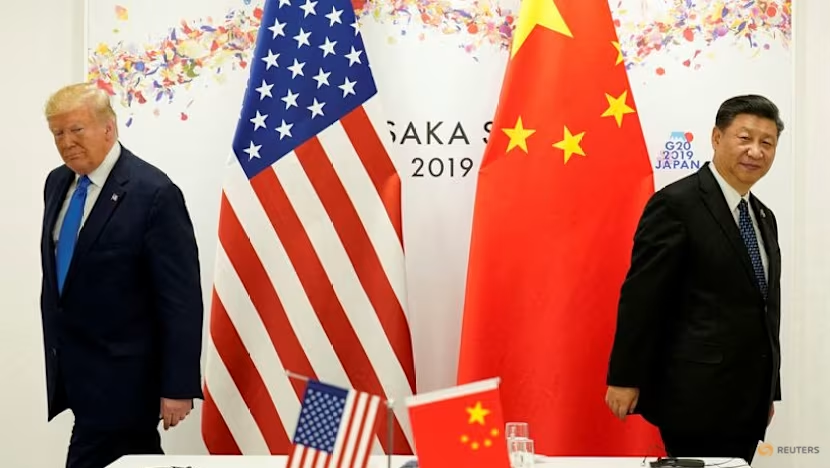
While U.S. President Donald Trump and Russian President Vladimir Putin shared a warm and symbolic handshake on the Alaskan tarmac, the carefully choreographed welcome was met with a cold and anxious reaction in Kyiv. Ukrainian officials and analysts, who were sidelined from the high-stakes summit, viewed the meeting as a potential reward for Russian aggression and a dangerous legitimization of a leader with an international arrest warrant.

The sentiment in Ukraine was encapsulated by Lieutenant General Ihor Romanenko, a former deputy head of the Ukrainian military’s General Staff, who told Al Jazeera that Putin was “legitimized in an absolutely unacceptable way.” Romanenko’s comments reflect a widespread fear that the very act of a face-to-face meeting with the U.S. President has elevated Putin from a global pariah to a respected world leader, undermining the diplomatic isolation the West has sought to impose.

Ukrainian President Volodymyr Zelenskyy, who was notably absent from the talks, was more measured in his public comments. In a post on X, he reaffirmed Ukraine’s “readiness to work with maximum effort to achieve peace” and expressed support for a potential trilateral meeting between Ukraine, the U.S., and Russia. Zelenskyy’s statement, while outwardly hopeful, comes after he has repeatedly warned that any peace deal decided “without Ukraine” would be a “dead decision.”

The Ukrainian president’s concerns are not unfounded. The Trump-Putin meeting ended with no concrete ceasefire or peace agreement announced, and both leaders made only brief remarks without taking questions. While Trump called the talks “very productive,” Putin reiterated that the “root causes” of the war must be addressed before any lasting peace can be achieved—a term that analysts say is a thinly veiled code for rejecting Ukraine’s sovereignty.

The optics of the meeting—the red carpet, the joint travel in the presidential limousine, and the friendly tone—have fueled a deep sense of unease in Kyiv. Analysts told Al Jazeera that the summit was a “masterclass in how a former intelligence officer uses his skills of manipulation on a self-centred narcissist.”

The outcome of the summit has left many in Ukraine with the feeling that the country will have to continue its “complicated fight until Trump grows his willpower and political will,” as General Romanenko put it. The lack of a ceasefire agreement means the war rages on, and Russia’s recent military advances in the Donbas region are seen as a strategic move to strengthen its hand at the negotiating table.

For now, all eyes are on Monday’s scheduled meeting between President Trump and President Zelenskyy in Washington D.C. The summit in Alaska, while it may have been a diplomatic win for Putin, has left Ukraine and its allies with the formidable task of ensuring that their interests are not sacrificed in the pursuit of a peace deal.

Air Canada Strike Grounds Hundreds of Flights, Stranding Thousands of Travelers

Air Canada’s operations have ground to a halt as a strike by more than 10,000 flight attendants entered its first full day, plunging peak summer travel into chaos and leaving thousands of passengers stranded across the globe. The work stoppage, which began at 1 a.m. EDT Saturday, follows the breakdown of months of contentious contract negotiations between the airline and the Canadian Union of Public Employees (CUPE).

The union, which represents flight attendants for both Air Canada and its low-cost subsidiary Air Canada Rouge, walked off the job after a deadline to reach a new agreement passed. In response, Air Canada announced it had suspended its entire schedule of approximately 700 daily flights, advising customers to “not to go to the airport” unless they had a confirmed booking on another carrier. The shutdown is affecting an estimated 130,000 customers per day, including a significant number of Canadians traveling abroad.

The core of the dispute centers on two key issues: wages and compensation for unpaid ground duties. While Air Canada has stated its latest offer included a 38% increase in total compensation over four years, the union has rejected the proposal, calling it “below inflation and below market value.” Flight attendants are also demanding pay for ground duties such as boarding and deplaning, which are currently uncompensated, a practice the union argues is unfair.

“We’re here to bargain a deal, not to go on strike,” said CUPE spokesman Hugh Pouliot, adding that the union wants a fair deal and has rejected requests from both the airline and the federal government to enter into binding arbitration.

The strike’s ripple effect has been felt worldwide. At major Canadian airports in Toronto, Montreal, and Vancouver, picket lines have formed, while frustrated passengers have been left scrambling to find alternative flights. For many, rebooking has been a near-impossible task, as alternative carriers are already operating at full capacity during the busy summer travel season.

“At this point, it’s just a waiting game,” said Alex Laroche, a Montreal resident whose long-planned European vacation is now in limbo. He initially was upset at the union, but after learning about the wage dispute, he said he “had a change of heart,” adding that the flight attendants’ wage is “barely livable.”

The strike’s duration is uncertain, but the impact will be severe. Air Canada’s Chief Operating Officer Mark Nasr has warned that even if a tentative deal is reached quickly, it could take up to a week to fully restart operations. With Canada’s economy heavily reliant on its national airline, there is a growing chorus of business leaders urging the federal government to intervene and force a resolution.

For now, travelers are being advised to check the airline’s website for updates, as the standoff continues with no new talks scheduled. The strike is not just a battle over pay and work conditions; it is a powerful demonstration of the fragile nature of air travel and the deep-seated grievances that can bring a major airline to a complete standstill.

Trump and Putin Hold Ukraine Talks in Alaska After “Extraordinary” Greeting

In a highly choreographed and symbolic display, U.S. President Donald Trump and Russian President Vladimir Putin today met on American soil for the first time in more than a decade, holding high-stakes talks on the war in Ukraine after a warm and unusual greeting on the tarmac of Joint Base Elmendorf-Richardson. The summit, held in the former Russian territory of Alaska, is a pivotal moment in a conflict that has raged for more than three years, but its outcome remains as uncertain as the relationship between the two leaders.

The arrival was a spectacle designed for the cameras. President Trump’s Air Force One and Putin’s Ilyushin Il-96 aircraft both landed on the runway, where a red carpet was rolled out and fighter jets stood in formation. The two leaders descended from their respective planes, walked the carpet, and met in a handshake that was both formal and friendly. In a move that surprised and raised eyebrows among seasoned diplomats, both leaders then got into the back seat of the presidential limousine—without staff or translators—to travel to the meeting site.

For President Trump, who has long boasted of his ability to negotiate with Putin, the meeting is a chance to deliver on a key campaign promise to end the war. “I won’t be happy if I walk away without some form of a ceasefire,” Trump told reporters on his way to Alaska, though he later acknowledged that this first meeting was primarily about “setting the table.”

For Putin, the summit offers a long-sought opportunity to break out of the diplomatic isolation imposed by the West and to re-engage with a U.S. president who has often expressed a desire for a transactional relationship. The choice of Alaska as the location is also significant, with some Kremlin-aligned analysts saying it “underlined the distancing from Europe and Ukraine.”

Trump Putin Ukraine peace talks

The core of the discussions, which a Kremlin spokesman said could last for six or seven hours, revolves around a potential peace deal for Ukraine. Trump has hinted at a “swapping of territories” as a possible solution, a proposal that has been fiercely rejected by Ukrainian President Volodymyr Zelenskyy and has caused deep unease among European allies.

The summit has been met with both cautious hope and profound skepticism. Protesters, including a small group of Ukrainian-Americans, gathered near the military base, holding signs that read “Support Ukraine” and “No compromise.” Their fears, and those of their government, are that Ukraine’s future will be decided without its consent.

Inside the meeting room, the two leaders were seated with their top aides in front of a blue backdrop with the words “Pursuing Peace” printed on it. While the world waits for the outcome of the talks, the carefully choreographed event in Alaska serves as a powerful reminder of the high stakes and deep-seated divisions that define this conflict.

RFK Jr. Revives Defunct Vaccine Safety Task Force, Citing Need for “Trust”

In a move that has ignited a firestorm of controversy, Health and Human Services (HHS) Secretary Robert F. Kennedy Jr. has announced the revival of a long-dormant federal task force on childhood vaccine safety, a body that was disbanded more than two decades ago. The decision, which Kennedy’s department said is aimed at “improving the safety, quality, and oversight” of pediatric vaccines, has been met with both praise from vaccine skeptics and alarm from the mainstream medical community, which warns of a dangerous politicization of public health.

The Task Force on Safer Childhood Vaccines was established by Congress in 1986 but was dissolved in 1998 after years of inactivity. Kennedy’s decision to bring it back follows a lawsuit against his own department, funded by the Children’s Health Defense (CHD), an anti-vaccine advocacy group that Kennedy founded and formerly led. The CHD had sued HHS for failing to reinstate the task force, arguing the department was in violation of U.S. law.

The newly revived panel will be led by National Institutes of Health (NIH) Director Jay Bhattacharya and will include senior officials from the Centers for Disease Control and Prevention (CDC) and the Food and Drug Administration (FDA). Its mandate is to deliver a report to Congress within two years with recommendations for “vaccines that have fewer serious side effects than those already on the market.”

For Kennedy, the move is a key step in his long-held mission to increase scrutiny of the nation’s vaccine schedule. Since taking office, the HHS Secretary has made a series of dramatic changes, including removing all members of the CDC’s Advisory Committee on Immunization Practices (ACIP) and replacing them with members who are more critical of vaccines. His administration has also cut federal funding for mRNA vaccine research and recommended removing COVID-19 shots from routine immunization schedules for healthy children and pregnant women.

The decision has been met with a chorus of condemnation from public health experts. Dr. Paul Offit, a vaccine scientist and member of the FDA’s vaccine advisory committee, told CNN that Kennedy “is an anti-vaccine activist who has these fixed, immutable, science-resistant beliefs that vaccines are dangerous.” He added that Kennedy is now in a position “to set up task forces like this one, who will find some way to support his notion that vaccines are doing more harm than good.”

The Infectious Diseases Society of America (IDSA) has also expressed concern, emphasizing that any changes to the vaccine system should be made transparently and with input from professional societies and patient advocacy groups.

The controversy is a stark reflection of the deep-seated distrust in public health institutions that has grown in recent years. While Kennedy and his supporters argue that a new task force is necessary to restore public confidence, critics fear that it is merely a political tool designed to legitimize debunked claims about vaccine safety. For now, the future of the nation’s vaccine policies and the public’s trust in them hangs in the balance, with the new task force at the very center of the storm.

Spain Faces “Extreme Risk” of Wildfires as 14 Blazes Rage Across the Country

Spain’s Prime Minister Pedro Sánchez today warned that the country is at “extreme risk” of new wildfires, as firefighters and soldiers battle 14 major blazes from the sun-drenched coast to the rugged mountains of the north. The dire warning comes as a scorching heatwave and dry conditions persist across the Iberian Peninsula, creating a perfect storm for a devastating wildfire season.

In a post on X, Sánchez wrote that Friday would “once again be a very tough day, with an extreme risk of new fires.” The national weather agency AEMET has issued extreme fire risk warnings for most of the country, including the regions of Castile and Leon, Castile-La Mancha, Andalusia, and Galicia, where the largest fires are burning.

The fires have already left a trail of death and destruction. This week, a man died after suffering burns on 98% of his body in a fire near Madrid, while a volunteer firefighter perished in the hard-hit Castile and Leon region. More than 8,000 people have been evacuated from their homes and hotels across the country, with some evacuees still unable to return.

Madrid wildfires

The sheer scale of the blazes has stretched resources to their limit. Firefighters and nearly 1,000 soldiers from the Military Emergency Unit (UME) have been deployed to assist local forces. Spain has also taken the unprecedented step of activating the EU Civil Protection Mechanism for the first time ever for forest fires, receiving two Canadair water-bombing aircraft from France to aid in the effort.

Across the border in Portugal, the situation is equally dire. More than 4,000 firefighters and a fleet of aircraft are battling at least seven active fires, prompting authorities to extend a state of alert. The European Forest Fire Information System (EFFIS) reports that over 158,000 hectares, an area roughly the size of metropolitan London, have already been scorched in Spain this year, a grim reminder of a problem that is only getting worse.

The fires are a brutal and painful manifestation of climate change, which scientists have warned is making the Mediterranean region increasingly vulnerable to extreme weather events. Spain’s environment minister, Sara Aagesen, has called the blazes a “clear warning” of the climate emergency.

For now, the battle rages on. As firefighters work tirelessly to contain the flames, the public is being urged to exercise extreme caution. The devastating fires are a stark new chapter in Europe’s annual fight against a changing climate, with millions left to wonder how long this “infernal summer” will last.

First Lady Melania Trump Threatens $1 Billion Lawsuit Against Hunter Biden over “Epstein” Claim

In a dramatic escalation of a political feud, First Lady Melania Trump is threatening to sue Hunter Biden for more than $1 billion unless he retracts a claim that convicted sex offender Jeffrey Epstein introduced her to her husband, President Donald Trump. The legal warning, delivered in a letter from her attorney, calls Biden’s comments “false, disparaging, defamatory and inflammatory” and alleges they have caused her “overwhelming financial and reputational harm.”

The threat follows remarks made by Hunter Biden in a sprawling interview earlier this month with journalist Andrew Callaghan on the “Channel 5” YouTube show. During the interview, Biden claimed, “Epstein introduced Melania to Trump. The connections are, like, so wide and deep.” He attributed the claim to author Michael Wolff, a source the Trump administration has previously accused of making up stories.

First Lady Melania Trump reacts to applause during her speech to US team families and competitors in the 2017 Invictus Games in Toronto, Canada Sept. 23, 2017. (DoD photo by EJ Hersom)

The First Lady’s attorney, Alejandro Brito, sent a letter to Biden’s legal team on August 6, demanding an immediate retraction and a public apology. The letter gives a deadline for compliance, after which, Brito writes, Mrs. Trump will have “no choice” but to file a lawsuit for a staggering sum of over $1 billion in damages. According to reports, Biden has failed to meet this deadline and has doubled down on his remarks in a follow-up interview.

When asked if he would apologize to the First Lady, Biden responded, “F— that – that’s not going to happen.” He added that the threats of lawsuits were “designed distraction” and that what he said was what he had “heard and seen reported and written” by others.

The Trumps and their legal team have long maintained that the President and First Lady met in 1998 at a New York Fashion Week party hosted by a modeling agent, Paolo Zampolli. The First Lady’s team has a history of pursuing legal action against those who spread what they consider false claims. The Daily Beast and a political strategist, James Carville, have both reportedly issued retractions or edited content after receiving legal letters from the First Lady’s team over similar claims.

The potential lawsuit, a legal strategy often employed by the President himself, now sets the stage for a high-stakes legal battle. While public figures must meet a high legal bar to succeed in a defamation suit, the public nature of the feud ensures that it will continue to be a dominant storyline in a tumultuous political environment. For now, the public waits to see if the First Lady’s legal team will follow through on its threat and take the matter to court.

AI Designs Novel Antibiotics to Combat Gonorrhoea and MRSA

In a breakthrough that could usher in a new “golden age” of medicine, scientists have used generative artificial intelligence (AI) to design two entirely new antibiotics capable of killing drug-resistant gonorrhoea and the deadly superbug MRSA. The discovery, led by researchers at the Massachusetts Institute of Technology (MIT), marks a significant leap from using AI to screen existing compounds to using it to create brand-new ones, atom by atom.

The research, published in the journal Cell, is a powerful response to the global crisis of antimicrobial resistance, which claims nearly five million lives a year. For decades, the pace of antibiotic discovery has stalled, leaving doctors with fewer and fewer options to treat increasingly resilient bacteria. Now, AI is offering a new path forward.

“We’re excited because we show that generative AI can be used to design completely new antibiotics,” said Professor James Collins, the senior author of the study and a leading figure in the Antibiotics-AI Project at MIT. “AI can enable us to come up with molecules cheaply and quickly and in this way, expand our arsenal, and really give us a leg up in the battle of our wits against the genes of superbugs.”

The MIT team used two different AI models to design more than 36 million potential compounds. Crucially, they instructed the models to create molecules that were structurally distinct from any existing antibiotics, in the hope of finding drugs that work by novel mechanisms that bacteria haven’t yet learned to resist.

The effort yielded two promising drug candidates, which the researchers have named NG1 and DN1. In laboratory tests, NG1 proved highly effective at killing drug-resistant gonorrhoea, and it successfully cleared the infection in a mouse model. Similarly, DN1 demonstrated strong activity against MRSA, clearing a skin infection in mice. Both compounds appear to work by disrupting the bacteria’s cell membranes, a mechanism different from many current antibiotics.

While the discovery is a major triumph, the journey to a viable drug is still long. The compounds require further refinement and years of rigorous clinical trials before they could ever be prescribed to humans.

The success of this study follows a growing trend of AI’s use in medicine. Previous efforts have seen AI successfully screen ancient microbes and existing drugs to find new antibiotic properties. But this new study, which uses generative AI to invent novel compounds, is seen by many as a game-changer. It demonstrates the power of AI to explore vast and previously inaccessible areas of “chemical space” and to create bespoke solutions to some of medicine’s most intractable problems.

For now, the two AI-designed compounds are being developed further by a nonprofit affiliated with the Antibiotics-AI Project, with the goal of improving their pharmacological properties. The ultimate hope is that this new era of AI-driven drug discovery will not only give doctors the tools to fight today’s superbugs but also enable them to stay one step ahead of the next global health threat.

From ‘Rocky’ to a Podium in D.C.: Sylvester Stallone Among Trump’s Kennedy Center Honors

President Donald Trump today announced his first slate of Kennedy Center Honors recipients since taking on a new role as the institution’s chairman, a list that includes actor Sylvester Stallone, country music legend George Strait, disco queen Gloria Gaynor, the iconic rock band KISS, and British actor Michael Crawford. The selections, which the President revealed himself in a press conference at the performing arts center, mark a significant departure from previous years and signal a new era for the prestigious awards.

The announcement is a culmination of a series of dramatic moves by the President to reshape Washington’s cultural landscape. After removing several members from the Kennedy Center’s bipartisan board, Trump appointed himself chairman, a position he used to take a hands-on approach to the honoree selection process. “I was 98% involved,” Trump said, adding that he “turned down plenty” of candidates, including “a couple of wokesters.”

For Sylvester Stallone, the honor is a new chapter in a career that has made him a pop culture icon. The actor, screenwriter, and director is best known for his unforgettable portrayals of underdog boxer Rocky Balboa and Vietnam veteran John J. Rambo. His work in films like Rocky and First Blood have cemented his place in cinematic history and resonated with millions of fans around the world.

Stallone, a longtime supporter of Trump, has been a favorite of the President. In his first term, Trump had floated the idea of giving Stallone the honor and previously named him as one of three “Hollywood special ambassadors.”

Image source: Wikimedia Commons

The choices have drawn both praise and criticism. Supporters see the inclusion of figures like Stallone and KISS as a welcome democratization of the awards, which have sometimes been perceived as favoring more classical or highbrow arts. However, critics argue that the picks are a blatant politicization of an award that is meant to transcend politics. The Guardian, for example, noted that the list is “characteristically white male-heavy.”

Trump, who famously avoided the honors ceremony during his first term after several honorees said they would not attend a White House reception, announced that he would personally host the gala this December. “I’ve been asked to host. I said, ‘I’m the president of the United States. Are you fools asking me to do that?'” Trump said, according to a report in Al Jazeera. “So I have agreed to host. Do you believe what I have to do?”

The December 8th ceremony will be a major cultural event and a litmus test for the new direction of the Kennedy Center. For now, the focus is on the honorees, a diverse group of entertainers whose work has left an indelible mark on American culture. But with Trump at the helm, it is clear that the politics of the performing arts will be just as much a part of the show as the honorees themselves.

‘Cryptocrash King’ Do Kwon Pleads Guilty to Fraud in $40 Billion Crypto Collapse

In a stunning reversal, South Korean cryptocurrency mogul Do Kwon, the central figure behind the infamous $40 billion collapse of the TerraUSD and Luna currencies, has pleaded guilty in a Manhattan federal court to two counts of fraud. The plea marks a dramatic conclusion to a saga that began with the charismatic “crypto king” on the run and ended with him accepting responsibility for what prosecutors have called “one of the largest frauds in history.”

Kwon, 33, the co-founder of Terraform Labs, admitted to one count of conspiracy to commit commodities fraud, securities fraud, and wire fraud, and a second count of wire fraud. As part of a plea deal with the U.S. Attorney’s Office for the Southern District of New York, Kwon has agreed to forfeit more than $19 million in ill-gotten gains and will lose his interest in Terraform and its cryptocurrencies.

The plea is a significant departure from his previous stance of not guilty and comes after a jury in a civil case had already found him liable for misleading investors. In court, Kwon admitted to his wrongdoing, stating, “I made false and misleading statements about why it regained its peg by failing to disclose a trading firm’s role in restoring that peg. What I did was wrong.”

The collapse of the Terra ecosystem in May 2022 sent shockwaves through the crypto world, wiping out an estimated $40 billion in market value and triggering a broader “crypto winter” that led to the bankruptcies of several major firms. The core of the fraud, according to prosecutors, was Kwon’s misrepresentation of the stability of TerraUSD, a so-called “algorithmic stablecoin” that was supposed to maintain a 1:1 peg to the U.S. dollar through a complex system of code and its floating sister currency, Luna.

The system, as the market discovered, was not stable. When TerraUSD began to de-peg, Kwon and Terraform Labs secretly arranged for a third-party trading firm to purchase large amounts of the token to artificially prop up its price. Kwon then lied to investors, claiming that the system’s own algorithm had restored the peg, a false assurance that led more retail and institutional investors to pour their money into the failing ecosystem.

Kwon’s legal troubles are not over. While his plea deal in the U.S. will likely result in a reduced prison sentence—prosecutors have agreed to recommend a term of no more than 12 years, far below the maximum of 25—he still faces charges in his native South Korea. His extradition from Montenegro, where he was arrested in March 2023 for traveling on a false passport, was a key moment in bringing him to justice.

For the countless investors around the world who lost their life savings in the crash, Kwon’s guilty plea is a form of vindication. The case is a powerful reminder that while the world of cryptocurrency may be a new frontier, the laws against fraud and deception remain very much in effect.

South Korea’s Ex-First Lady Kim Keon Hee Arrested on Corruption Charges

In a dramatic and unprecedented development, a South Korean court has ordered the arrest of Kim Keon Hee, the wife of the country’s jailed former president, Yoon Suk Yeol. The arrest, which came late Tuesday after a five-hour court hearing, marks a stunning fall from grace for the former first lady and an unprecedented moment in the nation’s political history, with both a former president and his spouse now in custody.

The Seoul Central District Court granted the special prosecutor’s request for an arrest warrant, citing the risk that Kim could destroy evidence. The charges against her are extensive, ranging from stock manipulation and bribery to meddling in political candidate selections. The investigation is one of three special prosecutor probes launched by South Korea’s new liberal government targeting the presidency of Yoon Suk Yeol, who was removed from office in April following his botched attempt to impose martial law.

The arrest creates an extraordinary situation in which both members of a former presidential couple are now simultaneously in jail. Yoon, who was sent back to prison last month, faces charges of insurrection, which could result in a life sentence.

The allegations against Kim Keon Hee have been a source of controversy for years, casting a shadow over her husband’s presidency. She is accused of participating in a stock price-rigging scheme involving a local BMW dealership, an offense that allegedly took place before her husband became president but which continued to draw scrutiny throughout his term. She is also linked to multiple corruption allegations, including claims that she received luxury gifts, such as two Chanel bags and a diamond necklace, as bribes from a religious official in exchange for business favors.

During Tuesday’s court hearing, Kim appeared solemn but denied the charges against her. She briefly addressed reporters, offering a vague apology for “causing public concern,” but also hinting at her innocence by portraying herself as “someone insignificant.” However, this did not sway the court, which approved her arrest.

The investigation is a key part of the new liberal government’s agenda, and it highlights a recurring pattern in South Korean politics: a cycle of scandal and imprisonment for former presidents and their families. While several former presidents have faced legal troubles, Kim’s arrest marks the first time a former first lady has been jailed.

The investigation team, led by Special Prosecutor Min Joong-ki, can hold Kim for up to 20 days before formally filing charges. She is being held at a detention center in southern Seoul, separate from the facility holding her husband. For now, South Korea watches as the legal drama unfolds, with the fate of its former first couple in the hands of the courts.

E.J. Antoni: Trump’s BLS Pick Floats Ending Monthly Jobs Report, Sparking Alarm Over Data Integrity

President Trump’s newly nominated pick to lead the Bureau of Labor Statistics (BLS), conservative economist E.J. Antoni, has sent shockwaves through Washington and on Wall Street by suggesting the agency should suspend its closely watched monthly jobs report. The proposal, which Antoni floated in a recent interview, has ignited a fierce debate over the integrity of U.S. economic data and the potential for a political takeover of a traditionally non-partisan agency.

The bombshell idea comes just days after President Trump abruptly fired the previous BLS commissioner, Erika McEntarfer, hours after the agency released a jobs report showing weaker-than-expected growth and a significant downward revision of past numbers. Trump, without evidence, accused McEntarfer of having “rigged” the numbers for political reasons.

Antoni, a chief economist at the conservative Heritage Foundation and a longtime critic of the BLS, has argued that the monthly jobs report is “unreliable” and its methodology “fundamentally flawed.” In an interview with Fox News Digital, he stated, “Until it is corrected, the BLS should suspend issuing the monthly job reports but keep publishing the more accurate, though less timely, quarterly data.” He pointed to a declining survey response rate and “error-filled” statistical assumptions as reasons for his concerns.

The suggestion has been met with immediate and widespread condemnation from economists across the political spectrum. Critics warn that sidelining the monthly jobs report—a key indicator used by everyone from policymakers at the Federal Reserve to investors and business leaders—would be like “gouging out our eyes.” The move, they say, would not only create economic uncertainty but also fuel a perception that the administration is politicizing a vital source of public information.

The White House, however, has sought to distance itself from the more extreme proposal. Press Secretary Karoline Leavitt, when asked if the report would continue to be published, said, “I believe that is the plan and that’s the hope.” However, that assurance has done little to quell the rising alarm.

Antoni’s nomination itself is a significant departure from past practices. Traditionally, the BLS commissioner has been a mild-mannered, non-partisan technocrat. Antoni, by contrast, has been an outspoken and partisan commentator, whose past remarks have been described by some as “rife with basic mistakes.”

The controversy underscores a broader battle over the independence of America’s statistical agencies. With the administration proposing budget cuts and a potential reorganization of the BLS, many fear that the foundation of reliable, non-political economic data is at risk. For now, the fate of the monthly jobs report rests in the hands of the Senate, which must confirm Antoni before he can take the helm of the embattled agency.

Zelensky Rejects Ceding Donbas, Warns of “Third War” as Russians Advance

In a defiant and unequivocal rejection of Russian demands, Ukrainian President Volodymyr Zelensky has declared that Ukraine will not cede the Donbas region to Russia, warning that such a concession would only serve as a “springboard for a future new offensive.” The powerful statement comes just days before a high-stakes summit between U.S. President Donald Trump and Russian President Vladimir Putin in Alaska, and as reports surface of a fresh Russian advance on the eastern front.

Speaking to journalists, Zelensky warned that abandoning Donbas would not bring peace, but rather pave the way for a “third war.” He drew a parallel to Russia’s 2014 annexation of Crimea, arguing that giving up land would only embolden Moscow. “For the Russians, Donbas is a springboard for a future new offensive. If we leave Donbas of our own accord or under pressure, we will start a third war,” he said.

The Ukrainian president’s comments are a direct challenge to the premise of a potential “land swap” that President Trump has hinted at as a solution to the conflict. While Trump has insisted any deal would be “to the betterment of both” nations, Zelensky has been firm in his position that Ukraine’s territorial integrity, as enshrined in its constitution, is non-negotiable.

Ukraine Zelensky

The urgency of Zelensky’s statement is underscored by new reports from the battlefield. According to Ukrainian research groups and open-source intelligence, Russian forces have reportedly made a significant breakthrough in the Donetsk region, advancing as much as 17 kilometers north of their previous lines near the town of Dobropillya. This is a massive leap by recent battlefield standards and is raising alarm bells that supply lines to the strategic city of Pokrovsk could be cut.

This new advance, coming just as Russia has signaled its willingness to negotiate, is seen by many in Kyiv as a classic Russian tactic: making military gains to strengthen its hand at the negotiating table. Zelenskyy himself said that Russia “is definitely not preparing for a ceasefire or an end to the war,” and that the new assaults suggest “preparations for new offensive operations.”

The diplomatic chess match now takes center stage as Trump prepares for his meeting with Putin. The summit, which will be the first between the two leaders since 2019, has been a source of anxiety for Ukraine and its European allies, who have insisted that the “path to peace in Ukraine cannot be decided without Ukraine.”

Zelensky’s rejection of ceding Donbas, combined with Russia’s fresh military advances, paints a grim picture of the immense challenges that lie ahead. The divide between the two sides remains immense, and for now, the war rages on, with the fate of Ukraine’s future hanging in the balance.

International Outcry Mounts as Israel Bombards Gaza City, Amid Warnings of “Unfolding Famine”

As Israeli airstrikes and tank fire pounded eastern districts of Gaza City overnight, a growing coalition of international allies, including the United Kingdom, issued a powerful joint statement demanding immediate and unrestricted humanitarian access to the besieged territory. The coordinated call to action comes as a global hunger monitoring system warns that a “full-scale famine” is now unfolding, a dire situation exacerbated by Israel’s planned offensive to take full military control of Gaza’s largest urban center.

The latest round of intense bombardment, which witnesses and medics say killed at least 11 people, marks a significant escalation in the 22-month war. The renewed offensive, approved by the security cabinet of Prime Minister Benjamin Netanyahu, has drawn sharp criticism not only from global leaders but also from military officials and protesters in Israel, who fear the plan endangers the lives of the 50 remaining hostages.

In a joint statement released by the UK’s Foreign, Commonwealth & Development Office, foreign ministers from 25 countries—including Australia, Canada, and multiple European nations—declared that the humanitarian suffering in Gaza has reached “unimaginable levels.”

“Famine is unfolding before our eyes,” the statement read. “Urgent action is needed now to halt and reverse starvation.”

The statement, which notably did not include Germany, a traditionally staunch ally of Israel, called on the Israeli government to “provide authorization for all international NGO aid shipments and to unblock essential humanitarian actors from operating.” It also demanded that “all crossings and routes must be used to allow a flood of aid into Gaza.”

The warnings echo a recent report by the Integrated Food Security Phase Classification (IPC), which described the situation in Gaza as the “worst-case scenario of famine.” Local health officials have reported a rising number of starvation-related deaths, including children, a figure Israel disputes.

The UN Security Council held an emergency meeting over the weekend to discuss the situation, with a senior UN official warning that Netanyahu’s plan for a new offensive could trigger “another calamity in Gaza.” He said, “This is no longer a looming hunger crisis; this is starvation, pure and simple.”

Israel, for its part, has defended its actions, with Netanyahu asserting that “our goal is not to occupy Gaza, our goal is to free Gaza” from Hamas. He has also denied that there is a “starvation policy,” blaming aid delays on Hamas and claiming that the group is looting supplies.

However, the international pressure is mounting. The joint statement from the UK and its allies, combined with a separate call from The Elders group of global leaders, who for the first time labeled the situation an “unfolding genocide,” signals a significant shift in the global response. The calls for action are a stark reminder that while the military campaign continues, the humanitarian crisis in Gaza is reaching a new and irreversible level of desperation.

A Digital Cage Match: Musk Threatens Apple, Calls OpenAI’s Altman a “Liar” in Escalating Feud

The long-simmering feud between tech titans Elon Musk and Sam Altman has boiled over into a full-blown public brawl, with Musk threatening immediate legal action against Apple and accusing the OpenAI CEO of being a “liar.” The escalating conflict, which has played out on Musk’s social media platform, X, centers on allegations of antitrust violations and a bitter rivalry for dominance in the burgeoning artificial intelligence market.

The latest salvo was fired when Musk, owner of X and AI company xAI, accused Apple of unfairly favoring OpenAI’s ChatGPT app in its App Store rankings. In a series of fiery posts, Musk claimed that Apple’s partnership with OpenAI and its editorial choices make it “impossible for any AI company besides OpenAI to reach #1 in the App Store,” calling it an “unequivocal antitrust violation.” He vowed that xAI would take immediate legal action.

This is not the first time Musk has targeted Apple. He previously threatened to ban Apple devices from his companies after the tech giant announced it would integrate ChatGPT into its “Apple Intelligence” suite, citing security concerns.

The War of Words on X

Musk’s accusations prompted a swift and sharp retort from Sam Altman. In a post on X, Altman fired back, alleging that Musk manipulates the platform to benefit his own companies and harm his competitors. “This is a remarkable claim given what I have heard alleged that Elon does to manipulate X to benefit himself and his own companies and harm his competitors and people he doesn’t like,” Altman wrote. He also linked to a report that claimed Musk had created a special system to prioritize his own posts in users’ feeds.

Musk’s response was equally personal, calling Altman a “liar” and claiming Altman’s post had garnered more views than many of his own, despite Musk’s vastly larger follower count. The exchange is the latest chapter in a long-standing rivalry that dates back to the very origins of OpenAI, which Musk co-founded before leaving in 2018.

A Battle for App Store Supremacy

At the heart of the dispute is the intense competition to be the dominant AI chatbot. While ChatGPT has consistently held the top spot in the App Store’s “Top Free Apps” section, Musk’s Grok chatbot has climbed to the fifth position.

Musk’s legal threats come at a time when Apple is already facing intense scrutiny from regulators. The company is currently battling a federal antitrust lawsuit from the Department of Justice and has been fined by the European Union for anti-competitive practices. Whether Musk’s lawsuit will gain traction remains to be seen, but the public clash between these tech titans serves as a powerful reminder of the high-stakes battle for control of the AI-powered future.

Deadly Wildfires and Scorching Heat Ravage Spain and Portugal

A deadly heatwave gripping the Iberian Peninsula has ignited a series of ferocious wildfires, with a blaze near Madrid killing one person and forcing hundreds of residents to evacuate. The inferno, fueled by soaring temperatures and powerful winds, is part of a larger crisis unfolding across Spain and Portugal, where thousands of firefighters are battling dozens of blazes from the sun-drenched beaches of Andalusia to the historic sites of the north.

The tragedy struck a wealthy suburb of Madrid, Tres Cantos, where a man died after suffering burns on 98% of his body. Emergency services confirmed that winds of up to 43 miles per hour whipped the flames, causing the fire to advance nearly four miles in just 40 minutes. While authorities announced Tuesday morning that the blaze had been contained, its destructive path has left a community in mourning and on high alert.

The Madrid fire is just one front in a country-wide battle. In the northwestern region of Castile and Leon, more than 30 blazes have been reported, with one threatening Las Médulas, a UNESCO World Heritage Site known for its ancient Roman gold mines. In the south, a fire near the popular beaches of Tarifa in Andalusia forced the evacuation of 2,000 people, including holiday-goers, as thick plumes of smoke darkened the sky.

The same punishing conditions are fanning flames in neighboring Portugal. Over 700 firefighters are working to control a major fire in Trancoso, about 217 miles northeast of Lisbon. The blaze, which started on Saturday, has already scorched over 3,000 hectares, or over 7,400 acres, and is being exacerbated by adverse weather conditions.

The wildfires are a stark and deadly reminder of the impact of climate change on a continent that is warming faster than any other. Scientists have long warned that hotter, drier summers are creating a “molotov cocktail” of climatic conditions that are making Southern Europe increasingly vulnerable to wildfires.

The European Union has stepped in to coordinate the response. Through its Civil Protection Mechanism, the EU has pre-positioned firefighters from 14 countries in high-risk areas of Spain, Portugal, France, and Greece to support local forces. The EU’s Emergency Response Coordination Centre is also monitoring the situation around the clock, with a dedicated wildfire support team providing expert advice.

For now, the heatwave shows no signs of abating, with Spain’s meteorology service predicting temperatures could reach as high as 112 degrees Fahrenheit in some areas. As firefighters risk their lives to contain the blazes, officials are urging residents and tourists to exercise extreme caution and heed evacuation orders. The fires are a devastating and painful sign that for much of Europe, the battle against a changing climate is already at our doorstep.

No Financial Punishment for Infidelity: Ex-CEO Andy Byron’s “Cheating” Unlikely to Impact Divorce Settlement

0

The public saga of former Astronomer CEO Andy Byron, whose career and marriage unraveled after a viral “kiss cam” video at a Coldplay concert, has taken a new turn, as legal experts now say his alleged infidelity is unlikely to cost him a heavy alimony payment. Despite the global media frenzy and subsequent allegations of a $40,000 OnlyFans scandal, California’s “no-fault” divorce laws mean the court will not penalize Byron for his actions, a stark contrast to the verdict of public opinion.

The legal reality, according to family law attorneys, is a simple one: In California, a state that pioneered the no-fault divorce system, the reasons for a marriage’s breakdown are irrelevant to the financial outcome. “The court doesn’t care who cheated or why the marriage ended,” said family law attorney Richard Sullivan. “Infidelity may be morally outrageous, but it doesn’t change the financial outcome.”

This legal principle is now at the heart of the looming divorce between Byron and his estranged wife, Megan Kerrigan. While the “ColdplayGate” incident and a subsequent report of payments to an OnlyFans creator have fueled intense public outrage, they do not, in themselves, constitute grounds for a larger financial settlement. California law does not award punitive damages for marital misconduct.

Andy Byron sues Coldplay

However, there is one crucial legal carve-out that could still make Byron’s alleged actions a factor in court: the misuse of “community funds.” In California, a community property state, all assets and debts acquired during the marriage are typically split 50/50. If Kerrigan can prove that Byron used marital money for the alleged affair—to pay for the video calls, gifts, or travel—he could be required to reimburse the marital estate for the amount spent. This would then be factored into the equitable division of assets.

“Unless community funds were used to support the affair—like expensive travel or gifts—cheating has very little legal consequence,” Sullivan added. “It might matter emotionally. But in court, it’s irrelevant.”

The legal analysis comes as Byron faces a very public and professional reckoning. He resigned from his CEO position at Astronomer following the initial viral video, and his estranged wife, Megan Kerrigan, has publicly signaled the end of their marriage by changing her social media name.

While the court of public opinion may have already handed down a severe verdict, the legal system remains bound by a different set of rules. For Andy Byron, the emotional cost of his alleged infidelity will be high, but in the eyes of California law, “cheating” is not a marital crime that automatically leads to a larger alimony payment. The focus will remain on a fair division of assets and financial support based on need, not on who was at fault.

European Allies Insist Ukraine Must Be at the Table for Peace Talks

As the world holds its breath for a historic summit between President Donald Trump and Russian President Vladimir Putin in Alaska, a coalition of European leaders has issued a powerful and unified statement, insisting that the “path to peace in Ukraine cannot be decided without Ukraine.” The declaration, a joint effort by leaders from the UK, France, Germany, Italy, Poland, Finland, and the European Commission, is a clear and direct pushback against any potential peace deal brokered without Kyiv’s consent.

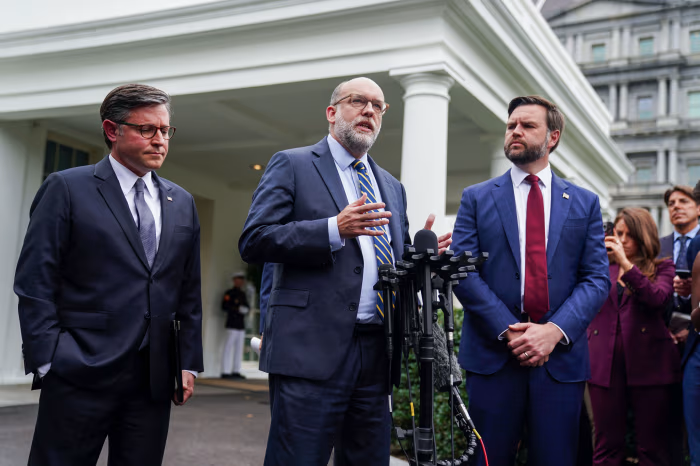
The statement, released late Saturday, follows a series of high-stakes diplomatic meetings in London where U.S. Vice President J.D. Vance and British Foreign Secretary David Lammy hosted a range of national security advisors from Ukraine and key European allies. These pre-summit talks were convened to forge a common strategy and set red lines ahead of Trump’s face-to-face meeting with Putin, which is scheduled for Friday.

Image NBC News

The central point of contention is President Trump’s recent public comments hinting at a “swapping of territories” as a way to end the war. This proposal has been met with immediate and fierce rejection from Ukrainian President Volodymyr Zelenskyy, who has been firm in his position that Ukraine will not cede any land to Russia.

In a video address, Zelenskyy warned that any agreements made without Kyiv’s participation would be “dead decisions.” He stated, “Ukrainians will not give their land to the occupier… The path to peace for Ukraine should be determined together and only together with Ukraine, this is a key principle.”

The European leaders’ statement echoes this sentiment, emphasizing that they “remain committed to the principle that international borders must not be changed by force.” They also stressed the need for “robust and credible security guarantees that enable Ukraine to effectively defend its sovereignty and territorial integrity.”

This diplomatic maneuver is a crucial moment for transatlantic relations. With Trump at the helm, there is a palpable sense of unease in Europe about the direction of U.S. foreign policy. The London talks and the joint statement are an attempt by European powers to assert their own strategic interests and to ensure that any peace deal does not come at the expense of Ukraine’s sovereignty or Europe’s long-term security.

For now, the focus shifts to Alaska, where the two presidents will meet for the first time since 2019. While Trump has expressed optimism, the chasm between the Russian and Ukrainian positions remains immense. The joint statement from Europe serves as a powerful reminder that while the U.S. may be the driver of a potential peace deal, the fate of Ukraine will not, and cannot, be decided without a united front from its allies and its people.

Israelis Protest Against Gaza City Occupation Plan, Fearing for Hostages’ Lives

In a powerful display of public dissent, tens of thousands of Israelis took to the streets of Tel Aviv and other cities on Saturday to protest a government plan for a large-scale military operation to occupy Gaza City. The demonstration, one of the largest anti-government rallies in months, was fueled by a deep-seated fear that the proposed military action could be a death sentence for the 50 remaining hostages held by Hamas.

The protest came just a day after Prime Minister Benjamin Netanyahu’s security cabinet approved the plan, which seeks to intensify Israel’s 22-month war in Gaza. The new operation would see Israeli forces enter the few remaining areas of the territory not yet completely destroyed, a move military officials have reportedly warned against, citing the increased danger to the hostages.

“If, God forbid, anything happens to my David or any other hostage, it’s on your hands,” said Sharon Aloni-Cunio, a former hostage, speaking to the massive crowd in Tel Aviv. Her words echoed the desperation of other families of captives, who have become the most vocal critics of the government’s war strategy. Einav Zangauker, whose son Matan is still in captivity, called for a general strike, urging fellow Israelis to “shut the country down” to pressure the government to prioritize a hostage deal.

The Hostages and Missing Families Forum released a statement calling the cabinet’s decision “a bright red flag” and accused the government of “sacrificing our loved ones.” The forum has been a consistent voice for a ceasefire and a deal to secure the release of the captives, but their pleas have largely been ignored by Netanyahu’s far-right coalition partners, who have pushed for a total takeover of Gaza.

The Israeli government’s plan has also drawn a wave of international condemnation. The Palestinian Authority condemned the move as “a new crime,” while a joint statement from the foreign ministers of the UK, Germany, Italy, Australia, and New Zealand warned it would “aggravate the catastrophic humanitarian situation” in Gaza. A separate statement from more than 20 countries, including key ceasefire mediators Egypt and Qatar, called the plan a “dangerous and unacceptable escalation.”

The UN Security Council is scheduled to hold an emergency meeting on Sunday to discuss the matter, a sign of the widespread global alarm over the potential consequences of the military action.

For the protesters in Tel Aviv, the fight is not just for the hostages; it is for a different path forward. “After two years of fighting there has been no success,” said Yana, a 45-year-old high school teacher at the rally. “I wonder whether additional lives for both sides, not just the Israelis but also Gazans, will make any difference.”

With a majority of Israelis favoring a ceasefire to secure the release of the remaining captives, Netanyahu is facing immense pressure from all sides. As the government moves forward with its plan, the protests in Israel serve as a powerful and painful reminder that the human cost of the war is not confined to Gaza, and that for many, a military victory is not worth the lives of their loved ones.

Niger Demands Answers After Martian Meteorite Sells for $5.3 Million in New York

The discovery of a rare Martian meteorite in the remote Agadez region of Niger has sparked an international controversy, as the country’s government launches a high-stakes investigation into how the precious rock ended up being sold for a record-breaking $5.3 million at a Sotheby’s auction in New York. The sale, which was finalized last month, has prompted outrage from scientists, cultural heritage advocates, and Nigerien officials who are now demanding the immediate return of what they consider a national treasure.

The meteorite, officially known as Northwest Africa 16788 (NWA 16788), is a colossal 54-pound rock that represents nearly 7% of all Martian material ever found on Earth. According to Sotheby’s, it was blasted off the surface of Mars by an ancient asteroid impact and traveled 140 million miles before landing in the Sahara Desert, where it was discovered by a meteorite hunter in November 2023.

Mars rock auction martian meteorite

But for the government of Niger, the meteorite’s origin is less important than its final destination. In an official statement, Nigerien authorities raised suspicions of illegal international trade and tasked the Ministries of Justice, Mines, and Higher Education with conducting a thorough inquiry into how the meteorite was exported.

“It was discovered in Niger? How come it ended up being sold in New York?” said Alia Baré, the daughter of former Nigerien president Ibrahim Baré Maïnassara, in an interview with Forbes Africa. “This is a national treasure that shouldn’t have been sold. Things have to change.”

Largest Mars Rock Ever Found on Earth Sells for $5.3 Million at Auction

The sale has reignited a long-simmering debate about the legal and ethical ownership of extraterrestrial objects found in developing nations. While some countries, like Argentina, have laws that classify meteorites as cultural treasures, many others do not have explicit legislation on the matter, creating a legal gray area that collectors and dealers often exploit. The “NWA” (Northwest Africa) designation itself, which applies to thousands of meteorites, is a result of this lack of regulation, as it is used when the exact place of recovery is not known.

Sotheby’s has maintained that the meteorite was “shipped and transported in line with the standard procedure of all meteorites that come out of Niger” and that “all relevant documentation was in order at each stage of its journey.” However, the auction house has not revealed the identity of either the seller or the anonymous buyer, fueling speculation and hindering Niger’s investigation.

For now, the fate of the priceless rock remains in limbo. Scientists are also concerned that the meteorite’s value could put it in the hands of a private collector who may not allow it to be studied, a loss to the scientific community. The controversy in Niger serves as a powerful reminder of the complex legal and ethical questions that arise when a rock from space becomes a commodity on Earth, and it is a stark new chapter in the ongoing struggle of African nations to protect their natural and scientific heritage from foreign exploitation.

U.S. and UK Host High-Stakes Ukraine Talks Before Trump-Putin Meeting

With a landmark summit between President Trump and Russian President Vladimir Putin looming, U.S. Vice President J.D. Vance and British Foreign Secretary David Lammy today convened a hastily arranged meeting with Ukrainian and European security officials to coordinate a unified stance on a potential peace deal. The talks, held at Lammy’s official country residence, are a clear signal that the U.S. and its allies are working to shape the narrative and set red lines ahead of the highly anticipated face-to-face in Alaska.

The meeting at Chevening House, south of London, included top national security advisors from Ukraine, the U.S., France, Germany, Italy, Finland, and Poland. While President Trump has repeatedly expressed confidence in his ability to broker a peace deal, his public comments hinting at “swapping of territories” have caused deep unease in Kyiv and across Europe.

Ukrainian President Volodymyr Zelenskyy, who spoke with UK Prime Minister Keir Starmer ahead of the talks, has been firm in his rejection of any deal that would involve ceding territory to Russia. In a post on social media, Zelenskyy wrote, “Any decisions that are without Ukraine are at the same time decisions against peace. They will not bring anything. These are dead decisions. They will never work.”

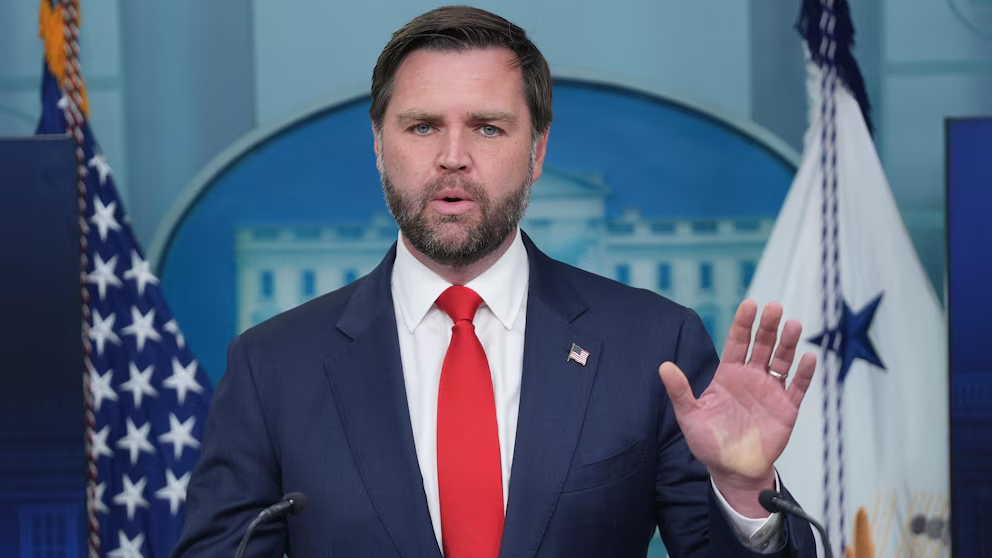
For the U.S. and its European partners, the meeting is an attempt to present a united front to Moscow and to underscore that Ukraine’s sovereignty is not a bargaining chip. Vice President Vance, who has been a vocal skeptic of American military aid to Ukraine, is now tasked with leading the diplomatic charge. His presence at the talks with Lammy, a political opponent with whom he has forged a personal friendship, signals a rare moment of bipartisan and international cooperation on a highly sensitive issue.

The talks focused on a range of critical issues, including:

  • A potential ceasefire: Discussions were held on the conditions and terms of a potential ceasefire, and how to ensure any such agreement is durable and respected by both sides.
  • Security guarantees: European and Ukrainian officials are seeking firm security guarantees from NATO or Western powers to prevent a future Russian attack.
  • Humanitarian aid and reconstruction: The meeting also addressed the need for a comprehensive plan for humanitarian aid and the rebuilding of Ukraine’s infrastructure, which has been devastated by more than three years of war.

While the meeting was a show of unity, the underlying tensions are clear. Trump’s planned meeting with Putin in Alaska has been criticized by some as a unilateral move that bypasses traditional diplomatic channels. The exclusion of Zelenskyy from the direct talks between Trump and Putin has also been a major point of contention.

As the world watches to see if diplomacy can succeed where three years of fighting have failed, the meeting in London serves as a crucial pre-game huddle. It is a powerful reminder that while the U.S. may be leading the charge for a peace deal, its allies are determined to ensure that Ukraine’s future is not decided without its consent.

North Korea Dismantles Propaganda Speakers in De-escalation Move

In a significant and hopeful step toward de-escalating tensions on the Korean peninsula, South Korea’s military announced today that it has detected North Korea removing some of its propaganda loudspeakers along the inter-Korean border. The move comes just days after the South began dismantling its own loudspeakers in a goodwill gesture initiated by newly elected President Lee Jae Myung.

For decades, the border between the two Koreas has been the front line of a Cold War-style psychological battle. From massive speaker arrays, both sides have blasted a barrage of propaganda—North Korea with grating, jarring sounds like howling animals and gongs, and South Korea with a mix of K-pop, world news, and information about democratic society. This sonic warfare has long been a major source of friction, particularly for border residents who have complained about the relentless noise.

The de-escalation began in June when President Lee Jae Myung, who campaigned on a platform of improving relations with Pyongyang, ordered the suspension of South Korea’s broadcasts. North Korea responded in kind, halting its own broadcasts soon after. This week’s removal of the physical equipment is the most concrete sign yet that both sides are serious about reducing friction.

South Korea’s Joint Chiefs of Staff (JCS) confirmed the development, though they did not specify the exact locations where the speakers were being removed. A JCS statement noted that “it remains to be confirmed whether the devices have been removed across all regions” and that the military will “continue to monitor related activities.”

The loudspeaker broadcasts have been a flashpoint for years. In 2024, the previous South Korean government, led by conservative President Yoon Suk Yeol, resumed the broadcasts after a years-long pause in retaliation for North Korea flying trash-laden balloons over the border. That move further inflamed tensions already high from North Korea’s advancing nuclear program and joint U.S.-South Korean military exercises.

The current atmosphere of cautious optimism, however, could be short-lived. Relations between the two countries remain fragile. In late July, Kim Yo Jong, the influential sister of North Korean leader Kim Jong Un, rebuffed President Lee’s overtures, stating that Seoul’s “blind trust” in its alliance with the United States makes it no different from its predecessor. There is also the matter of upcoming large-scale combined military exercises between South Korea and the United States, which begin on August 18 and are routinely labeled as “invasion rehearsals” by Pyongyang.

For now, the quiet on the border is a welcome change. The removal of the loudspeakers, a symbolic but significant step, offers a rare moment of hope for a region that has been on a hair-trigger for decades. The challenge now will be to build on this momentum and find a path toward meaningful dialogue and lasting peace.

Officer Killed in Attack on CDC in Atlanta

A police officer is dead and a nation is reeling after a gunman opened fire on the headquarters of the Centers for Disease Control and Prevention (CDC) in Atlanta on Friday, in an attack that authorities believe was motivated by anti-vaccine conspiracy theories. The tragic incident, which saw bullets rip through the windows of the nation’s leading public health institution, ended with the death of both the gunman and a DeKalb County police officer who responded to the scene.

The Georgia Bureau of Investigation (GBI) identified the deceased officer as David Rose, a 33-year-old former Marine and father of three, who was shot and killed while heroically responding to the active shooter report. The gunman was identified as Patrick Joseph White, a 30-year-old from suburban Atlanta who was found dead in a building across the street from the CDC campus.

The attack, which sent shockwaves through the thousands of employees who work on vital disease research, has been linked to a dangerous and growing narrative against public health institutions. According to law enforcement sources and White’s neighbors, he held a deep-seated belief that he had been made sick by the COVID-19 vaccine and was targeting the CDC as a result. “He very deeply believed that vaccines hurt him and were hurting other people,” a neighbor told the Atlanta Journal-Constitution.

The assault, which began just before 5 p.m., prompted a massive law enforcement response from multiple agencies. White, who was armed with a long gun and reportedly wearing a surgical mask, fired dozens of rounds at the CDC’s Roybal Campus, striking at least four buildings and causing panic. As bullets strafed the campus, employees sheltered in place, with many sending harrowing photos of bullet-pocked windows in their offices. Miraculously, no other civilians were injured.

The tragedy comes at a time of heightened political tension and declining public trust in the U.S. health system, with public health officials warning of elevated threats of violence against their professionals. The CDC, in particular, has been a target of intense criticism and political attacks for its handling of the COVID-19 pandemic.

Health and Human Services Secretary Robert F. Kennedy Jr., who has been a vocal critic of vaccines, issued a statement expressing his condolences to the family of Officer Rose, saying, “No one should face violence while working to protect the health of others.” However, some laid-off CDC employees and advocates called for his resignation, arguing that his rhetoric has fueled a climate of hostility and mistrust toward the agency’s work.

For now, the focus remains on the ongoing investigation and the grieving community. The death of Officer Rose, a man who was praised for his “dedication, courage, and professionalism,” is a stark and painful reminder of the real-world consequences of a public discourse that has increasingly villainized science and public health.

Trump and Putin to Meet in Alaska for Ukraine Peace Talks

In a dramatic and highly anticipated diplomatic move, President Donald Trump has announced he will meet with Russian President Vladimir Putin in Alaska next Friday, August 15, for talks aimed at brokering an end to the war in Ukraine. The summit marks the most direct attempt yet by the administration to fulfill a key campaign promise and comes after months of back-channel negotiations and a series of public ultimatums to Russia.

The announcement was made by the President on his social media platform, Truth Social, where he wrote, “The highly anticipated meeting between myself, as President of the United States of America, and President Vladimir Putin of Russia will take place next Friday, August 15, 2025, in the Great State of Alaska. Further details to follow.”

The choice of Alaska is laden with symbolism. The former Russian territory, sold to the United States in 1867, serves as a neutral ground just across the Bering Strait from Russia’s easternmost point. Kremlin aide Yuri Ushakov confirmed the meeting, calling the location “logical” and noting that it is a region where U.S. and Russian economic interests intersect.

The meeting will be the first between the two leaders since 2019 and will also be Putin’s first visit to the United States in a decade. The visit poses logistical challenges, given the International Criminal Court’s (ICC) standing arrest warrant for Putin, which limits his travel to non-member states.

The central and most contentious issue on the agenda is a potential peace deal for Ukraine. Trump has hinted at a possible “swapping of territories” between Ukraine and Russia, a proposal that has already drawn sharp criticism from Kyiv. Ukrainian President Volodymyr Zelenskyy has stated emphatically that any deal that involves ceding land to Russia is unacceptable and that “decisions without Ukraine” will not bring peace.

A Wall Street Journal report, citing European and Ukrainian officials, suggests that Putin is prepared to agree to a ceasefire but only in exchange for control over eastern Ukraine’s Donbas region and international recognition of Russia’s claims. When asked if a meeting with Zelenskyy was a prerequisite, President Trump replied, “No, he doesn’t,” a statement that has caused concern among Ukraine’s allies.

The summit follows a visit to Moscow by Trump’s special envoy, Steve Witkoff, who held what were described as “highly productive” discussions with Putin. Witkoff had proposed a three-way summit with Zelenskyy, but the Kremlin reportedly left this option “completely without comment.”

For President Trump, the meeting is a high-stakes gamble to secure a diplomatic victory. The world will be watching closely to see if this historic summit can succeed where previous efforts have failed and bring an end to a conflict that has displaced millions and cost countless lives.

NASA’s Webb Telescope Finds Strongest Evidence Yet of a Giant Gas Planet in Our Closest Star System

Astronomers using the powerful James Webb Space Telescope (JWST) have found the strongest evidence to date of a giant gas planet orbiting a star in the Alpha Centauri system, our closest stellar neighbor. The discovery, which places a potential Saturn-mass world just four light-years from Earth, is a landmark finding that brings a new level of detail to the ongoing search for exoplanets.

The new observations, detailed in a series of two papers accepted for publication in The Astrophysical Journal Letters, point to a potential gas giant orbiting Alpha Centauri A, one of two sun-like stars in the triple-star system. This is a monumental achievement, as the Alpha Centauri system’s proximity and brightness have long made it a challenging target for planet-hunting.

“If confirmed, the potential planet seen in the Webb image of Alpha Centauri A would mark a new milestone for exoplanet imaging efforts,” said Aniket Sanghi, a researcher at Caltech and co-lead author of the papers. “Of all the directly imaged planets, this would be the closest to its star seen so far. It’s also the most similar in temperature and age to the giant planets in our own solar system, and nearest to our home, Earth.”

A Mini-Neptune (sometimes known as a gas dwarf or transitional planet) is a planet less massive than Neptune but resembling Neptune in that it has a thick hydrogen–helium atmosphere, probably with deep layers of ice, rock or liquid oceans (made of water, ammonia, a mixture of both, or heavier volatiles). A gas dwarf is a gas planet with a rocky core that has accumulated a thick envelope of hydrogen, helium, and other volatiles, having, as a result, a total radius between 1.7 and 3.9 Earth radii. The term is used in a three-tier, metallicity-based classification regime for short-period exoplanets, which also includes the rocky, terrestrial-like planets with less than 1.7 RE and planets greater than 3.9 RE, namely ice giants and gas giants. Theoretical studies of such planets are loosely based on knowledge about Uranus and Neptune. Without a thick atmosphere, it would be classified as an ocean planet instead. An estimated dividing line between a rocky planet and a gaseous planet is around 1.6–2.0 Earth radii. Planets with larger radii and measured masses are mostly low-density and require an extended atmosphere to simultaneously explain their masses and radii, and observations show that planets larger than approximately 1.6 Earth-radius (and more massive than approximately 6 Earth-masses) contain significant amounts of volatiles or H–He gas, likely acquired during formation. Such planets appear to have a diversity of compositions that is not well-explained by a single mass–radius relation as that found for denser, rocky planets. The lower limit for mass can vary widely for different planets depending on their compositions; the dividing mass can vary from as low as one to as high as 20 ME. Smaller gas planets and planets closer to their star will lose atmospheric mass more quickly via hydrodynamic escape than larger planets and planets farther out. A low-mass gas planet can still have a radius resembling that of a gas giant if it has the right temperature.

The team used the JWST’s Mid-Infrared Instrument (MIRI) and its coronagraphic mask to block the overwhelming glare from Alpha Centauri A, allowing them to detect an object a stunning 10,000 times fainter. The candidate planet appears to be orbiting its star at a distance of about two astronomical units, or twice the distance between the Sun and Earth.

While the planet candidate lies within the star’s “habitable zone”—the region where liquid water could exist on a planet’s surface—researchers say that as a gas giant, it is highly unlikely to support life as we know it. The sheer size of the potential planet, estimated to be around the mass of Saturn, would likely prevent any smaller, rocky planets from surviving in stable orbits in the same region, much like Jupiter and Saturn shape our own solar system.

The initial detection was made in August 2024, but follow-up observations in early 2025 did not reveal the same object. However, Sanghi and his team ran millions of simulations to account for the planet’s orbit and found that the non-detection was not surprising. “We found that in half of the possible orbits simulated, the planet moved too close to the star and wouldn’t have been visible to Webb,” Sanghi said.

The discovery has generated excitement not just in the scientific community but also in popular culture. The Alpha Centauri system is famously the setting for the fictional moon Pandora in the Avatar films. The real-life detection of a potential gas giant in the system, even if it’s not a direct match to the film, underscores the rich scientific and cultural significance of our nearest stellar neighbors.

For now, the astronomers are calling for more observations to definitively confirm the planet’s existence. If confirmed, the finding would challenge our understanding of how planets form and survive in a chaotic, multi-star environment, and would offer a tantalizing glimpse into a new world right in our cosmic backyard.