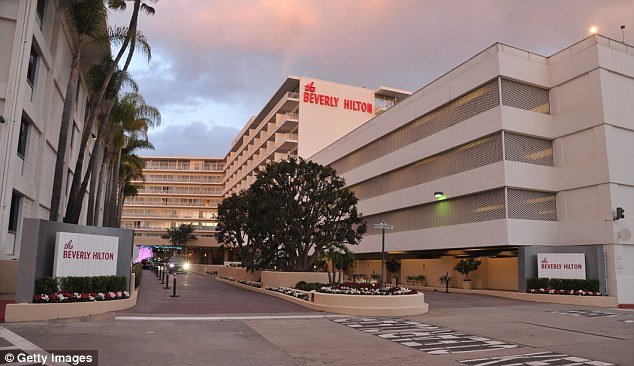
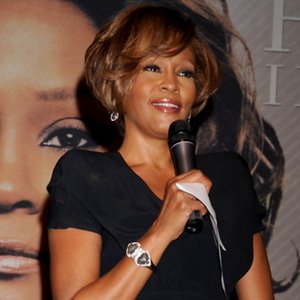
New reports are claiming that Whitney Houston visited a doctor three times in the eight day period before she was found dead in a bath tub at the Beverly Hilton Hotel.
According to Star magazine and Radar claim that Whitney Houston, who passed away aged 48, saw a Beverly Hills doctor on February 2, 7 and 8.
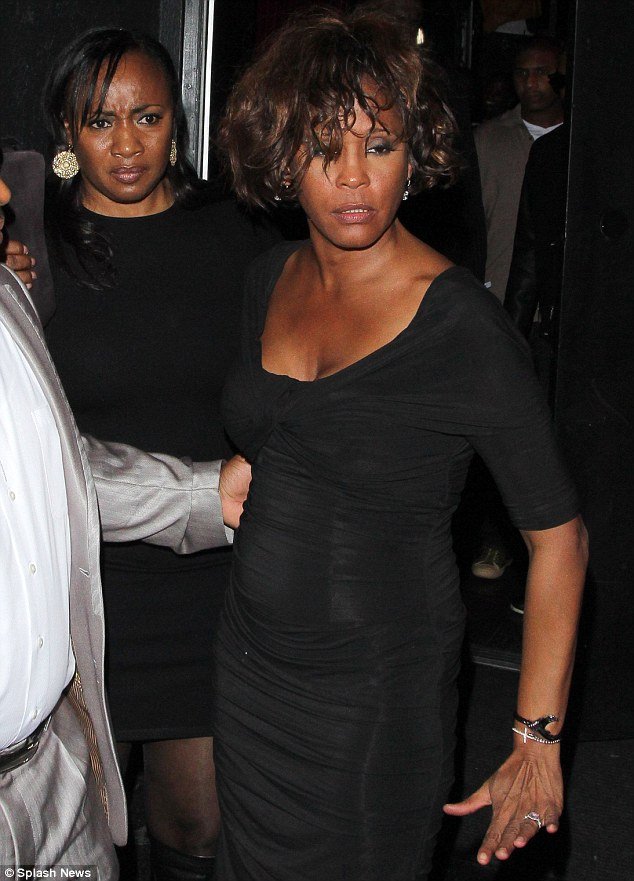
This was a day before Whitney Houston was photographed in public for the last time, looking sweaty and disheveled as she emerged from a Hollywood night club.
Whitney Houston then made a visit to a Beverly Hills medical building on February 10, about 48 hours before her death.
The visit, to a throat doctor, was witnessed by X Factor winner Melanie Amaro, who bumped into the idol.
“I was at the doctor’s office and she was there,” Melanie Amaro told CNN last week.
“I had a chance to meet her and talk to her.”
It’s not known if it was the same physician or whether any drugs were prescribed at each of the appointments, if anything.
Whitney Houston was found dead in a bath tub at the Beverly Hilton Hotel
It has already been reported by Radar that the Los Angeles County coroner’s office has issued subpoenas for medical and pharmacy records from Whitney Houston’s doctors and medical providers.
Los Angeles County assistant chief coroner Ed Winter said that Whitney Houston’s medical records could shed additional light on why she died and whether she had any serious medical conditions.
“We’ve already contacted a number of doctors with requests for records,” Ed Winter told Radar yesterday.
“I know there are reports that she maybe was drowned or did she overdose, but we won’t make a final determination until all the tests are in.”
It is also being reported today that Whitney Houston failed a routine medical check two weeks before she was found dead.
Star Magazine are alleging that Whitney Houston had sought a facelift to be performed by a Beverly Hills surgeon.
But Dr. Marc Mani, a board certified plastic surgeon, is alleged to have refused to perform the procedure on Whitney Houston after she didn’t pass the medical clearance exam that tests a patient’s heart, lung and liver, according to a source.
“She was concerned about her appearance and wanted a facelift,” the insider said.
Dr. Marc Mani refused to confirm to Radar Online whether Whitney Houston had attended his clinic, citing federal medical privacy laws.
Radar Online claims that preliminary results have revealed sedatives were found in Whitney Houston’s system.
Speculation has grown over Whitney Houston’s cause of death, which has yet to be determined pending the outcome of toxicology tests that could take up to six weeks.
The extraordinary story of Appalachia’s “Blue Family” began back to the early 1800’s, when an isolated family from eastern Kentucky – who can trace their roots back to a French orphan – started producing children who were blue.
As a result of a coincidental meeting of recessive genes, intermarriage and inbreeding, members of the Fugate family were born with a rare condition that made them visibly discolored.
The mystery behind the astonishing picture of the Fugates, which has been baffling people for years, appears to have finally been solved.
The story began when Martin Fugate, a French orphan, settled on the banks of eastern Kentucky’s Troublesome Creek to claim a land grant in the early 19th century.
Martin Fugate married a red-haired American named Elizabeth Smith – who had a very pale complexion – and their union formed a genetic mutation that resulted in their descendants being born with blue skin.
Looking at the portrait, they appear to have been either Photoshopped or made up to mimic characters from children’s cartoon The Smurfs, but science proves that the condition is in fact real.
Fugate family developed a rare skin discoloration as a result of a coincidental meeting of recessive genes, intermarriage and inbreeding
Called methaemoglobinaemia (commonly known as met-H), the condition reduces the individual’s ability to carry oxygen in their blood. As a result, their blood is darker than the color typically found running through people’s veins.
Because the Fugate family lived in such an isolated part of the Kentucky, they intermarried with a neighboring family for generations which led to a relatively “pure” gene pool where the met-H gene appeared much more frequently.
The family was first discovered in 1958 when one of the blue men, Luke Combs, who was a descendant of another branch of the Fugate family, took his white wife to the University of Kentucky Hospital and doctors paid more attention to him than his wife.
“Luke was just as blue as Lake Louise on a cool summer day,” Dr. Charles H. Behlen II told the Tri-City Herald in 1974.
Aside from the stark discoloration of the carrier’s skin, there are no serious problems associated with the disease.
In 1980, a counter-intuitive solution was discovered where the blue person drinks a chemical-filled solution that is itself blue. This then turns the carrier’s blood into a “normal” red hue which is then reflected in a change in skin tone.
Because of the dispersion of fluids, the solution only lasts for about a day so the carrier would have to drink a serving every day.
As eastern Kentucky has become vastly more populated than the early 19th century, and as more genes are married into the Fugate family tree, there were far fewer children born with the condition.
That said, the recessive met-H gene lingers to this day, but it is statistically insignificant now.
“They weren’t sick; it was just the way they look,” said nurse Ruth Pendergrass in the Tri-City Herald article.
“They’re normal people – they’re good people.”
How Met-H darkens blood?
The methaemoglobinaemia condition, or “met-H”, reduces someone’s ability to carry oxygen in the blood, leaving it darker than the color typically found in veins.
The Fugate family intermarried with a neighboring family for generations, which led to a relatively “pure” gene pool, often including the met-H gene.
But as Kentucky became more populated and more genes came into the Fugate family tree, there were far fewer children born blue.
The gene is still around today but has now become statistically insignificant and there are no serious medical problems associated with it.
Giant technology company Apple has won a patent dispute against Motorola Mobility regarding a “slide-to-unlock” feature on smartphones.
The judgement marks Apple’s first patent victory over Motorola in any part of the world.
Patent consultant Florian Mueller said the ruling could affect patent disputes involving Android device makers worldwide.
Motorola said it planned to appeal and the judgement would have “no impact” on supply or future sales.
A spokeswoman for the Motorola said: “Today’s ruling in the patent litigation brought by Apple in Munich, Germany, concerns a software feature related to phone unlocking in select Motorola devices sold in Germany.
“Motorola has implemented a new design for the feature. Therefore, we expect no impact on current supply or future sales.”
Apple said it would not be commenting on the decision.
Apple was granted the sliding patent in March 2010
Motorola Mobility is in the process of being acquired by Google, and most of its handsets run on the search firm’s mobile operating system, Android.
The Android system is Apple’s closest rival in the mobile market.
Florian Mueller, a patent expert who has in the past consulted for Microsoft, described the ruling as a “very significant win for Apple against Android”.
“After Google closes the acquisition of Motorola Mobility, the Apple-Motorola Mobility dispute will soon gain importance transcending that of the global battle with Samsung,” Florian Mueller said.
While this decision relates solely to activity in the German market, the decision could potentially help Apple with other patent disputes in other parts of the world, Florian Mueller added.
“Apple is already asserting the slide-to-unlock patent in different jurisdictions against all three leading Android device makers and might use it against even more of them going forward.”
The patent in question – EP1964022 – relates to the process of unlocking a smartphone by simply swiping a finger from one area of the screen to another.
A second patent ruling, which covers a method of scrolling through pictures in a photo gallery on mobile device, was also due on Thursday but was postponed by the court.
Jellyfish Lake, based on the Pacific island of Palau, is the only place in the world where tourists can safely swim amongst millions of jellyfish because the sometimes deadly creatures have lost their sting.
The lake was once connected to the Pacific Ocean but when the sea level dropped jellyfish became isolated in the algae rich lake.
With no risk of being eaten by predators, the jellyfish population thrived and there is now estimated to be up to 8 million jellyfish living in the lake.
Over time their stings weakened and these amazing images show tourists can now swim alongside the jellyfish without fear of being stung.
Jellyfish Lake, based on the Pacific island of Palau, is the only place in the world where tourists can safely swim amongst millions of jellyfish
Photographer Kevin Davidson joined the brave tourists to capture the mesmerizing beauty of Jellyfish Lake on camera.
Kevin Davidson, 51, who runs a small camera shop in Palau, said: “People who have a fear of jellyfish freak out, some people just turn around and leave, but there are no dangers.
“The jellyfish have evolved into their own subspecies and have slowly lost their stinging cells, some snorkelers may feel a slight sting on more tender parts of the skin, but they’re harmless.
“Swimming in the lake is an experience of a lifetime.
“It’s hard to describe how it feels but it’s unusually quiet and you can just feel hundreds of soft blobs touching your skin as you move slowly through the water.
“Since first visiting the lake almost 15 years ago, it’s become a small obsession. I’ve been hundreds of times, each thinking of a new way to photograph the tourists and the jellies.”
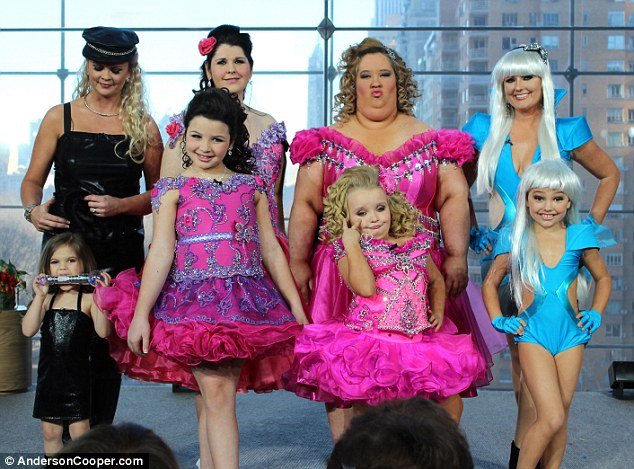
A group of indomitable and infamous pageant moms have been given the beauty queen treatment, transforming them into adult-sized versions of their daughters on Anderson Cooper show.
Anderson Cooper and his team have taken TLC’s Toddlers and Tiaras’ four most famous mothers and given them pageant makeovers – even going as far as dressing them in copycat outfits to mimic their daughters’ favorite competition costumes.
The results, while hilarious, are an attempt by Anderson Cooper to encourage the controversial women to think differently about dressing their young girls up and asking them to perform in the revealing outfits and make-up.
Six-year-old Alana Thompson, aka Honey Boo Boo Child, looked like a miniature version of her mother, June Shannon, from McIntyre, Georgia.
June Shannon, the self-proclaimed “Coupon Queen”, said she found the corset a little tight, but apart from that she was determined to see the humorous side of the get-up, echoing the mothers’ attitudes towards the pageant world as a whole.
“We have had a blast,” June Shannon said of the day at the studio.
“This is something we’ll laugh about for years to come. This is fun, this is all about having fun.”
A group of indomitable and infamous pageant moms have been given the beauty queen treatment, transforming them into adult-sized versions of their daughters on Anderson Cooper show
When questioned ether the outfit may make her change her philosophy towards child beauty pageants, it became clear the embarrassing makeover experience had made no impact.
“I don’t rethink any decision that I’ve made for my daughter as far as pageants,” June Shannon said.
“This was all in fun for us today, yeah, the corset is a little tight. With her, she enjoys doing it, so we are going to continue doing it.”
June Shannon insists on the programme, airing Thursday, February 16, that the highly criticized pageant world is nothing more than a sport.
“To us women who do it everyday it is a sport. Alana, she loves doing it, she’s not into the basketball or the baseball or anything like that.”
When asked whether she had indulged in any “GoGo Juice” – the caffeine-heavy mix of Red Bull and Mountain Dew she famously uses to energize her child – the larger-than-life June Shannon pointed out that Anderson Cooper and the audience had drunk it all. Indeed, at one point, the host takes a swig from a bottle and declares that the potent mix is “very sweet”.
“I don’t give her GoGo Juice everyday of the week,” explains June Shannon.
“Sometimes I don’t give it to her at pageants at all, we may use another remedy that day which may be pixie sticks or candy or just a regular caffeinated drink.”
The mother of eight-year-old Laci was a little less enamored with her Lady Gaga costume. The tiny electric blue spandex number was a touch on the revealing side for the mother-of-three Alicia, whose daughter’s verdict of the outfit was simply: “Weird.”
Anderson Cooper suggested that the audience had found the diminutive outfit “surprising” for such a young child, but the mom disagreed.
“Not at all. I mean, she doesn’t have anything, it’s different for children, it’s not showing anything, it’s a swimsuit for her.”
Happily for the mothers, there is another team of parents – namely, Lifetime’s Dance Moms – who are perhaps even more eyebrow-raising than they.
“They are worse than us, they make us look really good” said June Shannon, while Kayla, who famously encouraged her daughter to diet and lose 10 pounds, said of the Dance Moms: “I think they are mean, they seem mean-hearted.”
Speaking about eight-year-old EverRose’s diet, Kayla said she simply did not want her children to ever reach the weight of 300 pounds – as she once had.
“Obviously it does look like my child lost ten pounds in a couple of weeks,” the mother said of TLC’s editing.
“If I could do that I would bottle it, I would sell it and I would be a millionaire. Also, I would be skinny too.
“We watch what we eat all the time, not just a couple of weeks… Ten pounds she probably put on over the summer because she did not do as much activity. She takes dance, gymnastic and cheer. Over the summer that usually stops, so she was a little more sitting around. So she probably easily put that on over the summer.”
Kayla explains that she aims to teach her children to be as conscious of diet and exercise as they can be so that they do not have to deal with the bullying caused by obesity.
“I have four children and I want them all to not live the things that I have lived, as we all have experienced things in our lives that we don’t want our children to deal with,” Kayla emotionally revealed.
Following Whitney Houston’s death claims emerged stating that singer was disheveled and incoherent and that she interrupted an E! interview the Thursday before her death.
However, according to Radaronline, this is false and a source said: “Whitney waited until E! had finished filming to say hello. Clive, Brandy and Monica were doing interviews with multiple media outlets to promote their performance at the pre-Grammy party.
“The interview was finished, and the E! crew was off to the side taking their equipment down, and the trio was awaiting the next outlet to come in and set up. As soon as the E! crew saw Whitney enter the room, they started rolling their cameras. Whitney came over, and said hello to all three. She was completely sober, coherent, and absolutely respectful. She just wanted to wish Brandy and Monica good luck.”
Following Whitney Houston's death claims emerged stating that singer was disheveled and incoherent and that she interrupted an E! interview the Thursday before her death
The Beverly Hilton hotel room where Whitney Houston died in is said to be fully booked for the “foreseeable future” it has been reported.
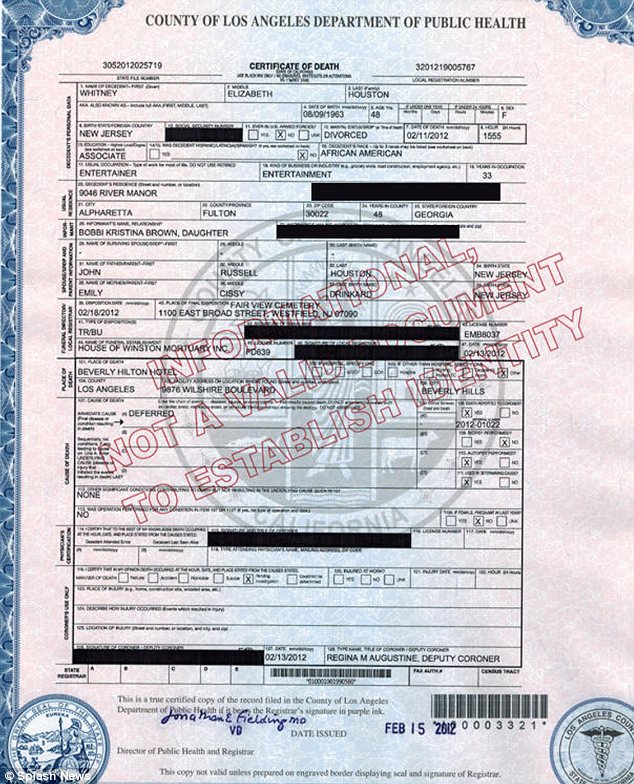
Meanwhile, Whitney Houston’s death certificate has been released, but failed to determine the cause of death listing “pending investigation” as the manner of death and “deferred” is written for the immediate cause.
While it is known that Whitney Houston drank alcohol and had taken prescription drugs before her death it is still not clear what the exact cause is – and it has been reported it will be hard to get a clear picture of exactly what she was taking.
Aretha Franklin, Whitney Houston’s godmother, has been asked to sing at the singer’s funeral, Franklin’s spokeswoman said.
According to CNN.com other stars confirmed on the guest list are Chaka Khan, Bebe & CeCe Winans, songwriter Diane Warren, the Rev. Jesse Jackson, pop singer Darlene Love, Bishop T.D. Jakes, Antonio L.A. Reid, Ray J and Brandy.
One person expected not to attend the funeral, which will take place at 12:00 p.m. EST, in Newark’s New Hope Baptist Church, is Bobby Brown, who family members are said to have told that he is not welcome.
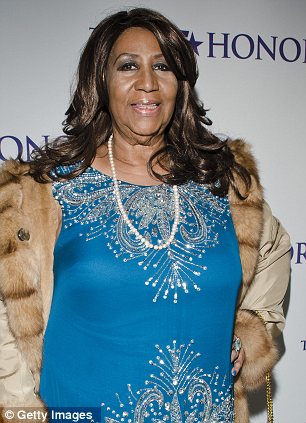
Aretha Franklin, Whitney Houston's godmother, has been asked to sing at the singer’s funeral
It has also been claimed that Whitney Houston’s mother Cissy is doing her best to stop the singer’s ex-husband Bobby Brown from getting closer to their daughter Bobbi Kristina, for fear it is a ploy to get his hands on Whitney’s fortune.
A source told TMZ.com that friends of the family have contacted Bobby Brown to tell him he’s not welcome at her funeral, and should not increase his part in Bobbi Kristina’s life.
However, a friend of Bobby Brown’s is said to have told TMZ that Bobby is keen to “bury the hatchet for the sake of his daughter”.
Whitney Houston’s death certificate has been released and failed to determine the singer’s cause of death.
The legendary singer’s death certificate is listing “pending investigation” as the manner of death and “deferred” is written for the immediate cause.
While it is known that Whitney Houston drank alcohol and had taken prescription drugs before her death it is still not clear what the exact cause is – and it has been reported it will be hard to get a clear picture of exactly what she was taking.
According to The LA Times: “The Los Angeles County coroner’s office said Wednesday investigators have asked <<a number>> of doctors to provide them with Houston’s medical information.”
L.A. County Sheriff’s Sgt. Steve Opferman told LA Times: “Celebrities often get their prescription drugs from doctors who are more than willing to give them what they want and sometimes using members of their entourage.”
Whitney Houston’s death certificate has been released and failed to determine the singer’s cause of death
Whitney Houston’s funeral will take place on Saturday at the Fairview Cemetery in Westfield, NJ, which is the same place her father is buried.
The funeral will be broadcast by The Associated Press and will allow fans to pay their own tributes from home on the television and web.
There will be no public memorial service and pastor Marvin L Winans, who will be giving a eulogy said the family didn’t want “a parade”.
“I don’t think knowing Cissy (Houston’s mother) and the Houston family … it was a matter of public or private as it was this is my daughter, this is my sister, this is my mother, this is my friend and we want to do this with dignity.”
At least 21 suspected militants have been killed in two separate attacks of an unmanned US drone aircraft in north-west Pakistan, according to Pakistani security officials.
The missiles struck targets in the North Waziristan tribal region near the Afghan border.
Pakistan has previously complained that such attacks violate its sovereignty.
Last month, President Barack Obama defended the use of drones to target militants in Pakistan’s tribal areas.
Security officials said that in the first attack two missiles killed at least five militants. Several others were wounded, although the exact number could not be established.
A second attack in the same area, near Miranshah, the main town of North Waziristan, killed 15 Uzbek fighters, officials said.
There is no way of getting independent confirmation of the figures as reporters are prevented by the authorities from travelling to the region.
The area is known as a sanctuary in Pakistan for the Taliban and al-Qaeda-linked militants.
Another drone attack last week hit a house in Spalga, killing at least nine people, including some Pakistani Taliban militants.
The US does not normally comment on drone operations, which have killed hundreds of people in recent years.
The recent attacks come a week after officials said one of the most senior al-Qaeda militants in Pakistan, Badar Mansoor, was killed in a US drone strike.
Islamabad is hosting talks on Thursday and Friday with leaders of Afghanistan and Iran to discuss counter-terrorism co-operation, and strengthening regional stability.
President Mahmoud Abbas has declared three days of mourning after at least eight Palestinian children have been killed in a collision between a school bus and an Israeli lorry on a road in the West Bank.
The school bus was carrying children as young as five or six on their way to Ramallah, just north of Jerusalem.
The vehicle overturned on impact and burst into flames. More than 30 children were injured, and there are fears the death toll may rise.
Israeli Prime Minister Benjamin Netanyahu has expressed his sorrow and offered assistance.
The bus is believed to have been carrying up to 50 children at the time of the crash, which happened on a busy road junction.
At least one report said a teacher had also been killed.
At least eight Palestinian children have been killed in a collision between a school bus and an Israeli lorry on a road in the West Bank
In a broadcast, President Mahmoud Abbas described the accident as a horrific national disaster and said all flags would fly at half-mast.
“The toll so far shows that more than 10 children have died and scores of injured are receiving treatment in various medical centres in the West Bank,” he said.
The higher figure of the number of dead has not been confirmed.
The children were apparently travelling from their school in the West Bank village of Anata when the two vehicles collided, head-on, according to reports.
The lorry driver, an Israeli-Arab, was injured.
Dr. Ahmad Bitawi, director of Ramallah Hospital, said five children and a teacher had been pronounced dead at the hospital, while a further 54 people injured in the crash were treated there, Reuters news agency reported.
Some of the survivors were also taken to Jerusalem’s Hadassah University Hospital.
“It is an ugly, unbelievable, terrible accident; it shakes the feelings of the whole world because it includes babies,” Adham Al-Hindin, uncle of two injured children, told Reuters.
The road conditions in the area were “pretty treacherous” following heavy rain overnight and the accident had happened during morning rush hour.
Shalom Galil – an Israeli paramedic at the scene – also said the adverse weather conditions appeared to have been a factor.
He said the steep road where the crash happened had been affected by oil. “We assume that either the bus or the truck slipped and crashed into each other.”
Shalom Galil said Israeli and Palestinian emergency services had worked closely together at the scene.
“Palestinian firefighters were involved. As far as I could see, there was full co-operation between the firefighters of Judea and Samaria [West Bank] and the Palestinian firefighters.”
New claims have suggested Whitney Houston was seen “drinking considerably” for at least two mornings in the week before her death on Saturday.
It is claimed that Whitney Houston, who was just 48 when she died, was seen ordering drinks at the bar at the Beverly Hilton Hotel before 10:00 a.m. on both Wednesday and Thursday mornings.
A source revealed to CNN that guests in Beverly Hilton hotel had heard Whitney Houston complaining to the bartender about her drinks being “watered down” or containing “too much ice”.
The source added that some of the guests later complained about Whitney Houston’s “erratic” behavior, saying that her disheveled appearance and odd clothing choice led to her appearing intoxicated.
New claims have suggested Whitney Houston was seen “drinking considerably” for at least two mornings in the week before her death on Saturday
However, Whitney Houston’s close friend Kelly Price, with whom the singer was seen partying just two days before her death, insisted she noticed no erratic behavior when the pair spent time together at the Tru Hollywood nightclub on Thursday night.
Kelly Price said in an interview on ITV’s Daybreak this morning: “I don’t know anything about her not being in a great frame of mind. I’ve said so many times that she came and she was happy and she beat me to my own party.
“She was happy to pose for the press, she was waiting on me when I got there and we had a great time that night.
“She was so happy and so full of life and she brought so much joy into the building that night – she brought an energy into the entire event that I’m so glad we were all able to experience that.”
Kelly Price added that she was so shocked when she was first told of Whitney Houston’s passing that she had hoped it was a hoax.
Kelly Price said: “I was shocked, very hurt, I’m still very hurt. In my heart and in my mind I was hoping it was a crazy internet hoax. As much as I hate them, I would have given anything for it to be a hoax that time.
“I haven’t fully been able to accept it. I need to find a way to have some closure for myself.
“I think going through the process of the Grammy Awards, I had to push my way through it. But in the last 24 hours it has really hit me.”
Meanwhile, plans to broadcast Whitney Houston’s funeral live on television and online have been revealed.
After it was confirmed the funeral will take place on Saturday at the Fairview Cemetery in Westfield, NJ, Whitney Houston’s publicist Kristen Foster announced The AP are allowed to film the service and stream it on their website, with some other broadcasters also taking the footage via a satellite.
Dolly Parton, who originally wrote and recorded the biggest hit I Will Always Love You, is set to earn millions of dollars since the Whitney Houston’s death.
Having already made a large amount of money from Whitney Houston’s smash hit version of I Will Always Love You, country singer Dolly Parton is set to earn millions more dollars since the death of the legendary singer last Saturday.
Originally co-written and recorded in 1973, the song was a modest success for Dolly Parton. The song was then revived by Whitney Houston in 1992 when it was included on the soundtrack of her romantic thriller The Bodyguard, in which she starred alongside Kevin Costner.
Dolly Parton, who originally wrote and recorded the biggest hit I Will Always Love You, is set to earn millions of dollars since the Whitney Houston’s death
I Will Always Love You soared straight to the top of the charts where it spent 10 weeks at number one – making Whitney Houston the record-holder for the longest time spent at the top spot by a solo female artist in Britain.
Dolly Parton has previously commented on the large amount of money she has made in royalties due to Whitney Houston’s version – joking in an interview with CNN last month that it had allowed her to buy “a lot of cheap wigs”.
According to figures from the Official Chart Company, I Will Always Love You is due to enter the charts at number 10 this Sunday. Its popularity has also been fuelled by actress Jennifer Hudson’s tribute performance of the track at the Grammy Awards on Sunday.
Whitney Houston’s other hits One Moment In Time, Saving All My Love For You, I Wanna Dance With Somebody, My Love Is Your Love, How Will I Know and I Have Nothing are also expected to appear in the Top 40, with a total of 27 singles by Houston appearing in the Top 200.
On Whitney Houston’s death, Dolly Parton commented: “Mine is only one of the millions of hearts broken over the death of Whitney Houston. I will always be grateful and in awe of the wonderful performance she did on my song and I can truly say from the bottom of my heart, <<Whitney, I will always love you. You will be missed.>>”
The private funeral of the legendary singer Whitney Houston will be streamed live on the internet, it was announced yesterday.
The revelation will please Whitney Houston’s grieving fans, who were disappointed to learn that the star’s funeral would be a private affair.
There will also be no public memorial service for Whitney Houston.
Members of the public wishing to pay their respects to the iconic singer will be able to do so by following online as she is laid to rest.
The private funeral of the legendary singer Whitney Houston will be streamed live on the internet by The Associated Press
The Associated Press has been granted the right to film the ceremony, which takes place on Saturday in Whitney Houston’s hometown of Newark, New Jersey.
The funeral will be streamed on the AP’s website, and will also be made available to broadcasters.
While the service at New Hope Baptist Church will be not be open to the public, that has not stopped Whitney Houston’s fans from bringing flowers as and other gifts as tributes to the singer.
The church, where Whitney Houston sang as a child, has become one of several sites where people have gathered to remember the singer since her death last Saturday night at the age of 48.
Whitney Houston is also being remembered by the New Jersey government, after governor Chris Christie ordered state buildings to lower their flags on the day of the funeral.
Whitney Houston decline from world-beating success into damaging drug addiction has been blamed by some on her turbulent marriage to singer Bobby Brown, and it has been reported that her family asked her ex-husband to stay away from her funeral.
However, Bobby Brown has insisted that those reports are false, and that he will attend the ceremony in order to support the couple’s 18-year-old daughter, Bobbi Kristina.
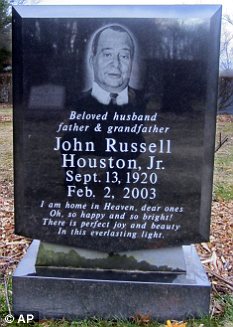
Whitney Houston may be buried alongside her father, army serviceman and entertainment executive John Russell Houston Jr., who died in 2003
There is believed to have been disagreement among the Houston family as to where Whitney Houston should be buried.
Whitney Houston’s mother Cissy and her cousin Dionne Warwick are said to have argued that the iconic singer should be laid to rest in Atlanta, but other relatives who argued for Newark won the day.
Whitney Houston may be buried alongside her father, army serviceman and entertainment executive John Russell Houston Jr., who died in 2003.
US researchers found that the speed of someone’s walking may predict the likelihood of developing dementia later in life.
The scientists also told a conference that grip strength in middle-age was linked to the chance of a stroke.
They said more studies were needed to understand what was happening.
Experts said the findings raised important questions, but more research was needed.
Suggestions of a link between slow walking speed and poor health have been made before.
A study, published in the British Medical Journal in 2009, said there was a “strong association” between slow walking speed and death from heart attacks and other heart problems. A Journal of the American Medical Association study suggested a link between walking faster over the age of 65 and a longer life.
Dr. Erica Camargo, who conducted the latest study at the Boston Medical Centre, said: “While frailty and lower physical performance in elderly people have been associated with an increased risk of dementia, we weren’t sure until now how it impacted people of middle age.”
US researchers found that the speed of someone’s walking may predict the likelihood of developing dementia later in life
Brain scans, walking speed and grip strength were recorded for 2,410 people who were, on average, 62 years old.
Results presented at the Academy of Neurology’s annual meeting said that 11 years later, 34 people had developed dementia and 79 had had a stroke.
The researchers said slower walking speeds were linked to a higher risk of dementia and stronger grip with a lower risk of stroke.
Dr. Erica Camargo said: “These are basic office tests which can provide insight into risk of dementia and stroke and can be easily performed by a neurologist or general practitioner.
“Further research is needed to understand why this is happening and whether preclinical disease could cause slow walking and decreased strength.”
The findings have not yet, however, been published in a peer-reviewed academic journal.
At least five Palestinian children have been killed and other 30 have been injured after a school bus has collided with a truck on a road in the West Bank, according to Israeli officials.
The collision happened on “a very steep and slippery road” near Jerusalem, according to Reuters.
An Israeli police spokesperson told AFP that an Israeli truck hit a Palestinian bus. The bus overturned and caught fire.
More than 30 children have been injured in the crash, which was “horrific,” according to the police spokesperson.
The legendary singer Whitney Houston will be always remembered as a master of “melisma”.
What is melisma and why did it influence a generation of singers and talent show aspirants?
According to Oxford English Dictionary, melisma means “a group of notes sung to one syllable of text”.
An early “I” in Whitney Houston’s I Will Always Love You takes nearly six seconds to sing.
In those seconds, Whitney Houston, a former gospel singer-turned-pop star, packs a series of different notes into the single syllable. The technique is repeated throughout the song, most pronouncedly on every “I” and “you”.
The vocal technique melisma has inspired a host of imitators. Other artists may have used it before Whitney Houston, but it was her rendition of Dolly Parton’s love song that pushed the technique into the mainstream in the 90’s.
It can be heard in the songs of Beyonce, Christina Aguilera, Jennifer Hudson and others.
And anyone who has watched a talent show like X Factor or American Idol in recent years will have picked up on the trend among amateur singers.
The legendary singer Whitney Houston will be always remembered as a master of "melisma"
The style became so prominent that former Pop Idol judges Pete Waterman and Simon Cowell had to ban aspiring stars from attempting to tackle Whitney Houston’s hits on the show.
Pete Waterman says: “It got so bad in Pop Idol 1 that we literally did say to everybody that walked in, ‘Look there’s no point in you singing Whitney Houston, so if you’re going to sing Whitney Houston, don’t bother singing, because we’ve heard it so many times now we’re actually averse to it’.”
But the melisma craze isn’t limited to contestants. Fame Academy vocal coach and judge Carrie Grant says her eight- and nine-year-old students come to lessons attempting to belt out their own takes on Whitney Houston’s famous melisma.
“She started a whole generation of singers who wanted to riff on their records, and that includes all the Beyonces and the Rihannas and probably every American idol contestant,” Carrie Grant says.
But most fail – miserably, according to Pete Waterman.
In order to achieve Whitney Houston’s vocal acrobatics it takes a combination of arduous training and natural talent.
“You can’t do it without proper breath control, and that’s the one thing that Whitney Houston had bags of,” says professional opera singer Sarah-Jane Dale.
“Let’s face it, singers like that do not come along every week.”
Whitney Houston also selected vowel sounds that would conserve air so she could hold the mammoth notes. For example, singing “luv” instead of “love”, according to Sarah-Jane Dale.
And then there’s the smooth, effortless sound of Whitney Houston’s melisma – the result of using her body to control her voice.
“It’s not just from your neck up. Singing is your whole body, and if you’re not connected to that breath and where it comes from, down in your diaphragm area, you’re not going to manage it,” Sarah-Jane Dale says.
The vocal technique traces its roots back to Gregorian chants and the ragas of Indian classical music.
In the modern era singers such as Aretha Franklin, Ray Charles and Sam Cooke are credited with bringing melisma from the choirs of churches to mainstream audiences.
Mariah Carey’s Vision of Love was a notable use. But it was Whitney Houston who popularized it and stretched the standards by attaching complicated strings of notes to single syllables.
But the term “melisma” is still relatively obscure within the pop music industry, with the effect often described simply as “ad libbing” or “riffing”.
In less flattering terms, Rolling Stone’s David Browne dubbed it an “overpowering, Category 5 vocal style” in the New York Times.
Singers can use melisma as a way of imposing their own personality on a song, according to Pete Waterman.
“A part of this comes from the creative desire to do it your way and not the way the record company, the record producers and the writers are wanting you to do it,” he says.
“The writer has written you a tune, and you totally ignore it and do your own thing anyway.”
Whitney Houston’s shift from sticking to the song’s parameters in I Wanna Dance with Somebody to taking vocal liberties in I Will Always Love You showcases this artistic transformation.
“I call it vocal gymnastics, where suddenly she wants to show you she can take a tune wherever she wants to take it,” Pete Waterman says.
“The vocal performance on it is just mind-blowing, I mean everybody stands up and goes, <<My God, where did that come from?>>”
But perhaps what Whitney Houston nailed best was moderation. In a climate of reality shows ripe with “oversinging”, it’s easy to appreciate Whitney Houston’s ability to save melisma for just the right moment.
“She’s like a cook who never overused her spice. She was always very delicate about what she would use,” Carrie Grant says.
“She never oversang, and people, therefore, were touched and moved by the emotion and the story of that song. She’s the singer that would give you goosebumps.”
The 6-metre bronze statue depicts Kim Jong-Il riding a horse next to his late father, Kim Il-Sung, also on horseback
An immense statue of the late North Korean leader Kim Jong-Il has been unveiled ahead of Thursday’s celebrations of the 70th anniversary of his birthday.
This is the first bronze sculpture of Kim Jong-Il.
The 6-metre bronze statue depicts Kim Jong-Il riding a horse next to his late father, Kim Il-Sung, also on horseback.
The statues were unveiled in a ceremony attended by top military and political officials on Tuesday in the capital, Pyongyang.
Kim Jong-Un, Kim Jong-Il’s youngest son and heir to the leadership position, was not present, although he reportedly initiated the building of the statue.
A series of commemorative items and tributes have been released since Kim Jong-Il’s death on 17 December of a heart attack at the age of 69.
These included a giant slogan carved into a mountainside, postage stamps, medals and gold and silver coins bearing his image.
Kim Jong-Il reportedly shunned the idea of the bronze statue in his lifetime.
According to various accounts, Kim Jong-Il reportedly told state officials in 1999 that he was not ready for the adulation before fulfilling his promise of building an affluent society, the Associated Press reports.
North Korea said on Wednesday it has awarded the highest title of Generalissimo to Kim Jong-Il, the same rank as that held by his father, the country’s founding leader.
North Korea is believed to be planning widespread celebrations on Thursday, also dubbed “the day of the shining star”, even as worries continue over food shortages in the country.
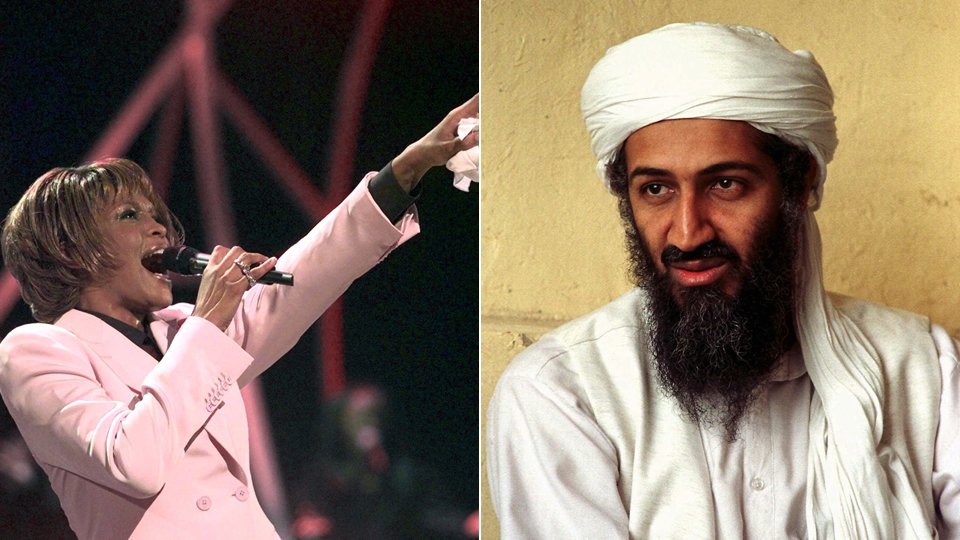
Whitney Houston was admired and wanted by one of history’s most depraved and despicable men, terror chief Osama bin Laden, Sudanese author Kola Boof has claimed.
Osama bin Laden is said to have lusted after Whitney Houston, dreamed of marrying her and at one point even plotted to murder her husband Bobby Brown.
The incredible account of Osama bin Laden’s infatuation with Whitney Houston comes from Sudanese author Kola Boof, who it is widely accepted lived with him as his mistress.
It was 1996, and just a few years later Osama bin Laden would mastermind the most appalling terrorist attack ever to happen on American soil.
But holed-up in his Moroccan compound Osama bin Laden had different things on his mind, namely sex, smoking cannabis and dancing to western pop groups like the B52s and Van Halen.
Kola Boof, who claims she was kept as a “sex slave” by Osama bin Laden, said he thought Whitney Houston was “the most beautiful woman he’d ever seen” and that he was desperate to marry her.
In an autobiography released in 2006, Diary of a Lost Girl: The Autobiography of Kola Boof, the former mistress claims Osama bin Laden plotted to have Bobby Brown murdered before wooing Whitney Houston by giving her a mansion he owned in the suburbs of Khartoum.
And according to the Kola Boof’s account, the strongly racist Osama bin Laden puffed on cannabis before announcing he would be willing to “break his color rule” and make Whitney Houston one of his wives.
Inside his warped mind Osama bin Laden believed Whitney Houston was truly Islamic but had been brainwashed by American culture.
Whitney Houston was admired and wanted by one of history's most depraved and despicable men, terror chief Osama bin Laden, Sudanese author Kola Boof has claimed
Kola Boof, 37, who is black, claimed Osama bin Laden scolded her for braiding her hair and ordered her to model herself on Whitney Houston instead.
Kola Boof recalls in her book: “He smoked a little marijuana from a gold hookah, sipping his tea and instructing me that I was always to keep hot tea for his <<kif-canbo>>, to ease the burn in his chest.
“Osama said only monkeys braid their hair. He told me that the singer Whitney Houston was the most beautiful woman he’d ever seen and that she never wore her hair braided.
“<<I want you to fix your hair like hers from now on>>, he said. <<I can’t put my fingers through it when it’s braided.>>
“Osama kept coming back to Whitney Houston. He asked if I knew her personally when I lived in America. I told him I didn’t.
“He said that he had a paramount desire for Whitney Houston, and although he claimed music was evil, he spoke of someday spending vast amounts of money to go to America and try to arrange a meeting with the superstar.
“It didn’t seem impossible to me. He said he wanted to give Whitney Houston a mansion that he owned in a suburb of Khartoum. He explained to me that to possess Whitney he would be willing to break his color rule and make her one of his wives.
“I tried to hide my outrage at his racist remarks, but it would come to pass that for the entire time that I would be trapped in his palm, Whitney Houston’s was the one name that would be mentioned constantly.
“How beautiful she is, what a nice smile she has, how truly Islamic she is but is just brainwashed by American culture and her husband – Bobby Brown, whom Osama talked about having killed, as if it were normal to have women’s husbands killed.
“In his briefcase I would come across photographs of the star, as well as copies of Playboy, but nobody in the West believes me when I tell them this. It’s like they have this totally bogus image of Osama bin Laden.
“Anyway, it would soon come to the point where I was sick of hearing Whitney Houston’s name.”
Kola Boof’s story first surfaced in 2002 when the Guardian newspaper published an article claiming she had had a forced sexual relationship with Osama bin Laden.
Later in a two-part interview with MSNBC Kola Boof was billed as the “Former Mistress of Osama Bin Laden”.
Some claimed Kola Boof had made up the story, and that it was impossible because of her afro-American heritage.
But Kola Boof has stood by her account and points out that yet two of Osama bin Laden’s twenty-five children are black and his Syrian grandmother also could be considered a Black woman.
Earlier in her account Kola Boof recalled how Osama bin Laden who she called “Somi” would abuse her.
She wrote: “We would be lying there in bed and he’d say, <<African women are only good for a man’s lower pleasures. What need do you have for a womb?>>
“I would feel insulted – not just to the heart, but to the soul.
“He would humiliate me by making me dance naked. It was such a strange thing, because for the most part he believed music was evil. If a guest at the estate played music, he would cover his ears until the <<poison>> was silenced.
“But other times he would become this devout party boy who wanted to hear Van Halen or some B-52’s. To this day I hear the song <<Rock Lobster>> in my sleep.
“I would be jerking around like a white girl – <<Dance like a Caucasoid girl!>> he would say – and his eyes would track me from one side of the terrace to the other. <<Your ass is too big, show me the front>>, he said.
“Osama, you understand, did not know the difference between being vicious and being tender.”
Recalling the time she first met Osama bin Laden at a Moroccan restaurant, Kola Boof said: “I ran out the door, gripped by terror, and drove home. Relieved that his henchmen hadn’t followed me, I ran a bath, lounged in the cold bathwater, then changed into a flowing silk robe.
“There was a bang on the door, and I could hear shouting: <<Hey, black girl!>> When I opened the door, there was Osama bin Laden and his seven-man posse. A cold bolt of lightning went through me.
“But Osama was trying to be charming, despite the fear in my eyes. <<Why did you run? I just think you’re lovely and I find you intriguing. I wanted to be your friend.>>”
A customer of Heart Attack Grill suffered a cardiac arrest in the chain’s Las Vegas branch on last Saturday.
An onlooker captured video of paramedics wheeling the unidentified man, thought to be in his 40’s, out of the fast-food diner.
The diner was midway through eating a 6,000-calorie Triple Bypass Burger when he began experiencing chest pains.
Heart Attack Grill – founded in 2005 using the catchphrase “Taste Worth Dying For!” – is run by a former nutritionist “Doctor” Jon Basso who, remarkably, used to run a Jenny Craig weight loss diet centre.
Jon Basso denied the incident was an elaborate publicity stunt.
He told Fox News: “The gentleman could barely talk. He was sweating, suffering.
“I actually felt horrible for him because the tourists were taking photos of him as if it were some type of stunt.
“Even with our own morbid sense of humor, we would never pull a stunt like that.”
The Heart Attack Grill sells calorie-laden fare with names such as Quadruple Bypass Burgers and Flatline Fries
The Heart Attack Grill sells calorie-laden fare with names such as Quadruple Bypass Burgers and Flatline Fries.
Meals at Heart Attack Grill can exceed 8,000 calories, as the recommended daily intake is 2,000 calories for women and 2,500 for men.
The Triple Bypass Burger contains three slabs of meat, 12 rashes of bacon, cheese, red onion, sliced tomato and the Heart Attack Grill’s own “unique special sauce”. And that’s before taking into account the accompanying “Flatliner Fries”, cooked in pure lard, and a giant soft drink.
Accentuating the medical theme, waitresses dressed as nurses deliver the artery-clogging food.
A sign at the entrance to an Arizona restaurant reads: “Go away. If you come in this place, it’s going to kill you.”
Heart Attack Grill has provoked widespread anger with promotions including offering free food to morbidly obese customers.
In an exploitative advertising campaign, the restaurant announced that it would pick up the bill for any patron who weighed more than 350 lbs.
Jon Basso hired a 644-lb man, Blair Rivers, to star in a tongue-in-cheek commercial promoting the special offer.
In the ad, Jon Basso says with a smile: “I personally guarantee a stable upward progression of body weight while you’re enjoying great tasting foods.
“Along with a cold beer and cigarette, it’s a diet you can stick to for life.”
The advertisement then states the side effects from eating Heart Attack Grill food “may include sudden weight gain, repeated increase of wardrobe size, back pain, male breast growth, loss of sexual partners, lung cancer, tooth decay and liver sclerosis stroke.
Belgian researchers have found a way to beat sleeping sickness using a bacterium against the tsetse fly host that spreads the disease to humans.
In the same way that we have friendly bacteria in our intestines, the tsetse fly harbors bacteria in its midgut, muscle and salivary glands.
Scientists have genetically modified these “good bugs” so they attack the culprit parasite carried by the fly.
But work is needed to hone the process.
The latest findings are published in the open access journal Microbial Cell Factories.
Belgian researchers have found a way to beat sleeping sickness using a bacterium against the tsetse fly host that spreads the disease to humans
Sleeping sickness, or human African trypanosomiasis, is a potentially fatal disease that plagues many regions of Africa.
Although the number of people being infected with the disease has been going down thanks to better diagnosis and treatment, there were still more than 7,000 new cases recorded in 2010.
The parasite causing sleeping sickness is transmitted to humans through the bite of the infected tsetse fly.
This causes fever, headaches, aching joints and itching. Then, follows the second stage of disease, as the parasites cross the blood-brain barrier to infect the central nervous system.
The person then becomes confused, poorly coordinated and experiences the sleep disturbances which give the disease its name.
Without treatment, sleeping sickness is fatal.
But current therapies often have unpleasant side-effects.
The drug most commonly used to treat the condition is a derivative of arsenic developed more than 50 years ago. And the treatment can be excruciatingly painful and potentially fatal. Often described by patients as “fire in the veins,” between 5% and 20% of those treated die of complications from the injected drug.
And so scientists are seeking alternatives.
The Belgium team at the Institute of Tropical Medicine in Antwerp have focused on finding a way to destroy the sleeping sickness parasite – trypanosome – that the tsetse fly carries.
They found bacteria called Sodalis glossinidius, which naturally live in the fly and can be used to mount an attack from the inside.
Altering the genes of the bacteria led it to release fragments of antibodies known as nanobodies against the parasite.
With more work, the researchers hope to be able to produce targeted nanobodies which could kill or block the development of trypanosome.
Florida police is searching for a man caught on camera stealing a $6,500 Rolex watch from a fellow passenger at an airport security checkpoint.
The Transportation Security Administration (TSA) captured the theft at Fort Lauderdale-Hollywood International Airport on January 18.
According to detectives in Broward County, 43-year-old Gloria de Regalado mistakenly left the luxury timepiece behind after recovering her belongings from the conveyor belt.
The incident occurred at the Terminal 3 checkpoint, where Gloria de Regaldo says she removed her jewellery and left it behind.
According to the Huffington Post, the mother-of-three returned 30 minutes after her clearance, after noticing she left her two-toned wristwatch and a sentimental bracelet at security.
But when the woman went back to retrieve it, the jewellery was gone.
Florida police is searching for a man caught on camera stealing a $6,500 Rolex watch from a fellow passenger at an airport security checkpoint
Surveillance footage released by the TSA shows a man behind Gloria de Regaldo putting on his shoes and gathering his things from a plastic bin as the watch catches his eye.
The video shows the man grabbing the Rolex and walking away to reorganize his backpack, when he appears to stuff the jewellery inside.
Gloria de Regalado, who lives in El Salvador and was travelling from her South Florida vacation home to Lexington, Kentucky, told the South Florida Sun-Sentinel the jewellery was a treasured gift from her husband to celebrate several milestones: her 40th birthday, the births of their three children, their 10th wedding anniversary, and the bracelet represented her Catholic faith.
She recalled making eye contact with the suspect before realizing the piece were missing on her walk through the concourse.
“He had an opportunity to do right by himself, he knew who I was and he could have redeemed himself, but he didn’t,” Gloria de Regaldo told the Sun-Sentinel.
TSA acted swiftly, reviewing the footage and notifying the Broward County Sheriff, whose officers searched the terminal and an airplane departing for Dallas for the suspect.
There is a $1,000 reward for information leading to his arrest.
Boxes containing $1.5 million jewelry, master tapes of British band Joy Division and even a gun were allegedly discovered in the basement of the site of Jamie Oliver’s new restaurant in Manchester, UK.
They were found in hundreds of safe deposit boxes – some of them dating back to 1935 – in the vault of the old bank site, which Jamie Oliver has converted into a restaurant.
According to The Sun, a source said: “There were all sorts in the boxes – even a gun in one.”
HSBC bank, the former occupant of the building, said it could not confirm exactly what was in the boxes due to customer confidentiality.
A spokesman said: “Even if I knew exactly what was in those boxes I would not be able to comment on that for reasons of confidentiality.
“We cannot reveal the precise contents, but these are safe deposit boxes – there are bound to be valuables in there.
“If we did find anything illegal in there we would be required to notify police.”
A spokesman for Jamie Oliver said: “The haul was actually removed before we moved in.”
Boxes containing $1.5 million jewelry, master tapes of British band Joy Division and even a gun were allegedly discovered in the basement of the site of Jamie Oliver's new restaurant in Manchester
The restaurant site, in Manchester, was an old Midland bank – which merged with HSBC in 1992.
The Grade II listed building – known locally as the King of King Street – was designed by Edwin Lutyens in 1928.
When HSBC moved to a new site in 2008 they had to transfer the contents of the boxes – it was then that the so-called haul was discovered.
A spokesman for HSBC added: “We were moving to a new site and wanted to transfer the safe deposit boxes.
“However [because the building is a Grade II listed building] National Heritage said we were unable to take the actual boxes with us, because they were part of the structure.
“At no point were drills used to break them open – we just used the keys we had.
“The owners would have been contacted and the contents transferred to secure storage at the new site.”
Jamie Oliver’s team acquired the property in 2010 and started work on the site in March 2011.
An excerpt from Jamie Oliver’s website reads: “The basement vault room has wall to wall original safety deposit boxes where the people of Manchester stored their heirlooms, mementos and collectables since the building’s completion in 1935.
“Our designers and architects have been visiting the vault room since March 2011, and regardless of who they’re with they can’t resist ‘checking’ at least one safety deposit box for any unclaimed goods.”
Jamie Oliver’s restaurant will be spread over three levels, with the bank’s old ground floor banking hall, mezzanines antechambers in the old clerks’ offices and the basement vault room all being transformed.
The diner opens this week in Manchester City Centre, next to the restaurant owned by Manchester United footballer Rio Ferdinand.
In a statement on his website, Jamie Oliver said: “I’ve wanted to open a Jamie’s Italian in Manchester for years but we’ve never found the right location, until now.
“It’s going to be a wonderful place to eat and one of the jewels in the Jamie’s Italian collection.”
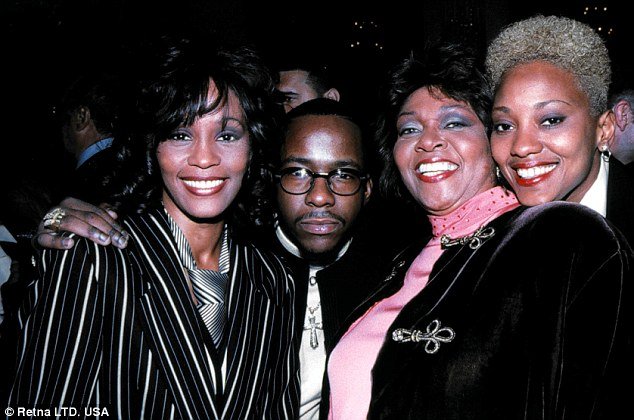
Bobby Brown, Whitney Houston’s ex-husband, has been told he is “not welcome” at the singer’s funeral by several members of her family.
A close family member, who has not been identified, warned Bobby Brown not to even try to attend as the Houston clan is “not fond of him”.
During Whitney Houston and Bobby Brown’s 14-year marriage they repeatedly came to blows in private and public, with her husband being rumored to have introduced her to illegal drugs.
Bobby Brown also published an autobiography where he hinted at doubts over Whitney Houston’s sexuality, but in the days after her death has been pictured devastated by his ex-wife’s death.
Sources close to Bobby Brown told TMZ people connected to the Houston family have warned him that he shouldn’t attempt to attend the funeral because the family isn’t fond of him.
At first it was thought that a public memorial service would take place at Newark’s Prudential Centre – which seats up to 19,000 people – but the family announced today that they are keeping it to themselves. There will be no public wake either.
Bobby Brown (pictured with daughter Bobbi Kristina) has been told he is “not welcome” at Whitney Houston’s funeral by several members of her family
The funeral will take place on Saturday at noon in the New Hope Baptist Church in Newark, where Whitney Houston first showcased her singing talents as a child.
Whitney Houston’s body was flown from Los Angeles in a private jet owned by Tyler Perry last night and transported to Newark’s Whigham Funeral Home, which handled the 2003 funeral of her father.
Carolyn Whigham, the funeral home’s owner, said the invitation-only funeral reflects the family’s desire to keep the memorial more personal.
“They have shared her for 30 some years with the city, with the state, with the world. This is their time now for their farewell,” Carolyn Whigham said.
“The family thanks all the fans, the friends and the media, but this time is their private time.”
Meanwhile, Whitney Houston’s fans have continued to gather and lay tributes for the superstar outside the Newark Church.
New reports claim that Whitney Houston was a secret lesbian and binged on the drugs and alcohol that killed her because she was torn over living a lie.
Rumors have been circulating for 30 years Whitney Houston had had a secret relationship with her ex-assistant, but her friends have now publicly spoken about her sexuality following her death.
British-based gay rights activist Peter Tatchell even said her marriage to Bobby Brown was a smokescreen.
“It’s important to tell the truth about this aspect of her life,” Peter Tatchell told the Daily Star.
“Whitney was happiest and at her peak in the 1980’s when she was with her female partner.
“They were so loved up and joyful together. Perhaps her inability to accept and express her same-sex love contributed to her substance abuse and decline.
“She was pressured into the Bobby Brown marriage. It was a disaster. Her life started going downhill soon afterwards.”
The campaigner did not name the woman, but other sources have said it was Robyn Crawford.
They had known each other since Whitney Houston was 16 and Robyn Crawford dropped out of Monmouth College to work for the singer.
Rumors have been circulating for 30 years Whitney Houston had had a secret relationship with her ex-assistant, Robyn Crawford (right), but her friends have now publicly spoken about her sexuality following her death
Just hours after Whitney Houston’s death, Robyn Crawford wrote a Valentine’s Day-themed tribute, which was published in a U.S. magazine.
It said: “I first met Whitney when I was 16 and knew right away she was special.
“Whitney was modeling and had peachy-colored skin and didn’t look like anyone I’d ever met in New Jersey.
“I can’t believe that I’m never going to hug her or hear her laughter again.”
The claims have also been backed up by Whitney Houston’s sister-in-law and her ex-bodyguard Kevin Ammons.
Even the singer’s former husband Bobby Brown has hinted their marriage was a cover-up for her desire for women.
Bobby Brown’s sister Tina said: “I saw her with a woman a couple of times.”
Bobby Brown, 43, wrote in his biography that the marriage was “doomed from the very beginning. I think we got married for all the wrong reasons. Now, I realize Whitney had a different agenda than I did when we got married.
“I believe her agenda was to clean up her image, while mine was to be loved and have children. The media was accusing her of having a bisexual relationship with her assistant, Robin [sic] Crawford. Since she was the American Sweetheart and all, that didn’t go too well with her image.
“In Whitney’s situation, the only solution was to get married and have kids. That would kill all speculation, whether it was true or not.”
Whitney Houston’s bodyguard wrote in his book about the star that Robyn Crawford slapped Whitney Houston when she saw her flirting with men and was furious when she vowed to marry Bobby Brown.
The bodyguard also claimed Whitney Houston paid off ex-publicist Regina Brown to keep quiet about her affair with Robyn Crawford.
Whitney Houston spoke out about the rumors in 2000, saying: “I am a mother, not a lesbian. I am not gay.”
It has also been claimed that Whitney Houston told friends she “really wanted to see Jesus” in the days before her death and claimed she had a feeling the end was near for her, according to TMZ.
The Thursday before she died Whitney Houston apparently performed Yes Jesus Loves Me at Tru nightclub in Hollywood and told one of her friends: “I’m gonna go see Jesus … I want to see Jesus.”
The next morning, hours before her death, Whitney Houston discussed a bible passage involving John the Baptist and Jesus when she flashed a big smile and said: “You know, he’s so cool … I really want to see that Jesus.”
Another source told TMZ Whitney Houston had been telling friends she “felt like her time was coming”.
At least 272 prisoners have been killed in a massive fire that has swept through a jail in Comayagua, in central Honduras, according to officials.
Many of the victims were burned or suffocated to death in their cells at the jail in Comayagua late on Tuesday night.
Families flocked to the site, desperate for news. Some prisoners escaped the blaze by breaking through the roof to jump from the building, they said.
Officials are investigating whether an electrical fault caused the blaze.
At least 272 prisoners have been killed in a massive fire that has swept through a jail in Comayagua in central Honduras
The fire broke out late on Tuesday night and took more than an hour to be brought under control.
Dozens of prisoners died trapped in their cells and were burned beyond recognition.
Comayagua firefighters’ spokesman Josue Garcia said there were “hellish” scenes at the prison and that desperate inmates had rioted in a bid to escape the flames.
“We couldn’t get them out because we didn’t have the keys and couldn’t find the guards who had them,” Josua Garcia said.
Lucy Marder, who heads the forensic services in Comayagua, said that reports indicated at least 272 people had been killed.
She later said that 356 people on the prison roster were unaccounted for.
“The majority could be dead, though others could have suffered burns, escaped or survived,” Lucy Marder said.
The prison in Comayagua, some 100km (60 miles) north of the capital, Tegucigalpa, was holding more than 800 inmates.
It was feared many of them had fled in the chaos, officials said.
Amid the confusion, relatives gathered outside the prison to try to get information.
“I’m looking for my brother. We don’t know what’s happened to him and they won’t let us in,” Arlen Gomez told Honduran radio.
Local hospitals are treating dozens of people for burns and other injuries.
Some of the injured have been taken to Tegucigalpa for treatment, among them 30 people with severe burns.
Firefighters said they had struggled to enter the prison because shots had been fired.
Honduran media reported that there had been a riot in the prison before the fire broke out.
Prison service head Daniel Orellana denied this.
“We have two hypotheses. One is that a prisoner set fire to a mattress and the other one is that there was a short-circuit in the electrical system,” he was quoted as saying by Reuters.
Prisons in Honduras, a country which has the world’s highest murder rate, are often seriously overcrowded and hold many gang members.