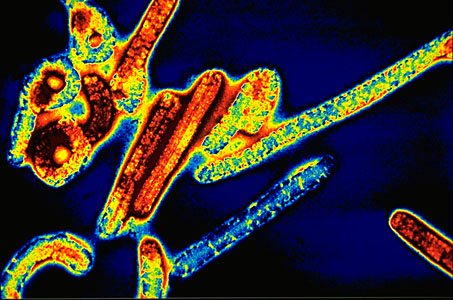
A deadly outbreak of Ebola virus has killed at least 13 people and infected a further seven in Uganda.
The health ministry says emergency measures are in place to deal with the outbreak, which began in late June but has only just been confirmed as Ebola.
The cases have been reported in Kibaale district, about 170 km (100 miles) to the west of the capital Kampala.
Officials say most are linked to one family, who may have contracted the virus while attending a funeral.
A deadly outbreak of Ebola virus has killed at least 13 people and infected a further seven in Uganda
Another suspected infection, at Kampala’s Mulago hospital, is also being investigated by doctors.
Ebola is one of the most virulent diseases in the world. It is spread by close personal contact, and kills up to 90% of those who become infected.
There is no vaccine for the virus. Symptoms include sudden onset of fever, weakness, headache, vomiting and impaired kidneys.
The first victim of this outbreak was a pregnant woman.
More than 1,200 deaths from the virus have been recorded since it was discovered in 1976.
Uganda has seen three major outbreaks over the past 12 years.
The deadliest was in 2000 when 425 people were infected, more than half of them died.
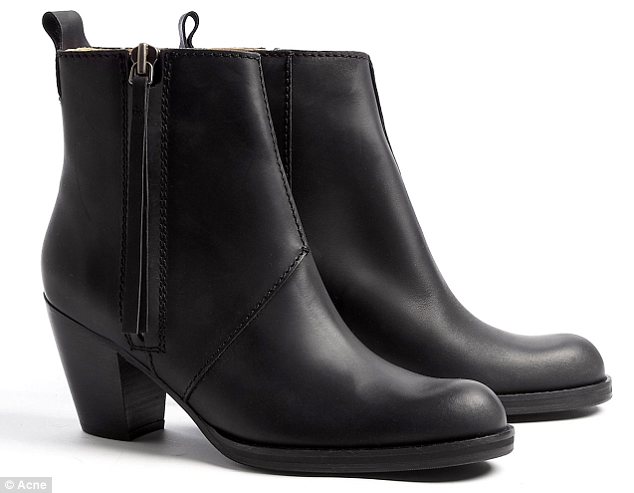
The Pistol ankle boots, designed by the Swedish label Acne, are proving the objects of desire among the world’s current It girls including Keira Knightley, Michelle Williams, Clemence Poesy and others.
The boots, which come in a variety of colors, have been photographed on the feet of many, their trademark zipper attached with leather tassel seen swinging with each starlet’s every step.
Some stars, like Dakota Fanning, have been spotted in variations of the classic black leather boot, which feature a sturdy wedge heel and stitching to create subtle panels at the front.
An almond-shaped tow toughens up the boot which also features a gunmetal-tone side zip that carries the tassel.
Dakota Fanning was spotted at LAX airport in January, wearing a camel toned pair of Pistols, which sell for $566 online at My-Wardrobe.com.
Price-wise, it is about the average one will pay for the shoe online. Net-a-Porter is selling it for $560.
Acne Pistol boots, which come in a variety of colors, have been photographed on the feet of many, their trademark zipper attached with leather tassel seen swinging with each starlet's every step
Dakota Fanning’s boot featured a black wedge heel and served as a statement item beneath her brown skin-tight pants – though not as much of a statement as the pink-dipped locks she also revealed during that spotting.
A spokesman for My-Wardrobe.com said that the boots were the “fastest selling ankle boots of all time” and after stock was replenished earlier this week, the Pistol is “flying out of the door”.
Keira Knightley appears to love her boots so much that she alternates between different colors.
The Anna Karenina actress has been photographed wearing the black variety several times but has also opted for a grey suede design on other occasions.
Michelle Williams wore her own Pistols while visiting Paris in February to promote My Week With Marilyn.
Photographed leaving the Musee d’Orsay, the petite blonde paired the design with black skinny-leg jeans.
The design is also featured on various fashion blogs, no doubt a result of the design’s multiple star endorsements.
French actress Clemence Poesy wore a black pair to the Chloe collection show Paris Fashion Week last year while Olivia Wilde was also spotted wearing the boots when she attended the Tribeca Film Festival in April.
Clemence Poesy kept her look all-black, pairing the boots with a leather jacket and skin-tight pants.
Rachel Weisz was also spotted wearing the design at JKF airport in February of last year.
Carrying her son Henry, the brunette beauty opted for navy skinny jeans to complete the casual look
Apple is reportedly considering buying a stake in Twitter worth hundreds of millions of dollars.
The technology giant, which has stumbled on the social media front, has been in talks with Twitter in recent months about the strategic investment, according to The New York Times.
Apple’s hefty injection of funds would value the social networking powerhouse at more than $10 billion, up from an $8.4 billion valuation last year, the newspaper’s sources said.
Apple has had huge success selling its iPhones and iPads but has had little traction in the fast-growing social media world.
As social media, accessed on computers and mobile devices, increasingly influences how people spend their time and money, Apple, which also sells applications, games, music and movies, is keen to get in on the action.
Apple is reportedly considering buying a stake in Twitter worth hundreds of millions of dollars
The New York Times said it’s not a done deal and the companies are not in negotiations at the moment. But are likely to form a strong partnership against intensifying competition from the likes of Google and Facebook.
Facebook is aligned with Microsoft, which owns a small stake in it, and Google, which rivals Apple in the smart phone market, is pushing its own social network, Google Plus.
“Apple doesn’t have to own a social network,” Timothy D. Cook, Apple’s chief executive, said at a recent technology conference.
“But does Apple need to be social? Yes.”
Twitter and Apple have already been working together, with the technology leader embedding Twitter features into its software for phones, tablets and computers.
Meanwhile, Twitter has been working to bolster its relationship with Apple, according to The Times.
An investment in Twitter would not be a big financial move for Apple, which has $117 billion in liquid investments, but it would be one of Tim Cook’s most important strategic decisions since taking the helm after Steve Jobs’ stepped down due to illness.
For Twitter, having the backing of a tech icon like Apple would see its valuation shoot up overnight.
Like that of other start-ups, the company’s valuation has languished in the wake of Facebook’s lackluster market debut.
But Twitter does not need Apple’s cash injection. Earlier this year, chief executive Dick Costolo, said the company had “truckloads of money in the bank”.
The Times’ sources reckon this “truckloads” adds up to more than $600 million in cash on hand thanks to a healthy flow of advertising revenue.
Both Apple and Twitter refused to comment in the article, but Dick Costolo said of Apple in a recent interview: “Those guys are a great partner. We think of them as a company that our company looks up to.”
Kardashian sisters are on the hunt for a plus-size beauty to model their new denim line.
Kim, Khloe and Kourtney Kardashian, aged 31, 28, and 33 respectively, took to Khloe’s blog to announce the search which invites women over the age of 18 to send full-length photos of themselves to the famous sisters.
Kardashian Kurves, the new line, has been created in conjunction with Sears and will feature three styles, each inspired by one of the three sisters.
The chosen model will star in an advertisement for the line, which has not been given a release date as yet.
Khloe Kardashian outlined the contest’s grand prize, a round trip for one to Los Angeles to attend a photo shoot, on her blog.
She added: “It’s a venture we’re really thrilled about!”
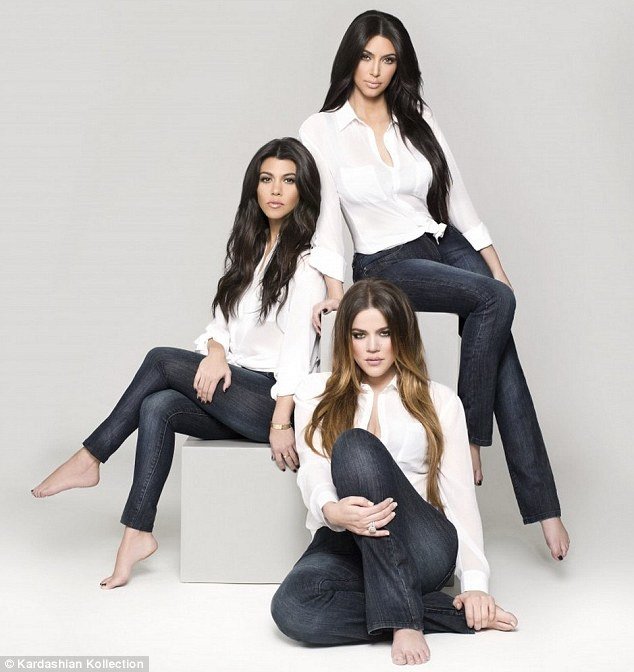
Kardashian sisters are on the hunt for a plus-size beauty to model their new denim line
The prize also includes one night’s accommodation in Los Angeles to ensure their model is in tip-top condition for the campaign’s photo shoot.
The line was originally announced through social media also – via Kim Kardaashian’s Twitter page.
The reality star posted: “Our Kardashian Kollection for Sears denim line is officially here!! There are three styles, each named after my sisters and me.”
Further images showed Kim Kardashian wearing her own version in the line.
She added on Twitter: “I’m wearing The Kim, which is a sexy, low cut, straight leg jean. Then Kourtney is wearing The Kourtney, a gorgeous skinny leg jean, and Khloe is wearing The Khloe, a tall curvy, high rise, boot cut!!”
Kim Kardashian continued to gush: “The jeans come in different washes so you can choose the fit and wash that’s perfect for you!”
“Nick Saglimbeni was the photographer and I love the way they turned out! Shoots with my sisters are the best!! Xo.”
All three sisters have posed in their first photos from the campaign, wearing their namesake trousers and identical button-down white shirts.
It is, of course, not their first collaboration with Sears.
They first launched the budget-friendly Kardashian Kollection for the chain store last August.
Unsurprisingly, Kim Kardashian did not look to her ex-sister in law, Kaela Humphries, to model the line.
The sister of Kris Humphries is a plus-size model herself and is signed to Ford modelling agency.
Interested fans need to submit an “essay” explaining what being “kurvy” and “konfident” means to them.
Last night, at the Olympic Opening Ceremony, Queen Elizabeth II appeared in her first movie acting role and proved herself an instant comedy hit.
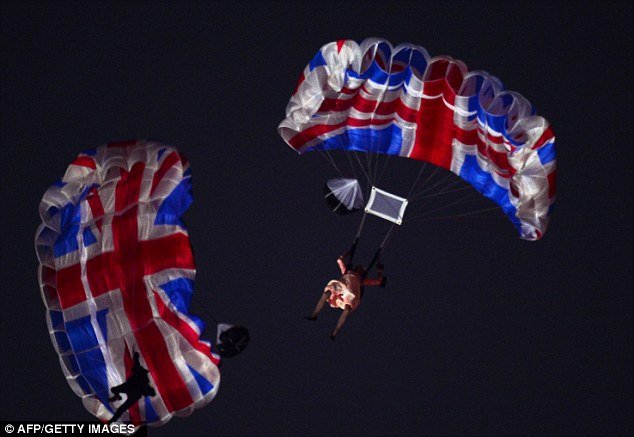
Her Majesty was seen in a film alongside James Bond actor Daniel Craig before apparently “parachuting” into the stadium for the opening ceremony.
The recorded sequence opened at Buckingham Palace, where a tuxedo-wearing Daniel Craig as 007 was presented to the Queen by her personal footman as she was writing a letter and training her corgis Monty, Willow and Holly to roll over.
Greeting him with an “Evening, Mr. Bond”, the Queen, in a rose-pink dress, was seen striding briskly through the palace with the action hero before climbing into a helicopter emblazoned with the Union Flag.
Queen Elizabeth II appeared in her first movie acting role and proved herself an instant comedy hit
The two were depicted as soaring over the streets of London and through Tower Bridge until they finally reached the Olympic Park.
As the film reached its climax, spectators inside the east London stadium heard an Agusta Westland AW139 helicopter, which finally appeared hovering above.
As the aircraft steadied in the movie sequence, James Bond was seen opening the door and appearing to hesitate. While he dithered, the figure of the Queen pushed past him and dived out into the air followed by 007 – Union Jack parachutes streaming behind them. Meanwhile, from the real helicopter above the stadium, the same two figures appeared to plunge to earth.
And, with the familiar Bond theme tune sounding around the stadium, the spotlight shone on the Royal Box to reveal the Queen in exactly the same dress she wore in the film.
Accompanied by the Duke of Edinburgh, she entered to rapturous applause with Jacques Rogge, president of the International Olympic Committee.
The Union Flag was then carried into the stadium and raised by representatives of the Royal Navy, Army and RAF.
Director Danny Boyle said: “The Queen made herself more accessible than ever before.”
Organizers said that having to secure permission to fly along the Thames through Tower Bridge – which had never been done before – was a challenge in itself.
The two parachutists who actually leapt from the helicopter last night were Gary Connery, a professional base jumper, and Mark Suttan, a former officer in the Royal Gurkha Rifles.
The US economic growth slowed in the second quarter to an annualized pace of 1.5%, as consumer spending eased.
But growth in the first three months of the year was revised up to 2% from a previous estimate of 1.9%, the Commerce Department said.
Previous data was also revised to show the economy shrank by less during the 2007-9 recession than thought.
Despite the slowdown, the second quarter growth figures were better than expected and US stocks rallied sharply.
The main Dow Jones index closed up 188 points, or 1.5%, at 13,076, its highest level since early May.
A joint statement from French President Francois Hollande and German Chancellor Angela Merkel reasserting their commitment to preserving the euro also helped to push Wall Street higher.
The US economic growth slowed in the second quarter to an annualized pace of 1.5 percent, as consumer spending eased
The Commerce Department’s latest figures showed the US economy shrank by 4.7% from the start of the recession in 2007 until it ended in 2009.
It had earlier been thought the economy contracted by 5.1% over that period.
Separately, in its twice-yearly review, the White House revised down its forecast for growth in 2012 to 2.3% from 2.7%, and in 2013 to 2.7% from 3%.
“The economy continues to face serious headwinds that have dampened growth and limited gains in employment,” the report said.
The 1.5% annual pace in the second quarter is equivalent to 0.4% quarter-on-quarter growth.
The Commerce Department said the slowdown reflected weaker consumer spending, which grew by 1.5% in the second quarter, compared with 2.4% growth seen in the first quarter.
It also cited an acceleration in imports for the slowdown in growth.
But it said there that these were partly offset by an upturn in private inventory investment, a smaller decrease in federal government spending, and an acceleration in exports.
Exports of goods and services increased by 5.3% in the second quarter, up from 4.4% in the first three months.
Peter Cardillo, chief market economist at Rockwell Global Capital, said the headline growth number was “a bit better-than-expected, but still the consumption is weak”.
“If the economic data next week continues [to be weak], then probably the market can keep their hopes up that [the] Fed would eventually resort to more stimulus.”
Last month, the US Federal Reserve cut its forecast for economic growth in 2012 to 2.4% from 2.9%.
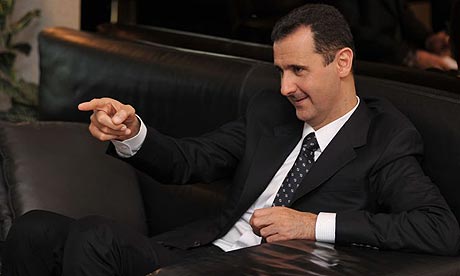
Syrian army has launched ground and air attacks against rebels in parts of Aleppo, activists say.
Rebels with the Free Syrian Army (FSA) say they have repelled an army incursion and destroyed tanks, but there is no independent verification.
Western nations have warned of a potential massacre in Aleppo, Syria’s most populous city.
Early on Saturday morning, activists said Syrian tanks began moving in on south-western districts of the city.
They said the bombardment of rebel-held areas intensified in the early morning, with military aircraft overflying the city at low altitudes.
Many casualties have been reported, our correspondent says, and a steady stream of vehicles carrying families is leaving Aleppo.
Syrian state television said that rebels, having failed in Damascus, were now trying to turn Aleppo into a den for their terrorism.
The rebels say they have destroyed a number of tanks, but their claim cannot be independently verified.
The rebels are vastly outgunned and outmanned by forces loyal to Syrian President Bashar al-Assad.
Syrian army has launched ground and air attacks against rebels in parts of Aleppo
Activists have reported violent clashes around the Salah al-Din and Hamdanieh quarters near the centre of Aleppo.
An emergency call has gone out to doctors to come to Salah al-Din and help if they can, our correspondent says.
On Friday, the Red Crescent suspended some of its operations in Aleppo because of the heavy fighting.
Rebels had been stockpiling ammunition and medical supplies in preparation for the expected assault.
Both sides are braced for heavy casualties.
“Rebels are stationed in narrow streets, in which fighting will be difficult,” a government security official told the AFP news agency.
The Syrian Observatory for Human Rights said 160 people were killed across Syria on Friday.
The fighting comes after two weeks during which rebels made significant gains.
On 18 July, an attack at Syrian security headquarters in Damascus killed four senior officials, including the defence minister and President Bashar al-Assad’s brother-in-law.
The Free Syrian Army (FSA) took control of several parts of Damascus before being driven out by a government counter-offensive.
The rebels also seized several border crossings with Turkey and Iraq.
There has been fighting around Aleppo for the past week, with the government deploying fighter jets and helicopter gunships to beat back the rebels.
Until recently, Aleppo and Damascus had been relatively free of the violence that has wracked other parts of the country.
Earlier this week, thousands of government forces were moved from the border with Turkey to join fierce fighting in Aleppo, activists said.
On Friday, UN Secretary General Ban Ki-moon urged the Syrian government to halt its offensive and demanded a clear statement that chemical weapons would not be used under any circumstances.
Syria has implicitly acknowledged that it has chemical weapons but says it will not use them against its own people, only against foreign invaders.
The former head of the UN monitoring mission in Syria, Maj. Gen. Robert Mood, said it was “only a matter of time” until President Bashar al-Assad was ousted.
On Sunday, the Syrian Observatory for Human Rights reported that at least 19,106 people had been killed since March 2011. The UN said in May that at least 10,000 people had been killed.
Syria blames the violence on foreign-backed “armed terrorist gangs”.
In June, the Syrian government reported that 6,947 Syrians had died, including at least 3,211 civilians and 2,566 security forces personnel.
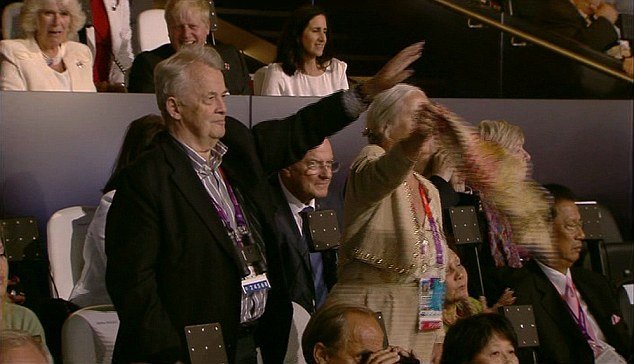
A German dignitary at the Olympic Opening Ceremony appeared to greet his country’s athletes with a Nazi salute.
The elderly man was caught on video repeatedly extending his right arm back and forth prompting a few awkward stares from members of the crowd.
Bizarrely he was sitting in front of Boris Johnson and Camilla Parker-Bowles who looked bemused at first before bursting into laughter.
Meanwhile a Conservative MP, who was demoted after attending a reportedly Nazi-themed stag party, appeared to describe the Olympic Opening Ceremony as “leftie multi-cultural crap”.
The comments, claiming the ceremony was more left wing than that which opened the 2008 Beijing Games in Communist China, appeared in a Twitter account purporting to be that of Aidan Burley, Tory MP for Cannock Chase.
The opening section showcased British history, including the creation of the NHS and the Jarrow march, a 1936 protest against unemployment in the North East.
A German dignitary at the Olympic Opening Ceremony appeared to greet his country's athletes with a Nazi salute
Two tweets were posted from @AidanBurleyMP, saying: “The most leftie opening ceremony I have ever seen – more than Beijing, the capital of a communist state! Welfare tribute next?”
A second tweet read: “Thank God the athletes have arrived! Now we can move on from leftie multi-cultural crap. Bring back red arrows, Shakespeare and the Stones!”
Downing Street distanced itself from the comments, with a senior source saying: “We do not agree with him.”
The tweets, widely repeated, caused an avalanche of criticism on the social networking site including from a fellow Conservative, Croydon MP Gavin Barwell.
“@AidanBurleyMP with respect, us Londoners are rather proud of the diversity of our city £nothingleftwingaboutit,” he tweeted in reply.
Aidan Burley lost his job as a parliamentary private secretary after media reports of the party on December 3 last year in a restaurant in the French Alpine resort of Val Thorens, at which one guest is alleged to have dressed in an SS uniform and others are said to have chanted Nazi slogans.
The Cannock Chase MP has repeatedly apologized for being present at the event, but said in December: “I do not believe I have broken any French law and have distanced myself from the behavior of other people on the stag.”
A later tweet from the account said the previous comments had been ”misunderstood”.
“Seems my tweet has been misunderstood. I was talking about the way it was handled in the show, not multiculturalism itself,” it said.
The event, in which the Queen had a starring role, featured a diverse cast including James Bond star Daniel Craig and JK Rowling, merging music, dance and special effects into a spectacular opening.
The world-wide audience was treated to a greatest hits medley of British pop over the decades with bursts of the Beatles, the Jam, Sex Pistols and Dizzee Rascal.
There were also excerpts from the Kinks, Frankie Goes To Hollywood and Mud’s Tiger Feet before Emeli Sande sang the cup final classic Abide With Me.
Queen Elizabeth II has declared the London Olympics officially open, before seven young athletes were given the honor of lighting the ceremonial flame.
The show featured British celebrities and sportspeople, including David Beckham and Bradley Wiggins, and screen characters Mr. Bean and James Bond.
In a speech watched around the world, Games chief Jacques Rogge said: “The Olympic Games are coming home tonight.”
Flag-bearer Sir Chris Hoy earlier led out Team GB to cheers and applause.
The identity of who was to light the symbolic flame was shrouded in secrecy ahead of the ceremony.
The group of seven, chosen by British Olympic champions, each lit a single tiny flame on the ground, igniting 205 petals, one for each competing nation or territory.
Long stems then rose towards each other to form a cauldron, signifying unity.
The flame made a dramatic arrival via the Thames on a speedboat carrying Beckham, who handed the torch to Sir Steve Redgrave.
The show, billed as a quirky take on UK life, started with iconic images of London and Britain being beamed to the world, and all four countries of the UK being represented in song.
Queen Elizabeth II has declared the London Olympics officially open, before seven young athletes were given the honor of lighting the ceremonial flame
The field at the stadium in Stratford, east London, was turned into a green meadow, with sheep, horses, chickens, ducks and geese among the cast.
The show took the watching world through “great revolutions in British society”, from an agricultural setting through to the Industrial Revolution itself.
Steelworkers began forging material that transformed into golden Olympic rings, which appeared to float into the air to be suspended above the performers.
There were cheers too as the crowd saw a film featuring an unlikely meeting between the Queen and agent 007 James Bond.
“Good evening Mr. Bond,” the Queen said in the clip, before they left together, apparently heading towards the Olympic Stadium in a helicopter.
The aircraft then flew over the stadium to the sound of the Bond theme tune, as two figures parachuted down, one dressed as the monarch.
As if by magic, the Queen appeared in the stands – part of a crowd of about 80,000 – amid cheers.
James Bond was not the only much-loved British character to take part. Mr. Bean prompted laughter when he appeared as part of the orchestra playing the Chariots of Fire theme.
The ceremony also celebrated the National Health Service by featuring a cast of more than 1,000 volunteers recruited from hospitals across the country, including Great Ormond Street children’s hospital in London.
All the action was played out to a soundtrack of some of Britain’s most iconic bands – including the Clash, the Rolling Stones, Queen, the Sex Pistols and David Bowie – with Sir Paul McCartney performing live at the show’s close.
The athletes taking part in the Games – led by Greece, the Olympics’ spiritual home – made laps of the stadium bearing their nations’ flags.
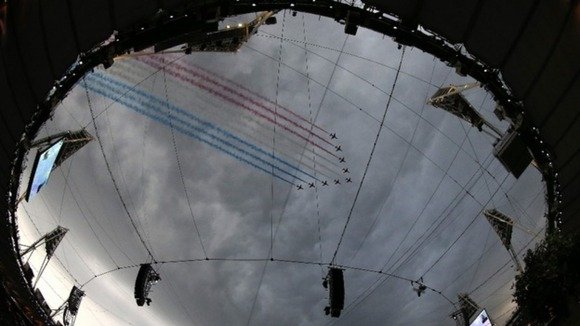
A Red Arrows fly-past marked the start of the pre-show at the symbolic time of 20:12 BST.
And Bradley Wiggins, wearing a yellow jersey, rang the world’s largest harmonically-tuned bell to launch the opening ceremony.
As the “Isles of Wonder” show began, artistic director Danny Boyle pledged a ceremony with a theme of “this is for everyone”.
The Oscar-winning film director later tweeted: “Thank you, everyone, for your kind words! Means the world to me.”
Earlier, crowds of people, many of them dressed in their nation’s colours, streamed into the Olympic Park for the show.
Transport ran smoothly and the crowds moved quickly through security.
The day of celebration began at 08:12 BST with a mass bell ringing. Big Ben rang for three minutes for the first time since King George VI’s funeral in 1952.
The three-and-a-half hour show was rehearsed more than 200 times, with each of the 7,500 volunteers spending on average 150 hours practicing during the build-up.
The event used 12,956 props and boasted a million-watt PA system using more than 500 speakers.
Thousands of fans also gathered at other outdoor locations across the capital to watch the show on big screens.
First Lady Michelle Obama arrived in London this morning and she has already showed off two very patriotic wardrobe choices as she helps motivate Team USA.
Leaving President Barack Obama at home in Washington, the First Lady is in the UK to lead the US Presidential Delegation to the Olympic Games.
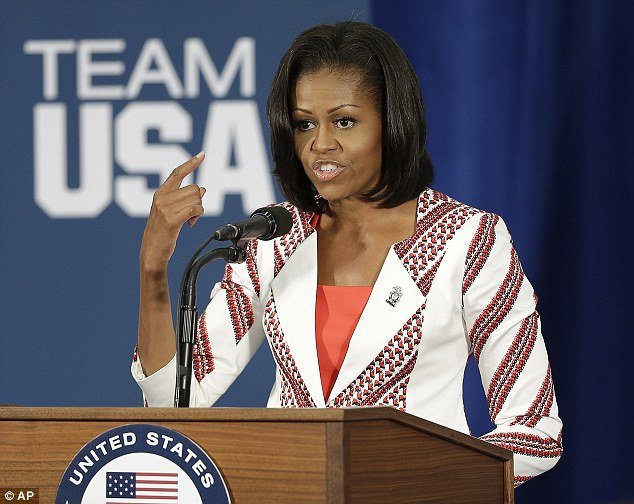
After a breakfast with Team USA at their training facility in the University of East London, where she wore a bold red and white striped jacket and black tailored trousers, her whirlwind schedule took her to an event to help promote her Let’s Move campaign.
At Michelle Obama’s breakfast stop, she greeted athletes with a rousing speech as her bold wardrobe choice also spoke volumes.
The red and white pattern on the jacket was a surprise choice for the normally impeccably dressed 48-year old, as she started to blend in with the America flags behind her.
At the following event, held at Winfield House in Regent’s Park where U.S. Ambassador Louis Susman now resides, mingled with David Beckham among other sporting stars.
Wearing another patriotic ensemble, Michelle Obama wore a sporty blue T-shirt, paired with white pants and a smart white and blue blazer that featured navy piping.
The event attracted around 1,000 American Military children as well as American and British students who couldn’t get enough of the event’s visiting host.
Michelle Obama jogged to a stage to the sound of a marching band that played the University of Florida flight song.
She told the crowd: “I’m so excited. I am thrilled to be here on London for the 2012 Olympic games. I am proud to be leading the U.S. delegation to the opening ceremony.”
Olympic gold-medal sprinter Carl Lewis signed autographs at the event while ex-NBA star Dikembe Mutombo offered basketball tips to the awed group of children.
David Beckham stood behind Michelle Obama, watching on as she addressed the crowd.
But soon, it was time for the games to begin and the blazer was shrugged off to allow the First Lady to show off THOSE famous arms as she played football and other sports with children on the lawn.
There was no doubting her passion for her country and team as she was seen getting active with her adoring fans.
First Lady Michelle Obama arrived in London this morning and she has already showed off two very patriotic wardrobe choices as she helps motivate Team USA
Michelle Obama proved an equally-inspiring presence earlier this morning at the breakfast event.
There, she had chosen an on trend pillar box red peplum shell top to wear underneath the nipped in jacket, which also featured cut-away collar detail and optical illusion panels.
During her address Michelle Obama urged America’s athletes to “have fun, breathe a bit, but also win”.
She said: “Wow, I’m going to be saying that a lot over the next few days. Wow, wow!
“I can’t believe I am here, I am beyond proud.
“I can’t begin to tell you how amazing it is for me to be leading the delegation.”
Michelle Obama spoke of her fond memories of the Olympics.
“Some of my fantastic memories growing up, and even as an adult, involved watching the Olympics on TV.
“I was just in awe of these athletes and my family, we would sit together for hours watching these men and women perform feats of endurance, speed and grace that would have us cheering at the top of our lungs.”
The First Lady said she and her brother hoped that they would one day achieve something “just as great” for themselves.
Michelle Obama also told the athletes the Olympics were particularly special to her family because of her father’s battle with multiple sclerosis, she said: “My father contracted MS in the prime of his life, but he retained the love of sports, and the Olympics was a special time for him.”
Talking about her drive to get America fit, Michelle Obama urged the athletes to think about the children that will be watching them across the Atlantic.
She said: “You just never know who you are going to inspire, you just never know.
“You are certainly inspiring me every day. I still have those same feelings of pride, excitement and wonder, so being here is other-worldly for me.
“I am still so inspired by all of you.
“This summer, people across America are going to be supporting Team USA and not just by cheering you on from our living rooms, but by striving to live up to the example that you have set.”
Michelle Obama is a passionate advocate of healthy living and later on this morning will be hosting a Let’s Move event for British and American school children alongside David Beckham.
And her day of events will conclude with a reception at Buckingham Palace for heads of state and then a visit to East London and the Opening Ceremony of the 2012 Olympic Games.
The style conscious First Lady is a walking advertisement for good eating and exercise and takes every opportunity to showcase her gym honed arms in demure but sleeveless outfits.
And fashion fans are hoping she will take this opportunity to showcases some of her signature preppy looks.
On a recent promotional jaunt for her gardening book American Grown: The Story of the White House Kitchen Garden and Gardens Across America, Michelle Obama changed outfit three times in one afternoon.
Speaking of her visit to the Olympics and her continuing ant-obesity campaigning Michelle Obama has said: “Olympians and Paralympians are true American heroes and role models for all of us, especially our young people.
“And I know that this delegation will help inspire a generation of young people to get into the Olympic spirit by getting active and healthy so they can reach their fullest potential and reach their dreams.”
Thousands of people awaits the spectacular opening of the London Games, as a fly-past by the Red Arrows marked the start of the pre-show.
The nine RAF jets flew over the Olympic Stadium at the symbolic time of 20:12 BST, amid cheers.
The three-hour spectacle will be viewed by a TV audience of one billion people.
Details of the ceremony remain a closely-guarded secret. Its artistic director, Danny Boyle, has dedicated it to the 15,000 volunteers taking part.
Danny Boyle has spoken of his “excitement” for the ceremony, which is named the Isles of Wonder, as well as feeling “nervousness” for all the volunteers.
Thousands of people awaits the spectacular opening of the London Games, as a fly-past by the Red Arrows marked the start of the pre-show
The Oscar-winning film director said the ceremony “might surprise people… it’s spectacular, but also inclusive – it has a warmth”.
The chairman of London 2012, Lord Sebastian Coe, said he was “as excited as hell”.
Crowds of people, many of them dressed up in their nation’s colors, are gathering in large numbers at the Olympic Park.
Transport to the stadium appears to be running smoothly and the crowds are moving quickly through security.
Rain has started to fall over the stadium, despite forecasters predicting dry weather ahead of the ceremony.
The day of celebration began at 08:12 BST with a mass bell ringing. Big Ben rang for three minutes for the first time since King George VI’s funeral in 1952.
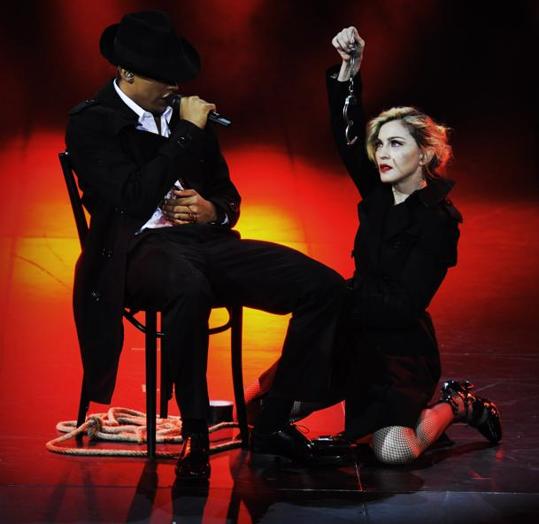
Madonna fans vented their anger after the singer ended a special intimate show at Paris Olympia after just 45 minutes.
Madonna said she had “a special affinity with France” as she opened the last minute concert, but drew boos from many disappointed fans.
Some had camped outside the Olympia club since Wednesday in anticipation of the show.
The 2,000 tickets sold out in minutes, with fans paying between $125-$320 and some changing hands for up to $1,600.
Madonna was also criticized for talking about politics instead of singing, after revealing she had a message for France’s extreme right-wing leader Marine Le Pen.
France’s National Front is threatening to sue the star for using an image of Marine Le Pen with a swastika superimposed on her forehead at a concert earlier this month.
Madonna fans vented their anger after the singer ended a special intimate show at Paris Olympia after just 45 minutes
“I know that I have made a certain Marine Le Pen very angry with me,” Madonna told fans.
“It’s not my intention to make enemies. It’s my intention to promote tolerance,” she continued.
Afterwards 33-year-old Guillaume Delaval complained: “She spoke for 15 minutes about tolerance, it’s not the UN here.”
Paris resident Allain Zambrana, 26, from Nicaragua, said he wanted to ask for his money back.
“I felt very frustrated because I camped out on the streets and then the show just ends like that.”
Several fans cried “refund!” as they realized Madonna had left the stage for good, with some audience members taking to Twitter to complain.
“We are singing <<shame on you>>,” explained Pierre from Belgium.
“Because she says she loves her fans but then she does this.”
Dutch fan Ellis Van Zoen, 22, agreed the show was “very short”, but added: “I’m torn – I thought it was a fantastic show and it was special. I don’t want to see fans yelling at her but I can understand why.”
Madonna also offered veiled criticism of the party’s anti-immigrant stance, as she paid homage to a France which she said had once “opened its arms to minorities”.
“We are entering some very scary times in the world,” she told the crowd.
“People are afraid, and what happens when people are afraid? They say <<get out! You’re the reason. You’re the problem. You’re to blame>>.”
Madonna, 53, who performed in an array of outfits including a black leather pencil skirt and French beret, also paid tribute to several French artists.
The event was also streamed live on YouTube, where separate footage showed fans chanting and booing while throwing empty bottles and cups onto the stage after the singer had left.
Madonna is due to perform in France again on 21 August, in Nice.
Duran Duran, Snow Patrol, Stereophonics and Paolo Nutini are celebrating the start of London Olympic Games at a special concert in Hyde Park this evening.
The show coincides with the opening ceremony, which will be shown on big screens in the park.
Scottish singer-songwriter Paolo Nutini took to the stage to loud cheers to open the show in front of 50,000 fans.
Each of the four acts on the bill was selected to represent the different countries of the UK.
Snow Patrol, representing Northern Ireland, will close the London concert.
Best known for hits such as Chasing Cars and Run, the band said the event was “really special.”
“It’s the only thing I’ll ever represent Northern Ireland at,” said frontman Gary Lightbody.
“My 100 metre sprinting days are long past me.”
“We were asked to represent our country, we’re never going to say no to that,” he added.
“The world is looking in on our nations and you’ve got to stand up for that.”
Duran Duran, Snow Patrol, Stereophonics and Paolo Nutini are celebrating the start of London Olympic Games at a special concert in Hyde Park this evening
Fellow headline act Duran Duran will perform second on the bill, representing England.
John Taylor from the band said: “We feel very English. But we feel British too, so we’re in the right place.”
Singer Simon Le Bon said it was “the biggest show we’ve ever played in London town”, and added: “It’s amazing out there.”
Bandmate Nick Rhodes said: “It’s the last day of the European tour and it’s the first day of the Olympics. What more could you ask for?”
Paolo Nutini, who performed hits such as Jenny Don’t Be Hasty, said it was “an honour” to be involved.
“To go fly the flag for your country makes it even sweeter,” he added.
Welsh rockers Stereophonics played four small warm-up shows around the UK this week in preparation for their set, following the big screen coverage of the opening ceremony.
Meanwhile, the crowd of around 80,000 in the Olympic Stadium will include Queen Elizabeth II and a host of dignitaries and celebrities.
Masterminded by Oscar-winner Danny Boyle, the £27 million ($43 million) extravaganza features a cast of 15,000 volunteers and is said to be a quirky take on British life.
Westminster Council has extended Hyde Park’s curfew until 01:00 BST for what they called an “exceptional evening”, which is timed to run around the opening ceremony.
Earlier this month organizers of a Bruce Springsteen concert pulled the plug on the power when his show over-ran.
Westminster Council has confirmed that the gig to coincide with the closing ceremony on 12 August, headlined by Blur, will also have the same curfew.
Skype, the Microsoft’s online message, phone and video chat service, has denied making changes to its system “in order to provide law officers greater access” to its members’ conversations.
It follows reports suggesting infrastructure upgrades had made it easier to hand on users’ chat data.
Skype has now posted a blog saying the changes were made solely to improve user experience and reliability.
But it added it would pass on messages to law enforcement when “appropriate”.
Concern about Microsoft’s intentions were first raised over a year ago after the Conceivablytech blog revealed the firm had filed a US patent for Legal Intercept – a technology “capable of silently copying the communication between at least two entities” on Voip (voice over internet protocol) calls.
It specifically made reference to “Skype and Skype-like applications” despite being filed in 2009, 17 months before Microsoft paid $8.5 billion to take over the service.
Skype has denied making changes to its system "in order to provide law officers greater access" to its members' conversations
In May 2012 the issue was revived after security researcher Kostya Kortchinsky blogged that the firm had changed its “supernode” policy.
While in the past Skype had relied on users with high-spec systems to help its members’ computers locate each other when a call was made, the firm had now switched to a system in which all such connections were made using in-house servers.
This prompted posts on some blogs linking the move to the earlier surveillance patent which were then followed up by the news site Extreme Tech.
Reports in the mainstream media including articles by Forbes, and The Washington Post followed.
The latter said industry and government officials had told it that Skype “has expanded its co-operation with law enforcement authorities to make online chats and other user information available to police”.
It said its sources had spoken to it “on the condition of anonymity”.
Skype’s blog post said it was “false” to believe the changes it had made allowed it to monitor and record audio and video calls. It said that while its servers helped members locate each other and maintain quality, the actual call data usually bypassed its equipment going directly from one users’ equipment to another.
“Skype to Skype calls do not flow though our data centres and the <<supernodes>> are not involved in passing media (audio or video) between Skype clients,” wrote Mark Gillett, the firm’s chief development and operations officer.
But he added that group calls including more than two parties were an exception, “where a server aggregates the media streams (video) from multiple clients and routes this to clients that might not otherwise have enough bandwidth to establish connections to all our partners”.
The Washington Post article had focused on written instant messages, rather than video/audio calls.
Mark Gillett denied Skype’s moves had been designed to “facilitate law enforcement” but he did acknowledge the company would give the authorities access to messages if “a law enforcement entity follows the appropriate procedures” and the procedure was “technically feasible”.
His post suggested it would be possible to pass on messages in some instances.
“In order to provide for the delivery and synchronization of instant messages across multiple devices, and in order to manage the delivery of messages between clients situated behind some firewalls which prevent direct connections between clients, some messages are stored temporarily on our (Skype/Microsoft) servers for immediate or later delivery to a user,” he wrote.
Skype’s privacy policy acknowledges: “IM messages are currently stored for a maximum of 30 days unless otherwise permitted or required by law.”
Scientists have proposed a new idea in the long-running debate over the Moon formation.
What is certain is that some sort of impact from another body freed material from the young Earth and the resulting debris coalesced into today’s Moon.
But the exact details of the impactor’s size and speed have remained debatable.
In a report online to be published in Icarus, researchers suggest that the crash happened with a much larger, faster body than previously thought.
Such theories need to line up with what we know about the Moon, about the violent processes that set off the creation of moons, and what computer simulations show about the more sedate gravitational “gathering-up” that finishes the job.
In recent years, scientists’ best guess for how the Moon formed has been that a relatively slowly moving, Mars-sized body called Theia crashed into the very young Earth.
What is certain is that some sort of impact from another body freed material from the young Earth and the resulting debris coalesced into today's Moon
That would have heated both of them up and released a vast cloud of molten material, much of which cooled and clumped together to give rise to the Moon.
That would suggest that the Moon is made up of material from both the early Earth and from Theia, which should be somewhat different from one another.
What complicates that story is a number of observations of “isotopic compositions” – the ratios of naturally-occurring variants of some atoms – taken from the Earth and from lunar samples.
While the Moon has an iron core like Earth, it does not have the same fraction of iron – and computer models supporting the Theia impact idea show just the same thing.
However, the ratio of the Earth’s and the Moon’s oxygen isotopes is nearly identical, and not all scientists agree on how that may have come about.
Confounding the issue further, scientists reporting in Nature Geoscience in March said that a fresh analysis of lunar samples taken by the Apollo missions showed that the Moon and the Earth shared an uncannily similar isotope ratio of the metal titanium.
That, they said, gave weight to the idea that the Moon was somehow cleaved from the Earth itself.
Now, Andreas Reufer, of the Center for Space and Habitability in Bern, Switzerland, and colleagues have run computer simulations that suggest another possibility: that a far larger and faster-moving body made an even more glancing blow with the young Earth.
They said this body would have lost only a small amount of material and most of it would have continued on after the “hit-and-run”.
That results in a much hotter disc of debris from the collision, but matches up with what would be needed to make a Moon-sized body.
The authors suggest that since most of what became the Moon would have been liberated by the impact from the Earth, similarities between the isotope fractions should be more pronounced.
More analyses of different elements within lunar samples – and a great deal more computer simulations that result in a Moon like our own – will be needed to settle the debate.
Robert Mood, the former head of the UN observer mission in Syria, says it is “only a matter of time” until President Bashar al-Assad’s government falls.
But Norwegian Maj. Gen. Robert Mood, who left Syria last week, said Bashar al-Assad’s fall would not necessarily mean an end to the 16-month-old conflict.
Syrian forces renewed their assault on the northern city of Aleppo, Syria’s most populous city, on Friday.
The US state department says it fears a massacre by Syrian government forces.
The pro-government al-Watan newspaper warned that the “mother of all battles” was about to start.
“In my opinion it is only a matter of time before a regime that is using such heavy military power and disproportional violence against the civilian population is going to fall,” Maj. Gen. Mood told the Reuters news agency.
Separately, UN High Commissioner for Human Rights Navi Pillay appealed to both sides to spare civilians, citing concerns of “the likelihood of an imminent major confrontation”.
Navi Pillay said she had received “as yet unconfirmed reports of atrocities, including extra-judicial killings and shooting of civilians by snipers” in Damascus.
Saying she had also received more reports of opposition fighters torturing or executing prisoners, Navi Pillay stated her belief that “crimes against humanity and war crimes have been, and continue to be, committed in Syria”.
Robert Mood, the former head of the UN observer mission in Syria, says it is only a matter of time until President Bashar al-Assad's government falls
An activist based in Fardos in Aleppo said at least 15 people had died on Friday morning during the military’s bombardment of a building.
“We have medical supplies but no doctors or equipment to treat the injured. The situation feels hopeless,” said the activist, identified only as Ramy.
“The people of Aleppo are not coping with this crisis. They are dying. It is a massacre. People can leave their homes and move around the city but who would really want to take the risk of being shot or bombed?”
He insisted that activists would continue to resist the government forces.
“Activists are prepared to engage in a guerrilla war, from street to street if necessary,” he said.
The Red Crescent has suspended some of its operations in Aleppo because of the heavy fighting.
Rebels have been stockpiling ammunition and medical supplies in preparation for the expected assault.
Syrian troops fired from helicopter gunships on south-western neighborhoods on Friday morning, the Syrian Observatory for Human Rights told the AFP news agency.
A convoy of tanks from Idlib province, near the border with Turkey, arrived in Aleppo overnight and was attacked by rebels, the Observatory said.
The US State Department said the deployment of tanks, helicopter gunships and fixed-winged aircraft around Aleppo suggested an attack was imminent.
But the US would not intervene, said spokeswoman Victoria Nuland, except by continuing to channel non-lethal assistance (such as communications equipment and medical supplies) to the rebels.
A Syrian MP from Aleppo has fled to Turkey, Turkey’s state-run Anatolia news agency says.
Ikhlas Badawi, a mother of six, said she was defecting in protest at the “violence against the people”.
Meanwhile, another defector, Gen. Manaf Tlas, has put himself forward as a possible figure to unite the fractious opposition.
In an interview with a Saudi newspaper, Asharq al-Awsat, he said: “I am discussing with… people outside Syria to reach a consensus with those inside.”
However, some in the opposition regard Gen. Manaf Tlas – who fled earlier this month – as a compromised figure too close to the government of President Bashar al-Assad.
For its part, Turkey has said it will not tolerate the creation of a Kurdish-run region in northern Syria.
This follows reports that Kurdish rebels in northern Iraq had formed an alliance with a Kurdish party across the border in Syria.
Turkey would strike against “terrorists” in northern Syria, warned Prime Minister Recep Tayyip Erdogan, in the same way it has attacked bases in northern Iraq used by militants linked to the Kurdistan People’s Party (PKK).
Turkey is concerned that the creation of a Kurdish authority in the north of Syria could provide a sanctuary to Kurdish rebels fighting for self-rule in Turkey’s southeast.
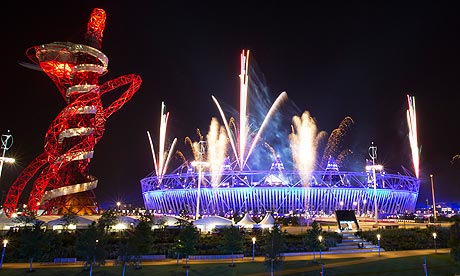
London Olympics opening ceremony is just hours away after seven years of preparations.
The three-hour spectacle in the Olympic Stadium will be viewed by a global TV audience of around one billion people.
The day of celebration began at 08:12 BST with a mass bell ringing. Big Ben rang for three minutes for the first time since King George VI’s funeral.
Lord’s cricket ground has turned away spectators trying to get in to watch archery amid confusion over ticketing.
The London 2012 website advertised the event’s preliminary rounds as “unticketed”, which some members of the public interpreted as open to the public.
But Olympic organizer LOCOG said it had not advertised or sold tickets for the ranking event and had always made it clear preliminary rounds were not open to spectators.
London Olympics opening ceremony is just hours away after seven years of preparations
South Korea later claimed the first two world records of London 2012 in the men’s team and individual archery.
Meanwhile, the Olympic flame has arrived at City Hall on the Queen’s rowbarge Gloriana after first weaving through the maze at Hampton Court Palace and being carried down the Thames on the final day of the torch relay.
Around 50 boats took part in the flotilla, each reflecting London’s waterborne heritage.
The flame’s 70-day nationwide journey ends with the lighting of the cauldron during this evening’s opening ceremony but the identity of the person who will take on the honor remains a mystery.
Five-times rowing gold medallist Sir Steve Redgrave and two-times decathlon champion Daley Thompson will take part in the closing stages, although neither is expected to light the flame.
The ceremony is expected to remain dry, but weather forecasters say the jet stream is moving southwards and there will be a return to more unsettled and chillier conditions over the next few days.
There have not been any reports of major transport issues. Network Rail and the Association of Train Operating Companies said most services were running to schedule. Some roads in London were congested around the route of the Olympic torch relay, and in St. John’s Wood where the archery competition began at Lord’s cricket ground.
Prime Minister David Cameron said: “It’s a great opportunity to show the world the best of Britain, a country that’s got an incredibly rich past but also a very exciting future.
“Someone asked me yesterday what face of Britain do we want to put forward – is it Blur or the Beefeaters? – and frankly it’s both.”
Mayor of London Boris Johnson said: “What’s so amazing is just the wave of excitement seems to pass from person to person like some benign form of contagion. Everybody is getting it.”
Danny Boyle, the artistic director of the £27 million ($43 million) opening ceremony, dedicated it to the 15,000 volunteers taking part.
“This is a live performance and it’s the actors, and in our case they’re volunteers, who have to get up there and do it.”
Europe’s largest bell will ring inside the Olympic Stadium at 21:00 BST at the start of the extravaganza, said to be a quirky take on British life.
Some 15,000 sq m of staging and 12,956 props will be used, and the event will boast a million-watt PA system using more than 500 speakers.
The crowd of about 80,000 will include the Queen and a host of dignitaries and celebrities.
Queen Elizabeth II and Prince Philip will host a Buckingham Palace reception for heads of state and government and an opening ceremony celebration concert featuring Snow Patrol, Stereophonics, Duran Duran and Paolo Nutini will be held in Hyde Park.
More than 10,000 athletes from 204 nations will take part in the London Olympics, which has taken £9 billion ($14 billion) of public money to stage.
In other developments:
• Ticketing delays at St James’ Park in Newcastle, which meant some fans missed a men’s football match on Thursday, were unacceptable, a senior 2012 official has said
• Three people due to work as staff at an Olympic venue in Newcastle were arrested on Wednesday on suspicion of immigration offences following accreditation checks
• Culture Secretary Jeremy Hunt narrowly avoided hitting a group of women with a handbell after it flew off the handle on HMS Belfast during the co-ordinated ringing – he called the moment a “classic”
• American First Lady Michelle Obama, who is in London to lead the US delegation, told the US Olympic team at their Docklands training camp “have fun, breathe a bit, but also win”
• International Olympic Committee president Jacques Rogge praised the regeneration which has taken place in east London and said the Games would have a “tangible legacy” with, uniquely, “no white elephants”
• London taxis staged a protest at Hyde Park Corner over Olympic traffic lanes. The protest was moved forward by three hours after police said they could not demonstrate on the Olympic Route Network from 16:00 to 03:00 BST.
Facebook shares have fallen to a new low, as concerns about its mobile strategy sparked a sell-off when markets opened on Friday.
Late Thursday, in its first report as a public company, Facebook said it lost $157 million from April to June.
Its shares plunged more than 16% to $22.37 when trading began in New York on Friday, worse than the declines seen in after-hours trade on Thursday.
Facebook shares have fallen to a new low, as concerns about its mobile strategy sparked a sell-off
Facebook shares were priced at $38 when it listed on the NASDAQ in May.
Facebook’s results on Thursday showed that revenue in the second quarter of the year had grown 32% to $1.18 billion, just beating forecasts. But analysts at Piper Jaffray said it appeared investors wanted “more than a slight beat”.
The number of monthly active users (MAUs) rose 29% from the same period last year to 955 million, but some analysts question the reliability of this data given the number of fake profiles on the social network.
The number of people who logged in daily to Facebook’s site from their mobile devices surged 67% year-on-year to 543 million.
But the company has yet to resolve how it generates profits as users move from the computer desktop version to accessing the site via mobile phone.
“We don’t view these results as dramatically good or bad,” said Citi analyst Mark Mahaney.
“Key questions remain: the future of Facebook mobile monetization and the future of Facebook user engagement.”
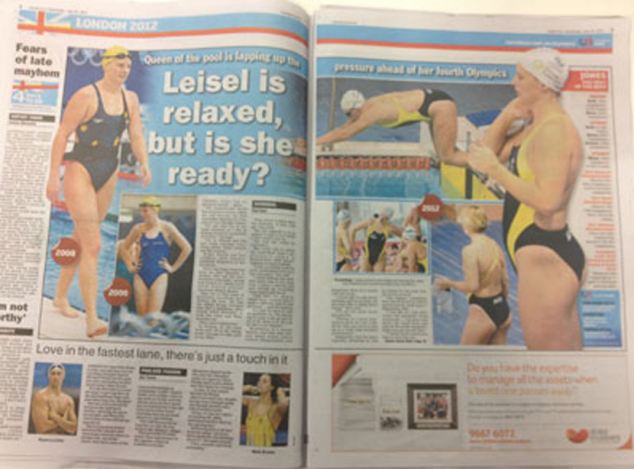
Nick Green, the Australian Olympic team chief, has slammed a newspaper as “disgraceful” for describing triple-gold medallist Leisel Jones as overweight just two days before the start of London 2012.
Swimmer Leisel Jones’s physique was today targeted in the Melbourne Herald Sun, which suggested she may be out of shape as she prepares for her fourth Olympics.
The paper questioned whether Leisel Jones, 26, fits into her swimsuit as well as she did four years ago, while a poll asked readers whether she is fit enough to compete.
A caption under an unflattering photo of Leisel Jones in the athlete read: “The Olympic veteran’s figure is in stark contrast to that of 2008.”
Swimmer Leisel Jones's physique was today targeted in the Melbourne Herald Sun, which suggested she may be out of shape as she prepares for her fourth Olympics
Nick Green has hit out at the paper for treating her in this manner.
He said: “I think it’s disgraceful to be honest. I’m disappointed with the article and it’s extremely unfair on Leisel Jones.
“She is a triple Olympic gold medallist for this country, I think she deserves a lot more respect than she has been given.”
Leisel Jones won the 100-meter breaststroke at Beijing in 2008 and is competing at her fourth Olympics.
Her coach Michael Bohl said he was happy with her condition.
Michael Bohl said: “She’s been doing nine sessions a week, and two gym sessions a week coming into this, and we were really happy with her form.”
Leisel Jones was also supported by former 400 meter track gold medallist Cathy Freeman, who described the comments about the swimmer’s weight “un-Australian”.
Cathy Freeman said: “It’s not very friendly or encouraging at this stage.”
But Leisel Jones denied she was feeling pressure about her weight.
Leisel Jones said: “I’m so relaxed, and I’m just really enjoying everything about these games and the lead-up.”
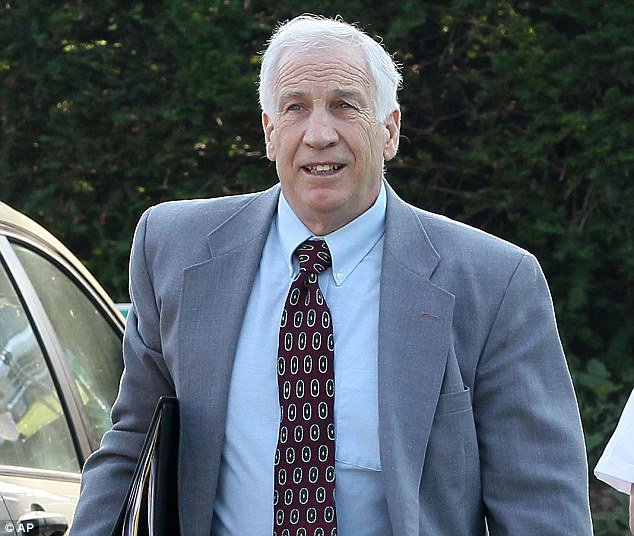
Former Penn State University football coach Jerry Sandusky allegedly called the boy he was seen raping in a locker room shower and left him two sickening voicemail messages professing his love – ten years after the reported abuse occurred.
Victim 2, whose graphic abuse was the single most shocking revelation of the horrific sex abuse scandal, stepped forward on Thursday to sue the university.
His identity remains a secret, but to prove the truth behind his claims, he released a pair of voicemails from Jerry Sandusky, left just two months before his arrest on dozens of sex abuse charges.
“I would be very firm and express my feelings up front. There’s nothing, really, to hide so…” Jerry Sandusky says in a voicemail left for the alleged victim, now an adult, on September 12, 2011.
He ends with: “Take care, love you, hope you get this message.”
Jerry Sandusky called again September 19 and asks the man whether he wants to go to a Penn State Football game.
Again, the former coach ends the voicemail with “thanks, I love you”.
Former assistant coach Mike McQueary, who was a graduate assistant at the time, testified at Jerry Sandusky’s trial that he saw the victim, a 10-year-old boy, with his hands pinned to a shower wall and Sandusky standing behind him in 2001.
Jerry Sandusky allegedly called the boy he was seen raping in a locker room shower and left him two sickening voicemail messages professing his love
“I heard rhythmic slapping sounds, two or three slaps that sounded like skin on skin,” Mike McQueary testified.
“I believe Jerry was sexually molesting him and having some type of intercourse with him.”
Jurors convicted Jerry Sandusky of 45 out of 48 counts of sex abuse charges last month. He awaits sentencing.
Despite the horrifying testimony, Victim 2 was never identified by investigators and never testified at trial.
Now, his lawyers say, he is coming forward to hold the Penn State administrators who covered up his abuse accountable.
“Our client has to live the rest of his life not only dealing with the effects of Sandusky’s childhood sexual abuse, but also with the knowledge that many powerful adults, including those at the highest levels of Penn State, put their own interests and the interests of a child predator above their legal obligations to protect him,” the lawyers said in a news release.
The university said it was taking the case seriously but would not comment on pending litigation.
University President Rodney Erickson and the board of trustees “have publicly emphasized that their goal is to find solutions that rest on the principle of justice for the victims”, a school spokesman said.
The statement from the man’s attorneys said Victim 2 suffered “extensive sexual abuse over many years both before and after the 2002 incident Michael McQueary witnessed”.
McQueary, who estimated the boy to be around 10 years old, reported the abuse to school officials, including longtime coach Joe Paterno, but none of them told police.
In a recent report conducted by former FBI Director Louis Freeh and commissioned by Penn State, the investigators excoriated Joe Paterno and the other administrators for not attempting to identify Victim 2, saying it showed “a striking lack of empathy”.
Trustees fired Joe Paterno, who has since died, because he failed to do more about claims against Jerry Sandusky, and the scathing independent review said several top school officials looked the other way because they were afraid of bad publicity. The NCAA has vacated 112 Penn State wins.
Before the trial, defense attorney Joe Amendola said he had met with a man he believed he might be Victim 2 and the man told him he had not been abused by Sandusky. Joe Amendola said he was not convinced and did not intend to subpoena him, but also said Jerry Sandusky himself was insistent they had the right person.
The statement from Victim 2’s lawyers leaves many questions unanswered, including whether he had been in contact with prosecutors before or during the trial, whether he remembers Mike McQueary, and whether he is the same person who met with Joe Amendola.
“Jerry Sandusky’s abuse of Victim 2 and other children is a direct result of a conspiracy to conceal Sandusky’s conduct and the decisions by top Penn State officials that facilitated and enabled his access to victims,” the statement read.
“We intend to file a civil lawsuit against Penn State University and others and to hold them accountable for the egregious and reckless conduct that facilitated the horrific abuse our client suffered.”
The statement did not say when the lawsuit would be filed or contain details on what redress the plaintiff is seeking. The lawyers said they would not have further comment, and messages left for their spokesman were not immediately returned.
Several messages seeking comment from Joe Amendola and Jerry Sandusky’s other lawyer, Karl Rominger, were not immediately returned.
Prosecutors had said on several occasions they did not know the identity of the boy, and they offered no reaction to the lawyers’ announcement Thursday.
“We can’t comment, given both our ongoing criminal prosecutions and our ongoing investigation,” said Nils Frederiksen, spokesman for the attorney general’s office.
The attorneys who released the statement include several based in Philadelphia and in State College, home to Penn State’s main campus – where the shower assault took place. They also represent three other young men Sandusky was convicted of abusing but have not filed any lawsuits.
A second accuser has filed paperwork indicating an additional complaint is in the works, while other lawyers also have indicated they represent young men with potential claims.
This week Penn State’s general liability insurer sought to deny or limit coverage for Jerry Sandusky-related claims.
Pennsylvania Manufacturers’ Association Insurance argued that Penn State withheld key information needed to assess risk.
In June, after Jerry Sandusky was convicted, the university said it hoped to quickly compensate victims and would reach out to their lawyers. Penn State spokesman Dave La Torre declined to comment on anything related to the victims and any settlement discussions.
Members of Egypt’s Olympic team have been given fake Nike gear, Yomna Khallaf, a synchronized swimmer, has alleged.
Yomna Khallaf said her workout bags had a big Nike logo in the front but the zippers had an Adidas branding on them.
The Egyptian Olympic Committee (EOC) secretary general, Motaz Sonbol, said they were shocked to find that the gear was not “directly from Nike”.
Nike said it was “concerned” athletes may have received products that do not meet the company’s quality standards.
Members of Egypt's Olympic team have been given fake Nike gear, Yomna Khallaf, a synchronized swimmer, has alleged
A Nike spokesman said the company was recently made aware that the EOC chose a sports gear vendor who allegedly supplied counterfeit footwear and apparel bearing the Nike trademarks.
The company said it was now in discussions with the EOC to see if a solution could be reached.
But the committee’s chairman, General Mahmoud Ahmed Ali, defended the decision to go for the “counterfeit” gear because of his country’s tight finances, AP reports.
“We signed with a Chinese distributor in light of Egypt’s economic situation,” he said.
Yomna Khallaf tweeted that she had to spend more than $300 of her own money to buy satisfactory gear.
The incident has caused a major controversy on social media, with some users describing it as a disgrace.
Egypt is being represented by 112 Olympians at London 2012.
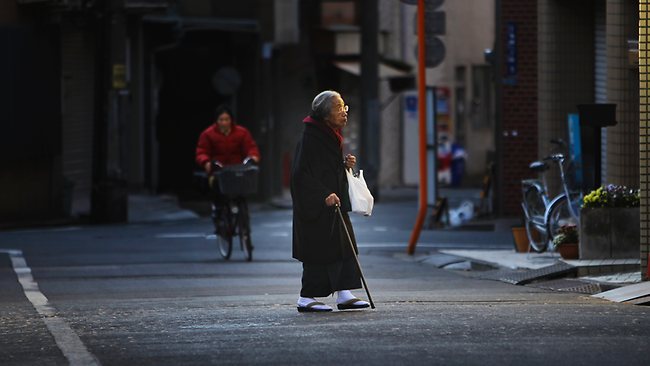
Japanese women have fallen behind Hong Kong in terms of global life expectancy rankings for the first time in 25 years.
This was partly due to the devastating earthquake and tsunami that hit the country in March 2011, said an annual report by Japan’s health ministry.
The expected lifespan for Japanese women dropped from 86.30 years in 2010 to 85.90 years in 2011.
The official life expectancy for women in Hong Kong last year was 86.70 years.
Japanese women have fallen behind Hong Kong in terms of global life expectancy rankings for the first time in 25 years
Japan has topped the women’s rankings for a quarter of a century, with longevity attributed in part to a healthy traditional diet.
The magnitude 9.0 earthquake and tsunami that left more than 20,000 dead or missing pushed the life expectancy down.
However the report noted that even without the disaster Japanese women would still have dropped behind Hong Kong in the statistics.
Other factors contributing to the dip included a rise in the number of suicides among Japanese women, disease and other natural death causes, the report said.
The life expectancy for men in Japan also declined from 79.55 in 2010 to 79.44 last year.
The men dropped from fourth place in 2010 to eighth last year in the global life expectancy ranking, said Japan’s Kyodo news agency.
A new research suggests that shift workers are slightly more at risk of having a heart attack or stroke than day workers.
An analysis of studies involving more than 2 million workers in the British Medical Journal said shift work can disrupt the body clock and have an adverse effect on lifestyle.
It has previously been linked to an increased risk of high blood pressure and diabetes.
Limiting night shifts would help workers cope, experts said.
The team of researchers from Canada and Norway analyzed 34 studies.
A new research suggests that shift workers are slightly more at risk of having a heart attack or stroke than day workers
In total, there were 17,359 coronary events of some kind, including cardiac arrests, 6,598 heart attacks and 1,854 strokes caused by lack of blood to the brain.
These events were more common in shift workers than in other people.
The BMJ study calculated that shift work was linked to a 23% increased risk of heart attack, 24% increased risk of coronary event and 5% increased risk of stroke.
But they also said shift work was not linked to increased mortality rates from heart problems and that the relative risks associated with heart problems were “modest”.
The researchers took the socio-economics status of the workers, their diet and general health into account in their findings.
Dan Hackam, associate professor at Western University, London Ontario in Canada, said shift workers were more prone to sleeping and eating badly.
“Night shift workers are up all the time and they don’t have a defined rest period. They are in a state of perpetual nervous system activation which is bad for things like obesity and cholesterol,” he said.
The authors say that screening programmes could help identify and treat risk factors for shift workers, such as high blood pressure and cholesterol levels.
They add that shift workers could also be educated about what symptoms to look our for, which might indicate early heart problems.
Jane White, research and information services manager at the Institution of Occupational Safety and Health, said there are complex issues surrounding shift work.
“It can result in disturbed appetite and digestion, reliance on sedatives and, or stimulants, as well as social and domestic problems.
“These can affect performance, increase the likelihood of errors and accidents at work, and even have a negative effect on health.”
She said the effects of shift work needed to be well-managed.
“Avoiding permanent night shifts, limiting shifts to a maximum of 12 hours and ensuring workers have a minimum of two full nights sleep between day and night shifts are simple, practical solutions that can help people to cope with shift work.”
Ellen Mason, senior cardiac nurse at the British Heart Foundation, said the increased risk to an individual shift worker “was relatively small”.
“But many Brits don’t work nine to five and so these findings becomes much more significant.
“Whether you work nights, evenings or regular office hours, eating healthily, getting active and quitting smoking can make a big difference to your heart health.”