Opera singer Camilla Williams, the first black woman to appear in a leading role with a major US opera company, has died in Indiana at 92.
Camilla Williams had been suffering from cancer, according to Indiana University Jacobs School of Music, where she became the first black professor of voice.
The opera singer made her debut in May 1946 in the title role of Madam Butterfly with the New York City Opera.
Camilla Williams also became a strong advocate for civil rights.
“It’s impossible to overstate how important that was for the music scene in New York, for African-American singers, and for American singers,” Paul F. Driscoll, the editor-in-chief of Opera News, told the Washington Post.
Opera singer Camilla Williams, the first black woman to appear in a leading role with a major US opera company, has died in Indiana at 92
Camilla Williams’ debut performance came nearly nine years before Marian Anderson became the first African-American singer to appear at New York’s more prestigious Metropolitan Opera.
A New York Times review of Camilla Williams at the time, said the singer displayed “a vividness and subtlety unmatched by any other artist who has assayed the part here in many a year”.
In 1947 Camilla Williams performed the role of Mimi in Puccini’s La Boheme and in 1948 she sang the title role of Verdi’s Aida.
In 1951 Camilla Williams sang the title female role in first complete recording of Gershwin’s Porgy and Bess.
A lifetime member of the National Association for the Advancement of Colored People (NAACP), Camilla Williams performed in her hometown of Danville, Virginia in 1963, to raise funds to free jailed civil rights demonstrators.
Camilla Williams also sang the national anthem before 200,000 people at the 1963 civil rights march on Washington, immediately before Martin Luther King gave his famous I Have a Dream speech.
In 1950, the opera singer married defense lawyer Charles Beavers, whose clients included civil rights leader Malcolm X.
After Charles Beavers’ death in 1970, Camilla Williams stepped away from opera in 1971 and began teaching before eventually retiring in 1997.
Her autobiography – “The Life of Camilla Williams, African American Classical Singer and Diva” – was published last year.
Dalisha Adams, a young mother from Brooklyn, has been arrested after she abandoned her two daughters aged just 3 and 5 on the street with only a few extra diapers.
Dalisha Adams, a 26-year-old security officer, was picked up by police on Sunday night after leaving her children in the cold near housing projects in Brooklyn around 3:00 p.m.
Two women came across the two girls and stayed with them until police arrived.
Though the two girls were bundled up warm wearing hooded down coats and Ugg boots, they seemed shaken up and very confused as to why they were abandoned near Bayview Housing Projects on Shore Parkway in Brooklyn, according to the New York Daily News.
The Bay View Houses are about a mile-and-a-half from the Breukelen Houses, where Dalisha Adams lives with her daughters and their 8-year-old sister, Dinasty, from another relationship, who was with relatives when the incident happened.
A neighbor of Dalisha Adams claims she often heard the mother screaming at her children.
The woman, who did not want to be identified, told the New York Daily News: “She was always yelling at the kids, <<Shut the f*** up>>.
“One day, I heard her curse out the little baby, “I’ll punch you in the f***ing face.”
The woman also said she heard more shouting on Sunday shortly before the girls were abandoned.
“A kid was crying. She was saying, <<Stop crying, shut the f*** up. I’m gonna get you out of here>>,” she said.
The two little girls aged just 3 and 5 have been abandoned by their mother on the street with only a few extra diapers
Other neighbors said the girls were always well dressed and clean but a resident of the housing project they lived at told the Daily News she would often shout and curse at them and pull on their arms.
The older daughter, who said her name was Domini, told the Daily News her younger sister was called Dioni and they lived in a blue house with flowers in front of it on 53rd street, but she did not know which borough of New York it was.
The girl also said her mother’s name was Dalisha and she drove a white car.
Five-year-old Domini told a photographer: “Mommy just left us on the sidewalk and drove away.”
The children showed no signs of physical abuse but were taken to Brookdale University Hospital for observation.
Just after 10:00 p.m. on Sunday night, police arrived at Dalisha Adams’ house and opened the door with a crow bar, but she was not at home.
Dalisha Adams was arrested after police matched the girls’ identity with photo records from Administration for Children’s Services, where the children are currently in custody.
The mother was charged with two counts of endangering the welfare of a minor, police said.
Police were alerted to the abandoned girls by an elderly couple who found them standing at a busy intersection with the diapers in their arms as cars zoomed by them.
Dalisha Adams was arrested after police matched the girls' identity with photo records from Administration for Children’s Services, where the children are currently in custody
The children’s grandmother, Bertha Davia, said it was all a misunderstanding and is asking ACS to place them in her care.
Bertha Davia, 52, told Eyewitness News that she lives in the complex next to where the children were left and the mother must have intended to leave her children in her care.
The grandmother said she is furious her daughter never told her the children were coming and only realized what had happened when she saw their picture on the news.
“She left them on the corner here. I live all the way over there. And they was roaming the hallways and all that. Why would she do that to my grandkids? For what reason?”
Although Bertha Davia is angry over the incident, she said she does not believe the two girls were abandoned on a street corner and it was just a big misunderstanding.
Michelle Davis, 43, from Brooklyn, told the Daily News: “They were wandering up and down the sidewalk for a while, just playing by themselves.
“It’s horrible. How could you leave your own children out there? They’re babies and you just leave them out there like that?”
The police said both children were in good condition after being checked over in hospital and were now in the care of the ACS, who did not immediately respond to an inquiry.
A large debate has sparked among public health advocates in US after the pharmaceutical company Gilead has applied to the FDA to market its HIV treatment medication Truvada as a HIV prevention pill.
Gilead wants to be able to market Truvada (tenofovir+emtricitabine), which is currently used as a HIV treatment, as a preventative pill to uninfected individuals, reports California Watch.
If the product will be approved, it would be the first of its kind.
The move has sparked debate among public health advocates who argue that the wide availability of the drug would discourage safe sex and would, in fact, increase the incidence of HIV.
“I believe that this could be catastrophic in terms of HIV prevention,” said Michael Weinstein, president the AIDS Healthcare Foundation, based in Los Angeles.
There are nearly 42,000 Californians living with HIV as of June 2011.
Michael Weinstein told California Watch that as an HIV treatment, he thinks Truvada is a “fabulous drug – it’s one pill once a day, and it has a low side-effect burden,” which include nausea, vomiting and weight loss.
Gilead wants to be able to market Truvada (tenofovir+emtricitabine), which is currently used as a HIV treatment, as a preventative pill to uninfected individuals
This new pharmaceutical prevention approach to HIV and AIDS is known in scientific circles as “pre-exposure prophylaxis”, or PrEP, and it involves taking the antiretroviral medications on a daily basis.
Clinical trials supported by the National Institutes of Health have shown that when taken daily, Truvada, a blue oval pill, reduced the risk for contracting HIV by between 44% among gay men in four countries and 73% by heterosexual couples in Uganda and Kenya.
Overall, these studies have generated enthusiasm among many medical researchers, reports California Watch.
Truvada is considered to be “an incredible achievement, a wonderful new tool that could be available to people who need additional protection against the acquisition of HIV”, according to Veronica Miller, executive director of The Forum for Collaborative HIV Research and a visiting professor at the UC Berkeley School of Public Health.
But Michael Weinstein said he’s not yet convinced by the research, and he wouldn’t want to see future mass marketing of the drug discourage gay men – the risk group most seriously affected by HIV, according to the Centers for Disease Control and Prevention – from using condoms based on “the false belief that they are protected by this”, when there’s a possibility that those taking the medication still could contract the disease.
Some HIV and AIDS awareness organizations say that while they wouldn’t want to see Truvada trump other forms of prevention, they are hopeful that the drug will help reach high-risk individuals.
“It comes down to choices,” said David Evans, director of research advocacy at Project Inform, a San Francisco organization focused on improving the health of people with HIV.
“For those who are high at risk, we want them to know that there is something new and a better option available to them.”
Nevertheless, David Evans said he shares some of the drug critics’ concerns. “We don’t want to see people give up safe sex practices,” he said.
The Annals of the Forum for Collaborative HIV Research noted that the drug had performed well in clinical trials; the safety risk is relatively low; and as a result, doctors can currently prescribe the drug for prevention off-label. However, those who use the drug could develop resistance to it, and if they don’t use it daily, the risk for contracting HIV increases, the forum said.
Other drug companies, including ViiV Healthcare, also are planning studies to sell similar prevention drugs, but given the number of clinical trials performed or under way on Truvada, Gilead’s product is likely to be the first to make it to market.
Gilead did not respond to requests for comment from California Watch.
European Union has decided to spend 3 million Euros to research “the potential of insects as an alternative source of protein”.
EU says that research projects will be selected during this year.
Food experts agree that insects would probably have to be disguised for European audiences, so the insect “food” could be used as an additive in burgers and other fast food.
The UN’s Food Standards Authority says of the research: “While insects have not traditionally been used for food in the UK or elsewhere in the European Union, it is estimated that about 2.5 billion people across the world have diets that routinely include insects.
“While many insects are regarded as pests, the UN’s Food and Agriculture authority is interested in promoting edible insects as a highly sustainable source of nutrition.”
Some worms contain three times as much protein as beef per ounce, while four crickets have as much calcium as a glass of milk.
Daniel Creedon, a chef who serves ants, locusts and bees in honey at the London Archipelago restaurant, said: “If insects start coming into the food chain they are probably going to have to be disguised.
“Food producers will probably get away with describing it as animal based proteins. Not many people will buy a locust burger.”
Website Treehugger said: “It is not hard to imagine the development of an insect-based food additive that enriches burger and nugget protein levels.
“Burgers with processed insect meal could be sold by chains under claims such as <<higher in protein>>, <<healthier fats>> and <<eco-burger>>.”
European Union has decided to spend 3 million Euros to research “the potential of insects as an alternative source of protein”
80% of countries on Earth already eat insects, and more than 2,000 insect species are often eaten by human beings.
Unlike conventional livestock, insects and bugs need little space and can be bred in sealed buildings under natural light where they live off waste, paper and algae.
The idea has previously been backed by the UN and EU as a way to tackle food shortages.
Some academics believe that the expense and environmental cost of raising livestock means that insect-eating will be inevitable – and it has been claimed that by the end of this decade, insect-eating will be widespread.
Prof. Marcel Dicke from Wageningen University in the Netherlands said: “The most important thing is getting people prepared, getting used to the idea. Because from 2020 onwards, there won’t be much of a choice for us.”
An estimated 2,000 insect species are consumed around the world, and people do not just eat insects, they relish them as delicacies. In Africa, caterpillars and winged termites are fried and eaten as roadside snacks (after wings, legs, and bristles are removed, of course), and often considered tastier than meat. Grasshoppers and bee larvae seasoned with soy sauce are favorites in Japan, where pricey canned insects are also available. Papua New Guinea is known for its nutty-flavored sago grubs (Rhynchophorus ferrugineus papuanus or R. bilineatus), beetle larvae that inhabit dead sago palm trees and are honored at annual festivals.
Insects often contain more protein, fat, and carbohydrates than equal amounts of beef or fish, and a higher energy value than soybeans, maize, beef, fish, lentils, or other beans. According to a 2004 United Nations Food and Agriculture Organization (FAO) report, caterpillars of many species are rich in potassium, calcium, magnesium, zinc, and iron, as well as B-vitamins. In some African regions, children fight malnutrition by eating flour made out of dried caterpillars. Pregnant and nursing women as well as anemic people also eat caterpillar species high in protein, calcium, and iron.
An increasing population of huge pythons, many of them pets that were turned loose by their owners when they got too big, appears to be wiping out large numbers of raccoons, opossums, bobcats and other mammals in Everglades, Florida, a study says.
The study, which was published Monday in the Proceedings of the National Academy of Sciences, found that sightings of medium-size mammals are down dramatically (as much as 99%, in some cases) in areas where pythons and other large, non-native constrictor snakes are known to be lurking.
Scientists fear the pythons could disrupt the food chain and upset the Everglades’ environmental balance in ways difficult to predict.
“The effects of declining mammal populations on the overall Everglades ecosystem, which extends well beyond the national park boundaries, are likely profound,” said John Willson, a research scientist at Virginia Tech University and co-author of the study.
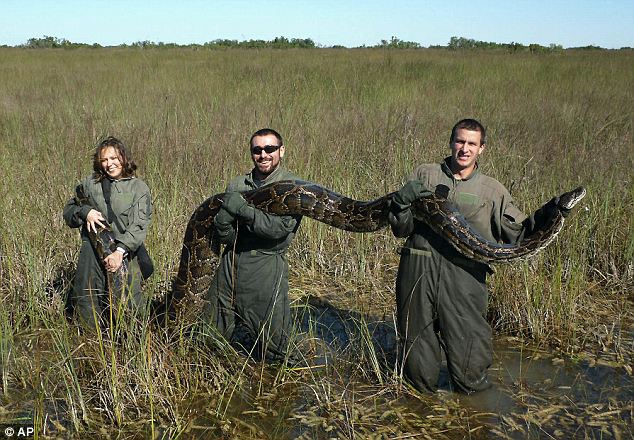
Tens of thousands of Burmese pythons, which are native to Southeast Asia, are believed to be living in the Everglades, where they thrive in the warm, humid climate.
While many were apparently released by their owners, others may have escaped from pet shops during Hurricane Andrew in 1992 and have been reproducing ever since.
Burmese pythons can grow to be 26 feet long and more than 200 pounds, and they have been known to swallow animals as large as alligators. They and other constrictor snakes kill their prey by coiling around it and suffocating it.
The National Park Service has counted 1,825 Burmese pythons that have been caught in and around Everglades National Park since 2000. Among the largest so far was a 156-pound, 16.4-foot one captured earlier this month.
For the study, researchers drove 39,000 miles along Everglades-area roads from 2003 through 2011, counting wildlife spotted along the way and comparing the results with surveys conducted on the same routes in 1996 and 1997.
The National Park Service has counted 1,825 Burmese pythons that have been caught in and around Everglades National Park since 2000
The researchers found staggering declines in animal sightings: a drop of 99.3% among raccoons, 98.9% for opossums, 94.1% for white-tailed deer and 87.5% for bobcats. Along roads where python populations are believed to be smaller, declines were lower but still notable.
Rabbits and foxes, which were commonly spotted in 1996 and 1997, were not seen at all in the later counts. Researchers noted slight increases in coyotes, Florida panthers, rodents and other mammals, but discounted that finding because so few were spotted overall.
“The magnitude of these declines underscores the apparent incredible density of pythons in Everglades National Park,” said Michael Dorcas, a professor at Davidson College in North Carolina and lead author of the study.
Although scientists cannot definitively say the pythons are killing off the mammals, the snakes are the prime suspect. The increase in pythons coincides with the mammals’ decrease, and the decline appears to grow in magnitude with the size of the snakes’ population in an area.
A single disease appears unlikely to be the cause since several species were affected.
The report says the effect on the overall ecosystem is hard to predict. Declines among bobcats and foxes, which eat rabbits, could be linked to pythons’ feasting on rabbits. On the flip side, declines among raccoons, which eat eggs, may help some turtles, crocodiles and birds.
Scientists point with concern to what happened in Guam, where the invasive brown tree snake has killed off birds, bats and lizards that pollinated trees and flowers and dispersed seeds. That has led to declines in native trees, fish-eating birds and certain plants.
In 2010, Florida banned private ownership of Burmese pythons. Earlier this month, U.S. Interior Secretary Ken Salazar announced a federal ban on the import of Burmese pythons and three other snakes.
Ken Salazar said Monday that the study shows why such restrictions were needed.
“This study paints a stark picture of the real damage that Burmese pythons are causing to native wildlife and the Florida economy,” he said.
The White House issued an angry denial following claims that First Lady Michelle Obama indulged in a $50,000 shopping spree at Agent Provocateur’s boutique in Madison Avenue in New York.
According to a report in the Daily Telegraph today, Agent Provocateur’s boutique in Madison Avenue was partially closed off for Michelle Obama.
Kristina Schake, director of communications for First Lady Michelle Obama said this morning: “This story is 100 per cent false.”
The Telegraph claimed: “Michelle Obama has risked the wrath of cash-strapped Americans by indulging in a $50,000 shopping spree at Agent Provocateur…
“Along with the Queen of Qatar, Sheikha Mozah, she closed off part of Madison Avenue to spend time in the luxury lingerie shop.”
The article also said that Michelle Obama’s alleged spree had sparked the 12% boost in sales recently released by the British label.
But while the chain’s profits are certainly on the rise, it was quick to point out that this is not thanks to Michelle Obama.
A spokesman for Agent Provocateur said: “Recent claims regarding Michelle Obama and purchases made at an Agent Provocateur boutique are incorrect.
“Agent Provocateur never discusses any of its clientele or their purchases.”
According to a report in the Daily Telegraph today, Agent Provocateur's boutique in Madison Avenue was partially closed off for Michelle Obama
Indeed, it goes without saying that Michelle Obama’s lingerie-purchasing habits are most likely not something she would be prepared to share with anyone but the President himself.
It seems Agent Provocateur is doing fine without her help though. In the last 43 weeks, the company reported trading has been up 12.5% on a like-for-like basis and 21.6% overall.
Over the Christmas period overall business also shot up more than 15%.
Agent Provocateur CEO Gary Hogarth told the Telegraph that the label had garnered several “unexpected famous names” in the U.S. as of late.
Beyonce Knowles and Christina Aguilera have been seen at its stores in recent months, presumably purchasing unmentionables which can run to as much as $1,990 for a single French lace nightie.
Michelle Obama has come under fire from critics of late, who have taken issue with her taste for expensive designer labels and lavish parties.
A new book by New York Times reporter Jodi Kantor, “The Obamas”, fuelled widespread criticism when it emerged that she had hosted a high-octane Alice in Wonderland Halloween party in 2009, a time when the country was in the midst of a recession.
The expensive wardrobe Michelle Obama packed for their $4 million Hawaii Christmas break, including a $2,000 dress and $1,000 skirt, also sparked a reaction.
One comment on the Naked DC site read: “She claims to be a champion of the poor and a fellow bargain shopper, but yet, here she is, sporting a dress that no unemployed American can afford.
“For someone who says she understands the troubles of the American people, who claims to shop at Target, she certainly fails to show it.”
Michelle Obama’s striking cobalt blue Barbara Tfank dress, worn for last week’s State of the Union address, is believed to be worth approximately $2,000.
While winning over the style set with the eye-catching look, some questioned whether her choice was appropriate, given that she was seated next to Jackie Bray, a single mother from North Carolina who put herself through community college to boost her career prospects after getting laid off from her job.
Agent Provocateur, founded by the son of fashion designer Vivienne Westwood, Joseph Corré, and his then-wife, Serena Rees, in 1994, was bought out by private equity firm 3i in 2007 for a reported $108.5 million.
With Sarah Shotton as creative director, the designs certainly are not for the faint-hearted. The current collection is inspired by her collection of vintage Playboy magazines.
The company’s expansion in the U.S. – where sales have outpaced the UK – is already underway.
According to Business Week, Agent Provocateur has annual sales of $40million, with a budgeted increase of nine per cent same-store sales this year in the U.S.
By summer, the label plans to have 11 retailers in the U.S. and is aiming to expand from 54 to 100 total stores worldwide in the next three years.
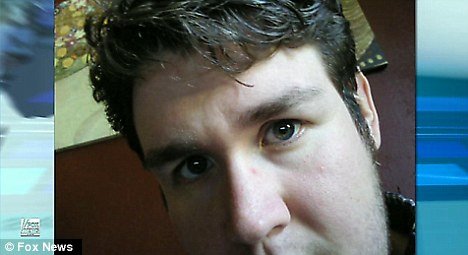
Jason Elia, a young man from Nashville, claimed his girlfriend dumped him for having cancer and then still insisted he hand over Superbowl tickets worth $8,000 he bought for her.
Now, the man whose story went viral on the Internet is facing claims from the woman in question that he made it all up.
Jason Elia told ESPN 97.5 radio in Houston that he was dumped because his girlfriend couldn’t handle the “stress” of having a partner with a chronic disease and when pushed for the ex-girlfriend’s identity, gave the Twitter handle of Sokhon Sen.
The story was quickly picked up by outlets across the country including Fox News, the blog Deadspin and the Huffington Post.
Jason Elia even launched a Twitter campaign to win the tickets, with the seats going to whoever brought him the most new followers.
However, Sokhon Sen said that her reputation has been falsely dragged through the mud by a man she only met once.
Jason Elia told national media that he was dumped because his girlfriend couldn't handle the “stress” of having a partner with cancer
Sokhon Sen says there were no Superbowl tickets and there were no demands. Most importantly, the young woman says, there was no breakup because there was never a relationship.
She doesn’t even care about the Superbowl, Sokhon Sen says.
Sokhon Sen believes Jason Elia is making the entire story up to get attention.
“I wouldn’t call Jason someone I dated. More like some creepy person now that I met once in my whole life. I have no idea what this whole Super Bowl thing is nor did I know about it,” she said.
Sokhon Sen believes Jason Elia is making the entire story up to get attention
The tale Jason Elia told was truly an outrage – one that had “the villain” adding insult to injury.
The host asks: “She broke up with you why?”
“Because I have cancer… She said it was too much stress for her to handle to have a boyfriend with a chronic disease,” Jason Elia responded.
Jason Elia said he was diagnosed with bladder cancer and given an 87% chance of survival.
Several news outlets picked up on the interview and broadcast the story far and wide. On Fox News, two legal analysts angrily decried the woman’s alleged claim to the Superbowl tickets.
When Sokhon Sen found out about the allegations that Jason Elia was making, she confronted him in a series of e-mails.
“Hey crazy, I read the story all over the Internet,” Sokhon Sen says in a terse exchange where she accuses him of lying about her and making up his story.
Jason Elia, in his replies, doesn’t deny that he made up the story and doesn’t deny that he was talking about her – he only says that he never intended to identify her on air.
Sokhon Sen believes Jason Elia, who says he is a TV writer who splits his time between Nashville, Tennessee, and Los Angeles, told the story to gain attention.
Jason Elia is running a contest from his Twitter account claiming he will give away the Superbowl tickets to whomever brings him the most Twitter followers. He currently has more than 14,000.
Sokhon Sen said she feels betrayed after being thrust into the spotlight and was unaware of the accusations Jason Elia is making.
For his part, Jason Elia is standing by his story, but he said the woman he was referring as his ex-girlfriend was not Sokhon Sen.
However, he declined to name the woman who he accused of dumping him over cancer.
A drone strike on al-Qaeda militants in southern Yemen killed at least 11 people, according to local residents and officials.
According to Reuters news agency, one tribal leader said at least four of the dead were local al-Qaeda leaders.
They were reportedly attacked by a drone in Abyan province.
Islamists began taking control of parts of Abyan last year. Security forces have tried unsuccessfully to push them out and suffered heavy losses.
The details of what happened are not clear, but some reports suggest a convoy of two cars was struck east of Lawdar city.
However, AFP news agency was told by tribal leaders that a control post and a school hosting a midnight meeting of local al-Qaeda chiefs and fighters were targeted in four overnight raids.
Regional al-Qaeda leader Abdul Monem al-Fahtani was among the dead, they said.
“We think they were carried out by American planes,” one tribal source told AFP, on condition of anonymity and without elaborating.
Researchers studying mice at the Stanford University School of Medicine in California have converted skin cells directly into cells which develop into the main components of the brain.
The experiment, which was reported in Proceedings of the National Academy of Sciences, skipped the middle “stem cell” stage in the process.
The researchers said they were “thrilled” at the potential medical uses.
Far more tests are needed before the technique could be used on human skin.
Stem cells, which can become any other specialist type of cell from brain to bone, are thought to have huge promise in a range of treatments. Many trials are taking place, such as in stroke patients or specific forms of blindness.
One of the big questions for the field is where to get the cells from. There are ethical concerns around embryonic stem cells and patients would need to take immunosuppressant drugs as any stem cell tissue would not match their own.
An alternative method has been to take skin cells and reprogram them into “induced” stem cells. These could be made from a patient’s own cells and then turned into the cell type required, however, the process results in cancer-causing genes being activated.
The research group is looking at another option – converting a person’s own skin cells into specialist cells, without creating “induced” stem cells. It has already transformed skin cells directly into neurons.
This study created “neural precursor” cells, which can develop into three types of brain cell: neurons, astrocytes and oligodendrocytes.
These precursor cells have the advantage that, once created, they can be grown in a laboratory into very large numbers. This could be critical if the cells were to be used in any therapy.
Brain cells and skin cells contain the same genetic information, however, the genetic code is interpreted differently in each. This is controlled by “transcription factors”.
The researchers used a virus to infect skin cells with three transcription factors known to be at high levels in neural precursor cells.
After three weeks about one in 10 of the cells became neural precursor cells.
Lead researcher Prof. Marius Wernig said: “We are thrilled about the prospects for potential medical use of these cells.
“We’ve shown the cells can integrate into a mouse brain and produce a missing protein important for the conduction of electrical signal by the neurons.
“More work needs to be done to generate similar cells from human skin cells and assess their safety and efficacy.”
Dr. Deepak Srivastava, who has researched converting cells into heart muscle, said the study: “Opens the door to consider new ways to regenerate damaged neurons using cells surrounding the area of injury.”
On January 30, Erivedge (vismodegib) was approved by the U.S. Food and Drug Administration to treat adult patients with basal cell carcinoma, the most frequent type of skin cancer.
Erivedge (vesmodegib) was approved by FDA to treat metastatic basal cell carcinoma.
Genentech (division of Roche) developed the drug in collaboration with Curis. Erivedge will available in pharmacies within one or two weeks. The capsules have to be taken once a day and its safety in children it is unknown.
Patients with locally advanced basal cell cancer who are not candidates for surgery or radiation and patients with metastasis (cancer spread to other parts of the body) may benefit from this medicine.
Erivedge is the first FDA-approved drug for metastatic basal cell carcinoma.
This drug was approved earlier under the FDA’s priority review program for drugs that may offer major advances in treatment.
Erivedge (Vismodegib) inhibits the Hedgehog pathway in the cancer cells.
This pathway is active in most basal cell cancers and only in a few normal tissues (hair follicles).
“Our understanding of molecular pathways involved in cancer, such as the Hedgehog pathway, has enabled the development of targeted drugs for specific diseases. This approach is becoming more common and will potentially allow cancer drugs to be developed more quickly. This is important for patients who will have access to more effective therapies with potentially fewer side effects,” said Richard Pazdur, M.D., director of the Office of Hematology and Oncology Products in the FDA’s Center for Drug Evaluation and Research.
A clinical study that enrolled 96 patients with locally advanced or metastatic basal cell carcinoma tested the safety and effectiveness of Erivedge.
Researchers recorded the percentage of patients who experienced complete or partial shrinkage or disappearance of the cancerous lesions. In 30% of the patients with metastatic disease a partial response was found and in 43% of the patients with locally advanced disease complete or partial responses were noted. The median progression-free survival rate for both groups was 9.5 months.
Basal cell carcinoma begins in the lower part of top layer of the skin (epidermis) on areas of skin that are exposed to ultraviolet radiation. It is mostly a slow growing and painless form of skin cancer. Most skin cancers appear in older people or in people with an weak immune systems. Every year around 1,000,000 of new cases of skin cancers (aside from melanoma) are diagnosed in U.S. and around 1,000 deaths are recorded.
Important Safety Information for Erivedge
“Erivedge can cause a baby to die before it is born (be stillborn) or cause a baby to have severe birth defects based on how the medicine interacts with the body.
• Female patients who can become pregnant should speak with their healthcare provider about the risks of Erivedge to their unborn child. Their healthcare provider should do a pregnancy test within seven days before they start taking Erivedge to find out if they are pregnant. Women should avoid pregnancy by using highly effective birth control before starting Erivedge, and continue during treatment and for seven months after their last dose. They should tell their healthcare provider right away if they have unprotected sex or think that their birth control has failed. Female patients must tell their healthcare provider right away if they become pregnant or think that they may be pregnant. Pregnant women are encouraged to participate in a program called the Erivedge pregnancy pharmacovigilance program by calling 1-888-835-2555.
• Male patients should always use a condom with a spermicide during sex with female partners while they are taking Erivedge and for two months after their last dose, even if they have had a vasectomy. Male patients should tell their healthcare provider right away if their female partner could be pregnant or thinks she is pregnant while they are taking Erivedge.
• Patients must not donate blood or blood products while they are taking Erivedge and for seven months after their last dose.
• The most common side effects of Erivedge are muscle spasms, hair loss, change in how things taste or loss of taste, weight loss, tiredness, nausea, diarrhea, decreased appetite, constipation, vomiting and joint aches. Another side effect may include missed monthly periods in females who can become pregnant.
• Patients should tell their healthcare provider if they have any side effect that bothers them or that does not go away.
• These are not all the possible side effects of Erivedge. For more information, please see the Full Prescribing Information for Erivedge, including the Boxed WARNING and Medication Guide.”
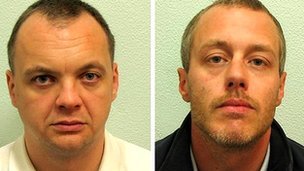
David Norris and Gary Dobson launch appeal against their convictions for the racist murder of teenager Stephen Lawrence in south-east London in 1993.
David Norris will appeal on the basis that the use in evidence of a surveillance video was unfair, his lawyer confirms.
The “Footscray” video showed David Norris and Gary Dobson using violent racist language.
Papers have also been received at the Court of Appeal from Gary Dobson’s solicitors, setting out his intention to appeal.
David Norris, 35, and Gary Dobson, 36, were sentenced to life after being found guilty by an Old Bailey jury at the beginning of January.
Gary Dobson was ordered to serve a minimum of 15 years and two months, and David Norris 14 years and three months.
David Norris and Gary Dobson launch appeal against their convictions for the racist murder of teenager Stephen Lawrence in south-east London in 1993
David Norris’ lawyer said the appeal will be based on the grounds that about two thirds of the way through the case, what had been a scientific case about forensic evidence became a case about a surveillance video made of the men.
He said was unfair, because the case was about scientific evidence and the video could not prove he was at the scene of Stephen Lawrence’s murder.
Meanwhile, the Attorney General is reviewing the minimum terms given to the pair following a request from a member of the public and is due to report back in the next few days.
Gary Dobson and David Norris were the first people convicted over the fatal attack on Stephen Lawrence by a group of white youths near a bus stop in Eltham on 22 April 1993.
French President Nicolas Sarkozy claimed that Britain is a country with “no industry” during a prime time national TV broadcast last night.
However, Nicolas Sarkozy’s claims have been ridiculed as “totally false” by his own Press.
Nicolas Sarkozy made the extraordinary outburst as he defended a VAT rise during a prime time national TV broadcast last night.
French president had just announced a 1.6% hike in VAT in a move designed to boost France’s failing economy.
When a journalist pointed out that Britain had experienced a rise in prices after increasing its VAT contributions, Nicolas Sarkozy spat out the words: “The United Kingdom has no industry anymore.”
Experts across the Channel today pointed out that industry accounts for almost 17% of GDP in Britain – compared with just over 14% in France.
It was newspaper Le Monde that branded Nicolas Sarkozy’s claim “totally false”, pointing out that “Britain is actually more industrialized than France”.
Le Monde admitted that “industrial decline is stronger in our country”, adding: “In 2007, industry accounted for 16.7% of GDP against 14.1% for France: a statistic that did not change in 2011.”
French President Nicolas Sarkozy claimed that Britain is a country with “no industry” during a prime time national TV broadcast last night
According to figures produced by INSEE, France’s national statistics and economic studies institute, industrial production in Britain is almost 5% higher than it is in France.
And separate figures from the OECD show that in 2009, Industry accounted for 19% of French Gross Value Added – a measure of the value of goods and services linked to GDP.
In 2010, in the UK the figure was 21.8%. In manufacturing alone, the UK figure stood at 11.5% compared with 10.7% in France.
Nicolas Sarkozy, who is hoping to be re-elected in the spring, is cutting an increasingly desperate figure as he fights to hold on to power.
He said he was borrowing the VAT measure from Germany, arguing that it had “helped to boost German competitiveness” and had not led to a rise in prices.
But in 2009 Nicolas Sarkozy claimed a similar VAT rise in the UK had “absolutely failed” to stimulate the economy.
The 11th-hour measures are a risky political gamble as the hugely unpopular Nicolas Sarkozy lags behind Socialist rival Francois Hollande in the polls.
Opinion polls also suggest the majority of the population is against an increase in sales tax, which will eat into their spending power.
It is not the first time Nicolas Sarkozy, who came face-to-face with Prime Minister David Cameron at an EU debt summit today, has expressed his dislike of his cross-Channel neighbors.
In October at an EU-27 summit, after criticism from UK ministers over the euro, Nicolas Sarkozy bluntly told David Cameron: “You have lost a good opportunity to shut up.”
He added: “We are sick of you criticizing us and telling us what to do. You say you hate the euro and now you want to interfere in our meetings.”
A month later, in response to a question at a press conference about whether France and Germany were trying to change the governments of Greece and Italy, Nicolas Sarkozy hit out, saying: “Perhaps the fact that you come from an island, you can’t understand the subtleties of the European construction.”
And today’s meeting – where EU leaders will sign off on a permanent rescue fund for the eurozone – could potentially herald a repeat of “Le Snub”, when the French leader refused to shake David Cameron’s hand after the Prime Minister vetoed proposed changes to the EU treaty in December.
Nicolas Sarkozy was not questioned on the latest comments by any of the carefully selected journalists assisting with the broadcast from the Elysee Palace.
Despite Nicolas Sarkozy’s previous view on such measures in the UK last night he saw the VAT rise as an essential measure to reverse his country’s fortunes, as he praised Angela Merkel for applying it.
It came as the German Chancellor offered “active support” at campaign rallies for Nicolas Sarkozy, who is widely expected to fail in his re-election bid.
A “Robin Hood” tax on financial transactions was also imposed by Nicolas Sarkozy last night – despite fierce opposition from EU leaders including Prime Minister David Cameron who described it as “utter madness”.
The 0.1% financial transaction levy will be introduced in August in France regardless of whether other European countries follow suit.
The tax is part of a package of measures set out by the president to promote growth and create jobs.
French and German proposals for the EU-wide financial transaction tax were among the reasons that British PM David Cameron vetoed EU treaty changes at a summit in Brussels in December.
The tax is intended to dissuade speculators from making very short-term investments in foreign exchange.
David Cameron argued that the so-called “Tobin Tax” – named after American economist James Tobin – would penalize the City of London, where 75% of European financial transactions take place.
Earlier this month, PM David Cameron vowed to wield a second veto in Europe if France and Germany insist on pushing ahead with the EU-wide tax.
“With tax on financial transactions, we are going to show an example,” said Nicolas Sarkozy last night, as he outlined the tough new measures in the hour-long broadcast, which was shown by eight channels.
While officially a presidential address, Nicolas Sarkozy made it clear that all of his attention is on the two-round presidential election to be held in April and May.
But he remains unpopular among voters. Not only are some 3 million people currently unemployed in France, but the country lost its triple-A credit rating from Standard and Poor’s earlier this month.
Before this happened, Nicolas Sarkozy had said that such a downgrade would hamper his election chances enormously, saying: “If we lose the triple-A, I’m dead.”
After the downgrade, Nicolas Sarkozy told aides: “For the first time in my life I am facing the end of my career.”
The decline of Nicolas Sarkozy, a right-wing conservative, is seen as Francois Hollande’s greatest asset, and last week the Socialist candidate launched an impassioned attack on “the world of finance”.
Francois Hollande, who was nominated to be the Socialist Party and Left Radical Party candidate in the 2012 French presidential election, has promised huge tax rises, some 23 billion euros in new spending by 2017, and 150,000 state-subsidized new jobs for young workers, as well as 60,000 new teaching jobs.
But Angela Merkel on Saturday pledged to support Nicolas Sarkozy on the campaign trail, because she apparently doubts Francois Hollande’s ability to solve the Eurozone sovereign debt crisis.
Angela Merkel and Nicolas Sarkozy have built up such a strong working relationship that they are referred to as “Merkozy”.
The latest opinion poll published this weekend suggested Francois Hollande would take 56% of votes in the second round of the election, with Nicolas Sarkozy on 44%.
Nicolas Sarkozy, who turned 57 on Saturday, has been involved in numerous scandals since coming to power in 2007.
Magistrates are currently looking at allegations that Nicolas Sarkozy and other senior members of the ruling UMP party received envelopes stuffed full of cash from Liliane Bettencourt, the L’Oreal heiress and France’s richest woman, in return for future tax breaks.
Nicolas Sarkozy’s third wife, the former supermodel Carla Bruni, has also been accused of enriching close friends in Paris through her charity work.
Sundance Film Festival 2012 took place from Thursday, January 19 to Sunday, January 29 in Park City, Utah.
The 28th edition of the festival presented about 118 independent films from 30 countries, including 45 first-timers (24 in competition) and 91 world premieres. Featured in four different competition categories were 58 individual films.
Parker Posey was the host of the closing awards ceremony.
“Every year the Sundance Film Festival brings to light exciting new direction and fresh voices in independent film, and this year is no different. While these awards further distinguish those that have had the most impact on audiences and our jury, the level of talent showcased across the board at the Festival was really impressive, and all are to be congratulated and thanked for sharing their work with us,” said John Cooper, Sundance Film Festival director.
Beasts of the Southern Wild won Grand jury prize for drama at the Sundance Film Festival 2012.
The film also received a prize for excellence in cinematography, US dramatic.
Beasts of the Southern Wild tells the story of two persons (a father and his daughter) who are trying to deal with the effects of global warming. Hushpuppy is 6 years old and lives in the vicinity of the Mississippi delta with her father. The film is directed Benh Zeitlin, 29, first-time filmmaker and features a cast of non-actors. Quvenzhane Wallis (Hushpuppy), 8, who was 6 when she started to shot the movie, is for Benh Zeitlin “the biggest person” he knows.
The movie is described by Damon Wise (The Guardian) as “the first significant eco-threat movie to be seen through the eyes of the generation that has inherited global warming.”
“I hope with this movie there is a flag that goes up to allow directors to explore the world,” said Benh Zeitlin.
Beasts of the Southern Wild won Grand jury prize for drama at the Sundance Film Festival 2012.
The Surrogate won drama audience award and best ensemble at Sundance Film Festival 2012.
The film is based on the autobiographical writings of Mark O’Brien, journalist and poet and presents a man, 38, half paralyzed from poliomyelitis (John Hawkes) who wants to have a relation with his therapist (Oscar-winning Helen Hunt).
John Hawkes has health problems because his spine’s curvature was affected. He said he needed a help of a chiropractor to diminish the damages he caused to his back.
“I’ve been doing yoga for like 25 years, but my spine doesn’t have enough movement in one direction and the opposite direction has way too much movement. (My chiropractor) doesn’t know how to fix it other than I might wear a brace for a while,” he said.
Fox Searchlight bought Beasts of the Southern Wild and The Surrogate and the films are expected to be launched in the US theaters this year.
The House I Live In documentary won Grand jury prize at Sundance Film Festival 2012.
The documentary exposes the failure of US war against drugs. Film director, Eugene Jarecki, said the authorities’ effort to stop the drug trade was “tragically immoral and so heartbreakingly wrong and misguided“. That war was “a terrible scar on America,” said Eugene Jarecki, because of unfair drug penalties affecting minorities.
The Invisible War by Kirby Dick won documentary audience award.
Both documentaries are the mirrors of the “dark and grim” times, as characterized by Robert Redford, the founder of the Sundance Film Festival.
Sundance Film Festival 2012 Full List of Winners
Grand jury prize, documentary: The House I Live In
Grand jury prize, drama: Beasts of the Southern Wild
US directing award: The Queen of Versailles, Lauren Greenfield
US directing award: Middle of Nowhere, Ava Duvernay
Waldo Salt screenwriting award: Safety Not Guaranteed, Colin Trevorrow
Audience award, US documentary: The Invisible War
Audience award, US dramatic: The Surrogate
Special jury prizes, US documentary: Love Free or Die and Ai Weiwei: Never Sorry
US dramatic special jury prize for producing: Jonathan Schwartz and Andrea Sperling, Smashed and Nobody Walks
US dramatic special jury prize for Ensemble Acting: The Surrogate
Shorts audience award: The Debutante Hunters
Excellence in cinematography, US documentary: Chasing Ice
Excellence in cinematography, US dramatic: Beasts of the Southern Wild
US documentary editing award: Detropia
Best of next award: Sleepwalk With Me
Alfred P Sloan feature film prize: Robot and Frank and Valley of Saints
World cinema jury special prize, Documentary: Searching for Sugar Man
World cinema documentary editing: Indie Game: The Movie, Lisanne Pajot and James Swirsky
World cinema jury prize,documentary: The Law in These Parts, Ra’anan Alexandrowicz, director
World cinema dramatic special jury prize: Can, Rasit Celikezer, director
World cinema cinematography award, drama: David Raedeker, My Brother the Devil
World cinema cinematography award, documentary: Lars Skree, Putin’s Kiss
World cinema directing award, documentary: Emad Burnat and Guy Davidi, 5 Broken Cameras
Shorts audience award: The Debutante Hunters, Maria White, director
World cinema audience award: Searching for Sugar Man
Sundance Film Festival has begun in Salt Lake City in 1978 as an effort to attract independent filmmakers.
Scotty Bowers, a former Marine turned rent boy for some of Hollywood’s biggest names in the 1940s, claims to have had threesomes with the royal couple Duke of Windsor and his American wife Wallis Simpson.
Scotty Bowers, now 88, has opened up his little black book and told all, shedding light on his prostitution ring which he claims catered for the royal couple as well as gay and bisexual A-listers such as Cary Grant, George Cukor and Rock Hudson.
His book, “Full Service: My Adventures In Hollywood And The Secret Sex Lives Of The Stars”, opens the doors of the closeted, X-rated underworld of old Hollywood through three decades.
Stories in the 286-page book tell of arranging bedroom partners for actresses like Rita Hayworth and Katharine Hepburn, who he claims he set up with “over 150 different women”, reports the New York Times.
Scotty Bowers’ own lovers included Edith Piaf, Spencer Tracy, Vivien Leigh and Cary Grant, as he claims.
The former Marine also says he provided services for the Duke of Windsor – who had abdicated as King Edward VIII – and his wife Wallis Simpson, allegedly sharing a series of three in the bed romps with the couple.
Scotty Bowers’ book, “Full Service: My Adventures In Hollywood And The Secret Sex Lives Of The Stars”, opens the doors of the closeted, X-rated underworld of old Hollywood through three decades
Scotty Bowers has been inundated with book and film offers but has until now remains tight-lipped over the secret lives of his famous clients.
“I’ve kept silent all these years because I didn’t want to hurt any of these people,” Scotty Bowers told the Times in an interview, adding that he doesn’t need the money.
“And I never saw the fascination. So they liked sex how they liked it. Who cares?
“I finally said yes because I’m not getting any younger and all of my famous tricks are dead by now. The truth can’t hurt them anymore,” he told the Times.
However, Scotty Bower’s chronicle of old Hollywood’s sexual underground is likely to upset the relatives and fans of some of those exposed.
Scotty Bowers, who now lives in Hollywood Hills with his wife of 27 years Lois, said it all started in 1946, when he was just 23.
Newly discharged from the Marines after World War II, Scotty Bowers got a job at a gas station near Paramount Pictures, reports the Times.
The former Marine was pumping gas one day when actor Walter Pidgeon drove up and propositioned him with a $20 bill.
He accepted, and soon the word spread. According to Scotty Bowers, he stumbled into a business that he ran from his base at the gas station, servicing clients himself as well as setting them up with his handsome Marine friends.
Scotty Bowers, whose striking good looks attracted Hollywood’s biggest icons, said the station was a “safer hangout” then gay bars, which were often raided, reports the Times.
“Sometimes police would come around, sure. But I think I never got caught partly because I kept everything in my head. There was no little black book,” Scotty Bowers told the Times.
However, Scotty Bowers quit his job in 1950 and told the Times he supported himself for the next 20 years through prostitution, bar work and working as a handyman.
In his book, Scotty Bowers writes that, in addition to his gay clients, he also gained a following among heterosexual actors like Desi Arnaz, who used him as a matchmaking service.
Scotty Bowers claims he never accepted payment for organizing sexual encounters, reports the Times.
“I wasn’t a pimp,” he said.
Scotty Bowers, who told the Times that he prefers the sexual company of women, said he continued his unorthodox life until the onset of AIDS in the 1980’s and he got married in 1984.
The disease “brought an end to the sexual freedoms that had defined much of life in Tinseltown ever since the birth of movies,” Scotty Bowers writes.
“It was obvious that my days of arranging tricks for others were over. It was too unsafe a game to play anymore.”
Scotty Bowers’ story is set to be published by Grove Press on February 14 and is written with Lionel Friedberg, an award-winning producer of documentaries.
Christina Aguilera was left red faced after a very unusual malfunction happened while she was performing at the funeral of soul legend Etta James at the Bishop Noel Jones City of Refuge in Gardena, California.
Christina Aguilera, 31, seemingly over did it with the fake tan and the result was unpleasant streaks down her leg.
As the blonde singer belted out a rendition of Etta James’s most popular song, At Last, lines of fake tan could be seen streaked down the inside of her thigh, across her shin.
It appeared Christina Aguilera was aware that something was awry as she attempted to subtly wipe her legs with the sleeve of her jacket just before she began to sing.
Despite the mishap, Christina Aguilera gave a heartfelt performance at the funeral.
The singer wore an all black ensemble that comprised of a skirt and a blazer but showed a little bit too much cleavage for such a somber occasion.
Christina Aguilera seemingly over did it with the fake tan and the result was unpleasant streaks down her leg
With her trademark curves covered up, Christina Aguilera was moved by her own performance and admitted before the funeral that Etta James was one of her idols.
She wrote on Twitter: “One of the greatest moments of my life…Singing with my idol, the legendary Etta James. You will be forever missed.”
Christina Aguilera added an old black and white photograph of herself performing with Etta James.
Music legend Stevie Wonder also performed three songs and gave a harmonica solo.
The Reverend Al Sharpton , who met Etta James when he was an up-and-coming preacher, delivered the heartfelt eulogy.
Reverend Al Sharpton described Etta James as a trailblazer who helped break down the “colour curtain in America”.
The reverend went on to say she used music to “bridge a world that was separate”, referring to America’s turbulent racial divisions during the civil rights era.
Reverend al Sharpton said: “She was able to get us on the same rhythms and humming the same ballads and understanding each others’ melodies way before we could even use the same hotels.”
Etta James died on January 20 at the age of 73 after a long battle with leukemia and complications from dementia.
Hundreds of her friends, fans and family came out to honor Etta James at the Inglewood Cemetery Mortuary.
Since the singer’s death, her album sales have sky rocketed, with fans snapping up her various records.
For the week ending on January 22, Etta James’ albums sold a total 30,000 copies, marking a 378% increase over the previous week, when she moved just over 6,000 units.
Etta James won four Grammy Awards, including a lifetime achievement honor and she was inducted in the Rock and Roll Hall of Fame in 1993.
Kweku Adoboli, the trader who allegedly gambled away a record of $2.3 billion, has pleaded not guilty to two charges of false accounting and two of fraud while working for Swiss bank UBS at Southwark Crown Court today.
Kweku Adoboli, 31, of Clark Street, east London, appeared at Southwark Crown Court accused of unauthorized trading that lost UBS about $2.3 billion.
The alleged rogue trader worked for UBS’s global synthetic equities division, buying and selling exchange traded funds, which track different types of stocks, bonds or commodities such as metals.
Kweku Adoboli is accused of dishonestly using his position to try to make a personal gain, and causing UBS losses or exposing the bank to the risk of loss.
City watchdog the Financial Services Authority and its Swiss counterpart have launched an investigation into why UBS failed to spot allegedly fraudulent trading.
Kweku Adoboli, the UBS trader who allegedly gambled away a record of $2.3 billion, has pleaded not guilty to two charges of false accounting and two of fraud while working for Swiss bank UBS at Southwark Crown Court today
Kweku Adoboli, the son of a former Ghanaian official to the United Nations, joined the bank in a junior capacity in 2002.
Charges relate to the period between October 2008 and September last year.
Prosecutors allege he gambled away the cash while buying and selling exchange traded funds.
Judge Alistair McCreath granted Kweku Adoboli’s new defense team an extra month to consult with their client after a previous appearance.
Kweku Adoboli switched legal teams in November.
He has hired London law firm Bark & Co, which specializes in fraud cases, in place of Kingsley Napley.
Judge Alistair McCreath set a provisional trial date of 3 September.
The judge remanded Kweku Adoboli in custody. A pre-trial management hearing will take place on 9 April.
A research team found that some bacteria can evade efforts to vaccinate against them by wearing a new disguise.
The study, published in Nature Genetics, tracked how pneumococcus bacteria responded to the introduction of a vaccine in the US in 2000.
Specialists said the evasion would make some vaccines less successful in the long term.
An updated pneumococcus vaccine is already in use.
A research team found that some bacteria can evade efforts to vaccinate against them by wearing a new disguise
Vaccines train the immune system to attack something unique to an infection. In the case of tetanus, it results in the body making antibodies which target the toxin produced.
Dr. Rory Bowden, one of the researchers from the University of Oxford, said: “There are plenty of vaccines out there that look stable and continue to work because they target bacteria or viruses that are not changing.”
Pneumococcus bacteria, however, comes in more than 90 varieties or serotypes. Each variety looks different to the immune system so would each need separate vaccines.
Infection can result in pneumonia and meningitis. Across the globe, more than 800,000 children under five die as a result each year.
A vaccine against more than 90 types would not be possible, but in 2000 the US authorities began immunizing against seven of the most common varieties.
Cases rapidly dropped. By 2007, there was a sustained 76% drop in cases of septicemia, pneumonia and meningitis in children under five.
However, some bacteria managed to change their outer coat – known as capsule switching – to avoid the immune response.
They did it by collecting pieces of DNA from other pneumococcus bacteria which had died.
By analyzing bacterial genes, the researchers identified five cases of capsule switching. They said one of the new strains, called P1, “quickly became established spreading from east to west across the United States”. It had “becomes one of the most prevalent” varieties by 2007, the report said.
An updated vaccine which protects against 13 types has since been introduced. Dr. Rory Bowden said the “holy grail” would be a universal vaccine which would target something common to all types of pneumococcus.
Prof. Derrick Crook, from Oxford University Hospitals NHS Trust, said: “Understanding what makes a vaccine successful and what can cause it to fail is important.
“Our work suggests that current strategies for developing new vaccines are largely effective but may not have long term effects that are as successful as hoped.”
Dr. Bernard Beall, from the US Centers for Disease Control and Prevention, added: “The current vaccine strategy of targeting predominant pneumococcal serotypes is extremely effective, however our observations indicate that the organism will continue to adapt to this strategy with some measurable success.”
The Wellcome Trust’s Dr Michael Dunn said: “New technologies allow us to rapidly sequence disease-causing organisms and see how they evolve. This will provide useful lessons for vaccine implementation strategies.”
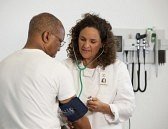
A new study review says that measuring blood pressure in both arms should be routine because the difference between left and right arm could indicate underlying health problems.
The Lancet research found that a large difference could mean an increased risk of vascular disease and death.
Although existing guidelines state that blood pressure should be measured in both arms, it is not often done.
A heart charity said it was too early to judge the findings.
The arm with the higher pressure can vary between individuals, but it is the difference between arms that counts, the study suggests.
Dr. Christopher Clark and colleagues, from the Peninsula College of Medicine and Dentistry at the University of Exeter, UK, reviewed 28 previous study papers looking at this area.
Most people in the study had an elevated blood pressure risk and about one-third had a normal level of risk.
A new study review says that measuring blood pressure in both arms should be routine because the difference between left and right arm could indicate underlying health problems
The study concluded that a difference in systolic blood pressure of 10 mm of mercury (mm Hg) between arms could identify patients at high risk of asymptomatic peripheral vascular disease.
A difference of 15mm Hg would also indicate an increased risk of cerebrovascular disease, a 70% increased risk of cardiovascular mortality and 60% increased risk of death from all causes, the authors said.
Peripheral vascular disease (PVD) is the narrowing and hardening of the arteries that supply blood to the legs and feet. There are often no symptoms.
The UK vascular check programme for over 40s which includes a test for hypertension, advises that blood pressure measurements be taken in both arms.
“But surveys have shown that the average GP doesn’t do it,” said Dr. Christopher Clark.
Early detection of PVD is important because these patients could then benefit from stopping smoking, lowering their blood pressure or being offered statin therapy.
Dr. Christopher Clark said the findings supported the need for blood pressure checks in both arms to be the norm.
Writing in The Lancet, Prof. Richard J. McManus, department of primary care health sciences at the University of Oxford and Prof. Jonathan Mant, from the department of public health and primary care at the University of Cambridge, said the review supports existing guidelines.
“Further research is needed to clarify whether substantial differences between arms should prompt aggressive management of cardiovascular risk factors.
“Ascertainment of differences should become part of routine care, as opposed to a guideline recommendation that is mostly ignored.”
Natasha Stewart, senior cardiac nurse at the British Heart Foundation, said measuring blood pressure on both arms to assess vascular disease is, theoretically, a quick and simple task.
“But it’s too early to say whether this idea could become part of standard healthcare practice and so we need more research to confirm the findings.”
Prof. Bryan Williams, from the Blood Pressure Association and the University of Leicester, said the study reinforced the message already in the guidelines from health watchdog NICE.
The 18th edition of SAG Awards was held at Los Angeles’ Shrine Auditorium on Sunday evening, January 29. Screen Actors Guild (SAG) Actor statuette honored the prime-time television performances and the exceptional motion pictures of 2011.
The SAG Awards was transmitted live on TBS and TNT. Berenice Bejo, Brad Pitt, Bryan Cranston, Don Cheadle, George Clooney and Viola Davis were among the presenters. About 100,000 members of Screen Actors Guild were able to vote for the nominees.
Mary Tyler Moore received the lifetime achievement award at SAG awards 2012.
Mary Tyler Moore as Laura Petrie in The Dick van Dyke Show. She won the prize for life time achievement at SAG Awards 2012.
Dick Van Dyke, her co-star on the sit-com “The Dick Van Dyke Show”, introduced her to the public.
In 1955, when she had 18, there were six Mary Moores in the Screen Actors Guild, thus she had to change her name, she recalled. Tyler is the middle name she shares with her father, George.
“I was Mary Tyler Moore. I spoke it out loud. Mary Tyler Moore. It sounded right so I wrote it down on the form, and it looked right. It was right. SAG was happy, my father was happy, and tonight, after having the privilege of working in this business among the most creative and talented people imaginable, I too am happy, after all,” she said.
Moore, 75, is especially known for “The Dick Van Dyke Show” (1961–66) and “The Mary Tyler Moore Show” (1970–77).
Jean Dujardin surpassed George Clooney, Brad Pitt and Leonardo DiCaprio and won the prize for outstanding performance by a male actor in a leading role. In “The Artist” he plays the role of a silent-film star which career starts to move to an end when the talkies arrive.
Viola Davis and Octavia Spencer (“The Help“) won prizes in the leading and supporting actress categories at SAG Awards 2012.
They play the roles of two black maids. In the 1960s Mississippi they have the courage to go public about the bigotry. “The Help,” also won outstanding performance by a cast in a motion picture.
“I just have to say that the stain of racism and sexism is not just for people of color or women. It’s all of our burden, all of us,” Viola Davis said.
Christopher Plummer won supporting-actor prize for his part in “Beginners“. He plays the role of an old widower who comes out as gay. He is also nominated for an Oscar and won at the Golden Globes. The 82-year-old artist could be the oldest actor to receive an Academy Award. Jessica Tandy was 80 when she won best actress for “Driving Miss Daisy.”
“Modern Family” received the outstanding performance by an ensemble in a comedy series award; Alec Baldwin won best actor for “30 Rock“.
Betty White won best actress at SAG awards 2012 for her Elka Ostrovsky part in “Hot in Cleveland.”
“You can’t name me, without naming those other wonderful women on `Hot in Cleveland. This nomination belongs to four of us. Please, please know that I’m dealing them right in with this. I’m not going to let them keep this, but I’ll let them see it,” she said.
Betty Marion White Ludden turned 90 on January 17. She is known for “The Mary Tyler Moore Show” and “The Golden Girls“.
“Game of Thrones” won the outstanding performance by a stunt ensemble award in a television series, outgoing “Dexter“,” Spartacus: Gods of the Arena”,” Southland“, and “True Blood”.
“Harry Potter and the Deathly Hallows Part 2” took the prize in the category of outstanding performance by a stunt ensemble in a motion picture.
Screen Actors Guild (SAG) was created in 1933 to protect the actors in Hollywood from beeing exploited.
It represents over 200,000 film and television principal performers and background performers worldwide. The Screen Actors Guild is associated with the Associated Actors and Artistes of America (AAAA) and is affiliated with the International Federation of Actors.
In 1995, the guild has started Screen Actors Guild Awards, this gala is perceived as an indicator of success at the Academy Awards.
Who wins one of the SAG awards has a good chance to win Oscars, too. Actors who received acting awards at SAG 2011, won Oscars later: Christian Bale and Melissa Leo (“The Fighter”), Colin Firth (“The King’s Speech”), Natalie Portman (“Black Swan”).
Mary Tyler Moore, SAG Awards 2012 winner, in “The Dick van Dyke Show” (video):
Researchers investigating a new form of contraception found that a dose of ultrasound to the testicles can stop the production of sperm.
A study on rats published in Reproductive Biology and Endocrinology showed that sound waves could be used to reduce sperm counts to levels that would cause infertility in humans.
Researchers described ultrasound as a “promising candidate” in contraception.
However, far more tests are required before it could be used.
The concept was first proposed in the 1970’s, but is now being pursued by researchers at the University of North Carolina who won a grant from the Bill & Melinda Gates Foundation.
The researchers found that two 15-minute doses “significantly reduced” the number of sperm-producing cells and sperm levels.
It was most effective when delivered two days apart and through warm salt water.
The researchers found that two 15-minute of ultrasound doses "significantly reduced" the number of sperm-producing cells and sperm levels
In humans, the researchers said men were considered to be “sub-fertile” when sperm counts dropped below 15 million sperm per milliliter.
The sperm count in rats dropped to below 10 million sperm per milliliter.
Lead researcher Dr. James Tsuruta said: “Further studies are required to determine how long the contraceptive effect lasts and if it is safe to use multiple times.”
The research team needs to ensure that the ultrasound produces a reversible effect, contraception not sterilization. As well as investigate whether there would be cumulative damage from repeated doses.
Dr. Allan Pacey, senior lecturer in andrology at the University of Sheffield, said: “It’s a nice idea, but a lot more work is needed.”
He said that it was likely that there would be recovery of sperm production, but the “sperm might be damaged and any baby might be damaged” when sperm production resumed.
“The last thing we want is a lingering damage to sperm,” Dr. Allan Pacey said.
South Sudan officials announced that at least 40 people have been killed by armed gunmen in a cattle raid in Warrap state.
According to other reports as many as 100 people could have been killed in the attack on a camp in Warrap state.
South Sudan’s interior minister accused the Sudanese government in Khartoum of arming the attackers, a militia group from Unity State, AFP reports.
Tensions remain high since South Sudan seceded peacefully from Sudan in July after decades of war.
An official in Warrap state told the Paris-based Sudan Tribune newspaper that villages belonging to the Luac Jang ethnic group in Tong East county came under attack early on Saturday.
Madot Dut Deng, speaker of the state assembly, said he had been told by officials that more than 76 people had been killed, with several unaccounted for.
Another state official told the newspaper that local people spoke of as many as 100 people killed.
Interior Minister Alison Manani Magaya said the attack was carried out by a militia group from neighboring Unity state.
“This militia group was armed by the government of Khartoum,” he said, but could not name the specific group responsible, AFP reports.
“The number of wounded is still not clear, but they took a lot of cattle with them,” Alison Manani Magaya added.
An earthquake with a preliminary magnitude of 6.3 hit Peru’s central coastline, the US Geological Survey (USGS) says.
The quake hit just after midnight (05:00 GMT) with its epicenter some 15 km (nine miles) south-east of the city of Ica, which suffered extensive earthquake damage in 2007.
Monday’s quake struck at a depth of 39 km (24 miles), the USGS said.
Peruvian media report that more than a dozen people have been injured.
“The majority are suffering trauma and cuts,” Fernando Leon Castaneda, manager of a local hospital, told Radio Programas del Peru.
Reports from Ica said electricity supplies had gone off but so far there are no reports of major damage.
The province of Ica was struck by a 7.9-magnitude undersea earthquake in 2007 that left thousands homeless.
Snowboarder Alecsander Barton from Michigan has been killed after triggering an avalanche in Utah Backcountry which officials had warned the public against using after a bout of violent snowstorms.
Alecsander Barton, 24, was boarding from the peak of Big Cottonwood Canyon, Utah with two friends when he triggered an avalanche that measured 700 feet wide.
It occurred at a time when avalanche danger had been classified as “high” due to heavy snowfall and loose, powdery snow.
Alecsander Barton’s two friends – a snowboarder and a skier – were not caught in the snow. They called 911 and, using beacons, found his body had been carried 2,400 feet by the snow.
The snowboarder, who was two days from his 25th birthday, was already dead.
“It sounds like they had skinned up the side of the mountain. Once they got to the peak, something happened. An avalanche was triggered,” police lieutenant Justin Hoyal told ABC News 4.
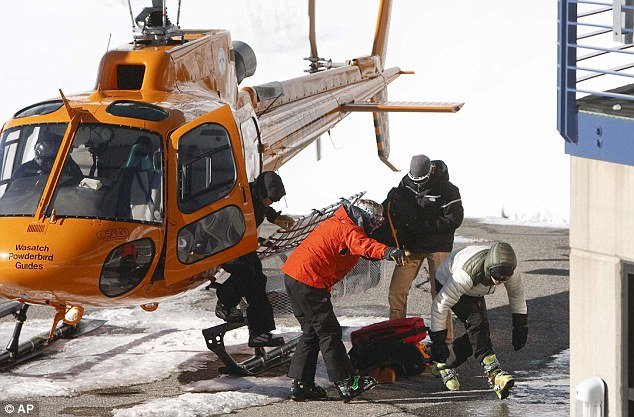
“Rescuers were flown up to the scene by Wasatch Powderbird and when they got there, the two witnesses up there – they had actually found their friend and he was deceased.”
The Utah Avalanche Center added: “His two companions switched their avalanche transceivers to receive, descended the slope and extricated their friend, buried under three feet of debris.”
Snowboarder Alecsander Barton from Michigan has been killed after triggering an avalanche in Utah Backcountry which officials had warned the public against using after a bout of violent snowstorms
Although the men – who all had considerable back country experience – had been equipped with the avalanche beacons, they were still in a dangerous area, police said.
“The back country conditions are extremely dangerous,” Justin Hoyal said.
“This is a sad reminder for people to know that conditions are so extreme right now that people need to stay out of the back country.”
Hours earlier, the Utah Avalanche Center had classified the danger level as “considerable”, but the rating was “high” on the upper slopes, meaning human-triggered avalanches were “very likely”.
“Avalanche conditions are deceptively tricky,” Craig Gordon of the Utah Avalanche Center told the Deseret News.
“You can get on some slopes and be good to go whereas others, all you need to do is find a weak spot in the snow pack and you’re staring down the barrel of a very dangerous avalanche.”
The Utah Avalanche Center reported that the trio was on the west side of Kessler Peak, in an area known as Little Giant.
It said the peak is “surrounded by radical terrain and avalanche paths on all sides” and that the friends had hiked to the peak along one of the paths.
Alecsander Barton’s death is the ninth avalanche fatality in the West this season, and experts warn the risk of slides could remain high all winter.
It is the second fatal avalanche of the season in the state. On November 13, professional skier Jamie Pierre, 38, was killed in a slide near Snowbird Ski Resort – just a week before it was due to open.
Alecsander Barton and Jamie Pierre were both killed after new, heavy snowfall led to avalanche warnings.
Experts say a weak base layer of snow, packed with large grains of ice, is causing trouble across Utah, Colorado, Montana and California.
They predict such conditions could keep avalanche risks high for the rest of the season.
American scientists have discovered that it is the man, not the woman, who is most likely to be the first to say “I love you” in a blossoming romance.
Researchers conducting this vital work have found that young men are three times more likely to take this plunge than their girlfriends.
According to researchers, there may be a more cynical explanation – that the men are simply trying to smooth-talk their partners into bed.
They explained: “Any strategy serving as the means to a sexual end would be beneficial to men, including declarations of love.”
American scientists have discovered that it is the man, not the woman, who is most likely to be the first to say “I love you” in a blossoming romance
They came to their conclusion after interviewing 171 heterosexual students under 25.
A sizeable majority (87 per cent) of the group said they believed women fell in love first, while three-quarters said they expected women to say “I love you” first.
But when asked about their own experiences, men said it took them a few weeks to realize they had fallen in love, compared with a few months for women.
It is probably no coincidence that this coincides with the average timescale when each partner wanted to have sex – within weeks for men and months for women.
Some 64% of men admitted they had said “I love you” first, compared with just 18% of women.
The research from Pennsylvania State University and published in the Journal of Social Psychology, concluded: “This shows that women tend to be more cautious about love and the expression thereof than is commonly believed. It can be argued that men’s falling in love and exclaiming this love first may be explained as a by-product of men equating love with sexual desire.”
Meanwhile, a separate study has found women are wary of men with a squinty gaze because they look promiscuous.
Hundreds of participants were shown three images of the same male face, but with eyes altered by computer. Women said the man with narrowed eyelids looked as if he would challenge authority, sleep around and steal another man’s girlfriend.
The man with an open gaze was considered more caring and emotionally supportive – and therefore better husband material.
Researchers from the University of Michigan said the simplest explanation was that “a lowered eyelid gaze is a display of sexual interest”.