Astronomers say the moon will go “super” this weekend, but that will mean bad news for the meteor shower watchers.
The Super Moon, or the year’s biggest full moon, will delight all on 5th of May, 2012, starting from 23:35 EST (or 03:35 GMT on May 6th). Even though the moon will be at its biggest for just a few hours, the full moon will appear to last for a full three days starting on 4th May till 6th May.
Unfortunately, the bright moon will wipe out the faint Eta Aquarids, the meteor shower from the debris of the Halley comet. However, given that the Eta Aquarids register at a high count of 60 meteors per hour, one shouldn’t lose all hope. Let’s just say that it won’t be seen in its usual self. Meteor shower enthusiasts will agree that the Aquarids are not really that bad a miss.
The Super Moon happens at the full moon when the moon is closest to the Earth. The 2011 Super Moon was spectacular – the moon won’t be that close to the Earth in another 18 years.
The Super Moon, or the year’s biggest full moon, will delight all on 5th of May, 2012, starting from 23.35 EST
This year’s Super Moon won’t be that great, but it will still be quite a sight, with the moon appearing 14% bigger and 28% brighter than usual full moon nights.
Photo enthusiasts interested in sky watching should definitely aim at photographing the Super Moon. Last year’s was a bumper catch and this time too people are optimistic. A tripod is not necessary, as you’ll require really small exposure time for the moon, but getting to a place with a clear sky will definitely mean a lot for the clarity of the photo. Unlike other night photos, you will be well-advised to keep the ISO of your camera sensor low.
And as for the Eta Aquarids, we aren’t very optimistic, especially if you were planning to photograph them. Living in the Southern Hemisphere will give you a slight advantage and you’ll be lucky to see a few good and bright streaks. The fact that you won’t be able keep your camera shutter open for most of the area in the sky, due to the bright moon, will not help your cause.
Ukraine denounces a threatened EU boycott of next month’s Euro 2012 football championship as “destructive”.
In a statement, Ukraine’s foreign ministry said the move would undermine the image of the tournament and be detrimental to millions of Ukrainians and Poles.
Poland – which is co-hosting Euro 2012 – has also criticized any boycott.
Several European leaders are considering cancelling their trips to Ukraine, in protest over the treatment of jailed former PM Yulia Tymoshenko.
Yulia Tymoshenko, who is on hunger strike, alleges she was beaten by prison guards.
The statement from the Ukrainian foreign ministry said sport events were designed to bring unity, and criticized what it said were attempts to politicize them.
“We view as destructive attempts to politicize sporting events, which since ancient times have played a paramount role in improving understanding and agreement between nations,” the statement said.
“A successful championship will be a victory not for politicians, parties or ideologies, but for all Ukrainians and Poles. Its failure will be a loss for millions,” it said.
Ukraine denounces a threatened EU boycott of next month's Euro 2012 football championship as "destructive"
Austria has said it will boycott all the matches in Ukraine, while the Netherlands said it will not attend unless Yulia Tymoshenko’s treatment improves.
On Thursday, EU officials said European Commissioner Jose Manuel Barroso would not be attending.
German Chancellor Angela Merkel is also reported to be considering boycotting the event, while the UK says it is undecided on whether to attend.
Meanwhile, five European presidents – from Austria, the Czech Republic, Germany, Italy and Slovenia – have said they will not attend a Ukrainian summit of Central and East European leaders next week in Yalta.
In an attempt to ratchet up the pressure further, Germany earlier said the EU is prepared to delay a trade agreement with Ukraine.
German Foreign Minister Guido Westerwelle said that “with our EU partners we are unanimous that the EU Association Agreement with Ukraine cannot be ratified as long as the rule of law in Ukraine does not develop in the right direction”.
But Ukraine’s deputy prime minister has said Euro 2012 is on track and UEFA – European football’s governing body – had not complained.
“The tournament is ready and on 11 May we will be transferring the control of the four stadia to UEFA.”
Yulia Tymoshenko, a former prime minister, was jailed last year for abuse of office, in a trial condemned by the West as politically motivated.
She is an arch-rival of Ukraine’s President Viktor Yanukovych, who beat her to the presidency in February 2010, avenging his defeat in the 2004 Orange Revolution.
The opening games of the month-long Euro 2012 will be played on 9 June.
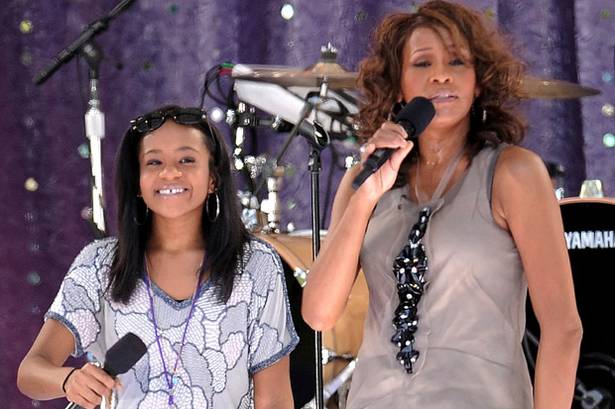
After yesterday’s Today show interview was focused on Whitney Houston, its second part turned this morning to Bobby Brown’s on-going relationship with daughter Bobbi Kristina.
According to Bobby Brown, 43, he and his daughter Bobbi Kristina share a very open, healthy relationship as he tells Matt Lauer: “I am her father, she talks to me about everything.”
When asked if the rumors of Bobbi Kristina’s substance abuse were accurate, Bobby Brown said that he was not concerned about that right now.
“I know what she is actually doing,” he said.
“I think people are making assumptions of what my daughter is [because of] how strong she is. People tend to want to control strong willed people.”
Bobby Brown says he and his daughter Bobbi Kristina share a very open, healthy relationship
Given their close relationship, Matt Lauer then asked if Bobbi Kristina Brown was dating her stepbrother, Nick Gordon, as rumors have alleged.
“Nick’s a good kid, I have nothing against Nick,” Bobby Brown said before being pushed by the host to make a declarative statement that they are not dating.
Bobbi Kristina is a strong girl, according to her father.
“Her mom taught her well. I think we raised her really well. She’s fine, she knows her mom is gone and she knows she has to live.”
Bobby Brown attempts to clear his name by dispelling the age-old rumors that he was the cause of Whitney Houston’s addiction in his interview with Today’s Matt Lauer.
In addition to recounting how well Whitney Houston looked the week prior to her death, Bobby Brown, 43, told Matt Lauer that he still asks himself if he could have helped her more.
“Maybe I could have done something different. You know?” Bobby Brown said.
“To ensure she had a longer life. But you have to want it.”
Although happily engaged, Bobby Brown had no qualms expressing the love he had for Whitney Houston, his ex-wife of 14 years.
Although happily engaged, Bobby Brown had no qualms expressing the love he had for Whitney Houston, his ex-wife of 14 years
Bobby Brown’s perception is that the couple had a great and “beautiful” relationship.
“I can honestly say that I loved that woman with everything that I am,” he admitted.
“I truly and genuinely love that woman. And I still love her to this day.”
Bobby Brown said it’s no secret (not even to his fiancée) how he felt about Whitney Houston.
“I was in love with her deeply,” he says of his late ex.
It’s commendable for Bobby Brown to take the high road by only having good things to say about Whitney Houston. From the outside looking in the couple may have appeared to be a little rough around the edges. But that’s not to say the love they had for each other wasn’t real. Take a look at the couple during the happier times of their marriage.
Ubuntu has some obvious advantages over other operating systems: is free of charge, free of viruses and designed to outpace its rivals on low-end systems.
Ubuntu claims 20 million people use it a day. Not an insignificant number, but still a drop in the ocean compared to Microsoft’s Windows or Apple’s OS X.
Even so, lead designer and one-time astronaut Mark Shuttleworth hopes that last week’s major upgrade to the Linux-based project will produce an outsized splash and increase the size of its somewhat divergent customer-base.
“In terms of our user, they would split into two sorts of camps,” Mark Shuttleworth says.
“One, not very tech savvy, that has an old PC lying around and Windows is getting difficult because of the computer’s age or viruses, and Ubuntu gives them a nice basic all-purpose PC with a great web experience.
“The other group tends to be the next generation of tech entrepreneurs – people who are passionate about technology and want to do amazing things with it.”
Mark Shuttleworth counts Wikipedia and Facebook’s Instagram photo app among his clients.
A third class of users is also attracted to the system – public bodies looking to cut their IT bills. The Dutch ministry of defense, part of France’s police force and schools across the south of Spain have all opted to switch thousands of their PCs to the software.
Ubuntu is able to offer itself as a free download thanks to coders across the world volunteering to develop the open-source project.
Mark Shuttleworth’s London-based company, Canonical, manages and funds the endeavor and makes money back by offering support, training and online storage.
The system may remain niche so long as it lacks native versions of big name software like Photoshop, iTunes and Microsoft Office – despite alternative products – but it may still shake up the wider industry thanks to efforts to incorporate innovative technologies.
The adoption of a head-up display (HUD) in the upgrade is a case in point.
It aims to replace increasingly overloaded point-and-click menu systems with a panel into which users type what they want the computer to do. The computer then tries to offer up a list of functions that match their request.
“The core idea is that instead of hunting for some functionality in a menu you can simply express what you want,” Mark Shuttleworth says.
“You can say I want to send that to grandma, or I want to back this up.
“It’s driven by the idea that search or expressing your intent has become really powerful. If Google can turn the whole internet into one page of likely results just based on the one sentence you give it, why can’t we do that with your email or graphics application?”
Ubuntu has some obvious advantages over other operating systems, is free of charge, free of viruses and designed to outpace its rivals on low-end systems
For now the innovation remains optional. The software designer admits it still needs “a great deal of work”, but he adds that it is only one of many steps he hopes to take towards a more intuitive, multi-sensory experience.
“You could imagine having the device track your eyeballs so it knows what you are looking at – so you could look at a movie and say <<I want to watch that>>.
“You can get away from the designer of the application having to provide a cumbersome way to express all the things you can do which you have to navigate, and just let you just say what you want to get done – whether that’s by talking, pointing or by touch interface – all of these things have to come together to make it feel more human.”
Delivering these ambitions will take years, perhaps decades.
In the shorter term, Ubuntu’s fans have been excited by a job posting which discussed creating a Ubuntu smartphone system.
Mark Shuttleworth refuses to reveal any details, beyond hinting that it will be a closer relation to the firm’s core product than some of its rivals’ mobile systems are to their desktop equivalents.
“You know you wouldn’t want to run Mac OS X nor Windows 8 on a phone,” he says.
“Those companies have quite different sorts of interfaces. We think we have found a way to have a more harmonious portfolio… we will be judged on what we ship.”
The firm’s smartphone efforts are also concentrated on “Ubuntu for Android” – an app that makes high-end phones act like a PC when docked with a monitor and keyboard, which is due out later this year.
The firm suggests businesses could ultimately cut costs by only having to buy a single device for each of their employees.
It is a radical proposition, and also a bit of a philosophical challenge.
“There are two counter-balancing forces – one force saying everyone should have fewer CPUs [central processing units] as their phone can replace other devices,” says Mark Shuttleworth.
“But then you have exactly the opposite trend which is saying that anything that could have a screen can also have a brain, a memory and a personality – printers with touch-screens, desk phones that deliver your mail. And those are two completely contradictory forces.

“Holding those two opposing ideas in our head at the same time is what’s really exciting.”
Other ambitions include the roll-out of the first Ubuntu powered television sets and perhaps support for mark two of the Raspberry Pi stripped-back computer, whenever it launches.
“We just couldn’t connect all the dots in the first version… I’d be delighted if a future version worked with us,” Mark Shuttleworth adds.
But as his firm rushes to release new innovations, one major cloud looms: the threat of a patent dispute.
Although Canonical has avoided becoming involved in one of the rising number of lawsuits sucking up time and brainpower at its competitors, it is an ever-present concern.
“We know that we are sort of dancing naked through a minefield and there are much bigger institutions driving tanks through,” Mark Shuttleworth says.
“It’s basically impossible to ship any kind of working software without potentially trampling on some patent somewhere in the world, and it’s completely impossible to do anything to prevent that.
“The patents system is being used to slow down a lot of healthy competition and that’s a real problem. I think that the countries that have essentially figured that out and put hard limits on what you can patent will in fact do better.”
Two men from UK, who have been totally blind for many years, have had part of their vision restored after surgery to fit pioneering eye implants.
The men are able to perceive light and even some shapes from the devices which were fitted behind the retina.
The patients are part of a clinical trial carried out at the Oxford University Eye Hospital and King’s College Hospital in London.
Professor Robert MacLaren and Dr.Tim Jackson are leading the trial.
The two patients, Chris James and Robin Millar, lost their vision due to a condition known as retinitis pigmentosa, where the photoreceptor cells at the back of the eye gradually cease to function.
The wafer-thin, 3 mm square microelectronic chip has 1,500 light-sensitive pixels which take over the function of the photoreceptor rods and cones.
The surgery involves placing it behind the retina from where a fine cable runs to a control unit under the skin behind the ear.
When light enters the eye and reaches the chip it stimulates the pixels which sends electronic signals to the optic nerve and from there to the brain.
The chip can have its sensitivity altered via an external power unit which connects to the chip via a magnetic disc on the scalp.
The wafer-thin, 3 mm square microelectronic chip has 1,500 light-sensitive pixels which take over the function of the photoreceptor rods and cones
Chris James from Wroughton in Wiltshire said there was a “magic moment” when the implant was switched on for the first time and he saw flashing lights – showing that the device was functional.
“I am able to make out a curve or a straight line close-up but I find things at distance more difficult. It is still early days as I have to learn to interpret the signals being sent to my brain from the chip.”
Chris James, a motor-racing enthusiast, says his ambition is to be able to make out the silhouettes of different cars on the race-track.
Prof.Robert MacLaren, who fitted the first implant in the UK at the Oxford Eye Hospital, said:
“It’s the first time that British patients who were completely blind have been able to see something.
“In previous studies of restorative vision involving stem cells and other treatments, patients always had some residual sight.
“Here the patients had no light perception at all but the implant reactivated their retina after more than a decade.”
The chip results in the brain receiving flashes of light rather than conventional vision – and it is in black and white rather than color.
But in an unexpected development, the other British man to have the implant says he is now able to dream in color for the first time in 25 years. Robin Millar says he is also able to stand in a room and detect light coming through windows.
Prof. Robert MacLaren said the results might not seem extraordinary to the sighted, but for a totally blind person to be able to orientate themselves in a room, and perhaps know where the doors and windows are, would be “extremely useful” and of practical help.
In 2010 a Finnish man who received the experimental chip was able to identify letters, but his implant worked only in a laboratory setting, whereas the British men’s devices are portable. The implant was developed by a German company, Retina Implant AG.
Dr. Tim Jackson, eye surgeon at King’s College Hospital who has also fitted one of the devices, said:
“This pioneering treatment is at an early stage of development, but it is an important and exciting step forward, and may ultimately lead to a much improved quality of life for people who have lost their sight from retinitis pigmentosa.
“Most of the people who receive this treatment have lost their vision for many years, if not decades. The impact of them seeing again, even if it is not normal vision, can be profound, and at times quite moving.”
Both surgeons stress that the chip is not a treatment but part of a clinical trial. Up to a dozen British patients will be fitted with the implants.
Although it could ultimately benefit patients with the most common form of progressive blindness, age-related macular degeneration, they are not eligible for the study at present.
Nor are patients with glaucoma or optic nerve disease.
Chinese activist Chen Guangcheng says he has been unable to meet US officials to discuss his desire to leave the country.
The blind dissident, in hospital in Beijing, says he believes Chinese officials were preventing US envoys from visiting him on Thursday.
After he escaped house arrest last week, Chen Guangcheng spent six days in the US embassy before emerging on Wednesday.
The issue continues to overshadow key talks between the US and China.
US Secretary of State Hillary Clinton is in Beijing to attend talks focusing on North Korea and Syria.
As the talks opened, Hillary Clinton did not mention Chen Guangcheng by name but addressed the topic of human rights.
Chinese activist Chen Guangcheng says he has been unable to meet US officials to discuss his desire to leave the country
Earlier, the US ambassador to China, Gary Locke, rejected the suggestion that Chen Guangcheng had been pressured into leaving the US embassy.
“I can tell you unequivocally that he was never pressured to leave. He was excited and eager about leaving,” he said.
However, Chen Guangcheng says since he left he has been made aware of threats made to his wife and family while he was in the embassy.
“She told me our house has been installed with seven CCTV cameras inside the courtyard. There are people in and outside of our house and on the roof…They just eat and stay in our house, and they plan to build up electric wires around my house,” he said.
Although he initially said he wanted to stay in China, Chen Guangcheng changed his mind because he believes China has reneged on an agreement to guarantee his safety.
There is no official confirmation about the nature of any such agreement, but media reports from the US suggest that Chen Guangcheng had been promised safety in a university town elsewhere in China.
Chen Guangcheng also said that US officials had been to the hospital where he is currently receiving treatment, but he had not seen them. He believes Chinese foreign ministry officials are not letting them in.
“Yesterday afternoon I thought they [US officials ] left. I looked for them, but couldn’t find them…Today I got to know that they were prevented from coming in, not that they are not coming in,” he said.
A Chinese foreign ministry spokesman said he had “no information” on Chen Guangcheng’s request to leave China.
Both Hillary Clinton and US Treasury Secretary Timothy Geithner are attending the annual two-day talks, which had been expected to focus on North Korea and Syria.
Hillary Clinton has previously expressed her support for Chen Guangcheng, who has been held under house arrest for almost two years.
As the talks opened, she addressed the topic of human rights.
“The United States believes that no state can legitimately deny the universal rights that belong to every human being – or punish those who exercise them,” the top US diplomat said.
President Hu Jintao, also speaking at the start of the talks, said it was not possible for China and the US to see “eye to eye on every issue”.
Chinese officials on Wednesday accused the US of interference in their domestic affairs and demanded an apology for housing Chen Guangcheng at the embassy.
Chen Guangcheng had been at the US embassy for almost a week after escaping from house arrest in his home village in the eastern province of Shandong.
He had planned his escape from house arrest for months. On 27 April, he scaled the wall the authorities had built around his house and was then driven hundreds of miles to Beijing.
The activist spent seven years in prison or under house arrest after he exposed human rights abuses, including the way thousands of women were forced to have abortions under China’s “one-child-policy”.
Several people involved in Chen Guangcheng’s escape have been detained or have disappeared in recent days.
Carry-on baggage fee will soon cost some Spirit Airlines passengers $100, which is more than they may have paid for their flight.
The Miramar, Florida, airline currently charges $45 at the gate for a carry-on bag.
As of November 6, just days before Thanksgiving, customers who wait to pay the carry-on baggage fee at the boarding gate will have to fork over $100.
Any bag that needs to fit in the overhead bin is considered a carry-on.
Luckily, a small bag that fits under the seat is still free.
Carry-on baggage fee will soon cost some Spirit Airlines passengers $100, which is more than they may have paid for their flight
The price for a carry-on bought at an airport kiosk will increase to $50 from $40.
Larger pieces of luggage checked at the airport will cost between $8 and $10 more, while the fee for bags checked online will rise by between $2 and $5.
Spirit Airlines will also increase a handful of other fees by between $2 and $10.
Spirit is one of two airlines that charge for carry-ons; Allegiant is the other.
In the first quarter, Spirit’s average revenue from fees per passenger on a round-trip flight topped $100 for the first time.
“Despite achieving among the best first quarter results in the industry, we will not relax our vigilance toward further improving our cost structure,” Ted Christie, Spirit’s Chief Financial Officer said in a statement on May 1.
He said that Spirit would have to make certain adjustments to remain profitable.
“However, we must remain focused on offsetting cost headwinds, including rising jet fuel prices and aircraft maintenance expenses, in order to maintain our competitive advantage.”
A study found that overdue babies, those who were born after 42 weeks, were more likely to suffer behavioral problems such as ADHD in early life.
Women should be aware of the risks of prolonging pregnancy, experts report in the International Journal of Epidemiology.
The research was carried out in The Netherlands, where until recently it was commonplace for women to choose not to be induced if they were overdue.
A study of more than 5,000 babies found those born after 42 weeks were more likely to develop behavioral problems than those born around their due date, and had more than twice the risk of Attention Deficit/Hyperactivity Disorder (ADHD).
A study found that overdue babies, those who were born after 42 weeks, were more likely to suffer behavioral problems such as ADHD in early life
Lead researcher Dr. Hanan El Marroun from the Department of Child and Adolescent Psychiatry at Erasmus MC-Sophia in Rotterdam said post-term as well as pre-term births seemed to be associated with long-term health effects.
She said: “Every pregnant woman knows that if the child comes early that’s not good, so why don’t we question the long-term effects of when a child comes too late?”
Complications include a higher risk of stillbirth and difficulties in delivering large babies.
However, a minority of women, dubbed “the 10-month mamas”, believe a baby will come in its own time and avoid medical intervention.
Researchers have found that aspirin could be as effective as more expensive drugs for heart failure patients with a normal heart rhythm.
Their study on more than 2,000 patients, published in the New England Journal of Medicine, said aspirin was as effective as the commonly prescribed drug warfarin.
It said each drug had risks, but they had similar benefits overall.
However, a British cardiologist argued the risks from warfarin were less serious.
Heart failure is a major health problem in many parts of the world. It affects 900,000 people in the UK and six million people in the US. A failing heart struggles to pump blood around the body, meaning even trivial tasks become exhausting.
As the blood is not pumped round the body as efficiently the risk of a blood clot increases, if a clot blocks blood to parts of the brain it will result in a stroke.
Patients are treated with drugs to reduce the risk of a fatal blood clot forming. However, researchers said it was unknown whether aspirin or warfarin was the better treatment in the 75% of heart failure patients who still have a normal heart beat.
Aspirin was as effective as the commonly prescribed drug warfarin, say researchers
Researchers gave 2,305 patients, in 11 countries, either aspirin or warfarin.
The combined risk of death, stroke and major bleeding was the same for each drug, according to the researchers.
Patients taking warfarin had a much lower risk of stroke, but had a high risk of bleeds. They said that after four years there was a “small benefit” with warfarin, but it was “borderline” and of “uncertain clinical significance”.
They concluded: “There is no compelling reason to use warfarin rather than aspirin.”
The lead researcher, Dr. Shunichi Homma, from the Columbia University Medical Center, said: “Since the overall risks and benefits are similar for aspirin and warfarin, the patient and his or her doctor are free to choose the treatment that best meets their particular medical needs.
“However, given the convenience and low cost of aspirin, many may go this route.”
However, Dr. Andrew Clark, from the British Society for Heart Failure and the University of Hull, said: “The study shown here demonstrates that warfarin quite markedly reduces the risk of stroke associated with heart failure compared with aspirin, but at a cost of an increase in major haemorrhage.
“How to interpret that for individual patients means weighing the risk of stroke against the risk of haemorrhage, but also weighting that by importance.
“I would regard a gastrointestinal haemorrhage requiring transfusion as being of less importance than a stroke, so would tend in favor of warfarin.
“I would be more inclined to prescribe warfarin that previously, but the evidence is not overwhelming.”
The British Heart Foundation said both warfarin and aspirin had risks and benefits, but this study showed “neither has an advantage over the other overall in preventing stroke or death in the long term.”
Dr. Walter Koroshetz, who is the deputy director of the US National Institute for Neurological Disorders and Stroke, said the study would have “a large public health impact”.
He added: “Patients and their physicians now have critical information to help select the optimum treatment.
“The key decision will be whether to accept the increased risk of stroke with aspirin, or the increased risk of primarily gastrointestinal haemorrhage with warfarin.”
President Nicolas Sarkozy and his rival Francois Hollande have traded insults in their only TV debate of the election campaign.
Nicolas Sarkozy called Francois Hollande a “little slanderer”, while his challenger said the president shirked responsibility.
The president defended his record and said he had kept France out of recession. But Francois Hollande said France was going through a “serious crisis” and was struggling with slow growth.
The run-off vote takes place on Sunday.
It was a long, bad-tempered debate that left the impression that neither candidate liked each other.
There were plenty of angry exchanges, with both candidates accusing each other of lying.
Francois Hollande accused Nicolas Sarkozy of “ruining the French economy”, prompting his rival to say he had been unfairly blamed.
“It’s never your fault,” Francois Hollande responded, to which Nicolas Sarkozy said: “It’s a lie, it’s a lie!”
President Nicolas Sarkozy and his rival Francois Hollande have traded insults in their only TV debate of the election campaign
Analysts said neither candidate landed a knockout blow – which may be to the advantage of Francois Hollande, the favorite for Sunday’s vote.
Opinion polls suggest the Socialist candidate has a lead of seven percentage points.
Francois Hollande said he would work to help those in need, saying that those “with privileges” had been protected under Nicolas Sarkozy.
“I will be a president for justice, because we are going through a serious crisis that hits in particular the most modest of us, the hardest working people, those who are the most vulnerable.”
He accused Nicolas Sarkozy of failing to take responsibility for the economic difficulties that France was suffering, blaming it instead on the global economic crisis.
Francois Hollande said unemployment levels were “a record” and referred to the downgrading of France’s credit rating.
Lashing back at Francois Hollande, President Nicolas Sarkozy said France had done better than other European countries in coping with the economic climate.
“What is the country to not have known recession since 2009 – it is France,” Nicolas Sarkozy said.
He rejected Francois Hollande’s proposed stimulus programmes, insisting that France had to cut spending and debts.
Nicolas Sarkozy also accused Francois Hollande of representing only the unions, rather than all of France.
“It’s all very nice to talk about uniting people, but it has to be put into practice,” he said.
Francois Hollande also said he would be firm on demands made by the Muslim community, saying he supported France’s ban on face-covering veils and would not allow separate hours in swimming pools for men and women.
Nicolas Sarkozy has similarly criticized demands for special treatment from France’s Muslim community.
The debate was broadcast live by several channels and ran over time to nearly three hours.
There has been a huge build-up to the event, billed variously by newspapers as The Last Duel and The Final Confrontation.
About a third of France’s 63 million people were set to watch the live debate.
Nicolas Sarkozy had attacked Francois Hollande for refusing to hold three election debates instead of one, but there has been just one debate per presidential election since 1974, apart from in 2002 when Jacques Chirac refused to debate with the far right’s Jean-Marie Le Pen.
A key moment in Nicolas Sarkozy’s 2007 debate with Segolene Royal – Francois Hollande’s former partner and mother of his children – came when he told the Socialist candidate to “calm down”. She repeatedly refused to do so, saying some anger was “perfectly healthy”.
In this debate, Nicolas Sarkozy came across as the more aggressive participant, leaning forward and raising his voice more often, analysts say.
It was presented by two French TV anchors, Laurence Ferrari of TF1 and David Pujadas of France 2.
The Scream, the iconic artwork of Norwegian expressionist Edvard Munch, has become the most expensive item sold at auction, after it fetched $119.9 million.
The 1895 pastel was bought by an anonymous buyer at Sotheby’s in New York. Bidding lasted 12 minutes.
The work is one of four in a series by Edvard Munch and was the only one still owned privately.
Proceeds of the sale are to go towards founding a new museum, hotel and art centre in Norway.
Seven bidders were competing for the work, which had a starting price of $40 million. The crowd broke into applause, following the sale on Wednesday.
The sale price includes the buyer’s premium.
The Scream, the iconic artwork of Norwegian expressionist Edvard Munch, has become the most expensive item sold at auction, after it fetched $119.9 million
The previous record for an artwork sold at auction was for Picasso’s Nude, Green Leaves, and Bust, which sold for $106.5 million in 2010.
The other three versions of The Scream are all owned by Norwegian museums, but Sotheby’s say the version they sold is the most colorful.
It is also the only one to include a poem by Edvard Munch on the frame, which talks of the inspiration behind the series of works.
It reads: “I was walking along a path with two friends – the sun was setting – suddenly the sky turned blood red – I paused, feeling exhausted, and leaned on the fence – there was blood and tongues of fire above the blue-black fjord and the city.
“My friends walked on, and I stood there trembling with anxiety – and I sensed an infinite scream passing through nature.”
The piece was sold by businessman Petter Olsen, whose father was friendly with the Norwegian artist.
Earlier this year, Petter Olsen spoke of his decision to sell The Scream.
“I have lived with this work all my life, and its power and energy have only increased with time,” he said.
“Now, however, I feel the moment has come to offer the rest of the world a chance to own and appreciate this remarkable work.”
The Scream has become one of the famous works of art in popular culture.
“Together with the Mona Lisa, it’s the most famous and recognized image in art history,” Michael Frahm, an art adviser with Frahm Ltd., told the Associated Press news agency.
He added that it has been “used by everyone from Warhol to Hollywood to cartoons to teacups and T-shirts”.
Two of the other versions of The Scream were stolen, in 1994 and 2004 respectively. Both were later recovered.
The European Space Agency is to mount Juice probe, a billion-euro mission, to Jupiter and its icy moons.
Juice probe has just been approved at a meeting of member state delegations in Paris.
It would be built in time for a launch in 2022, although it would be a further eight years before it reached the Jovian system.
The mission has emerged from a five-year-long competition to find the next “large class” space venture in Europe.
Juice stands for JUpiter ICy moon Explorer. The concept proposes an instrument-packed, nearly five-tonne satellite to be sent out to the Solar System’s biggest planet, to make a careful investigation of three of its biggest moons.
The spacecraft would use the gravity of Jupiter to initiate a series of close fly-bys around Callisto and Europa, and then finally to put itself in a settled orbit around Ganymede.
Emphasis would be put on “habitability” – in trying to understand whether there is any possibility that these moons could host microbial life.
Callisto, Europa and Ganymede are all suspected to have oceans of water below their icy surfaces. As such, they may have environments conducive to simple biology.
“People probably don’t realize that habitable zones don’t necessarily need to be close to a star – in our case, close to the Sun,” explained Prof. Michele Dougherty, a Juice science team member from Imperial College London, UK.
“There are four conditions required for life to form. You need water; you need an energy source – so the ice can become liquid; you need the right chemistry – nitrogen, carbon, hydrogen; and the fourth thing you need is stability – a length of time that allows life to form.
“The great thing about the icy moons in the Jupiter system is that we think those four conditions might exist there; and Juice will tell us if that is the case,” she said.
The European Space Agency is to mount Juice probe, a billion-euro mission, to Jupiter and its icy moons
The mission will cost ESA on the order of 830 million Euros ($1.1 billion) over its entire life cycle. This includes the cost of manufacturing the spacecraft bus, or chassis, launching the satellite and operating it until 2033.
This sum does not however include Juice’s 11 instruments. Funding for these comes from the member states. When this money is taken into account, the final budget for Juice is expected to be just short of 1.1 billion Euros.
It has not yet been decided which European nations will provide which instruments. An Announcement of Opportunity will be released this summer with a view to identifying the instrument providers by the start of next year.
The final and formal go-ahead for Juice should be given in 2014. In ESA-speak, this stage is referred to as “adoption”.
It is the moment when all the elements required to build the satellite are in place and the full costs are established.
It is also the point at which any international participation is recognized.
At the moment, Juice is a Europe-only venture, but there is every possibility that the Americans will get on board.
The US space agency (NASA) walked away from the idea of producing a companion satellite to Juice – a spacecraft that would orbit Europa rather than Ganymede – due to programmatic differences and budget concerns.
Nonetheless, there is a strong desire among the American scientific community to have some involvement in Juice, especially in those aspects that concern Europa.
Dr. Britney Schmidt from the University of Texas at Austin is excited that Europe has chosen to fly Juice, and expects the probe’s data to resolve many outstanding questions at the icy moon.
“We know that ice is a really good place [for life] to do business on Earth,” she said.
“There’s plenty of microbial and even some macroscopic organisms that use ice to make a living. It’s not so hard to imagine that life like that which lives in Antarctica and in the Arctic might be very possible on Europa.”
The ESA executive has put down 68 million Euros as a kind of placeholder, to give some idea of how much NASA might like to contribute. The sum is roughly the equivalent of two instruments. However, it should be said that no explicit discussions between ESA and NASA have taken place concerning which specific instruments might come from across the Atlantic.
One further issue needs to be resolved: the name of the mission. The “Juice” label was dreamt up by the science team who devised the mission concept, but the researchers acknowledge there was a touch of humor in its creation.
They would like to use the name Laplace, after the great 18th/19th-Century French mathematician and astronomer Pierre-Simon Laplace. A number of commentators would like to see ESA run a public competition to find a suitable mission name.
The Juice proposal was chosen over two other ideas – Athena, which envisages the biggest X-ray telescope ever built, and NGO, which would place a trio of high-precision satellites in space to detect gravitational waves.
These defeated concepts will probably now be entered into the next competition, due to be announced next year or the year after.
Kodak Theatre, the Hollywood venue that hosts the Oscars, has been renamed the Dolby Theatre in a new sponsorship deal.
The 3,400-seater building, which has been home to the annual Academy Awards ceremony since 2002, was previously known as the Kodak Theatre.
Earlier this year a judge granted Eastman Kodak permission to end the $74 million, 20-year naming rights deal it signed in 2000.
Kodak Theatre, the Hollywood venue that hosts the Oscars, has been renamed the Dolby Theatre in a new sponsorship deal
Dolby has agreed a 20-year contract with theatre owners the CIM Group.
“The Academy’s Board of Governors believes that the home for our awards is in Hollywood,” said Tom Sherak, president of the Academy of Motion Picture Arts and Sciences.
“It is where the Academy and the motion picture industry are rooted. We are pleased to have a new agreement with CIM that will continue our long-standing partnership.”
Kevin Yeaman, of British-founded audio technology specialists Dolby, said the partnership “allows the theatre to be not only the world stage for the Academy Awards, but for Dolby innovations for decades to come”.
Eastman Kodak entered bankruptcy protection from its creditors in January this year after failing to keep up with competitors.
The 133-year-old company announced it was to stop making digital cameras in order to focus on more profitable divisions.
Bobby Brown has spoken out for the first time since Whitney Houston’s death in an interview with Matt Lauer on The Today Show.
Bobby Brown, 43, told Matt Lauer he was “hurt” by suggestions that he played a role in Whitney Houston’s demise.
“I was hurt. I was hurt… because, you know, me being off of narcotics for the last seven years, I felt that she was… I didn’t know she was struggling with it still,” Bobby Brown told Matt Lauer in a new sitdown interviewing, aired Wednesday on The Today Show.
“But at the same time… listen, it’s a hard fight. It’s a hard fight to… maintain sobriety that way.”
Matt Lauer asked Bobby Brown if he thought Whitney Houston’s cocaine use shortly before her death (the coroner’s reported indicated she had the narcotic in her system at the time of her death in February) led to the pop star’s death, and the recovering addict said he believed it did.
“From what I feel and… how I saw her, the last time I saw her, it had to be that particular day… It had to be that one, because that’s all it takes… One hit, you know, and… it could definitely take your life away from you,” Bobby Brown said.
“And – unfortunately – that was it.”
Bobby Brown has spoken out for the first time since Whitney Houston’s death in an interview with Matt Lauer on The Today Show
Many fans blamed Whitney Houston’s early descent into drug addiction on her relationship with Bobby Brown, and the singer said those thoughts are still upsetting.
“It makes me feel terrible. But… I know differently. I think if anyone ever knew us, if anybody ever spent time around us instead of time lookin’ through the bubble – they would know how we felt about each other, they would know how happy we were together… And the reality show gave us a wakeup, because… we looked at the bubble and saw ourselves,” the singer said, referring to Being Bobby Brown.
“We [were] able to see what other people were saying about us… We [were] able to see that our drug use had affected our relationship, had affected the love that we felt for each other.”
Pushed more by Matt Lauer over the rumor, Bobby Brown said: “No, that’s not true. I didn’t get high before I met Whitney.”
“I smoked weed, I drank the beer, but no, I wasn’t the one that got Whitney on drugs at all,” he added.
Asked if drugs were a part of Whitney Houston’s life before their relationship, Bobby Brown claimed that they were.
“It’s just – it’s just unexplainable – how one could, you know, [say that I] got her addicted to drugs. I’m not the reason she’s gone,” he said.
“And it’s not revisionist history? It’s not a chance of, after the fact, setting the record straight in Bobby Brown’s way?” matt Lauer asked.
“No. I can honestly say that I love that woman with everything that I am… And I believe she loved me the same way,” he replied.
“We wouldn’t have been able to make the most beautiful girl in the world without love. And that’s the truth.”
Three-year-old Emmelyn Roettger of Washington D.C. loves writing, spelling and counting and is fascinated by science and space.
Despite her tender age Emmelyn Roettger, known as Emme, is familiar with the concept of mitosis and can explain the process of metamorphosis in butterflies.
In fact her outstanding thirst for knowledge and academic competency is such that she has earned herself a place in Mensa, becoming the high-IQ society’s youngest U.S. member.
Emmelyn Roettger was accepted into the club in March, aged two years and 11 months, with an IQ of 135.
The little girl suffers from poor vision, causing “unspecified delays” in her development which doctors had initially mistaken for signs of autism.
But when her mother, Michelle Horne, thought to get her vision checked everything fell into place and Emme’s talents took off.
Emmelyn Roettger was accepted into Mensa on March this year, aged two years and 11 months, with an IQ of 135
Wearing glasses the youngster immediately showed an unusually high appreciation for the world around her.
“She showed an obvious want for things,” her mother told MSNBC, “grabbing at things, trying to get to toys, fussing for things that she couldn’t reach — and she started crawling within a few weeks.”
By 15 months she was recognizing letters and could write them before turning two. She learnt to write her name and count to 100 shortly after her second birthday and simple maths puzzles came naturally to her.
But paediatricians continued to refer to the toddle as “delayed” so her mother sought support from other avenues.
Emmelyn Roettger came across the Wechsler Preschool and Primary Scale of Intelligence, a standardized intelligence test designed for children between the ages of two and a half and seven.
Emme scored so highly (in the 99th percentile on all measures) that Michelle Horne submitted her score to Mensa.
“My husband thought it was a silly idea at first,” Michelle Horne said.
“I was looking for support, though, and I thought Mensa could be another resource for us.”
The society accepted Emme into its family, as the youngest U.S. member. Her parents hope her unusual talents will be nurtured and challenged by being in the club.
Frank Lawlis, American Mensa’s supervisory psychologist and author of The IQ Answer, told MSNBC that while life can be easier in some ways for kids with sky-high IQs, in other ways it is limiting.
“There’s a social stigma to being very smart, just like there’s a stigma to being retarded,” he said.
“It can limit a person’s potential for social relationships.”
The death of Whitney Houston hasn’t diminished the marketing value of her ex-boyfriend Ray J as he just inked a major deal – to fight the war on ingrown hairs.
Ray J is officially the new face of Prince Reigns shaving serum and, according to the singer’s rep, the deal is worth up to $1 million though the rep wouldn’t divulge the exact terms of the contract.
Ray J is officially the new face of Prince Reigns shaving serum
A rep for the company told TMZ that Sophie Monk signed a similar deal.
Ray J’s former sex tape partner Kim Kardashian has also dabbled in the body hair removal business inking a deal of her own with the TRIA laser hair removal system a few years ago.
Activision has released the first details of Black Ops 2, the latest installment in its best-selling Call of Duty series.
Black Ops 2 is set in 2025 and centres on “the enemy” taking control of the US army’s unmanned weapon systems.
The title is being developed by the firm’s Treyarch studio and is due for release on 13 November.
That will pitch it against the return of Microsoft’s Halo series. The science fiction first-person shooter launches a new trilogy a week earlier.
Activision said the last title in the Call of Duty series, Modern Warfare 3, broke sales record grossing $775 million on its first five days on sale.
Black Ops 2 is set in 2025 and centres on "the enemy" taking control of the US army's unmanned weapon systems
However, news site Gamasutra recently reported that analysts at Macquarie Equities had suggested that since its debut the title had underperformed its predecessor.
According to their numbers, by March the number of copies of MW3 sold was 4.2% behind where the first Black Ops title had been at the same time a year earlier.
Postings on site forums suggested that some players might have begun tiring of the format.
Video game website IGN said that a decision to develop a topical plot centred on cyber-terrorism in conjunction with Batman Begins scriptwriter David Goyer and the Brookings Institution think tank was designed to bolster interest.
“The decision to move Black Ops forward in time is a response to market saturation – there is an abundance of military shooters around – and a way to reinvigorate the genre,” said games writer Daniel Krupa.
“But it isn’t a strikingly original move. Ubisoft’s long-running Ghost Recon series is also making a leap forward in time this year. Halo is a military shooter set in the distant future.
“Ultimately, the real future of the first-person shooter won’t lie in the trenches of conflicts past or present, but in other settings with stronger narratives.”
UEFA has confirmed that yellow cards rules used by the Champions League will not be changed for at least three years.
Seven players are suspended for the Chelsea vs. Bayern Munich final after six were cautioned in the semi-finals.
The rules are different for Euro 2012 when UEFA will wipe the slate clean for yellow cards after the quarter-finals.
A UEFA spokesman said: “Different rules can apply in different competitions. The rules are a result of careful, democratic procedure.”
UEFA has confirmed that yellow cards rules used by the Champions League will not be changed for at least three years
International players’ union FIFPro had made a plea for the six players who are suspended to be allowed to play, which was rejected.
Chelsea’s captain John Terry will also be suspended after being sent off against Barcelona in the semi-final second leg at the Nou Camp.
Michael van Praag, head of UEFA’s Champions League Rules group, was quoted on FIFPro’s website saying: “We have just had three sessions with representatives of the European Clubs’ Association and others, in which we confirmed the rule for the coming three years.
“We did not receive any request whatsoever concerning the yellow card rule, not even from the representative of Bayern Munich. And so we will be continuing the rule for the next three years.”
Before that announcement, Simon Barker – a spokesman for FIFPro – had said: “Anybody committing a serious offence in the semi-final should be awarded a red card and miss the final, but the offences that result in a yellow card do not justify the serious punishment of missing the match of your life.
“Some people say this will give players the licence to kick all and sundry during the semi-final, but that is utter nonsense.
“Any serious offence will result in a red card and that still means exclusion from the final.”
At Euro 2012, only players sent off in the quarter-final or semi-final will be banned from the final in Kiev.
Motorola Mobility has been granted an injunction against the distribution of key Microsoft products, Xbox 360 games console, Windows 7 system software, Internet Explorer and Windows Media Player, in Germany.
The court’s decision follows a ruling that Microsoft had infringed two patents necessary to offer H.264 video coding and playback.
A US court has banned Motorola from enforcing the action until it considers the matter next week.
The handset maker is in the process of being taken over by Google.
This is just one of several cases involving about 50 intellectual properties that the smartphone maker has claimed that Microsoft should have licensed.
Motorola Mobility has been granted an injunction against the distribution of Xbox 360 games console in Germany
Microsoft has said that if it met all of Motorola’s demands it would face an annual bill of $4 billion. Motorola disputes the figure.
A statement from Motorola said: “We are pleased that the Mannheim Court found that Microsoft products infringe Motorola Mobility’s intellectual property. As a path forward, we remain open to resolving this matter. Fair compensation is all that we have been seeking for our intellectual property.”
Microsoft said it planned to appeal the German ruling.
“This is one step in a long process, and we are confident that Motorola will eventually be held to its promise to make its standard essential patents available on fair and reasonable terms for the benefit of consumers who enjoy video on the web,” a spokesman said.
“Motorola is prohibited from acting on today’s decision, and our business in Germany will continue as usual while we appeal this decision and pursue the fundamental issue of Motorola’s broken promise.”
Microsoft moved its European software distribution centre from Germany to the Netherlands last month ahead of the verdict to minimize potential disruption.
However, Motorola cannot enforce the ruling until a Seattle-based judge lifts a restraining order.
The restriction was put in place after Microsoft claimed that Motorola was abusing its Frand-commitments – a promise to license innovations deemed critical to widely-used technologies under “fair, reasonable and non-discriminatory” terms.
A hearing is scheduled for 7 May, although the judge may issue his ruling at a later date.
The German case is also likely to be considered by the European Commission.
It is carrying out two probes into whether Motorola’s Frand-type patent activities amount to “an abuse of a dominant market position”.
Chinese activist Chen Guangcheng has left the US embassy in Beijing, a week after seeking shelter following his escape from house arrest.
State news agency Xinhua said Chen Guangcheng left “of his own volition”. He is having a check-up at a Beijing hospital. His lawyer said he was “happy” and “free”.
The announcement came as US Secretary of State Hillary Clinton arrived in China for high-level annual talks.
Hillary Clinton said Chen Guangcheng’s departure “reflected his choices and our values”.
“The United States government and the American people are committed to remaining engaged with Mr. Chen and his family in the days, weeks, and years ahead,” Hillary Clinton said in a statement.
Chen Guangcheng’s case threatened to overshadow the talks, which are due to focus on issues like Syria and trade.
US officials were said to have been in talks with their Chinese counterparts ahead of the announcement.
Chen Guangcheng is having a check-up at a Beijing hospital after he left US embassy
After leaving the US embassy, the Chinese dissident had a telephone call with Hillary Clinton in which he said: “I want to kiss you.”
Chen Guangcheng’s lawyer Li Jinsong said he had spoken to his client on the phone. He said Chen Guangcheng was “very happy and wants to hug all his friends”. Li Jinsong said the dissident had told him he now had “true freedom”, his rights were now protected by the national law and he was “a free citizen”.
Chen Guangcheng’s wife said she and their two children were well.
A US official said Chen Gunagcheng was to stay in China where he had been promised a “safe” place.
Neither Beijing nor Washington had confirmed Chen Guangcheng’s whereabouts.
The US official, who wanted to remain anonymous, said the dissident had gone into the embassy because he needed medical care and had not requested political asylum.
“China acknowledged that Mr. Chen will be treated humanely while he remains in China,” the official said.
“When he leaves the hospital, the Chinese authorities have stated that Mr. Chen and his family will be relocated to a safe environment so that he may attend a university to pursue a course of study,” he said.
“This was an extraordinary case involving exceptional circumstances, and we do not anticipate that it will be repeated,” the official said.
Chinese foreign ministry spokesman Liu Weimin earlier said Chen Guangcheng had been taken into the US embassy “via abnormal measures” and the Chinese authorities were “strongly dissatisfied”.
Chen Guangcheng, who has been blind since childhood, has long been a high-profile figure and international rights groups have frequently expressed alarm at the treatment of him and his family.
He was placed under house arrest in 2010 after spending more than four years in jail for disrupting traffic and damaging property.
Chen Guangcheng exposed how local authorities in Linyi, in Shandong province, forced thousands of women to have abortions or be sterilized as part of China’s one-child policy
His colleagues said the escape from house arrest had taken months to plan, and was carried out with the help of a network of friends and activists.
Chen Guangcheng scaled the wall that the authorities had built around his house, and was driven hundreds of miles to Beijing, where activists say he stayed in safe houses before fleeing to the embassy.
Several people involved in Chen Guangcheng’s escape have been detained or have disappeared in recent days.
Mariah Carey and Nick Cannon’s twins, Moroccan and Monroe, celebrated their first anniversary in Paris with a get together most parents couldn’t even afford to dream of for their toddlers.
Mariah Carey, 42, and her husband, Nick Cannon, 31, held a luxury bash inside Plaza Athenee decking out the kids – known affectionately as “dem babies”- in angelic outfits.
While their little girl, Monroe donned a silky white dress with floral pattern detail and a bow in her hair, their son Moroccan channeled his father’s attire.
Despite his young age Moroccan was already looking handsome as he wore a smart ivory suit just like his daddy.
In a snap released by their star parents, both tots looked well behaved at the gathering as they were toted around in the arms of their guardians with pacifiers in their mouths.
Mariah Carey and Nick Cannon’s twins, Moroccan and Monroe, celebrated their first anniversary in Paris
The set-up seemed to be an extravagance, with blue and pink star-shaped balloons in the background and wine glasses on the tables of the hotel suite.
Plastic cups would be more appropriate at a get-together for children but it was only the best treatment for Mariah Carey and Nick Cannon’s offspring.
Custom-made French pastries, plenty of toys and confetti were present on Sunday, according to People magazine.
It’s not entirely a surprise that they went all out for precious duo.
Nick Cannon told the publication last month that they planning something big.
He said: “We’re going away. We’re taking a break. It’s going to be exciting. We’re doing something special and something unique.”
Mariah Carey and Nick Cannon made their trip to Europe a double celebration as the event also fell on their April 30 anniversary.
The couple renewed their vows on Friday for the fourth time in the City of Love, heading for the Eiffel Tower and donning white again to do so.
Maxwell Drew Johnson, Jessica Simpson’s newborn baby, is already getting a taste of the high life thanks to the $4,000-a-day hospital suite she was birthed in.
Baby girl Maxwell Drew Johnson weighed in at a sizeable 9lbs 13oz after being born yesterday at a luxury wing of the Cedars-Sinai hospital in Los Angeles.
Members of the Jessica Simpson’s family were spotted arriving at the hospital with her mother Tina and sister Ashlee, along with the parents of her fiancé Eric Johnson, seen with excited looks on their faces.
Ashlee Simpson told People magazine yesterday: “Bronx and I are in love with Maxwell already! Jessica has wanted to be a mom since we were little girls and I couldn’t be more excited for her and Eric!”
Jessica Simpson’s suite comes complete with flat screen televisions, chilled juices on ice, muffin baskets, manicures and pedicures and a private dinner for two post-labor.
According to TMZ, the most expensive suite in the hospital costs $3,784 a day and comes complete with three bedrooms and two bathrooms.
Maxwell Drew Johnson, Jessica Simpson's newborn baby, is already getting a taste of the high life thanks to the $4,000-a-day hospital suite she was birthed in
Jessica Simpson, 31, announced the arrival of Maxwell Drew Johnson via a banner on her official website.
She wrote: “Eric and I are elated to announce the birth of our baby girl, Maxwell Drew Johnson.
“We are so grateful for all the love, support and prayers we have received. This is been the greatest experience of our lives.”
Maxwell Drew Johnson apparently takes her middle name from Jessica Simpson’s mother Tina, whose maiden name is Drew.
While Drew pays tribute to Jessica Simpson’s side of the family, Maxwell is Eric Johnson’s middle name.
Jessica Simpson was last spotted out and about on Sunday, when she went for a drive with her fiancé.
She has looked ready to pop for several weeks now and the star’s due date was April 21.
A year on from the death of Osama Bin Laden, two Pakistani men tell how they came to host the then leader of al-Qaeda.
Late one night in the summer of 2010, on the fringes of the Waziristan region in north-western Pakistan, half a dozen men of a local tribal family waited nervously for the arrival of a guest whose identity they didn’t know.
They had been alerted to this visit weeks earlier, by someone they describe simply as an “important person”. They were not given any names, and the exact time of the guest’s arrival was conveyed to them just a few hours in advance.
At about 23:00, when the world around them was in deep sleep, they heard the rumble of the approaching vehicles.
“A dozen big four-wheel drive jeeps drove into the compound,” recalls one family elder.
“They seemed to converge from different directions.”
One of the 4x4s drove up close to the veranda, and from its back seat emerged a tall and frail-looking man. He wore flowing robes and a white turban.
The waiting men couldn’t believe their eyes. Standing before them was none other than Osama Bin Laden, the most wanted man in the world.
“We were dumb-struck,” says the elder.
“He was the last person we’d expected to turn up at our doorstep.”
He stood beside the vehicle for a while, shaking hands. The elder says he kissed Osama Bin Laden’s hand and pressed it against his eyes in a gesture of reverence.
Then, putting his hand lightly on the shoulder of one of his assistants, Osama Bin Laden walked into the room they’d set up for him. The villagers didn’t follow him in. Only a couple of his own men kept him company.
A year on from the death of Osama Bin Laden, two Pakistani men tell how they came to host the then leader of al-Qaeda
This happened exactly one year before Osama Bin Laden was killed in a secret operation of the US Navy Seals in the Pakistani garrison town of Abbottabad, located some 300 km (186 miles) to the north-east of this remote tribal compound.
The shock of his death prompted one of his former hosts to tell close friends about this unexpected visit.
Two of the men who’d met Osama Bin Laden on that occasion agreed to speak about that meeting. Both requested that their names and locality be kept secret.
During the three hours Osama Bin Laden spent with them, they said he offered prayers, rested, and ate the lamb chops, chicken curry and rice they’d prepared for him and his entourage.
All that time, his hosts weren’t allowed to leave the compound, or let anyone in. Armed men took positions at the main gate, along the walls and on the roof.
There was a slight commotion among the guards when one of the hosts requested that his 85-year-old father be allowed to see Osama Bin Laden.
“Consider this to be his dying wish,” he pleaded. The message was passed to Osama Bin Laden, who agreed to see the old patriarch.
Four armed men escorted the son home to fetch his father. The old man was only told about Osama Bin Laden’s presence once they were back inside the compound.
They said the old man spent 10 minutes with Osama Bin Laden, pouring out his admiration and prayers for him, and offering time-tested advice on tribal warfare, all in his native Pashto language, which Osama Bin Laden apparently didn’t understand.
This brought smiles to the faces of Osama Bin Laden’s hosts and his guards, they say.
Osama Bin Laden and his men departed in just the same way as they’d come – their 4x4s leaving the compound in a bustling confusion – and heading out in different directions, giving his hosts little chance to determine which way Osama Bin Laden’s vehicle went.
While they were quite open about the details of the visit, they didn’t want to discuss the identity of the “important man” who had asked them to host Osama Bin Laden. They were also reluctant to share information on who else was in the entourage.
Following Osama Bin Laden’s death a year later, both Pakistani and American officials had insisted that the al-Qaeda chief had lived in total seclusion for nearly five years, without once leaving his Abbottabad compound.
That would seem not to be the case. And many questions remain unanswered.
The area where he showed up in 2010 is in the middle of a vast tribal hinterland which was, and to an extent still is, the focus of a number of military operations against militants. Troops stationed there were on high alert and had set up dozens of security checkpoints to monitor commuters along both regular and rarely frequented routes.
How did he get past those posts undetected?
The Pakistanis have always denied having any knowledge of his whereabouts or providing any support to Osama Bin Laden.
There’s also the question of who was planning his itinerary, what was the purpose of his visit and, above all, how frequently did he pay midnight visits to unsuspecting hosts?