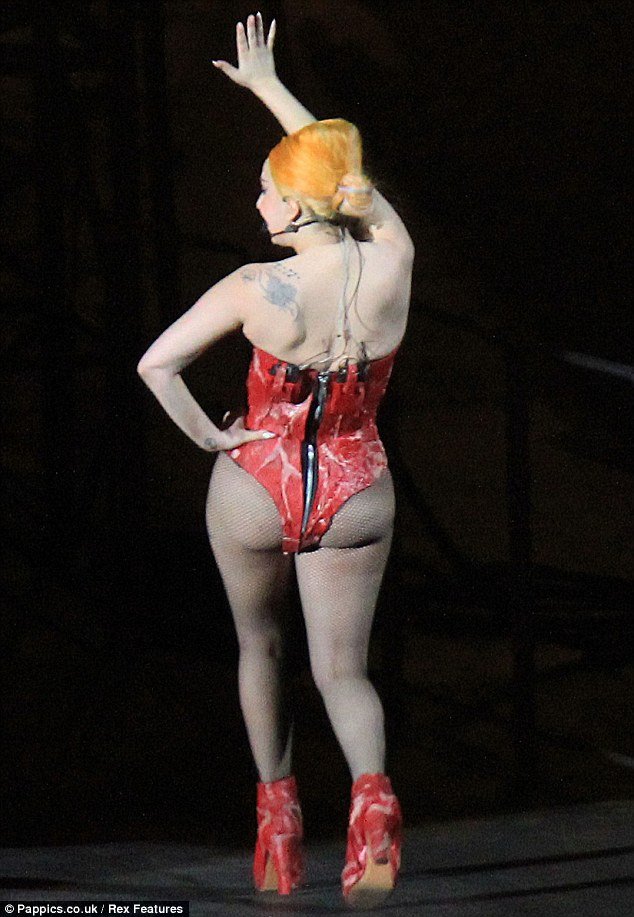
Lady Gaga first caused a stir when she wore a dress made entirely of meat to the MTV Video Music Awards in 2010.
Lady Gaga, 26, has raised the steaks once again by stepping out in a carnivorous creation as she performed in Bucharest, Romania, last night.
Taking to the stage in Piata Constitutiei Square, the singer showed off her voluptuous figure in a skimpy thong style corset, which appeared to be fashioned out of meat.
With matching ankle boots and fishnet tights completing the look, the Born This Way hitmaker showcased a more curvaceous figure than usual as she performed in front of 35,000 fans.
But the food-based fashion item wasn’t the only unusual look the star went for, with Lady Gaga also opting for a bizarre white ram’s head hat and matching futuristic dress at one stage during the gig, before changing into a black gothic-inspired creation.
Lady Gaga has raised the steaks once again by stepping out in a carnivorous creation as she performed in Bucharest, Romania, last night
However, it might have been that her choice of outfit made the New Yorker feel somewhat nauseous
According to onlookers, halfway through the performance, Lady Gaga had to leave the stage to vomit.
Lady Gaga told the crowd: “I went backstage and vomited, and I did not want you to see this… It happens to me sometimes.”
Despite her health ailment, Lady Gaga continued with the show, and at one stage even dragged a delighted young fan and his mother up on to the stage.
The star first wore a meat dress to the MTV Video Music Awards in 2010, before going on to pose in a beefy bikini on the cover of Vogue Hommes Japan.
And despite coming under fire from vegetarian campaigners for her controversial choice of clothing, the star explained her ensemble was aimed to make a statement about human rights.
Lady Gaga told Ellen DeGeneres in an interview: “Well, it is certainly no disrespect to anyone that is vegan or vegetarian.
“As you know, I am the most judgment-free human being on the earth. However, it has many interpretations but for me this evening.
“If we don’t stand up for what we believe in and if we don’t fight for our rights, pretty soon we’re going to have as much rights as the meat on our own bones. And, I am not a piece of meat.”
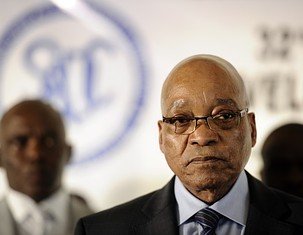
South African President Jacob Zuma has announced an inquiry into violence at Lonmin Marikana platinum mine, calling the deaths there “tragic”.
Thirty-four people were killed when police opened fire on striking platinum miners on Thursday.
At least 78 people were injured in the confrontation.
President Jacob Zuma said he was “saddened and dismayed” at the “shocking” events and offered sincere condolences to all families who had lost loved ones.
He said: “We have to uncover the truth about what happened here. I have decided to institute a commission of inquiry. It will enable us to get to the real cause of the incident and derive the necessary lessons.”
The president said his thoughts were with the families of those who had lost their lives but also with the police “who have to intervene in difficult situations”.
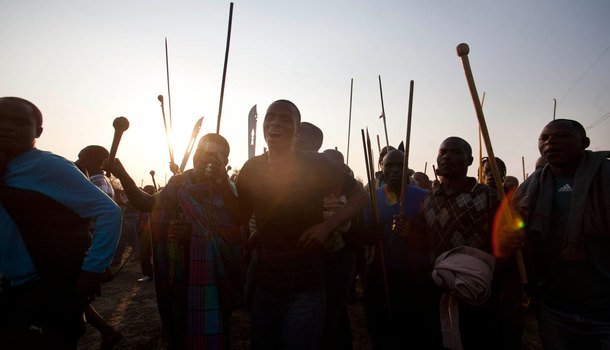
President Jacob Zuma has announced an inquiry into violence at Lonmin Marikana platinum mine, calling the deaths there "tragic"
Jacob Zuma added: “Today is not an occasion for blame, finger-pointing or recrimination. Today challenges us to restore calm and to share the pain of the affected families and communities. Today is about reminding ourselves of our responsibility as citizens.”
The president said it was a “cornerstone of hard-won democracy” to allow for peaceful protests, but added that today was “a day for us to mourn together as a nation – a day to start rebuilding and healing”.
Jacob Zuma had cut short his attendance at a regional summit in Mozambique to deal with the crisis.
He will later visit some of injured being treated in hospital.
Some of the strikers’ wives gathered near the mine on Friday, chanting anti-police songs and demanding to know what had happened to their husbands.
“Police, stop shooting our husbands and sons,” read a banner carried by the women, according to the Associated Press news agency.
A strike at the mine began a week ago and had claimed the lives of 10 people, including two police officers, before the incident on Thursday.
Police were then sent to break up 3,000 miners – some armed with clubs and machetes – who had gathered on a hillside overlooking Marikana to call for a pay rise of about $1,000 a month.
The circumstances that led police to open fire remain unclear, but reports from eyewitnesses suggest the shooting took place after a group of demonstrators rushed at a line of police officers.
Police, armed with automatic rifles and pistols, fired dozens of shots, witnesses said.
Police chief Riah Phiyega said officers “were forced to use maximum force to defend themselves”.
She said 259 people had been arrested on various charges.
The Association of Mineworkers and Construction Union (AMCU) accused the police of carrying out a massacre.
“There was no need whatsoever for these people to be killed like that,” General Secretary Jeffrey Mphahlele told Reuters news agency.
The miners, who are currently earning between 4,000 and 5,000 rand ($484-$605), say they want their salary increased to 12,500 rand ($1,512).
South Africa is the largest platinum producer in the world and the dispute has already affected production.
Lonmin, the world’s third-largest platinum producer, has encountered similar labor disputes at the Marikana mine. In May 2011, the company sacked some 9,000 employees after a strike.
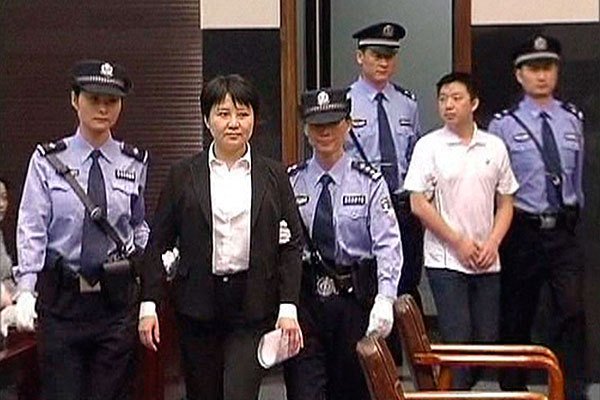
The verdict in the murder trial of Gu Kailai, wife of former politician Bo Xilai, will be delivered on Monday, Chinese officials say.
Gu Kailai was tried for the murder of British businessman Neil Heywood in Hefei city, Anhui province, on 9 August.
A court official told reporters Gu Kailai had not contested allegations that she killed Neil Heywood by poisoning.
Neil Heywood was found dead at a hotel in Chongqing in November 2011.
“On Monday the court will reconvene and announce the verdict and sentence,” Zhang Mingwu, deputy director of the information office of Anhui province, told AFP news.
Gu Kailai was tried for the murder of British businessman Neil Heywood in Hefei city, Anhui province, on 9 August
A court spokeswoman said the verdict was scheduled for 09:00 local time, Reuters news agency reported.
Gu Kailai was tried along with her aide, Zhang Xiaojun, who was described by the court as an accomplice.
The two defendants face a possible death penalty if found guilty.
Analysts say given the reports a guilty verdict appears almost certain, but point to suggestions in state media that Gu Kailai may have been trying to protect her son as signs her case could be treated with a degree of leniency.
The scandal surrounding Ms Gu, herself a prominent lawyer, appears to have ended Bo Xilai’s political career.
Bo Xilai was the Communist party chief in the city of Chongqing but was sacked in March and is currently under investigation for unspecified “disciplinary violations”. He has not been mentioned in Gu Kailai’s case.
The trial and verdict come as China prepares to install a new generation of leaders at a once-in-a-decade congress to be held in the next two or three months.
Seven members of the nine-strong politburo Standing Committee are due to retire.
Bo Xilai was once thought to be a key candidate for promotion to the top leadership, but has not been seen in public since the investigation into his wife was announced.
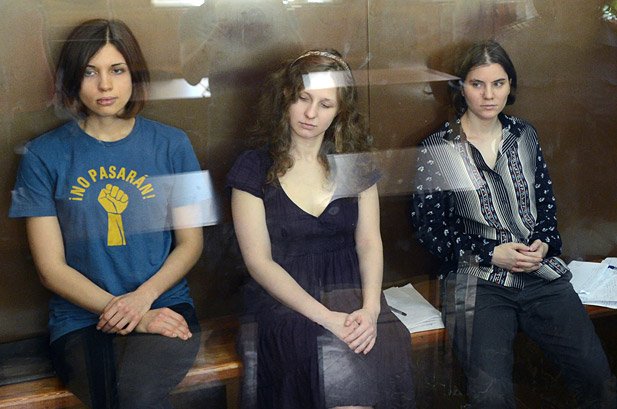
The three members of Russian punk band Pussy Riot accused of hooliganism have been jailed for two years after staging an anti-Vladimir Putin protest in a Moscow cathedral.
Judge Marina Syrova convicted the women of hooliganism motivated by religious hatred, saying they had “crudely undermined social order”.
The women say the protest, in February, was directed at the Russian Orthodox Church leader’s support for Vladimir Putin.
The US, UK and EU all criticized the sentences as “disproportionate”.
Prosecutors had been seeking a three-year jail sentence for the women.
Judge Marina Syrova said Maria Alyokhina, 24, Nadezhda Tolokonnikova, 22, and Yekaterina Samutsevich, 29, had offended the feelings of Orthodox believers and shown a “complete lack of respect”.
“Tolokonnikova, Alyokhina and Samutsevich committed hooliganism – in other words, a grave violation of public order,” Judge Marina Syrova said.
Along with other members of their band, the women staged a flashmob-style performance of their song close to the altar in the cathedral on 21 February.
Judge Marina Syrova convicted Pussy Riot members of hooliganism motivated by religious hatred
Their brief, obscenity-laced performance, which implored the Virgin Mary to “throw Putin out”, enraged the Orthodox Church – its leader Patriarch Kirill said it amounted to blasphemy.
Vladimir Putin was elected for a third term as president two weeks later.
Maria Alyokhina, Nadezhda Tolokonnikova and Yekaterina Samutsevich, watching Friday’s proceedings from inside a glass-walled cage in the courtroom, smiled as the widely predicted conviction was announced.
The judge then took three hours to read the verdict, before handing down “two years deprivation of liberty in a penal colony” for each defendant.
“Considering the nature and degree of the danger posed by what was done, the defendants’ correction is possible only through an actual punishment,” Judge Marina Surova said.
One man in the courtroom shouted “shame” at the sentencing, and there were chants and whistles from the band’s supporters outside.
Nadezdha Tolokonnikova’s husband, Pyotr Verzilov, said: “Russia’s image was quite scary even before [this]. What happened now is a clear sign that Russia is moving towards becoming more like China or North Korea.”
Opposition leader Alexei Navalny added: “They are in jail because it is Putin’s personal revenge. This verdict was written by Vladimir Putin.”
The defendants’ lawyer, Nikolai Polozov, said they would not appeal to President Vladimir Putin for a pardon. However, there will be a legal appeal against the verdict.
Amnesty International said the ruling was a “bitter blow” for freedom of expression in Russia.
EU foreign affairs chief Catherine Ashton and the UK’s Foreign Office criticized the severity of the sentences.
US state department spokeswoman Victoria Nuland said: “We urge Russian authorities to review this case and ensure that the right to freedom of expression is upheld.”
On Thursday, Nadezdha Tolokonnikova had said she was “not bitter about being in jail”. But, speaking through her lawyer on Twitter, she said: “Politically, I am furious.”
“Our imprisonment serves as a clear and unambiguous sign that freedom is being taken away from the entire country,” she said.
The women have been detained for the past five months.
Associated Press news agency said a number of protesters had been arrested outside the court before the sentencing was announced, including ex-world chess champion Garry Kasparov and opposition politician Sergei Udaltsov.
There were also pro-Pussy Riot protests in Paris, where demonstrators in Igor Stravinsky square chanted “Freedom”, and in Kiev, where women protesters sawed down a wooden cross in a central square.
Other shows of support took place in Belgrade, Berlin, Sofia, London, Dublin and Barcelona.
The band has also had vocal support from artists including Paul McCartney and Madonna, and from politicians.
Critics of the band have also been demonstrating, saying the stunt was an insult to the Russian Orthodox Church.
Igor Kim from Moscow said: “Shouting and screaming and spreading hate in Church is unacceptable and is contrary with Christian ethics.”
Valentina Ivanova, a retired doctor, told Reuters: “What they did showed disrespect towards everything, and towards believers first of all.”
One protester outside court in Moscow simply shouted: “Let Pussy Riot and all their supporters burn in hell.”
Medical expert Emily Gibson has spoken out about the various health risks that come with hair removal.
Family physician Emily Gibson, who also serves as a medical director at Western Washington University in Bellingham, said that removing the hair is like creating “open wounds” that are prone to infection and even sexually-transmitted disease, such as herpes, if in contact with another person.
She added that men are at risk of infection just as much as women.
In an article she wrote for KevinMD.com, she explained “that irritation is combined with the warm moist environment” and therefore becomes a breeding ground for infection.
Dr. Emily Gibson pinpointed A streptococcus, which, in extreme cases, can lead to organ failure, and staphylococcus aureus, which can cause pimples and boils as well as far more serious side effects, in particular.
She added that “freshly-shaved areas are also more vulnerable to herpes infections due to the microscopic wounds being exposed to virus”.
Emily Gibson said that she has seen cellulitis, a soft tissue bacterial infection.
“No matter what expensive and complex weapons are used – razor blades, electric shavers, tweezers, waxing, depilatories, electrolysis – hair, like crab grass, always grows back and eventually wins,” Dr. Emily Gibson wrote in the report.
“In the mean time, the skin suffers the effects of the scorched battlefield,” she continued.
The Independent reported that hair removal cost Americans $2.1 billion in 2011.
Despite the health risks, Dr. Emily Gibson noted the practice’s popularity: “The amount of time, energy, money and emotion both genders spend on abolishing hair some areas is astronomical.
“The hair removal industry, including medical professionals who advertise their specialty services to those seeking the <<clean and bare>> look, is exponentially growing.”
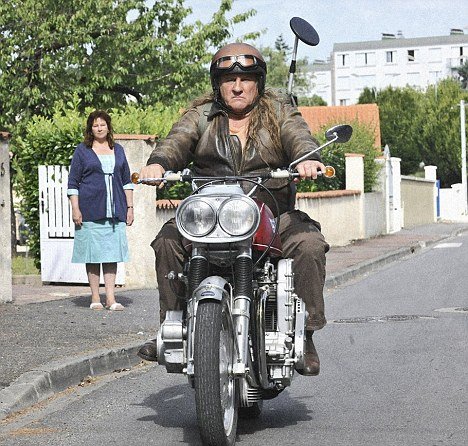
Gerard Depardieu has been accused of assaulting a motorist following a collision in Paris.
Gerard Depardieu, 63, who hit the headlines last year for peeing on a plane, allegedly punched a driver in the face.
The motorist filed a complaint with the local prosecutor’s office on Wednesday accusing Gerard Depardieu of assault and battery following the alleged incident in the capital’s Sixth Arrondissement, near the Saint Sulpice Church.
After Gerard Depardieu’s scooter allegedly collided with the unnamed driver, an argument ensued.
The motorist claims the actor punched him in the face, leaving him injured.
Gerard Depardieu has been accused of assaulting a motorist following a collision in Paris
An official from the prosecutor’s officer said: “There was a confrontation and the driver filed a complaint.”
Last August, Gerard Depardieu was in the headlines again after he was banned from an Air France flight for urinating in the aisle.
The actor was desperate for the toilet as the plane prepared to take off after he was told he would have to wait to use the bathroom.
Gerard Depardieu tried to urinate in a bottle, but it overflowed on to the floor. The flight ended up being delayed two hours while it was cleaned, and the actor was told he could not fly.
Explaining the scenario on CNN last year, he said: “I’m not a monster. I’m just a man who wants to pee.”
The bottle overflowed because, as he explained: “I am an elephant . . . I have a lot of pee.
“I don’t understand why she blocked the door.”
Asked if he was drunk at the time and if there was “any wine involved”, Gerard Depardieu, who co-owns a vineyard, replied: “No.”
A statement released by his companion on the flight, actor Edouard Baer said the actor “offered to clean up the mess”.
Edouard Baer also claimed: “Gerard is very sorry for what happened. He wanted to go to the toilet but he was forbidden because we were about to take off, so he was forced to do it on the plane in front of everybody.
“He has prostate problems and it was very worrying and humiliating for him. He was also stone-cold sober at the time. This is not the way he usually behaves.”
Connor Cruise, Tom Cruise’ son, proudly posted a snap of him and his sister Isabella on his Twitter page last night.
Connor Cruise, who has just followed in his father’s footsteps with his first action film role, captioned the snap simply: “Me and my sister.”
The picture showed Connor Cruise, 17, posing with her arm around Isabella, 19, both teens grinning for the camera.
Isabella Cruise was casually dressed, wearing a slick of lipstick to brighten her look.
Connor Cruise proudly posted a snap of him and his sister Isabella on his Twitter page last night
The aspiring artist has been spotted spending lots of time with boyfriend Eddie Frencher, a fellow Scientologist, recently.
The pair shares a modest apartment in the notorious Skid row district in Downtown Los Angeles and enjoys living a less famous life than her surname demands.
Meanwhile Connor Cruise has embraced the celebrity side of life, DJ-ing at Hollywood parties and now starring in a remake of Eighties teen action film Red Dawn.
He plays Daryl Bates in the movie, a member of armed resistance forces the Wolverines.
Tom Cruise and his ex-wife Nicole Kidman adopted Isabella in 1992, nine years before their separation, and added Connor to their family in 1995.
Since their parent’s divorce Connor and Isabella have remained with their father, being home schooled at his Los Angeles home, and are rarely seen with their mother.
Isabella and Connor are siblings to Suri Cruise, the daughter of recently divorced Tom Cruise and Katie Holmes.
The judge in a patent trial involving Apple and Samsung has said iPhone maker’s lawyer William Lee must be on drugs if he thought she would accept his list of potential witnesses.
William Lee had named 22 people he wanted to rebut testimony given by Samsung’s choice of experts.
“Unless you’re smoking crack you know these witnesses aren’t going to be called” said Judge Lucy Koh.
William Lee replied: “Your honor, I’m not smoking crack. I can promise you that.”
The clash, reported by the Verge news site, took place close to the end of the trial after William Lee presented a 75-page document detailing the witnesses.
The judge in a patent trial involving Apple and Samsung has said iPhone maker's lawyer William Lee must be on drugs if he thought she would accept his list of potential witnesses
The judge had previously made it clear she wanted closing arguments to be presented next week. She has given each side a maximum of 25 hours to make its case.
Of that time Apple has less than four hours of witness testimony remaining on its clock, and William Lee said he honestly believed he could cover all the people he had named within that period.
The move could potentially have made it harder for Samsung’s legal team to prepare.
Samsung called on damages expert Michael Wagner shortly before the exchange, who said Apple had overestimated Samsung’s profit margins.
His evidence was intended to undermine the US firm’s claim that it was owed $2.5 billion in damages.
Under cross examination Michael Wagner acknowledged that his analysis had been based on data provided by Samsung as part of its response to Apple’s patent infringement accusations.
In addition to denying the allegations the South Korean firm is also pursuing its rival for royalty payments.
Judge Lucy Koh’s outburst is not the first time she has expressed anger at the two sides’ behavior in the case.
Earlier the judge chided Samsung’s lawyer John Quinn for approving a press release which publicized evidence she had ruled inadmissible in court.
She had also demanded each legal team write out their legal arguments after they wrangled over whether a witness should be allowed to present certain evidence, saying: “I don’t trust what any lawyer tells me in this courtroom. I want to see actual papers.”
Despite the potential large payouts involved in the case the firms’ share prices do not appear to have suffered.
Apple’s stock has closed at a record high of $636.34 after rising 6.9% since the start of the trial.
Samsung’s shares have gained 5.5% over the same period.
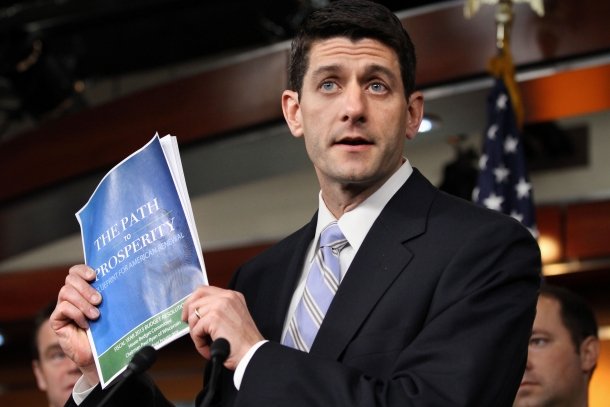
Republican VP candidate Paul Ryan acknowledged lobbying the government for millions of dollars in economic stimulus money after twice denying he had done so.
Wisconsin congressman Paul Ryan said he had forgotten that his office sent letters – with his signature – to the Energy and Labor departments asking for money from the stimulus program on behalf of two companies in his home state.
“They should have been handled differently, and I take responsibility for that,” Paul Ryan said in a written statement released only after he again denied requesting stimulus funds in an Ohio TV interview on Thursday.
Paul Ryan’s denial in an interview with Cincinnati’s WCPO-TV contradicted letters he wrote in 2009 to Energy Secretary Steven Chu and Labor Secretary Hilda Solis seeking stimulus grant money for two Wisconsin energy conservation companies.
One of them, the nonprofit Wisconsin Energy Conservation Corp., later received $20.3 million from the Energy Department to help homes and businesses improve energy efficiency, according to federal records.
Republican VP candidate Paul Ryan acknowledged lobbying the government for millions of dollars in economic stimulus money after twice denying he had done so
“After having these letters called to my attention I checked into them, and they were treated as constituent service requests in the same way matters involving Social Security or Veterans Affairs are handled,” Paul Ryan said in a statement late Thursday.
“This is why I didn’t recall the letters earlier.”
Paul Ryan’s denial came as new audio surfaced of Ryan telling Boston’s WBZ Radio two years ago that he “did not ask for stimulus money” in response to a caller’s question about the recovery program.
He said: “I’m not one who votes for something and then writes to the government to ask them to send us money.”
The exchange was first reported Thursday by The Boston Globe.
But a year earlier in his request to Steven Chu for funds for the Wisconsin Energy Conservation Corp. Paul Ryan said the stimulus cash would help his state create thousands of new jobs, save energy and reduce greenhouse gas emissions.
The apparent contradiction underscores Paul Ryan’s conflicts with his larger federal budget proposal as the House Budget Committee chairman.
That plan would slash Energy Department programs aimed at creating green jobs and calls for “getting Washington out of the business of picking winners and losers in the economy – and that includes our energy sector”.
Paul Ryan’s actions in Congress have been drawing fresh scrutiny since he was named last weekend as Republican presidential candidate Mitt Romney’s running mate.
The vice presidential contender is not alone among Republicans who criticized the stimulus plan only to seek money later.
Georgia’s Republican senators, Saxby Chambliss and Johnny Isakson, for example, blasted the bill as a bloated government giveaway yet asked then-Defense Secretary Robert Gates to steer $50 million in stimulus money to a constituent’s bio-energy project.
Paul Ryan’s views are also consistent with Romney’s long-held position that the stimulus was a flawed idea that did not create private sector jobs.
“That stimulus didn’t work,” Mitt Romney said at an Ohio speech in June.
“That stimulus didn’t put more private-sector people to work.”
Yet in Ryan’s letter to the Labor Department in October 2009, he backed the Energy Center of Wisconsin’s grant application for stimulus money “to develop an industry-driven training and placement agenda that intends to place 1,000 workers in green jobs”.
The company did not win the Labor Department grant, federal records show.
Despite the letter, Paul Ryan echoed Mitt Romney’s position on Thursday.
“Regardless, it’s clear that the Obama stimulus did nothing to stimulate the economy, and now the president is asking to do it all over again,” he said.
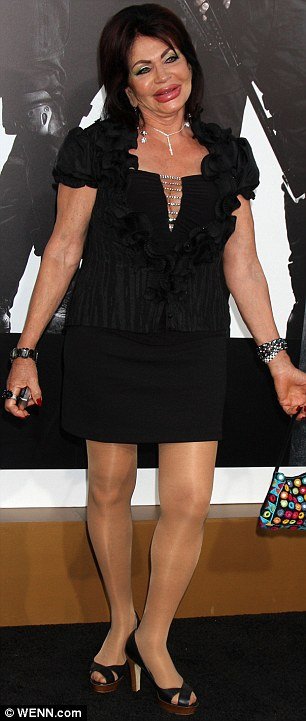
Jackie Stallone, Sylvester Stallone’s 90-year-old mother, showed off her inflated lips last night at the Los Angeles premiere of The Expendables 2.
The astrologer, along with her indefatigable pout, joined her son Sylvester Stallone, 66, at the Los Angeles premiere of his latest action movie.
Jackie Stallone’s famously crooked grin, which her son has also inherited, appeared bigger than ever as she posed for photographs on the red carpet at the Grauman’s Chinese Theatre.
Apparently her quest not to grow old gracefully has continued in earnest – and she appears to have had a fresh bout of collagen injections.
Jackie Stallone, Sylvester Stallone’s 90-year-old mother, showed off her inflated lips last night at the Los Angeles premiere of The Expendables 2
Three-times-married Jackie Stallone, whose maiden name is Labofish, was dressed in an outfit you wouldn’t catch your average 90-year-old grandmother in: it consisted of a short black skirt and plunging blouse, strung together by jewelled strips.
Jackie Stallone completed her look with platform heels – adding some height to her diminutive stature – and wore green contact lenses, heavy eye make-up, including thick painted-on brows.
She attended the event to support her son Sly, who was promoting his movie in Hollywood following the London premiere earlier this week.
Last night Sylvester Stallone opened up to Jay Leno in an interview recorded earlier in the day, talking about the recent loss of his son Sage, who died aged 36 last month from an apparent drug overdose.
Sly told Leno: “When life hits you pretty hard you can go into a dark corner, or you can say, <<Ok, fine,’ I’m going to find something to focus on, children, your wife, be supportive to other people too>>.
“Because I know a lot of people go through [losing a child], and they don’t get the attention that I do.
“And I feel for them, because it’s one club that no one wants to be a member of, that’s for sure.
“But I think about his memory, he was a lovely boy and I’ll always treasure that.”
Last night’s Hollywood premiere was perhaps the hardest leg so far for Sylvester Stallone, as it means returning to the city where Sage died.
Indeed, from Hollywood Boulevard where Sylvester Stallone surveyed thousands of fans tonight, it’s just a small drive to the Studio City house where his son died alone.
Sylvester Stallone was also joined by wife Jennifer Flavin last night and their three daughters, Scarlet, Sophia and Sistine.
At least 30 people have been killed after South African police clashed with striking miners at Lonmin Marikana mine on Thursday, the police minister has said.
According to witnesses, police opened fire on strikers armed mostly with clubs and machetes.
The Lonmin-owned platinum mine has been at the centre of a violent pay dispute, exacerbated by tensions between two rival trade unions.
Violence during the strike had already killed 10 people.
Speaking to local radio, police minister Nathi Mthethwa confirmed the death toll, adding: “A lot of people were injured and the number keeps on going up.”
At least 30 people have been killed after South African police clashed with striking miners at Lonmin Marikana mine on Thursday
The incident is one of the bloodiest police operations since the end of the apartheid in South Africa.
Police were sent to intervene after several thousand miners gathered at Marikana, which lies about 100 km (62 miles) north-west of Johannesburg, to call for a pay rise of more than $1,000 a month.
The circumstances that led police to open fire remain unclear, but reports from eyewitnesses suggest the shooting took place after a group of demonstrators rushed at a line of police officers.
One witness, Molaole Montsho, of the South African news agency Sapa, said police had first used water cannon, tear gas and stun grenades in an attempt to break up the protest.
“And then in the commotion – we were about 800 m (2,600 ft) from the scene – we heard gunshots that lasted for about two minutes,” he said.
Police ministry spokesman Zweli Mnisi said an investigation into the incident had begun.
Speaking on Thursday, President Jacob Zuma said he was “shocked and dismayed at this senseless violence”.
“We call upon the labor movement and business to work with government to arrest the situation before it deteriorates any further,” he said.
“I have instructed law enforcement agencies to do everything possible to bring the situation under control and to bring the perpetrators of violence to book.”
Scientists say they are a step closer in the difficult journey towards developing a male contraceptive pill, after successful studies in mice.
A contraceptive pill for women has been around for decades, but an equivalent for men has proved elusive.
A US study, published in the journal Cell, showed a drug could make mice temporarily infertile without hampering their sex drive.
Experts said the findings were “exciting”, but needed tests in people.
It has been argued that the lack of a male contraceptive pill has contributed to the number of unplanned pregnancies.
One of the challenges is developing a drug which can cross over from the blood into the testes.
Scientists say they are a step closer in the difficult journey towards developing a male contraceptive pill, after successful studies in mice
US researchers at the Dana-Farber Cancer Institute and Baylor College of Medicine were testing a drug called JQ1. It targets a protein which exists only in the testes and is critical for sperm production.
The testes of mice taking the drug began to shrink as they produced fewer sperm, which were also less mobile. Some were rendered infertile.
When the animals were no longer taking the drug they were able to have babies.
One of the researchers, Dr. James Bradner said: “This compound produces a rapid and reversible decrease in sperm count and motility with profound effects on fertility.
“These findings suggest that a reversible, oral male contraceptive may be possible.”
Researchers hope to be able to target the same protein in men, however, more tests will be needed to show whether the drug is both safe and effective in people.
Prof. Moira O’Bryan, the head of male infertility at Monash University in Australia, said: “This is an exciting report that could have major scientific and social impacts.”
She added: “The strong similarity between sperm production in the mouse and the human suggest that a variation of JQ1 may ultimately result in a human contraceptive.
“Although there is undoubtedly an urgent need for additional contraceptive options, the path between this paper and a new product is likely to be long.”
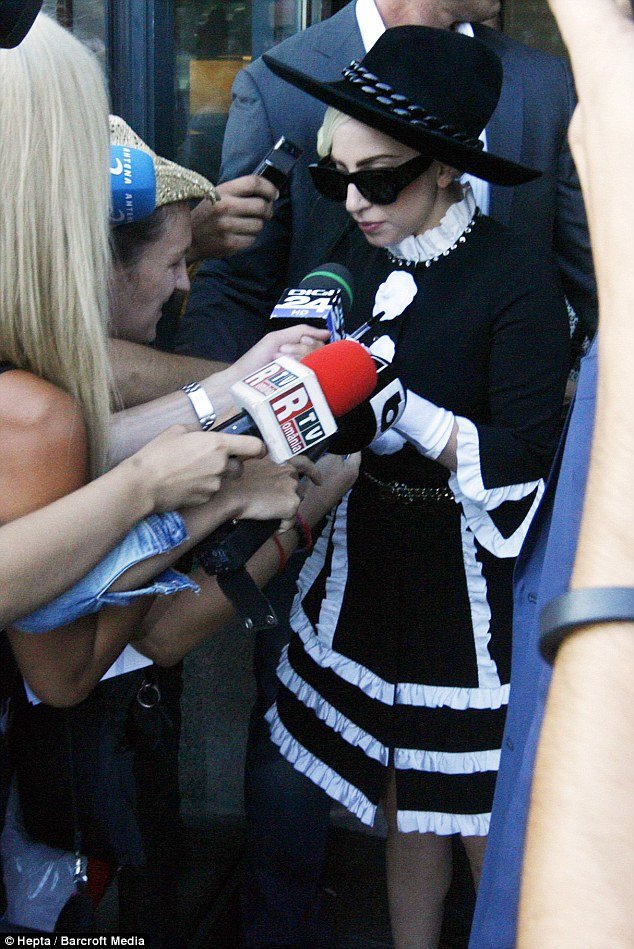
Lady Gaga dressed extremely conservatively in a monochrome ensemble as she stepped out in Bucharest, Romania, yesterday.
Lady Gaga, 26, looked relatively smart compared to her usual standards as she left her hotel to attend her concert.
She hid her face behind a pair of large black sunglasses and covered her head with a matching big fedora.
Her black dress was highlighted by three white ruffled flowers in place of buttons, and lining around the edges of the outfit.
Despite her less than exciting attire, her fans were still keen to see her as they lined the street waiting for a glimpse of their idol.
Once Lady Gaga left the safety of her hotel she was surrounded by screaming crowds as she signed autographs and answered questions from the press.
Lady Gaga dressed extremely conservatively in a monochrome ensemble as she stepped out in Bucharest, Romania
The singer tweeted: “SO EXCITED to be in Romania performing at an outdoor stadium tonight ! thank you so much for all the love from downstairs, i could hear u!”
Unfortunately one fan was brutally pinned to the floor after bodyguards thought he was getting too close to the star.
Today the busy singer announced she is releasing new track, Partynauseous, next month.
The song is a collaboration between the Born This Way hitmaker and rap star Kendrick Lamar.
Lady Gaga tweeted: “I am so excited to announce that a record I’ve been working on has now become a collaboration with Kendrick Lamar for HIS ALBUM. (sic)
“Kendrick Lamar and I are dropping the record September 6. It’s called <<Partynauseous>>.”
Lady Gaga explained her part of the song is based on an incident earlier this year, when she was banned from performing in Jakarta, Indonesia, on her Born This Way Ball tour after hardline extremists in the Muslim country complained her sexy clothes and dance routines would corrupt young people.
She added: “I wrote <<PARTYNAUSEOUS>> about Jakarta, and my relationship with that country (sic). Wishing I could <<get high with the enemy>> and make peace (sic). Once @kendricklamar + I started talking about life + his forward thinking views about love + hip hop, the song became something more (sic).”
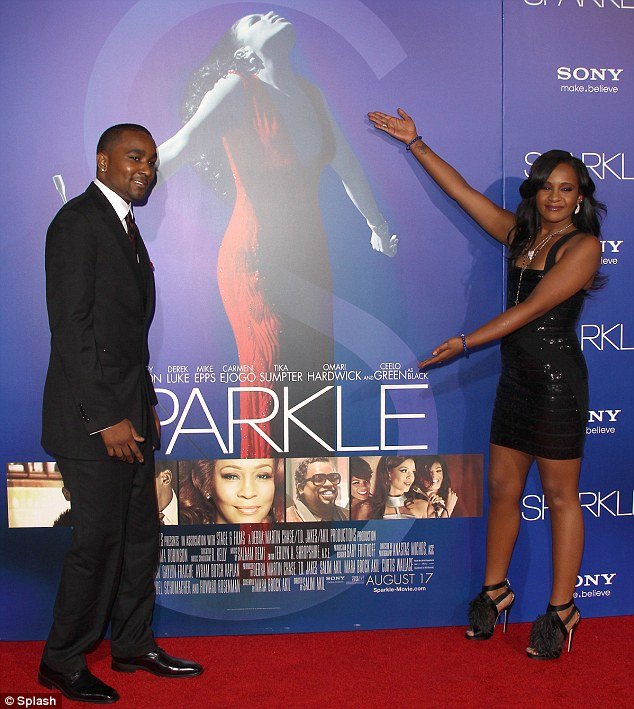
Bobbi Kristina Brown and Nick Gordon took Whitney Houston’s place at the premiere on Sparkle last night.
And it was as boyfriend and girlfriend that the pair walked the red carpet, following their coming out as a couple in the months since their mother’s death.
Bobbi Kristina Brown, 19, showed her curves in a clinging bandage dress, teamed with feathered stilettos. Her flawless red carpet look was completed by her mother’s diamond ring on her hand.
Nick Gordon, 22, wore a sharp black suit, teamed with a diamond stud in his ear and a red handkerchief.
He escorted his “sister” down the red carpet.
Bobbi Kristina Brown and Nick Gordon took Whitney Houston’s place at the premiere on Sparkle last night
Bobbi Kristina Brown and Nick Gordon lived together as brother and sister for more than a decade before their mother’s death. Whitney Houston took Nick Gordon into her home at the age of 12 when his father went to prison and his mother was unable to take care of him.
Nick Gordon was Whitney’s unofficially adopted son, and she treated him like family up until her death at the age of 48 due to an accidental drowning complicated by heart disease and cocaine use.
Whitney Houston, a prestigious six-time Grammy award winning singer, was found dead in a Beverly Hills hotel room on February 11, 2012.
Nick Gordon first fueled rumors about their relationship status in a tweet written in March, exclaiming: “Yea we got a little closer and what!!!”
The controversial couple have reportedly been sharing her $1.2 million Atlanta home together ever since.
“No matter what…This connection between us will #STAYSTRONG 4EVER! We will love & miss u 4ever lady:),” Bobbi Kristina Brown wrote this week, adding, “& still through those trials & tribulations the devil kept on trying to break them & soon realized…He couldn’t”.
By the age of 30 Bobbi Kristina Brown will have inherited everything that belonged to her iconic mother – mansions, jewellery, cars, and an extraordinary fortune.
She recently did a guest stint on Tyler Perry’s sitcom For Better Or Worse.
Bobbi Kristina Brown is currently filming her blooming love for Nick Gordon on her upcoming reality show, The Houston Family Chronicles, which is set to premiere on Lifetime next month.
Whitney Houston stars as Emma, the mother of Sparkle Anderson, played by Jordin Sparks, and her two sisters who are trying to make it as a motown girlband in the remake of the 1976 movie-musical.
The darker aspects of the story reminded Whitney Houston of her own troubled life, according to Carmen Ejog, who plays troubled Tammy “Sister” Anderson.
“Sister really takes like a crazy journey and Whitney was very aware of that story line being very parallel to her own, and I think it’s to her credit that she was excited to bring a message that was as dark as it was light, and was not scared of doing that,” Carmen Ejog told MTV News.
“If she was here right now she’d be talking about those parallels without any shame and with the sense of giving to us as an audience, as like the receiving of this movie and this story.
“When you get to that level you could just be guarded and just keep so many things to yourself and she just wasn’t that person.
“<<Learn from me, learn from this cautionary tale>>, is literally what she says in the movie, and that’s amazing.”
Also at last night’s premiere was Whitney Houston’s grieving mother Cissy and her boyfriend Ray J, who she was dating at the time of her death.
Blogger Renee DiResta got some surprising and less surprising results as part of a research into stereotypes found on Google.
Renee DiResta hit on a clever idea to find out what people think about different U.S. states.
She began typing the names into Google and used the search engine’s autocomplete function to complete the query.
So, for example, she asked “why is Georgia so” and Google’s algorithm, which tries to predict the next word based on popular searches, did the rest.
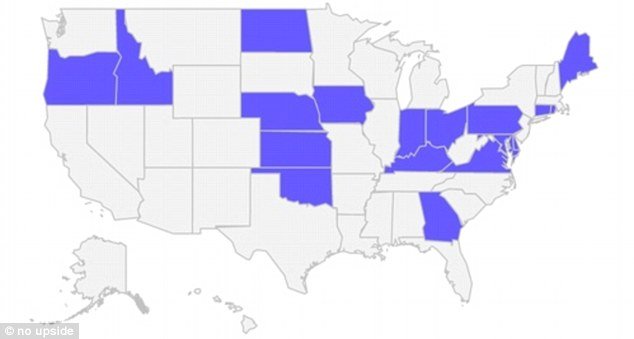
The result showed what people ask most about a state. In Indiana’s case they want to know why it’s so “boring”, and the same with Maine.
Georgia is “hot”, “racist”, and also “boring”. Oregon is “liberal”, “weird”, “rainy”, and again, “boring”. Ohio is also “boring”, but “important in the primaries”.
When Renee DiResta used the formula of “Why is Arizona so …?” the terms that popped up included “hot”, “racist”, “conservative” and “crazy”.
West Virginia also didn’t come out well, the top suggested search terms included “poor”, “racist”, “fat” and “weird”.
According to recently released Gallup research, West Virgina was ranked the least livable state based on low unemployment, appalling obesity rates and lack of economic growth.
For 18 states, the common search term associated with them was “boring”. Among those considered snoozeworthy included Idaho, Montana.
For 18 states, the common search term Google autocomplete revealed as being associated with them was “boring”
But Google wasn’t all negative.
When the state of Colorado was searched, autocomplete terms that appeared were: “cold”, “healthy”, “skinny” and “awesome”.
Venture capitalist Renee DiResta, a recent New York transplant to San Francisco, said in her blog about the experiment: “I started wondering, how do Americans really think about <<those people>> in other states? What are the most common stereotypes?”
“The qualitative searches were most interesting to me. There are 12 unique terms that are classifiable as <<culture/sentiment>> queries, of which ten are negative: backwards, bad, boring, crazy, dangerous, hated, racist, stupid, trashy, weird.
“There were a few redeeming positive results; Colorado, Minnesota, Texas, and Vermont are <<awesome>>, and Montana, New Hampshire, and New York are <<great>>.
“But for the most part, it doesn’t seem like we think very nice things about each other… at the very least, we’re more inclined to search for articles supporting (or related to) negative biases.
“The single most common result of all was <<boring>>, which appeared for 18 states with no particular regional concentration. Other popular terms (returned for >10 states) were <<humid>>, <<windy>>, <<expensive>>, and <<liberal>>.
“Strangely, Connecticut and Pennsylvania both returned <<haunted>>; apparently there are a lot of ghost sightings (and related walking tours).
“My favorite result of all was <<enchanting>>: New Mexico is beautiful.”
WHAT IS GOOGLE AUTOCOMPLETE?
When a user types a word into the Google search box, the autocomplete algorithm offers search terms based on what is entered.
For example, if someone starts to type “new york”, autocomplete will offer searches for “New York City”, “New York Times”, and “New York University” based on the first word.
Queries are algorithmically determined based on a number of purely algorithmic factors (including popularity of search terms) without human intervention.
Facebook’s stock plunged to an all-time low today as the market braced for the company’s insiders to dump their stock after the expiration of a lock-up period.
Investors ranging from Accel Partners to Goldman Sachs, Zynga CEO Mark Pincus and Facebook board members James Breyer, Peter Thiel and Reid Hoffman are among those free to sell stock they own now.
By 10:30 a.m., the price was down 7% to $19.69 a share. By noon, it had climbed back to $19.95 a share. In May, the initial public offering of the stock was $38.
If the stock hits $19, it will have lost half its value since Facebook went public in May.
Before noon, the company lost $4 billion in market value, due to the plunging prices.
Facebook's stock plunged to an all-time low today as the market braced for the company's insiders to dump their stock after the expiration of a lock-up period
Mark Zuckerberg himself lost an estimated $1 billion Thursday morning alone.
It’s not yet known whether anyone had sold shares. The stock price decline could reflect investors’ anticipation of such a move.
More than 270 million shares have been unlocked – more than one-half of the 421 million shares sold in the May initial public offering of the social networking company.
Roughly 64 million shares of Facebook traded hands in the first hour of trading, more than double its 50-day daily average of just under 30 million shares.
“Pressure will be back on the shares now that liquidity is back in the market,” said Frank Davis, director of sales and trading at LEK Securities in New York.
“If (the value of) your holdings has been cut in half, are you going to sit around and risk the rest of that?”
It’s conceivable no one would sell those extra shares, but if too many do, Facebook’s stock would decline even more because the market would be flooded with additional shares.
It’s been a rough run for Facebook. After one of the most-anticipated IPOs in history, Facebook suffered what may be the most-botched public offering as trading glitches marred its first day.
Facebook, the world’s No. 1 Internet social network with 955 million users, has seen its shares pummeled since the market debut in May that put its value at more than $100 billion.
Investors have been concerned about Facebook’s ability to keep increasing revenue and make money from its growing mobile audience, even as many analysts hold positive long-term views.
Those eligible to sell additional shares Thursday were the investors and directors who had participated in the May IPO. The exception was CEO Mark Zuckerberg, who will be ineligible until November.
Other shareholders, including many Facebook employees, will be able to sell beginning in October. The last lockup period expires next May, a year after the IPO.
In all, up to 1.91 billion more shares could flood the stock market over the next several months – more than four times the 421 million shares that have been trading since Facebook’s IPO. Of the 1.91 billion, 271 million shares became eligible for sale Thursday.
What are lock-ups?
Lock-ups prevent company insiders from selling their shares in a newly-floated firm.
They usually start to expire 90 days from the initial public offering (IPO).
They are designed to prevent the share price from fluctuating wildly if too many investors decide to sell their shares all at once.
The lockup expired for initial investors on Thursday. It expires for Facebook employees in October.
CEO Mark Zuckerberg must keep his shares until November.
The United Nations has decided to end its military observer mission in Syria, days before its mandate expired.
A small, civilian office will be set up instead to maintain political contacts.
“The conditions to continue UNSMIS were not filled,” France’s UN ambassador Gerard Araud said after a Security Council meeting.
The United Nations has decided to end its military observer mission in Syria, days before its mandate expired
The UN mission had been part of envoy Kofi Annan’s six-point peace plan. But continued violence made the observers’ mission increasingly difficult.
A bomb exploded close to their hotel in Damascus on Wednesday. The observers’ patrols were suspended in mid-June because of the “significant risk to their lives” and diplomats said the condition for renewing their mandate – a reduction in violence – had not been met.
Russia warned earlier that pulling out of Syria would have “serious negative consequences” for the region.
Moscow’s UN envoy Vitaly Churkin said Russia, which has vetoed three UN Security Council resolutions on Syria, wanted the UN to make an international appeal for the Syrian conflict to end.
Kofi Annan resigned as UN-Arab League envoy to Syria a fortnight ago, complaining of a “clear lack of unity” in the Security Council.
Although the 101 remaining military observers will leave Damascus over the next eight days, a civilian liaison office is due to remain and a new special envoy is expected to be appointed.
Vitaly Churkin said Russia had called for a meeting on Friday of Security Council members as well as representatives from Saudi Arabia and Iran to discuss the crisis.
Police in South Africa have opened fire during clashes with striking workers at Lonmin platinum mine in Marikana, leaving at least seven people dead, witnesses say.
South African media reports put the death toll at 12 or even higher.
Police opened fire after miners carrying machetes defied an ultimatum to disarm, reports from the scene say.
The mine has been at the centre of a violent industrial dispute exacerbated by inter-union tensions.
Police in South Africa have opened fire during clashes with striking workers at Lonmin platinum mine in Marikana, leaving at least seven people dead
Ten people had previously died as a result of clashes since last Friday.
The striking miners had gathered on a rocky hill near Marikana, the third-largest platinum mine in the world.
Some union leaders and police had tried in vain to disperse the crowd, some of whom said they were prepared to die on the hill.
During the clashes, missiles – thought to be either petrol bombs or grenades – were thrown at police, who responded by opening fire, eyewitnesses said.
“There are bodies on the ground; I saw one with a bullet wound on the forehead,” said one eyewitness.
The recent violence was initially thought to have been triggered by a turf war between the long-established National Union of Mineworkers (NUM) and the newly-formed Association of Mineworkers and Construction Union (AMCU), which is more militant.
However, the AMCU has since demanded a pay rise of 12,000 rand ($1,500) per month.
Lonmin said in a statement on Thursday that the strike was illegal and that any striking workers who did not return to work by Friday would be sacked.
The company said it had missed six days of production as a result of the unrest, and estimated it would lose around 2% of its normal yearly output of saleable platinum. Lonmin’ share price dropped by more than 6% on Thursday on the London Stock Exchange.
The violence has shocked South Africans, with many finding the scenes reminiscent of how the apartheid regime dealt with protests.
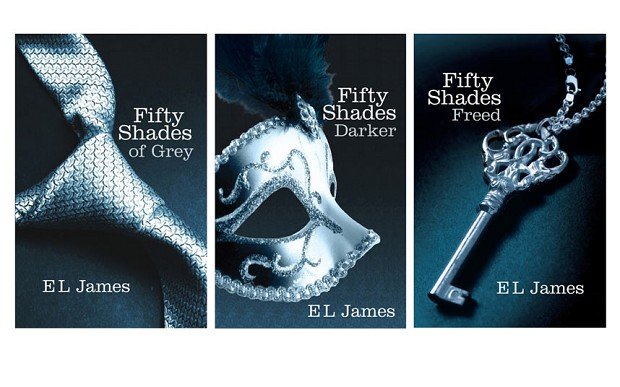
Rumors of an official merchandising deal for a Fifty Shades brand surfaced months ago, and this week TMZ claimed that Fifty Shades-themed lingerie, sleepwear and clothing will be coming to a store near you very soon.
Three separate companies have confirmed licensing deals with author E.L James to sell the first-ever official Fifty Shades branded apparel line: A company called HYP will be selling hosiery, garters, and tights; FREEZE Clothing will be selling the knits, tees, and hoodies and Briefly Stated will sell daywear, loungewear, sleepwear and underwear.
TMZ claimed that Fifty Shades-themed lingerie, sleepwear and clothing will be coming to a store near you very soon
E.L. James – who earns almost $1.5 million a week from the erotic books – signed a deal with independent agency Caroline Mickler earlier this summer, giving Mickler the responsibility for building the brand worldwide.
Caroline Mickler told fashion blog fashionista.com: “The market’s interest in Fifty Shades of Grey as a brand is enormous.
“With continuing book sales and a film version keeping awareness high, we expect this property to make a very strong showing in a number of licensed categories over the coming months.”
A Facebook poll today put Batman star Christan Bale as favourite to play billionaire Christian Grey in the movie of the book ahead of Robert Pattinson and Magic Mike star Matt Bomer who has been the favorite for the role since Universal Pictures acquired the rights.
The first pictures of the flex cable components for Apple’s iPad Mini and iPhone 5 incorporating the new smaller dock connector have emerged.
The photograph, shared by French tech website nowhereelse.fr, shows two components, one of which is said to be similar to another apparently leaked picture of a part of the new iPhone.
As well as the new dock connector, the part also seems to take in the headphone jack and the home button connector for the hotly awaited devices.
In an attempt to ascertain the credibility of the leak, the French website asked Kyle Wiens of iFixit to give his opinion on the picture’s authenticity.
He confirmed that the component is indeed consistent with other Apple parts, but added that he wasn’t 100% certain that it was authentic.
The first pictures of the flex cable components for Apple's iPad Mini and iPhone 5 incorporating the new smaller dock connector have emerged
One detail that has troubled Apple observers is that the headphone jack on the pictured component is located directly next to the dock connector.
Macrumours.com points out that so far case leaks, design drawings and physical mockups of Apple’s forthcoming devices have all so far suggested the headphone jack on the iPad Mini will by found along the top edge – as it is on the full-size iPad.
There was a public outcry when it was revealed that the next iPhone would get a new docking port connector.
The newer, slimline port means that thousands of current Apple accessories will need a potentially clunky adapter to work with the “iPhone 5” – or their devices will become unusable.
Leaks from the website iMore, which has strong sources “close to Apple”, earlier this month suggested the entire next generation of iDevices, including the iPod Nano, iPod Touch, iPad Mini and future versions of the iPad, will use the new port.
The site believes a special connector will be released to connect older accessories – such as docking stations and speakers – to newer versions of the range.
Many fans were left angry after images allegedly showing the iPhone 5’s new design leaked out, showing the traditional 30-pin dock connector – used for charging, syncing files and pumping audio to hi-fis – had been re-designed into a smaller shape.
The new port looks similar to micro USB, the standard supported by all other phone manufacturers – however it is very unlikely that Apple will support this standard, despite moves by the EU to get all phone companies to rally around one type of cable.
Apple’s version has a triangle-shaped wedge at one end, which should stop users plugging in the cable the wrong way round.
Mac fans may spot a superficial similarity to a Firewire port, which is used to transfer raw video footage and larger files at high speed.
The new port means older accessories will be rendered redundant unless adapters are released to make them compatible again – which is likely to be an ungainly solution, and may be impossible for some docks.
The “nano-SIM” slot, containing the SIM card which connects a phone to the carrier network, has also been redesigned to be thinner, although this will be unlikely to cause much disruption to users as networks will provide replacements SIMs if necessary.
There are also rumors, reported on iMore, that the iPad 3, which was released in the Spring, will get a slight tweak this Autumn to brink the dock connector in-line with the rest of the range.
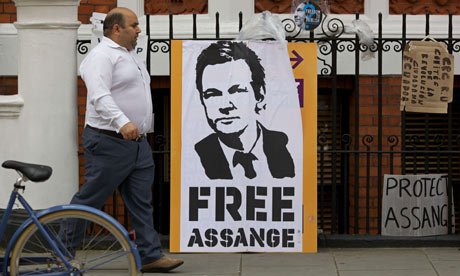
Ecuador has granted asylum to WikiLeaks founder Julian Assange two months after he took refuge in country’s London embassy while fighting extradition from the UK.
It said there were fears Julian Assange’s human rights might be violated.
Ecuadorian foreign minister Ricardo Patino accused the UK of making an “open threat” to enter its embassy to arrest him.
Julian Assange took refuge at the embassy in June to avoid extradition to Sweden, where he faces questioning over assault and rape claims, which he denies.
The Foreign Office said the decision on Julian Assange’s application for political asylum would not affect the UK’s legal obligation to extradite him to Sweden.
It tweeted: “We remain committed to a negotiated solution that allows us to carry out our obligations under the Extradition Act.”
Ecuador has granted asylum to WikiLeaks founder Julian Assange two months after he took refuge in country’s London embassy
The UK government will still seek to arrest him and it will not grant him safe passage. If he steps out, he will be arrested.
Announcing Ecuador’s decision, Ricardo Patino said the country believed Julian Assange’s fears of political persecution were “legitimate”.
He said the country was being loyal to its tradition of protecting those who were vulnerable.
“We trust that our friendship with the United Kingdom will remain intact,” he added.
The announcement was watched live by Julian Assange and embassy staff in a link to a press conference from Quito.
Outside Ecuador’s embassy in London, news was slowly spreading through Julian Assange’s assembled supporters and they were delighted.
“The political temperature has risen very significantly. It is clear this is only the beginning of a very long legal contest,” he said.
There was now a “complete standoff” between the UK and Ecuador regarding the status of the embassy in London.
The British government now had to make a decision, adding that the risks were enormous – including making other embassies around the world vulnerable.
Julian Assange entered the embassy after the UK’s Supreme Court dismissed the Australian national’s bid to reopen his appeal against extradition and gave him a two-week grace period before extradition proceedings could start.
It was during that fortnight, while on bail, that he sought refuge.
A subsequent offer by Ecuador to allow Swedish investigators to interview Julian Assange inside the embassy was rejected.
The WikiLeaks website Julian Assange founded published a mass of leaked diplomatic cables that embarrassed several governments, particularly the US’s, in 2010.
Earlier, the UK Foreign Office warned it could lift the embassy’s diplomatic status to fulfill a “legal obligation” to extradite the 41-year-old by using the Diplomatic and Consular Premises Act 1987.
That allows the UK to revoke the diplomatic status of an embassy on UK soil, which would potentially allow police to enter the building to arrest Julian Assange for breaching the terms of his bail.
Julian Assange says he fears that if extradited to Sweden, he will then be passed on to the American authorities.
In 2010, two female ex-WikiLeaks volunteers accused Julian Assange, an Australian citizen, of committing sexual offences against them while he was in Stockholm to give a lecture.
Julian Assange claims the sex was consensual and the allegations are politically motivated.
In the upcoming interview with Oprah Winfrey, Rihanna opens up about her relationship with Chris Brown.
And what Rihanna has to say about her ex-boyfriend, who was convicted of assaulting her three years ago, in the prerecorded interview will come as a surprise to some.
Rihanna, 24, tells Oprah Winfrey: “I felt like the only person they hate right now is him. It was a weird, confusing space to be in.
“Because as angry as I was – as angry and hurt and betrayed – I just felt like he made that mistake because he needed help. And who’s going to help him? Nobody’s going to say he needs help, everybody’s going to say he’s a monster, without looking at the source. And I was more concerned about him.”
Previously released preview clips of the upcoming TV special Oprah: The Next Chapter, showed Rihanna describe the fall-out from the horrific night after a pre-Grammy party.
She said: “It was embarrassing it was humiliating… I lost my best friend.”
In the upcoming interview with Oprah Winfrey, Rihanna opens up about her relationship with Chris Brown
Oprah Winfrey is then seen asking series of probing questions concerning Rihanna’s past and present relationship with Chris Brown, including: “Do you think Chris Brown is a true love for you?” and “Where does your relationship stand today?”.
While producers saved Rihanna’s answers for the actual episode, her replies managed to shock the talk show queen.
Oprah Winfrey exclaims: “I would have never thought that. You just shocked me.”
In one of the promos ahead of the episode, Oprah Winfrey, 58, reveals she had a pre-conceived idea of what to expect when she travelled to the singer’s home country of Barbados.
During the documentary, which was filmed on August 5, Rihanna went back to her childhood home in the island capital Bridgetown.
Speaking to camera in the preview, Oprah Winfrey said: “I went there with my own ideas about who she was from watching her videos and listening to her music.
“I thought she was gonna be kind of a bada**, a kind of hard edged, rocker, pop woman. Nothing could have been farther from the truth.”
Over clips of the interview and footage of Rihanna driving Oprah to visit her old neighborhood, Oprah Winfrey said: “She was thoughtful… She was very emotional… She was vulnerable.”
In brief segments from the one-to-one on the sofa, Rihanna admitted: “I am super duper terrified of the pedestal that comes with fame…
“It’s amazing how lonely you can feel.”
As well as crying, Rihanna also burst into laughter when Oprah Winfrey commented on her frequent use of the F-word.
Oprah also praised Rihanna for her skills behind the wheel: “First of all I’m surprised by what a good driver she is.”
Visiting her former home, Rihanna appears down-to-earth and humble as she chats to her old neighbors and embraces local children.
Teasing viewers to watch the interview, she said: “She pushes the edge a lot, and there’s a reason for that.”
Rihanna’s appearance on Oprah’s OWN channel comes three years after the talk show queen made a public appeal to the singer to leave her ex-boyfriend Chris Brown.
Oprah Winfrey spoke out a month after Rihanna was assaulted by the R&B singer, amidst rumors at the time they were still together.
The TV presenter said in 2009: “If a man hits you once, he will hit you again. He will hit you again. It makes me so sad. Love doesn’t hurt.
“Both Chris Brown and Rihanna, if I were your friend, I would call you up and say give it some time. Get yourself some counseling. Take care of yourself. Heal yourself first.”
Oprah Winfrey is hoping the Rihanna special will help her struggling network continue its comeback.
It has seen viewership increase by 25% since the start of the year, though from a very low starting baseline.
Discovery has just revealed they expect the network to start making money at the end of 2013.
The Rihanna interview will air on OWN on August 19.
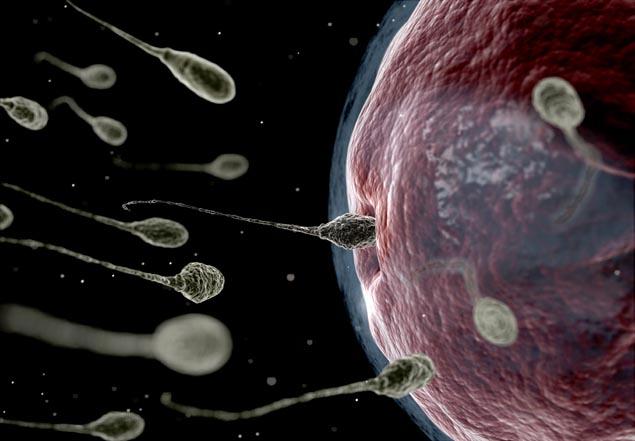
A study in the journal Biology of Reproduction suggests that eating around two handfuls of walnuts a day improves sperm health in young men.
Sperm shape, movement and vitality improved in men who added walnuts to their diet over 12 weeks.
The fatty acids found in these nuts are thought to have helped sperm development. It is not known if this would help improve male fertility.
About one in six couples are infertile, with 40% of these due to a male factor.
Dr. Allan Pacey, senior lecturer in andrology at the University of Sheffield said: “It would be relatively easy to poke fun at studies like this, but there is increasing evidence to show that aspects of a man’s diet can affect the number and quality of sperm produced by his testicles.”
A study in the journal Biology of Reproduction suggests that eating around two handfuls of walnuts a day improves sperm health in young men
The researchers say the next step is to work with couples who are attending infertility clinics to determine if placing sub-fertile men, with poor semen quality, on a walnut diet results in better success conceiving.
It is thought that infertility in men may be a result of too few sperm being made, or that the sperm have poor swimming ability, size or shape.
This study involved 117 men between the ages of 21 and 35, who were divided into two groups. One group added 2.6 ounces (75 grams) of whole-shelled walnuts to their daily diet.
The other group continued their usual diet but avoided eating tree nuts. Both groups ate a typical Western-style diet.
Lead author, Prof. Wendie Robbins from UCLA’s Fielding School of Public Health said: “We found a significant improvement in sperm parameters in the group that consumed the walnuts.
“The men who ate no tree nuts saw no change.”
Sperm quality improved in terms of concentration, vitality, movement, shape and chromosome abnormalities.
Dr. Allan Pacey said: “The study has been well executed and my only criticism would be that the men in the walnut-eating arm of the trial could have altered other aspects of their behavior to give the results shown in the paper.
“A better trial would be to produce tablets of walnut extract that looked identical to a placebo so that the study was completely blind.
“In spite of this, the results of the study show a small but statistically significant improvement in sperm health.”
These benefits may be down to the fatty acids in the nuts.
Co-author Catherine Carpenter, from the UCLA Centre for Human Nutrition said: “Walnuts provide a particularly rich source of a-linolenic acid, a natural plant source of omega-3, which we suspect may have been responsible for the improvements we observed.”
The walnuts for the study were supplied by the California Walnut Commission and the study was funded by the UCLA Fielding School of Public Health’s Centre for Occupational and Environmental Health.
Samsung has released a new tablet, the Galaxy Note 10.1.
Samsung Galaxy Note 10.1 launch comes midway through a patent trial involving the South Korean firm and Apple, in which each company has accused the other of copying its technology.
The new Android tablet distinguishes itself from the iPad by featuring a stylus and a screen which can measure 24 levels of pressure sensitivity.
It also allows a split-screen mode in which two apps can be used at once.
In addition Samsung has opted to retain a look it introduced in 2011 placing wider bezels along two of the device’s sides. The feature was created after a German court temporarily banned earlier models for infringing Apple’s tablet design.
The significance of this is that Apple is seeking damages in the California trial claiming that its rival’s original Galaxy Tab computers were “confusingly” similar to its own.
Samsung Galaxy Note 10.1 launch comes midway through a patent trial involving the South Korean firm and Apple, in which each company has accused the other of copying its technology
Samsung rejects the accusation saying Apple’s US design patent showed “little more than a blank rectangle”, and it would go against legal precedent to allow it to monopolize the shape.
The judge overseeing the case has asked the chief executives of both firms to meet again to see if they can resolve the dispute without the need for a court ruling.
According to analysts at IHS iSuppli, Apple had a 69.6% share of the global tablet market in the April-to-June quarter, compared with Samsung’s 9.2% share.
The Asian tech firm began calling its witnesses at the trial in San Jose earlier this week after Apple rested its case.
Among them was Dr. Woodward Yang, an electrical engineering professor from Harvard University, who backed Samsung’s claim that Apple had infringed patents involving sending photos by email and playing music in the background.
Samsung also took evidence from Jeeyuen Wang, one of its designers, who rejected claims she had made reference to or copied the look of Apple’s iOS system app icons.
Apple’s lawyer then showed the court documents signed by Jeeyuen Wang which featured side-by-side comparisons of the two firms’ interfaces.
Samsung also presented video testimony from Rodger Fidler, a former employee at the Knight Ridder newspaper group, who developed a mock-up tablet for a concept video in 1994. He said he had shown the prototype to Apple.
The evidence is intended to suggest that Apple’s designs were not unique and therefore do not deserve patent status.
Earlier this year a court in the Netherlands rejected a claim that an early Galaxy Tab computer had infringed Apple’s design rights after hearing about the Knight Ridder effort.
Apple is claiming a total of $2.5 billion in damages claiming seven patent breaches in addition to other trade violations.
The judge could triple that figure if she decides to punish Samsung for willful misconduct.
For its part the South Korean company is demanding a “reasonable royalty rate” for five patents which it claims Apple has infringed.
Both sides are expected to present closing arguments next week.
However, Judge Lucy Koh has convinced the firms to make one last effort to resolve the lawsuit outside court.
“I see risk here for both sides if we go to a verdict,” the judge said according to a transcript provided by Forbes magazine.
“I think it’s worth one more attempt. If you could have your CEOs have one last conversation, I’d appreciate it.”
Lawyers for the companies said at the very least there would be a telephone conversation involving the businesses.
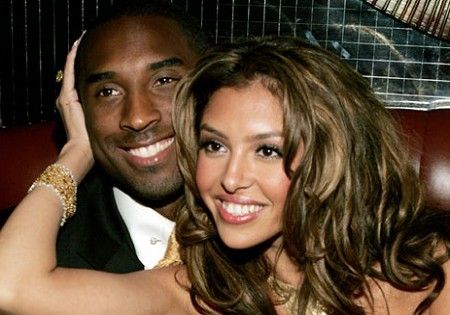
Vanessa Bryant has denied that she has been under the surgeon’s knife after reports suggested she had sought cosmetic help to stop philandering husband Kobe from straying.
Vanessa Bryant’s representatives have blasted the allegations as “100 per cent not true” and “ridiculous”.
During her appearance at the London Olympic Games, Vanessa Bryant, 30, set tongues wagging that she had undergone surgery after pictures of her looking rather different from her former self emerged.
A source told The National Enquirer that Vanessa Bryant was starting to feel “insecure” about her looks and “would do anything to keep Kobe happy”.
Not only had she made obvious changes to her hair, which once bared blonde highlights and is now raven black, but her skin tone, pout, brow and tip of the nose appeared to belong to someone else.
Vanessa Bryant denies having plastic surgery after reports claimed she had sought cosmetic help to stop philandering husband Kobe from straying
Plastic surgeon Dr. Anthony Youn offered his expertise to the US publication, saying: “Vanessa appears to have undergone some plastic surgery.
“Her nose is thin with what appears to be scars at the base of each nostril. In some people, this is a telltale sign of a nose job.”
The medical professional – who practices in Troy, Michigan – also stated that Vanessa Bryant’s lips look to have been plumped, “possibly from an injectable filler like Juvederm”.
Following Kobe Bryant’s rumored reputation of playing away from home, including an admission to one particular infidelity in 2003 and pictures of him shirtless with two women during a recent nightclub venture, Vanessa is said to be “obsessed” with her looks in a bid to stay young and youthful for her husband of 11 years.
A source told the Enquirer: “The sad thing is that Vanessa is wrecking her natural beauty.
“She started freaking out over a few crow’s feet, and the next thing you know she was getting a full facial makeover… she is extremely insecure.
“She’d do anything to keep Kobe happy.”
The on/off couple has had a somewhat turbulent romance over the years and was on the verge of divorce just two months ago.
But during the London Olympics, they appeared to have reconciled and were seen laughing in the stands during a swimming final with their six-year-old daughter Gianna.
However, Australian Olympic gold medalist Stephanie Rice was still forced to deny she was having a fling with Kobe Bryant after they were seen during a cycling event together.