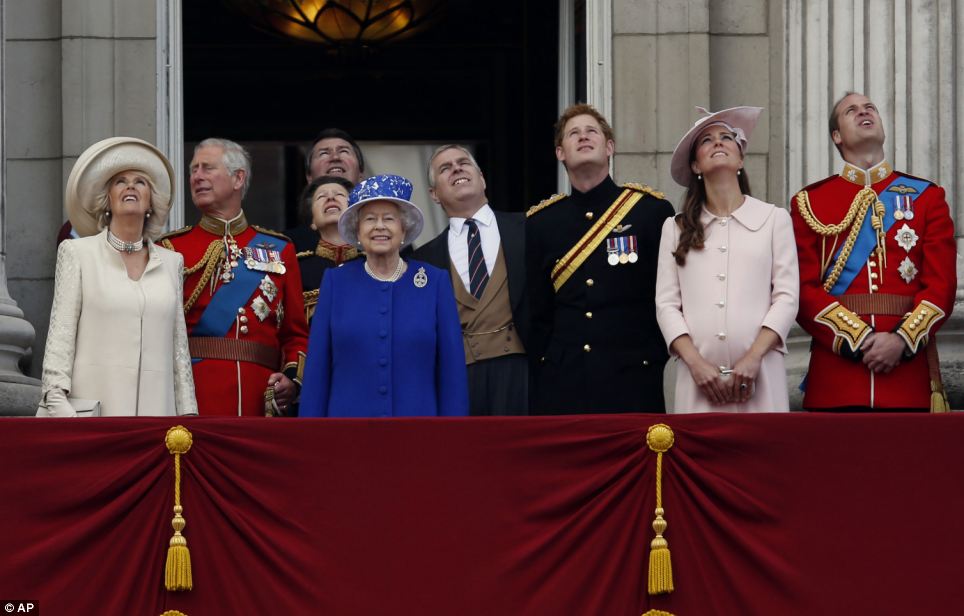
Kate Middleton made her last public appearance before the birth of her first child when she joined thousands of well-wishers to celebrate Queen Elizabeth’s official birthday at the Trooping the Color parade today.
Wearing a pale pink Alexander McQueen coat and matching hat, the Duchess of Cambridge, who is eight months pregnant, travelled to the pageant in a carriage with the Duchess of Cornwall and Prince Harry.
Kate Middelton smiled and waved at the crowds lining the route as the carriage drove to the televised military spectacle which is held every year at Horse Guards Parade in London’s Whitehall.
But it would appear the chilly weather was a bit too cold for the royal family, and they covered their laps with blue blankets.
Queen Elizabeth II celebrated her birthday with traditional pomp and circumstance – but without her husband by her side.
Prince Philip remains in the hospital, recovering from exploratory abdominal surgery.
Instead the Queen invited her cousin, the Duke of Kent, to join her in her glass coach for the short journey from Buckingham Palace along The Mall.
It is thought to be only the third time that Prince Philip has missed the event after not attending in 1962 and 1968 when he was away on royal tours.
She first took the royal salute in 1951 – when she deputized for her sick father, King George VI – and has continued receiving the mark of respect every year except 1955 when there was a national rail strike.
Kate Middleton made her last public appearance before the birth of her first child when she joined thousands of well-wishers to celebrate Queen Elizabeth’s official birthday at the Trooping the Color parade
The Queen, dressed in a royal blue Angela Kelly coat and hat with a matching lace dress, looked on under cloudy skies which parted now and then to reveal the sun.
Other royals watching included the Duke of York and his daughters Princesses Beatrice and Eugenie, and the Earl and Countess of Wessex with their daughter Lady Louise Mountbatten-Windsor.
The Queen took the royal salute as members of the royal family looked on.
Taking part in the ceremony on horseback are the Prince Charles – who is Colonel of the Welsh Guards, the Princess Royal – who is Colonel of the Blues and Royals, and Prince William – who is Colonel of the Irish Guards.
More than 1,000 soldiers, horses and musicians are taking part in the parade known as “Trooping the Color”, an annual ceremony marking the queen’s official birthday.
The ceremony is also an important social occasion for the Guardsmen taking part and gives their wives, girlfriends, and relatives the chance to celebrate the achievements of the young men and enjoy the spectacle.
Many of the spectators in the stands overlooking the parade ground were dressed in morning suits or smart suits, while women wore dresses topped with hats and fascinators.
After the parade ended, the Queen was cheered by crowds gathered along the Mall as she was driven back to Buckingham Palace, where she watched an aerial display by the RAF.
Following the parade, the King’s Troop Royal Horse Artillery fired a 41-gun salute in Green Park to mark the Queen’s official birthday.
The royals then gathered on the balcony at Buckingham Palace to watch the traditional RAF flypast.
Thousands of spectators crowded around the front of the palace and on The Mall, many cheering as a succession of planes roared overhead.
Among the featured 32 aircraft were 13 different types – from the famous Spitfire, Hurricane and Lancaster aircraft of the RAF Memorial Flight – to modern multi-role Typhoon fighters.
The Red Arrows completed the flypast – leaving a trail of red, white and blue smoke which swept across the sky behind them.
After the splendid ceremony, the Queen paid a visit to her husband, the Duke of Edinburgh, who is recovering from exploratory abdominal surgery at a London hospital.
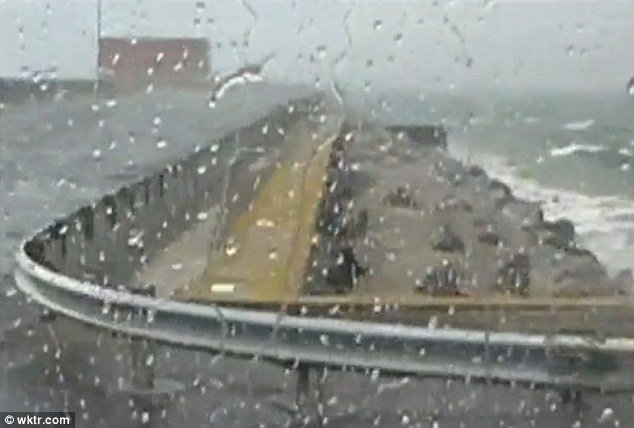
Kent Holcomb, a truck driver from Hampton Roads, was left stranded on the Chesapeake Bay Bridge-Tunnel in Virginia on Thursday afternoon after harsh thunderstorms forced the closure of the bridge.
Trapped in the middle of the 37-km long structure, Kent Holcomb took out his cell phone and started filming as his big rig was rocked back and forth by the strong winds.
Wisely Kent Holcomb didn’t leave his vehicle, but his footage clearly shows the extreme weather conditions including waves crashing against the sides of the bridge.
“I’ve never been so scared in my life. They closed the bridge, and I’m stuck in the middle of it,” Kent Holcomb said on the video.
“You can see by my cord, just how bad this truck is rocking… I’m going to need a drink after this.”
Kent Holcomb was left stranded on the Chesapeake Bay Bridge-Tunnel in Virginia after harsh thunderstorms forced the closure of the bridge
The bridge tunnel is a fixed link crossing the mouth of Chesapeake Bay and connects the Delmarva Peninsula’s Eastern Shore of Virginia with Virginia Beach and the metropolitan area of Hampton Roads, Virginia.
Kent Holcomb was heading home to Hampton Roads from Rhode Island when he ran into the bad weather.
High winds forced crews to close the 23-mile-long bridge tunnel.
“I thought I was going to be able to beat it – and I guess the bridge people thought that too – but that wasn’t the case,” Kent Holcomb told WTKR.
The bridge-tunnel originally combined 19 km of trestle, two 1.6 km long tunnels, four artificial islands, two high-level bridges, approximately 3.2 km of causeway, and 8.9 km of approach roads – crossing the Chesapeake Bay and preserving traffic on the Thimble Shoals and Chesapeake shipping channels.
It replaced vehicle ferry services which operated from South Hampton Roads and from the Virginia Peninsula from the 1930s until completion of the bridge–tunnel in 1964.
The system remains one of only ten bridge-tunnel systems in the world, three of which are located in Hampton Roads, Virginia.
A new research has revealed that some men who take anti-baldness drugs lose interest in alcohol.
Those who take finasteride (also known as Propecia) to stop their hairline receding also tend drink less alcohol after starting the medication.
The research, carried out at the George Washington University, revealed that two thirds of men who take the drug, and who develop side effects such as low s** drive, drink less as a result.
It showed that this side effect continues even after the man has stopped taking the medication.
Finasteride is the only once-a day pill developed to treat mild to moderate male pattern hair loss.
In a clinical study of 535 men taking the drug, 99% had visible results – growth or no further hair loss – after two years.
Men taking finasteride to stop their hairline receding also tend drink less alcohol after starting the medication
It works by stopping the conversion of testosterone to dihydrotestosterone, or DHT, which is thought to be the active hormone in hair loss.
Researcher Dr. Michael Irwig interviewed 83 healthy men who developed persistent s***al side effects while taking finasteride.
He also collected information relating to the men’s medical histories, s***al function, and alcohol consumption before and after taking finasteride.
Of the 63 men who consumed at least one alcoholic drink per week prior to starting finasteride, 65% noted a decrease in their alcohol consumption even after they stopped taking finasteride.
Thirty-two per cent reported no change in their alcohol consumption, and three per cent reported an increase in alcohol consumption.
Live Science reports that many of the men also noted that they had a lower alcohol tolerance after taking the medication, that they felt more anxious after drinking, and that they recovered less quickly from the effects of alcohol.
The researchers do not know why Propecia has this effect upon people’s drinking habits.
However, Dr. Michael Irwig believes that it reduces the brain’s ability to make hormones, called neurosteroids, which are linked to interest in alcohol.
Previous research has also suggested that finasteride can cause permanent, irreversible, impotence.
Dr. Michael Irwig found that finasteride can cause persistent s***al dysfunction, including low s***al desire, erectile dysfunction and problems with orgasms.
These problems, he discovered, often did not resolve themselves when the man stopped taking the drug.
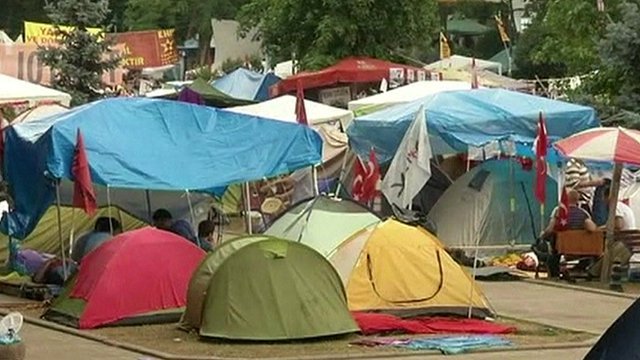
Turkish Gezi Park activists have vowed to continue occupying Istanbul’s park.
Their defiant statement came despite PM Recep Tayyip Erdogan’s promise to halt a redevelopment plan which sparked two weeks of anti-government unrest.
Recep Tayyip Erdogan’s offer was presented as a major concession.
But after all-night discussions in Gezi Park, the protesters said their movement was bigger than a simple conservation protest.
“We will continue our resistance in the face of any injustice and unfairness taking place in our country,” the Taksim Solidarity group, seen as most representative of the protesters, said.
“This is only the beginning.”
Meanwhile, in the capital Ankara, riot police again deployed tear gas and water cannon to disperse demonstrators overnight. About 30 protesters were reported to have been arrested.
Later on Saturday, supporters of Recep Tayyip Erdogan’s ruling Justice and Development Party (AKP) are expected to take to the streets of the capital for an election rally to show support for the embattled premier.
The prime minister’s offer to stop the Gezi Park redevelopment until a court ruled on its legality was his first conciliatory gesture since the challenge to his Islamist-backed government began.
He had previously taken a tough line on the protests, branding the demonstrators “extremists” and “looters”. He said the unrest was being encouraged by foreign forces to undermine Turkey and its economy.
“Young people, you have remained there long enough and delivered your message…. Why are you staying?” Recep Tayyip Erdogan said in a speech broadcast live on television in which he made his offer.
Turkish Gezi Park activists have vowed to continue occupying Istanbul’s park
The contested Gezi Park is a rare patch of green in Turkey’s biggest city.
Last month, an Istanbul court issued an initial injunction against the plan to cut down trees in the park to make way for a shopping centre and replica 18th-Century military barracks. The government has appealed against the ruling.
The project was the initial spark for the protests, which then broadened into anti-government demonstrations in several cities which saw violent clashes between police and demonstrators.
Five people have died and thousands have been injured since the protests began on 31 May, spreading to the adjacent Taksim Square a day later and then to other towns and cities across Turkey.
Protesters have accused Recep Tayyip Erdogan’s government of becoming increasingly authoritarian and of trying to impose conservative Islamic values on a secular state.
The police crackdown on protesters in Istanbul, Ankara, and other towns and cities has drawn international concern, especially from Europe.
And Turkish broadcasters have been heavily criticized for not covering the protests in their early days.
The BBC has suspended its partnership with Turkish broadcaster NTV following its decision not to transmit the BBC programme Dunya Gundemi (World Agenda).
The dropping of the programme came after NTV had apologized to its staff and viewers for not covering the protests when they first began.
Turkey protest timeline:
May 31: Protests begin in Gezi Park over plans to redevelop one of Istanbul’s few green spaces
June 3: Protesters establish camps with makeshift facilities from libraries to food centres
June 4-10: Protests widen into show of anti-government dissent in towns and cities across Turkey; clashes between police and demonstrators
June 11-12: Night of clashes see riot police disperse anti-government demonstrators in Taksim Square, which adjoins Gezi Park; camps in the park remain
June 13: PM Recep Tayyip Erdogan issues a “final warning” to protesters to leave Gezi Park
June 14: Government agrees to suspend Gezi Park redevelopment plans until a court rules on the issue, PM holds talks with members of a key protest group
June 15: Protesters vow to continue occupying Gezi Park
Greek Prime Minister Antonis Samaras has said a small number of people could be hired to produce news and current affairs programmes until a new public service broadcaster is set up.
Antonis Samaras has been heavily criticized for ordering the sudden closure of public broadcaster ERT.
The offer of a concession follows pressure from the PM’s partners in the coalition government.
ERT’s sudden closure is part of the drive to cut government spending.
The government said the closure was an essential measure to help meet the country’s debt bailout obligations.
It described ERT as a “haven of waste” and said it would relaunch it as a smaller, independent public broadcaster.
Antonis Samaras is due to meet his coalition partners on Monday to discuss the issue.
He wants the replacement broadcaster to be established by the summer.
The European Broadcasting Union (EBU) has called on the Greek government to reopen ERT.
Greek PM Antonis Samaras has said a small number of people could be hired to produce news and current affairs programmes at ERT
A petition signed by 51 European directors general is to be handed over to the Athens government.
The EBU called the government’s action “anti-democratic” and “unprofessional”.
Viewers watching the news on the main ERT TV channel saw broadcasting cease late on Tuesday evening.
Journalists however refused to leave the building and online and satellite broadcasts are being maintained with the help of the EBU website.
ERT, which began broadcasting in 1938, was funded by a direct payment of 4.30 euros ($5.6) added monthly to electricity bills.
It ran three domestic TV channels, four national radio stations, as well regional radio stations and an external service, Voice of Greece.
Since its sudden closure, nearly 2,700 workers have lost their jobs, but they will be able to apply to work for the new corporation.
Employees have protested outside the building since Tuesday and the closure also sparked a 24-hour general strike in the country.
The Greek government has pledged to cut thousands of public-sector jobs in order to receive billions of euros in rescue loans from the EU and IMF.
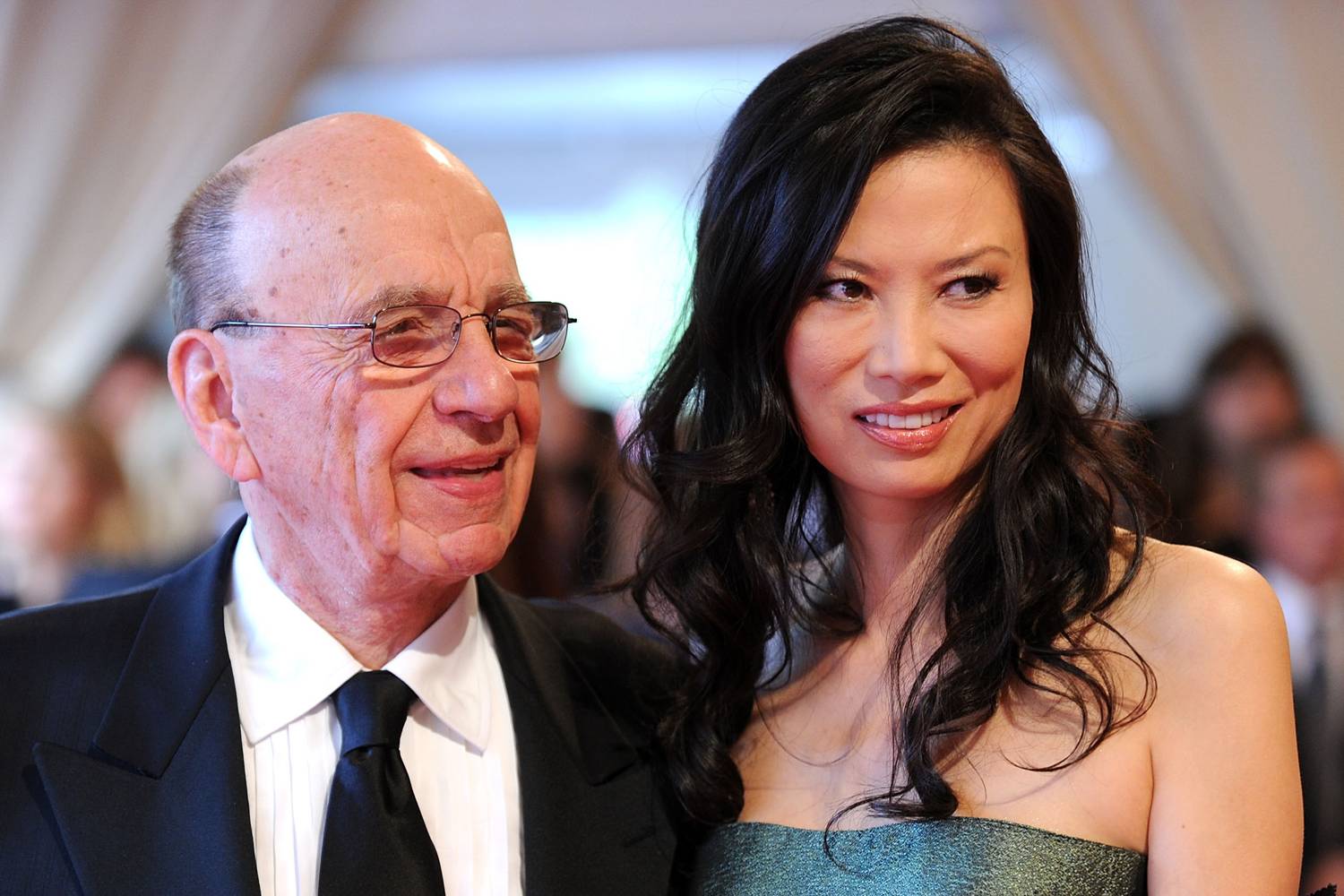
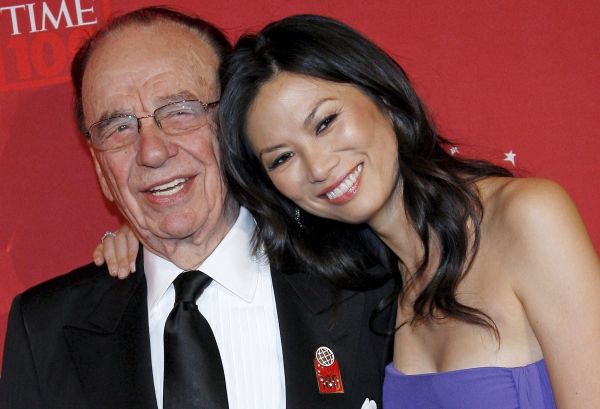
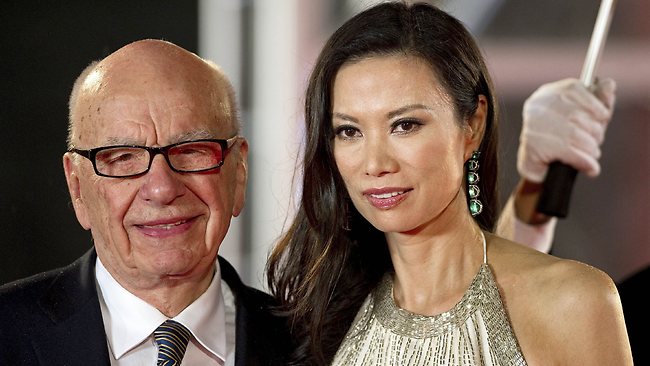
Wendi Deng Murdoch is the wife and soon to be the ex-wife of Rupert Murdoch – one of the richest men in the world.
Wendi Deng is a businesswoman, mother of two and Yale graduate, but perhaps her biggest claim to fame involves a pie made from shaving foam. Wendi Deng – the third wife of media mogul Rupert Murdoch – slapped a man who was trying to throw the pie into her husband’s face during a British parliamentary hearing into the News International phone-hacking scandal.
The incident was televised and her fame spread, even back to her native China.
It also went some way to improving her image, as gossip magazines had previously labeled 44-year-old Wendi Deng a “gold-digger” for her marriage with the 82-year-old Rupert Murdoch. The “trophy wife” became the “tiger wife” almost overnight.
Wendi Deng and Rupert Murdoch married in 1999. They have two daughters together, 11-year-old Grace and 9-year-old Chloe, and lived in a $44 million Manhattan penthouse, with many other palatial homes around the world.
It’s a long way from Wendi Deng’s childhood in the eastern Chinese city of Xuzhou.
She was born Deng Wenge – literally “Cultural Revolution” Deng – which she changed to Wendi as a teenager.
Wendi Deng Murdoch is the wife and soon to be the ex-wife of Rupert Murdoch
Wendi Deng’s father was the director of a factory, and initially she seemed destined to become a doctor, attending medical school in Guangzhou.
But plans changed when, at the age of 18, Wendi Deng met an American couple, Jake and Joyce Cherry.
Joyce Cherry started teaching Wendi Deng English language, and in 1988 the Cherrys sponsored her to get a student visa to study in California.
In 1990, Jake Cherry left his wife to marry Wendi Deng, but less than three years later they divorced.
After a stint working in a California restaurant Wendi Deng was accepted by Yale University to study for an MBA.
Wendi Deng’s connection with Rupert Murdoch’s News Corp began when she was given an intern position at Star Television, a Hong Kong satellite TV service which is part of Murdoch’s vast media empire.
Rupert Murdoch and Wendi Deng met at a cocktail party, and were married two years later – weeks after his divorce from Anna Maria Torv.
That divorce was one of the most expensive in history: Anna Maria Torv received a $1.7 billion settlement.
Wendi Deng is unlikely to receive as much money, as she signed a pre-nuptial agreement, and aides at News Corp have been quick to say that the divorce will not have a big effect on the running of Rupert Murdoch’s empire, which is reportedly worth $9.4 billion.
But she is still likely to receive a sizeable fortune, and she’s also an influential News Corp employee in her own right, playing an important role in the organization’s growth into China, and chief of strategy for MySpace’s China operation.
The Wall Street Journal, one of the many media outlets that Rupert Murdoch owns, once described her as News Corp’s “de-facto diplomat” in China.
Wendi Deng’s also produced her own film, Snow Flower and the Secret Fan, about two foot-bound Chinese children.
While the couple were said to have spent some considerable time apart, their relationship was reportedly strengthened during the allegations of phone hacking that engulfed parts of the Murdoch empire in 2011.
No more so than when Wendi Deng made global headlines as a result of the shaving foam pie incident.
So the announcement of the end of the marriage caught some by surprise. Michael Wolff, Rupert Murdoch’s biographer, told The Daily Telegraph he was “absolutely gobsmacked”.
Rupert Murdoch’s spokespeople have declined to comment on the reasons for the divorce.
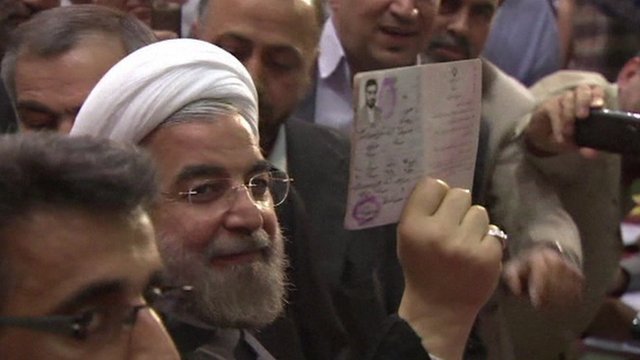
Iran’s presidential election initial count put the reformist-backed candidate, Hassan Rouhani, in the lead.
Official figures give Hassan Rouhani 51% of the five million ballots counted so far – well ahead of second-placed Tehran mayor Mohammad Baqer Qalibaf on 17%.
If Hassan Rouhani maintains that margin, he will be able to avoid a run-off vote.
Electoral officials said turnout was high among the 50 million Iranians eligible to vote on Friday for a successor to Mahmoud Ahmadinejad.
Mahmoud Ahmadinejad’s eight years in power have been characterized by economic turmoil and Western sanctions against Iran over its nuclear programme.
The interior ministry began releasing preliminary figures early on Saturday after a delay of several hours.
Voting was extended until 23:00 local time on Friday to allow more people to cast their ballots. Iranian Press TV reported that turnout was 80%.
It is unclear when the final results will be known.
Although all six candidates are seen as conservatives, analysts say Hassan Rouhani – a 64-year-old cleric often described as “moderate” who has held several parliamentary posts and served as chief nuclear negotiator – has been reaching out to reformists in recent days.
Official figures give Hassan Rouhani more than 51 percent of the five million ballots counted so far
The surge of support for him came after Mohammad Reza Aref, the only reformist candidate in the race, announced on Tuesday that he was withdrawing on the advice of pro-reform ex-President Mohammad Khatami.
Hassan Rouhani therefore went into polling day with the endorsement of two ex-presidents – Mohammad Khatami and Akbar Hashemi Rafsanjani, who was disqualified from the race by the powerful Guardian Council, a 12-member body of theologians and jurists.
However, Hassan Rouhani faced a tough challenge from hard-line candidates, including Mohammad Baqer Qalibaf – who is seen as a pragmatic conservative – and nuclear negotiator Saeed Jalili – who is said to be very close to the Supreme Leader, Ayatollah Ali Khamenei.
The other three candidates are Mohsen Rezai, a former head of the powerful Revolutionary Guards, former Foreign Minister Ali Akbar Velayati, and former Telecommunications Minister Mohammad Gharazi.
As polls closed, representatives of all six candidates issued a joint statement urging their supporters to remain calm until the official results were known.
“We ask people not to pay attention to rumors of victory parades being organized and to avoid gathering before the official results,” the statement said.
Earlier, Interior Minister Mostafa Mohammad Najjar told state TV that any presidential candidates unhappy with the results would have three days to lodge complaints to the Guardian Council.
President Mahmoud Ahmadinejad cast his ballot in Tehran accompanied by Vice-President Mohammad Reza Rahimi and government spokesman Gholam Hoseyn Elham, Fars news agency reported.
Facebook revealed today that it received 9,000-10,000 requests for user data from US government entities in the second half of 2012.
The social-network said the requests, relating to between 18,000 and 19,000 accounts, covered issues from local crime to national security.
Microsoft meanwhile said it received 6,000 and 7,000 requests for data from between 31,000 and 32,000 accounts.
Leaks by former computer technician Edward Snowden suggest the US electronic surveillance programme is far larger than was known.
Internet companies – including Facebook, Google, Yahoo, Apple and Microsoft – were reported last week to have granted the National Security Agency (NSA) “direct access” to their servers under a data collection programme called PRISM.
The firms denied the accusations, saying they gave no such access but did comply with lawful requests.
Several also called on the government to grant them permission to release data about the number of classified orders they received.
In an effort to reassure its users, Facebook lawyer Ted Ullyot wrote on the company’s blog that following discussions with the relevant authorities it could for the first time report all US national security-related requests for data.
“As of today, the government will only authorize us to communicate about these numbers in aggregate, and as a range,” he said.
Facebook revealed it received 9,000-10,000 requests for user data from US government entities in the second half of 2012
For the six months ending 31 December 2012, the total number of user-data requests Facebook received was between 9,000 and 10,000, relating to between 18,000 and 19,000 accounts.
“These requests run the gamut – from things like a local sheriff trying to find a missing child, to a federal marshal tracking a fugitive, to a police department investigating an assault, to a national security official investigating a terrorist threat,” Ted Ullyot said.
“With more than 1.1 billion monthly active users worldwide, this means that a tiny fraction of 1% of our user accounts were the subject of any kind of US state, local, or federal US government request.”
Ted Ullyot did not indicate to what extent the company had fulfilled the requests, but said Facebook had “aggressively” protected its users’ data.
“We frequently reject such requests outright, or require the government to substantially scale down its requests, or simply give the government much less data than it has requested,” he said.
Later, Microsoft also published information about the volume of national security orders during the second half of 2012, stressing that they had an impact on only “a tiny fraction of Microsoft’s global customer base”.
While praising the Department of Justice and Federal Bureau of Investigation for permitting the disclosures, Microsoft Vice-President John Frank called on them to “take further steps”.
“With more time, we hope they will take further steps. Transparency alone may not be enough to restore public confidence, but it’s a great place to start,” he wrote in a statement.
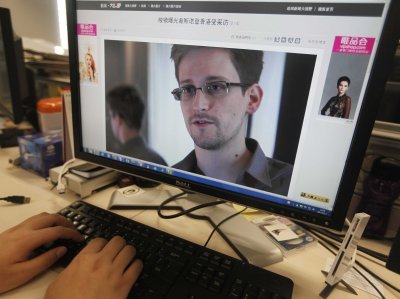
Earlier this month, Edward Snowden, a former employee of defense contractor Booz Allen Hamilton and former CIA technical assistant, leaked details of the PRISM programme.
Edward Snowden, 29, fled the US to Hong Kong shortly before the Guardian and Washington Post newspapers published his revelations.
His whereabouts are unknown, and he has vowed to fight extradition to the US should the authorities attempt to prosecute him.
It appears the Washington Post on Friday revised the story about Barack Obama’s trip to Africa with no note to the reader about the changes.
The Washington Post on Thursday reported the White House canceled Barack Obama’s Tanzanian safari “following inquiries” from the paper “about the trip’s purpose and expense” – but the version online and in print on Friday offers a different take with no clarification or note that the story has been updated and changed.
In the first version, there’s a direct connection between the Washington Post’s inquiries and the canceled safari – and in the updated version, that link is no longer directly made. Readers to the item, meanwhile, were not told that any information in the story had been revised. The story states “published: June 13,” but not that it was updated and revised.
“Obama’s trip to Africa could cost $60 million to $100 million based on the costs of similar African trips in recent years, according to one person familiar with the journey,” the Washington Post reported.
In the first version of the story, posted online on Thursday, the reporters stated: “The president and first lady had also planned to take a Tanzanian safari as part of the trip, which would have required the president’s special counter-assault team to carry sniper rifles with high-caliber rounds that could neutralize cheetahs, lions or other animals if they became a threat, according to the planning document. But the White House canceled the safari on Wednesday following inquiries from The Washington Post about the trip’s purpose and expense, according to a person familiar with the decision.”
Friday’s version of the story – both online and in print – has the same set-up in the section about the canceled Tanzanian safari, but no longer includes the line that the White House canceled the trip following their inquiries. Instead, the story now reads that officials said the safari had been canceled in favor of a trip to Robben Island.
“When The Post first asked White House officials about the safari last week, they said no final decision had been made,” the story reads.
“A White House official said Thursday that the cancellation was not related to The Post’s inquiries.”
Spokesman Josh Earnest told the newspaper: “We do not have a limitless supply of assets to support presidential missions, and we prioritized a visit to Robben Island over a two-hour safari in Tanzania. Unfortunately, we couldn’t do both.”
It appears the Washington Post revised the story about Barack Obama’s trip to Africa with no note to the reader about the changes
The Washington Post, however, notes that “internal administration documents circulated in April show that the Obama family was scheduled to go to both Robben Island and the safari park, according to a person familiar with the plans.”
The story does not include any indication that it was revised and updated.
Document: Major resources needed for Obama Africa trip is currently #1 on the Washington Post’s “most popular” list for Politics.
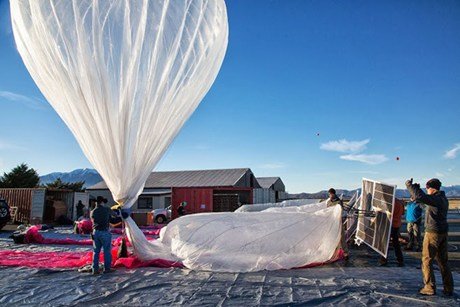
Google is launching superpressure balloons into near space to provide internet access to buildings on the ground.
About 30 of the superpressure balloons are being launched from New Zealand from where they will drift around the world on a controlled path.
Attached equipment will offer 3G-like speeds to 50 testers in the country.
Access will be intermittent, but in time Google hopes to build a big enough fleet to offer reliable links to people living in remote areas.
It says that balloons could one day be diverted to disaster-hit areas to aid rescue efforts in situations where ground communication equipment has been damaged.
But one expert warns that trying to simultaneously navigate thousands of the high-altitude balloons around the globe’s wind patterns will prove a difficult task to get right.
Google calls the effort Project Loon and acknowledges it is “highly experimental” at this stage.
Each balloon is 15 m (49.2 ft) in diameter – the length of a small plane – and filled with lifting gases. Electronic equipment hangs underneath including radio antennae, a flight computer, an altitude control system and solar panels to power the gear.
Google aims to fly the balloons in the stratosphere, 20 km (12 miles) or more above the ground, which is about double the altitude used by commercial aircraft and above controlled airspace.
The giant tech company says each should stay aloft for about 100 days and provide connectivity to an area stretching 40 km in diameter below as they travel in a west-to-east direction.
Google says the concept could offer a way to connect the two-thirds of the world’s population which does not have affordable net connections.
“It’s pretty hard to get the internet to lots of parts of the world,” said Richard DeVaul, chief technical architect at Google[x] – the division behind the scheme.
“Just because in principle you could take a satellite phone to sub-Saharan Africa and get a connection there, it doesn’t mean the people have a cost-effective way of getting online.
“The idea behind Loon was that it might be easier to tie the world together by using what it has in common – the skies – than the process of laying fibre and trying to put up cellphone infrastructure.”
Google launches internet-beaming balloons into near space
A group of about 50 testers based in Christchurch and Canterbury, New Zealand, have had special antennae fitted to their properties to receive the balloons’ signals.
Google now plans to partner with other organizations to fit similar equipment to other buildings in countries on a similar latitude, so that people in Argentina, Chile, South Africa and Australia can also take part in the trial.
“Google as an organization believes that the more people who use the internet, ultimately, the better the world will be,” added Richard DeVaul.
“And the more people who use the internet the more likely they are to use Google services.”
Google is not the first company to pursue such an idea. An Arizona-based firm, Space Data, already provides blimp-based radio repeaters to the US Air Force to allow it to extend communications coverage.
Another Orlando-based firm, World Surveillance Group, sells similar equipment to the US Army and other government agencies.
However, they typically remain airborne for up to a few days at a time rather than for months, and are not as wide-ranging. One expert cautioned that Google might find it harder to control its fleet than it hoped.
“The practicalities of controlling lighter-than-air machines are well known because of the vagaries of the weather,” said Prof. Alan Woodward, visiting professor at the University of Surrey’s department of computing.
“It’s going to take a lot of effort to make these things wander in an autonomous way and I think it may take them a little longer to get right than they might believe.”
What are superpressure balloons?
Superpressure balloons are made out of tightly sealed plastic capable of containing highly pressurised lighter-than-air gases.
The aim is to keep the volume of the balloon relatively stable even if there are changes in temperature.
This allows them to stay aloft longer and be better at maintaining a specific altitude than balloons which stretch and contract.
In particular it avoids the problem of balloons descending at night when their gases cool.
The concept was first developed for the US Air Force in the 1950s using a stretched polyester film called Mylar.
The effort resulted in the Ghost (global horizontal sounding technique) programme which launched superpressure balloons from Christchurch, New Zealand to gather wind and temperature data over remote regions of the planet.
Over the following decade 88 balloons were launched, the longest staying aloft for 744 days.
More recently, NASA has experimented with the technology and suggested superpressure balloons could one day be deployed into Mars’s atmosphere.
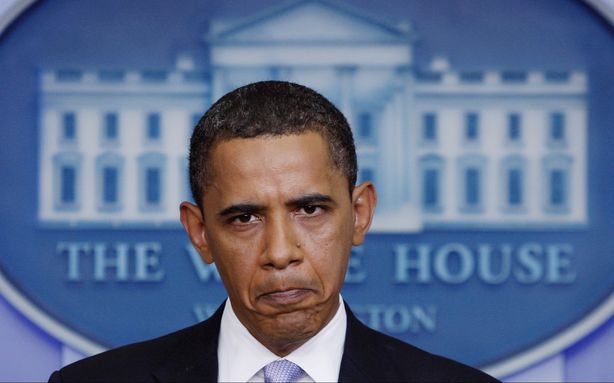
President Barack Obama’s trip to Africa this month could cost the tax payers anywhere from $60 million to $100 million, according to the Washington Post, which obtained an internal planning document for the travel itinerary.
At the end of June, President Barack Obama and his family will take an eight-day trip to sub-Saharan Africa, making stops in Senegal, Tanzania, and South Africa in the name of reinforcing U.S. commitment to forging strong relationships with emerging democracies in the region.
Barack Obama will hold meetings with “a wide array of leaders from government, business, and civil society, including youth,” according to a White House press release announcing the trip, and seek to “underscore the [his administration’s] commitment to broadening and deepening cooperation between the U.S. and the people of sub-Saharan Africa to advance regional and global peace and prosperity.”
Presidential trips to foreign countries tend to be expensive in any administration: According to the Washington Post, former President Bill Clinton’s 1998 trip to Africa racked up a bill of at least $42.7 million, not including what were likely significant Secret Service costs. For his part, former President George W. Bush and his wife, Laura, took two trips to Africa in 2003 and 2008, involving significant resources as well. But there are also paper reports that, due to “a confluence of factors,” Barack Obama’s three-country trip could be “one of the most expensive” of his presidency.
“Obama’s trip could cost the federal government $60 million to $100 million based on the costs of similar African trips in recent years, according to one person familiar with the journey, who was not authorized to speak for attribution,” the Washington Post reported. The paper said that it received the internal planning document from a “person who is concerned about the amount of resources necessary for the trip.”
President Barack Obama’s trip to Africa this month could cost the tax payers anywhere from $60 million to $100 million
According to the Washington Post, the expenses listed on the document include: “Hundreds of U.S. Secret Service agents will be dispatched to secure facilities in Senegal, South Africa and Tanzania. A Navy aircraft carrier or amphibious ship, with a fully staffed medical trauma center, will be stationed offshore in case of an emergency.
“Military cargo planes will airlift in 56 support vehicles, including 14 limousines and three trucks loaded with sheets of bulletproof glass to cover the windows of the hotels where the first family will stay. Fighter jets will fly in shifts, giving 24-hour coverage over the president’s airspace, so they can intervene quickly if an errant plane gets too close.”
Other sources of expense include the use of 56 vehicles and hundreds of Secret Service agents, according to the Washington Post. The document, however, did not note specific prices.
President Barack Obama and First Lady Michelle Obama had reportedly been planning to go on a safari in Tanzania, but the Washington Post says that trip was canceled after reporters inquired into the cost and purpose of the trip.
At a press briefing on Friday, White House spokesman Ben Rhodes defended the trip, noting that “we have not traveled to Africa in the same way that we’ve traveled to other regions in the world” and that “Africa’s a critically important region of the world.”
“We have huge interests there… So for the United States to say, <<We’re a world leader except in this continent>> doesn’t make any sense,” Ben Rhodes told reporters.
“From a foreign policy perspective, in some respects, people believe this trip is overdue. And, frankly, there will be a great bang for our buck for being in Africa, because when you travel to regions like Africa that don’t get a lot of presidential attention, you can have very long-standing and long-running impact from the visit.”
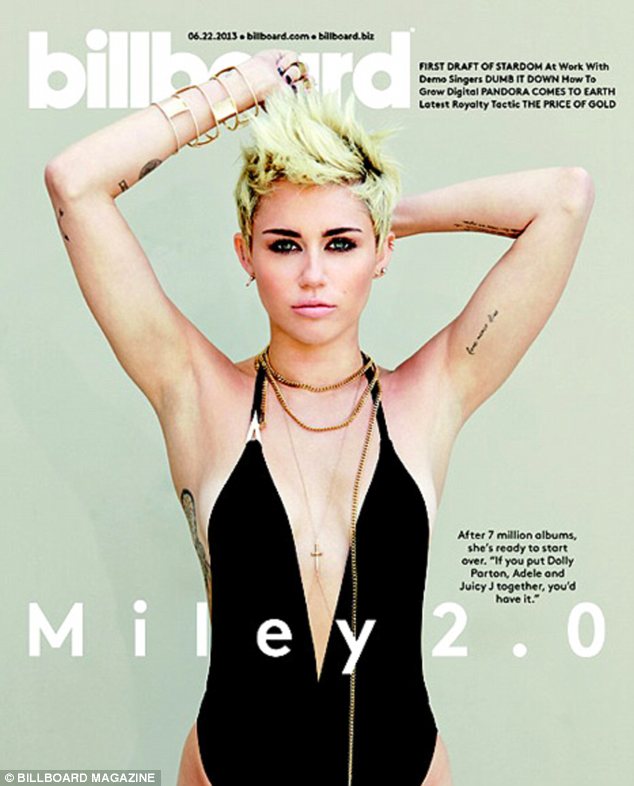
Miley Cyrus continues to deny she and fiancé Liam Hemsworth have ended their engagement, but it was the actress turned singer who added further fuel to split rumors in her latest interview.
Miley Cyrus, 20, has been working on her fourth studio album and admitted that she has had to sacrifice relationships in the process.
“I never stop working, ever – I put my track list together this morning,” she tells the new issue of Billboard.
“I want my record to be the biggest record in the world, and I’ve given everything to get here, even down to friends and family and relationships – I’ve just put this music first.”
Amid claims Liam Hemsworth is unsure that Miley Cyrus is the same girl he fell in love with, she added: “That’s been kind of a trip: It’s not like I’m losing who I am – I actually found out more about who I am by making this music.
“I’m going on a journey, and that’s more than a lot of 20-year-olds can say. And I’m still going to change so much. Because I’m not the same person I was six months ago – I’m not even the same person I was two weeks ago.”
Miley Cyrus is showing a different side to herself with her new music, and claims she has been compared unfairly to her peers.
“A lot of people wanted to try to make me the white Nicki Minaj,” she rather oddly suggested.
“That’s not what I’m trying to do. I love <<hood>> music, but my talent is as a singer.”
Miley Cyrus adds further fuel to her split from Liam Hemsworth rumors during Billboard interview
Miley Cyrus went on: “I can’t really be told what to do right now. I’m too young to go in and make someone else’s vision come to life. I want to go make my visions.”
She released her first single off the new album, We Can’t Stop, on June 3, and it quickly reached the top of the iTunes chart.
But despite its success, Miley Cyrus received some criticism for the themes of the song.
Naturally, Miley Cyrus isn’t fussed about her critics and wanted to be truthful in the lyrics on her track, produced by Mike WiLL Made It.
“I’m 20 years old and I want to talk to the people that are up all night with their friends,” she said.
“It’s based on a true story of a crazy night I had: When I heard the song for the first time, it captured exactly what I was living. I didn’t make this song for the critics, but for the people living it.”
Miley Cyrus also revealed her inspiration for the album, which is due to be released in September.
“I’ve always wanted country-rock influences, but now I’m moving over to a more urban side,” she explained.
“It’s not a hip-hop album, though – it’s a pop album. I’m not coming in trying to rap. It’s more like, <<I don’t see any girls out there doing what Miguel and Frank Ocean are doing>>.”
Meanwhile Miley Cyrus is currently dealing with some family drama as her parents announced on Thursday that they are splitting up.
And just hours after Tish released a statement that she and country singer Billy Ray Cyrus will be ending their marriage, their daughter reached out to her father on Twitter.
Perhaps showing signs that communication is breaking down between the high-profile duo, she wrote: “@billyraycyrus since your text and email obviously aren’t working would you like to talk like this?”
Moments later Miley Cyrus proclaimed that it’s her prerogative how she uses her social media accounts.
“It’s my twitter I can tweet what I want to #wecantstop,” she wrote.
The new issue of Billboard Magazine hits newsstands June 17.
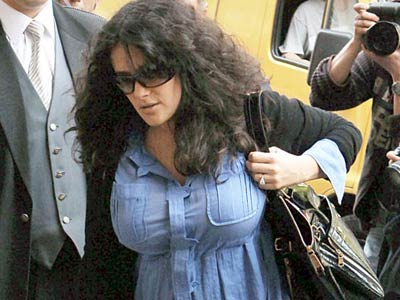
Actress Salma Hayek has described her heavily pregnant body as “completely disfigured”.
Salma Hayek, now 46, gained 50 lbs before giving birth to her daughter Valentina in 2007 and tells Glamour magazine’s Glam Belleza Latina it changed the way she views herself.
The Mexican actress, who moved to the US in 1991, told the publication: “I gained so much weight, I got an opportunity to see myself completely disfigured in many different ways – for a very good reason – and I don’t regret it for a second.
“That’s when I started appreciating my body. The things that I used to criticize, they were not that bad after all.”
Salma Hayek gained 50 lbs before giving birth to her daughter Valentina in 2007
Of regaining her pre-pregnancy body, she said with a laugh: “I did get it back, shockingly.”
Salma Hayek said that like many women, she’s struggled with her self-image: “We’ve got to fight for our confidence every day in modern life because we live in a society that is very harsh to women.
“You have to be smart and successful and a good mother and beautiful and young and skinny forever.”
The actress, who is married French billionaire Francois-Henri Pinault, now stays in shape with the help of juices and even has her own detox drink programe, Cooler Cleanse.
“My favorite is the green one,” Salma Hayek says, referring a spinach, kale, and celery blend.
“If I had to eat all those vegetables, it would be a drag. But in the juice, they taste really good.”
Salma Hayek is currently promoting the July 12 release of Grown Ups 2, which also stars Adam Sandler and Chris Rock.
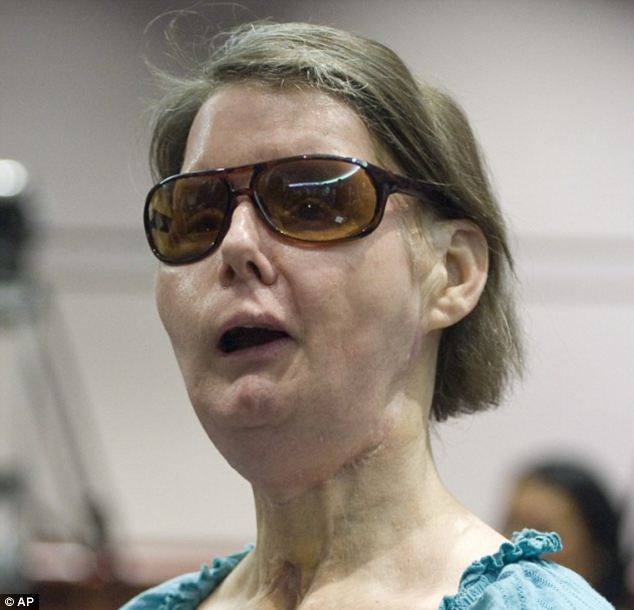
Charla Nash, who lost her eyesight, lips, nose, and hands when she was mauled by a chimpanzee in 2009, has been denied permission to sue Connecticut.
Her family sought permission to sue for $150 million but was denied on Friday by state Claims Commissioner J. Paul Vance Jr.
Connecticut has “sovereign immunity” from lawsuits unless they’re allowed by the commissioner.
Charla Nash’s lawyer had said the state should be held responsible for failing to seize the animal before the attack, because it was warned the animal was dangerous.
J. Paul Vance Jr. said in his decision that at the time of the attack, state law did not prohibit the private ownership of chimpanzees and did not require the state to seize an animal that was privately owned and not banned by the state.
He noted that the state banned the ownership of chimpanzees after the attack.
“The State of Connecticut, were it a private person, would generally not have any duty to control the conduct of (a) third party absent some special relationship,” J. Paul Vance Jr. wrote.
Charla Nash has a chance to appeal to the state General Assembly to reverse Vance’s decision.
“I hope and pray that the commissioner will give me my day in court,” Charla Nash previously told reporters following a hearing in August before Claims Commissioner J. Paul Vance Jr.
“And I also pray that I hope this never happens to anyone else again. It is not nice.”
State Attorney General George Jepsen said the state shouldn’t be held liable for the mauling.
He argued the judge should deny permission due to a law called the “public duty doctrine”. It says the state has a duty to protect the general public in regulatory matters, but not any individual who is injured by another person not complying with regulations, the Hartford Courant reported.
Charla Nash, who lost her eyesight, lips, nose, and hands when she was mauled by a chimpanzee in 2009, has been denied permission to sue Connecticut state
Charla Nash, who received a successful face transplant in 2011, reached a $4 million settlement last year with the estate of chimp owner Sandra Herold, who died in 2010. She had sought $50 million.
The settlement agreement filed in Stamford Probate Court calls for Sandra Herold’s estate to provide Charla with $3.4 million in real estate, $331,000 in cash, $140,000 in machinery and equipment and $44,000 in vehicles.
Brenden Leydon, a Stamford lawyer representing Sandra Herold’s estate, had argued that it couldn’t be sued because Charla Nash was an employee of Herold and any claims were a worker’s compensation matter.
Charla Nash now lives in a nursing home outside of Boston. She had gone to Sandra Herold’s home on the day of the attack to help lure Herold’s 200-pound chimpanzee, Travis, back into her home.
But the animal went berserk and ripped off Charla Nash’s nose, lips, eyelids and hands before being shot to death by a police officer.
Travis had starred in TV commercials for Old Navy and Coca-Cola when he was younger and made an appearance on The Maury Povich Show.
The chimpanzee was the constant companion of the widowed Sandra Herold and was fed steak, lobster and ice cream. The chimp could eat at the table, drink wine from a stemmed glass, use the toilet and dress and bathe himself.
A month after the mauling, Charla Nash’s family sued Sandra Herold for alleged negligence and recklessness.
The lawsuit alleged Sandra Herold knew Travis was dangerous but failed to confine him to a secure area and allowed him to roam her property.
It also claimed Sandra Herold gave the chimp medication that exacerbated his “violent propensities”.
Travis had previously bitten another woman’s hand and tried to drag her into a car in 1996, bit a man’s thumb two years later and escaped from her home and roamed downtown Stamford for hours before being captured in 2003, according to the lawsuit.
Charla Nash wants to sue the state Department of Energy and Environmental Protection, which she holds responsible for not seizing the animal before the attack despite a state biologist’s warning it was dangerous.
Kim Kardashian is just weeks away from welcoming her first child with Kanye West into the world, but her pregnancy has been a bumpy ride at times.
Back in March, Kim Kardashian, 32, suffered a frightening health scare.
In a newly released preview for an upcoming episode of Keeping Up With The Kardashians, it has been revealed that doctors believed Kim Kardashian might have appendicitis.
In a newly released preview for an upcoming episode of Keeping Up With The Kardashians, it has been revealed that doctors believed Kim Kardashian might have appendicitis
The reality star visited the doctor after having severe stomach pains.
Kim Kardashian is seen sat on an exam table with a thermometer under her tongue as the medic delivers the worrying news that she could have appendicitis.
“That got me anxious because of your blood count,” he says.
“This could be appendicitis.”
The doctor no doubt worried Kim Kardashian as he went on to explain the dangers that could come should they need to operate on her.
“We really don’t want to operate on a pregnant woman because it has potential complications for the pregnancy,” he said.
But the doctor added: “If we really feel strongly that this could be appendicitis, then sometimes we have to operate.”
Kim Kardashian told the camera: “Getting appendicitis while pregnant is not fun. It’s not easy, it’s going to be really tough to go through.”
The doctor is then seen examining Kim Kardashian’s burgeoning belly and asks her to “show me where you think the pain is the worst”.
When she winces in pain, the doctor asks her: “Does that hurt more?” to which she replies: “Like so much.”
At the time, after Kim Kardashian learned all was OK with her and her baby, she wrote on Twitter: “Thanks for all the well wishes, I’m doing fine! Just resting…have a good weekend. Love you guys!”
The next episode of Keeping Up With the Kardashians airs Sunday, June 16 on E!.
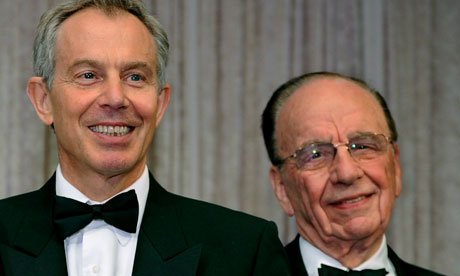
Tony Blair strongly denied outrageous internet rumors today linking him with the divorce of Rupert Murdoch and Wendi Deng.
The internet was awash with unfounded suggestions that the former British Prime Minister may have been romantically involved with 44-year-old Wendi Deng, who is a close friend.
The feverish speculation followed a Twitter claim by BBC business editor Robert Peston, who has close links with Murdoch empire insiders, that he had been “told that undisclosed reasons for Murdoch divorcing Deng are jaw-dropping – & hate myself for wanting to know what they are”.
The rumors are understood to have been emphatically rejected by Tony Blair aides as untrue – either now or in the past – and also as highly defamatory.
A spokesman for Tony Blair told the Hollywood Reporter: “If you are asking if they are having an affair, the answer is no.”
The spokesman said Tony Blair would not be making a public comment on the divorce himself.
With no explanation forthcoming from the Murdoch camp, rumors started flying within hours of the bombshell news that the media tycoon had filed for divorce in a New York court, ending his 14 years marriage to his third wife.
It is no secret that the ambitious Wendi Deng and Tony Blair are good friends. He is godfather to Grace, her older child with 82-year-old Rupert Murdoch.
Rupert Murdoch biographer Michael Wolff described Tony Blair as “one of Wendi’s first official social conquests” and suggested that the former prime minister had seen her as a key link in his efforts to woo her politically powerful husband.
Rupert Murdoch, who is estimated to be worth nearly $11 billion, cited as grounds for the divorce “that the relationship has broken down irretrievably”.
Tony Blair strongly denied outrageous internet rumors today linking him with the divorce of Rupert Murdoch and Wendi Deng
Insiders said the marriage has actually been strained for years. Some pointed to an article in the New York Times last year in which Wendi Deng’s friends admitted the Murdochs were living “largely separate lives” as she looked after their two children and played the socialite while her husband ran his huge media business.
They reportedly came close to splitting up as long ago as 2006 when Wendi Deng reacted with fury to Rupert Murdoch’s decision that their two young daughters, Grace and Chloe, would not have the same say over the running of the family media empire as his children from previous marriages.
Rupert Murdoch’s biographer Neil Chenoweth suggested that the media mogul had planned the divorce as long ago as February after the death of his mother two months earlier gave him extra shares in the family business that he could use to pay off his wife.
In the same month, observers of the couple at the Oscars saw a noticeable change in Wendi Deng’s behavior towards her husband.
“She was snippy with him during the Oscar weekend and she’s really impatient with him these days,” a source at the time told Deadline Hollywood, a film industry website which first reported the divorce.
Michael Wolff recalled reports that Rupert Murdoch told his oldest son, Lachlan, some years ago that he had concluded that marrying the fiery Wendi Deng was a “mistake”.
Other sources claimed the workaholic Rupert Murdoch was more concerned with the imminent division of his media empire into publishing and entertainment arms than with his split from his wife.
Although the couple have a pre-nuptial agreement which should ensure that the Murdoch business empire is not affected by the split, their settlement will have to sort out what happens to their seven homes.
They include a Manhattan apartment Rupert Murdoch bought for $45 million, a 16-acre vineyard in Los Angeles, a flat in London’s Mayfair, an 11-bedroom house in Beverly Hills and a period house outside the Forbidden City in Beijing.
The Wall Street Journal reported in 2000 that Wendi Deng helped break up the marriage of an American couple, Jake and Joyce Cherry, who had befriended her.
In 1988, they arranged for Wendi Deng, then aged 19, to leave China for Los Angeles to learn English.
Wendi Deng reportedly ran off with 53-year-old Jake Cherry and later married him, enabling her to get a “green card” to work in the US. The marriage soon ended after Jake Cherry discovered Wendi Deng was spending time with a man nearly half his age, said the Journal.
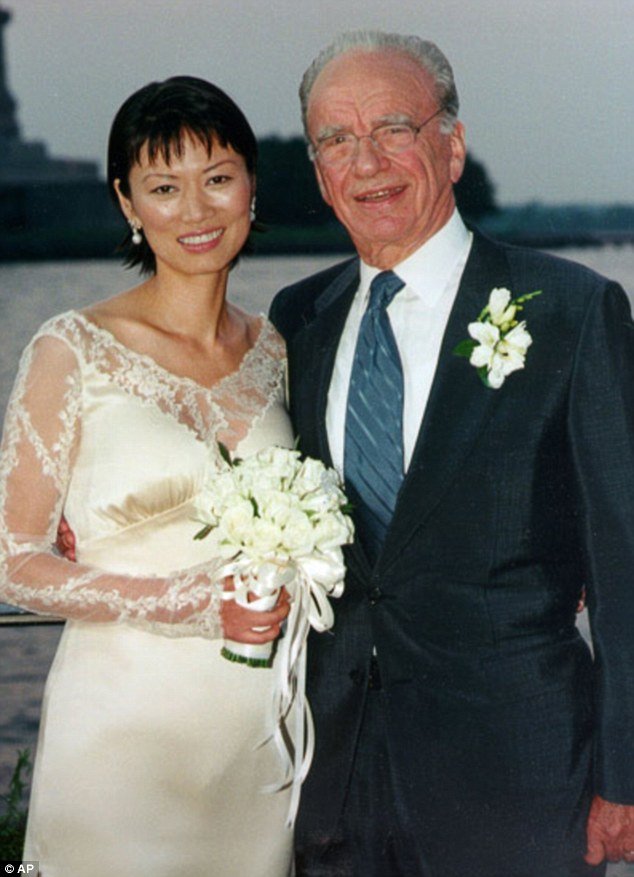
Rupert Murdoch and his Chinese-born third wife, Wendi Deng, married on June 25, 1999, just 17 days after his divorce from Anna Maria Torv, to whom he was married for 32 years.
Rupert Murdoch married his first wife, a flight attendant named Patricia Booker, in 1956 and they had a daughter, Prudence, in 1958 before divorcing in 1967. That same year, Rupert Murdoch married Anna Maria Torv, a journalist working for The Daily Telegraph in Sydney, and they went on to have three children: Elisabeth, Lachland and James.
After three decades, Rupert Murdoch and Anna Maria Torv divorced in 1999, with Anna receiving a record settlement of $1.7 billion in assets. She blamed their divorce on Rupert Murdoch’s affair with Wendi Deng, an employee of his Hong Kong-based company Star TV, and “his determination to continue with that. I thought we had a wonderful, happy marriage. Obviously, we didn’t,’ she said, calling him ‘extremely hard, ruthless”.
The marriage to Rupert Murdoch was not the first for Wendi Deng either; her tangled love life was revealed by the Wall Street Journal in 2000.
Growing up as the daughter of a factory worker in Guangzhou in southern China, Wendi Deng’s childhood was a far cry from the opulence she enjoys today. She lived in a modest home but worked hard at school, where she was a champion volleyball player.
While studying at a medical college, Wendi Deng met an American couple, Jake and Joyce Cherry, who had been temporarily relocated to the country to work on a factory. She learned English from the couple and they ultimately sponsored her to travel to the U.S. when she was 19 to take classes at California State University.
But Joyce Cherry soon learned Wendi Deng was having an affair with Jake Cherry, who was three decades her senior, the Wall Street Journal reported. She ordered the girl out of her home and Jake Cherry followed closely behind. He divorced his wife and married Wendi Deng, who was 22.
But they too divorced after Jake Cherry learned Wendi Deng was spending time with a man named David Wolf.
After achieving her MBA from Yale, Wendi Deng joined the Murdoch-owned Star TV in Hong Kong as an intern in 1996.
Rupert Murdoch and Wendi Deng married on June 25, 1999, just 17 days after his divorce from Anna Maria Torv
While his company has claimed that Rupert Murdoch and Wendi Deng met after his separation from his second wife, Anna, sources told the New York Times last year that they met months before in a question session at Star TV.
It was there Wendi Deng stood up and asked: “Why is your China strategy so bad?”
But Wendi Deng was not satisfied with Rupert Murdoch’s answer and after the meeting, she spoke to him further and they discussed media and business, the New York Times reported.
In a biography, Rupert Murdoch explained that he met her “casually once or twice” during meetings at Star TV. He claimed their first date was in June 1998 in London, when Wendi Deng traveled to the city with colleagues from Star.
“I was a recently separated, lonely man, and I said, <<Let’s go out to dinner one night>>, and I talked her into staying in London a couple of extra days – and that was the start of it,” Rupert Murdoch said.
The couple’s wedding ceremony, attended by 81 guests, took place aboard a yacht in the New York Harbor. They went on to have two children: Grace, born in 2001, and Chloe, born in 2003.
The New York Times profile piece noted that while Rupert Murdoch transformed following their marriage – hair dye, Prada suits, workouts – Wendi Deng was also very much changed.
While Wendi Deng once never wore makeup and would try to get dresses on the cheap, she was soon traveling around the world with her husband, stocking up on expensive homeware and bedecking herself in designer gowns and jewelry. Friends noted that she has remained the same brash, confident person throughout, however.
Wendi Deng and Rupert Murdoch’s relationship has not been entirely smooth. In 2006, Rupert Murdoch declared in a television interview that his daughters with Wendi Deng would not have the same voting rights as his children from previous marriages.
His wife was enraged and friends told the Times Wendi Deng threatened to leave him – but they worked through it.
The piece noted that the couple were living “largely separate lives” as Rupert Murdoch struggled to deal with the News of the World phone hacking scandal in London.
Wendi Deng’s defensiveness of her husband became apparent when she famously protected him from a pie-throwing activist during a hacking hearing in London two years ago.
Wendi Deng, showing her athleticism that harked back to her volleyball days, lunged at the attacker to smack him across the head.
With a net worth of $11.2 billion, Rupert Murdoch’s divorce from Wendi Deng could be the most expensive ever.
Rupert Murdoch was married three times and his split from second wife, of 32 years, Anna Murdoch, in 1999, is currently the world’s biggest.
Anna Murdoch received $1.7 billion of his assets – including $110 million in cash, according to ABC news.
The second most expensive divorce was in 2008, when Formula One tycoon Bernie Ecclestone settled with Slavica for $1.2 billion.
Australia-born Rupert Murdoch took residence in the U.S. in 1974 and became a naturalized American citizen in 1985, based in New York City.
Rupert Murdoch and Wendi Deng filed for their divorce at the New York State Supreme Court this morning. It is not clear which of them will move out of their Upper East Side apartment.
As well as New York being their main residence, Rupert Murdoch and Wendi Deng may have filed their petition in the city because it’s “a place where prenups are generally given a significant amount of presumptive validity by the courts”, Bernard Clair, an established Manhattan divorce lawyer not involved in the Murdoch case, told NBC.
The issue of such validity would arise if the agreement was challenged in court.
With a net worth of $11.2 billion, Rupert Murdoch’s divorce from Wendi Deng could be the most expensive ever
Entering into a prenup has long been an option in the U.S. and all states recognize premarital agreements through statutes or court decisions.
Such agreements have only recently become legally enforceable in Australia, since 2000; and prenups first became legally recognized in Britain in 2010.
A pre-nuptial agreement is a contract entered into before marriage which specifies property and financial distribution in the event that the marriage terminates.
In the case of the Murdochs, the education and upbringing of the children born to the couple will also be an issue, as they have two daughters together – Grace, 11 and Chloe, 9.
Rupert Murdoch and Wendi Deng had a pre-nup agreement and have held shares in trust for their children, so the divorce is unlikely to lessen the media mogul’s grip on his media empire.
Under the property distribution laws in many states, a spouse who brings a large amount of cash, property, and other financial holdings to a marriage and makes them part of the marital estate may lose much of that property to the other spouse upon divorce.
Therefore, a spouse who brings substantially more money or property to a marriage may want a premarital agreement to protect some or all of those assets if the marriage fails.
Rupert Murdoch’s marriage to his first wife, Patricia Booker, a former shop assistant and flight attendant from Melbourne, lasted from 1956 to 1967.
They had one daughter, Prudence, in 1958. It is not clear what settlement they reached.
New reports claim the reason Rupert Murdoch has filed for divorce from his wife of 14 years Wendi Deng is a “jaw-dropping” one.
Since news emerged of the media tycoon’s decision, Twitter has been awash with speculation about why the 82-year-old is splitting up with his third wife.
BBC financial correspondent Robert Peston, who is said to be a close friends with some key Rupert Murdoch staffers, hinted at a shocking reason writing on his Twitter page: “Undisclosed reasons for Murdoch divorcing Deng are jaw-dropping.”
Later several US websites began carrying a denial of one of the astonishing theories that emerged from the Twitter rumor mill and which was unsupported by any evidence.
Rupert Murdoch’s biographer, Michael Wolff, added to the speculation writing on his Twitter account: “I’m hearing the WHY, the big reveal, the scandal details, could come tomorrow.”
“I think he genuinely loved her,” Michael Wolff told the Guardian.
“Everyone is wondering what went wrong.”
The News Corp chairman and CEO married Wendi Deng, 44, in 1999 after meeting at a party in Hong Kong two years prior.
Wendi Deng is most famously known for punching a man who threw a pie at Rupert Murdoch over the phone hacking scandal during a British parliamentary committee.
British media reported there is not only a pre-nuptial agreement, but also two further “post-nups” in 2002 and 2004. The divorce will not have any real effect on News Corporation.
Rupert Murdoch and Wendi Deng 1999 marriage came 17 days after his divorce from ex-wife Anna Maria Torv Murdoch Mann was finalized, which was one of the most expensive in history at $1.7 billion.
Court papers state “the relationship has been irretrievably broken for the last six months”.
Rupert Murdoch and Wendi Deng lived in a $44 million Fifth Avenue penthouse previously owned by Laurance S. Rockefeller and have an impressive portfolio of homes in Los Angeles, London, Canberra, Australia, Carmel, California, and Centre Island, New York.
The Murdochs would have celebrated their fourteenth wedding anniversary in less than a fortnight.
A source told the Mail: “This divorce is no surprise, it’s been on the cards for a while. Wendi and Rupert have been living separate lives. She’s a New York fixture and is interested in her own career.”
Ira E. Garr of the law firm Garr Silpe is representing Rupert Murdoch in the divorce. He has represented Ivana Trump in the past.
Rupert Murdoch and Wendi Deng, who married on a private yacht in 1999, have two children, Grace, 11, and Chloe, 9, to whom Wendi Deng admits to being a disciplinarian mother.
According to the Guardian, the pair has filed for joint custody of their children.
The reason Rupert Murdoch has filed for divorce from Wendi Deng is reported to be jaw-dropping
It appears also that Wendi Deng has no voting stock in News Corp.
Though their two daughters have financial shares in the family trust, they do not have voting shares.
Rupert Murdoch’s older children by his previous wives have the holding rights. He and second wife Anna had three children – Lachlan, James and Elisabeth.
The couple are said to have clashed over this in 2006 after Rupert Murdoch said in an interview that Grace and Chloe would be on a level footing in terms of the family’s economic trust with his children from his previous marriages, but they would not have the same voting rights.
They are said to have eventually come to a more acceptable agreement.
In 2012, Wendi Deng was profiled in a New York Times story which claimed the couple were leading “largely separate lives and sleeping in separate bedrooms”, a far cry from the show of unity just one year earlier when Deng leaped to the defense of her husband during a grueling question and answering session in British Parliament, punching a protestor who tried to throw a cream pie in his face.
Wendi Deng’s actions seemed to give their marriage legitimacy, as she was previously thought to merely be a “gold-digger” and “trophy wife”.
Rupert Murdoch’s net worth was listed at $11.2 billion by Forbes in March, ranking him 33rd on the U.S. billionaire’s list.
His last divorce, from Scottish-born Anna Murdoch, after 32 years of marriage, cost him £1 billion ($1.6 billion).
However, Wendi Deng may be able to demand a larger settlement because she has been actively involved in the Murdoch business in China, where she is chief of strategy for its social networking site MySpace.
The divorce papers were filed at the New York state supreme court in Manhattan yesterday morning.
Wendi Deng was credited with rejuvenating the 82-year-old News Corporation founder, chairman and CEO, transforming his wardrobe and introducing him to a new group of younger friends in the new media world, including Facebook founder Mark Zuckerberg.
She is reportedly the daughter of a factory director who grew up in the eastern Chinese city of Xuzhou in 1968.
Wendi Deng left for the U.S. when she was 19-years-old to study and worked in a Chinese restaurant in California before going on to graduate from Yale University in 1996.
While studying at a medical college, she met an American couple, Jake and Joyce Cherry, who had been temporarily relocated to the country to work on a factory.
Wendi Deng learned English from the couple and they ultimately sponsored her to travel to the US when she was 19 to take classes at California State University.
But Joyce Cherry soon learned Wendi Deng was having an affair with Jake Cherry, who was three decades her senior, the Wall Street Journal reported in 2000.
Joyce Cherry ordered the girl out of her home and Jake Cherry followed closely behind. He divorced his wife and married Wendi Deng, who was 22.
But they too divorced after he learned Wendi Deng was spending time with a man named David Wolf.
Soon after, Wendi Deng was employed as an intern by Star TV, News Corp’s Asian satellite-television operation in Hong Kong, where she met Rupert Murdoch during one of his visits.
Wendi Deng approached Rupert Murdoch and asked: “Why is your China strategy so bad?”
After the meeting, they discussed media and business, the New York Times reported.
In a biography, Rupert Murdoch explained that he met Wendi Deng “casually once or twice” during meetings at Star TV. Their first date was in June 1998 in London, when she traveled to the city with colleagues from Star.
At News Corp, Wendi Deng was involved in the conglomerate’s Chinese interests and Internet and film ventures, and she produced the 2011 feature Snow Flower and the Secret Fan for Fox Searchlight pictures. This was largely eclipsed when the phone-hacking scandal emerged.
Wendi Deng was described by friends in a New York Timesarticle last year like someone who is a world-class networker, collecting powerful friends and brokering connections.
She would host annual dinner parties with powerful women, hosts book parties for friends, and regularly holds get-togethers.
The same article, from June 2012, said the Murdochs had grown to live largely separate lives, with Wendi Deng taking the girls to piano lessons and attending red-carpet galas, and Rupert Murdoch dealing with the phone-hacking scandal that was unfolding in Britain at the time.
The filing comes just days before the split of News Corp into two companies, one for its entertainment assets and the other for its publishing business.
It was not immediately clear whether the divorce and the company split were connected in any way, though analysts said the end of the Murdochs’ marriage was unlikely to have an effect on the corporate separation.
“I doubt it has a substantial impact on the spin,” said Gabelli & Co. analyst Brett Harriss.
“Given that it’s his third wife, I see it unlikely that he didn’t plan for this contingency.”
News Corp shares were unchanged in midday trading.
Rupert Murdoch controls 40% of the voting shares of News Corp through a separate family trust.
Wendi Deng and Rupert Murdoch’s children are having shares currently worth around $270 million.
Rupert Murdoch handed each of his six children $100 million in shares in February 2007 and another $60 million nine months later.
According to the United Nations, India looks set to overtake China as the world’s most populous country from 2028.
At that point, India and China will number 1.45 billion people each. Subsequently India’s population will continue to grow until the middle of the century, while China’s slowly declines.
The UN also estimates that the current global population of 7.2 billion will reach 9.6 billion by 2050.
That is a faster rate of growth than previously estimated.
The population growth will be mainly in developing countries, particularly in Africa, the UN says.
The world’s 49 least developed countries are projected to double in size from around 900 million people in 2013 to 1.8 billion in 2050, whereas the population of developed regions will remain largely unchanged.
India looks set to overtake China as the world’s most populous country from 2028
The UN said the reason for the increase in its projection for total global population in 2050 is largely new information on fertility levels in certain high birth rate countries.
Large developing countries, such as China, India and Brazil, have seen a rapid fall in the average number of children per woman, but in other nations, such as Nigeria, Niger, Ethiopia and Uganda, fertility levels remain high.
Nigeria’s population is expected to exceed that of the United States by the middle of the century, and could start to rival China’s by 2100.
China’s population is expected to start decreasing after 2030.
“Although population growth has slowed for the world as a whole, this report reminds us that some developing countries, especially in Africa, are still growing rapidly,” commented Wu Hongbo, the UN’s Under-Secretary-General for Economic and Social Affairs.
The UN publishes an assessment of past, current and future population trends every two years, in a recurrent series known as the World Population Prospects.
Researchers have used data for 233 countries and areas to produce Friday’s report.
The British government has warned airlines not to allow Edward Snowden, an ex-CIA employee who leaked secret US surveillance details, to fly to the UK, according to reports.
The Associated Press news agency reported seeing a document at a Thai airport telling carriers to stop Edward Snowden, 29, boarding any flights.
The travel alert – reported to feature a Home Office letterhead – said Edward Snowden “is highly likely to be refused entry to the UK”.
The Home Office would not comment.
According to AP, the alert was issued on Monday by the Home Office’s risk and liaison overseas network.
The document had a photograph of Edward Snowden and gave his date of birth and passport number, the news agency reported.
It said: “If this individual attempts to travel to the UK: Carriers should deny boarding.”
The British government has warned airlines not to allow Edward Snowden to fly to the UK
It went on to warn airlines they may “be liable to costs relating to the individual’s detention and removal” should they allow him to travel.
According to the Home Office website, a charge for such a situation would be £2,000 ($3,130).
Bangkok Airways, Singapore Airlines and Malaysia Airlines confirmed they had received the notice, which was not supposed to be seen by the public, AP reported.
The Home Office does have the power to block people’s entry to the UK in certain circumstances, such as if it believes it is in the public interest to do so.
The powers had been used in the past, including to deny entry to extremist preachers and extremist European politicians.
Edward Snowden was last seen in Hong Kong, where he travelled ahead of the Guardian newspaper’s stories revealing the extent of the National Security Agency’s (NSA) programme to take data from US internet and telephone firms.
There is no suggestion that he has any intention of trying to travel to the UK.
Edward Snowden’s actions have divided opinion in the US, with some calling him a hero and others calling for him to be tried for treason.
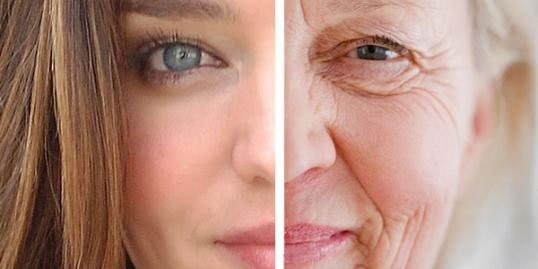
Menopause and its side effects can all be blamed on men, Canadian experts suggest.
Evolutionary geneticists from McMaster University say men’s tendency to choose younger mates meant fertility became pointless for older women.
According to aPLOS Computational Biology article, experts say men’s preferences eventually led to the menopause.
However, a UK expert said that was the “wrong way round” and men chose younger women because older women were less fertile.
Researchers have long been puzzled as to why it appears that human are the only species where females cannot reproduce throughout their lives.
Previous theories had proposed a “grandmother effect”. This suggests that women lose their fertility at an age where they might not live to see a child grow, and instead are available to care for younger women’s children.
The menopause was therefore seen as the block to older women from continuing to reproduce.
But this latest theory suggests things work the other way around, and that it is the lack of reproduction that has given rise to menopause.
Evolutionary geneticists from McMaster University say men’s tendency to choose younger mates meant fertility became pointless for older women
Using computer modelling, the team from McMaster’s concluded “preferential mating” was the evolutionary answer – men of all ages choosing younger women as partners.
That meant there was “no purpose” in older women continuing to be fertile.
Prof. Rama Singh, an evolutionary geneticist who led the study, said men choosing younger mates were “stacking the odds” against continued fertility.
He said: “There is evidence in human history; there was always a preference for younger women.”
Prof. Rama Singh stressed they were looking at human development many thousands of years ago – rather than current social patterns,
He said this extended longevity – plus later childbirth – could potentially alter the timing of the menopause, over a significant period of time.
“The social system is changing. There are women who are starting families later, because of education or a career.”
Prof. Rama Singh suggested this trend would mean those women would have a later menopause, and those genes would be passed on to their daughters “with the possibility of menopausal age being delayed”.
However, Dr. Maxwell Burton-Chellew, an evolutionary biologist in the department of zoology at the University of Oxford, challenged the theory.
“The authors argue that the menopause exists in humans because males have a strong preference for younger females.
“However, this is probably the wrong way round – the human male preference for younger females is likely to be because older females are less fertile.
“I think it makes more sense to see the human male preference for younger females largely as an evolved response to the menopause, and to assume that ancestral males would have been wise to mate with any females that could produce offspring.”
Dr. Maxwell Burton-Chellew added: “Evolutionarily-speaking, older females
faced an interesting ‘choice’: have a child that may not reach adulthood before your own death, or stop reproducing and instead focus on helping your younger relatives reproduce.”
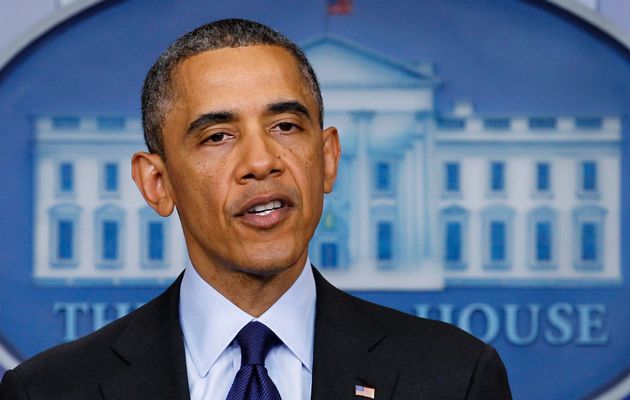
The White House has announced today that President Barack Obama has approved for the first time a direct military aid to the Syrian opposition.
President Barack Obama made the decision after his administration concluded Syrian forces under President Bashar al-Assad were using chemical weapons, a spokesman said.
Ben Rhodes did not give details about the military aid other than to say it would be “different in scope and scale to what we have provided before”.
Russia said the US claims on Syria’s chemical weapons use were unconvincing.
Yury Ushakov, a senior aide to President Vladimir Putin, told reporters that Washington had provided Moscow with its evidence, but “what was presented…. does not look convincing to us”.
The US announcement is one that the Syrian opposition has been pushing and praying for months.
It seems clear that President Barack Obama has finally been persuaded, as Britain and France have argued, that the battlefield cannot be allowed to tilt strongly in the regime’s favor, as is currently happening.
Washington’s “clear” statement was welcomed by NATO Secretary General Anders Fogh Rasmussen, who urged Syria to let the UN “investigate all reports of chemical weapons use”.
British Foreign Secretary William Hague said the UK agreed with Washington’s assessment and said an urgent response to the Syria crisis would be discussed at the G8 this week.
But a spokesperson for UN Secretary General Ban Ki-moon told said that he remained against “any further militarization” of the conflict in Syria, saying the people there need peace not more weapons.
Ben Rhodes, a deputy national security adviser to Barack Obama, said the US intelligence community believed the “Assad regime has used chemical weapons, including the nerve agent sarin, on a small scale against the opposition multiple times over the last year”.
He said intelligence officials had a “high confidence” in their assessment, and also estimated that 100 to 150 people had died from chemical weapons attacks, “however, casualty data is likely incomplete”.
“We have consistently said the use of chemical weapons violates international norms and crosses red lines that have existed in the international community for decades,” Ben Rhodes said.
President Barack Obama has approved for the first time a direct military aid to the Syrian opposition
Ben Rhodes said President Barack Obama had made the decision to increase assistance, including “military support”, to the Supreme Military Council (SMC) and Syrian Opposition Coalition.
He did not give details of the aid, but administration officials have been quoted by US media as saying it will most likely include sending small arms and ammunition.
The New York Times quoted US officials as saying that Washington could provide anti-tank weapons.
Syria’s rebels have been calling for both anti-tank and anti-aircraft weaponry.
The Wall Street Journal reported that Washington is also considering a no-fly zone inside Syria, possibly near the border with Jordan, that would protect refugees and rebels who are training there.
When asked whether Barack Obama would back a no-fly zone over Syria, Ben Rhodes said one would not make a “huge difference” on the ground – and would be costly.
He said further actions would be taken “on our own timeline.”
The CIA is expected to co-ordinate delivery of the military equipment and train the rebel soldiers in how to use it.
Until now, the US has limited its help to rebel forces by providing rations and medical supplies.
Ben Rhodes said the White House hoped the increased support would bolster the effectiveness and legitimacy of both the political and military arms of Syria’s rebels, and said the US was “comfortable” working with SMC chief Gen Salim Idris.
“It’s been important to work through them while aiming to isolate some of the more extremist elements of the opposition, such as al-Nusra,” he said.
The US decision marks a significant escalation of the proxy war that has been gathering pace in Syria, our Beirut correspondent says.
The support of the West’s regional allies, Qatar and Saudi Arabia, had helped the rebels in the days after the uprising became militarized.
But the tide turned after the Assad government turned to Moscow and Tehran for help. Hezbollah fighters have also been involved in the government’s counter-offensive.
Now the West is lining up to try and help the rebels, but that is likely to take many months with more bloodshed and destruction.
The White House announcement immediately shook up the ongoing debate in Washington DC over how the US might provide assistance to the rebels.
Republican Senators John McCain and Lindsey Graham, who have been particularly strident in their calls for military aid, said the finding must change US policy in Syria. They called for further action, saying US credibility was on the line.
“A decision to provide lethal assistance, especially ammunition and heavy weapons, to opposition forces in Syria is long overdue, and we hope the president will take this urgently needed step,” they said in a joint statement.
“But providing arms alone is not sufficient. The president must rally an international coalition to take military actions to degrade Assad’s ability to use airpower and ballistic missiles and to move and resupply his forces around the battlefield by air.”
The White House announcement came on the same day the UN said the number of those killed in the Syrian conflict had risen to more than 93,000 people.
A UN report released on Thursday found at least 5,000 people have been dying in Syria every month since last July, with 30,000 killed since November.
More than 80% of those killed were men, but the UN’s Office of the High Commissioner for Human Rights (OHCHR) says it has also documented the deaths of more than 1,700 children under the age of 10.
Ginnifer Goodwin was picked to play America’s most famous First Lady Jackie Kennedy in Killing Kennedy – a new TV movie about JFK’s assassination.
With her hair back-combed and with the same make-up style Ginnifer Goodwin, 35, is the mirror image of Jackie “O”.
Ginnifer Goodwin – whose credits include Big Love – will play the part alongside Rob Lowe as J.F.K in Killing Kennedy about the ill fated 35th United States President.
The National Geographic Channel’s film adaptation is from Bill O’Reilly and Martin Dugard’s book Killing Kennedy: The End Of Camelot and will have its small screen release in November.
It is a dream role for Ginnifer Goodwin – who is currently dating her Once Upon A Time co-star Josh Dallas – while Michelle Trachtenberg has been chosen to play Lee Harvey Oswald’s wife Marina Oswald.
The make-up and wardrobe specialists on the project have obviously pulled-out all the stops to make both Ginnifer Goodwin and Rob Lowe look just like the iconic couple for the new movie.
Rob Lowe, 49, too bears an uncanny resemblance to the late former president and strikes a mirror image pose of JFK in his promotional shot for Killing Kennedy.
With the same posture, and president’s classic comb-over, Rob Lowe somehow manages to evoke the image of JFK, who was assassinated in 1963.
Ginnifer Goodwin was picked to play America’s most famous First Lady Jackie Kennedy in Killing Kennedy
Rob Lowe started filming the movie earlier this week, and the National Geographic Channel will be hoping that it proves to be ratings gold with viewers.
The actor of course previously played Sam Seaborne in The West Wing from 1999 to 2003 so he knows all about the workings of The White House albeit from a different era from his new project.
Chronicling the final years of JFK and his assassin Lee Harvey Oswald before their deaths in 1963, the subject of the film seems to have had an effect on Rob Lowe.
He tweeted: “Just saw Ginnifer Goodwin as Jackie Kennedy in the sad and awful blood-stained dress. Extremely emotional.”
Rob Lowe also said the show will be to mark the 50th anniversary of the president’s death, adding: “We were never the same.”
He isn’t the only actor to be playing JFK this year, as James Marsden will also portray the late president in the film The Butler.
The film by director Lee Daniels also stars Oprah Winfrey and Mariah Carey, and is scheduled for release on August 16.
Rob Lowe recently confessed to having a ball getting a makeover as plastic surgeon Jack Startz in Behind the Candelabra.
He told EW: “I’ve taken great glee in showing pictures that I have on my iPhone of Dr. Startz to people.
“People, honestly, fall over. They are so repelled and engaged, which is sort of what I was going for. I wanted him to be at once repellant and engaging, if that’s possible.”
Rob Lowe also plays the hyperactive character Chris Traeger on Parks and Recreation and Ulysses S. Grant in the upcoming American Civil War drama To Appomattox.
Ireland Baldwin shows an incredible resemblance to her mother Kim Basinger as she attended the amfAR Inspiration Gala in New York on Thursday in a breath-taking black gown.
Ireland Baldwin, 17, ruled the red carpet when she stood on the steps of the historic Plaza Hotel in Manhattan, revealing that she is true Hollywood royalty.
And it was plain to see just how much she resembled her similarly stunning mother, actress Kim Basinger.
Alec Baldwin and Kim Basinger’s model daughter was dripping in glamour in a curve-kissing black gown with capped sleeves that rested on her arms and showed off her toned shoulders.
The sweeping train meant that the dress was long enough even for the Amazon-sized teenager who has inherited tall genes from her 6 foot tall father and 5’6 1/2″ mother, but surpassed both of them in height.
While the lace topped bodice of the beautiful dress hung low on her bust-line, the classic cut meant that the overall silhouette was elegant.
Large silver cluster earrings and heavy sparkling bangles added a dramatic touch, while Ireland Baldwin kept her makeup simple with pale lips, lush dark lashes, and smooth bronzed skin.
Ireland Baldwin shows an incredible resemblance to her mother Kim Basinger as she attended the amfAR Inspiration Gala in New York
Ireland Baldwin’s hair is most often seen loose and natural like any carefree California teen, but for the special occasion she had it secured back in a sophisticated chignon with long, perfectly straight bangs falling over her face.
As she stared out with a sultry expression through the blonde fringe, Ireland Baldwin looked shockingly similar to her stunning mom, Kim Basinger.
Ireland Baldwin, who recently scored a top contract with agency IMG, recently told People.com she is working hard towards her goal of becoming a top model: “I’m getting into it. Doing it right. I want to know where it’s going to take me.”
She said she was inspired by a number of contemporary models including Kate Moss and Miranda Kerr, but of course also looks up to Kim Basinger.
“Oh! And my mom, of course,” Ireland Baldwin told People.
“My mom’s very happy she can finally give me tips. She’s always there, so she’ll stand in the back and say, <<Turn your head this way, or do this>>.”