Kobe Bryant’s wife, Vanessa, is reportedly walking away from their ten year marriage with three of their properties.
Vanessa Bryant, 33, will get all of their mansions in the Newport Beach area of California, according to TMZ.
Kobe Bryant’s wife will secure $75million, which is said to be close to half of their total assets.
A source close to the couple told TMZ that the property settlement agreement has already been finalized.
Kobe Bryant’s wife, Vanessa, is reportedly walking away from their ten year marriage with three of their properties
Vanessa Bryant, who has two daughters with Kobe, now faces the tough decision of where to actually live as she continues her life as a single woman.
The mother-of-two will be able to choose from the estate that she was living in with Kobe Bryant before she filed for divorce, the estate her mother is currently living in, and also the new estate that has been under construction for two years and has just recently been completed.
Vanessa Bryant filed for divorce from the NBA superstar husband last month, citing “irreconcilable differences”.
When the news broke, TMZ also reported that the couple had no pre-nuptial agreement, and that Vanessa Bryant had requested spousal support.
Vanessa and Kobe Bryant met when she was just 18 and she was working as a backing dancer in a studio where he was recording, though that material was never released to the public.
Vanessa Bryant is also said to be asking for joint custody of their two daughters – eight-year-old Natalia and five-year-old Gianna.
She is also asking that Kobe Bryant get visitation rights, which means she wants the kids in her care most of the time.
Vanessa Bryant is being represented by Laura Wasser and attorney Samantha Klein, whose clients include Britney Spears, Angelina Jolie, Maria Shriver and Kim Kardashian.
Scientists from Dickinson College, Pennsylvania, have found that boa constrictors halt squeezing a prey when their victim’s heart stops.
This accurate calculation of death, while seemingly just cruel, allows the snake to expend the minimum amount of energy
Scientists discovered boas can actually “feel” their victim’s heartbeat after a series of experiments.
First they used dead rats with implanted “simulated hearts” (water-filled bulbs connected to a pump) to lure the snakes.
Scientists from Dickinson College, Pennsylvania, have found that boa constrictors halt squeezing a prey when their victim's heart stops
When the boas struck out at the rats the scientists controlled their fake hearts remotely.
They also measured the pressure of the squeeze on the rat’s bodies to see whether the snake adjusted according to heartbeat strength.
When scientists kept the hearts pumping, they found the snakes clung onto the rats for “longer than any previous observation of a snake constricting a prey item – live or dead”.
“I couldn’t believe my eyes the first time we tested a snake with a rat with a simulated heart,” lead researcher, Dr. Scott Boback, from Dickinson College, told BBC Nature.
“It was writhing and squeezing the rat in an apparent effort to kill it.”
The team then tried the same experiment with live rats.
The scientists found the boas constricted the rats and then gradually eased off as their prey’s heartbeat dwindled.
“There was such a clear difference I knew we were discovering something interesting,” Dr. Scott Boback said.
In a summary of the study, published in the Royal Society journal Biology Letters, the scientists wrote: “Many of us think of snakes as audacious killers, incapable of the complex functions we typically reserve for <<higher>> vertebrates.
“We found otherwise.”
The scientists added the snakes’ sense of touch may mean the serpents are “capable of things that we did not realize before”.
“For instance, snakes may utilize this acute tactile sense to coordinate complex movements associated with limbless locomotion,” said Dr. Scott Boback.
Democrat Harry Reid, the U.S. Senate Majority Leader, announced he will postpone a vote on a contested anti-online piracy bill.
This decision follows protests by online encyclopaedia Wikipedia, and thousands of other websites, which went “dark” in protest for 24 hours earlier this week.
“In light of recent events, I have decided to postpone Tuesday’s vote on the PROTECT IP Act,” Harry Reid said in a statement.
The Senate was due to hold a procedural vote on the bill on Tuesday.
Two versions of anti-piracy legislation are pending in Congress: the Protect IP Act (PIPA) before the Senate and Stop Online Piracy Act (SOPA), due to be voted on by the House of Representatives.
In the wake of Wednesday’s protest, and amid a barrage of emails and phone calls from web users to their local congressmen, some lawmakers have shown signs of retreating from the bill.
Of about 40 co-sponsors for the PIPA bill, a handful withdrew their support on Wednesday, as thousands of websites participated in a co-ordinate online protest.
More than seven million people signed a petition on Google saying that passage of the legislation would result in censoring the web and impose a regulatory burden on businesses.
It is not clear whether the SOPA bill will also be stalled.
Michael Oreb is a clock collector who was eagerly awaiting the delivery of an antique cuckoo timepiece from Pennsylvania, tracking each step of its progress toward his Hollywood home.
But, footage from security cameras he installed showed an impatient U.S. postal worker briefly checking the gate, and then hurling it over the fence into Michael Oreb’s front yard.
This comes a month after a string of delivery men came under fire for carelessly handling packages, and amidst dire times for the United States Postal Service.
Michael Oreb, who had installed security cameras only a week ago, witnessed the moment the postal worker threw his precious package over the gate, apparently because he couldn’t get it open after one go.
“I looked and he pulled up, threw it (the box) over the fence, and then got in the van and drove off,” Michael Oreb told NBC Los Angeles.
Though Michael Oreb immediately went out to confront the postal worker, the delivery man had already sped off.
He told the website that he knew his antique clock was going to be damaged based on the way it was thrown. Upon inspection, the chains were broken, the second hand was bent and loose, and there could be more damage still.
Michael Oreb, who had installed security cameras only a week ago, witnessed the moment the postal worker threw his precious package over the gate, apparently because he couldn’t get it open after one go
Michael Oreb said every generation in his family has owned a 1938 German Black Forest cuckoo clock, and he was looking forward to continuing the legacy.
He decided to call and complain to USPS and said within ten minutes of phoning in, a representative was at his door.
Though the representative offered to take the clock for repairs, Michael Oreb wanted to hang onto it. He said: “I will take it in and find me a repairman who works on antique clocks and have them repair it and I’ll send them the bill.”
In response to the video showing the careless employee, USPS released a statement saying they were “dismayed” to see the video.
USPS said: “That does not represent the kind of service we strive to provide our customers,” adding the incident is currently under investigation so they can take “appropriate actions” regarding the clock-thrower.
Michael Oreb told NBC Los Angeles that he doesn’t think the man should lose his job.
“I think he should be reprimanded, maybe put through some more training and stuff like that, cause you never know what’s inside the packages when you see them.”
The cameras, Michael Oreb said, were for his wife’s peace of mind. They have only been living in their northern Hollywood home for seven months, and she felt safer knowing things were being monitored.
The bad image comes at a time when the Postal Service needs all the good news it can get. The service has lost over $25 billion since the 2006 fiscal year, forecasting a dismal $14 billion loss in 2012.
It is set to close up to 250 of nearly 500 mail processing centres as early as March and lower delivery standards if $20 billion isn’t cut.
Hackers group Anonymous launched a massive cyber attack against U.S. government and anti-piracy websites yesterday in response to Megaupload.com shut down.
Megaupload.com, one of the world’s biggest file-sharing services has been shut down by U.S. authorities and its founder and several company executives were arrested on charges of violating privacy laws.
Federal prosecutors have accused it of costing copyright holders more than $500 million in lost revenue. The firm says it was diligent in responding to complaints about pirated material.
In response, the hackers group Anonymous has targeted the FBI and U.S. Department of Justice websites.
The news came a day after anti-piracy law protests, but investigators said they were ordered two weeks ago.
Hackers group Anonymous launched a massive cyber attack against U.S. government and anti-piracy websites yesterday in response to Megaupload.com shut down
The U.S. Justice Department said that Megaupload’s two co-founders Kim Dotcom, formerly known as Kim Schmitz, and Mathias Ortmann were arrested in Auckland, New Zealand along with two other employees of the business at the request of US officials.
It added that three other defendants were still at large.
“This action is among the largest criminal copyright cases ever brought by the United States and directly targets the misuse of a public content storage and distribution site to commit and facilitate intellectual property crime,” said a statement posted on its website.
The FBI website was intermittently unavailable on Thursday evening due to what officials said was being “treated as a malicious act”.
The hackers’ group Anonymous said it was carrying out the attacks.
The Motion Picture Association of America’s website also suffered disruption.
The charges included, conspiracies to commit racketeering, copyright infringement and money laundering.
A federal court in Virginia ordered that 18 domain names associated with the Hong Kong-based firm be seized.
The Justice Department said that more than 20 search warrants had been executed in nine countries, and that approximately $50 million in assets had been seized.
It claimed that the accused had pursued a business model designed to promote the uploading of copyrighted works.
“The conspirators allegedly paid users whom they specifically knew uploaded infringing content, and publicized their links to users throughout the world,” a statement said.
“By actively supporting the use of third-party linking sites to publicize infringing content, the conspirators did not need to publicize such content on the Megaupload site.
“Instead, the indictment alleges that the conspirators manipulated the perception of content available on their servers by not providing a public search function on the Megaupload site and by not including popular infringing content on the publicly available lists of top content downloaded by its users.”
Before it was shut down the site posted a statement saying the allegations against it were “grotesquely overblown”.
“The fact is that the vast majority of Mega’s internet traffic is legitimate, and we are here to stay,” it added.
“If the content industry would like to take advantage of our popularity, we are happy to enter into a dialogue. We have some good ideas. Please get in touch.”
The announcement came a day after thousands of websites took part in a “blackout” to protest against the Stop Online Piracy Act (SOPA) and the Protect Intellectual Property Act (PIPA).
The U.S. Chamber of Commerce has defended the proposed laws saying that enforcement agencies “lack the tools” to effectively apply existing intellectual property laws to the digital world.
Industry watchers suggest this latest move may feed into the wider debate.
“Neither of the bills are close to being passed – they need further revision. But it appears that officials are able to use existing tools to go after a business alleged to be inducing piracy,” said Gartner’s media distribution expert Mike McGuire.
“It begs the question that if you can find and arrest people who are suspected to be involved in piracy using existing laws, then why introduce further regulations which are US-only and potentially damaging?”
A new combination of drugs had positive effects in hepatitis C genotype 1 infection in a high percent of patients who had not responded to previous treatment, according to a study published on New England Journal of Medicine on January 19.
This report came from Phase II of a pilot study funded by Bristol-Myers Squibb and led by Anna S. Lok, M.D., professor of Internal Medicine, Division of Gastroenterology at the University of Michigan Medical School.
“The two recently approved hepatitis C drugs – telaprevir or boceprevir — combined with PEG-interferon alfa and ribavirin have limited success in patients who have not responded to previous treatment with PEG-interferon alfa and ribavirin. Because of this high unmet medical need, there is a necessity for new combination regimens that can increase response rates in that population. The high rate of sustained virologic response in patients who received the four drug regimen is very exciting. Although only four of 11 patients given the two direct-acting antiviral agents only achieved sustained virologic response, this is the first study to show that sustained virologic response can be achieved without the use of interferon or ribavirin. These data are very encouraging because PEG-interferon alfa and ribavirin are associated with many side effects and many patients with hepatitis C choose not to receive treatment for fear that they cannot tolerate those drugs,” said Dr. Lok.
The clinical trial enrolled patients with chronic hepatitis C, who had not responded to previous treatment with PEG-interferon alfa and ribavirin.
Twenty-one patients with chronic hepatitis C virus (HCV) genotype 1 infection, who had not responded to previous treatment with PEG-interferon alfa and ribavirin after more than 12 weeks of treatment were enrolled.
They randomly received a combination of two investigational direct-acting antiviral agents (daclatasvir and asunaprevir) alone, or were given this combination along with PEG-interferon alfa-2a and ribavirin.
In the group that received the combination alone were assigned 11 patients, 4 of them (2 of 9 with HCV genotype 1a and 2 of 2 with genotype 1b) had a sustained virologic response at 12 weeks after treatment and at 24 weeks after treatment, 6 (with HCV genotype 1a) had viral breakthrough while receiving therapy, and resistance mutations to both antiviral agents were found in all cases; 1 patient had a viral response at the end of treatment but had a relapse after the treatment period.
In the group that received daclatasvir, asunaprevir, PEG-interferon alfa-2a and ribavirin were assigned 10 patients. They all had a sustained virologic response at 12 weeks after treatment, and 9 had a sustained virologic response at 24 weeks.
A sustained virologic response or SVR means there is no detectable hepatitis C virus in a patient’s blood after treatment is stopped. Achieving sustained virologic response is important, because research has shown that late relapse is rare.
“Overall, these results suggest that further research into combinations of direct-acting antiviral agents, with or without PEG-interferon and ribavirin, should be encouraged. Caution must be exercised in selecting the right combination of direct-acting antiviral agents in studies of interferon-free regimens because in this study, all 7 patients who received only two direct-acting antiviral agents that did not achieve sustained virologic response had emergence of drug resistance variants to both drugs,” said Dr. Lok.
Diarrhea was the most common adverse event in both groups. Six patients had temporary elevations of alanine aminotransferase (ALAT, a hepatic enzyme that rise when the liver is damaged) levels to more than 3 times the upper limit of the normal range.
Daclatasvir is a NS5A replication complex inhibitor daclatasvir and was administered 60 mg once daily. Asunaprevir is a NS3 protease inhibitor and was given 600 mg twice daily.
Hepatitis C genotype 1 is the most common type in the United States and the most difficult to treat.
Chronic hepatitis C might lead to liver cirrhosis.
This disease is caused by a virus (hepatitis C virus, or HCV) that infects the liver and it is transmitted through direct contact with infected blood and blood products, transfusions of infected blood, using unsterilized needles or other contaminated instruments. Hepatitis C is extremely rare transmitted through sexual intercourse.
Worldwide around 170 million people are infected with hepatitis C, especially with genotype 1. The chronic infection occurs in almost 80% of them. Twenty percent of persons with chronic hepatitis C are at risk of developing cirrhosis and, of those, up to 25 percent may progress to liver cancer. There is no vaccine to prevent hepatitis C, but this is a potentially curable disease.
A sex scene appeared in the background during Scotland Tonight news debate on Wednesday.
A naked blonde woman could be seen on a studio TV screen as Ed Miliband’s leadership of the Labour Party was debated on STV’ Scotland Tonight.
The raunchy clip is thought to have been from an episode of Channel 4 drama Shameless.
The footage appeared on screen for a few seconds as host John MacKay questioned political blogger Dan Hodges.
Dan Hodges was in ITN’s London studio when the naked woman appeared on the screen behind him after the watershed. Shadow Scotland Office Minister Willie Bain was also involved in the debate.
A naked blonde woman could be seen on a studio TV screen as Ed Miliband's leadership of the Labour Party was debated on STV’ Scotland Tonight
Yesterday the broadcaster was forced to apologize for the mistake after viewer Paul Traynor made a formal complaint.
An insider told the Daily Record that no one in the newsroom realized the blunder had happened until they watched the footage.
The insider said: “It’s unfortunate but in a busy newsroom we have monitors showing the various TV channels.
“You can only see the scene for a few seconds and the vast majority of viewers probably won’t even have spotted it.
“However, it was probably a bit of a distraction and not exactly what they expected to see on Scotland Tonight.
“The show was on after the watershed but we will try not to let it happen again.”
A spokesman for STV said: “We hope viewers weren’t too distracted by the unexpected and incidental content on the show.”
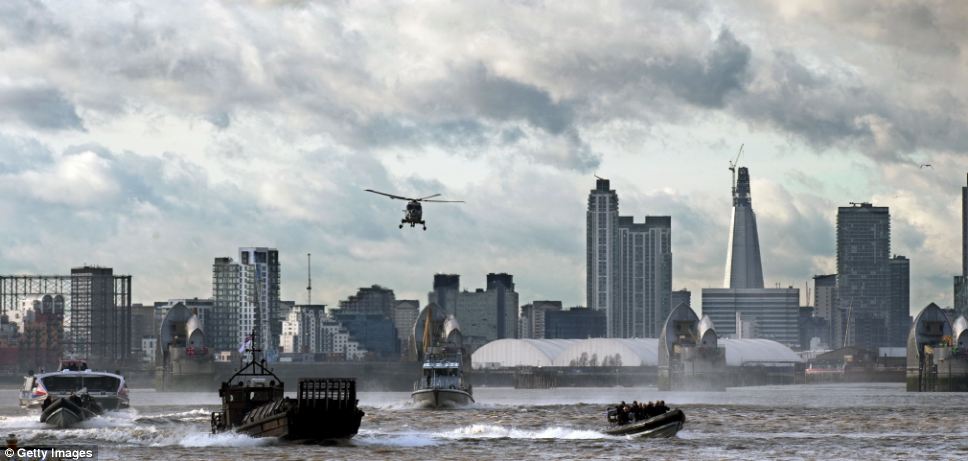
Royal Marines and Scotland Yard took command of the River Thames yesterday in a determined show of strength as part of a security exercise for the London Olympics called Operation Woolwich Arsenal Pier.
Elite military and police teams joined forces in a combined exercise to give a glimpse of the sheer scale of the Britain’s biggest peacetime security operation yesterday.
The British forces show was designed to test the water for the joint operation, and to illustrate the country’s readiness against terrorism.
Around 100 marines and 50 officers rehearsed a string of high-speed drills amid fears attackers could use the waterways to launch onslaughts on London landmarks.
About 50 marine police officers in rigid inflatables and fast response boats were joined by up to 100 military personnel and a Royal Navy Lynx helicopter for the exercises.
Assistant Commissioner Chris Allison, head of the force’s security operation for the Games, said a Mumbai-style terror attack was one of a host of potential threats to the games.
Royal Marines and Scotland Yard took command of the River Thames yesterday in a determined show of strength as part of a security exercise for the London Olympics called Operation Woolwich Arsenal Pier
Speaking on the shores of the Thames, Chris Allison said: “There is no specific threat from the river but we would be failing in our duty to ignore it at games time.
“What you have seen today is the sort of things we can do.”
Despite a heavy military presence on show today, Chris Allison insisted the sporting event would remain a “blue games”.
The Thames runs directly past the O2 Arena, which will be known as the North Greenwich Arena for the purpose of the Games, when it will host events including gymnastics.
The river will also be used to transport tourists between venues via water buses and a new cable car.
Typhoon jets and HMS Ocean, the largest ship in the Royal Navy’s fleet, will eventually be deployed to protect the London 2012 Games along with up to 13,500 military personnel.
“If we need the military support, it is there,” Chris Allison said.
“All of our planning is designed to mitigate against potential risks during the summer of 2012, and this is an example of where we will be using specialist military capability to support us.
“This exercise is not in response to any specific threat, but is part of our planning to pre-deploy certain specialist assets to bolster our operation.
“This will be a summer like no other in London. The Thames runs through the very heart of our capital and will be a popular place for people who want to be part of the Olympic spirit.
“This is all part of our planning to ensure this summer’s events take place safely and securely.”
A Chinese recruit has to stand and take a bottle smashed over her head if she wants to qualify as one of country’s first female bodyguards.
The female bodyguards training session, which took place in Beijing, involved 20 women, most of whom are university graduates.
The four-week programme is run by trainers from Tianjiao Special Guard Consultant Ltd and is the first open group training for female bodyguards in China.
Each trainee goes through ten months of instruction to develop her skills in reconnaissance, anti-terrorism training, martial arts and business etiquette.
The female bodyguards training session, which took place in Beijing, involved 20 women, most of whom are university graduates
The best individual from the class is also invited to study further at the International Security Academy in Israel.
With the booming economy in China and increasing wealth sparked by high demand for Chinese goods and materials, demand for bodyguard services had risen dramatically on the Chinese mainland.
Graduates of bodyguard courses can look forward to a well-paid career if they are recruited by wealthy businessmen.
That is especially the case for women, who are in high demand because they are less visible than their male counterparts and because they can assume roles such as secretary or nanny.
Female bodyguards are often paid far better than male counterparts – up to $100 a day – because they can adopt these different roles. The average annual wage in China is just $1,500.
The boom in China has also seen a rise in the growth of wealthy women, who prefer female bodyguards because their presence does not raise questions of potential relationships.
Ryan Brunn, the man sentenced to life in prison for beating and killing 7-year-old Jorelys Rivera, who was found in a trash bin, has committed suicide in his jail cell.
Ryan Brunn, 20, was found unresponsive at the Jackson State Prison today and was later pronounced dead at a hospital, the Atlanta Journal Constitution reported.
Kristen Stancil, a spokeswoman for the state Department of Corrections said:
“I can confirm that Ryan Brunn did commit suicide.”
Ryan Brunn killed himself by hanging, a source told 11Alive News.
He had pleaded guilty on Tuesday to several charges including murder and child molestation in the December 2 killing of Jorelys Rivera.
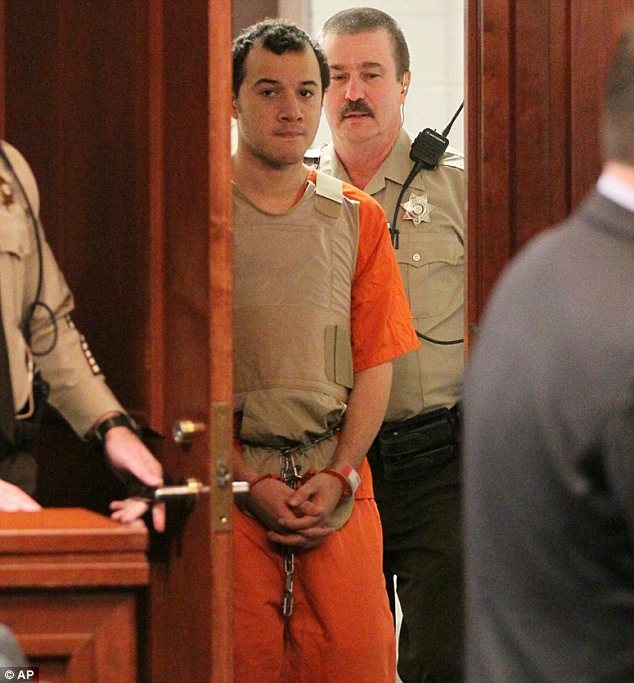
Ryan Brunn, the man sentenced to life in prison for beating and killing 7-year-old Jorelys Rivera, has committed suicide in his jail cell
Ryan Brunn responded “Yes, sir,” when a judge asked if he was pleading guilty to several charges. The judge accepted his plea and sentenced him to life without parole.
“I’d like to apologize for everything that’s done. Lo Siento,” Ryan Brunn said, apologizing in Spanish as he took the stand briefly a second time.
Ryan Brunn said he chose Jorelys Rivera because he happened to find her roller skate and used it to lure her to a vacant apartment, where he killed her, he told the judge.
He said he first sexually assaulted her.
“I didn’t want her to go home and tell her mom or dad on me. So I cut her,” he told the Cherokee County judge.
Police say Ryan Brunn snatched Jorelys Rivera as she walked from the playground to her apartment to get sodas for her friends.
Ryan Brunn was being held without bond at the Cherokee County jail. His family has said he is innocent. The charges carried the possibility of a death sentence if convicted, but prosecutors had not decided yet whether to seek it.
Ryan Brunn has no known criminal past and he cleared background checks by the company that runs the apartment complex where he had been working about a month.
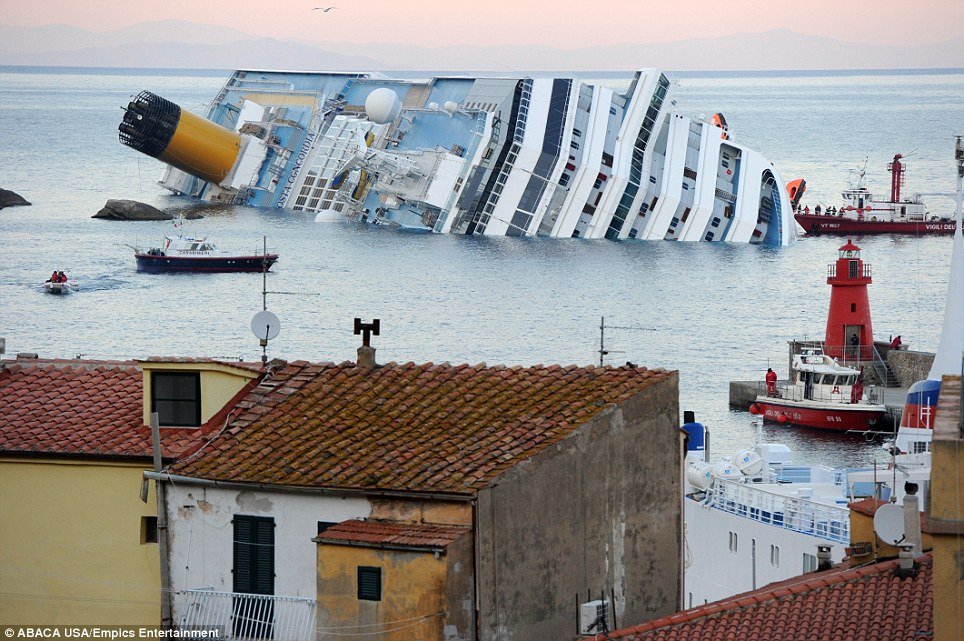
A new amateur video has emerged showing the crew of the Costa Concordia cruise ship reassuring passengers nothing was wrong, after the vessel had begun taking in water.
In the footage, a crew member says “everything is under control” and asks passengers to go to their cabins.
It is thought the delay in deciding to abandon the ship may have cost lives. At least 11 people died.
Rescue workers have suspended their search once again after the ship shifted in choppy waters on Friday.
The boat’s movements have twice before hampered the work of rescuers, with the search suspended almost all day on Wednesday.
The ship may have only moved by a metre or as little as a few centimetres, but officials fear it could suddenly slip into much deeper water.
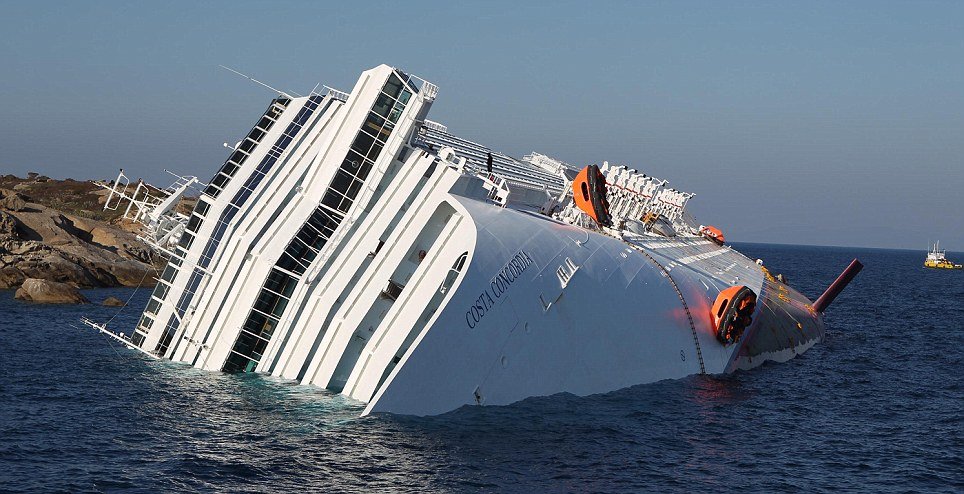
A new amateur video has emerged showing the crew of the Costa Concordia cruise ship reassuring passengers nothing was wrong, after the vessel had begun taking in water
The Costa Concordia ran aground off Italy’s coast a week ago with some 4,200 people on board.
Twenty-one people are still missing, and hopes to find any of them alive are fading fast.
The latest amateur footage was posted online by Italy’s Rainews24 on Thursday.
In it, a female crew member is heard telling passengers: “We kindly ask you to return to your cabins, or go for a walk in the hall, if you like.”
She says that she is relaying a message from the commander.
“We’ll resolve the electrical problem that we have with the generator. Everything will be fine. If you want to stand here, it’s fine.
“But I’m kindly asking you to go back to your rooms, where you’ll be seated and tranquil. Everything is under control.”
In the audio tape aired earlier on Thursday, a port authority officer is heard asking the crewman about the situation on board, after passengers had reported a huge jolt and been told to put on life vests.
But an unidentified voice from the Costa Concordia replies: “We had a blackout and we are checking the conditions on board.”
“Do you need help or are you staying in the Giglio area for now?” the port official asks.
“Confirmed. We remain here in the area to check the blackout,” the crew member replies, without making any reference to a crash.
The impression left by the recording is that the crewman failed to give a full account of the gravity of the situation.
The ship’s captain, Francesco Schettino, is under house arrest on suspicion of multiple manslaughter.
The Costa Concordia owners say he was sailing too close to Giglio on an unauthorized course.
Prosecutors have also accused Francesco Schettino of fleeing the ship before evacuation was complete. He denies the accusations.
However Italian media have said Captain Francesco Schettino did admit to making a navigational error.
He told investigators he had “ordered the turn too late” as the luxury ship sailed close to an island, according to a leaked interrogation transcript.
Francesco Schettino also reportedly said the crew had decided to sail close to the island to salute a former colleague.
The company that owns the ship, Costa Cruises, has suspended Captain Francesco Schettino and withdrawn an offer to pay his legal costs, according to reports.
Italian media have also shown pictures of a Moldovan woman, identified as Domnica Cemortan, who says she was on the bridge after the ship ran aground. The woman defended Captain Francesco Schettino’s actions, in an interview with Moldovan TV.
The reports say investigators are trying to speak to her.
Salvage operators are standing by to start pumping fuel from the ship’s tanks to avoid a potential environmental disaster.
Scientists say there may be no such thing as a “G-spot” after all.
G-spot was first described in western medicine by Dr. Grafenberg in 1950, the bean-shaped area of the vaginal wall is supposed to guarantee a female orgasm as soon as it is stimulated.
Earlier Indian texts such as the Kama Shastra seem to support this claim, describing a sensitive area in the vagina that induces great pleasure.
A study published in The Journal of Sexual Medicine, has cast doubt on whether G-spot erogenous zone exists at all.
Researchers, led by Dr. Amichai Kilchevsky, from the Yale-New Haven Hospital in Connecticut, studied nearly 100 peer-reviewed articles published on the subject published during the past six decades. These included clinical trials, case reports and reviews.
They found that none could conclusively prove that the mythic G-spot zone exists and that the strongest evidence remains anecdotal.
G-spot was first described in western medicine by Dr. Grafenberg in 1950, the bean-shaped area of the vaginal wall is supposed to guarantee a female orgasm as soon as it is stimulated
One 2008 study, which used ultrasound imaging to survey the vaginal wall said women who reported having orgasms had thicker tissue in the G-spot area than women who didn’t. However, Dr. Amichai Kilchevsky’s team found other imaging studies couldn’t confirm this finding.
They also reported inconclusive results from tissue biopsies, with some studies reporting more nerve endings in the “G-spot area” while others found fewer.
Meanwhile a 2010 study, found the clitoris – a known erogenous zone – dropped during sex so that it was closer to the vaginal wall.
A team lead by Dr. Odile Bouisson suggested pressure on the wall could actually be indirectly stimulating the clitoris, thereby enhancing the sensation of pleasure.
The authors concluded: “Objective investigative measures have failed to provide strong and consistent evidence for the existence of an anatomical site that could be related to the famed G-spot.”
The surveys revealed that while a majority of women believe the G-spot exists, there were many who had been unable to locate it.
They postulated that the myth of this other arousal zone may enjoy wide credence today because the G-spot term was coined in the 1980’s at a time of sexual liberation in western society.
Dr. Amichai Kilchevsky said he hoped their findings would take the pressure off women who find it difficult to orgasm.
His team added that couples shouldn’t give up all hope.
“Reliable reports and anecdotal testimonials of the existence of a highly sensitive area… demand further consideration,” they said.
Sarah Burke, the Canadian freestyle skier, has died from injuries sustained in a training accident, a family spokeswoman says.
Sarah Burke, 29, helped bring freestyle skiing events to the Winter Olympics, and was considered a gold medal contender for the 2014 Games.
The Canadian freestyle skier was injured in a superpipe accident at Park City in the US state of Utah.
Tests showed Sarah Burke sustained “irreversible damage to her brain” her spokeswoman said.
Sarah Burke, the Canadian freestyle skier, has died from injuries sustained in a training accident
Sarah Burke was airlifted to hospital after her crash on 11 January.
Sarah Burke, the four-time Winter X Games champion crashed on the same superpipe where snowboarder Kevin Pearce suffered a traumatic brain injury during a training accident in late 2009.
The best-known athlete in her sport, Sarah Burke specialized in skiing the superpipe – a version of a traditional halfpipe with walls over 5 m (16ft) high.
“Sarah, in many ways, defines the sport,” Peter Judge, chief executive of Canada’s freestyle team, said before she died.
“She’s been involved since the very, very early days as one of the first people to bring skis into the pipe.”
“She’s also been very dedicated in trying to define her sport but not define herself by winning. For her, it’s been about making herself the best she can be rather than comparing herself to other people.”
A native of Midland, Ontario, Sarah Burke won was named female action sports athlete of the year by TV network ESPN in 2007.
Sarah Burke tore her vertebral artery as a result of the fall, which led to severe bleeding on the brain. That caused her to go into cardiac arrest on the scene, where CPR was performed.
“The family expresses their heartfelt gratitude for the international outpouring of support they have received from all the people Sarah touched,” Nicole Wool, her spokeswoman said.
Sarah Burke’s organs and tissues were donated as per her wishes.
The sport’s leaders defend the safety record of the superpipe and other freestyle events, pointing to requirements for mandatory helmet use, air bags on the sides of pipes during practice and better pipe-building technology.
“There are inherent risks in everything,” Peter Judge said prior to her death.
“Freestyle is a very safe sport in large part because we had to build a safe sport in order to get into the Olympics.”
Italian media reported today that a mystery woman was on the bridge alongside cowardly captain Francesco Schettino when Costa Concordia cruise ship ran aground off Giglio island on Friday night.
The blonde woman is a 25-year-old Moldovan crew member who was not properly identified by investigators as she reportedly did not appear on any official manifest for the Costa Concordia.
The woman was identified as passenger rep Domnica Cemortan, possibly hired without a proper contract. Reports speculated she may have been on the bridge because Captain Francesco Schettino was trying to impress her.
Prosecutor Francesco Verusio had asked police to try and trace the woman, pictured on the doomed Costa Concordia just before it left Civitavecchia harbor on the evening it ran aground.
Domnica Cemortan is swiftly emerging as a key witness to the chain of events up until the liner struck an underwater reef just off the island of Giglio.
Witnesses have said that she appeared to know Francesco Schettino.
But a statement from Costa Cruises later confirmed Domnica Cemortan was an authorized passenger.
The statement said: “Costa Cruises would like to clarify that the law as it stands, safety regulations and the control systems applied meticulously by the company do not permit the embarkation of unregistered passengers.
“Based on the pictures broadcast by the media, the woman stated as being in the company of Captain Schettino on the evening of January 13th was certainly embarked on January 13th in Civitavecchia and duly registered.
“The company is ready to provide the authorities, when requested, with the identity of the person and the number of the ticket purchased.”
Investigators want to find out where Domnica Cemortan was at the moment the Costa Concordia hit the rocks.
Domnica Cemortan, from Chisnau, Moldova, was working as a passenger rep for Costa Cruises
There is also the possibility Domnica Cemortan would have key evidence on what happened in the moments after the fatal “sail by” which was apparently carried out by Francesco Schettino as a “salute” to a former captain.
It is believed that Domnica Cemortan, from Chisnau, Moldova, was working as a passenger rep for Costa Cruises and gave a brief interview to the media defending Francesco Schettino, adding that his actions had helped save the lives of holidaymakers and crew.
Domnica Cemortan has also said in an interview on Moldovan TV that she did have dinner with the captain, but that she went to the bridge after the impact to give instructions to Russian speaking passengers.
Italian newspapers suggested that she was the blonde woman seen dining with Francesco Schettino at around 9:00 p.m. – just under 30 minutes before the disaster – but there is also the possibility she may have been the guest of another officer on the liner.
Last night in a bizarre twist a male passenger had to be taken off the Costa Concordia’s sister ship Serena after suffering a heart attack as the liner sailed past Giglio at the start of a seven-day cruise.
Searching has resumed on the stricken vessel with divers focusing primarily on the stern by the deck four restaurant muster station, where the majority of the 21 people still listed as missing were thought to be.
A team of medical scientists, led by a cell biologist from Dana-Farber Cancer Institute in Boston, Bruce M. Spiegelman, discovered a hormone, called irisin, that appears to increase fat burning and to improve glucose homeostasis.
These findings might play a great role in fighting obesity and controlling hypertension and type 2 diabetes.
The study was published this month in Nature, International weekly journal of science.
Irisin is produced by muscles during the exercise and has the ability to convert white adipose cells into a brown-fat-like development.
“It has powerful effects on the browning of certain white adipose tissues,” cell cultures as well as in living animals, the researchers wrote.
The white fat is the “bad fat” that makes the belly look unaesthetic, and, worse, can clog the arteries leading to heart attack or stroke. Brown fat is the “good fat” that can easy be transformed in energy, leaving no trace. Brown fat can be found in young mammals, as well as in children. As you grow older, the brown adipose cells diminish.
“We knew the effect wasn’t only limited to muscle,” said Pontus Bostrom, cell biologist at Harvard and member of the team.
“There has been a sensation in the field that work out ‘talks to’ various tissues in the human body. But the problem has been, how?” said Bruce Spiegelman.
Researchers found out that exercise can increase the expression of a membrane protein (FNDC5) from what irisin is produce.
They have studied mice that were let to do three weeks of free-wheel running. Irisin levels arised by 65 percent. In the persons who underwent ten weeks of “supervised endurance exercise training,” irisin levels doubled.
The team introduced into obese mice bodies (mice fed with a high-fat diet) viruses carrying a synthesized gene. This gene triggered a cascade of reactions leading to an increased secretion of irisin. Even a short course of FNDC5 and a small increase in irisin levels led to some weight loss. Fat burning increased like after exercising, growth hormone levels were elevated, blood sugar levels (glycemia) were lowered. Their muscles consumed more oxygen (burned more calories), their growing insulin resistance was reversed and their glucose tolerance was improved.
The medical scientists injected those mice with anti-FNDC5 antibodies to stop the secretion of irisin, and as a result after ten days of swim training they had the same weight.
Irisin might make the way to lose weight more easy.
Irisin seems to be a promising remedy for diabetes, obesity, and probably neurological disorders as Parkinsons.
“In the future, we hope to be able to give this as a therapeutic to treat metabolic diseases, but there’s a long road ahead,” said Pontus Bostrom.
The medical team wants to find out if long-term treatment with irisin can lead to more weight loss and control obesity-related conditions (hypertension, heart disease, diabetes).
“Whether long treatments with irisin an/or higher doses would cause more weight loss remains to be determined,” wrote the researchers.
However, even as a treatment or a dietary supplement, this hormone will be able to help a person to lose weight in an easier manner, but it cannot replace the exercise.
“The very last factor in the planet we’re striving to do is substitute for diet and workout,” said Spiegelman.
Regular exercise leads to improvements in metabolic function and other processes (such as inflammation) that obesity aggravates.
Irisin was named after the Greek messenger goddess, Iris, it is a way to say that this hormone carries a message of health throughout the body.
RoseMarie Terenzio, John F. Kennedy Jr.’s assistant, has revealed how she talked his wife Carolyn Bessette into taking the flight the couple perished on 12 years ago.
RoseMarie Terenzio, 44, was JFK personal assistant, publicist and one of his closest confidantes during the last five years of his life.
In her book, “Fairy Tale Interrupted”, RoseMarie Terenzio reveals that the couple was having serious troubles in their marriage and Carolyn Bessette had initially refused to join JFK on that ill-fated flight on July 16, 1999.
With their marriage under intense strain, Carolyn Bessette, a Calvin Klein executive, who struggled with the constant media attention her husband attracted, had said she was not going to join him at his cousin Rory’s wedding on July 17.
JFK Jr.,39, who ran George magazine, had told RoseMarie Terenzio that Carolyn Bessette was determined to stay at home and that he was not “going to fight with her about it”, she recalls in People Magazine.
But RoseMarie Terenzio tried to change her mind.
“<<I’m not a priority>>, she said. <<It’s always something else. George. Somebody getting fired. A trip to meet advertisers. I just want some normal married time. I’m exhausted>>” RoseMarie remembers Carolyn Bessette telling her.
But RoseMarie Terenzio said she urged Carolyn Bessette to take the flight and go to the wedding in Massachusetts.
“I know. But now’s not the time to take a stand. His whole family’s going to be at this wedding. Listen. You don’t want to put yourself in a position of being judged, you get enough of that.
“Go get a dress and I’ll get you a car to the airport.” RoseMarie Terenzio told her, according to People.
In her book, “Fairy Tale Interrupted”, RoseMarie Terenzio reveals that the couple was having serious troubles in their marriage and Carolyn Bessette had initially refused to join JFK on that ill-fated flight on July 16, 1999
As he left, JFK Jr. had thanked RoseMarie Terenzio was talking Carolyn Bessette around.
“He turned to me and said, <<Rose you’re the best. Thanks for smoothing things over>>.”
Hours later, JFK Jr.’s plane crashed in the Atlantic Ocean near Martha’s Vinyard, Massachusetts killing him, Carolyn Bessette and her sister Lauren.
After the tragic, untimely deaths, RoseMarie Terenzio said her whole world came crashing down around her, along with her hopes for the future.
“I don’t feel responsible for what happened, but I will certainly always have the feeling that I should have kept my mouth shut and not told Carolyn to get on the plane,” said RoseMarie Terenzio reports People magazine.
Only now as the head of her own public relations company, is RoseMarie Terenzio finally ready to tell her story, giving a very real insight into the lives of the tragic couple.
“John was more than a mannequin of good looks and privilege; Carolyn was not this uptight, cold and guarded person,” RoseMarie Terenzio told People magazine.
Writing the book “felt like paying tribute to them. It felt really good.”
In her book, RoseMarie Terenzio reveals JFK Jr. and Carolyn Bessette’s sometimes tumultuous relationship and the strain Carolyn felt from the constant media attention after their secret wedding in September 1996.
“Whenever she went out – to get coffee, walk the dog, or meet a friend – they were there, pushing in close and shouting things like wh*re and b**ch. If they could break her perfect exterior, it would be an instant story,” RoseMarie Terenzio says in the report by People.
“Carolyn retreated into herself. Unfortunately John didn’t understand. <<Just don’t pay attention to it. I don’t>>, he said.
“I knew that John’s dismissive attitude was due to his frustration. He couldn’t protect his wife. He should have told her as much – I know she really wanted to hear it,” RoseMarie Terenzio added.
The book also gives an insight into the couple’s more loving relationship and how JFK Jr. proposed to Carolyn Bessette on a fishing trip.
RoseMarie Terenzio revealed to People: “The couple teased each other a lot, one Valentine’s Day there was some tabloid story about him cheating, so she sent him flowers from all these famous models and actresses, like Pamela Anderson. He thought it was hilarious.”
JFK Jr.’s former assistant added that she felt the marriage became strained because they struggled to find “peaceful marriage time” amongst the media frenzy and the magazine struggling.
RoseMarie Terenzio also delves into how she planned the couple’s secret wedding on Georgia’s Cumberland Island as well as their tragic funeral and how she struggled to cope with their deaths.
Football’s world governing body, FIFA, has insisted beer must be sold at all venues hosting matches in the 2014 World Cup in Brazil.
FIFA General Secretary Jerome Valcke said the right to sell beer must be enshrined in a World Cup law the Brazilian Congress is considering.
Alcoholic drinks are currently banned at Brazilian stadiums and the country’s health minister has urged Congress to maintain the ban in the new law.
Brewer Budweiser is a big FIFA sponsor.
Jerome Valcke is visiting Brazil to press for progress on the much-delayed World Cup law.
FIFA has become frustrated, because voting on the legislation has been held up in Congress by the dispute over alcohol sales.
FIFA has insisted beer must be sold at all venues hosting matches in the 2014 World Cup in Brazil
The Brazilian government has also failed to resolve differences with FIFA over cut-price tickets for students and senior citizens, and demands for sponsors of the World Cup to have their trademarks protected.
In remarks to journalists in Rio de Janeiro, Jerome Valcke sounded frustrated with Brazilian officials.
“Alcoholic drinks are part of the Fifa World Cup, so we’re going to have them. Excuse me if I sound a bit arrogant but that’s something we won’t negotiate,” he said.
“The fact that we have the right to sell beer has to be a part of the law.”
Alcohol was banned at Brazilian football matches in 2003 as part of attempts to tackle violence between rival football fans.
But the measures have had limited impact.
In order to drink, supporters tend to stay longer outside stadiums, areas that are harder to police than inside.
Much of the football violence in Brazil stems from club rivalries. Fans who follow the national side tend to be wealthier and include more women and families.
Health Minister Alexandre Padilha and other members of Congress have called for the ban to be maintained.
Jerome Valcke said negotiations with Brazil over details of the World Cup had been slow.
“We lost a lot of time and we were not able to discuss with people in charge that are willing to make a decision,” he said, adding that it was the first time a country was still in talks five years after winning the right to host the tournament.
During his visit to Brazil, Jerome Valcke has been touring the stadiums in 12 cities where the 2014 World Cup will be played.
Jerome Valcke criticized the pace of construction and said Brazil had not yet improved its infrastructure to the level needed to welcome visitors.
A 26-year-old Australian man has been seriously wounded in a shark attack while was swimming off Coral Bay beach, in the third such incident this month.
According to Australian police, the man was swimming off Coral Bay beach when a 10ft (3 m) tiger shark bit his arm.
The attack came one day after a surfer was seriously injured in a shark attack north of Sydney.
Shark attacks in Australia average about three a year, and this month’s spate of incidents is unusual.
Medics say the injuries of the man attacked on Thursday are not life-threatening and his condition is stable.
A 26-year-old Australian man has been seriously wounded in a shark attack while was swimming off Coral Bay beach, in the third such incident this month
In Wednesday’s attack, the man was set upon near Newcastle, 125 km (80 miles) from Sydney. Witnesses believe a great white or bull shark was involved.
On 4 January, another surfer survived a shark attack in the city of Gosford, north of Sydney.
In October, a great white shark killed a US diver in what was thought to be the second fatal shark attack in Western Australia in 12 days.
Shark attacks in Australia have caused 27 deaths in the last 22 years.
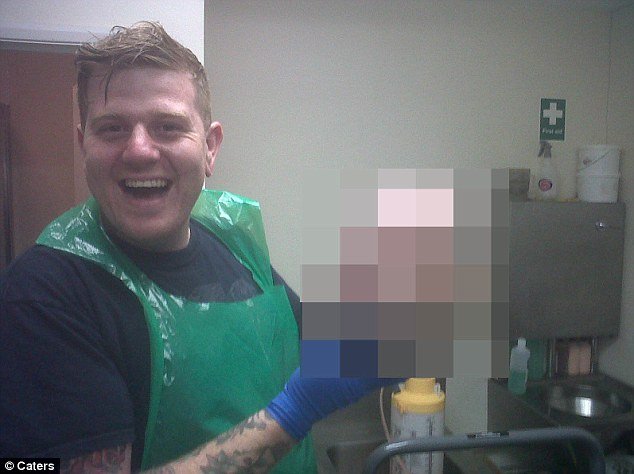
A disturbing picture found on a mobile phone showing an embalmer laughing as he holds aloft a severed head was today at the centre of a police investigation in UK.
The image, which features a man named as David Amor smirking at the camera, was on a phone found in a ditch in Aylesbury, Buckinghamshire, by two young children over the weekend.
It is one of three images on the phone that show the decapitated body, believed to have been hit by a train.
The sickening shot is understood to have been taken as 26-year-old David Amor worked in a mortuary to preserve the body of the dead man until his funeral could take place.
Police yesterday launched an investigation into the shocking images.
Chief Inspector Olly Wright from Aylesbury Vale police, said: “The incident is being treated seriously and while we carry out our initial investigation we feel it would be inappropriate to speculate as to the circumstances in which this photo was taken.”
Officers were in the process of seizing the mobile phone so that they could examine the pictures further.
A spokesman added: “We are looking into this to establish whether any offence has taken place.”
The phone was found by a brother and sister, aged 12 and 10, who gave it to their father.
The father, in an attempt to identify the owner, removed the SIM card and put it in his own computer.
He said: “It’s like when you find a wallet, you look inside to see if there’s anything to say who it belongs to.
“However, after finding that, I don’t want to get in touch with this guy. It’s a total lack of respect for the dead.
“That was probably someone’s father, someone’s son and someone’s brother, it’s unbelievable to think they could do that to someone.”
The sickening shot is understood to have been taken as 26-year-old David Amor worked in a mortuary to preserve the body of the dead man until his funeral could take place
The father-of-two, who asked not to be named, described how his children screamed and ran out of the room when the images appeared on his computer.
Also on the phone were lists of David Amor’s appointments and an electronic business card for his embalming business.
David Amor advertises his services at £50 ($80) for “straight cases”, and £60 ($930 for “PM” cases.
Embalming is the process by which bodies are preserved so they can be displayed at the funeral.
“At first I wasn’t sure if it was real, until I started clicking through the rest of them,” said the father.
“It’s really upset my daughter, she doesn’t want to talk about it or go near the phone, she’s really traumatized.”
David Amor states on a social networking site that his place of work is Amor Embalming.
He is understood to live with a cross-dresser, David Hill, in Aylesbury.
When questioned at his home, david Hill refused to comment about the pictures.
Wearing what looked like a blond wig and accompanied by another person who also looked like a man dressed as a woman, he shouted: “We don’t want to make a comment. No comment. Go away or we are calling the police.”
Neighbours last night described David Amor’s actions with the severed head as “vile”.
“It’s disgusting,” said one man. “They live here now and I hope it will be <<lived here>> soon.”
A spokesman for the British Institute of Embalmers, who have no record of David Amor, described his behavior as a “shocking” and said the relatives of the dead man would be “appalled”.
Members of the BIE abide by a strict code of ethics that included treating every body with respect, they added.
“If it was one of our members, they’d be on a disciplinary, and thrown out of the institute” said the spokesman.
“There’s no legal requirement to register as an embalmer, and once somebody has done some sort of training they can work as an embalmer.”
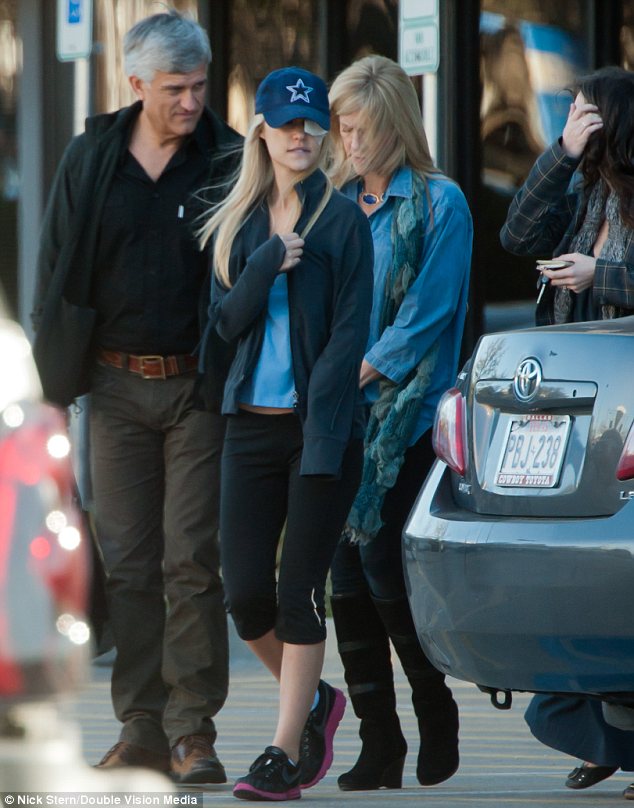
Lauren Scruggs, the model and fashion blogger who lost her left hand and left eye after she walked into a spinning plane propeller, has been pictured in public for the first time since the horrific accident.
Lauren Scruggs was spotted leaving a hospital in Dallas, where she has been recovering since the accident, with her parents on Tuesday.
The 23-year-old model is said to be doing well despite her appalling ordeal, and she looked in good spirits as she faced the camera again.
As she walked rigidly upright wearing stylish sneakers, pedal-pushers and a blue halterneck top, Lauren Scruggs also had a baseball cap pulled down over her face, hiding her bandaged left eye.
Lauren Scruggs was spotted leaving a hospital in Dallas, where she has been recovering since the accident, with her parents on Tuesday
Lauren Scruggs’ left sleeve was left hanging unobtrusively down by her side, to avoid drawing attention to her injury.
Her public appearance comes after it was revealed that the pilot of the plane which injured her tried to warn her to avoid the propeller.
Curt Richmond revealed to air safety officials that he put his arm up and yelled at Lauren Scruggs as she tried to walk in front of the plane on December 3 at Aero County Airport in McKinney, Texas.
Curt Richmond, who has not spoken publicly about the accident, said the plane’s engine was still running and he told the young woman to walk behind the plane and out of harm’s way.
The pilot put down his arm and turned away from Lauren Scruggs when he thought she had turned to walk away from the spinning propeller, according to a report from the National Transportation Safety Board.
But it’s unclear whether Lauren Scruggs heard his warning over the roar of the engine.
Moments later, someone on the ground screamed “Stop! Stop!” and Curt Richmond saw Lauren Scruggs laying on the tarmac. He immediately cut the engine.
Investigators say Lauren Scruggs walked into the whirling propeller blades on the front of the plane after a 30-minute plane ride to look at Christmas lights from the sky.
Curt Richmond, believed to be a friend of Lauren Scruggs’, had left the engine running while new passengers filed into the small plane as he prepared another trip to the skies.
The NTSB did not find fault with the pilot for the accident but at least one aviation expert said Curt Richmond is ultimately responsible.
“The bottom line is, he should have shut the engine down,” air safety investigator Denny Kelly said.
“The bottom line is he made a mistake.”
Lauren Scruggs, who has been recovering in hospital since the accident, wrote on the LoLo magazine website for the first time earlier this month.
The model said: “I don’t know how to thank each one of you, properly, for so much love during this difficult incident in my life. My heart is so grateful beyond what I could ever imagine.
“So thank you dearly for the sweet encouragements, the precious words in letters and messages, the beautiful grace in pretty presents, but mostly I am so so thankful for you and your loving hearts and sweet spirits.”
Lauren Scruggs, a communications graduate who is known to her friends as Lo, had just got off of the plane after viewing Christmas lights from above Dallas when the tragedy struck.
She has been in intense rehabilitation ever since.
Lauren Scruggs made her first trip outside the hospital last week, taking a break from her four-and-a-half weeks of intense rehab.
Her mother, who has updated her daughter’s progress on the CaringBridge account, wrote of their visit to Whole Foods: “We had many complete strangers stop us, with tears in their eyes, saying they have been praying for Lo and for our family.”
She recently posted that her daughter is adjusting to her new life and that simple tasks such as “typing an email” are heightened.
“Many have told us how the accident has them seriously thinking about how important God needs to be in their lives, or how it has helped them refocus where they have gotten off track in their spiritual walk.”
In addition to losing her hand and eye, Lauren Scruggs suffered from brain injuries and scaring to half of her face.
Doctors removed her left eye on December 15 and since then she has been in intensive therapy to relearn how to walk, talk, use a stationary bike and even dress herself.
Friends, family and members of the community have so far raised $10,000 to help with her medical bills.
Most recently Lauren Scruggs’ twin sister Brittany Morgan reported feeling sympathetic pain in her own left eye.
“Being twins, and having a bond that most never understand, Britt’s left eye has been twitching for the last 4-5 days every 30 seconds or so,” their mother wrote late last month.
“She knows it’s because of the deep connection she and Lo have, and God allowing her to go through this with her at the <<twin>> level.”
In the build-up to the holiday, Lauren Scruggs’ mother reported her daughter/stylist and fashion blogger’s further strides in her recovery.
She managed to cook scrambled eggs, dress herself, brush her teeth and her hair and take a shower without help, her mother wrote on the webpage.
“Lo is making remarkable strides!” Lauren Scruggs’ mother wrote.
“Her spirit is incredible. She’s positive, hungry and cheery! Her appetite is very healthy, even though she is still taking lots of pain medication.”
December 3rd 2011: Lauren Scruggs walks into an aeroplane propeller at Aero County Airport in McKinney, Texas. She is hospitalized with serious injuries.
December 5th: Lauren Scruggs talks for the first time since the accident, saying her name and telling her family: “I love you.”
December 7th: Lauren Scruggs takes her first steps, but is still being operated on.
December 8th: Lauren Scruggs sees her face in the mirror and says: ‘It’s not that bad.’
December 10th: Lauren Scruggs smiles and raises her eyebrows, showing that her facial nerves were not as badly damaged as was initially feared.
December 12th: Lauren Scruggs is back on solid foods and eats sweet potatoes and hard-boiled eggs.
December 14th: Doctors operate on Lauren Scruggs to remove her left eye, usually a very painful operation.
January 3rd 2012: Lauren Scruggs leaves hospital for the first time, taking a trip to Whole Foods with her mother.
January 9th: Lauren Scruggs returns to her website, LoLo, to post a message of thanks for her supporters, family and friends.
The Italian rescue teams have decided to resume their work aboard the wrecked cruise ship, Costa Concordia, off the coast of Tuscany.
Operations were suspended on Wednesday as Costa Concordia shifted its position. More than 20 people are still missing.
Salvage operators are standing by to start pumping fuel from the ship’s tanks to avoid a potential environmental disaster.
Costa Concordia cruise ship ran aground on Friday with some 4,200 people on board, tourists and crew. At least 11 people were killed.
The bodies of two French victims have been identified by relatives, the French embassy in Rome confirms, AFP news agency reports.
Rescue workers have now almost completed their investigation of the fourth level of the ship.
Earlier, coastguard spokesman Filippo Marini said the ship had been stabilized.
“The tests during the night were positive and we have divers going down now,” Filippo Marini told reporters, AFP news agency says.
“We will then use the micro-explosives to open more holes. They will enter inside the ship and search for more people.”
A specialist team from a Dutch salvage company is preparing to pump more than 2,300 tons of fuel from the ship’s 17 tanks.
Mike Lacey, of the International Salvage Union, says the operation could take some time.
“[The fuel] is spread around 17 tanks. The quantities in each tank will obviously be different, and the people there involved in the operation of removing the oil are experts at this sort of thing – and they know exactly what to do,” Mike Lacey.
“They’ll be drilling into each tank, and pumping the oil out and putting it into a barge or a coastal tanker or even a tug.
“These things are all very weather-dependent. If the weather turns against them, then they won’t be able to work. So I understand they expect to take a week to two weeks to get all the fuel off.”
Costa Concordia cruise ship ran aground on Friday with some 4,200 people on board, tourists and crew
Some 300 Philippine crew members of the Costa Concordia have arrived back in Manila.
They looked visibly shaken by their ordeal.
Some crew members said they did their job well, making sure their passengers were safe, but found the captain and officers had already left the ship by the time the “abandon ship” message was given. They said they felt angry and let down.
“It’s… horrible because it is supposed to be the captain to [be] the last one to stay on the ship if there is a collision like this and not the passengers and the crew members,” said Andrew Bacud, a steward on the ship.
On Wednesday, the first of the 11 confirmed dead to be identified was a 38-year-old Hungarian violinist, Sandor Feher.
His body was found in the wreck and identified by his mother.
The ship’s captain, Francesco Schettino, has yesterday admitted to making a navigational error, Italian media reported.
Francesco Schettino told investigators he had “ordered the turn too late” as the luxury ship sailed close to an island, according to a leaked interrogation transcript.
Captain Francesco Schettino is under house arrest on suspicion of multiple manslaughter. Prosecutors have also accused him of fleeing the ship before evacuation was complete.
New filmmaking talents are expected to submit their short films (up to 15 minutes in length) between February 2 and March 31 for YouTube’s Your Film Festival.
The contest launches at the Sundance Film Festival in Park City, Utah which opens January 19.
“YouTube is committed to bringing entertaining, original content to a global audience and Your Film Festival is another example of our investment in great creators worldwide. Through this programme, YouTube will give filmmakers the opportunity to reach a vast audience, screen their work during the Venice Film Festival and potentially be rewarded in a career-changing way,” said Robert Kyncl, global head of content at YouTube.
Everyone who is at least 18 years old can enter the contest and make the film about any subject in whichever genre, but the work submitted for the contest can’t have been distributed prior to January 1, 2010. International films will have subtitles added. Admission is free.
Your Film Festival is particulary aiming to reward young filmmakers and producers.
“We’re looking for stories in any genre or format. So that can be short film, live-action or documentary or a web series episode. The sky’s the limit as long as it’s story-driven. What we’re really trying to do is find the best stories in the world and find the best storytellers and connect them with a global audience on a scale that hasn’t been available to them before. We’re really excited about it,” said Nate Weinstein, entertainment marketing manager for YouTube.
Fifty semi-finalists, ten from five geographic regions, will be selected by Scott Free Productions, the film and television production company founded by Ridley and Tony.
The films will make a channel on YouTube (www.YouTube.com/yourfilmfestival) and the users will be able to vote them in June. The first 10 filmmakers (two from each region) will have the chance to present their creations at the 69th Venice International Film Festival in August.
“Through our sponsorship of Your Film Festival we are supporting the journey of emerging filmmakers through YouTube’s innovative entertainment platform. The festival has such a wonderful and rich history with launching great talent. We’re thrilled to remain on the cutting edge and let the world participate in our festival,” said Alberto Barbera, the Venice Film Festival’s artistic director.
YouTube launches Your Film Festival. Young talents are expected to submit their works between February 2 and March 31.
The winner, selected by a jury headed by Ridley Scott, will receive $500,000 and a development deal at Scott Free Productions.
“Short filmmaking is exactly where I started my career 50 years ago, so to be helping new filmmakers find an entry point like this into the industry is fantasticIt’s great to be partnering with YouTube again for this global search for the next generation of exciting filmmakers,” said .” Ridley Scott.
YouTube partnered with Scott Free on the documentary Life In A Day, which premiered at Sundance a year ago. The feature-length documentary combined videos submitted by YouTube users.
Your Film Festival is co-sponsored by Emirates Airlines.
Your Film Festival: “The global search for the world’s best storytellers.” (video):
Viagra, the drug designed to help revive a man’s love life, can have the same effect on a wilting bouquet.
Apparently just one milligram of Viagra can give cut flowers another week of life.
The handy tip comes from TV gardener David Domoney, who declares: “You only need a tiny amount of Viagra to stiffen things up nicely.
“Just 1mg – there are 50mg in a single tablet – dissolved into water with your plants will make them last a week longer.”
Viagra, the drug designed to help revive a man’s love life, can have the same effect on a wilting bouquet
David Domoney says nitric oxide, the chemical in the drug which relieves impotence by relaxing the muscles on blood vessels, causing them to dilate, also slows down the dying process in plants.
He adds: “Now scientists are working on ways to market a gardeners’ version of Viagra for plants. Soluble aspirin also works in the same way, too. Put one tablet into some wilting flowers and the effervescence will prolong their life.”
Scientists in Australia originally discovered Viagra’s plant preserving qualities and the research was published in the British Medical Journal, which said: “Viagra can double the shelf life of cut flowers.”
David Domoney, now hosting Garden ER on Channel 5, also claims a range of other unlikely products – though none quite as unlikely as Viagra – can improve the health of your plants. They include:
• Vodka: A shot of the spirit in a vase stops the water going green with algae.
• Beer: Works brilliantly as a slug trap – bury half a cup in the soil near plants that have been attacked by the pests.
• Sugar: Use it to feed house plants.
• Tea: A great food for azaleas and other plants and good for fertilizing hanging baskets.
• Deep Heat muscle relaxant: Spray it on a tea bag and place it around the garden to provide a harmless cat repellent.
• Banana skins: Put them fleshy side down on flower beds to feed the roses.
• Cola: The fizzy drink is a good fertilizer for pot plants but be sure to use the regular variety rather than the sugar-free.
• Soap: Grate it into the holes where you are planting bulbs and it will stop squirrels coming to eat the bulbs later on.
Parijat Saha, a teacher from India, got the shock of his life when he checked his bank account online and found 490 billion rupees ($9.8 billion).
Parijat Saha expected his balance to be $200 and could not believe his eyes – but a check at an ATM confirmed his billionaire status, on paper at least.
The honest Parijat Saha rang the State Bank of India (SBI) to point out the error.
Red-faced bank officials would not comment, but sources say the funds were “uncleared” and he could not have withdrawn the money if he had tried.
Parijat Saha, a teacher from India, got the shock of his life when he checked his bank account online and found 490 billion rupees ($9.8 billion)
Parijat Saha’s monthly salary as a school teacher in the eastern state of West Bengal is 35,000 rupees ($700).
But his account balance of $9.8 billion is closer to India’s annual education budget of $11.5 billion.
“On Sunday evening, when I was checking my savings account balance on the internet, I was expecting an amount of a little more than 10,000 rupees ($200),” said Parijat Saha, who lives in the town of Balurghat in South Dinajpur district.
The billions he found there instead have left him in shock.
“I called up a friend in the bank and joked, maybe money is overflowing in your bank, that’s why your system has remitted so much money into my account,” Parijat Saha said.
The government-run bank – motto “Safe Banking with SBI” – has not explained what happened.
Subhashish Karmakar, chief manager of the bank’s branch in Balurghat, declined to speak about the source of the funds or how the money got into Parijat Saha’s account.
“I have been specifically asked not to comment on this issue,” he said.
The bank’s regional headquarters in Calcutta and national headquarters in Mumbai have been alerted and officials are trying to figure out what went wrong, sources in the bank say.
Parijat Saha says he has managed to withdraw the $200 from his account that belonged to him.
“Even though I got my money back, the account still holds the billions of dollars as uncleared amount. I don’t know how long I’ll have to keep that astronomical figure in my account.”
After yesterday “blackout” protests on thousands of internet sites, eight US lawmakers have announced they have withdrawn their support for anti-piracy laws.
Two of the bill’s co-sponsors, Marco Rubio from Florida and Roy Blunt from Missouri, are among those backing away.
Online encyclopedia Wikipedia and blog service WordPress are among the highest profile sites to block their content.
The Motion Picture Association of America (MPAA) has branded the protests as “irresponsible” and a “stunt”.
The MPAA, Hollywood’s primary advocate in Washington and a key supporter of the legislation, is led by former Connecticut Democratic Senator Chris Dodd.
Both bills focus on responding to online piracy, specifically illegal copies of films and other media.
The bills would also outlaw sites from containing information about how to access blocked sites.
With Marco Rubio and Roy Blunt withdrawing their support, the Senate bill – Protect Intellectual Property Act (PIPA) – that had looked likely to pass, now appears to be in trouble.
Marco Rubio is a rising star in the Republican Party, and is often suggested as a viable vice-presidential choice for this year’s Republican presidential nominee.
Republicans and Democrats were among the lawmakers rowing back on Wednesday.
Online encyclopedia Wikipedia and blog service WordPress are among the highest profile sites to block their content as a protest against anti-piracy laws in US
The list of senators no longer backing PIPA includes Marco Rubio and Roy Blunt, and Utah Senator Orrin Hatch, all Republicans, as well as Democrat Ben Cardin of Maryland.
In the House of Representatives, Republicans Ben Quayle of Arizona, Lee Terry of Nebraska and Dennis Ross of Florida said they were no longer supporting the Stop Online Piracy Act (SOPA), joining Pennsylvania Democrat Tim Holden.
Dennis Ross tweeted that he was no longer supporting SOPA, because as “a true free marketer, I want IP protected correctly”.
In a Facebook posting, Marco Rubio said he and fellow Senators “heard legitimate concerns about the impact the bill could have on access to the internet”.
Senator Orrin Hatch called PIPA “not ready for prime-time” and said he would remove himself from the bill’s list of sponsors.
The US news website Politico estimated that 7,000 sites were involved by early Wednesday morning.
Google did not shut down its main search but is showing solidarity by placing a black box over its logo when US-based users visit its site.
Online marketplace Craigslist asks site visitors to contact their representatives in Congress before moving on to the main site.
Visitors to Wikipedia’s English-language site were greeted by a dark page with white text which said: “Imagine a world without free knowledge… The US Congress is considering legislation that could fatally damage the free and open internet. For 24 hours, to raise awareness, we are blacking out Wikipedia.”
If users tried to access its other pages via search sites, the text briefly flashed up before being replaced by the protest page. However, people were sharing workarounds to disable the redirect.
When the protest ended at 05:00 GMT on Thursday, Wikipedia carried the message: “Thank you for protecting Wikipedia”.
WordPress’s homepage displayed a video which claimed that SOPA “breaks the internet” and asked users to add their name to a petition asking Congress to stop the bill.
“The authors of the legislation don’t seem to really understand how the internet works,” said Matt Mullenweg, the site’s co-founder.
Other net firms that have criticized the legislation decided not to take part in the blackout.
Twitter’s founder, Dick Costolo, tweeted that it would be “foolish” to take the service offline.
The moves were described as an “abuse of power” by one of the highest-profile supporters of the anti-piracy bills.
“It is an irresponsible response and a disservice to people who rely on them for information,” Senator Chris Dodd said in a statement, calling the actions taken by the high-profile websites “yet another gimmick”.
In addition to the MPAA’s support for the legislation, the US Chamber of Commerce said claims against the legislation had been overstated
“[The sponsors] announced they would roll back the provisions of these bills designed to block foreign criminal websites, striking a major conciliatory note with those who raised legitimate concerns,” said Steve Tepp, chief intellectual property counsel at the chamber’s Global Intellectual Property Center.
“What remains are two pieces of legislation that are narrowly tailored and commercially reasonable for taking an effective swipe at the business models of rogue sites.”
The proposed legislation would allow the Department of Justice and content owners to seek court orders against any site accused of “enabling or facilitating” piracy.
SOPA also calls for search engines to remove infringing sites from their results. PIPA does not include this provision.
Google posted a blog on the subject claiming that the bills would not stop piracy.
“There are better ways to address piracy than to ask US companies to censor the internet. The foreign rogue sites are in it for the money, and we believe the best way to shut them down is to cut off their sources of funding.”
The events coincided with news that the US House of Representatives plans to resume work on SOPA next month. The Senate is expected to start voting on 24 January on how to proceed on PIPA.
Even if Congress approves the bills, President Barack Obama may decide to veto them.
The White House issued a statement at the weekend saying that “we will not support legislation that reduces freedom of expression, increases cybersecurity risk, or undermines the dynamic, innovative global internet”.