A new NASA-funded university study based on satellite data has found that Earth’s clouds got a little lower by around 1% cent a year on average during the first decade of this century.
The results have potential implications for future global climate.
Scientists at the University of Auckland in New Zealand analyzed the first 10 years of global cloud-top height measurements (from March 2000 to February 2010) from the Multi-angle Imaging SpectroRadiometer (MISR) instrument on NASA’s Terra spacecraft.
The study, published recently in the journal Geophysical Research Letters, revealed an overall trend of decreasing cloud height. Global average cloud height declined by around 1% over the decade, or by around 100 to 130 feet.
Most of the reduction was due to fewer clouds occurring at very high altitudes.
Earth's clouds got a little lower by around one percent cent a year on average during the first decade of this century
Lead researcher Roger Davies said that while the record is too short to be definitive, it provides a hint that something quite important might be going on. Longer-term monitoring will be required to determine the significance of the observation for global temperatures.
A consistent reduction in cloud height would allow Earth to cool more efficiently, reducing the surface temperature of the planet and potentially slowing the effects of global warming.
This may represent a “negative feedback” mechanism – a change caused by global warming that works to counteract it.
“We don’t know exactly what causes the cloud heights to lower,” says Roger Davies.
“But it must be due to a change in the circulation patterns that give rise to cloud formation at high altitude.”
NASA’s Terra spacecraft is scheduled to continue gathering data through the remainder of this decade. Scientists will continue to monitor the MISR data closely to see if this trend continues.
Faster-than-light neutrinos experiment that might have been the biggest physics story of the past century may instead be down to a faulty connection.
In September 2011, the OPERA experiment reported it had seen particles called neutrinos evidently travelling faster than the speed of light.
The team has now found two problems that may have affected their test in opposing ways: one in its timing gear and one in an optical fibre connection.
More tests from May will determine just how they affect measured speeds.
The OPERA collaboration (an acronym for Oscillation Project with Emulsion-Racking Apparatus) was initially started to study the tiny particles as they travelled through 730km of rock between a particle accelerator at the European Organization for Nuclear Research (CERN) in Switzerland and the Gran Sasso underground laboratory in Italy.
Its goal was to quantify how often the neutrinos change from one type to another on the journey.
But during the course of the experiments the team found that the neutrinos showed up 60 billionths of a second faster than light would have done over the same distance – a result that runs counter to a century’s worth of theoretical and experimental physics.
The team submitted the surprising result to the scientific community in an effort to confirm or refute it, and several other experiments around the world are currently working to replicate the result.
Faster-than-light neutrinos experiment that might have been the biggest physics story of the past century may instead be down to a faulty connection
A repeat of the experiment by the OPERA team will now address whether the issues they have found affect the ultimate neutrino speed they measure.
The two problems the team has identified would have opposing effects on the apparent speed.
On the one hand, the team said there is a problem in the “oscillator” that provides a ticking clock to the experiment in the intervals between the synchronizations of GPS equipment.
This is used to provide start and stop times for the measurement as well as precise distance information.
That problem would increase the measured time of the neutrinos’ flight, in turn reducing the surprising faster-than-light effect.
But the team also said they found a problem in the optical fibre connection between the GPS signal and the experiment’s main clock.
In contrast, the team said that effect would increase the neutrinos’ apparent speed.
Only repeats of the experiments by OPERA and other teams will put the matter to rest.
“These latest developments show how hard the OPERA team is working to understand the results,” said Dave Wark, a particle physicist from the Rutherford Appleton Laboratory in the UK and committee member of Japan’s principal neutrino facility T2K.
“Just as it would have been unwise to jump to the conclusion that the initial results were the result of an anomaly, it would be unwise to make any assumptions now. It is the nature of science that theories have to be tested, re-tested and then tested again”.
In a statement, the OPERA collaboration said: “While continuing our investigations, in order to unambiguously quantify the effect on the observed result, the collaboration is looking forward to performing a new measurement of the neutrino velocity as soon as a new bunched beam will be available in 2012.”
Meanwhile, the Borexino and Icarus experiments, also at Gran Sasso, the Minos experiment based at the US Fermilab, and Japan’s T2K facility are all working on their own neutrino speed measurements, with results expected in the next few months.
Famous actress Raquel Welch is still time-haltingly beautiful forty-six years after she emerged from the sea in mankind’s first bikini.
Raquel Welch, 71, attended the Vanity Fair Montblanc party on Tuesday night in L.A, wearing a gold metallic dress that showed off her iconic curves.
Hailed by Playboy as The Most Desired Woman of the ’70s, Raquel Welch became a sex symbol after she emerged from the sea in a furry bikini as Loana in the 1966 film Hammer film One Million Years B.C.
Raquel Welch went on to star as lust in Bedazzled with Peter Cook and Dudley Moore.
Raquel Welch is still time-haltingly beautiful forty-six years after she emerged from the sea in mankind's first bikini
The actress also took part in the first interracial sex scene – with Jim Brown in the 1969 film 100 Rifles – and stared as a transsexual heroine in Myra Breckenridge.
In 1974, Raquel Welch won a Golden Globe for her role in The Three Musketeers.
Raquel Welch became a sex symbol after she emerged from the sea in a furry bikini as Loana in the 1966 film Hammer film One Million Years B.C.
Ten years later in 1984, Raquel Welch’ star hadn’t dimmed but she became more of a style icon as she published her Total Beauty and Fitness Program.
In 2007, MAC Cosmetics made Raquel Welch’s the face of its Beauty Icon series and, since June 2010, she has appeared in TV ads for Foster Grant sunglasses.
“I have pictures of me at 23 or 24, and I think: <<Oh my God, I was really once that size!>>”, said Raquel Welch said in 2008.
“But actually I think my face looks better now.”
Raquel Welch has claimed she is happy to age with grace.
She once joked: “Every time I have a birthday, every disc jockey in Hollywood starts yahooing it all over the place.
“But if you can’t have fun as an ageing sex symbol when you hit 60, I don’t know what will become of you.”
Raquel Welch has been married four times and has a son, Damon, 51, and daughter, Tahnee, 49.
Raquel Welch has said: “I am playing grandmothers in movies now. I’d like to be one for real, but my kids are not co-operating with me.”
At least 48 people died and dozens have been injured in a wave of bombings and shootings across Iraq, police say.
The attacks targeted predominantly Shia areas, in particular police officers and checkpoints.
In Baghdad, nine people died in two successive blasts in the central Karrada district. Outside the capital, at least two were killed in Baquba.
No group has yet said it was behind the violence. Attacks in Iraq have risen since US troops withdrew in December.
Tolls from other attacks around Baghdad include:
• six dead after a car bomb in Shia-dominated Kadhimiya, norht of Baghdad
• six killed by gunmen at a police checkpoint in the Sarafiya district of the capital
• two dead and five injured in an explosion in the western al-Mansour district
• two killed and 10 injured in two explosions in Dorat Abo Sheer, southern Baghdad
• two killed and nine wounded in an attack by gunmen using weapons with silencers, targeting a police patrol in Saidiya, southern Baghdad
• seven injured, most of them policemen, in a blast in al-Madaen, south of Baghdad
• five civilians injured in a bomb explosion in Taji, north of Baghdad
There are also reports of bombings in the provinces of Salahuddin and Kirkuk.
The capital of Salahuddin province is Tikrit, the home town of former leader Saddam Hussein, who was executed in 2006.
There are fears the death toll from Thursday’s violence could rise.
Last week, at least 18 people were killed in a suicide attack near the Iraqi police academy in the capital.
Shia targets have come under increasing attack since the government of Shia Prime Minister Nouri al-Maliki moved against senior members of the predominantly Sunni Iraqiya political bloc.
The day after US troops withdrew a warrant was issued for the arrest of Vice-President Tariq al-Hashemi, who is accused of financing death squads.
Tariq al- Hashemi, who denies the charges, is currently in Iraqi Kurdistan, under the protection of the regional government.
Al-Qaeda in Iraq said it carried out previous waves of attacks in December and January.
However, a senior government official said the upsurge in violence since the withdrawal of US troops was politically motivated. The official blamed Tariq al- Hashemi for planning and co-ordinating the attacks.
Male Y chromosome may not become extinct after all, according to a new study.
Previous research has suggested the Y sex chromosome, which only men carry, is decaying genetically so fast that it will be extinct in five million years’ time.
A gene within the chromosome is the switch which leads to testes development and the secretion of male hormones.
But a new US study in Nature suggests the genetic decay has all but ended.
Professor Jennifer Graves of Australian National University has previously suggested the Y chromosome may become extinct in as little as five million years’ time, based on the rate at which genes are disappearing from the chromosome.
Genetics professor Brian Sykes predicted the demise of the Y chromosome, and of men, in as little as 100,000 years in his 2003 book “Adam’s Curse: A Future without Men.”
The predictions were based on comparisons between the human X and Y sex chromosomes. While these chromosomes were once thought to be identical far back in the early history of mammals, the Y chromosome now has about 78 genes, compared with about 800 in the X chromosome.
Jennifer Hughes and colleagues at the Whitehead Institute in Cambridge, Massachusetts, have sought to determine whether rumors of the Y chromosome’s demise have been exaggerated.
In a previous Nature paper in 2005, they compared the human Y chromosome with that of the chimpanzee, whose lineage diverged from that of humans about six million years ago.
They have now sequenced the Y chromosome of the rhesus monkey, which is separated from humans by 25 million years of evolution.
Previous research has suggested the Y sex chromosome, which only men carry, is decaying genetically so fast that it will be extinct in five million years' time
The conclusion from these comparative studies is that genetic decay has in recent history been minimal, with the human chromosome having lost no further genes in the last six million years, and only one in the last 25 million years.
“The Y is not going anywhere and gene loss has probably come to a halt,” said Jennifer Hughes.
“We can’t rule out the possibility it could happen another time, but the genes which are left on the Y are here to stay.
“They apparently serve some critical function which we don’t know much about yet, but the genes are being preserved pretty well by natural selection.”
Most human cells contain 23 sets of chromosomes, including one pair of sex chromosomes. In women, this sex pair consists of two X chromosomes, while men have one X and one Y chromosome. It is a gene within the Y chromosome which triggers the development in the embryo of male testes and the secretion of male hormones.
Genetic deterioration of the Y chromosome has occurred because unlike with the two X chromosomes in women, there is very little swapping of genetic material between the Y and X chromosome during reproduction. This means mutations and deletions in the Y chromosome are preserved between (male) generations.
“The X is fine because in females it gets to recombine with the other X but the Y never gets to recombine over almost its entire length, and shutting down that recombination has left the Y vulnerable to all these degenerative forces,” said Dr. Jennifer Hughes, “which is why we’re left with the Y we have today.”
Commenting on the paper, Professor Mark Pagel, an evolutionary biologist at the University of Reading and author of “Wired for Culture: Origins of the Human Social Mind”, said that while there might be some squabbling in academic circles over the timings of the events, the paper told us there was a future for males in the very long term.
“It’s a very nice piece of work, showing that gene loss in the male-specific region of the Y chromosome proceeds rapidly at first – exponentially in fact – but then reaches a point at which purifying selection brings this process to a halt.”
Reality star Kourtney Kardashian has confirmed she is expecting a baby girl.
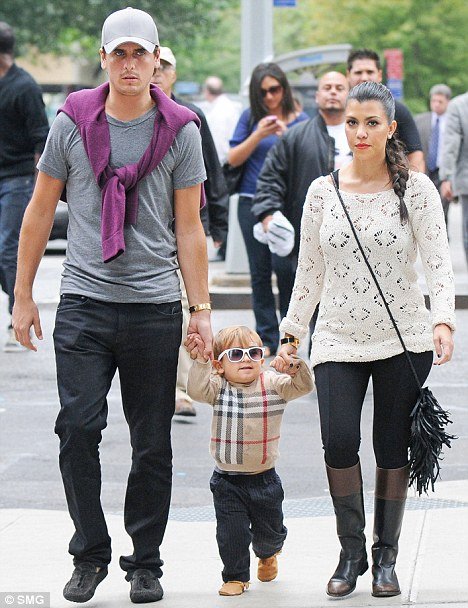
Kourtney Kardashian, 32, who already has a two-year-old son Mason, says she and boyfriend Scott Disick, 28, feel blessed.
She told E! News: “We feel so blessed to be having a little girl and to be able to share this new experience with Mason.”
Kourtney Kardashian’ second child is due in the late spring. The couple announced the pregnancy back in November.
Earlier this month it was rumored that Kourtney Kardashian’s unborn child was a girl.
“Kourtney was hoping for a girl,” an insider told America’s Life & Style at the time.
“She loves having a boy but thinks having a girl would be perfect so she can dress her up and show her the ropes in life.”
Kourtney Kardashian, who already has a two-year-old son Mason, says she and boyfriend Scott Disick feel blessed to have a baby girl
Scott Disick previously told Life & Style magazine: “A girl would be a fantastic addition to our family.”
Kourtney Kardashian and Scott Disick are also the parents of two-year-old son Mason Dash, who was born in December 2009.
Upon announcing her second pregnancy, Kourtney Kardashian told People magazine: “This baby was unexpected, but it’s 100 per cent a blessing.”
Meanwhile, the reality star’s happy news has been slightly dampened by a cold which has infected the entire Kardashian clan.
Kourtney Kardashian has blamed Scott Disick for “passing around” the illness, with few members of the close-knit unit managing to avoid it.
The reality star wrote on twitter page: “Who is passing around sick germs in the fam like it ain’t no thang? @KhloeKardashian & I are sick & now @KylieJenner. @ScottDisick is the ONE!(sic)”
Kourtney Kardashian added she was glad to have a film to watch while she rested and battled the symptoms.
She tweeted: “OMG I’m on day 3. It’s horrible. At least Boogie Nights is on. (sic)”
Half-sister Kylie Jenner also tweeted: “Don’t feel good. One gets sick. We all get sick (sic)”
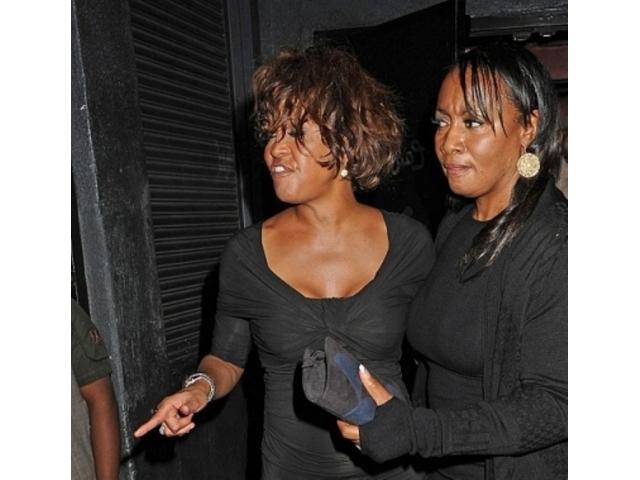
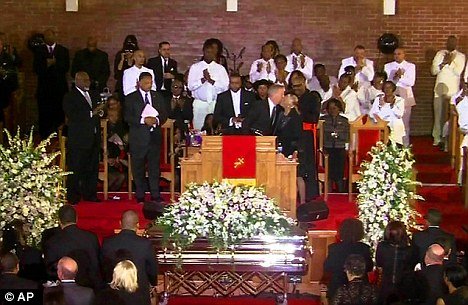
There were numerous reports this week saying that Aretha Franklin was “banned” from Whitney Houston’s funeral on Saturday.
New York Daily News reported that Aretha Franklin, Whitney Houston’s godmother, “angered” the late singer’s mother, Cissy Houston, with her comments during an interview on the Today Show.
“Parents have to really talk to their children before they leave home,” Aretha Franklin told Al Roker.
“They have to make sure when they leave home, they have all the right things. She left home with all the right things, but she just kind of lost her way along the way.”
The Daily News story also suggests it was this “veiled criticism” of Whitney Houston’s upbringing – and not Aretha Franklin’s medical excuse – that led her to miss the legendary singer’s service.
Meanwhile, HollywoodLife seized on the possible controversy, writing that Aretha Franklin’s “drug comments” might have caused her to be “banned” from the funeral by Cissy Houston.
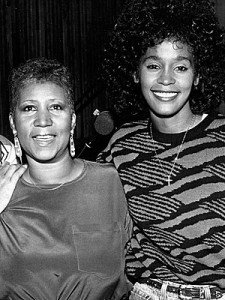
There were numerous reports this week saying that Aretha Franklin was “banned” from Whitney Houston’s funeral on Saturday
The website uses the fact that Aretha Franklin played a sold-out concert in New York on Saturday night as evidence that there could be something to the “ban” explanation.
But Aretha Franklin said in her statement regarding her absence from the funeral that she wanted to “stay off [her] leg” as much as possible until her concert that night.
And it warrants mention that during the funeral, Dionne Warwick called for Aretha Franklin – still on the scheduled speakers list – to address mourners, before being alerted that the singer was not in attendance.
If there was any animosity between the Houston family and Aretha Franklin, it was awfully well hidden.
HollywoodLife also leaves out Aretha Franklin’s rep’s comments to the Daily News in which she reiterates that the singer was essentially incapacitated between concert performances over the weekend.
Scientists have been saying for 20 years that the eight-hour sleep may be unnatural, and now more and more historians are backing them up.
In the early 1990’s, psychiatrist Thomas Wehr conducted an experiment in which a group of people were plunged into darkness for 14 hours every day for a month.
It took some time for their sleep to regulate but by the fourth week the subjects settled into a very distinct sleeping pattern. They slept first for four hours, then woke for one or two hours before falling into a second four-hour sleep.
Though sleep scientists were impressed by the study, among the general public the idea that we must sleep for eight consecutive hours persists.
More recently, the theory that humans slept in two distinct chunks has resurfaced, but in the rather less likely field of history.
Over the course of 20 years, historian Roger Ekirch undertook an intensive study into the human relationship with night for his book “At Day’s Close: Night in Times Past”.
In diaries, court records, medical books and literature – from Homer’s Odyssey to the anthropological account of modern tribes in Nigeria – Roger Ekirch has found more than 500 references to a segmented sleeping pattern.
Roger Ekirch believes this painting from 1595 is evidence of significant activity at night
Much like the experience of Thomas Wehr’s subjects, these references describe a first sleep which began about two hours after dusk, followed by waking period of one or two hours and then a second sleep.
“It’s not just the number of references – it is the way they refer to it, as if it was common knowledge,” Roger Ekirch says.
During this waking period people were quite active. They often got up, went to the toilet or smoked tobacco and some even visited neighbors. Most people stayed in bed, read, wrote and often prayed. Countless prayer manuals from the late 15th Century offered special prayers for the hours in between sleeps.
And these hours weren’t entirely solitary – people often chatted to bed-fellows or had sex.
A doctor’s manual from 16th Century France even advised couples that the best time to conceive was not at the end of a long day’s labor but “after the first sleep”, when “they have more enjoyment” and “do it better”.
Scientists have been saying for 20 years that the eight-hour sleep may be unnatural, and now more and more historians are backing them up
Roger Ekirch found that references to the first and second sleep started to disappear during the late 17th Century. This started among the urban upper classes in northern Europe and over the course of the next 200 years filtered down to the rest of Western society.
By the 1920’s the idea of a first and second sleep had receded entirely from our social consciousness.
Roger Ekirch attributes the initial shift to improvements in street lighting, domestic lighting and a surge in coffee houses – which were sometimes open all night. As the night became a place for legitimate activity and as that activity increased, the length of time people could dedicate to rest dwindled.
In his new book, “Evening’s Empire”, historian Craig Koslofsky puts forward an account of how this happened.
“Associations with night before the 17th Century were not good,” Craig Koslofsky says. The night was a place populated by people of disrepute – criminals, prostitutes and drunks.
“Even the wealthy, who could afford candlelight, had better things to spend their money on. There was no prestige or social value associated with staying up all night.”
That changed in the wake of the Reformation and the counter-Reformation. Protestants and Catholics became accustomed to holding secret services at night, during periods of persecution. If earlier the night had belonged to reprobates, now respectable people became accustomed to exploiting the hours of darkness.
This trend migrated to the social sphere too, but only for those who could afford to live by candlelight. With the advent of street lighting, however, socializing at night began to filter down through the classes.
In 1667, Paris became the first city in the world to light its streets, using wax candles in glass lamps. It was followed by Lille in the same year and Amsterdam in 1669, where a much more efficient oil-powered lamp was developed.
London didn’t join their ranks until 1684 but by the end of the century, more than 50 of Europe’s major towns and cities were lit at night.
Night became fashionable and spending hours lying in bed was considered a waste of time.
“People were becoming increasingly time-conscious and sensitive to efficiency, certainly before the 19th Century,” says Roger Ekirch.
“But the industrial revolution intensified that attitude by leaps and bounds.”
Strong evidence of this shifting attitude is contained in a medical journal from 1829 which urged parents to force their children out of a pattern of first and second sleep.
“If no disease or accident there intervene, they will need no further repose than that obtained in their first sleep, which custom will have caused to terminate by itself just at the usual hour.
“And then, if they turn upon their ear to take a second nap, they will be taught to look upon it as an intemperance not at all redounding to their credit.”
Today, most people seem to have adapted quite well to the eight-hour sleep, but Roger Ekirch believes many sleeping problems may have roots in the human body’s natural preference for segmented sleep.
This could be the root of a condition called sleep maintenance insomnia, where people wake during the night and have trouble getting back to sleep, Roger Ekirch suggests.
The condition first appears in literature at the end of the 19th Century, at the same time as accounts of segmented sleep disappear.
“For most of evolution we slept a certain way,” says sleep psychologist Gregg Jacobs.
“Waking up during the night is part of normal human physiology.”
The idea that we must sleep in a consolidated block could be damaging, Gregg Jacobs says, if it makes people who wake up at night anxious, as this anxiety can itself prohibit sleeps and is likely to seep into waking life too.
Russell Foster, a professor of circadian [body clock] neuroscience at Oxford, shares this point of view.
“Many people wake up at night and panic,” Russell Foster says.
“I tell them that what they are experiencing is a throwback to the bi-modal sleep pattern.”
But the majority of doctors still fail to acknowledge that a consolidated eight-hour sleep may be unnatural.
“Over 30% of the medical problems that doctors are faced with stem directly or indirectly from sleep. But sleep has been ignored in medical training and there are very few centres where sleep is studied,” Russell Foster says.
Gregg Jacobs suggests that the waking period between sleeps, when people were forced into periods of rest and relaxation, could have played an important part in the human capacity to regulate stress naturally.
In many historic accounts, Roger Ekirch found that people used the time to meditate on their dreams.
“Today we spend less time doing those things,” says Dr. Gregg Jacobs.
“It’s not a coincidence that, in modern life, the number of people who report anxiety, stress, depression, alcoholism and drug abuse has gone up.”
Stages of sleep
Every 60-100 minutes we go through a cycle of four stages of sleep
• Stage 1 is a drowsy, relaxed state between being awake and sleeping – breathing slows, muscles relax, heart rate drops
• Stage 2 is slightly deeper sleep – you may feel awake and this means that, on many nights, you may be asleep and not know it
• Stage 3 and Stage 4, or Deep Sleep – it is very hard to wake up from Deep Sleep because this is when there is the lowest amount of activity in your body
• After Deep Sleep, we go back to Stage 2 for a few minutes, and then enter Dream Sleep – also called REM (rapid eye movement) sleep – which, as its name suggests, is when you dream
In a full sleep cycle, a person goes through all the stages of sleep from one to four, then back down through stages three and two, before entering dream sleep
Elizabeth Smart and her new husband Matthew Gilmour incorporated their respective family traditions into their tradition-filled Hawaiian ceremony on Saturday.
Elizabeth Smart, 24, who made headlines when she was found 9 months after being kidnapped at knife-point when she was a young teen, looked stunning in a lace boat-necked dress with a full, drop-waist skirt.
The groom, Matthew Gilmour, 22, showed off his Scottish heritage with pride as he wore his dead father’s kilt and a boutonnière with blue thistle that had been flown in for the occasion.
Their Hawaiian wedding may not seem fitting for the ever-traditional couple, but the location has a real resonance with the bride: it is the place where Elizabeth Smart and her family visited in 2003 shortly after they reunited following her harrowing kidnapping.
“I guess you could say it was kind of a refuge,” Elizabeth Smart told People magazine.
“Oahu is a very special place for me, very different than what I was used to.”
Elizabeth Smart and Matthew Gilmour, who met while on their missionary year in France, married at an 11:30 a.m. ceremony in the LDS Laie Hawaii Temple which was only attended by very close family and friends.
In accordance with the religion’s teachings, the actual ceremony itself can only be attended by fellow Mormons who have been given a “temple recommend” sign-off, which essentially says that they are viewed in good standing with the church.
Traditionally, Mormon brides are allowed to wear their wedding dress in the temple for the ceremony, though without anything covering their face or head which meant that Elizabeth Smart would have had to take off her beautiful, flowing lace veil.
After the ceremony, which took approximately 30-minutes, the celebration continued as the group- which only included 12 guests- went to the Turtle Bay Resort for the wedding luncheon.
The elegant lunch highlighted the cuisine of the region, as the group of immediate family and a select few close friends dined on island fish in mango-papaya salsa, Huli Huli chicken, teriyaki steak and roasted Molokai sweet potatoes.
Elizabeth Smart and her new husband Matthew Gilmour incorporated their respective family traditions into their tradition-filled Hawaiian ceremony on Saturday
Matthew Gilmour and Elizabeth Smart then took a boat ride amid the beautiful Hawaiian surroundings as men in native garb rowed and played the uekelele.
That evening, the party continued at a luau where guests were treated to a buffet-style dinner of Lomi Lomi salmon and Kalua pig as well as some instructional hula dancing.
While the Hawaiian culture was seen throughout the day, Scottish customs were scattered throughout.
One such instance was the toast that Matthew Gilmour gave at the luau, where he began with the traditional “On behalf of my wife and I” introduction, which was met by a roar of cheers and clapping by the group.
Throughout the day, Elizabeth Smart and Matthew Gilmour continued wearing their wedding outfits.
Elizabeth Smart finally found her perfect dress- after trying “just about every dress in Utah”- off the rack at Kleinfelds bridal salon in New York.
She certainly isn’t the first would-be bride to have luck there: the store is the hub of activity on the TLC reality show Say Yes To The Dress.
In order to look appropriate on her wedding day, Elizabeth Smart had the dress tulle dress retrofitted with lace sleeves and a demure neckline of scalloped lace.
Matthew Gilmour represented his Scottish ancestry – and his father, who died in 2008 after a battle with cancer – by wearing his dad’s kilt.
“I wasn’t surprised Elizabeth was ready before Matthew because there is a lot to putting on a kilt,” his uncle Neville Henderson said.
The groom’s mother Kay Gilmour made sure to let the other men get in on the action, as she brought ties for Neville Henderson and Elizabeth’s father that matched the same tartan as his kilt.
Though their wedding was clearly a start of their new life together, the couple has visited each other’s hometowns and plan to settle in Salt Lake City where Matthew Gilmour will attend university.
After their missionary year, the then-friends realized that they were bound for more and began dating.
The sparks really flew when Elizabeth Smart visited him in Scotland and they visited historic castles, getting a true sense of his heritage.
Matthew Gilmour followed suit by flying to Salt Lake City to spend time with her. While there, he asked for her father’s permission to propose, picked out the unique sapphire ring, and asked her the big question while they were out walking near her house.
“The thing that attracted me the most-at the beginning and now- is how confident she is, especially considering everything she has been through,” Matthew Gilmour told People.
The wasted no time planning after they were engaged, and while they originally wanted to get married in the summer in Salt Lake City, they switched to the Hawaiian option due to the massive amount of unexpected media attention.
Instead, they rushed to get everything together in less than a month after he proposed.
“Elizabeth’s desire was for what most women want – to celebrate her nuptials in a private wedding with family and close friends,” said family spokesman Chris Thomas.
“After the story broke about her engagement and the media became increasingly invasive, Elizabeth recognized it was going to be impossible to have a traditional wedding devoid of distractions and unusual challenges outside of her control.
“She decided…the best way to avoid significant distraction was to change her wedding plans and to get married in an unscheduled ceremony outside of Utah.”
Though she has become an occasional ABC News contributor, Elizabeth Smart has been wary of unwanted media attention since she first made headlines in 2002 when itinerant street preacher Brian David Mitchell broke into the Smart home and kidnapped her.
Brian David Mitchell and his wife Wanda Barzee held her for nine months, during which she was continuously raped and was even married to Mitchell in a bizarre ceremony.
In December, Elizabeth Smart spoke out about the ordeal, saying: “He went straight from marrying me to raping me. And after that moment I couldn’t feel more worthless and more degraded. It was the worse feeling I could have ever felt.”
Brian David Mitchell was convicted of kidnapping and sexual assault and was sentenced to serve life in prison in May 2011.
Wanda Barzee was sentenced to 15 years in a Texas federal prison hospital for her role in the kidnapping of the girl.
Now, after testifying at their respective trials and even forgiving Brian David Mitchell of the atrocities he committed against her, Elizabeth Smart is determined to move on with her new life, accompanied by her husband throughout.
Elizabeth Smart and Matthew Gilmour were spotted on the Monday after their wedding, buying groceries at a local store while they enjoy their honeymoon at the same hotel that hosted their reception.
The National Enquirer quotes an insider as saying that the couple hopes to start a family immediately and aim to have their first baby by their one-year anniversary.
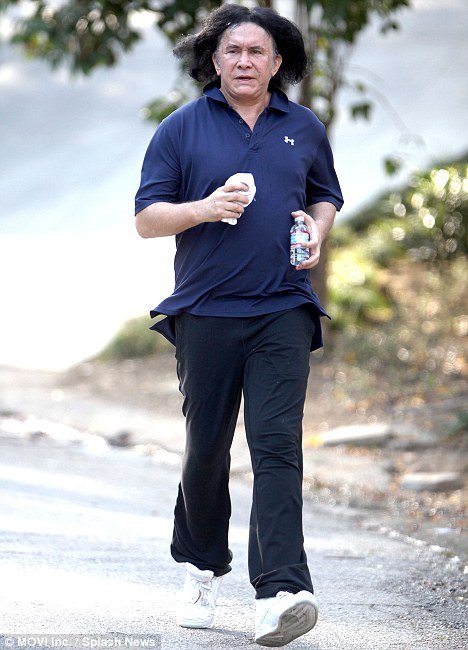
Kiss rocker Gene Simmons looked strangely taut as he jogged in Studio City yesterday with his family.
Gene Simmons’ trademark raven mane flapped as he propelled himself along the sidewalk but his face stayed still.
The 62-year-old rocker freely admitted that he wanted to get rid of his jowls.
Gene Simmons had a his “n” hers joint facelift with his wife Shannon Tweed, 54 , in 2007.
“I’d thought about it before,” Gene Simmons told People magazine at the time.
“I was aware I had jowls.”
“Like Jabba the Hutt!” teased Shannon Tweed at the time, she was Playboy’s 1982 Playmate of the Year.
“I didn’t want him to look younger than me,” Shannon Tweed added.
Kiss rocker Gene Simmons looked strangely taut as he jogged in Studio City yesterday with his family
Gene Simmons and Shannon Tweed wed just a few months ago after 28 years together, with their children they star in A&E reality program, Gene Simmons Family Jewels.
The couple likes to spice things up in the bedroom.
After getting hitched last October following 28 years of unwedded bliss, Simmons told Hollyscoop: “Romance is interesting, but somebody much more prolific than I am put it better – she should be a Madonna in the kitchen and a w***e in the bedroom.”
But unlike many women her age, Shannon Tweed didn’t seem to mind the label her husband had publicly given to her.
Seemingly in agreement she added: “[You have to] keep having sex in different ways. Try to think of something new.”
Gene Simmons and Shannon Tweed have two grown children, Nicolas, 22 and Sophie Alexandra, 19.
Shannon Tweed, who appears alongside them on reality show, Gene Simmons Family Jewels, insists they know exactly what to do when the couple feels like being naughty.
Shannon Tweed continued: “Thank God the children are grown up. As soon as they hear noise from upstairs, they leave the house. That’s good.”
Argentine officials confirms 49 people have been killed and at least 600 injured in the worst train crash in the country in the last 40 years.
The train hit the end of the platform at Once station in the capital Buenos Aires during the morning rush hour.
“We assume that there was some fault in the brakes,” Transportation Secretary JP Schiavi said.
Dozens of people were trapped for hours in the wreckage but all have now been successfully taken to safety.
“The train was full and the impact was tremendous,” a passenger identified as Ezequiel told local television.
Medics at the scene were overwhelmed by the casualties, he added.
“People started to break windows and get out however they could,” another eyewitness told Reuters.
“Then I saw the engine destroyed and the train driver trapped amongst the steel. There were a lot of people hurt, a lot of kids, elderly,” the eyewitness added.
Police outside Once station had to “keep back the curious and concerned as paramedics treated the injured”, eyewitness Tom said.
Argentine officials confirms 49 people have been killed and at least 600 injured in the worst train crash in the country in the last 40 years
The train had hit the barrier at about 12mph (20km/h), destroying the front of the engine and crunching the carriages behind it, JP Schiavi said.
One of the carriages was driven nearly 6m (20 ft) into the next, he added.
Survivors told local media that many people had been injured in a jumble of metal and glass.
Emergency medical system director Alberto Crescenti said that some passengers who survived had to have limbs amputated. Many suffered from arrested breathing and trauma to the thorax region.
Many are in a critical condition in the city’s hospitals and there are concerns that the death toll could rise.
Five similar accidents have occurred in and around the city in recent months.
Many parts of Argentina’s rail network are antiquated and in need of repair and this incident will increase concern about lack of investment in the system.
“This is the responsibility of a company that is known for insufficient maintenance and… improvisation,” Edgardo Reinoso of the train workers’ union told Reuters.
“Lack of controls” on the part of state agencies was also to blame, Edgardo Reinoso added.
In September 2011, 11 people died when a commuter train in Buenos Aires hit a bus crossing the tracks and then hit a second train coming into a station.
This latest accident is Argentina’s worst train crash since February 1970, when a train smashed into another at full speed in suburban Buenos Aires, killing 200 people.
Jeb Corliss, the world famous stunt artist who almost died after crashing into a cliff during a botched leap from Table Mountain in South Africa, today posted incredible footage of the accident on his website.
Jeb Corliss, a 35-year-old Californian daredevil, broke both of his legs and was airlifted to hospital following the horrific smash last month in Cape Town.
The base jumper was being filmed for a television documentary when he careered into a rock face after leaping from the famous landmark wearing only a winged flying suit.
Jeb Corliss, who has spent more than five weeks in hospital since the January 16 accident, today posted a chilling video of the smash on the internet.
The incredible video lasts almost three minutes and is entitled Table Mountain Crash All Angles.
The video starts with a black screen containing a warning message: “May be disturbing for some viewers”, before showing Jeb Corliss fearlessly starting his stunt.
It shows the daredevil leaping from the flat surface of the mountain and soaring towards the sea.
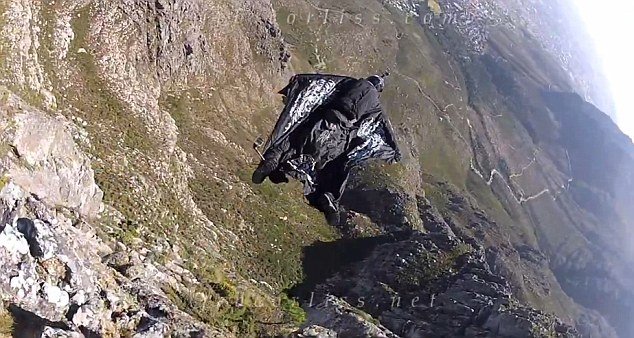
Seconds later the accident can be clearly seen as Jeb Corliss’ legs smash into a rock face, sending him spiraling towards the ground.
The horrifying moment of impact is repeated several times from multiple angles during the video, which is played out over upbeat rock music.
Later scenes show Jeb Corliss deploying his emergency parachute as he realises something has gone wrong.
Jeb Corliss, who was wearing a camera mounted on his helmet during the stunt, then appears to bounce along the ground before coming to a halt in a bush.
A series of still images then show the moment of his impact in detail. They reveal how the experienced base jumper appeared to misjudge the distance to the rock face, which was marked by a helium balloon tied to a rucksack.
Instead of soaring over the cliff, he collides with the rocky outcrop from just below the waist.
Jeb Corliss almost died after crashing into a cliff during a botched leap from Table Mountain in South Africa
Following the accident Table Mountain officials said it was a miracle that Jeb Corliss had survived after he fell around 200 feet from the 3,500 foot-high landmark.
The stunt man, who has made a name for himself as one of the world’s most daring base jumpers, was airlifted to hospital and needed surgery on both of his legs.
Michelle Norris, spokeswoman for the Christiaan Barnaard Hospital in Cape Town, today said he remained there under observation and was due to be discharged on Friday.
The spokeswoman said: “Mr. Corliss needed extensive surgery on his legs and also needed skin grafts to repair the damage. He suffered serious and injuries and remains in the hospital, although he has been making good progress in recovery.
“One of the reasons he is still with us is that we needed to check how the wounds would heal from the skin grafts, but we hope to be able to discharge him on Friday. After that he plans to return home immediately to America to be with his family.”
Jeb Corliss’ video record of the incident concludes by offering thanks to those who helped rescue him following the smash.
A screen entitled “Special Thanks”, reads: “To the hikers that gave me water, to the rescue team that gave me life, to the hospital and staff that put me back together, THANK YOU.”
Jeb Corliss’ botched Table Mountain leap came as he made a documentary for an American television network. The daredevil has previously made headlines with a string of other base jumps.
The extreme sport involves leaping from buildings or mountains with only a parachute or winged jumpsuit to aid the jumper’s landing. Jeb Corliss has previously made successful leaps from the Eiffel Tower in Paris and the Christ the Redeemer statue in Rio de Janeiro.
Tina Brown, Whitney Houston’ sister in law and Bobby Brown’ sister, gave an ample interview to National Enquirer and explained how the late singer’s career spiraled out of control.
Whitney Houston spent days locked in her bedroom amid piles of garbage smoking crack, her sister in law remembered.
When Whitney Houston got high, she imagined the devil was beating her, but she was actually punching herself black and blue with her own fists.
And the star’s beautiful singing voice, ravaged by drugs, was gone.
“I did crack with Whitney,” said Tina Brown, a recovering addict herself.
Tina Brown’s heartbreaking memories of Whitney Houston, who once had the world in her hands, are one shocking revelation after another.
There were the days that Whitney Houston disappeared to languish in dangerous drug dens.
There was the failed attempt at an intervention by her family when a cursing Whitney Houston nearly leaped from a second-story window trying to escape.
There were the drug-induced delusions Whitney Houston had of hidden surveillance cameras watching her every move.
Tina Brown’s drug partner days with Whitney Houston occurred when the star and Bobby Brown lived in the posh Country Club of the South in Alpharetta, Georgia, and she remembers the day she and her sister-in-law first got high.
In her own words Tina Brown explained: “It was February 21, 2004. The reason why I know this date is because February 20 is my birthday.”
“We were drinking a lot,” said Tina Brown.
“I passed out on the couch but I wake up about six in the morning. I went into Whit¬ney’s bedroom. All Whitney was wearing was her mink coat and a pair of furry boots, her usual garb.”
Whitney Houston suggested they call dealers. “Call them,” Tina Brown recalls.
What followed was a re¬lationship forged by drugs. Although Tina Brown had known Whitney Houston since her marriage to her brother in 1992, she’d never gotten close to her until that day.
“Hey, I was using and she was paying. It was free,” said Tina Brown.
Tina Brown, Whitney Houston’ sister in law, remembered the singer spent days locked in her bedroom amid piles of garbage smoking crack
That first drug binge went on for roughly 24 days in Whitney Houston’s home. Bobby Brown, no stranger to drugs himself, was serving 60 days in jail at the time for a probation violation on a drunk-driving conviction.
Dealers came and went, delivering marijuana, powder cocaine and crack. And it was during this time that Tina Brown started to realize what drugs had done to Whitney Houston.
“She saw demons when she got high,” recalls Tina Brown.
“She’d point to the floor and say, <<See that demon. I’m telling you somebody’s messing with Bobby>>. ”
One day a stoned Whitney Houston called Tina Brown over to a sink. “A dish had broken and in the cracks of the plate, she saw a pair of smiling lips,” said Tina Brown.
When Whitney Houston got high, she would imagine concealed wires and spy cameras were everywhere.
“She would get a screwdriver and take things apart to find the cameras,” said Tina Brown.
In mid-March, Whitney’s mother Cissy Houston, who’d attempted many times to free her daughter from the grip of drugs, knew it was time to try again.
When Cissy Houston and other family members arrived at the home, Tina Brown was sweeping the foyer while Whitney was in her upstairs bedroom, getting high.
“I opened the door and the cars pull up, black cars. The driver gets out and opens the door for Cissy. Then, here comes Gary, Whitney’s brother.”
Tina Brown tried to close the door. She yelled up to Whitney Houston, using the singer’s shortened nickname, Nip.
“I yelled, <<Nip they’re down here>>. ”
“Don’t let them in,” Whitney Houston screamed.
It was too late.
“I did not want them to see what she’d be doing up there but her mother came up there and she seen it. And it’s a disas¬ter, paraphernalia everywhere.”
Tina Brown said Cissy Houston gave Whitney an ultimatum. Get into rehab or she was going to take her daughter Bobbi Kristina away from her or have her locked up.
Bobby Brown’ sister could hear Whitney Houston cursing at her mother as security gathered up Bobbi Kristina and put her in a car. Tina Brown got into another. They were to be taken to a nearby hotel.
That’s when all hell broke loose as a stoned-out Whitney Houston made a desperate bid to escape the intervention.
“Whitney tried to jump out the window, her bedroom window on the second floor,” said Tina Brown. “She has her white bag and one of her legs over the window.
“She’s screaming: <<Tina, don’t you leave me. Catch my bag>>.
“I said: <<Nip, don’t jump. Come on, there’s nowhere you can go>>.”
The whole intervention team checked into rooms for the night and promised to regroup in the morning. Whitney Houston and Tina Brown were in one suite together. They got high all day long.
Before they fell off to sleep, the two were laughing so hard about Whitney Houston’s antics, the singer peed herself.
Tina Brown said that one of her older children is handicapped and uses pull-up diapers. She had a pair in her purse. Whitney Houston found them and put them on.
That’s when the laughter stopped. Tina Brown saw something that frightened her to the bone – black and blue bruises up and down Whitney Houston’s legs.
Tina Brown cried out: “Nip, what the hell!”
Whitney Houston’s answer frightened Tina Brown even more.
“The devil be hitting me,” said Whitney Houston. “I walked by and he just go bam.”
Tina Brown said: “No, Nip. That’s not the devil. That’s you. I mean there was black and blue all up and down her legs. I said, <<Does Bobby know this?>> She said: <<No, no, it’s going to be all right. You know I rebuke the devil. He’s always hitting me>>. But it’s her hitting herself.”
In the morning, Whitney Houston’s relatives saw the bruises too.
“All kinds of psychiatrists came up to the hotel room. And she went off with them. It was a big thing about the bruises.”
At the end of that bizarre intervention, Whitney Houston reluctantly agreed to go into outpatient rehab at a center in Smyrna, Georgia, but only if Tina Brown went with her. Whit¬ney Houston would smoke crack before the sessions.
Tina Brown ultimately moved into Whitney Houston’s house, acting in a sort of maid’s capacity after Bobby Brown got out of jail. The drug deliveries continued.
Whitney Houston would purchase eight balls of crack, pieces of rock cocaine weighing an eighth of an ounce each. She’d cut open a cigar, take the tobacco out, put in marijuana and the whole piece of crack and puff away.
In June 2004, Tina Brown was sent to prison for a year for possession of drug paraphernalia and violation of probation. She has a record of arrests for drug offenses.
It was a blessing, Tina Brown says, to be away from Whitney Houston and the nonstop drug use.
Bobby Brown was worried Tina Brown may have been Whitney Houston’s drug partner but at least she was able to keep the singer at home when she binged on drugs.
With Tina Brown in jail, Whitney Houston started to disappear for days at a time, sometimes doing drugs with friends, but other times visiting crack houses in dangerous areas of Atlanta. From jail, Tina Brown remembers calling her mom Carole Brown. Her mother was weeping.
“A drug dealer had called Bobby and said, <<Come get your wife. I’m sick of this bitch. She’s in here peep¬ing out the windows and doing all kinds of s–t in the house>>.”
Tina Brown learned Whitney Houston had been in the drug den for days giving orders to dealers and drug buyers, telling some to leave, telling others where to sit, seeing demons, thinking she was under surveillance. It became too much for the dealer.
“Bobby and security had to go get her,” said Tina Brown.
When Tina Brown was released from prison on June 3, 2005, she was drug-free but that ended July 5, the first time she went over to Whitney Houston’s house.
“I started again. She needed some help in the house and that was it,” Tina Brown recalled.
At that time, Whitney Houston was actually getting ready to cut a single with record producer Jermaine Dupri. It would be the first time she’d entered a studio in years, said Tina Brown.
But Whitney Houston’s beautiful singing voice, the one that sold more than 100 million albums, the one that hit those impossible-to-imagine high notes, was gone.
“It’s horrible. She couldn’t sing anymore,” said Tina Brown.
Still, Tina Brown did her best to get Whitney Houston ready for her studio session.
“She had a machine to get her voice in shape. I’d hook it up and put this liquid in this holder and this breathing device in her mouth. It’s like steam and she had to do these treatments for an hour, three times a day. But she kept doing it just once.
“She put off the studio appearance for like two weeks. They were calling me and I told them, <<You come and get her out of the damn room. I can’t make her go.>>”
Tina Brown’s relationship with Whitney Houston eventually ended. She kept up her own battle to become drug-free and prayed for a Whitney Houston comeback, a day when she’d reach the top once again, but it didn’t happen.
A chilling picture apparently showing late singer Whitney Houston in an open coffin has been published on the cover of the National Enquirer.
The image shows Whitney Houston lying dead in her golden casket, clad in her favorite purple dress and wearing what looks like a diamond broach and earring.
National Enquirer has run the snap alongside a bold headline proclaiming: “Whitney: The last photo!”
It is understood Whitney Houston picture in open casket was taken inside the Whigham Funeral Home in Newark, New Jersey, where her family attended a private wake last Friday on the eve of her funeral.
National Enquirer claims the photo was taken at the private viewing – although does not reveal who took the picture.
Whitney Houston was wearing jewels worth $500,000 and had gold slippers on her feet, according to the publication.
Picture of dead Whitney Houston in the coffin published by National Enquirer
No doubt the photograph – which was published in the magazine’s latest edition – is bound to stir a strong reaction.
Whitney Houston’s funeral took place on Saturday and was attended by stars including Mariah Carey, Oprah Winfrey and her co-star from The Bodyguard, Kevin Costner.
Whitney Houston was laid to rest at Fairview Cemetery in Westfield, New Jersey, on Sunday in a burial service attended by close family and friends. The legendary singer, who died on February 11 at age 48, is buried near her father, John Russell Houston, Jr.
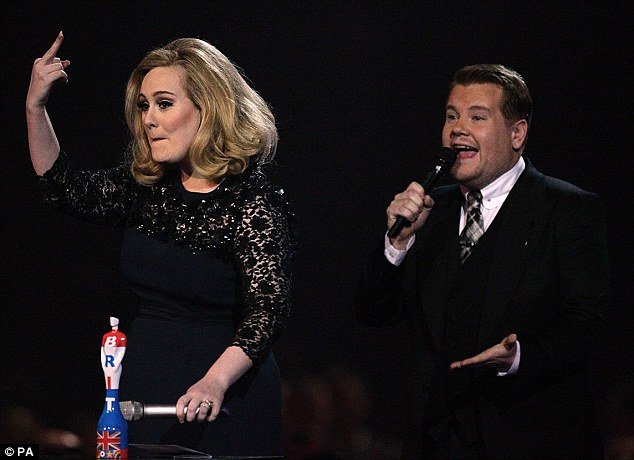
British singer Adele has won two prizes at the Brit Awards ceremony in London, but was at the centre of controversy after one of her acceptance speeches was cut short and she made a rude gesture.
Adele’ speech was interrupted by Brits host James Corden after she picked up the prize for best British album. The singer, who had won the top award of the night, Album of the Year, flipped the middle finger to show just how annoyed she was.
“I flung the middle finger. That was for the suits at the Brit Awards, not my fans. I’m sorry if I offended anyone but the suits offended me,” Adele said.
Adele also won best British female.
Ed Sheeran also won two awards – best British male and British breakthrough.
Coldplay were crowned best British group for a record third time, while former X Factor boy band One Direction beat Adele to the award for best British single.
Double awarded Adele was at the centre of controversy at Brit Awards after one of her acceptance speeches was cut short and she made a rude gesture
Adele added her Brits to the six Grammy Awards she won last weekend, capping a year of huge global success. According to her record label, the London singer’s second album 21 has sold 17 million copies around the world and hit number one in 24 countries.
Accepting the best album prize – the final and most prestigious of the night – Adele said: “Nothing makes me prouder than coming home with six Grammys and then coming to the Brits and winning album of the year.
“I’m so proud to be British and to be flying our flag.”
But there were boos from the audience as the singer was interrupted by host James Corden in order to introduce the final performers, Blur.
Adele then added: “Can I just say, then, goodbye and I’ll see you next time round.”
Adele’s gesture was then momentarily visible on the live ITV1 coverage.
“I was about to thank the British public for all their support but they cut me off,” the star later said backstage.
“So thank you very much for all your support. It’s amazing.”
ITV later issued a statement about the incident, saying: “The Brits is a live event. Unfortunately the programme was over-running and we had to move on. We would like to apologize to Adele for the interruption.”
A Brits spokesman added: “We regret this happened and we send our deepest apologies to Adele that her big moment was cut short.
“We don’t want this to undermine her incredible achievement in winning our night’s biggest award. It tops off what’s been an incredible year for her.”
Adele’s 21 beat Coldplay’s Mylo Xyloto, Florence & The Machine’s Ceremonials, PJ Harvey’s Let England Shake and Ed Sheeran’s + to the best British album award.
In the best British female category, Adele beat Jessie J, Florence & The Machine, Kate Bush and last year’s winner Laura Marling. She also sang Rolling at the Deep at the ceremony – only her second performance since throat surgery last year.
Meanwhile, US pop star Bruno Mars was named best international male, Rihanna picked up best international female and the Foo Fighters won best international group.
Ed Sheeran led the nominations going into the ceremony, up for best British male, breakthrough, single and album.
He beat rapper Professor Green, James Blake, James Morrison and Noel Gallagher to the prize for best British male.
The 21-year-old told the crowd: “I honestly didn’t think I’d get this one.”
Coldplay were crowned best British group in a category voted for by listeners to BBC Radio 2. Frontman Chris Martin described it as “very humbling”.
Speaking backstage about winning best group more times than any other band, Chris Martin said: “They keep splitting up. They keep taking themselves out of the game. We’re the only players still on the pitch. No Pulp, no Oasis. Take That are on holiday. We’ll take it if they’re not around.”
The outstanding contribution honour went to reformed Britpop favourites Blur, who performed a medley of their hits. Their last appearance at the Brit Awards was in 1995, when they went home with four trophies.
Singer Damon Albarn said: “Last time we were here was 17 years ago and what happened that night seemed to have a really profound effect on our lives, so it’s very nice to come back and say thank you very much for this honour.”
One Direction won best single for their hit What Makes You Beautiful, beating tracks including Adele’s Someone Like You, Ed Sheeran’s The A Team and Price Tag by Jessie J and BoB.
The international breakthrough trophy went to fast-rising New York-based pop star Lana Del Rey. She told the crowd: “This award means much more to me than you know and I just want to say that without the support of everyone in this room and everyone in the UK I’d really be lost.”
The event also included tributes to the late stars Whitney Houston and Amy Winehouse and featured performances from Noel Gallagher, Florence and the Machine, Rihanna and Olly Murs with Rizzle Kicks.
Council of Europe has urged Germany to end the practice of surgically castrating sex offenders.
The Council of Europe’s anti-torture committee said such voluntary treatment, albeit rare in Germany, was “degrading”.
In Germany no more than five sex offenders a year have been opting for castration, hoping it will lower their sex drives and reduce their jail term.
The committee’s recommendations are not binding but have great influence.
The committee’s official title is the European Committee for the Prevention of Torture and Inhuman or Degrading Treatment or Punishment (CPT).
“Surgical castration is a mutilating, irreversible intervention and cannot be considered as a medical necessity in the context of the treatment of sexual offenders”, the CPT report said. It was based on an investigation in Germany carried out in November-December 2010.
The German authorities argue that castration is not a punishment but a treatment which enables, as a government statement put it, “suffering tied to an abnormal sex drive… to be cured, or at least alleviated”.
Research for the report revealed that of the 104 people operated on between 1970 and 1980, only 3% reoffended, compared with nearly half of those who refused castration or were denied it by the authorities.
But the CPT objected to the practice of surgical castration for sex offenders, saying:
• The physical effects are irreversible and may have serious physical and mental consequences;
• Surgical castration does not conform to recognized international standards and is not mentioned in guidelines drawn up by the International Association for the Treatment of Sexual Offenders (IATSO)
• There is no guarantee of a lasting reduction in the sex offender’s testosterone level
• It is “questionable” whether consent to surgical castration “will always be truly free and informed”.
In February 2009 the Council of Europe made a similar complaint about the use of surgical castration in the Czech Republic.
Despite the criticism, the Czech Republic still offers prisoners the option of surgical castration.
The CPT says very few European countries still offer the procedure to sex offenders.
The EU’s highest court has been asked to rule on the legality of ACTA, the controversial anti-piracy agreement.
The Anti-Counterfeiting Trade Agreement (ACTA) has been criticized by rights campaigners who argue it could stifle free expression on the internet.
European Union trade head Karel De Gucht said the court will be asked to clarify whether the treaty complied with “the EU’s fundamental rights and freedoms”.
The agreement has so far been signed by 22 EU member states.
The European Commission said it “decided today to ask the European Court of Justice for a legal opinion to clarify that the ACTA agreement and its implementation must be fully compatible with freedom of expression and freedom of the internet”.
Several key countries, including Germany and Denmark, have backed away from the treaty amid protests in several European cities.
The EU's highest court has been asked to rule on the legality of ACTA
ACTA is set to be debated by the European Parliament in June.
While countries can individually ratify the terms of the agreement, EU backing is considered vital if the proposal’s aim of implementing consistent standards for copyright enforcement measures is met.
As well as the 22 European backers, the agreement has been signed by the United States, Japan and Canada.
Karel De Gucht told a news conference on Wednesday: “Let me be very clear: I share people’s concern for these fundamental freedoms… especially over the freedom of the internet.
“This debate must be based upon facts, and not upon the misinformation and rumour that has dominated social media sites and blogs in recent weeks.”
However, Karel de Gucht went on to say that the agreement’s purpose was to protect the creative economy.
“[ACTA] aims to raise global standards for intellectual property rights,” he said, adding that the treaty “will help protect jobs currently lost because counterfeited, pirated goods worth 200bn euros are currently floating around”.
ACTA’s backers face strong opposition within the EU. Viviane Reding, the commissioner for justice, fundamental rights and citizenship, took to Twitter to outline her worries on the treaty.
“For me, blocking the Internet is never an option,” she wrote in a statement.
“We need to find new, more modern and more effective ways in Europe to protect artistic creations that take account of technological developments and the freedoms of the internet.”
What is ACTA?
• The Anti-Counterfeiting Trade Agreement (ACTA) is an international treaty aiming to standardize copyright protection measures.
• It seeks to curb trade of counterfeited physical goods, including copyrighted material online.
• Preventative measures include possible imprisonment and fines.
• Critics argue that it will stifle freedom of expression on the internet, and it has been likened to the controversial Stop Online Piracy Act (SOPA).
• ACTA has been signed by 22 EU members, but is yet to be ratified by the European Parliament.
At least 340 people have been injured in a commuter train crash at a station in Buenos Aires, Argentina.
The train is reported to have slammed into the barrier at the end of the platform at the Once station in the west of the city.
The injured driver and some passengers were taken away on stretchers, with the first carriage the worst affected.
The ministry of transport said it could not rule out fatalities, with many people still said to be trapped.
At least 340 people have been injured in a commuter train crash at a station in Buenos Aires, Argentina
The transportation secretary, JP Schiavi, told reporters at the station that the commuter train had hit the barrier at about 12 mph (20km/h), destroying the front of the engine and crunching the carriages behind it.
One of the carriages was driven nearly six metres (20ft) into the next, he said.
“There are people still trapped, people alive, and there may have been fatalities. We don’t know if there are dead people in the wreckage,” JP Schiavi said.
Survivors told the TeleNoticias channel that many people had been injured in a jumble of metal and glass.
In September 2011 eleven people died when another commuter train in Buenos Aires hit a bus crossing the tracks and then hit a second train coming into a station.
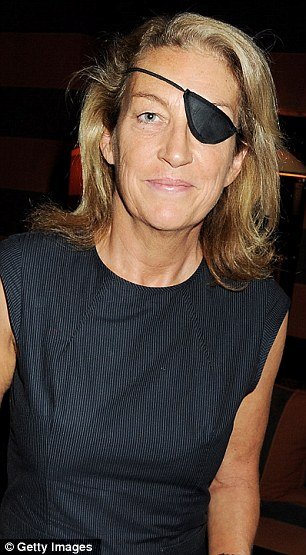
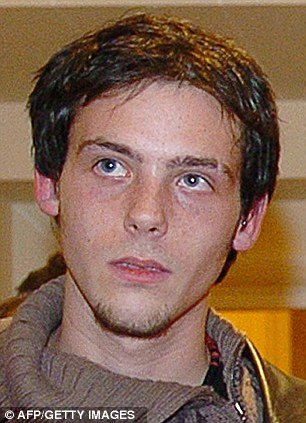
Western journalists Marie Colvin and Remi Ochlik have been killed in the Syrian city of Homs when shells hit the building they were staying in, according to opposition activists.
Marie Colvin was an American Sunday Times reporter, and Remi Ochlik, a French photographer.
Several other people were reportedly killed when the shell hit the makeshift media centre in the Baba Amr area.
Opposition-held districts have been under siege by security forces for more than two weeks, leaving hundreds dead.
Activists said more than 40 people died on Tuesday, including Rami al-Sayed, a man who broadcast a live video stream from Homs used by world media.
Rami al-Sayed was fatally wounded by shrapnel during the shelling of Baba Amr. His brother posted a video of his body in a makeshift hospital.
The Red Cross has called on the government and rebels to agree to a daily ceasefire, to allow medical supplies to reach the worst affected areas and get civilians out, but there is no sign yet of this being agreed.
Marie Colvin, Sunday Times reporter
Marie Colvin and Remi Ochlik were reportedly staying in a house in Baba Amr that was being used by activists as a media centre when it was hit by a shell on Wednesday morning.
Rockets were also said to have hit the building’s garden when people tried to flee afterwards.
At least two other foreign journalists were wounded, activists said.
One was named as British freelance photographer Paul Conroy, who was working with Marie Colvin, and Edith Bouvier of the French newspaper, Le Figaro. Edith Bouvier was said to be in a serious condition.
French photojournalist Remi Ochlik
In Paris, French Foreign Minister Alain Juppe said the deaths would be investigated.
“It’s another demonstration of the degradation of the situation in Syria and of a repression that is more and more intolerable,” he told reporters.
“I hope that on Friday at the <<Friends of Syria>> meeting in Tunis we will be able to move towards a peaceful solution of the situation.”
UK Prime Minister David Cameron told parliament: “This is a desperately sad reminder of the risks that journalists take to inform the world of what is happening, and the dreadful events in Syria.”
The editor of the Sunday Times, John Witherow, said the newspaper was doing what it could to recover Marie Colvin’s body and get Paul Conroy to safety.
“Marie was an extraordinary figure in the life of the Sunday Times, driven by a passion to cover wars in the belief that what she did mattered,” a statement said. “She believed profoundly that reporting could curtail the excesses of brutal regimes and make the international community take notice.”
There was no immediate comment from Remi Ochlik’s agency, IP3 Press.
Remi Ochlik, 28, had reported from Haiti and covered many of the recent uprisings in the Arab world.
Marie Colvin, in her 50s, had been a foreign correspondent for the Sunday Times for two decades, and had reported from several war zones. She lost the sight in one eye in Sri Lanka in 2001 after being hit by shrapnel.
On Tuesday, Marie Colvin told the BBC the bombardment of Baba Amr by Syrian government artillery and tanks had been “unrelenting”.
“I watched a little baby die today, absolutely horrific, a two year old – found the shrapnel had gone into the left chest and the doctor said: <<I can’t do anything>>,and his little tummy just kept heaving until he died. That is happening over and over and over.”
“There are 28,000 people in Baba Amr,” she added. “The Syrians will not let them out and are shelling all the civilian areas.”
“There is Free Syrian Army here. They’re very, very lightly armed. People are terrified they will leave.”
Western journalists have mostly been barred from Syria since the uprising against President Bashar al-Assad began last March.
But increasingly, they have risked entering the country undercover, helped by networks of activists, to report from flashpoints.
Last month, the French television journalist, Gilles Jacquier, was killed in Homs while visiting the city on a government-organized trip.
Anthony Shadid, of the New York Times, died of an apparent asthma attack in Syria last week.
In the northern province of Idlib, reports put Tuesday’s death toll there at more than 50.
New videos posted online by activists there suggest opponents of President Assad were the victims of summary executions.
One shows residents of the village of Abdita looking at a row of about a dozen dead bodies laid out on the ground.
There was similar footage from the nearby village of Balshun showing bodies scattered around in an open field.
Some had their hands bound and had died from a bullet wound to the head.
State media said security forces had been operating in the area, pursuing “armed terrorist gangs” and that a number had been killed.
In another video from Idlib, about 500 Syrian troops appear to announce their defection from the army to join the Free Syrian Army. The footage cannot be independently confirmed.
Kim Kardashian and his best friend Jonathan Cheban headed off to Miami for some rest and relaxation few days ago.
Kim Kardashian, 31, appeared sizzling in a selection of simple and beautifully flattering bikinis.
The reality star seemed happy to be spotted in tasteful swimwear, but according to Life and Style, Kim Kardashian is devastated that by not settling out of court, Kris Humphries has opened their divorce up to the cameras.
California allows filming as part of an open policy on popular cases.
Kim Kardashian and his best friend Jonathan Cheban headed off to Miami for some rest and relaxation few days ago
A source told Life and Style magazine: “Kim’s freaking out, she has no interest in dragging out the divorce or having it play out on TV.
“Believe or not she’s a private person.”
“All of her dirty laundry will be aired, and there is a lot to air,” the mole continued.
Kris Humphries wants to prove that Kim Kardashian never intended to marry him and therefore committed fraud.
Jonathan Cheban may have to testify in court, he revealed: “I hope it doesn’t come down to that but I’ll do what I need to do.”
Scientists have discovered a new family of caecilians, the most enigmatic branch of the amphibians, in northeastern India.
Caecilians, which at first glance resemble worms, live in forest soil and are most closely related to an African group of caecilians.
The females incubate their young for several months without eating.
Writing in the Royal Society Journal Proceedings B, the scientists say the animals may be threatened by population growth and slash-and-burn agriculture.
Caecilians are very hard to spot as they live either underground or under leaf litter that lies on the soil.
The new discovery was the result of about 250 soil-digging expeditions over five years that covered every northeast Indian state.
“Caecilians are the most cryptic group of animals, and it’s not possible to identify whether it’s a new species or genus or family just after collecting it,” said SD Biju from the University of Delhi, who led the project.
“We studied the molecules (DNA) and the morphology, both internal and external, to identify the species,” he said.
Scientists have discovered a new family of caecilians, the most enigmatic branch of the amphibians, in northeastern India
When the analysis was complete, the researchers found they had not only a new species on their hands, but the first representative of a hitherto unknown family.
This is the 10th caecilian family to be identified, and the team named it Chikilidae, derived from the name used in the local Garo tongue.
DNA evidence suggests the family split from its closest African relatives more than 140 million years ago, when the ancient super-continent of Gondwana fragmented, separating present-day India and Africa.
Unlike the familiar frogs and salamanders, caecilians are limbless and smooth.
Their eyesight is very limited and their skulls adapted for burrowing.
Reproduction and rearing of the young are varied. The most unusual known example is a species where the babies eat the mother’s skin, which she sheds for the purpose.
Chikilidae’s habits are not quite so spectacular, though the mothers stay wrapped around their developing eggs for 2-3 months at a time, apparently not eating at all during this period.
Although Chikilidae turned up in about a quarter of the survey sites and so might be quite abundant, Prof. SD Biju believes its future is not assured.
“We found them not only in the forest area but also very close to human settlement,” he said.
“So conservation of this group is extremely challenging.”
Some of the animals have reportedly been killed by villagers who mistook them for poisonous snakes. In fact, they carry no venom.
One positive point for the new discoveries is that the region seems to be free of the fungal disease chytridiomycosis, which has devastated amphibian populations in many parts of the world.
Globally, amphibians are the most threatened group of animals, with about 40% of species on the internationally-recognized Red List.
But new discoveries are regularly made, though most come from rarely-visited regions of rainforest rather than quite densely-populated areas.
Prof. SD Biju has been involved in discovering scores of other new amphibian species in India, where he has been dubbed “FrogMan”.
A 12.76-carat pink diamond, found by an Australian mining company, is believed to be the largest rough pink diamond found in the country.
The rare diamond was found at Rio Tinto’s Argyle diamond mine in Western Australia’s East Kimberly region.
Estimated to be worth millions, it has been named the Argyle Pink Jubilee, and is being cut and polished in Perth.
The diamond will be sold later this year after being shown around the world, including in New York and Hong Kong.
The process of polishing and cutting, which began in Perth on Tuesday, is expected to take about 10 days. The diamond will then be graded by a team of international experts.
More than 90% of the pink diamonds in the world come from the Argyle mine, a Rio Tinto statement said.
The rare pink diamond was found at Rio Tinto's Argyle diamond mine in Western Australia's East Kimberly region
The Argyle Pink Jubilee is a light pink diamond, the company said. It is similar in color to The Williamson Pink – the diamond found in Tanzania that Queen Elizabeth II received as a wedding gift and which was subsequently set into a brooch for her coronation.
A Rio Tinto spokesperson said that a diamond of this calibre was ”unprecedented”.
”It has taken 26 years of Argyle production to unearth this stone and we may never see one like this again,” said Argyle Pink Diamonds Manager Josephine Johnson.
In 2010, a rare 24.78-carat “fancy intense pink” diamond was sold for a record-breaking $46 million, the highest price ever paid for a jewel, to a well-known British dealer at an auction in Geneva.
That diamond had been in a private collection for 60 years.
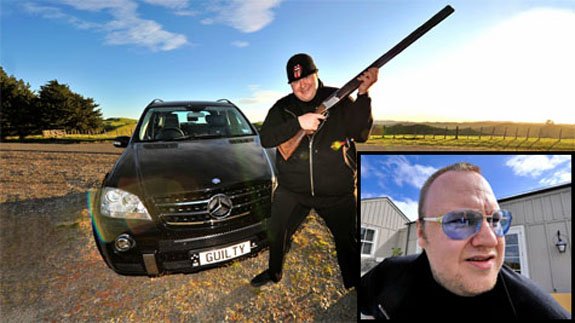
Kim Dotcom, Megaupload founder, has been granted bail by a New Zealand court.
Kim Dotcom, 38, has been in prison since 20 January at the request of the US authorities.
Megaupload founder faces charges in the US for one of the biggest copyright infringement cases in the country’s history.
The file-sharing site is accused of costing copyright holders more than $500 million in lost revenue.
North Shore District Court Judge Nevin Dawson overturned two previous rulings that Kim Dotcom, who is a German national, was an “extreme flight risk” because he had the money and connections to get out of the country.
The judge said the risk had diminished because all his funds were seized and no new assets or bank accounts had been uncovered.
Kim Dotcom, Megaupload founder, has been granted bail by a New Zealand court
Speaking to reporters in Auckland, Kim Dotcom said he was “relieved to go home to see my family, my three little kids and my pregnant wife”.
On 17 February Kim Dotcom was charged with three new criminal copyright counts and five new wire fraud counts.
That is on top of one count of racketeering, one count of conspiracy to commit money laundering and two counts of criminal copyright infringement charges.
US authorities are seeking to extradite Kim Dotcom, who changed his name legally from Schmitz, and three other co-defendants who had earlier been granted bail.
The US Justice Department and Federal Bureau of Investigation allege that Megaupload and its related sites made millions in ‘criminal proceeds’ by sharing pirated copies of movies, music and other content.
Founded in 2005, Megaupload was shut down by authorities last month.
They also seized millions of dollars worth of assets owned by Kim Dotcom including luxury cars, artwork and investments.
Kim Dotcom has denied any criminal misconduct and has said he will fight extradition to the US.
The BBC issued a statement in a lengthy defense of its decision to show extensive coverage of Whitney Houston’s funeral.
BBC was forced into the response after receiving 118 complaints about the way the broadcaster’s news channel had remained “glued” to the ceremony on Saturday, sparking accusations that it had been “voyeuristic”.
The British broadcaster admitted that the “duration” of its coverage was “too long” for some viewers and said it was “sorry” it was not to the “satisfaction” of all its audience.
However, BBC said the singer had made a “substantial impact on late twentieth century music” and that her death had come as “a great shock to the wider music industry and to her millions of fans”.
In its response,BBC admitted that the funeral service had lasted “significantly longer” than any broadcasters had expected and said once it had “committed” to showing the ceremony it would not have been “appropriate” to “opt out” any earlier than it did.
For some viewers BBC’s decision to focus so much time on the ceremony sparked concerns that other events were not being given enough coverage.
One said: “Yes, Whitney was wonderful singer but hours and hours of live broadcast of funerals on CNN and BBC and wherever is getting to feel kind of strange.”
Another viewer said: “Much as I understand sadness at the death of Whitney Houston would BBC and Sky kindly get on to some real news.”
“Kinda weird that Sky News and BBC News 24 are live streaming Whitney Houston’s Funeral. Feels voyeuristic,” added another viewer.
Stevie Wonder, Alicia Keys, R Kelly and a host of gospel stars performed at Saturday’s service at New Hope Baptist Church in Newark, New Jersey.
Actor Kevin Costner, who starred with Houston in The Bodyguard, fought back tears as he gave a moving eulogy.
The BBC issued a statement in a lengthy defense of its decision to show extensive coverage of Whitney Houston’s funeral
The BBC, which is also understood to have received about 35 complaints that it had interrupted coverage of the service, said the decision to air the funeral had been made “very carefully”.
BBC statement said: “We know from our audiences across the BBC as a whole that there was significant interest in the death of Whitney Houston, and we wanted to provide for that audience full, live coverage of the occasion.
“This was the funeral of a recording artist who had a substantial impact on late twentieth century music and whose death had come as a great shock to the wider music industry and to her millions of fans.
“This was reflected in our viewing figures and they show that the coverage of the funeral drove significantly higher audiences for the News Channel during this period compared to the rest of Saturday.
“We recognize that the duration of the coverage was too long for some viewers, but we kept the news ticker going on screen throughout and those who wanted other news of the day could have turned over to BBC 1 for the main tea time bulletin there.
“The funeral of Whitney Houston gave us an opportunity to bring a significant and moving story live to our audience. We are sorry if this wasn’t to the satisfaction of all our viewers but it is part of the News Channel function to be there when major stories take place, and we felt that this was such an occasion.”
A BBC spokeswoman said: “The News Channel’s coverage of Whitney Houston’s funeral reflected the significant interest in her sudden death as well as acknowledging the impact she had as a global recording artist.
“While some people felt there was too much coverage, we kept the news ticker going throughout, BBC1 ran the main teatime bulletin and there were normal radio bulletins along with the website and mobile app services, providing viewers with the best access to the day’s other news stories.”
Whitney Houston will always be remembered for her beautiful singing voice, but the late singer, in fact began her career as a model.
Images of Whitney Houston modelling for Seventeen Magazine in 1981 show a fresh-faced and hopeful young girl who had her whole life ahead of her.
The beautiful model, who was 18 at the time, can be seen smiling as she looks out to sea in a fuchsia swimsuit, while another photograph shows her running along the edge of the water in a pink and white striped romper suit.
Two of the shots show Whitney Houston sporting a red one-piece along with a snorkelling mask as she carries flippers before heading out into the surf with her fellow models.
Another image sees the angelic-faced Whitney Houston sat on the edge of a sunbed while wearing a red dress as she throws her head back in laughter.
Images of Whitney Houston modelling for Seventeen Magazine in 1981 show a fresh-faced and hopeful young girl who had her whole life ahead of her
Fashion editor Diane Forden, who worked with Whitney Houston during her modelling days, has spoken out to tell of how the future superstar was just as sweet in person as she appears in the beach shots.
Diane Forden wrote on the website BridalGuide.com: “I had the pleasure of working with Whitney during her high school years when she was a teen model.
“She was a delightful, sweet, wonderful person, and all of us who worked with her loved her. She was truly beautiful inside and out.”
Whitney Houston sporting a red one-piece along with a snorkelling mask as she carries flippers before heading out into the surf
The fashion editor also took to the website to tell of how professional Whitney Houston was, despite her young years.
Diane Forden wrote: “Anytime we were booking models for a photo shoot, we would always say, <<Let’s book Whitney>>, <<See if Whitney is available>>, <<Whitney would be great for this story>>.
“She was never a diva and she was always professional. She showed up on time and made our jobs easier by doing her best in front of the camera. She never complained if days ran long and cheerfully did whatever was expected.”
Two years after Whitney Houston graced the cover of the teen magazine, she landed a record deal with Arista and began putting together her first album.
Whitney Houston released her self-titled debut album two years later, in 1985, which sold more than 25 million copies internationally and paved the way for her to hit the big-time.
The touching photographs only make the star’s untimely death seem even more tragic, and they are unearthed as it is reported by Radar Online that she allegedly died from a deadly concoction of Valium, Xanax and alcohol.
However the cause of death is yet to be confirmed, pending toxicology reports which are expected to be released in a few weeks.
Whitney Houston was laid to rest on Sunday in her homeland of Newark, New Jersey, following her funeral the day before.