John Kelly, a small business owner and youth baseball coach from Chicago could be ruined after his friends and family exposed his racist Facebook rant against Whiney Houston.
John Kelly used the “n” word to describe Whitney Houston on his own Facebook account.
The offensive term was spotted by a family friend and re-posted on Westside Baseball of Oak Lawn Facebook page.
John Kelly has been suspended as president of the team amid denials he is racist.
The post reads: “I’m so sick of reading about this dumb stupid N ***** Whitney Houston.
“She’s the dumb ass that decided to do drugs n kill herself stay with that woman beater … she blew more $$ up her nose than most of ye will make in yer lifetime …
“There are kids dying real fathers n mothers fighting for their lives…grow up ye dumb assess…think she’d give a flying f*** about u???? Just saying.”
John Kelly could be ruined after his friends and family exposed his racist Facebook rant against Whiney Houston
Terrified for his children’s safety following his racist post, John Kelly claims he has many black friends.
“I didn’t even realize I put it in until after I sent it,” John Kelly told the Chicago Sun-Times.
John Kelly said his Facebook page is restricted to friends and family only and a black former player’s mother saw the comment and re-posted it on her Facebook page and on the league’s page.
“I don’t need this drama in my life. It’s going to affect me hugely, and my business,” said John Kelly, known as a family man.
Suspended from coaching for a year, John Kelly is unrepentant about the sentiments expressed in his controversial comment.
He said he was personally appalled that New Jersey Governor Chris Christie lowered flags to half-staff at state buildings on the day of Whitney Houston’s funeral.
John Kelly said that as a known drug addict Whitney Houston should not be promoted as a role model for kids.
“I do stand behind everything I said except the n-word. I regret using that adjective,” explained John Kelly.
“Does that make me a racist? Are you kidding me? It was the farthest thing from my mind. I have some amazing friends who are black.”
The mother who exposed John Kelly’s rant asked not to be identified publicly.
“John and I had been cordial because our kids are close friends,” she said.
“He would make implications, post a picture of something, but he never used the n-word.
“If this is the way he talks, what is he thinking when he has a black kid in the field?”
Even though John Kelly claims he apologized to her last week, the mother is still incensed.
“Do you want this guy around your children,” she said.
Meeting John Kelly in a local Dunkin-Donuts, the anonymous mother said the meeting went badly.
“He asked why I was attacking him personally,” she said.
“I told him I just felt like the [Whitney Houston] comment was the last straw and that I didn’t think he was a good role model for children. He started swearing.”
Now attending sensitivity classes at his own behest, John Kelly caused major embarrassment for his colleagues at Westside Baseball.
“He’s wrong. He knows it. He apologized,” said Acting President Jim Hebel.
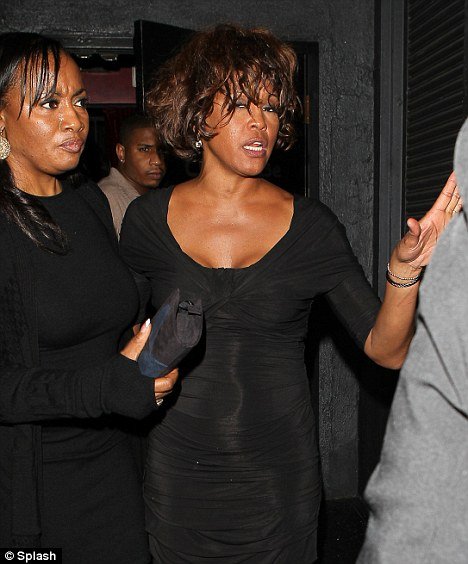
A new behind-the-scenes footage of Whitney Houston filming her forthcoming movie Sparkle shows the singer, who passed away age of 48, looking happy and healthy.
In a new clip featured on U.S. network Entertainment Tonight, presenter Mark Steins also said he had heard Whitney Houston’s voice was “100% back” as he went on set of the film last October and November.
Mark Steins gave his thoughts on interviewing Whitney Houston, who is shown on set performing and interacting with the crew.
He revealed that Whitney Houston didn’t want to be interviewed alone, instead opting to sit side by side with director Salim Akil and co-star Jordin Sparks.
Whitney Houston is shown filming a scene in curlers, but Mark Steins said the singer insisted on changing into a patterned shift dress and putting on make-up.
Wearing a purple dress, Whitney Houston looked fresh and youthful as she chatted with the presenter, who said she looked “healthier and heavier” then he could recall.
New behind-the-scenes footage of Whitney Houston filming her forthcoming movie Sparkle shows her looking happy and healthy
And in an eerie foretelling, Whitney Houston animatedly discussed a connection between the movie and the New Hope Baptist Church in Newark, where her funeral was held last week.
The legendary singer revealed that in the movie, the church is called the New Hope Baptist Church, where her character sings in the choir.
Whitney Houston added the film’s writers “had no idea” that it was the same name as her own childhood church “I grew up with in New Jersey”.
She was laid to rest in the church last weekend in a moving service.
In between filming scenes in a church, singing the gospel hymn Eyes On The Sparrow, Whitney Houston revealed her distaste for cursing.
Whitney Houston said of refusing to listen to a rap song with explicit lyrics: “I did that with my own daughter. I said, <<We’re not listening to that, no.>>”
Jordin Sparks, the former American Idol winner, who is four years older than Whitney Houston’s own daughter, Bobbi Kristina, recalled her favorite on-set memory of the superstar.
The 22-year-old singer told Access Hollywood: “[Whitney] had an iPod and she’d be blasting gospel, and I’d put on Teach Me How To Dougie or something. She’d say, <<You listen to this?>> and I’d say, <<Yes, I do>>.
“One night we were waiting for the camera change and we all stood up and starting Dougie-ing. It was this crazy moment.
“It was so funny and such an out of body experience. I’m going, <<This is Whitney Houston, regal Whitney Houston>> and there she was, just getting down. It was awesome.”
Whitney Houston’s last performance hits the big screen on August 17 of this year, though it was originally slated for an August 10 release.
The film was inspired by the story of 1960’s girl group The Supremes and is a remake of the 1976 film of the same name starring Aretha Franklin.
The 2012 version of Sparkle takes place in Detroit and is set in the Motown era.
Musical prodigy Sparkle (Jordin Sparks) has to deal with the hardships of becoming a star and keeping her family together, while Whitney Houston plays her struggling mother Emma.
The film also stars Derek Luke, Mike Epps and The Voice judge Cee Lo Green.
It is Jordin Sparks’ début performance as an actress, and it was meant to be the role that re-launched Whitney Houston’s career.
The film will be dedicated to Whitney Houston’s memory.
The father of Minnie Driver’s 3-year-old son Henry has been identified as Timothy J Lea, 52, co-producer of The Riches, as well as hit shows CSI New York and Law and Order.
Speaking to the Observer this week to promote her film Hunky Dory, a low-budget British movie, Minnie Driver left several clues to his identity, claiming he was a writer on The Riches, the American TV series in which she co-starred with comedian Eddie Izzard.
When asked whether he was a good father to Henry, Minnie Driver said: “Sort of. He’s figuring it out . . . I mean, he hasn’t been that involved; his choice. But he is now.”
Minnie Driver, 42, dated Timothy J Lea for a short time before they split up.
On Henry’s publicly-available birth certificate, the mother’s name is registered as Amelia Minnie Driver, her full name, and the father as Timothy Jonathan Lea, born in Dunbartonshire, Scotland.
Timothy J Lea was brought up in Australia and moved to America where he graduated from high school in Stamford, Connecticut.
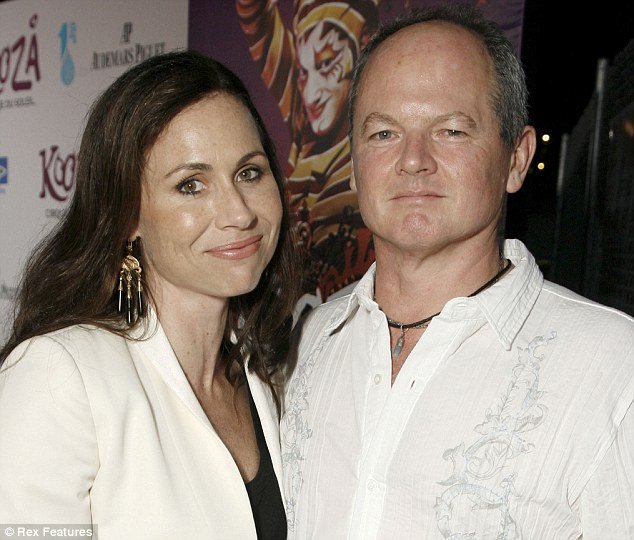
Actress Minnie Driver dated TV producer Timothy J Lea, the father of her son Henry, for a short time in 2009 before they split up
Minnie Driver said of her decision to keep his identity a secret: “We weren’t together and he wasn’t directly in the business, so I chose to protect him and not have a rain of publicity. He’s not famous. There’s no big story.”
Despite splitting up with Henry’s father before he was born, Minnie Driver said she had coped well with being a single working mother: “I had good friends around me, so it was sort of hilarious.
“I was making a film at the time and the paparazzi would shout: <<Who’s the sperm donor?>> at me.”
Minnie Driver, who has dated Matt Damon and was engaged to Barbra Streisand’s stepson Josh Brolin, also spoke of her own unconventional upbringing as one of two children born out of an affair.
The actress’ mother Gaynor Churchward, a former couture model and designer, was mistress to her father Ron Driver, a self-made millionaire who had a wife and daughter who knew nothing of his other family.
Speaking about her childhood, Minnie Driver said: “My father lived his life and he didn’t look much beyond that evening. But I think that’s a good thing. I think I’m like him in a way.”
Kim Kardashian shared vintage vignettes of her happy family that pre-date her parents’ divorce to celebrate her late father Robert’s birthday.
Robert Kardashian passed away in 2003 after a battle with esophageal cancer, and she wrote: “Wonder if they celebrate birthdays in heaven…if so I’m sure my dad is having the best birthday ever! Happy birthday dad.”
She added: “Celebrating with angels.”
Kim Kardashian revealed in an episode of Kim and Kourtney Take New York that her father contacted her through medium John Edwards and told her to go ahead with the divorce.
It’s been a hard few months for the former golden girl of reality television.
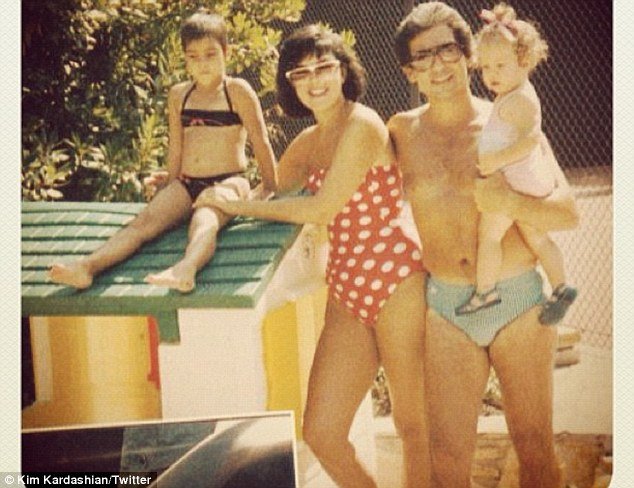
Kim Kardashian with her mother Kris, father Robert Kardashian and sister Khloe
It’s not over for Kim Kardashian, either, as she is staring down the barrel of messy divorce proceedings after her ex-husband Kris Humphries, 27, refused to settle out of court.
Kris Humphries is also, according to several sources including Life and Style magazine, planning to file a complaint against Kim Kardashian’s mother, Kris Jenner.
The NBA star has petitioned to have his Minnesota-licensed attorney practice in California, so appears to be bringing the battle to her doorstep.
According to Life and Style, Kim Kardashian is devastated that by not settling out of court, Kris Humphries has opened their divorce up to the cameras.
California allows filming as part of an open policy on popular cases.
A source told Life and Style: “Kim’s freaking out, she has no interest in dragging out the divorce or having it play out on TV.
“Believe or not she’s a private person.”
“All of her dirty laundry will be aired, and there is a lot to air,” the mole continued.
Kris Humphries wants to prove that Kim Kardashian never intended to marry him and therefore committed fraud.
Bobbi Kristina Brown, Whitney Houston’s daughter, is back home in Atlanta following her mother’s funeral, which took place in Newark, New Jersey, last week.
The 18-year-old aspiring singer was understood to have gone missing following the ceremony at the New Hope Baptist Church, with a source telling the Daily Beast she was later found at a hotel “getting high”.
Though reports had suggested Bobbi Kristina Brown had gone off the rails following the funeral, a source close to the family has told People Magazine she is now recovering at home.
The insider said: “She’s doing okay. She’s still obviously got a lot to deal with but she’s doing a little better each day, and being back home in Atlanta seems to be a good thing”.
Bobbi Kristina Brown, Whitney Houston’s daughter, is back home in Atlanta following her mother’s funeral
Bobbi Kristina had been in Los Angeles with her mother when the legendary star died unexpectedly in her hotel room at the Beverly Hilton on February 11.
Following the days after Whitney Houston’s death, Bobbi Kristina was comforted by family members including her grandmother Cissy, as well as her Uncle Gary and Aunt Pat.
Ellin LaVar, Whitney Houston’s former hairstylist, explained: “She is a strong girl. I think with support she will make it through this.”
The status of Bobbi Kristina’s relationship with her father Bobby Brown is currently unclear. Bobby Brown abruptly left Whitney Houston’s funeral after a disagreement over seating plans.
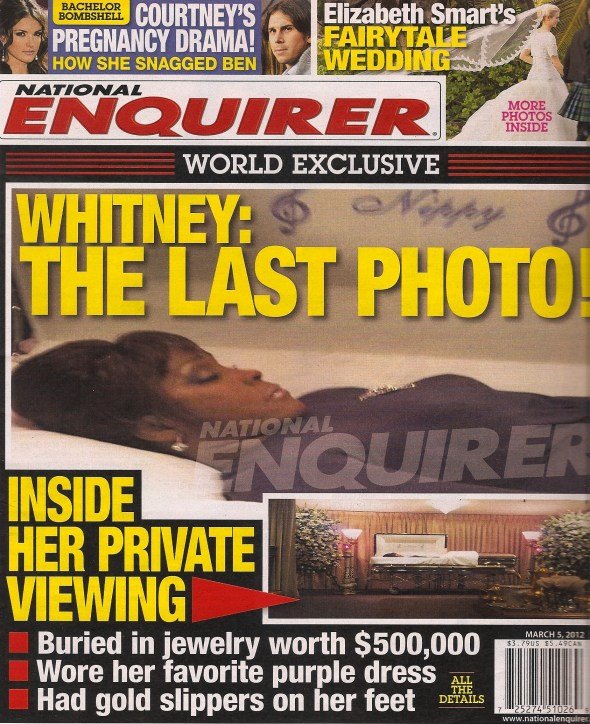
The decision to publish a photograph of dead Whitney Houston in her coffin on National Enquirer cover has been widely criticized as a tasteless move by the sensationalist publication.
The source of the picture of Whitney Houston in an open casket is still in question, with the owners of the Whigham Funeral Home in Newark saying that it was nothing to do with them.
Whitney Houston ‘s funeral home owners have denied any direct links to the picture published by the National Enquirer.
Carolyn Whigham, speaking for the funeral home is quoted on the Chicago Tribune website as saying: “I’m going to answer you as the [family’s] publicist told me to answer you: We have no comment. But it was not the funeral home.”
The publication of the photograph has upset many, though others have been unable to overcome their curiosity and have made the trip to the newsstands to purchase a copy.
Whitney Houston’s picture in casket published by National Enquirer
Diana Moss of Chicago was interviewed after purchasing a copy, saying that although she does not normally buy the National Enquirer and thought the photo to be in poor taste, she shelled out the $3.79 cover price because her daughter wanted to see it: “I normally don’t buy these, but she was curious to see [Whitney Houston’s photo].”
Fox News has also reported that the publisher of the National Enquirer has said that she thought the photo was “beautiful.”
There is no credit for the photograph but nobody has officially claimed that the image is fraudulent.
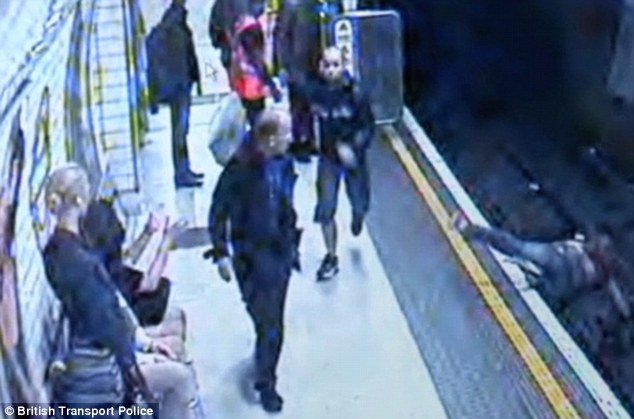
A crazed commuter launched an apparently random attack on a young woman, pushing her on to the tracks of the London Underground.
The victim struck up a brief conversation with the thug and following a trivial row over the man’s hat, he turned and shoved her on to the rails on the Northern Line at Leicester Square.
The 23-year-old woman only missed the live rail by inches, and was able to pull herself back onto the platform with the help of other travelers before the next train came down the platform.
Injuries to her side were so severe, witnesses initially thought she had been stabbed.
The incident – highlighted on the BBC’s six-part The Tube documentary on Monday night – shows the very real dangers faced by commuters and staff each day.
British Transport Police are still hunting the man behind the vicious assault, describing him as smartly dressed.
BTP said the incident stemmed from a short argument about the attacker’s hat.
A crazed commuter launched an apparently random attack on a young woman, pushing her on to the tracks of the London Underground
The incident took place on Friday, September 16, at about 11:20 p.m., but police are so keen to find the man they have re-appealed again for more information on the back of the BBC’s documentary.
The woman suffered a wound to her side and was taken to hospital, while both platforms of the Northern Line were shut for the rest of the evening.
BTP Detective Sergeant Fin Egan, the investigating officer, said: “This was a dangerous and reckless act which could have had grave consequences had a Tube train been approaching.
“The victim suffered a nasty cut to her side as she landed on the rails, but was able to pull herself back up onto the platform.
“The platform was busy at that time and I am appealing for anyone who recognizes the man in the images or who witnessed the incident to get in contact.”
The man in the images is described as white, aged about 40 with a thin build.
He was wearing a blue shirt, a black jacket and a black wide brimmed hat. He also wore orange/yellow tinted glasses. He spoke with a European accent.
Footage of the aftermath of the incident can be seen in Episode 1 of The Tube, available on BBC iPlayer.
Anyone who knows the man pictured in the image or who has any information about the incident can contact British Transport Police on 0800 40 50 40 or call Crimestoppers anonymously on 0800 555 111.
Kyle Dyer, the veteran TV anchor who was bitten in the face by an 85-pound dog during a live broadcast earlier this month has spoken out about the frightening experience two weeks after her attack.
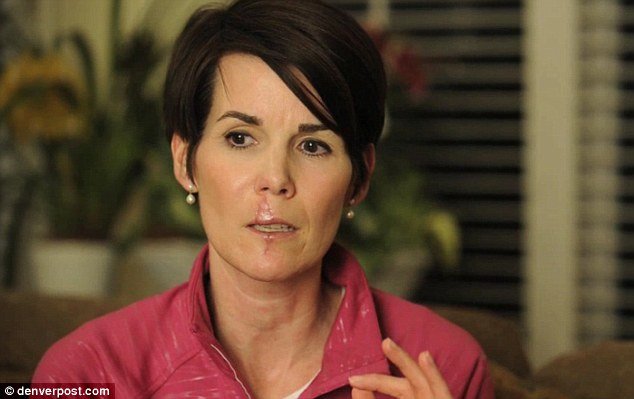
The veteran anchor of Denver’s KUSA-TV gave her first interview yesterday, proudly showing scars on her face, which include a V-shaped scar on her upper lip where skin had to be grafted.
Kyle Dyer told the Denver Post that the first thoughts that went through her mind after the Argentine Mastiff bit her was: “I’m bleeding, and it had to be on television!”
Despite the painful weeks of recovery, two surgeries, and the long road ahead, Kyle Dyer said she feels lucky and calls the attack “a fluke”.
“It could have been so much worse,” she said.
“It may seem like a superficial business, but the people out there in Colorado are not superficial,” Kyle Dyer told the Denver Post.
The TV anchor said she’s received an outpouring of support from people who have also been bitten by dogs and who are wishing for a speedy recovery.
“I just keep reading those letters and know that I’m going to heal. I’m going to be better than ever,” she said.
Kyle Dyer gave her first interview after she was bitten on live TV, proudly showing scars on her face, which include a V-shaped scar on her upper lip where skin had to be grafted
The news of the attack spread like wildfire around the world. Kyle Dyer said she personally witnessed the breadth of the news by way of her niece, who lives in Lithuania.
Kyle Dyer said her niece read about the attack in the town’s local newspaper. “There’s so many different learning things that have come out of this,” she said.
Kyle Dyer was injured February 8 while doing an on-air segment with the dog’s owner and a fire-fighter who had rescued the Mastiff from an icy pond in suburban Lakewood the day before.
She was petting the dog’s head seconds before it bit her.’
Over Valentine’s Day weekend, Kyle Dyer wrote on her Facebook page that her mouth was stitched shut so the graft over her lips could receive better blood circulation.
While more surgeries may be in her future, Kyle Dyer won’t know for certain until this summer, as doctors asses her progress.
Kyle Dyer, who had been working at the Denver station for over 15 years, underwent reconstructive surgery and over 70 stitches after the attack.
She said she harbors no ill will toward the dog.
“It was just an accident,” Kyle Dyer said, saying that she’s glad he is back with his owners.
Unless the dog has rabies – which it is not showing signs of – it will not be put down.
Even if the vaccinations are current, the dog’s owners will definitely face two charges from Denver Animal Care and Control: a penalty for having the dog bite someone and a second penalty for having the dog off its leash at the time.
“While we normally walk Max on-leash, we understand that by letting him off-leash in an open area away from anyone was still a mistake. We will never walk him off-leash in public areas after this,” the dog’s owners said in their statement.
Max was brought into the studio after the station’s news chopper captured video footage of a firefighter rescuing Max from a freezing pond Monday after he fell through the ice and couldn’t make it out.
“I know that she is a great journalist who loves happy stories – this was a happy story,” Kyle Dyer’s co-anchor Gary Shapiro said in a note to fans.
“Kyle was glad she got assigned to it, because she loves animals,” Gary Shapiro said.
Though she is out of the hospital, her recovery is just beginning.
Kyle Dyer, who is married and has children, is expected to take several weeks to return to work.
In a video which has now gone viral, actor Zac Efron is seen approaching a fan to greet them, when he accidentally drops a condom on the red carpet at the premiere of his new Dr. Seuss film, The Lorax, at Universal Studios, Hollywood.
Zac efron, 24, swept up the contraceptive immediately, grinning sheepishly and immediately put his sunglasses on as he continued on his way.
The Disney’s High School Musical series star coughed with and held his hand to his mouth, pausing to regroup after the mishap.
The actor’s bashful smile and clear embarrassment served as apology enough- though hopefully any youngsters present might not have recognized what they saw.
Zac Efron’s co-stars Taylor Swift and Danny DeVito were also present at the screening.
Zac Efron is seen approaching a fan to greet them, when he accidentally drops a condom on the red carpet at the premiere of his new Dr. Seuss film, The Lorax
There has been talk of a romance between the Zac Efron and the country singer Taylor Swift, though they have denied it.
Taylor Swift told Ellen DeGeneres during a recent appearance on her talk show: “We are not a couple. He’s awesome, we are not a couple though. You hear people get together when they’re shooting movies, co-stars.
“But not like animated co-stars. You know what I’m saying. Oh my god, as we were recording out voiceovers on separate coasts we really connected.”
Zac Efron and Taylor Swift then picked up their guitars and performed a duet as Ellen DeGeneres watched on.
They also talked about what they did for Valentine’s Day.
Taylor Swift described how she had a ‘pathetic single girls party’ where she ate lots of junk food.
And Zac Efron added: “That’s so different than what single guys do. I went to a screening of a film that I did called Liberal Arts. Then cooked some dinner with a friend.”
Rumors began to swirl about Zac Efron and Taylor Swift after they were spotted sharing a very friendly meal last month.
On January 6, Zac efron had a “flirty dinner with the country superstar” at an outdoor corner table at Los Angeles’ Pace.
Us Weekly described how Zac Efron and Taylor Swift were “were deep in conversation and very giggly”, after arriving together in Efron’s Audi.
But they have been flirting for a long time.
Back in 2009, Zac Efron – single since splitting with Vanessa Hudgens in December 2010 – called Taylor Swift a “lovely girl, very beautiful”.
In turn, Taylor Swift, dumped by Jake Gyllenhaal in December 2010, gushed that Zac Efron was an “all-around amazing guy”.
McDonald’s is prepared to target a more pious crowd for the season of Lent with its latest innovation – Fish McBites.
Fish McBites was first reported on Tuesday, a day before the start of the Christian season of fasting on Ash Wednesday.
It was pictured at a McDonald’s branch near Texas Christian University in Fort Worth, which may strengthen the impression that it is aimed at the faithful who have denied themselves the pleasure of meat.
Fish McBites appear to be modeled on Chicken McBites, a version of popcorn chicken introduced over the last few months.
But it is also inspired by the Filet-O-Fish, a fixture on the McDonald’s menu for more than four decades and the company’s most popular maritime product so far.
Fish McBites, like the Filet-O-Fish, are made from Alaskan pollock and served with tartar sauce.
The new snack is currently available only in selected restaurants, at a price of $1.99 for a small portion, $2.99 for a regular and $4.99 for a “shareable” size.
McDonald’s is prepared to target a more pious crowd for the season of Lent with its latest innovation - Fish McBites
McDonald’s website trumpets the new product as “tender, flaky and delightfully poppable”, and encourages its customers to “Say ahoy to this seaworthy lineup”.
A McDonald’s spokesman told the Huffington Post: “These are in test in a couple of markets, however the test is in infancy. We will continue to evaluate customer feedback and restaurant operations.”
While it is not clear whether or not the timing was deliberate, fast-food restaurants which rely primarily on sales of red meat have been known to suffer during Lent.
During Lent, which this year started on February 22, Ash Wednesday, and ends on Easter Sunday, April 8, devout Catholics are not supposed to eat meat – particularly on Fridays.
Many other people, religious and non-religious alike, try to give up indulgent treats they know are unhealthy.
The Filet-O-Fish itself was introduced in 1962 in response to poor sales every Friday at Lou Groen’s McDonald’s franchise in Cincinnati, Ohio, an area with a large Catholic population at the time.
It has reportedly become popular with other religious groups such as Jews or Muslims who require their meat to be slaughtered in accordance with ritual guidelines, but have no such restrictions with fish.
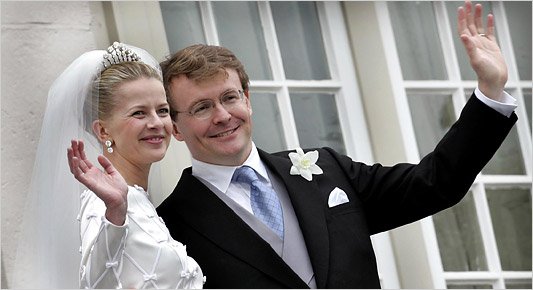
Prince Johan Friso of the Netherlands, who was injured in an avalanche in Lech, Austria, last week, is in a coma and may never regain consciousness, say doctors treating him.
Dutch Prince Johan Friso, who had been on a skiing holiday in the Austrian resort of Lech, lay buried under snow for about 15 minutes before being rescued.
The prince was taken to hospital in Innsbruck after the accident, in which nobody else was hurt.
Prince Johan Friso, 43, is the second son of Queen Beatrix of the Netherlands.
However, he is not in line for the throne since marrying in 2004 without the government’s permission.
Queen Beatrix and the prince’s wife, Mabel, have been to visit him at Innsbruck’s University Hospital, as have his brothers, Crown Prince Willem-Alexander and Prince Constantijn.
A friend of the prince who was skiing with him at the time of the avalanche has been questioned by police.
Prince Johan Friso had been skiing with between one and three other people off the marked pistes when the avalanche hit shortly after midday local time last Friday, said resort officials.
The prince was buried by an avalanche reportedly measuring about 30 m wide by 40 m long.
A beeper he was wearing allowed rescuers to locate him quickly.
Dutch Prince Johan Friso, who was injured in an avalanche in Lech, Austria, last week, is in a coma and may never regain consciousness
Speaking to reporters in Innsbruck, Dr. Wolfgang Koller said it had taken nearly 50 minutes to revive the prince.
MRI scans have shown his brain suffered “massive damage” in the avalanche.
Prince Johan Friso will be moved at a later date to a private clinic for further treatment but it may take years before he awakens, if ever, the doctor said.
“We cannot say today with certainty whether Prince Friso will one day regain consciousness,” added Dr. Wolfgang Koller, who is head of the trauma unit at the hospital.
“In any case, a neurological rehabilitation will be required that will take months, if not years.”
The doctor explained that the prince’s brain had been deprived of oxygen due to the amount of time spent under the snow.
“This resulted in a heart attack that lasted about 50 minutes….
“Fifty minutes of reanimation is very, very long, one might even say too long.
“Our hope was that the patient’s mild hypothermia would provide some protection for the brain. This hope was not realized.”
The Dutch royal family regularly spends skiing holidays in Lech, in the western Vorarlberg province of Austria.
Florian Moosbrugger, owner of the hotel where the royal family stays, had been skiing with the prince, a childhood friend.
He survived the incident unscathed, having worn an avalanche airbag, and reportedly dug his friend out with his own hands and called the emergency services, the Austrian Times reports.
He has been questioned by police seeking to establish which of the skiers went down the slope first, and how the avalanche began.
Florian Moosbrugger, who could reportedly face charges of “unintentional grievous bodily harm in particularly dangerous circumstances”, says he is totally innocent.
According to his mother Kristl, Queen Beatrix herself comforted him after he was questioned.
Kristl Moosbrugger has defended her son.
“No avalanche was coming downhill,” she told Austrian broadcaster ORF.
“There were also strong skiing traces in the snow. They felt sure.”
How did 30-ton dinosaurs, such as the Brachiosaurus, animals longer than four-storey buildings, have sex?
Experts have answered to this question – they made love just like dogs do.
Kristi Curry Rogers, Assistant Professor of Biology and Geology at Macalester College in Minnesota, told the Discovery Channel: “The most likely position to have intercourse is for the male behind the female, and on top of her, and from behind, any other position is unfathomable.”
Some experts have questioned this line of thinking and suggested that dinosaurs romped in water.
Dinosaurs made love just like dogs do, say experts
Biologist Stuart Landry believes that big dinosaurs would just fall over on land and would have needed water to provide support.
However, Gregory Erickson, a paleobiologist at Florida State University backs Prof. Kristi Curry Rogers.
Gregory Erickson told Discovery: “It’s going to be very touch and go. It’s an awkward thing.
“I’ve heard speculation that they did it in the water, but they’re not aquatic animals. Just because they’re large animals, doesn’t mean they can’t mate on land – after all, elephants do it.”
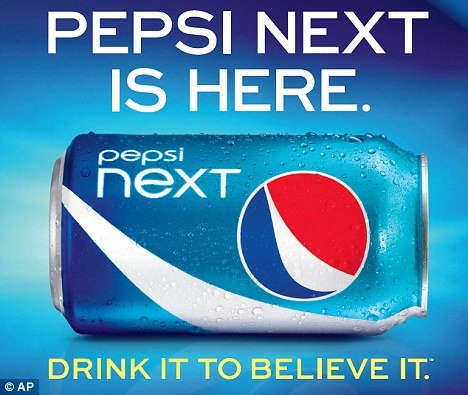
As some people dislike the calories in soft drinks, but loathe the taste of their zero-calorie diet equivalents, Pepsi is hoping to win back beverage consumers with a compromise, a mid-calorie soda.
The American company is rolling out Pepsi Next, a cola that has less than half the calories of a standard Pepsi at 60 calories per can.
Pepsi Next, which is slated to hit store shelves in the U.S. by the end of next month, is the company’s biggest product launch in years.
Pepsi Next comes as people increasingly move away from sugary drinks to water and other lower-calorie beverages because of health concerns.
It is also an attempt by Pepsi to revive the cola wars against Coke and others.
Pepsi Next isn’t the first drink to try to hit the sweet spot between diet and standard cola.
Dr. Pepper Snapple rolled out its low-calorie Dr. Pepper Ten, which has ten calories. The company said the drink, which has sugar unlike its diet soft drink, helped boost its fourth-quarter sales.
But coming up with a successful “mid-calorie soda”, which has more calories, has proved a challenge for beverage makers.
In 2001, Coke rolled out C2 and Pepsi in 2004 introduced its Pepsi Edge, both of which had about half the calories of a regular soft drink. Both products also were taken off the market by 2006 because of poor sales.
John Sicher, editor of Beverage Digest, said: “The problem was that consumers either wanted regular soda or a diet drink with zero calories – not something in between.”
Pepsi Next is made with a mix of three artificial sweeteners and high fructose corn syrup
Pepsi says its latest stab at an in-between soft drink uses a different formula to more closely imitate the taste of a regular soda.
Pepsi Next is made with a mix of three artificial sweeteners and high fructose corn syrup.
Melissa Tezanos, a spokesperson for Pepsi, said the company developed the cola by researching the “taste curve” that consumers experience when drinking a regular soft drink
She compared that arc to how someone might evaluate a sip of wine, from the moment the liquid hits the tongue to the after-taste it leaves.
Melissa Tezanos said: “We wanted to develop a taste curve that gives the full flavor of regular Pepsi.”
Pepsi Next also follows the company’s lower-calorie variations of its other drinks.
The sport drink Gatorade, a unit of Pepsi, has G2, which at 20 calories has a little less than half the calories of the original version. And the company’s Tropicana unit introduced Trop50, which is half of the 110 calories in a regular glass of orange juice.
But orange juice and sports drinks have nutritional benefits that a drink maker can market. A mid-calorie soft drink is a tougher sell because it provides only empty calories.
So health-conscious drinkers usually opt for a diet soft drink or quit altogether.
Sales in the $74 billon soft drink industry have been fizzling out, with volume falling steadily since 2005, according to Beverage Digest, which tracks the industry.
Meanwhile, healthier drinks are growing more popular, with bottled water accounting for 11% of all beverages consumed in 2010, up from 2% in 2000. Consumption of sports drink rose to 2.3%, from 1.2%.
Diet soft drinks also rose to 29.9% of the carbonated drink market in 2010, up from 24.7% a decade earlier.
To keep up with changing tastes, Coke and Pepsi have introduced newer versions of their diet drinks – Coke Zero and Pepsi Max – that promise a taste that’s more like their regular sodas.
Pepsi hopes Pepsi Next will help it gain back the market share it has lost in recent years.
The company’s namesake drink had its share in the carbonated soft drink market fall to 9.5% in 2010, from 13.6% a decade earlier, while Diet Pepsi’s share remained steady at 5.3%.
Coke is still the top selling brand, with 17% market share. Diet Coke follows with 9.9%.
Pepsi, based in Purchase, New York, said earlier this month that it plans to increase marketing for its brands by $500 million to $600 million this year. A centerpiece of that will be Pepsi’s first global ad campaign this summer, a peak time for the soda market.
Soda calorie counter
A standard can of soft drink contains the following calories:
A US study found that some antipsychotic medication may increase the risk of death in patients with dementia more than others.
The antipsychotics have a powerful sedative effect so are often used when dementia patients become aggressive or distressed.
A study, published on the BMJ website, argued that antipsychotics should not be used “in the absence of clear need”.
Experts said better alternatives were needed to antipsychotics.
A study in 2009, suggested 180,000 people with dementia were taking antipsychotic medication in the UK and said the drugs resulted in 1,800 additional deaths.
Researchers at Harvard Medical School followed 75,445 people in nursing homes who had dementia and were prescribed antipsychotics.
The researchers said some drugs were associated with more than twice the risk of death than risperidone, another antipsychotic which was used as a benchmark to compare the other drugs.
The study concluded: “The data suggest that the risk of mortality with these drugs is generally increased with higher doses and seems to be highest for haloperidol and least for quetiapine.”
However, the way the study was conducted meant it could not say definitively that certain drugs actually caused more deaths, merely that there was a link between the two.
The Department of Health said antipsychotic use was “resulting in as many as 1,800 unnecessary deaths per year. This is simply unacceptable.”
“That’s why reducing the level of antipsychotics prescribing for people with dementia by two-thirds is one the key priorities in the National Dementia Strategy.”
A US study found that some antipsychotic medication may increase the risk of death in patients with dementia more than others
The Dementia Action Alliance – which includes the Alzheimer’s Society, Age UK and the Department of Health – has called for all prescriptions for antipsychotics to be reviewed by the end of March 2012.
Dr. Chris Fox, who researches dementia at the University of East Anglia, said: “This study provides an interesting insight into the differential harm of these medicines.
“More work is needed on alternatives to these medicines in dementia with behavioral problems.
“In addition, there is a need to consider duration of use in more acute situations such as severe distress. Is six or 12-week use safe in people with dementia?”
Alzheimer’s Research UK’s chief executive Rebecca Wood said the risks of antipsychotics were “well-established” yet “progress has been frustratingly slow” in reducing their use.
She said the drugs “should only be used for people with dementia where there is no alternative for dealing with challenging behavior”.
Dr. Anne Corbett, research manager at Alzheimer’s Society, said: “For a minority of people with dementia antipsychotics should be used, but then only for up to 12 weeks, and under the correct circumstances. For the majority, they do far more harm than good.”
Maryland gay marriage bill has been approved in the state Senate, less than a week after it passed the state House.
The bill, which will become law when signed by Governor Martin O’Malley, who sponsored it, will make Maryland the 8th US state to permit gay marriage.
But opponents have vowed to challenge the measure by putting it on the state ballot in November’s election.
Republican New Jersey Governor Chris Christie vetoed such a bill last week.
Martin O’Malley has said he will sign the Maryland law, which passed in the Senate 25-22.
“This issue has taken a lot of energy, as well it should, and I’m very proud of the House of Delegates and also the Senate for resolving this issue on the side of human dignity, and I look forward to signing the bill,” Gov. Martin O’Malley said.
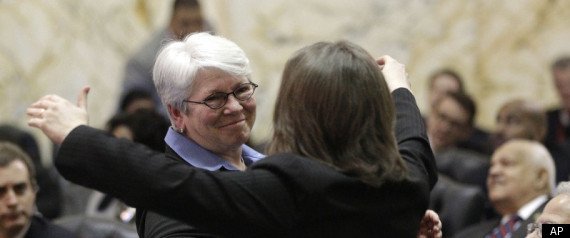
Maryland gay marriage bill has been approved in the state Senate, less than a week after it passed the state House
Although Maryland has one of the largest Democratic majorities in any state legislature, the measure encountered resistance from African-American Catholic and evangelical lawmakers.
Some religious groups have said they will push for a referendum on the issue in November, in an effort to repeal it.
“The enormous public outcry that this legislation has generated – voiced by Marylanders that span political, racial, social and religious backgrounds – demonstrates a clear need to take this issue to a vote of the people,” said Kathy Dempsey, spokeswoman for the Maryland Catholic Conference.
Meanwhile, the Human Rights Campaign, which advocated for the bill said: “Along with coalition partners, we look forward to educating and engaging voters about what this bill does. It strengthens all Maryland families and protects religious liberty.”
The organization added that they expect opponents of the measure will be able to secure the required number of signatures to get the issue onto November’s ballot.
Maryland would join Iowa, New York, Washington, Massachusetts, Connecticut, New Hampshire, Vermont and the District of Columbia, which have already legalized same-sex marriage.
It was reported that armed security guards have been placed at Whitney Houston’s grave to prevent grave robbers from plundering $500,000 worth of jewels and clothing the singer was buried in.
Round-the-clock guards are protecting the grave at the Fairview Cemetery in New Jersey, despite the area being closed to the general public earlier this week.
A source told the Daily Star: “There is a very genuine fear that her coffin will be targeted by grave robbers.
“It would be hard for them to actually dig her casket up, but that won’t stop psychotic fans or people who think it could make them money.
“The fact she was buried with such valuable jewellery is just an invitation to sickos.
“It’s ironic that Whitney, who was most famous for The Bodyguard movie when she was alive, has to have bodyguards even in death.”
Whitney Houston, who died on February 11 aged 48, is understood to have been buried in a gold lined casket worth upwards of $15,000, and wearing a diamond brooch and earrings.
The overwhelming number of fans paying visits to the grave following Whitney Houston’s burial on February 19 forced official to close the cemetery to the public indefinitely.
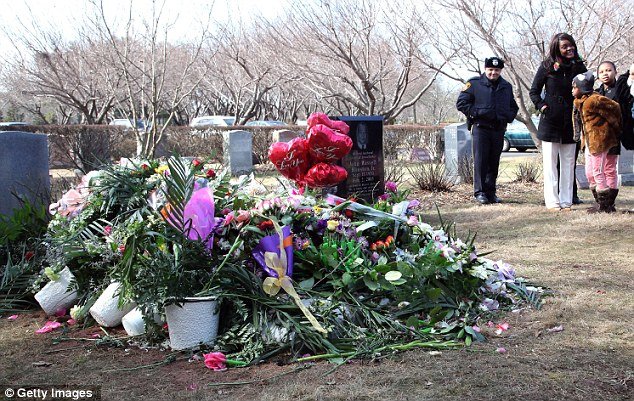
Armed security guards have been placed at Whitney Houston's grave to prevent grave robbers from plundering $500,000 worth of jewels and clothing the singer was buried in
Police Captain Cliff Auchter said that overcrowding and traffic congestion led to the decision.
“It’s a private property, and it’s up to them to make that decision,” Cliff Auchter he told reporters.
“It was done in light of the overcrowding that occurred. The cemetery is a maze of very small roads, so if two cars come face to face, you have a Mexican standoff.”
The situation is being evaluated on a daily basis, Cliff Auchter added, and those with relatives buried on the site will not be affected by the ban.
Meanwhile a source close to Whitney Houston’s family spoke of their rage at the publication of the late singer in her coffin by The National Enquirer.
“Seeing Whitney at a funeral home for the final time was a very intimate moment for her closest relatives, and that’s exactly how it should have been kept,” the Mirror quoted the source.
“For a magazine to be profiting from their grief is a disgrace.”
Whitney Houston was found dead in the bath of her Beverly Hilton hotel room in Los Angeles on February 11.
Researchers claim that eating oranges and grapefruit could cut your risk of stroke.
Both the whole fruit and breakfast juices appear to protect against having a “brain attack”, probably due to their high content of a certain type of antioxidant.
A new study looked at citrus fruit for the first time, rather than a range of fruit and vegetables which have been linked to stroke protection.
The study involved thousands of women taking part in the ongoing Nurses’ Health Study in the US, but experts believe the benefits may also apply to men.
A research team based at Norwich Medical School in the University of East Anglia in UK investigated the strength of protection from flavonoids, a class of antioxidant compounds present in fruits, vegetables, dark chocolate and red wine.
The study used 14 years of follow-up data provided by 69,622 women who reported their food intake, including details on fruit and vegetable consumption every four years.
The research team examined the relationship of the six main subclasses of flavonoids – flavanones, anthocyanins, flavan-3-ols, flavonoid polymers, flavonols and flavones – with risk of ischemic, hemorrhagic and total stroke.
The researchers did not find a beneficial association between total flavonoid consumption and stroke risk, as the biological activity of the sub-classes differ.
But women who ate high amounts of flavanones in citrus had a 19% lower risk of blood clot-related (ischemic) stroke than women who consumed the least amounts.
The highest level of flavanones was around 45 mg a day compared with 20 mg a day. A glass of commercial orange juice can provide 20-50mg depending on processing and storage conditions.
In the study, reported in the medical journal Stroke, flavanones came primarily from oranges and orange juice (82%) and grapefruit and grapefruit juice (14%).
Researchers claim that eating oranges and grapefruit could cut your risk of stroke probably due to their high content of a certain type of antioxidant
However, researchers recommended that consumers wanting to increase their citrus fruit intake should eat more whole fruit rather than juice, due to the high sugar content of commercial fruit juices.
Lead researcher Aedin Cassidy, professor of nutrition, said: “Studies have shown higher fruit, vegetable and specifically vitamin C intake is associated with reduced stroke risk.
“Flavonoids are thought to provide some of that protection through several mechanisms, including improved blood vessel function and an anti-inflammatory effect.”
A previous study found that citrus fruit and juice intake, but not intake of other fruits, protected against risk of ischemic stroke and intracerebral hemorrhage.
Another study found no association between yellow and orange fruits and stroke risk, but did link increased consumption of white fruits like apples and pears with lower stroke risk.
An additional study found that Swedish women who ate the highest levels of antioxidants – about 50% from fruits and vegetables – had fewer strokes than those with lower antioxidant levels.
More studies are needed to confirm the association between flavanone consumption and stroke risk, and to gain a better understanding about why the association occurs, said Prof. Aedin Cassidy.
Dr. Sharlin Ahmed, Research Liaison Officer at The Stroke Association said: “We all know that eating plenty of fresh fruit and veg is good for our health. This study suggests that eating citrus fruits in particular, such as oranges and grapefruits, which are high in vitamin C could help to lower your stroke risk.
“However, this should not deter people from eating other types of fruit and vegetables as they all have health benefits and remain an important part of a staple diet.
“More research is needed in this area to help us understand the possible reasons why citrus fruits could help to keep your stroke risk down.
“Everyone can reduce their risk of stroke by eating a healthy balanced diet that is low in saturated fat and salt, exercising regularly and ensuring that your blood pressure is checked and kept under control.”
Ray J’s relationship with reality star Kim Kardashian was thrust into the spotlight when their sex tape was leaked back in 2007, catapulting her to fame.
Ray J’s romance with Kim Kardashian is again making headlines, with the R&B singer alleging that the reality star may have cheated on her first husband Damon Thomas with him.
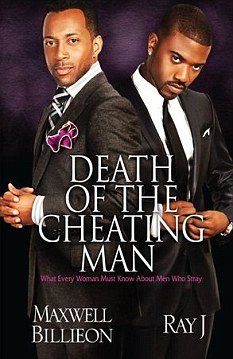
According to The New York Post, Ray J, 31, refers to a woman he dated for two years as “KK” in his new book “Death Of The Cheating Man: What Every Woman Must Know About Men Who Stray”.
In addition to the matching initials, the time frame given for this relationship with Kim Kardashian is also the same.
Kim Kardashian, 31, who was spotted out looking at locations for a new DASH clothing store in West Hollywood earlier this week, was married to music producer Damon Thomas from 2000 to 2004.
The reality star is said to have made the sex tape with Ray J back in 2003 before it was leaked in 2007.
Life & Style say that Ray J claims: “KK pursued and slept with him while she was still married to her first husband”.
“To be honest, the whole thing started off wrong,” wrote Ray J, who was last romantically linked to Whitney Houston before her death.
“We’d known each other for a while before we dated and there was a mutual attraction, but she was married.
“She let me know she wanted to get with me. She left her husband for me as soon as we started having sex and things between us got intense really fast. After that, I felt obligated to be with her.”
Kim Kardashian, currently in the midst of a divorce from second husband Kris Humphries, has previously denied cheating on Damon Thomas.
Ray J also goes onto reveal details about the intimate side of their relationship.
“We were like animals; sexually free to try anything, and we did,” Ray J writes in the book.
“For years KK and I had a great sex life. There was more to our relationship, but the majority of it was about our wild and extreme sexual chemistry.
“She was a straight freak who was down to do whatever, whenever and that seriously hypnotized me.”
Ray J refers to a woman he dated for two years as “KK” in his new book “Death Of The Cheating Man. What Every Woman Must Know About Men Who Stray”
Ray J also documents Kim Kardashian’s attentiveness towards him, describing how she would greet him with hot towels and toothpaste on his toothbrush in the morning.
However, Ray J, who alleges that they both cheated on the other during the course of their relationship, claims that Kim Kardashian ended up being a little too attentive towards him, wanting to know his whereabouts “at all times”.
Ray J adds: “She literally thought I was cheating with every girl I ran across.”
Kim Kardashian has yet to comment on her ex boyfriend’s allegations, but a source told Life & Style that she is “furious about Ray J cashing in on her”.
The insider added: “There’s so much that has gone wrong for her this year – he’s just another person trying to humiliate her.”
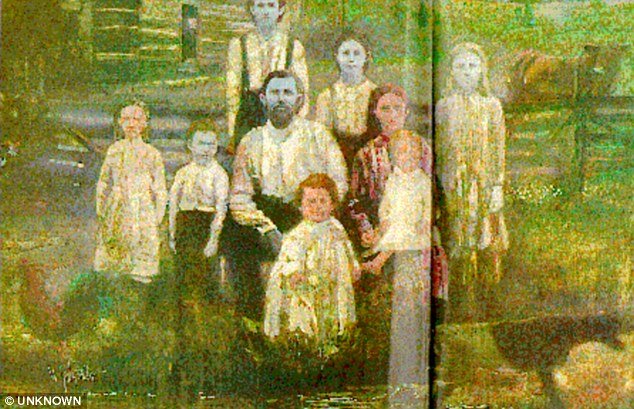
The story of blue family began when French orphan Martin Fugate settled on the banks of Troublesome Creek in 19th century and married a red-haired woman named Elizabeth Smith
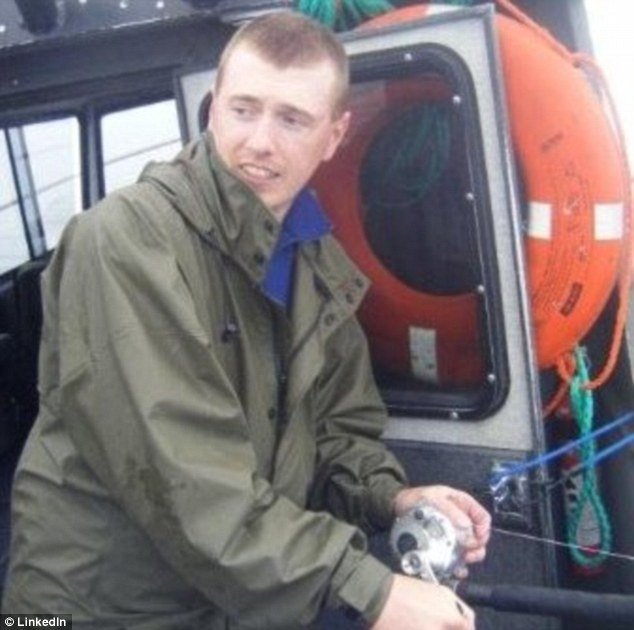
Ben Stacy came from an isolated family in Kentucky whose members were born with a rare condition that discolored the skin, as a result of a coincidental meeting of recessive genes, intermarriage and inbreeding in the 1800’s.
Ben Stacy was born in 1975 and although the color soon diminished from him, his lips and fingernails still went blue when he became cold or angry as a child.
The story began when French orphan Martin Fugate settled on the banks of Troublesome Creek to claim a land grant in the early 19th century and married a red-haired woman named Elizabeth Smith.
Elizabeth Smith had a very pale complexion – and their union brought on the “methaemoglobinaemia” genetic mutation, also known as met-H, which reduces an individual’s ability to carry oxygenated blood.
Minnesota-based blood expert Dr. Ayalew Tefferi said the whole story is “fascinating” and shows how society and disease can intersect – as well as the “danger of misinformation and stigmatization.”
“If I carry a bad recessive gene with a rare abnormality and married, the child probably wouldn’t be sick, because it’s very rare to meet another person with the (same) bad gene,” he told ABC News.
Ben Stacy came from an isolated family in Kentucky whose members were born with a rare condition that discolored the skin
Ben Stacy was born and taken to the University of Kentucky Medical Center, where doctors were amazed by his blue skin and quickly prepared a blood transfusion before his grandmother butted in.
The man explained that he looked like his ancestors in Troublesome Creek and his great-grandmother Luna, who died aged 84, was once called “the bluest woman I ever saw”, reported ABC News.
Ben Stacy, 37, works as a water plant supervisor for the University of Alaska in Fairbanks. He gained a wildlife management degree from Eastern Kentucky University.
The Fugate family tree shows Martin and Elizabeth had a blue boy called Zachariah who married his mother’s sister. Their son named Levy married into a nearby family and they had eight children.
One of these children was Luna, who married John Stacy and had 13 children. Ben Stacy comes from this family line, reported ABC News. His mother Hilda Stacy, 56, lives in Hazard, Kentucky.
There are other relatives in the Stacy line still alive in Virginia and Arkansas. Ben Stacy has a wife named Katherine Stacy in Alaska and they appear to have four children.
As eastern Kentucky has become vastly more populated than the early 19th century, and as more genes are married into the Fugate family tree, there were far fewer children born with the condition.
The blue people in Kentucky began to disappear in the early 20th century as families moved apart and the disease therefore became less common as inbreeding reduced, reported ABC News.
Looking at the old family portrait, they appear to have been either Photoshopped or made up to mimic characters from children’s cartoon the Smurfs, but science proves that the condition is real.
The family was first discovered in 1958 when Luke Combs, who was a descendant of another branch of the Fugates, took his white wife to a hospital and doctors ended up paying more attention to him.
“Luke was just as blue as Lake Louise on a cool summer day,” Dr. Charles H. Behlen II said in 1974. Fortunately for the sufferers, there are no serious problems associated with the disease.
Starting with March 1 Google controversially changes its privacy policy to allow it to gather, store and use personal information about its users.
There is one way to stymie Google’s attempts to build a permanent profile of you that could include personal information including age, gender, locality and even sexuality.
From March 1, you won’t be able to opt out of the new policy, which has been criticized by privacy campaigners who have filed a complaint to U.S. regulators.
Before that date you can delete your browsing history and, which will limit the extent to which Google records your every move – including your embarrasing secrets. Learn how:
1. Go to the Google homepage and sign into your account. Use the dropdown menu under your name in the upper right-hand corner to access your settings. Click on “account settings”.
2. Next, find the section called “Services” and you’ll see a link to “View, enable, or disable web history”, shown in the red box below. Click on it.
3. Finally, you can remove all of your search details by clicking on “Remove Web History”, shown in the red box below. Once you have done this your history will remain disabled until you turn it back on.
Starting with March 1 Google controversially changes its privacy policy to allow it to gather, store and use personal information about its users
Although disabling web history will not prevent Google from gathering and storing this information and using it for internal purposes, but it mean the Web giant will anonymize the data in 18 months.
It will also prevent it from certain kinds of uses, including sending you customized search results.
If you don’t sign in, Google will track your searches via the computer’s IP address. The only way to clear your personal history is by signing in.
While it is not known exactly how Google would use your combined information, the policy has been widely criticized.
The Center for Digital Democracy has filed a complaint with the Federal Trade Commission (FTC).
It has asked the FTC to sue Google to stop the policy change and to fine the company.
If successful, the FTC can impose fines up to $16,000 per day for each violation.
Privacy problems are particularly pertinent to those who share a Google account with other members of their family.
For example if one person searches for pictures of scantily clad women, the next family member to use the internet may find themselves being recommended a bikini contest on YouTube.
Cecilia Kang, of the Washington Post, described collation of vast tracts of information as a “massive cauldron of data”.
“Privacy advocates say Google’s changes betray users who are not accustomed to having their information shared across different Web sites,” Cecilia Kang said.
“A user of Gmail, for instance, may send messages about a private meeting with a colleague and may not want the location of that meeting to be thrown into Google’s massive cauldron of data or used for Google’s maps application.”
Technology site Gizmodo said that the change was the end of Google’s “don’t be evil motto”.
The site’s Mat Honan wrote: “It means that things you could do in relative anonymity today, will be explicitly associated with your name, your face, your phone number.
“If you use Google’s services, you have to agree to this new privacy policy. It is an explicit reversal of its previous policies.”
Larry Dignan, meanwhile, writing on ZDnet.com, described the new policy as “Big Brother-ish”.
A collection of early comic books has been sold for $3.5 million at auction in New York.
The trove of 345 comics had been bought by the late Billy Wright from Virginia when he was a boy.
A copy of Detective Comics No. 27, which was sold for 10 cents in 1939 and featured Batman’s debut, got the top bid on Wednesday – raising $523,000.
The “jaw-dropping” collection was found last year when a relative of Billy Wright was clearing a basement in his house.
Batman first appearance was in Detective Comics in May 1939
“This really has its place in the history of great comic book collections,” said Lon Allen, managing director of comics for Heritage Auctions, which was overseeing the sale.
Lon Allen described the trove as “jaw-dropping”, adding that Billy Wright seemed to have a knack of buying the right comics at the right time.
Another book – Action Comics No. 1 from 1938 featuring the first appearance of Superman – fetched $299,000.
This remarkable collection might never have seen the light of day, as Billy Wright never mentioned it to his family when he was alive.
The neatly stacked comics – all in good condition – lay untouched in his home in Martinsville for 17 years.
Experts say the comic books collection is all the more valuable and significant because the books were kept by a man who bought them as a boy.
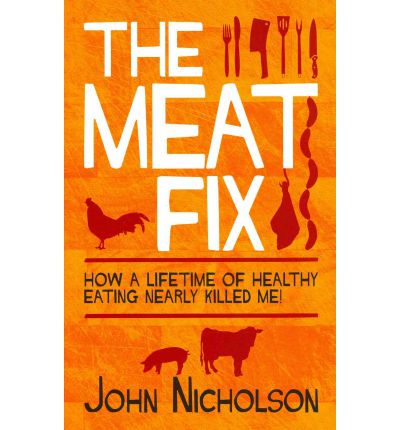
John Nicholson’s book “The Meat Fix. How a lifetime of healthy eating nearly killed me!”presents author’ story of how eating meat again, after twenty-six vegetarian years, changed his life powerfully for the better, and of his quest to understand why the supposedly healthy diet he had existed on was actually damaging him.
The reformed vegan John Nicholson has gorged on all the foods his granny enjoyed… and has never felt better.
“As the kitchen filled with the smell of caramelized meat, my mouth watered in anticipation of the coming feast: a thick cut of tender steak, fried in butter and olive oil.
This was not a regular treat. In fact, for the previous 26 years I’d been a vegan, eschewing not just meat but all animal products.
My diet was an extreme version of the NHS Eat Well regime, which recommends lots of starchy foods and smaller quantities of saturated fats, cholesterol, sugar and red meat.
According to government advice, I was doing everything right – and yet my health had never been worse. My weight had crept up over the years, until in 2008 I was 14½ stone – which is a lot of blubber for someone who is 5ft 10in – and was classified as clinically obese.
I waddled around, sweating and short of breath, battling extremely high cholesterol and suffering from chronic indigestion. I was always tired and needed to take naps every afternoon. I had constant headaches and swallowed paracetamol and sucked Rennies like they were sweets.
Worst of all, I had irritable bowel syndrome (IBS), which left me feeling as if I had lead weights in my gut. My belly was bloated and distended after every meal. I was, to use a technical term, knackered.”
John Nicholson’s book presents the story of how eating meat again, after twenty-six vegetarian years, changed his life powerfully for the better
“But that was about to change. In 2010, I decided to give up my supposedly healthy lifestyle and embrace good old-fashioned meat.
From that day on, I ate red meat four or five days a week. I gobbled the fat on chops, chicken skin and pork crackling. I feasted on everything we’re told to avoid. The effects were instant.
Twenty-four hours after eating meat again, all my IBS symptoms had gone. As the weeks and months passed, every aspect of my health improved dramatically. I became leaner, shedding body fat and becoming stronger and fitter. My headaches went away, never to return. Even my libido increased.
It felt like being young again, like coming back to life. But though I felt energized, I was also furious.
Furious with myself for sticking to the “healthy” eating advice, which was actually far from a sensible diet. But also furious with the so-called experts who have been peddling this low-fat, high-carbohydrate claptrap for so long that no one thinks to question it.
My maternal grandmother would certainly have challenged it. Like my grandfather, she was born into a poor family in East Yorkshire at the turn of the century and their eating regime was simple: meat and at least two vegetables at every meal, lots of butter and full-cream milk (they would have scorned yogurt as little more than “off” milk), bread, potatoes, cake and puddings.
Nothing would have swayed them from that lifestyle. Had a low-fat diet been suggested by a doctor, Gran would have told him to his face that it was all rubbish and that you needed fat to “keep the cold out”.
If she could have seen people buying skimmed milk today, she would have thought they had lost their minds. Getting rid of the best bit of milk? Lunacy.
Late in her life, I recall her scorning the advice on limiting the consumption of eggs because of concerns about cholesterol. On one occasion, she watched in astonishment as a celebrity TV chef made an egg-white omelette. “He’s a bloody fool, that man,” she said.
She was right to be skeptical, it turns out. For years the authorities told us cholesterol-rich foods would kill us – but we’ve since learned that is utter drivel.”
John Nicholson was fat and ill as a vegan
“While Ancel Keys, the scientist whose research in the Fifties first raised concerns about cholesterol levels, suggested that heart disease was linked to large amounts of cholesterol in the blood, he never claimed those levels were linked to the amount of cholesterol we eat.
“There’s no connection whatsoever between cholesterol in food and cholesterol in blood,” he said in a magazine article in 1997. “And we’ve known that all along.”
Since then, the NHS’s paranoia about cholesterol in food has been replaced by concerns about saturated fat – found in everything from butter, cheese and cream to pies, cakes and biscuits.
They suggest saturated fat increases the risk of heart disease. But this is open to debate.
France has the lowest rate of death from coronary heart disease in Europe, yet the country has the highest consumption of saturated fats.
Gran survived into her 80’s and Grandad into his 70’s, despite laboring down the pit his whole working life. Did they achieve this by gobbling low-fat spreads, soya oil or skimmed milk? No, they lived on old-fashioned foods such as butter, lard and beef fat. Indeed, a growing body of opinion suggests that the factory-made products that have replaced these staples – vegetable oils, polyunsaturated margarine and spreads – are the real cause of the degenerative diseases that are so common today.”
John Nicholson is leaner and healthier after he changed his diet as a meat eater
“Findings by the Weston A. Price Foundation, a non-profit-making research organization in America, show most cases of heart attack in the 20th century were of a hitherto little-known form known as myocardial infarction (MI) – a huge blood clot leading to the obstruction of a coronary artery.
MI was almost non-existent in the U.S. in 1910 and was causing no more than 3,000 deaths a year by 1930. However, by 1960, there were at least 500,000 MI deaths a year across the country.
It surely can’t be a coincidence that this happened as the U.S. embraced a new diet based on increasingly large portions of highly processed foods and vegetable oils?
Similar changes in the national diet took place in Britain during the early years of my life and I can’t help wondering whether my father might still be alive today if it had not been for this shift.
I grew up in the North-East during the Sixties and had no idea about “healthy eating”. Those few people who did fret about their diet were thought of as fussy.
No one thought food was a problem, unless the chip shop ran out of battered sausage on a Friday. We ate suet puddings every week, our bacon and eggs were fried in lard, milk was full-fat – I’m not sure skimmed milk even existed in the Sixties – and we ate eggs every day.
Then, in the Seventies, things changed. We got wealthier and food became cheaper. Mam began buying more cakes and confectionery instead of home-baking. We ate more shop-bought food in general.
She also stopped using lard in the chip pan, opting for Spry Crisp ’n Dry instead. Gran wasn’t pleased. She thought vegetable oil was a new-fangled fad – it was, and that was precisely why Mam liked it. She saw it as moving on, modern and fashionable.
Dad never did any exercise and drove everywhere in his newly acquired company car.
More processed food, margarine, sugar and vegetable oil, combined with days spent behind a desk and a wheel, saw him gain a sizeable belly and the apple shape so common today. In 1987, he died of a massive heart attack, aged just 65.
His diet in his later years was not one that would have appealed to Gran. She was vehemently against margarine.
“I’m not eating anything made in a factory,” she’d say. “You don’t know what they put in it.”
It was a fear shared by many of her era. Had I heeded such warnings, I would have avoided my battle with processed food, in the form of soya, the bean whose industrially produced extracts are marketed as a low-fat and exceptionally healthy source of protein.
Today, soya is everywhere. About two-thirds of all processed food in the U.S. contains some form of it. That percentage will not be much different here – you’d be amazed at how often you eat ‘hidden’ soya.
When my partner, Dawn, and I decided to become vegan during the Eighties, it was still rare in Britain. This lifestyle shift came about shortly after we’d left Newcastle Polytechnic and moved to live self-sufficiently in a rented cottage in northern Scotland.
When one of our chickens became ill, we found it terribly difficult to put it out of its misery and began to doubt whether killing – or eating – animals was for us.
We didn’t see why someone else should have to do our dirty work for us, so in January 1984 we ate our last bacon sandwiches and embarked on our dramatic lifestyle change.
At about this time, governments in the U.S. and Europe were recommending that people cut down on eating animal fats, cholesterol and red meat in favor of more starchy foods, fruit and vegetables and wholegrains.
This new healthy eating advice had much in common with the vegetarian diet. We felt we were following a golden path, especially when we discovered the apparent wonders of soya.
Only later did we discover that research by the Weston A. Price Foundation had suggested that processed soya foods are rich in chemicals called trypsin inhibitors, which disrupt protein digestion. I believe it was these that created all my problems with IBS.
Soya has also been associated with hypothyroidism, or an under-active thyroid, a condition whose symptoms include unexplained weight gain, lack of energy and depression – all problems that Dawn began to experience. These problems were exacerbated by other health problems caused by our diet.
As voracious consumers of nuts, pulses and wholegrains, our diet was very high in copper and, because of the lack of animal protein, low in zinc. Some researchers have linked this imbalance to constant feelings of fatigue, something with which Dawn and I were all too familiar.
For years, we gave the NHS every chance to find out what was wrong with us and get us well. But doctors didn’t and couldn’t – perhaps because they wouldn’t even consider that our apparently healthy diet might be the problem.
Finally, in desperation, Dawn suggested we should try eating meat again. At the same time, we cut out all vegetable oils, except olive oil, and ate lots of lard, beef dripping, butter, cream and full-fat milk.
We have also cut out starchy carbohydrates such as bread, which contains a component of starch that causes blood sugar levels to peak and trough, leading to a cycle of hunger and over-eating.
Admittedly, the absence of bread is one aspect of our new diet that might have caused Gran to ask if I had gone “soft in the head”. In her day, they needed lots of carbohydrates to fuel their physically demanding lives, but we are far more sedentary.
But I’m sure she would have approved of everything else about our new diet because her generation knew how to eat properly. That’s a skill we have forgotten, brain-washed as we are by government and medical propaganda.
It’s time we reminded ourselves of it, questioning the one-size-fits-all, “healthy” eating advice we’re spoon-fed and opting instead for wholesome, unprocessed, home-made food.”
Seven US Marines have died after two helicopters collided in Arizona, officials say.
The mid-air accident happened near the city of Yuma during a training exercise, the US Marines said.
The accident happened on Wednesday night, and an investigation is under way into how it happened.
The marines, flying in Cobra and Huey helicopters, were part of the 3rd Marine Aircraft Wing, based at Miramar in Southern California.
They collided in a remote portion of the Yuma Training Range Complex, the Marine Corps said.
Seven US Marines have died after two helicopters collided in Arizona
Identities of the marines will be withheld for at least 24 hours until their families have been notified.
A marine spokeswoman told CNN that helicopter teams use the area to because it mimics conditions in Afghanistan.
Any investigation into the cause of the collision could take months, she added.
During a September training exercise near Camp Pendleton, California, a helicopter went down – killing the two marines on-board and setting off a brush fire.
US researchers have identified how the time of day can increase the risk of dying from an irregular heartbeat.
According to a study published in the journal Nature, the risk of “sudden cardiac death” peaks in the morning and rises again in the evening.
The study suggests that levels of a protein which controls the heart’s rhythm fluctuates through the day.
A body clock expert said the study was “beautiful”.
The inner workings of the body go through a daily routine known as a circadian rhythm, which keeps the body in sync with its surroundings. Jet lag is the result of the body getting out of sync.
As the chemistry of the body changes throughout the day, this can impact on health. The researchers say they have identified, in mice, how the time can affect the risk of sudden cardiac death.
They identified a protein called kruppel-like factor 15 (Klf15), which was controlled by the body clock and whose levels in the body went up and down during the day. The protein influences ion channels which control heart beat.
Genetically modified mice which produced too much Klf15 and those which produced none at all both had an increased risk of developing deadly disturbances in cardiac rhythm.
Prof. Darwin Jeyaraj, from the Case Western Reserve University School of Medicine, said: “Our study identifies a hitherto unknown mechanism for electrical instability in the heart.
“It provides insights into day and night variation in arrhythmia susceptibility that has been known for many years.”
There are important differences in the way that human and mouse hearts work, so it is unknown whether the same mechanism exists in people.
Fellow researcher Prof. Mukesh Jain said: “We are just scratching the surface. It might be that, with further study, assessment of circadian disruption in patients with cardiovascular disease might lead us to innovative approaches to diagnosis, prognosis, and treatment.”