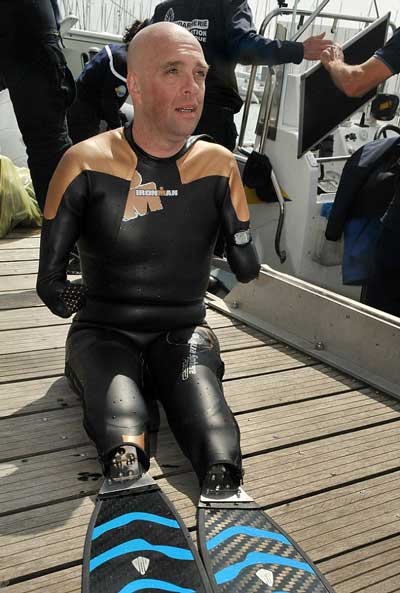
Philippe Croizon, a Frenchman who lost his limbs in an accident, has completed the first part of his challenge to swim between five continents.
Philippe Croizon swam from Papua New Guinea to Indonesia with long-distance swimmer Arnaud Chassery and a local man who joined them to show his support.
He uses prosthetic limbs with flippers attached and took seven-and-a-half hours to swim the stretch.
“It was very, very hard,” he said after the event, which involved crossing 20 km (12 miles) between two points on New Guinea island which is shared between the two countries.
“It took us an hour-and-a-half more than we expected because we had to swim against the currents,” he said.
Philippe Croizon swam from Papua New Guinea to Indonesia with long-distance swimmer Arnaud Chassery and a local man who joined them to show his support
He said they did not come across any sharks or jellyfish, but were joined by a Papua New Guinean man named Zet Tampa, who swam with them to show solidarity, Philippe Croizon tweeted.
The swim had been postponed as Philippe Croizon waited for a permit to enter Indonesia, which he received late on Wednesday.
Philippe Croizon lost his limbs 18 years ago while adjusting a TV aerial on a roof.
In 1994, he lost his limbs after receiving an electric charge of 20,000 volts which fused him to the metal ladder on which he was standing.
Philippe Croizon would have been killed instantly – but another massive electric charge snapped him back to life, although he was so seriously burnt that both his arms and his legs had to be amputated.
He says he was inspired to swim while in hospital. He saw a documentary on television about an Englishwoman who had swum the English Channel earlier that year.
In 2010, Philippe Croizon became the first limbless man to cross the 34 km Channel between France and England – a feat that had only been achieved by some 900 other, able-bodied, swimmers.
The other crossings Philippe Croizon has planned are: the shark-infested Gulf of Aqaba in Jordan to the Egyptian coast in June (the Asia to Africa stretch); the busy shipping straits between Gibraltar and Morocco in July; and the icy Bering Strait between Alaska and Russia in August.
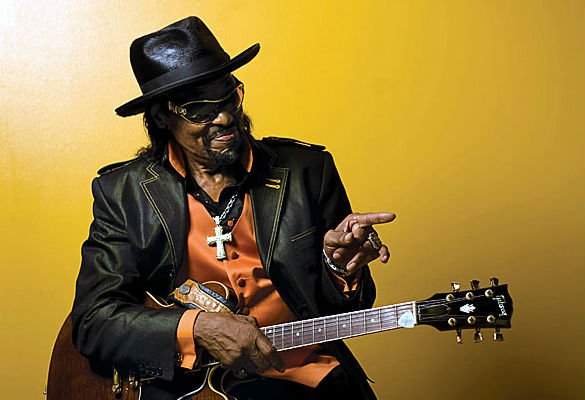
Musician Chuck Brown, who mixed funk, soul and Latin styles to help create the upbeat “go-go” scene in Washington DC in the 1970s, has died at 75.
Known as the “godfather of go-go”, Chuck Brown’s biggest hit was Bustin’ Loose, which spent a month at the top of the US R&B chart at the end of the 1970s.
Guitarist and singer Chuck Brown was known for performances that did not stop between songs and could go on for several hours.
He said the style was named go-go because “the music just goes and goes”.
Chuck Brown, who mixed funk, soul and Latin styles to help create the upbeat "go-go" scene in Washington DC in the 1970s, has died at 75
Washington DC Mayor Vincent Gray was among those paying tribute.
“Go-go is DC’s very own unique contribution to the world of pop music,” he told the Associated Press news agency.
“Today is a very sad day for music lovers the world over.”
Chuck Brown got his first guitar after trading five cartons of cigarettes for the instrument in prison, while serving eight years for murder in the 1950s and 60s. He shot a man in what he said was self-defense, according to the Washington Post.
With his group the Soul Searchers, Chuck Brown combined funky horns with lively percussion and his own deep vocals to create vibrant club tunes.
Go-go struggled to make a global impact and got overtaken by the burgeoning hip-hop movement as the 1980s wore on.
But Chuck Brown’s influence was felt more widely, with samples of Bustin’ Loose used in rap star Nelly’s 2002 chart-topping single Hot in Herre, while rapper Eve sampled Chuck Brown’s song Blow Your Whistle in her single Tambourine.
In the ’90s, Chuck Brown helped launch the career of singer Eva Cassidy when the pair performed together on the album The Other Side. It included her solo rendition song Over The Rainbow, which was to become her signature track when posthumous fame came after her death in 1996.
Meanwhile, Chuck Brown was nominated for his first Grammy Award in 2010, for best R&B performance by a duo or group with vocals for Love, a collaboration with singer Jill Scott.
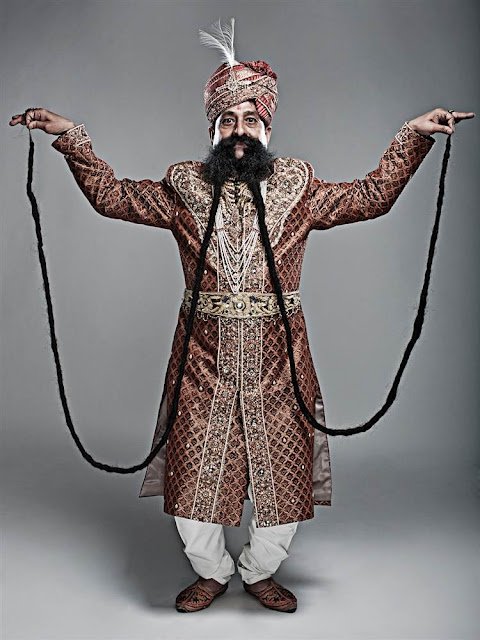
Ram Singh Chauhan from India has the world’s longest moustache, which is officially recorded by Guinness World Records as 4.29 m (14 ft) long.
Here Ram Singh Chauhan offers five tips of his secret.
1. Start growing early – as soon as you can. Ram Singh Chauhan, now 54, started growing his moustache in 1970 – facial hair grows fastest in one’s youth, he says.
“As you grow old your hormones grow weak, so the speed slows down.”
And, of course, he has never cut it, “apart from trimming around the lip area”.
Steve Parsons of the British-based Handlebar Club seconds this advice, as a young man’s facial hair is more durable than that of an elderly man.
“As moustache hair goes white it starts to become more brittle and is more likely break off,” says Steve Parsons
2. Groom it well. Ram Singh Chauhan spends an hour every day cleaning and combing his moustache.
“I massage it and oil it regularly and I wash it every 10 days which takes a long time,” he says. “My wife helps me.” He uses a coconut-based hair oil.
Ram Singh Chauhan from India has the world's longest moustache, which is officially recorded by Guinness World Records as 4.29 m (14 ft) long
Steve Parsons, who himself sports an elaborate handlebar moustache, recommends leave-in conditioner as an antidote for troublesome split ends.
“You can also use pomades or beeswax but that requires a good wash to get it out. Our advice? Dip it in beer on a regular basis,” he says.
Rod Littlewood, vice-president of the World Beard and Moustache Association, says it’s best for the moustachioed to avoid eating some food in public.
“Candy floss is a horror!”
3. Get your family on side. Ram Singh Chauhan’s wife Asha says they used to fight over his moustache in the early years.
“He used to take a long time to get ready, to wash and also people used to stare at him,” she says. She didn’t feel comfortable. But later, as he started getting recognition for his long moustache, she started to like it and to respect his commitment. Now, she says, the moustache is like a part of the family and she shares his pride in it.
Steve Parsons, meanwhile, admits that his wife is not the greatest fan of his lip furniture, but he has a good riposte: “I always say kissing a man without a moustache is like drinking champagne without the bubbles.”
4. Endure any discomfort. Ram Singh Chauhan says life is not easy with such a long moustache. When it was shorter, he used to wrap it around his ears. Now it’s longer, he wraps it around his neck.
Sleeping can be uncomfortable but he says there’s no gain without pain and he wouldn’t want it any other way. “I am special with my moustache, and I have never dreamt of being without it.”
The Movember charity, which encourages men to grow their moustaches in November to raise awareness of men’s health issues, acknowledges that new moustaches can be itchy when they start growing.
Movember co-founder JC advises men to ignore the itch and be brave.
“Remind yourself that other men have endured worse in the past. Surely you can stand a little face tickle from your mo?”
5. Don’t be a slave to fashion. When he was younger, Ram Singh Chauhan says, moustaches were very much in vogue in his home country. He earned a lot of respect from fellow students at college, but finds the youth of today have little interest in facial hair.
“My own son doesn’t have one,” he says regretfully.
Jane Fonda, Bruce Willis, Eva Longoria and Lana Del Rey were among the famous faces on the red carpet at the opening night gala of this year’s Cannes Film Festival.
They and a host of other stars were on hand to see Moonrise Kingdom, the new film from US director Wes Anderson, launch the annual cinema showcase.
Bruce Willis, Bill Murray and Britain’s Tilda Swinton joined other cast members at the movie’s glitzy premiere.
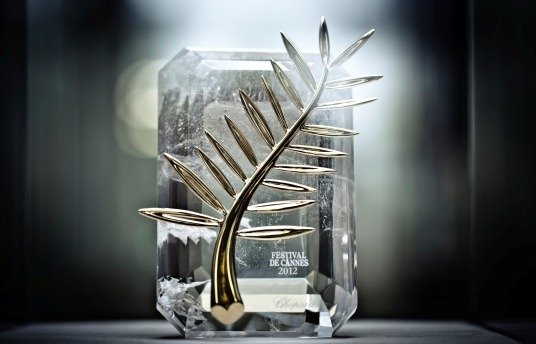
The film is one of 22 in contention for Cannes’ prestigious Palme d’Or award.
Eva Longoria was among the famous faces on the red carpet at the opening night gala of this year's Cannes Film Festival
Reactions to Wes Anderson’s Moonrise Kingdom have been broadly positive.
Moonrise Kingdom was a suitable curtain-raiser for a festival in which US films and directors are heavily represented.
The main competition line-up contains six US-based movies, among them a new thriller starring Brad Pitt and an adaptation of Jack Kerouac’s seminal novel On the Road.
“American cinema is back in force,” said Cannes’ artistic director Thierry Fremaux, when he announced the programme last month.
The US invasion continues on Friday with an out of competition screening of the latest DreamWorks animation, Madagascar 3: Europe’s Most Wanted.
On Thursday the Critic’s Week sidebar launches with Broken, a London-based drama from acclaimed theatre director Rufus Norris, starring Tim Roth and Cillian Murphy.
Emergency workers in Tyumen, central Russia, had to rescued a man from a rubbish chute after he jumped into it to hide from his girlfriend.
The man plunged three floors from the eighth floor of an apartment building in Tyumen, Siberia, before getting stuck. Residents then heard the 31-year-old man’s cries for help.
Rescue workers had to use tools to cut him free. He was not seriously hurt.
He had had a row with his girlfriend, officials said, without elaborating.
Emergency workers in Tyumen, central Russia, had to rescued a man from a rubbish chute after he jumped into it to hide from his girlfriend
Soviet-era buildings in Russia frequently have a metal rubbish chute in the stairwell, with a latch opening on each floor.
Tyumen emergency service officials said the incident happened late on Wednesday, but the man is already back at work.
“According to the 31-year-old victim, he jumped into the metal chute on the eighth floor to escape his girlfriend,” a statement on the service’s website said.
The officials said there had been a similar incident in Tyumen a few years ago, again with a happy outcome.
Estimates of the latest US census data show that children from racial and ethnic minorities now account for more than half the births in the US.
Black, Hispanic, Asian and mixed-race births made up 50.4% of new arrivals in the year ending in July 2011.
It puts non-Hispanic white births in the minority for the first time.
Sociologists believe the ongoing economic slowdown has contributed to a greater decline in birth rates among white people.
Estimates of the latest US census data show that children from racial and ethnic minorities now account for more than half the births in the US
The US Census Bureau recorded 2.02 million babies born to minorities in the year to July 2011, just over half of all births, compared with 37% in 1990.
US birth rates have been declining, but the drop has been larger for white people.
The number of white births has fallen by 11.4% since 2008, compared with 3.2% for minorities, according to Kenneth Johnson, a sociologist at the University of New Hampshire.
Roderick Harrison, a former chief of racial statistics at the Census Bureau, now a sociologist at Howard University, told Associated Press: “This is an important landmark. This generation is growing up much more accustomed to diversity than its elders.”
The nation’s minority population now makes up 36.6% of the total US population.
Demographers also believe the Hispanic population boom may now have peaked.
“The Latino population is very young, which means they will continue to have a lot of births relative to the general population,” Mark Mather of the Population Reference Bureau said.
“But we’re seeing a slowdown that is likely the result of multiple factors: declining Latina birth rates combined with lower immigration levels. If both of these trends continue, they will lead to big changes down the road.”
Indian actor Shah Rukh Khan may be banned from entering Mumbai’s Wankhede Stadium after reports that he was involved in a brawl with the staff.
Mumbai Cricket Association (MCA) president Vilasrao Deshmukh said Bollywood superstar misbehaved with the staff during an Indian Premier League (IPL) match.
Reports said the scuffle took place after Shah Rukh Khan was stopped from entering the stadium on Wednesday night.
The MCA officials said they had lodged a police complaint against Shah Rukh Khan.
Shah Rukh Khan may be banned from entering Mumbai's Wankhede Stadium after reports that he was involved in a brawl with the staff
Shah Rukh Khan is the owner of the Kolkata Knight Riders team, which won Wednesday night’s match against the Mumbai Indians. He has not yet commented on the incident.
“There is a proposal before MCA to ban the actor from entering the stadium. We will go by whatever the majority decision is,” Vilasrao Deshmukh told reporters on Thursday.
He said the staff’s attempts to pacify Shah Rukh Khan had been unsuccessful.
MCA vice-president Ratnakar Shetty said the association members were “very angry over the incident”.
He said he was not present during the incident, but MCA officials had told him that it was “an unpleasant incident”.
“Foul language was used,” he said.
IPL Chairman Rajiv Shukla said he had asked for a report on the matter.
“I will take the version of the MCA, Shah Rukh Khan and the police before talking about the issue,” he said.
Shah Rukh Khan is one of Bollywood’s biggest stars. He has appeared in more than 70 films, anchored television shows and done innumerable advertisements.
Aishwarya Rai Bachchan is a former Miss World, a successful Bollywood star and married to the son of one of India’s best-loved stars.
She found international fame in the Hollywood film Bride and Prejudice, and Julia Roberts billed her as the world’s most beautiful woman.
Thanks to the notoriety such fame and fortune has brought her, Aishwarya Rai Bachchan has become one of the most admired and revered women in India, and indeed the world. But such fame has come at a cost for the 38-year-old star.
Since the birth of her daughter in November last year, Aishwarya Rai has been open about the fact that she is in no hurry to lose the few extra pounds she gained during her pregnancy.
The model and actress, who won the Miss World title in 1994, defended her choice, saying she wanted simply to “enjoy motherhood”.
But with the star, who married Abhishek Bachchan, the son of India’s most loved film star Amitabh Bachnan in 2007, tipped for her 10th appearance at Cannes next week, furious speculation is mounting as to how she will look.
Since the birth of her daughter in November last year, Aishwarya Rai has been open about the fact that she is in no hurry to lose the few extra pounds she gained during her pregnancy
Commentators have been unkind, lambasting the star for letting her fans down.
Many have gone a step further, suggesting the star has a “duty” to her fans to regain her pre-pregnancy figure.
One website posted a video of the star looking less than her usual svelte self, flicking between photographs of her pre-birth, and photos now.
Called “Aishwarya Rai’s shocking weight gain”, the clip, which came accompanied by elephant sound effects, has been seen more than 500,000 times.
Dozens more videos in a similar vein have been posted, each with viewing figures in the tens or hundreds of thousands.
Comments left after the video prove that many of those watching have little sympathy for Aishwarya Rai.
“She is a Bollywood actress and it is her duty to look good and fit,” one said.
Another added: “She needs to learn from people like Victoria Beckham who are back to size zero weeks after their delivery.”
It has opened up a debate in the country, and beyond, about the attitudes held towards women in the public eye.
“Aishwarya is like a goddess,” said showbusiness columnist Shobhaa Dé in the New York Daily News by way of explanation.
“She is held up as the ideal of beauty and so there is an expectation on her to look perfect at all times.”
“The role models being held up are Angelina Jolie and Victoria Beckham, but our body frames are different – we have wider hips and curves – so this whole business of looking desperately skinny two weeks after giving birth is a western import.”
Cinema professor Shohini Ghosh added that women in India were up against an almost impossible task.
“There is a glorification of motherhood in India and Indian cinema,” he told the paper.
“But people are confused because they don’t know whether to glorify Aishwarya in her new motherhood or lament that she is not looking like a runway model.”
It’s safe to say that far too many fall into the latter category, judging by the cruel comments flooding internet sites.
Some, however, have come out in defense of the star, saying that she, like any new mother, should be focusing on her infant, not her diet.
“She is a real women looking after a baby. We should be concern for her health and happiness especially if she is nursing the baby. Not the Western belief of expecting people in the spot light to lose all weight in month. If she dieted what will happen to the baby’s diet,”one said.
“That’s because Aish is not one of those selfish ones who puts the focus on their bodies instead of their babies, which makes them moody and ineffective as parents,” another said.
“Kudos to you Aish for keeping it real and letting your baby have all the bonding and attention she needs with you. Enjoy your life.”
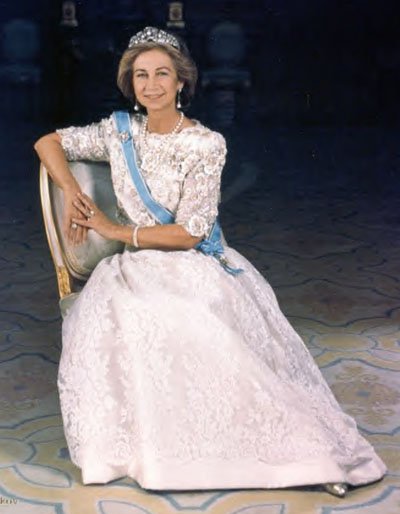
Queen Sofia of Spain has cancelled her visit to the UK for Queen Elizabeth’s Diamond Jubilee because of disputes over Gibraltar.
A Spanish government statement said it was “hardly appropriate” for Queen Sofia, 73, to attend a lunch on Friday.
The UK and Spain have been in dispute over fishing rights off Gibraltar, a UK territory which Spain also claims.
Spain has also protested over a visit to Gibraltar by Queen Elizabeth’s son Prince Edward and his wife Sophie.
Prince Edward and the Countess of Wessex are to visit Gibraltar on 11-13 June as part of the celebrations to mark the 60th anniversary of the Queen’s reign.
Queen Sofia of Spain has cancelled her visit to the UK for Queen Elizabeth's Diamond Jubilee because of disputes over Gibraltar
Spain continues to claim sovereignty over Gibraltar, which has been ruled by Britain since 1713 under the terms of the Treaty of Utrecht.
Queen Sofia’s husband, King Juan Carlos, had already declined his invitation to the lunch at Windsor Castle on Friday.
He is recovering from surgery last month after he fell and broke his hip while hunting elephants in Botswana.
In 1981, the Spanish royal couple declined an invitation to Prince Charles’ wedding to Diana, Princess of Wales because they planned to visit Gibraltar as part of their honeymoon.
And a visit by Princess Anne to Gibraltar in 2009 sparked an official complaint from the Spanish government.
An additional cause of unhappiness for the Spanish royal household is the fact that the British regimental band of Gibraltar will be performing at the Diamond Jubilee, reports the Spanish news agency Efe.
A spokesman for the UK Foreign Office told the AFP news agency: “The visit was a private commitment and we don’t comment on private visits.”
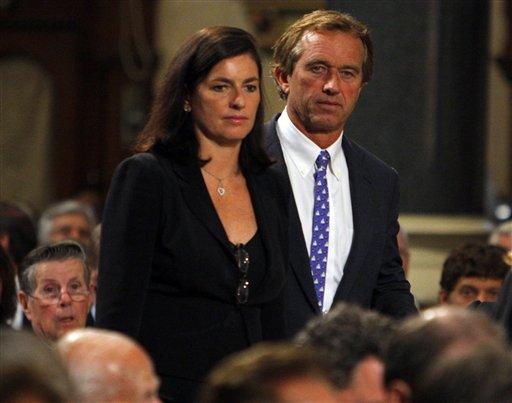
Mary Kennedy, the estranged wife of Robert F. Kennedy Jr., has been found dead at her home in New York state.
No cause of death had been released, but US media reported Mary Kennedy, 52, had been discovered hanged in a barn behind the family’s lavish home yesterday.
In a statement, Mary Kennedy’s family said her “radiant and creative spirit” would be sorely missed.
Robert F. Kennedy Jr., a lawyer and radio host, is the nephew of President John F. Kennedy and son of Senator Robert F. Kennedy, both assassinated in the 1960s.
His marriage to the former Mary Richardson in 1994, in a ceremony aboard a boat on the Hudson river, was his second.
Mary Kennedy, the estranged wife of Robert F. Kennedy Jr., has been found dead at her home in New York state
The couple had four children over the 16 years of their marriage before he filed for divorce in 2010.
Mary Kennedy, an architect, had brushes with the law over drug and alcohol abuse, and was arrested twice for driving under the influence at about the time they separated.
“We deeply regret the death of our beloved sister Mary, whose radiant and creative spirit will be sorely missed by those who loved her,” the family said in a statement issued by lawyer Kerry Lawrence, who had represented Mary Kennedy in a drink-driving case.
“Our heart goes out to her children who she loved without reservation.”
A neighbor, Leslie Lampert, told the Associated Press news agency that Mary Kennedy was “community oriented” and “a lovely individual”.
“She was always kind in our presence.”
Police confirmed a body had been found on the Kennedys’ property in Bedford, north of New York City, but would not release the name.
The incident was under investigation by the Bedford Police Department with assistance from the Westchester County Medical Examiner’s Office. An autopsy is scheduled for Thursday.
US broadcaster ABC News cited a family member and other sources as saying Mary Kennedy appeared to have hanged herself.
Chinese dissident Chen Guangcheng says he and his family have completed passport applications and officials say they should be ready within 15 days.
The blind activist said officials had helped him fill in the forms on Wednesday at the Beijing hospital where he is staying.
Chen Guangcheng spent six days in the US embassy last month after escaping house arrest.
He wants to leave China and has been offered a place at a US university.
Chen Guangcheng left the US embassy after six days to seek medical treatment but then said that he wanted to go to the US because he feared for his safety.
Chen Guangcheng says he and his family have completed passport applications and officials say they should be ready within 15 days
Amid a diplomatic crisis between the US and China over his fate, Chen Guangcheng was offered a place to study law at New York University after Beijing said he would be allowed to apply to study abroad.
The US says the visas for Chen Guangcheng and his family are ready.
Chen Guangcheng said government officials came to see him on Wednesday and completed passport applications for him, his wife and their two children.
He said the officials told him the passport would take 15 days to issue, without giving a definite date.
“People from the immigration administration department have been here. We had our pictures taken and forms filled out. [They said] within 15 days,” Chen Guangcheng said.
“They didn’t promise when we’ll get the passport. They didn’t say anything like we will definitely get the passport on a certain day, etc. There was nothing like that told to us,” he added.
He said he was well, but said doctors had told him he still should not walk because of the foot injury he sustained escaping from house arrest.
Chen Guangcheng and his family are living in the hospital room, and his wife said she was not allowed to leave the hospital freely.
On Tuesday Chen Guangcheng accused local Chinese authorities of harassing his family in his hometown of Dongshigu village, as he spoke via telephone to a US congressional committee.
His nephew, Chen Kegui, has been charged with “intentional homicide” in the wake of Chen Guangcheng’s escape to Beijing.
Liu Weiguo, the lawyer for Chen Kegui, said last week his client was acting in self-defense when he injured three people – none of them critically – who broke into his house on 27 April.
Chen Guangcheng, a self-taught lawyer who campaigned against forced abortions under China’s one-child policy, was himself jailed for four years in 2006 for disrupting traffic and damaging property, and placed under house arrest after his release in 2010.
Veterans of Chinese Communist Party have written to President Hu Jintao to ask him to sack leading politician Zhou Yongkang.
Zhou Yongkang is currently in charge of China’s security apparatus.
In an open letter to President Hu Jintao, the party’s general secretary, the veterans suggest Zhou Yonkkang is part of a movement to revive the China of Mao Zedong.
Speculation has been growing about the future of Zhou Yongkang since the downfall of another top politician, Bo Xilai.
It is not often that party members make such a daring plea to their boss.
Zhou Yongkang is currently in charge of China's security apparatus
The letter urges the president to sack Zhou Yongkang from his post as head of China’s police force, its courts and its spy network.
He is also a member of the standing committee of the Chinese Communist Party, the country’s highest decision-making body.
The letter’s authors, who all know each other, also want him out of that job too.
Some of the veteran party members who wrote the note joined the Chinese communists before they took power in 1949.
They hold no senior positions – and do not seem to be particularly influential.
But one of the authors, Yu Yongqing, said they had received hundreds of calls of support, and some threatening ones.
Yu Yongging, who held a senior position in the party in the city of Zhaotong in Yunnan province, said Zhou Yongkang had to go because of his support for Bo Xilai.
Bo Xilai was recently sacked from his position in the party’s politburo and as party secretary of the city of Chongqing, where he led a campaign that sought to revive interest in the Mao Zedong era.
“Mr. Bo confessed that he has received support from Zhou Yongkang. Mr. Zhou also helped him to make contact with various central party departments,” said Yu Yongging.
The letter seems to warn about the dangers of reviving an interest in Chairman Mao and his policies.
It stresses the danger China faces from such things as corruption and the inequality of wealth without political reform.
For weeks there has been speculation about the future of Zhou Yongkang.
There has been no official comment, but this letter shows there is some concern about Zhou Yongkang within the party.
The letter also calls for the sacking of Liu Yunshan, the head of the party’s propaganda department.
He has been tipped for promotion later this year when the party holds a once-in-a-decade reshuffle of its top leaders.
Experts have found that slimmers need to eat less than someone of the same weight who has not dieted to stay at their new weight.
To be precise, they need to eat at least 300 fewer calories a day. This equates to a bag of Maltesers and a Milky Way – the sort of treats they were probably looking forward to enjoying after the pounds had come off.
And over the course of a week, it amounts to 15 cans of cola or 17 slices of buttered toast.
The European Congress on Obesity heard that several quirks of biology combine to create a “perfect storm” that makes it all but impossible to keep lost weight off.
The calorie counts come from Professor Michael Rosenbaum, of New York’s Columbia University, who has monitored dieters for years at a time.
The men and women are taken into hospital and put on a strict diet to shed 10% of their weight.
They then try to stay at that weight. Test carried out before and afterwards have revealed the secrets of their success – or failure.
Experts have found that slimmers need to eat less than someone of the same weight who has not dieted to stay at their new weight
Prof. Michael Rosenbaum said: “The number of calories you are going to have to eat to maintain that weight loss falls by 22%.
“That’s 300 calories or more a day less than someone who looks exactly like they do.”
What is more, his studies suggest that the effect does not wear off, with an ex-dieter having to eat hundreds of fewer calories a day for years to come if they are to stay slim.
The conference in Lyon heard that the phenomenon can largely be blamed on the effect dieting has on muscle.
In slimmers, muscle uses fewer calories to do its work than in someone else of a similar weight who has not dieted.
Changes in hormones, metabolism and appetite also play a role.
Prof. Michael Rosenbaum’s studies also show that after dieting, the areas of the brain that perceive food as rewarding are more active, while those that generate feelings of restraint are less so.
And former dieters have to eat more to feel satisfied, but think they have eaten less.
He said: “You are creating the perfect storm for weight regain – energy expenditure is down and desire to eat is changed in ways that favor regain of lost weight.
“Weight loss is a relatively brief therapeutic intervention, but trying to keep the weight off requires a lifetime of diligent attention.”
Google has patented the technology behind the Project Glass, its augmented-reality glasses.
Three patents for a “wearable display device” with characteristics of the much-talked about futuristic glasses were submitted last autumn.
The patents reference such functions as displaying data in front of the wearer’s eyes and playing audio.
In April, Google revealed details of its research into the glasses and showed a demo video of a prototype.
The patents show images of different versions of augmented reality glasses, some with lenses and some without.
Google is working on the project in its research lab, Google X.
The prototypes are currently being tested by the firm’s executives, including Sergey Brin and Vic Gundotra.
Google has patented the technology behind the Project Glass, its augmented-reality glasses
The demo video showed science fiction-like glasses equipped with a microphone and partly transparent tiny screen right above the user’s right eye.
Besides displaying information about the wearer’s surroundings, the glasses were shown to be used to communicate with other people, browse the web, listen to music and also take photos.
There are other firms researching the augmented-reality eyewear.
For instance, Oakley is currently developing similar glasses targeted at athletes and other sportsmen and women.
A number of companies had attempted to pioneer the concept as well, but did not get very far because their versions required users to carry separate battery equipment, said Chris Green, analyst at Davies Murphy Group Europe.
“There are huge opportunities for tailored advertising with augmented reality systems – especially if they have in-built GPS location tracking,” he said.
“The monetization opportunities would be enormous – but there are still big issues involved with shrinking the technology and making the computer that receives and processes the data truly portable.”
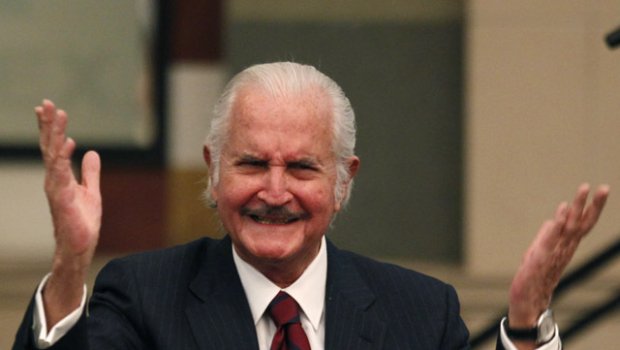
Mexican writer Carlos Fuentes has died, aged 83, at a hospital in Mexico City.
Hospital sources did not comment on author’s cause of death.
Carlos Fuentes was one of the most prolific Latin American authors known equally for his fiction and his essays on politics and culture.
His most famous works were The Death of Artemio Cruz and The Old Gringo.
Carlos Fuentes was associated with the Latin American Boom – a literary movement made up of mainly young authors whose politically critical works broke with established traditions.
He wrote a wealth of novels, plays and essays and regularly commented on political events in Spanish newspaper El Pais.
Born in Panama in 1928, Carlos Fuentes did not move to Mexico until he was 16.
The son of a diplomat, Carlos Fuentes spent much of his childhood moving around the Western Hemisphere.
The author said it was this which allowed him to view Latin America from a distance, giving him a critical edge.
Mexican writer Carlos Fuentes has died, aged 83, at a hospital in Mexico City
In many of his works Carlos Fuentes drew on historical events.
His narrative, like that of his contemporaries of the Latin American Boom, was rarely linear, instead relying on flashbacks and changing perspectives.
Among English-language readers Carlos Fuentes is arguably best known for his novel The Old Gringo, which was made into a film starring Gregory Peck in 1989.
The novel was inspired by the real-life disappearance of American journalist Ambrose Bierce during the 1910-1920 Mexican Revolution.
Carlos Fuentes was also outspoken in his political views, and was a vocal critic of US administrations, including Washington’s policies on immigration and the war on terror.
He was also highly critical of Mexican politics, and in a recent interview, he called for a different approach to the war on drugs.
He also described the three main candidates in the Mexican presidential election as “mediocre”.
Cultural and political figures around the world expressed their grief at the news of his death.
“I am profoundly sorry for the death of our loved and admired Carlos Fuentes, writer and universal Mexican. Rest in peace,” Mexican President Felipe Calderon wrote on Twitter.
The front-runner in July’s election, Enrique Pena Nieto, said he had not always agreed with Fuentes on political matters but that he recognized his “extraordinary work”.
Nobel Prize-winning Peruvian author Mario Vargas Llosa told Spanish daily newspaper El Pais that “with him, we lose a writer whose work and whose presence left a deep imprint”.
Mexican novelist Jose Agustin said Carlos Fuentes “became an essential protagonist in Mexican political and cultural life. He had an immense value, from his first launch in the 1950s he never once backed down for anybody”.
Chilean-American writer Ariel Dorfman said Carlos Fuentes had an amazing generosity of spirit.
“He was constantly, constantly championing the younger people. I never heard him say anything nasty about anybody,” said Ariel Dorfman.
Carlos Fuentes had often been mentioned as a candidate for the Nobel Prize but never won.
Among the many major literary awards he did win was the Cervantes Prize in 1987.
Carlos Fuentes continued to write until the end, with an essay on the recent change of power in France published in Mexican newspaper Reforma on Tuesday, the same day the Angeles del Pedregal hospital announced his death.
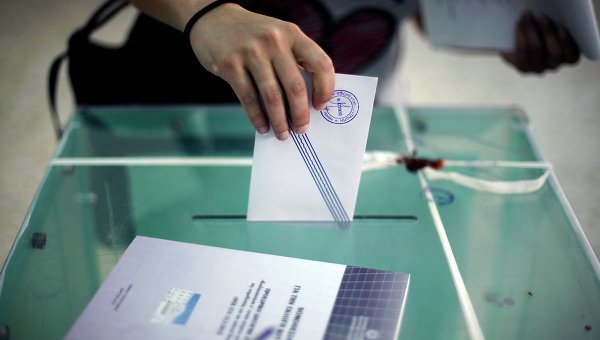
Greece has set the new election date on 17 June and a judge has been appointed to head an interim government.
Council of State president Panagiotis Pikramenos will head the caretaker government until the election.
The election date was announced after party leaders met Greek President Karolos Papoulias on Wednesday.
Final talks to form a coalition failed on Tuesday, raising new concerns over Greece’s eurozone future. No party won a majority in the 6 May election.
There has been deadlock since the election over whether to continue with the austerity measures required by an international bailout agreement.
The uncertainty pushed the euro to a new four-month low against the dollar.
EU officials fear Greece will elect an anti-bailout government, which could trigger a Greek exit from the euro. That possibility is now discussed openly among Europe’s leaders.
But a senior adviser to European Council President Herman Van Rompuy played down that possibility on Wednesday.
Greece has set the new election date on 17 June and a judge has been appointed to head an interim government
On Wednesday the eurozone crisis pushed Asian stocks lower and knocked oil prices.
Tokyo’s Nikkei index dropped 1%, while Hong Kong’s Hang Seng and South Korea’s KOSPI lost about 3%.
The euro fell more than half a cent to $1.27.
Meanwhile the borrowing costs for Spain and Italy rose again, with Spanish bond yields hitting 6.5% and Italy’s 6.1%.
The uncertainty over the euro has also sparked concern over a run on the banks in Greece.
Greek newspapers report that around 700 million Euros ($897 million) has been withdrawn from high street banks over the past few days.
People are concerned that an exit from the eurozone and a reversion to the drachma would wipe out much of their savings, he says.
European leaders say they will cut off funding for Greece if it rejects the bailout agreed in March.
This would mean effective bankruptcy for Greece and its all but certain exit from the euro, analysts say.
German Finance Minister Wolfgang Schaeuble stressed again on Wednesday that there would be no new discussions on Greece’s bailout.
The head of the International Monetary Fund, Christine Lagarde, has raised the possibility of orchestrating an “orderly exit” for Greece from the eurozone.
“It is something that would be extremely expensive and would pose great risks, but it is part of options that we must technically consider,” she said on Tuesday.
After talks in Berlin with German Chancellor Angela Merkel following his inauguration as French president, Francois Hollande said he wanted Greece to remain in the euro.
Opinion polls suggest Greece’s leftist Syriza bloc, which came second in the 6 May vote and rejects all further cutbacks, could become the largest party after a new election.
Syriza wants to renegotiate the bailout package but also wants to keep Greece in the euro.
Pasok and New Democracy, which signed up to the bailouts and had previously dominated Greek politics for decades, saw their combined share of the vote drop from about 77% to about 33% on 6 May.
On Tuesday, Greece said it would make a “timely payment” on 435 million Euros’ worth of debt due on 15 May.
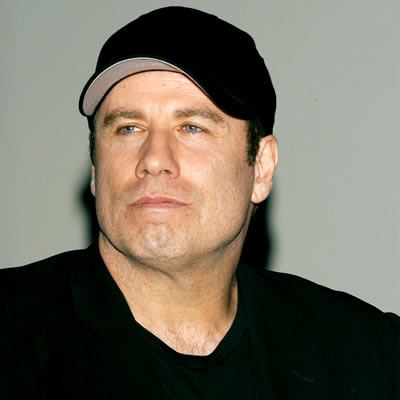
One of the two male masseurs who have claimed actor John Travolta had sexually assaulted them has withdrawn his legal action.
The unidentified man had claimed that John Travolta, 58, groped him during a massage session in Beverly Hills in January.
A second masseur who claims John Travolta made similar advances later that month in Atlanta is to press ahead with his case, according to his lawyer.
The actor’s lawyer said the star had been “completely vindicated” by the dismissal of the first complaint.
One of the two male masseurs who have claimed actor John Travolta had sexually assaulted them has withdrawn his legal action
In a statement, Marty Singer said he expected his client to “similarly be vindicated” with regards to the second claimant, referred to in documents as John Doe No 2.
Okorie Okorocha, the attorney for both claimants, attributed the first masseur’s decision not to proceed to disagreements over how to handle the case.
“Let’s just say we had differences in opinion of how to handle the case and decided to part ways,” Okorie Okorocha told People magazine.
The notice of dismissal was filed on Tuesday at the US District Court in Los Angeles.
John Travolta was Oscar-nominated for his roles in Saturday Night Fever and Pulp Fiction and has been married to actress Kelly Preston since 1991.
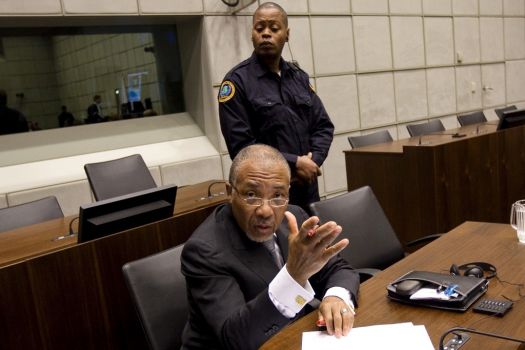
Charles Taylor, the former Liberian president, has accused the prosecution of paying witnesses to testify against him in his war crimes trial.
Charles Taylor, 64, who was found guilty of aiding and abetting war crimes last month, is addressing judges at The Hague.
It is Charles Taylor’s last chance to speak at the international court before he is sentenced later this month.
He was convicted of arming rebels in Sierra Leone during its civil war and helping them plan atrocities.
In its landmark ruling last month, the Special Court for Sierra Leone found Charles Taylor guilty on 11 counts, relating to atrocities that included rape and murder.
Charles Taylor, the former Liberian president, has accused the prosecution of paying witnesses to testify against him in his war crimes trial
Delivering his statement from a witness box on Wednesday, Charles Taylor said money had played a “corrupting” role in his trial.
“Witnesses were paid, coerced and in many cases threatened with prosecution” if they did not testify against him, Charles Taylor said.
He also said judges were handicapped by not having the “full contextual picture” of events at the time.
Charles Taylor said he condemned atrocities across the world, and had the “deepest sympathy” for victims in Sierra Leone.
From the outset of the trial, Charles Taylor has insisted he is innocent of all charges.
The prosecution wants an 80-year prison term, which the defense says is excessive.
Prosecutors have said that Charles Taylor’s ill health and age, or the fact that he has a family, should have no impact on the sentence.
In written filings, prosecutors said a sentence of 80 years would reflect the severity of the crimes and the central role that Charles Taylor had in facilitating them.
“The purposely cruel and savage crimes committed included public executions and amputations of civilians, the display of decapitated heads at checkpoints… public rapes of women and girls, and people burned alive in their homes,” wrote prosecutor Brenda Hollis.
But defense lawyers said the recommended sentence was “manifestly disproportionate and excessive”, and that Charles Taylor had only been found guilty of an indirect role – aiding the rebels, rather than leading them.
They said their client should not be made to shoulder the blame alone for what happened in Sierra Leone’s war.
The court should not support “attempts by the prosecution to provide the Sierra Leoneans with this external bogey man upon whom can be heaped the collective guilt of a nation for its predominantly self-inflicted wounds”, his lawyers wrote.
During the 1991-2002 Sierra Leone civil war, Charles Taylor supported Revolutionary United Front rebels who killed tens of thousands of people.
The war crimes included murder, rape, the use of child soldiers and the amputation of limbs. In return, Charles Taylor received “blood diamonds”.
The sentence is due to be handed down on 30 May.
Charles Taylor is widely expected to appeal against any prison sentence and the hearing could continue for several more months.
Under a special arrangement with the international court, any prison term Charles Taylor does receive will be served in Britain.
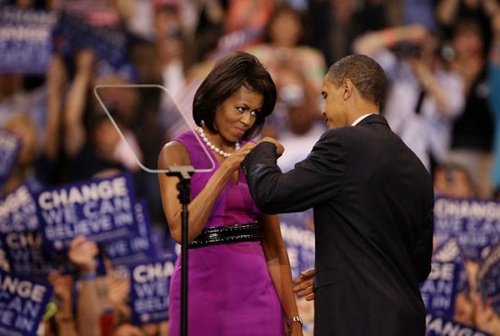
Edward Klein’s book, The Amateur, claims that Michelle Obama prepared divorce papers to separate from Barack Obama in 2000 following his disastrous attempt to win a House seat in Chicago.
When Barack Obama lost miserably, the future First Lady was supposedly disgusted that her husband had ignored her warnings not to take on the four term incumbent Bobby Rush.
Their marriage – in its eighth year at the time – was “on the rocks” with Barack Obama so depressed some of his friends feared he was suicidal.
The claims mark the second time the Obamas have faced allegations they were on the verge of divorce after reports in 2010 suggested they were having difficulties.
Michelle and Barack Obama admitted that in the past they did go through a rough patch but that they patched things up and grew closer together.
The Obamas have now been married for 21 years and have two children, Malia, 13, and Sasha, nine.
In The Amateur, Edward Klein’s unauthorized account of Barack Obama’s life and first term in office, it is claimed that the future president was over ambitious in his attempt to take on House member Bobby Rush for the black South Side seat in Chicago.
In a crushing blow, Barack Obama lost by two votes to one prompting claims from Bobby Rush that he was an “educated fool”.
Edward Klein writes: “After Obama’s humiliating defeat he was broke and deeply in debt and it looked as though he might be finished in public life.
“During the dark days that followed his defeat, he turned to Michelle for comfort. But she was in no mood to offer him sympathy.
“After all he had refused to listen to her warnings about taking on the formidable Bobby Rush. He had put his family in a precarious financial position. And he had dashed Michelle’s hopes of creating a stable and secure future.
“As a result their marriage was on the rocks, and Obama confided to friends that he and Michelle were talking about divorce.
“Michelle actually had divorce papers drawn up, one of her friends told me.”
Michelle Obama prepared divorce papers to separate from Barack Obama in 2000 following his disastrous attempt to win a House seat in Chicago
In desperation Barack Obama begged friends to help him open an office to stay in politics – but did not tell his wife for fear of her wrath if she found out.
The couple appear to have worked out their differences, however – Barack Obama ran for a Senate seat in Illinois and won it in, assuming office in 2005 and restoring his wife’s faith in him.
The Amateur also includes a number of other claims about Barack Obama, including an interview with his former pastor Jeremiah Wright which could ignite the debate about his religion.
During the “birther” row about where Barack Obama was born he faced repeated accusations that not only was he born in Kenya, he was in fact a Muslim and not a Christian as he claims to be.
Asked by Edward Klein if he converted Barack Obama from Islam to Christianity, Jeremiah Wright said: “That’s hard to tell.
“I think I convinced him that it was okay for him to make a choice in termsof who he believed Jesus is. And I told him it was really okay and not a put down of the Muslim part of his family or his Muslim friends.”
Barack Obama was supposedly known as “Black Jesus” by his former senior campaign adviser David Axelrod because of his messiah complex, Edward Klein writes.
He also had a run-in with Steven Rogers, a wealthy businessman who became the Gund Family Distinguished Professor of Entrepreneurship at Northwestern University’s Kellogg School of Management.
Early in his campaign for the U.S. Senate he gave Barack Obama $3,000 and arranged for thousands more dollars to be donated to him on one condition: he come and speak at the school when he got elected.
After becoming a Senator Barack Obama is said to have gone back on his offer because he was too busy and told Steven Rogers: “Come on man, you should know better when politicians make promises.”
In a furious tirade Steven Rogers screamed at him: “You’re a dirty rotten m*****f*****. What kind of s*** are you trying to pull? F*** you, you big-eared m*****f*****.”
A year later, Barack Obama finally showed up but by then Steven Rogers’ had all but written him off as a friend.
In extracts which had already been made public Edward Klein claims that Michelle Obama is so jealous of her husband receiving female attention she orders women who are close to him in the White House to be watched.
The First Lady is supposedly paranoid Barack Obama will cheat on her as John F. Kennedy did to his wife.
In the book, Edward Klein adds more detail and claims when Barack Obama was studying at Harvard as a law student she would fly into jealous rages when she saw him with other women.
She was supposedly so territorial that she “drove a lot of Barack’s friends away”, Edward Klein writes.
The only reason they got married at all was that Michelle Obama “insisted” upon it – because she wanted to “remake him” as she wanted and not let him have an easy life.
The book claims that once her husband assumed office Michelle Obama began to wield power behind the scenes to such an extent that Barack Obama shares a “co-presidency” with her.
Edward Klein also alleges that Barack Obama twice snubbed Caroline Kennedy, the daughter of former U.S. President John F. Kennedy, and that he and Michelle privately made disparaging comments about her family – and even their clothes.
He writes: “Caroline heard there was a lot of nasty s**** being said about the Kennedys by the president and Michelle.
“There were catty remarks about how badly the Kennedy women dressed and how their houses were shabby and threadbare.
“Caroline got the impression that most of this negativity was coming from Michelle, who didn’t want the Kennedys to be part of the administration for fear that they would have too much influence over the president.”
Among others who were also shut out of the White House were Oprah Winfrey who Edward Klein claims was given the cold shoulder for being too fat.
The title of the book comes from a supposed outburst last August by former U.S. President Bill Clinton who branded Barack Obama “an amateur”.
He also urged his wife Hillary to quit her post as U.S. Secretary of State and challenge Barack Obama for the Democratic ticket in this year’s elections, telling her: “Your country needs you! Your country needs us!”
The White House has denounced the book and said that Edward Klein has a record for making things up.
Bill Clinton has also denied he insulted the President.
A US panel of experts has backed the over-the-counter HIV tests that would allow people to check in the privacy of their homes if they have the virus.
Experts said the OraQuick In-Home HIV Test was safe and effective and its potential to prevent infections outweighed the risk of false results.
The Food and Drug Administration (FDA) will decide this year whether to approve it.
The 20-minute test is 93% accurate for positive results and 99.8% for negative, the manufacturer said.
HIV affects nearly 1.2 million people in the US, with 50,000 new cases each year.
Experts said the OraQuick In-Home HIV Test was safe and effective and its potential to prevent infections outweighed the risk of false results
Experts on the Blood Products Advisory Committee voted 17-0 to back the test, saying it would help people who are HIV-positive get access to healthcare and social services.
They urged Pennsylvania-based OraSure, the company that manufactures the product, to include highly visible warnings about false negative results.
The panel also advised that the packaging should carry a toll-free phone number offering counseling to those testing positive.
Carl Schmid, deputy director of the AIDS Institute, welcomed the panel’s approval on Tuesday of the home test.
“We are always looking for game changers, and we believe this is one of them,” Carl Schmid told the Associated Press.
“Not only will it help reduce the number of infections but it will bring more people into care and treatment.”
FDA does not have to follow the recommendations of the advisory panel, though it usually does.
In 2004, the FDA approved a 99%-effective version of the test for use by healthcare professionals.
OraSure said the home test could retail for less than $60 if approved.
To take the test, the user swabs the outer gum area so the oral fluid, which is not the same as saliva, can be checked for the HIV virus.
The test provides results within about 20 minutes, but experts say the results should be confirmed with a blood test, which is more accurate.
Last week, a separate FDA panel approved a drug called Truvada, which could become the first drug in tablet form to protect healthy people from the HIV virus.
The 65th Festival de Cannes opens today on the French Riviera with 8 films generating big buzz.
Out of 1,779 films submitted this year, only 54 features made the cut.
From Moonrise Kingdom to Cosmopolis, you’ll find many mysterious twists in this year’s top line-up. And watch for red carpet photos with familiar faces including Brad Pitt, Nicole Kidman, Bruce Willis, Robin Pattinson, Kristin Stewart and Director Philip Kaufman.
1. Moonrise Kingdom – Bruce Willis and Bill Murray – Wes Anderson’s film will open the festival on May 16th and play in competition. In this film, a couple of young lovers escape their New England town, which results in a local search party for them.
2. Killing Them Softly – Brad Pitt and Ray Liotta – Jackie Cogan (Brad Pitt) is a professional enforcer who investigates a crime that went down during a mob-protected poker game.
3. Mud – Matthew McConaughey, Reese Witherspoon, Michael Shannon – When encountering a fugitive, two teenage boys agree to help him run from the bounty hunters and reunite with his true love.
The 65th Festival de Cannes opens today on the French Riviera with 8 films generating big buzz
4. The Paperboy – Zac Efron (The Lucky One), John Cusack, Matthew McConaughey, and Nicole Kidman – This film was directed by Lee Williams, who directed Best Picture Academy Award Nominee Precious. In this film, a reporter goes back to his hometown in Florida to investigate a case and find out more about a death-row inmate.
5. Lawless – Guy Pearce, Tom Hardy, Shia LaBeouf – This film is a prohibition-era American saga directed by Australian John Hillcoat. Set during the Depression-era in Franklin County, Virginia, a bootlegging gang is threatened by authorities that demand part of their profits.
6. Cosmopolis – Robert Pattinson, Jay Baruchel, Kevin Durand – Traveling across New York City in a stretch limo for a haircut, this film follows a 28-year-old billionaire Asset Manager’s day that evolves into a journey with a cast of characters that break apart his world.
7. Rust and Bone – Oscar-winner Marion Cotillard – Ali leaves the north of France for Antibes to live with his sister and her husband as a family. His bond with Stephanie, a killer whale trainer, grows deeper after Stephanie has a terrible accident.
8. Hemingway & Gellhorn – Nicole Kidman and Clive Owen – Produced by HBO Films, this historic piece is the story of Ernest Hemingway and his third wife. Nicole Kidman plays Hemingway’s war-reporter wife Martha Gellhorn in a production screening out of the Cannes competition.
This year Festival de Cannes will pay tribute to Hemingway & Gellhorn director Philip Kaufman, who will be leading the Master Class. Following Martin Scorsese, Stephen Frears, Nanni Moretti, Wong Kar Wai and Sydney Pollack, Philip Kaufman will talk to Michel Ciment about filmmaking and his passion for cinema.
There are four juries who will be judging the 2012 films, including 1. Feature Film (President Nanni Moretti), 2. Cinefoundation and Short Films (President Jean-Pierre Dardenne), 3. Un Certain Regard (President Tim Roth), and 4. Golden Camera (Carlos Diegues).
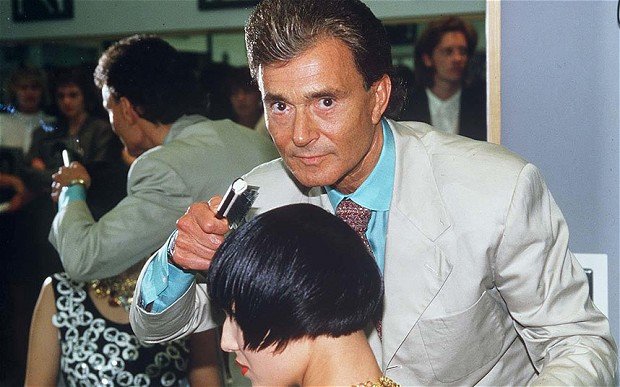
Famous hairdresser Vidal Sassoon, who has died at his home in Los Angeles at the age of 84, is credited with revolutionizing hair-styling for women.
Here are five ways in which Vidal Sassoon changed the world of hair.
1. Hair for work
In the 1950s, hair was about height, curls and hairspray. Women often visited the hairdressers two or three times a week to have their hair elaborately teased and “set”. Hats added even more drama on top of dressed styles.
Vidal Sassoon’s “wash and wear” cuts of the 1960s changed all that, allowing women to spend less time on their appearance.
According to fashion commentator Caryn Franklin, Vidal Sassoon created a “visual aesthetic for modern women wanting to distance themselves from the modern housewife”.
As more and more women entered the workforce, they needed cuts that would reflect authority and efficiency in a male-dominated world.
Speaking to the Los Angeles Times in 1993, Vidal Sassoon explained: “Women were going back to work, they were assuming their own power. They didn’t have time to sit under the dryer anymore.”
“Clients came into his salon every day who were at the forefront of the feminist expansion into the workplace,” Caryn Franklin says. Vidal Sassoon cuts were futuristic, illustrating where “women wanted to go” rather than where they currently were.
2. Celebrity hairdressing
Hailed as one of the world’s first celebrity hairdressers, Vidal Sassoon’s client list included Twiggy, Jane Fonda and Mia Farrow. Although he opened his first London salon in 1954, his first New York branch opened its doors in 1965 and became one of a string of international salons.
Not only was he stylist to the stars, he became a celebrity himself, moving to Los Angeles in the 1970s. He paved the way for other “name” hairdressers like Trevor Sorbie, Nicky Clarke and John Frieda.
A regular face on television, he appeared in his Sassoon commercials in the 80s alongside famous supermodels. He recently judged the final of reality TV show Shear Genius and a documentary about his life was made in 2010.
For a hairdresser to become a Hollywood sensation in Vidal Sassoon’s time “was a mega-mega achievement”, says celebrity hairdresser Errol Douglas.
Until then, hairdressers were not typically viewed as stylists, but Vidal Sassoon brought a designer image to the industry. At the same time he appealed to ordinary people.
For Guardian columnist Sali Hughes, Vidal Sassoon’s mass popularity stemmed from the fact that he was a “working class boy who started out as a barber and lived and breathed hair from when he was a child”.
Today Sassoon-esque short hair on women is a standard look
3. Short hair for women
Vidal Sassoon once explained to the Los Angeles Times that he viewed hair like fabric which needed to be shaped.
“My idea was to cut shape into the hair, to use it like fabric and take away everything that was superfluous.”
Vidal Sassoon didn’t invent the idea of short hair for women, but he brought a range of short styles into the mainstream.
He is perhaps best remembered for his “Mary Quant” cut, a geometric five-point bob worn by the fashion designer which contrasted sharply with the romantic, curly looks of the 1950s. Sassoon cuts “swept away classic femininity and added design into hair”, says Caryn Franklin.
Another look, the “Greek Goddess”, a short tousled perm, was inspired by the women of Harlem in New York.
And his looks got even shorter, such as the “pixie crop” worn by Mia Farrow in Rosemary’s Baby. This was shocking to some in an era where androgynous style was only beginning to take off.
Today Sassoon-esque short hair on women is a standard look.
“He made short hair sexy,” says hair stylist Lee Stafford.
4. Hair products
As the years passed, the hairdresser devoted more and more time to developing the growing Sassoon brand. Although he steered hair styling away from lacquered beehives, he was one of the first stylists to create a popular line of products under his name.
Vidal Sassoon products catered for both the mass and high-end market, with luxurious product lines stocking salons while affordable hair-care items lined supermarket shelves.
Fashion historian Laura Kitty says that people ended up having “more of a connection” with the Sasoon brand because his products became so widespread, something other hairstylists didn’t have.
“He really managed to tap into the idea of aspiration mass market products for hair. It was like you were buying a haircut in his salon.”
Vidal Sassoon also branched into a range of hairdryers and styling tools for women to attempt to “create a Sassoon look” at home.
His two-in-one combined shampoo and conditioner Wash and Go “was the biggest selling hair product of the 80s”, says Sali Hughes.
5. Hair academies
Vidal Sassoon was the hairdresser’s hairdresser, notes Sali Hughes, pointing out that his geometric cuts needed cutting every six weeks, keeping stylists in business.
His training academies taught would-be hairdressers to create haircuts based on a client’s bone structure, a practice known as “precision cutting”.
And they produced alumni notable in the world of hairdressing, such as Lee Stafford, who says that hairdressers all over the world still come to London to train.
According to Laura Kitty, a large number of up-and-coming stylists in the 80s and 90s had trained at one of his academies.
And although Vidal Sassoon began as an apprentice barber and learned the “old methods”, he devised new techniques to teach to younger stylists as his career progressed.
“His ideas have been disseminated at a much larger scale than any other stylist in modern memory.”
But while his methods may have changed over the years, Lee Stafford says the essence of Vidal Sassoon styling remained the same.
“He never ever changed his philosophy, it was all about beautiful hair cutting.”
The Pentagon has issued further safety procedures for F-22, its most advanced fighter jet, after pilots complained of oxygen shortages during flights.
The rules include limiting the distance F-22 planes can travel from airstrips.
Defence Secretary Leon Panetta did not rule out grounding the jets again if necessary.
The Air Force banned its F-22s from flying for four months last year to investigate the oxygen-deficit problem, but its cause remains unclear.
The Pentagon has issued further safety procedures for F-22 after pilots complained of oxygen shortages during flights
The Air Force has introduced more than a dozen pilot safety rules in the F-22, and says oxygen issues are very rare, but some pilots have refused to fly the aircraft.
The safety precautions announced on Tuesday mean the F-22 will have to abandon long-distance air patrol missions in Alaska, the Pentagon said. The jet has never been used in combat.
Leon Panetta has also asked for a back-up oxygen system to be put into the planes, with the first of these due to be installed in December.
“We haven’t determined the root cause,” Pentagon spokesman George Little said.
“It could be something connected to the oxygen system.
“It could be other aspects of the aircraft that could contribute to hypoxia-like [oxygen-deprivation] events, whether it’s G-forces, the altitude at which the plane flies.”
Twelve hypoxia-related incidents, including dizzy spells and blackouts, have been reported between April 2008 and January 2011.
There are worries that new F-35 fighter jets, which are being developed by Lockheed Martin, could pose similar problems.
“I think it’s safe to say that everybody in leadership is concerned about this,” Pentagon spokesman John Kirby said.
The F-35 will have many of the same features as the F-22, but cannot fly as high or as fast.
The 65th Cannes Film Festival (Festival de Cannes) opens today on the French Riviera with US director Wes Anderson’s film Moonrise Kingdom.
Wes Anderson’s movie, which stars Bill Murray, is one of the 22 movies selected to compete for the festival’s biggest prize, the Palme d’Or.
However, the celebrations have been marred by criticism that no female directors will be in competition.
The only woman to have won the prestigious award was Jane Campion in 1993, with The Piano.
A group of prominent female filmmakers have written an open letter to the French newspaper Le Monde criticizing the lack of women being showcased.
Ripe with sarcasm, the letter was signed by directors Fanny Cottencon and Virginie Despentes – who made the sexually explicit Baise Moi in 2000 – among others.
It said: “Men love their women to have depth, but only when it comes to their cleavages.
“All 22 films in the official selection were written, happy coincidence, by 22 men.”
However, festival director Thierry Fremaux has supported the longlist of nominees, insisting the judges “would never select a film that doesn’t deserve it just because it is directed by a woman”.
The 65th Cannes Film Festival opens today on the French Riviera with US director Wes Anderson's film Moonrise Kingdom
This year’s Palme d’Or judges are led by Italian Nanni Moretti and include Britain’s Ewan McGregor and Andrea Arnold, acclaimed for directing the 2009 film Fish Tank.
Last year saw the British filmmaker Lynne Ramsey nominated for her film We Need To Talk About Kevin.
Her star in that film, British actress Tilda Swinton, is due on the red carpet as a cast member of Anderson’s opening night film – which also stars Bruce Willis.
Also in competition this year is Ken Loach with his Glasgow-set comedy-drama The Angel’s Share.
He has been nominated 11 times, last winning the Palme d’Or in 2006 for the IRA drama The Wind That Shakes The Barley.
Past winners Michael Haneke and Jacque Audiard – who won the jury’s Grand Prize for his film A Prophet in 2009 – are also in the running.
Australian John Hillcoat and New Zealand’s Andrew Dominik are both nominated respectively for the prohibition era film Lawless and Killing Me Softly, which stars Brad Pitt.
Brad Pitt and his fiancée Angelina Jolie are both expected on the red carpet this year.
American David Cronenberg is in competition with his film Cosmopolis, starring an against-type Robert Pattinson, while Cronenberg’s son Brendan is competing in the Un Certain Regard category – which awards new talent – with his film Antiviral.
Two female film-makers join him in that category: France’s Catherine Corsini and Sylvie Verheyde.
The 2012 Cannes Film festival will take place from May 16 to May 27. Out of 1,779 films submitted this year, only 54 features made the cut.
Film festival held annually in Cannes, France. First held in 1946 for the recognition of artistic achievement, the festival came to provide a rendezvous for those interested in the art and influence of the movies. Like other film festivals, it became an international marketplace where producers and distributors could exchange ideas, view films, and sign contracts. The phenomenon of international coproduction arose at Cannes in the late 1940s.
Beau Sancy, one of the world’s oldest and most famous diamonds, has sold for $9.7 million at auction in Geneva – twice its reserve.
The 35-carat gem was worn by Marie de Medici at her coronation as queen of France in 1610.
It has since passed among the royal families of Europe, used to show off their wealth – and pay their debts.
Beau Sancy, one of the world's oldest and most famous diamonds, has sold for $9.7 million at auction in Geneva
The pear-shaped, rose-cut stone attracted fierce bidding and was won by an anonymous buyer.
“It’s extremely rare for a diamond of this importance to come on the market,” said David Bennett of auction house Sotheby’s.
“It’s never been out of royal hands, it’s of immaculate provenance, it’s in all the history books of famous stones.”
After being worn at Marie de Medici’s coronation, the diamond was pawned by Mary Stuart to finance the fight by her brother, the future Charles II, for the English throne, following the English Civil War.
Later still it was the centrepiece in the crown of the first king of Prussia, and it was sold by the Royal House of Prussia, the descendants of those who once ruled Prussia.
But, as its buyer was anonymous, no one knows whether it is royalty or commoner who owns the Beau Sancy now.