Robert Pattinson and Kristen Stewart relationship was left in tatters when she was photographed cheating on him with married film director Rupert Sanders.
But Robert Pattinson and Kristen Stewart have reportedly decided to give their romance another shot.
The Twilight co-stars are said to have had a tearful heart-to-heart, with the 26-year-old actor eventually deciding to forgive his girlfriend for what he considers to be a “stupid mistake”.
A source told The Sun: “They pretty much decided they couldn’t live without each other.
“Kristen poured her heart out to Robert and told him it was a one-off and a mistake.”
Robert Pattinson and Kristen Stewart are now said to be moving into a secluded Los Angeles home together, and are hoping to rebuild their relationship.
Robert Pattinson and Kristen Stewart have reportedly decided to give their romance another shot
The source added: “Rob sees it as Kristen made a really stupid mistake. After a lot of long tearful talks, they’ve worked it out.
“Rob can see how truly sorry Kristen is and has totally forgiven her. They really do love each other.”
Kristen Stewart seems to have been quietly confident about making amends with Robert Pattinson for some time.
Earlier this month, Kristen Stewart told reporters at a press conference they were “totally fine” about making potentially awkward public appearances together in November while they promote The Twilight Saga: Breaking Dawn Part 2.
Back in July, Kristen Stewart was photographed in the arms of father-of-two Rupert Sanders, breaking not only the hearts of his wife Liberty Ross and her long-term love R-Patz – but loyal fans across the globe.
In the wake of the news, both Kristen Stewart and Rupert Sanders were quick to make public statements saying that their tryst had been a mistake.
Kristen Stewart said: “This momentary indiscretion has jeopardized the most important thing in my life, the person I love and respect the most, Rob. I love him, I love him, I’m so sorry.”
While Rupert Sanders told People magazine: “I am utterly distraught about the pain I have caused my family. My beautiful wife and heavenly children are all I have in this world.
“I love them with all my heart. I am praying that we can get through this together.”
A NATO air strike in Afghanistan’s eastern province of Laghman has killed at least eight women, local officials say.
NATO has conceded that between five and eight civilians died as it targeted insurgents, and offered condolences.
Afghan President Hamid Karzai “strongly condemned” the deaths and has sent officials to the area to investigate.
Earlier on Sunday, four US soldiers with the NATO forces were killed in an attack by suspected Afghan police.
The attack in southern Zabul province brought to 51 the number of NATO troops killed in “insider attacks” this year, and came a day after two UK soldiers were killed at a checkpoint in Helmand by a man in police uniform.
Local officials in the remote area of Laghman said at least eight women had died, while provincial council member Gulzar Sangarwal said nine were dead.
Major Adam Wojack, a spokesman for the ISAF international forces, said between five and eight civilians could have been killed, and said an investigation was under way.
He said a group of some 45 insurgents had been targeted by an ISAF unit, and many had been killed.
A NATO air strike in Afghanistan's eastern province of Laghman has killed at least eight women
“Unfortunately, we have become aware of possible ISAF-caused civilian casualties as a result of this strike, numbering five-eight Afghans,” he said.
“ISAF offers its sincerest condolences to the affected community and family members, as well as to the Afghan people, concerning this tragic loss of life.”
At least seven women were also reported to have been injured. Provincial health director Latif Qayumi said some of them injured were girls aged as young as 10.
The Laghman governor’s office said a number of civilians had gone to the mountains to collect wood and nuts from a forest in the Noarlam Saib valley, a common practice in the area.
The mountainous, highly forested terrain remote from government control make the area attractive to Taliban and other insurgent groups, correspondents say.
The issue of civilian deaths by international forces has created tensions between the US President Karzai.
In August, UN figures suggested the number of civilians killed and injured in the first half of 2012 had fallen 15% on the same period of 2011.
Analysts said increased sensitivity on both sides about the impact of civilian deaths had led to more carefully targeted attacks.
In his statement, President Hamid Karzai expressed his “sorrow” over the incident, saying he “strongly condemns the airstrike by NATO forces which resulted in the deaths of eight women”.
ISAF spokesman Lt. Col. Hagen Messers said the remote base in Zabul province came under attack in the early hours of the morning, AFP reports.
The US troops were scrambled to help the Afghans repel the attack, but four of them were shot dead by Afghans in police uniform.
Officials said it was not yet clear whether the attacker or attackers were genuine police, but one provincial office told AFP that three or four known policemen had since disappeared from the base.
“At the moment, we don’t know where they have gone. We don’t know if they fled fearing arrest or if they are linked to the Taliban,” he said.
Zabul’s deputy police chief Ghulam Gilani told the Associated Press the police could have been forced into attacking the American troops.
“Whether they attacked the Americans willingly we don’t know,” he said.
Meanwhile, more details have also emerged of the scale of damage caused by an insurgent attack on NATO’s heavily fortified Camp Bastion base in Helmand province, in which two US marines were killed.
Militants breached the perimeter of the sprawling base in Helmand province, destroying six US Harrier aircraft and damaging two more, destroying three refueling stations and damaging six aircraft hangars.
NATO said 14 of the insurgents were killed and one was injured and taken into custody. Nine coalition personnel were wounded.
In a statement, NATO said the attack had been carried out by 15 insurgents dressed in US Army uniforms who “appeared to be well-equipped, trained and rehearsed”.
Hundreds of thousands of worshippers have attended a seafront Mass in Beirut on the concluding day of Pope Benedict XVI’s visit to Lebanon.
Pope Benedict XVI appealed for leaders in the Middle East to work for peace and reconciliation and urged those at the service to “be peacemakers”.
The pontiff also renewed his call for a end to the violence in Syria.
He later left Lebanon, after a ceremony at Beirut airport attended by flag-waving crowds.
The visit came amid anti-US protests in the region over a film deemed insulting to Islam.
It was the first papal trip to Lebanon since John Paul II went there in 1997.
An estimated 350,000 worshippers gathered for the waterfront Mass earlier on Sunday. They waved flags and cheered as the Pope made his way through the crowd in his bullet-proof popemobile.
During the service, the Pope urged Christians throughout the Middle East to do their part to end “the grim trail of death and destruction” in the region.
Hundreds of thousands of worshippers have attended a seafront Mass in Beirut on the concluding day of Pope Benedict XVI's visit to Lebanon
Calling again for peace in Syria, he said: “I appeal to the Arab countries, that, as brothers, they might propose workable solutions respecting the dignity, the rights and the religion of every human person.”
Christians from around Lebanon, as well as Syria, Iraq and further afield, travelled to see him speak in what must have been a very thrilling day.
On Saturday, the pontiff met Lebanese political leaders at the presidential palace near Beirut.
Lebanon’s politicians are bitterly divided over the conflict in neighboring Syria, but the Pope met leaders from across the spectrum, including the Shia Muslim movement Hezbollah.
Addressing an audience of government officials, foreign diplomats and religious leaders, he called for the “fundamental right” of religious freedom to be observed.
Earlier in his visit, the Pope condemned religious fundamentalism and called on all religious leaders in the Middle East “to do everything possible to uproot this threat”.
Controversy over a film deemed to be offensive to the Prophet Mohammed has provoked protests throughout the region since the Pope’s arrival in Lebanon.
The film, Innocence of Muslims, is believed to have been made by a Coptic Christian in the US, and related unrest has led to the death of, among others, the US ambassador to Libya.
The Pope also addressed a gathering of thousands of young people on Saturday, and urged them to stay in Lebanon “and take your place in society and in the Church”.
The number of Christians in the region has been greatly reduced in recent years due to political upheaval and economic pressures.
Libyan authorities have arrested some 50 people in connection with Tuesday deadly attack on the US consulate in Benghazi, the president of Libya’s interim assembly has said.
Mohamed Magarief told CBS News he had “no doubt” the attack was pre-planned.
That appears to contradict US envoy to the UN Susan Rice who told ABC that the evidence suggested it had been part of “spontaneous” protests.
US Ambassador Chris Stevens and three other US consulate staff were killed.
They died when the consulate in Benghazi was set ablaze, in protests apparently inspired by demonstrations at the US embassy in the Egyptian capital, Cairo.
It was part of a wave of violent protests in the Muslim world over an anti-Islam film made in the US.
Libyan authorities have arrested some 50 people in connection with Tuesday deadly attack on the US consulate in Benghazi
Some of the suspects in last Tuesday’s violence in Benghazi were from outside Libya, Mohamed Magarief told CBS News.
“It was planned, definitely, it was planned by foreigners, by people who entered the country a few months ago, and they were planning this criminal act since their arrival,” he said.
He said the suspects were connected to al-Qaeda, or its “affiliates and maybe sympathizers”.
“We don’t know what are the real intentions of these perpetrators,” he said.
“They entered Libya from different directions. Some of them definitely from Mali and Algeria.”
Al-Qaeda in the Arabian Peninsula has said in a statement the attack avenged the killing of Abu Yahya al-Libi – a Libyan-born al-Qaeda commander killed in June by a US drone strike in the North Waziristan-Afghan borderlands.
Susan Rice, meanwhile, told ABC that the the US’s “current best assessment” was that “this began as a spontaneous not a pre-meditated response” to the protests in Cairo.
“As that unfolded it seems to have been hijacked, let us say, by some individual clusters of extremists who came with heavier weapons, weapons that as you know in the wake of the revolution in Libya are quite common and accessible and then it evolved from there,” she added.
The Benghazi violence was followed by a string of attacks on US consulates, embassies and business interests across the Middle East and north Africa. British, Swiss, German and Dutch properties were also targeted.
Two people were killed during protests outside the US embassy in the Tunisian capital, Tunis on Friday, while three were killed in clashes in the Sudanese capital, Khartoum.
On Saturday, the US ordered all non-essential staff to leave Tunisia and Sudan, fearing further violence. The US had asked Sudan for permission to send troops to protect its Khartoum embassy, but the request was turned down.
A State Department statement also advised US citizens in Tunisia to leave by commercial flights and those in Sudan to “exercise caution at all times”.
The Canadian government announced on Sunday it was closing its embassies in Sudan, Libya and Egypt for the day as a precautionary measure.
The US and Canadian announcements came as Al-Qaeda in the Arabian Peninsula called for fresh attacks against Western embassies, describing the recent unrest as “a great event”, and urging protesters to unite to “expel the embassies of America from the lands of the Muslims”, AP reports.
Meanwhile a man involved in producing the film – a low-budget, amateurish production called Innocence of Muslims – has been questioned by police in the US.
Nakoula Basseley Nakoula has admitted his role in the film but investigators are trying to find out whether he was the internet user named “sambacile” who posted a clip of it online.
He was freed on probation in June 2011 on condition that he did not use the internet without authorization or assume aliases.
Nakoula Basseley Nakoula was released by police after questioning and may have gone into hiding, the Associated Press reports.
US defence secretary Leon Panetta has warned territorial disputes in East Asia have the potential to become wider conflicts if provocations are not reduced.
“A misjudgement on one side or the other could result in violence, and could result in conflict,” Leon Panetta said at the start of an Asian tour.
His comments came as anti-Japanese protests continue to sweep China over a disputed island chain.
Demonstrators gathered in cities across China for a second day on Sunday.
Riot police used tear gas and water cannon in the southern city of Shenzhen to break up an angry crowd.
China is reasserting its claim to sovereignty over the disputed Senkaku or Diaoyu islands in the East China Sea, in the wake of a Japanese government decision last week to purchase the islands from their private Japanese owners.
US defence secretary Leon Panetta has warned territorial disputes in East Asia have the potential to become wider conflicts if provocations are not reduced
Japanese Prime Minister Yoshihiko Noda has urged Beijing to take steps to protect Japanese nationals, but added that the authorities in both countries should “remain calm”.
Speaking in Tokyo, Leon Panetta said: “I am concerned that when these countries engage in provocations of one kind or another over these various islands, that it raises the possibility that a misjudgement on one side or the other could result in violence, and could result in conflict.”
“And that conflict would then have the potential of expanding,” he warned.
The US defence chief stressed that during his talks in Tokyo and later in Beijing he would appeal for restraint.
Leon Panetta also said that Washington did not take a position with regard to the territorial disputes in Asia.
He will also visit New Zealand as part of his tour.
On Sunday, hundreds of Chinese protesters again faced off against riot police at the Japanese embassy in Beijing.
In Shenzhen, police fired tear gas to disperse a demonstration, while in the nearby city of Guanghzhou angry crowds burned Japanese flags.
One eyewitness in the city of Xi’an described how his camera was snatched from him and damaged because it was a Japanese brand.
“Japanese-made cars were randomly stopped, their drivers grabbed and thrown out… and the cars smashed and burned. The police and army seemed to do little to stop the riot,” he said.
Tensions have been heightened this week after the purchase of some of the islands by the Japanese government from their private Japanese owners.
China briefly sent six surveillance ships into waters around the islands on Friday in response.
The islands are also claimed by Taiwan and have been a long-running source of friction in the region.
Analysts see Japan’s decision to buy the islands as damage limitation in response to a much more provocative plan by the nationalistic governor of Tokyo, who wanted to purchase and develop the islands.
And yet there is virtually no mention of the protests in China’s state media, and attempts have been made to control discussion on the internet.
This reflects the Communist leadership’s ambivalence about such displays of nationalist fury: they can be useful to send a message to Japan, but could easily get out of control and spark wider expressions of discontent.
There is plenty of scope for miscalculation in the coming days: Chinese fishing fleets are set to return to the disputed waters, and nationalists could try to provoke Japan by landing on the islands.
In Japan, the government seems unlikely to back down with election looming.
There is talk in the Japanese press that some on both sides could be willing to risk a limited naval clash in defence of the conflicting claims.
Further complicating matters, Japan’s newly appointed ambassador to China, 60-year-old Shinichi Nishimiya, died on Sunday, the foreign ministry said.
The envoy – who had been due to take his post in October – collapsed several days earlier near his Tokyo home and was taken to hospital.
The foreign ministry has not publicly commented on what caused his death.
Post-menopausal women who have Type 2 diabetes appear to have a 27% greater risk of developing breast cancer, experts say.
An international team, writing in the British Journal of Cancer, examined 40 separate studies looking at the potential link between breast cancer and diabetes.
Being obese or overweight is linked to both conditions.
But cancer experts say there may be a direct connection between the two.
These studies involved more than 56,000 women with breast cancer.
Post-menopausal women with Type 2 diabetes had a 27% increased risk of breast cancer.
But there was no link for pre-menopausal women or those with Type 1 diabetes.
The authors have also suggested that a high body mass index (BMI), which is often associated with diabetes, may be an underlying contributing factor.
Prof. Peter Boyle, president of the International Prevention Research Institute, who led the study, said: “We don’t yet know the mechanisms behind why Type 2 diabetes might increase the risk of breast cancer.
“On the one hand, it’s thought that being overweight, often associated with Type 2 diabetes, and the effect this has on hormone activity may be partly responsible for the processes that lead to cancer growth.
“But it’s also impossible to rule out that some factors related to diabetes may be involved in the process.”
An IBM team in Zurich has published single-molecule images so detailed that the type of atomic bonds between their atoms can be discerned.
The same pioneering team took the first-ever single-molecule image in 2009 and more recently published images of a molecule shaped like the Olympic rings.
The new work opens up the prospect of studying imperfections in the “wonder material” graphene or plotting where electrons go during chemical reactions.
The images are published in Science.
The team, which included French and Spanish collaborators, used a variant of a technique called atomic force microscopy (AFM).
AFM uses a tiny metal tip passed over a surface, whose even tinier deflections are measured as the tip is scanned to and fro over a sample.
The IBM team’s innovation to create the first single molecule picture, of a molecule called pentacene, was to use the tip to pick up a single, small molecule made up of a carbon and an oxygen atom.
An IBM team in Zurich has published single-molecule images so detailed that the type of atomic bonds between their atoms can be discerned
This carbon monoxide molecule effectively acts as a record needle, probing with unprecedented accuracy the very surfaces of atoms.
It is difficult to overstate what precision measurements these are.
The experiments must be isolated from any kind of vibration coming from within the laboratory or even its surroundings.
They are carried out at a scale so small that room temperature induces wigglings of the AFM’s constituent molecules that would blur the images, so the apparatus is kept at a cool -268C.
While some improvements have been made since that first image of pentacene, lead author of the Science study, Leo Gross, said the new work was mostly down to a choice of subject.
The new study examined fullerenes – such as the famous football-shaped “buckyball” – and polyaromatic hydrocarbons, which have linked rings of carbon atoms at their cores.
The images show just how long the atomic bonds are, and the bright and dark spots correspond to higher and lower densities of electrons.
Together, this information reveals just what kind of bonds they are – how many electrons pairs of atoms share – and what is going on chemically within the molecules.
“In the case of pentacene, we saw the bonds but we couldn’t really differentiate them or see different properties of different bonds,” Dr. Leo Gross said.
“Now we can really prove that… we can see different physical properties of different bonds, and that’s really exciting.”
The team will use the method to examine graphene, one-atom-thick sheets of pure carbon that hold much promise in electronics.
But defects in graphene – where the perfect sheets of carbon are buckled or include other atoms – are currently poorly understood.
The team will also explore the use of different molecules for their “record needle”, with the hope of yielding even more insight into the molecular world.
Wang Lijun, the former police chief at the centre of China’s biggest political scandal in years, will be tried in Chengdu next Tuesday, a Chinese court official said.
Wang Lijun is charged with defection, abuse of power and bribe-taking.
He triggered events leading to the downfall of powerful politician Bo Xilai when he briefly fled to a US consulate in February.
Bo Xilai’s wife has since been given a suspended death sentence for the murder of British businessman Neil Heywood.
“Wang Lijun’s case will be heard on 18 September,” an official at the Chengdu Intermediate People’s Court who was only identified by his surname, He, told reporters.
Wang Lijun will be tried in Chengdu next Tuesday
An earlier state media report said that the evidence against Wang Lijun was “concrete and abundant”.
The indictment against him said he knew that Bo Xilai’s wife, Gu Kailai, was a murder suspect, but “consciously neglected his duty and bent the law for personal gain”, Xinhua news agency reported.
One report said the trial, which comes with China expected to hold its key party leadership congress in coming weeks, would last one day.
Bo Xilai, Wang Lijun’s former boss in Chongqing, had been tipped for promotion to the top leadership ranks at the party congress before his downfall.
He has not been seen in public since the scandal erupted. He is said to be under investigation by the party’s disciplinary officials.
Wang Lijun was seen as a loyal lieutenant of Bo Xilai, but in early February the Chongqing city government said Wang had been shifted to another job.
Four days later, he fled to the US consulate in nearby Chengdu, where many believe he sought asylum. He spent the night there but was persuaded to leave a day later. He gave himself up to police and has been in detention since then.
According to the UK Foreign Office, Wang Lijun made allegations about Neil Heywood’s death while at the consulate.
Shortly afterwards, Bo Xilai was sacked and his wife Gu Kailai was accused and later convicted of murdering Neil Heywood. Gu Kailai’s trial last month took only a day.
Wang Lijun, 52 began his career in law enforcement in the Inner Mongolia Region in 1984 and moved to the southwestern city of Chongqing in 2008.
He had a reputation for being tough on organized crime and was once the subject of a TV drama called Iron-Blooded Police Spirits.
Asian markets have risen, following gains on Wall Street, after the US Federal Reserve unveiled its latest stimulus plan.
The US central bank said it would buy $40 billion of mortgage debt a month and kept interest rates at below 0.25%.
It said it would also continue its programme to reduce long-term borrowing costs for firms and households.
Japan’s Nikkei 225 index rose 1.8%, South Korea’s Kospi gained 2.6% and Hong Kong’s Hang Seng added 2.5%.
This followed gains of 1.6% rise in the Dow Jones and S&P 500 indexes on Thursday.
Asian markets have risen, following gains on Wall Street, after the US Federal Reserve unveiled its latest stimulus plan
Investors are hoping the measures will revive growth in the US economy, the world’s biggest, and a key market for Asian exports.
“They’re saying that the punch bowl, the fuel for the economy, isn’t going away – it’s going to be here as long as you need it,” said Tony Fratto, managing partner at Hamilton Place Strategies, a policy consulting firm.
There have been growing fears about the global economy with a weak recovery in the US and the ongoing debt crisis in the eurozone.
The slowdown in China’s economy, the world’s second-largest, and one of its biggest drivers of growth after the global financial crisis, has fanned those fears.
Prompted by these concerns, policymakers in these regions have been taking measures to try to spur a fresh wave of growth.
The Federal Reserve’s announcement came days after the European Central Bank (ECB) announced its latest plan.
Last week, the ECB said that it would buy bonds from the bloc’s debt-ridden nations in an attempt to bring down their borrowing costs.
Meanwhile, China has cut its interest rates twice since June to bring down borrowing costs for businesses and consumers. Beijing has also lowered the amount of money that banks need to keep in reserve three times in the past few months to further encourage lending.
This week South Korea has also unveiled two stimulus measures aimed at boosting domestic demand and helping small businesses.
Analysts said the moves had helped reassure investors and markets that policymakers were doing all they could to ensure growth in the global economy.
“You’re witnessing global economic stimulus across the board,” said Quincy Krosby, a market strategist at Prudential Financial.
“The Fed’s actions are occurring in conjunction with the European Central Bank’s commitments to support the euro and amid talk that China could also deliver a stimulus package.”
Thousands of people have been evacuated in Guatemala after the Fuego volcano started spewing ash and lava.
Volcanologists said powerful eruptions were catapulting burning rocks as high as 1,000 m (3,280 ft) above the crater and lava was flowing down its slopes.
Local residents reported how the roaring of the volcano shook windows and roofs in nearby villages.
Experts say the eruption of the Fuego, 50 km (31 miles) south-west of Guatemala City, is the biggest since 1999.
Thousands of people have been evacuated in Guatemala after the Fuego volcano started spewing ash and lava
Guatemalan President Otto Perez Molina said the eruption could affect people as far away as the capital.
“We will do the best we can to avoid people being harmed,” he said.
Cars, lorries and buses covered in grey cash could be seen speeding away from the area towards Guatemala City.
Some of those who fled their homes headed for an emergency shelter at a school in the town of Santa Lucia Cotzumalguapa.
Miriam Carumaco, 28, who arrived there with 16 members of her family, said: “We heard loud thunder and then it got dark and ash began falling.
“It sounded like a pressure cooker that wouldn’t stop.”
Head of Emergency Evacuations Sergio Cabanas originally said evacuation orders for more than 33,000 people in 17 towns and villages had been issued.
However, he later said that 11,000 had been evacuated and no more would be necessary as the eruptions had died down by late Thursday.
“It is hoped that by tomorrow [Friday] the volcano will return to normal activity and that families will be able to return home,” he said.
Officials said lava was covering a 7 km (4.3-mile) area on the south and south-western side of the Fuego.
The authorities recommended that air traffic controllers suspend flights in the vicinity of the volcano, as the ash cloud emanating from its crater was spreading quickly.
The 3,760 m-tall (12,336 ft) Fuego is one of Central America’s most active volcanoes.
Libya has made several arrests in connection with the attack on the US consulate in Benghazi in which Ambassador Christopher Stevens was killed.
New Libyan Prime Minister Mustafa Abu Shaqur said the investigation was making progress.
The attack happened on Tuesday during protests over a US-made film that mocks the Prophet Mohammed.
Similar protests have spread across the Middle East and North Africa. Further unrest is expected at Friday prayers.
Clashes between riot police and protesters continued overnight in the Egyptian capital Cairo, where Islamist groups and others have called for a peaceful “million-man march” later on Friday.
US President Barack Obama has promised to do whatever is necessary to protect US citizens abroad and said he was urging foreign governments to guarantee their security.
A White House statement said he had thanked Yemeni President Abd-Rabbu Mansour Hadi for condemning an attack on the US embassy there and for launching an investigation.
“President Obama expressed appreciation for the co-operation we have received from the Yemeni government and underscored the importance of working together to ensure the security of US personnel,” the statement said.
Libya has made several arrests in connection with the attack on the US consulate in Benghazi
In Benghazi, US and Libyan officials are investigating the possibility that heavily armed militants used the protest as a pretext for a co-ordinated assault.
Libyan officials say those arrested are being interrogated on suspicion of having instigated the attack.
Four embassy staff died, including Ambassador Christopher Stevens.
PM Mustafa Abu Shaqur blamed the attack on “criminals” and said anger against the film could not justify it.
“The people, they don’t understand that such a case like this, the American government has nothing to do with it,” he said.
“Somebody made a film and they put it on YouTube. It was very offensive for sure but that doesn’t justify taking this wild actions against Americans or American embassies. People can come out and demonstrate and express their opinion peacefully.”
Following the attack, some Libyans have taken part in rallies in Benghazi and Tripoli denouncing the violence.
Libyan Deputy Interior Minister Wanis al-Sharif told reporters that those arrested had been taken from their homes on Thursday but gave no further details.
No group has said it carried out the attack and Wanis al-Sharif said it was too early to say if those arrested belonged to a particular organization.
Meanwhile, further protests against the US-made film are expected on Friday.
In Yemen, demonstrators briefly stormed the grounds of the US embassy in Sanaa on Thursday and burnt the US flag before being driven back by security forces.
A White House spokesman said all those working in the embassy were safe and accounted for.
In Egypt, 224 people were injured in protests outside the US embassy in Cairo on Thursday, with some demonstrators demanding the expulsion of the ambassador. Police vehicles were set alight.
Egyptian media said that as night fell on Thursday, police were continuing to fire tear gas at stone-throwing protesters.
Calls for a million-man march in Cairo came from The Muslim Brotherhood, the Salafist al-Nour party and non-religious groups including the “Ultra” fans of Zamalek football club.
They said they had invited Muslims, Coptic Christians and all Egyptian citizens to join them.
President Mohammed Mursi said Egyptians rejected “any kind of assault or insult” against the Prophet Muhammad, but appealed for calm.
Small protests have also been reported in Bangladesh, Iraq, Morocco, Sudan and Tunisia, and security has been increased at US embassies and consulates around the world.
US Secretary of State Hillary Clinton has condemned the film, entitled Innocence of Muslims, as “disgusting” and “reprehensible” but said it was no excuse for violence.
The film was shot in the US and posted online earlier this year. It depicts the Prophet Muhammad as a womanizer and the bloodthirsty leader of a ragtag group of men who enjoy killing.
However, the film’s exact origin and the motivation behind its production remain a mystery.
Some of the actors involved have since condemned the film, saying they had no idea it was to be used as anti-Islam propaganda.
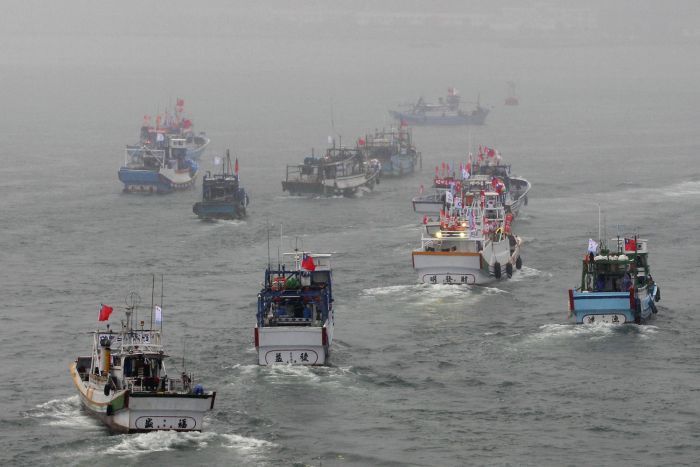
Six Chinese surveillance ships have entered waters near islands claimed by both Japan and China.
China said the ships were carrying out “law enforcement” to demonstrate its jurisdiction over the islands, known as Diaoyu in China and Senkaku in Japan.
At least two of the vessels left after the Japanese coast guard issued a warning, Japanese officials say.
The move came after Japan sealed a deal to buy three of the islands from their private Japanese owner.
Japan controls the uninhabited but resource-rich East China Sea islands, which are also claimed by Taiwan.
Six Chinese surveillance ships have entered waters near islands claimed by both Japan and China
The Japanese Coast Guard said the first two Chinese boats entered Japan’s territorial waters at 06:18 local time, followed by another fleet of four other ships just after 07:00.
The first two ships then left the area. A third ship left later on Friday morning, one report said. No force was used, Japanese officials added.
“Our patrol vessels are currently telling them to leave our country’s territorial waters,” the coastguard said in a statement.
The Chinese foreign ministry confirmed that its ships were there.
“These law enforcement and patrol activities are aimed to demonstrate China’s jurisdiction over the Diaoyu Islands and its affiliated islets and ensure the country’s maritime interests,” a statement said.
The US has called for ”cooler heads to prevail” as tension intensifies between China and Japan over the islands, which lie south of Okinawa and north of Taiwan.
US Defense Secretary Leon Panetta is due to visit both Japan and China from this weekend as part of a tour of the region that also includes New Zealand.
The dispute has seriously marred diplomatic relations between China and Japan and threatens to damage the strong trading relationship.
The row has also generated strong nationalist sentiment on both sides that observers say now makes it very difficult to be seen to be backing down.
The Japanese government says it is buying the islands to promote their stable and peaceful management.
Its move followed a bid by right-wing Tokyo Governor Shintaro Ishihara to buy the islands using public donations – an action that would likely have further provoked China.
China, on the other hand, says the islands have historically been its territory and fishing grounds.
Meanwhile Japan’s newly-appointed ambassador to China, Shinichi Nishimiya, remains in hospital in Tokyo after he was found unconscious near his home in Tokyo on Thursday.
No details have been given on his condition. He was appointed on Tuesday to replace Uichiro Niwa, who has been criticized for his handling of one of the worse diplomatic rows between Japan and China in recent years.
Japan-China disputed islands:
• The archipelago consists of five islands and three reefs
• Japan, China and Taiwan claim them; they are controlled by Japan and form part of Okinawa prefecture
• The Japanese government signed a deal in September 2012 to purchase three islands from Japanese businessman Kunioki Kurihara, who used to rent them out to the Japanese state
• The islands were the focus of a major diplomatic row between Japan and China in 2010
Barack Obama has said the United States does not currently consider Egypt to be an ally.
The president was speaking with reference to violent clashes at the US embassy in Cairo, over a US-made anti-Islamic film which has sparked anger among Muslims.
Barack Obama’s comments also came after the storming of the US consulate in Benghazi, Libya, which killed the US ambassador on Tuesday.
President Barack Obama referred to US-Egypt relations as a “work in progress”.
Barack Obama has said the United States does not currently consider Egypt to be an ally
“I don’t think we would consider them an ally, but we don’t consider them an enemy. They are a new government that is trying to find its way,” Barack Obama said in a television interview with Spanish-language network Telemundo.
He said that so far Egypt’s government has “said the right thing and taken the right steps” but it has also responded to other events in ways that “may not be aligned with our interests”.
Barack Obama also said that he expected Egypt to protect the US embassy and its staff.
“If they take actions that indicate they are not taking those responsibilities, as all other countries do where we have embassies, I think that’s going to be a problem,” he said.
Egypt was a close and vital Middle East ally of the United States while ousted President Hosni Mubarak was in power.
Cairo has been key US ally since 1979 Egypt-Israel peace deal, and the US gives more than $1 billion in military aid to Egypt every year.
After last year’s uprising and the resurgence of the once-banned Muslim Brotherhood, question marks have been raised over the future of the relationship.
Angry anti-US protests have taken place across the Middle East and North Africa.
The grounds of the US embassy in the Yemeni capital Sanaa were briefly stormed by protesters on Thursday.
On Wednesday, demonstrators in Cairo angry at the film – Innocence of Muslims – breached the walls of the US embassy and tore down the flag. The clashes, which began on Tuesday, continued in the early hours of Thursday morning.
Egypt’s interior ministry says 16 people were injured overnight – 13 of them members of the security forces. Two police vehicles were burnt out and 12 protesters were arrested.
President Mohamed Mursi has appealed for calm: “I call on everyone to take that into consideration, to not violate Egyptian law… to not assault embassies.”
“I condemn and oppose all who… insult our prophet. [But] it is our duty to protect our guests and visitors from abroad,” he said in a statement broadcast by state media.
In July US Secretary of State Hillary Clinton met Mohamed Mursi for the first time and reaffirmed Washington’s “strong support” for the Egyptian people and their shift to civilian rule.
An outbreak of the Ebola virus in the Democratic Republic of Congo has now killed 31 people and could threaten major towns, the World Health Organization has warned.
An epidemic was officially declared on 17 August in the northwestern Orientale Province.
WHO official Eugene Kabambi told Reuters that the situation was “very serious” and was “not under control”.
An outbreak of the Ebola virus in the Democratic Republic of Congo has now killed 31 people and could threaten major towns
Ebola is highly contagious and kills up to 90% of people infected.
There is no known treatment or vaccine for the disease, which is spread by close personal contact and causes massive internal bleeding.
The death toll from this latest outbreak, centred on the towns of Isoro and Viadana, has more than doubled over the course of a week to 31.
Up to five health workers are thought to be among the dead.
“The epidemic is not under control. On the contrary the situation is very, very serious,” Eugene Kabambi warned, speaking in DR Congo’s capital Kinshasa.
“If nothing is done now, the disease will reach other places, and even major towns will be threatened,” he said.
Last month an outbreak of a more deadly Ebola strain in neighboring Uganda killed 16 people, but health workers say the two outbreaks do not appear to be related.
Former White House intern Monica Lewinsky has reportedly been meeting with a number of major publishers – who were all asked to sign nondisclosure agreements before seeing her.
An insider familiar with the project said: “I’m sure every major publisher was interested in hearing what she had to say.”
It is unclear who the frontrunners are, according to the New York Post.
Monica Lewinsky moved to England in 2005 where she earned her master’s degree in social psychology.
She then worked as a news correspondent for the UK’s Channel Five News.
Monica Lewinsky may be poised to write a tell-all book
Monica Lewinsky, 39, has given a number of interviews since the 1998 Bill Clinton scandal erupted but has generally kept under the radar.
Her friends have previously said she is not interested in capitalizing off the scandal, though if these rumors are true, this appears to have changed.
Monica Lewinsky has her own business designing purses, The Real Monica Inc.
Her rep said yesterday: “I cannot comment on anything at this point.”
Though it has been 14 years since it emerged that Bill Clinton had nine separate sexual encounters with his intern at the time, her presence still looms in the life of Clinton post-presidency and in that of his wife Hillary.
In what was an unfortunate and awkward schedule at the DNC in Charlotte last week, Monica Lewinsky’s former rabbi – who publicly condemned Bill Clinton during the sex scandal – gave the benediction minutes after the former President took the stage.
ABC News reported that the awkward pairing was likely overlooked by organizers because Rabbi David Wolpe is such a well-known figure in the Jewish community.
In July during a visit to Egypt as U.S. Secretary of State, Hillary Clinton was taunted by her husband’s affair by protesters as they chanted “Monica, Monica”.
Hillary Clinton was subjected to them whilst visiting the Egyptian port city of Alexandria to reopen the US Consulate.
Dustin Hoffman, rock band Led Zeppelin and talk show host David Letterman are to be honored by Washington’s Kennedy Center.
The performance hall will give all three surviving Led Zeppelin members – John Paul Jones, Jimmy Page and Robert Plant – individual awards.
Blues musician Buddy Guy and Russian ballerina Natalia Makarova will also be recognized at the gala in December.
President Barack Obama will also host a White House reception for them.
“With their extraordinary talent, creativity and tenacity, the seven 2012 Kennedy Center honorees have contributed significantly to the cultural life of our nation and the world,” said chairman David Rubenstein.
The award is the highest honor awarded to those that have influenced American culture through the arts, with Meryl Streep, Barbra Streisand and Oprah Winfrey among past recipients.
Dustin Hoffman, Led Zeppelin and David Letterman are to be honored by Kennedy Center
Led Zeppelin will be celebrated for transforming the sound of rock and roll and influencing other artists with blues-infused hits such as Stairway to Heaven.
The band issued a joint statement saying America was the first place to embrace their music.
“We owe a large debt to the vitality and variety of the music of the American people,” they added.
David Rubenstein called two-time Oscar-winner Dustin Hoffman, 75, “one of the most versatile and iconoclastic actors” of any generation.
The star of such films such as Rain Man, The Graduate and Tootsie recently made his directing debut with Quartet, to be screened at the London Film Festival next month.
Dustin Hoffman said he may have found a new calling with the film, which stars Dame Maggie Smith as one of a group of ageing opera singers and musicians reunited at a retirement home.
He also revealed he was last in Washington for Barack Obama’s inauguration in 2009, when it was very cold.
“Since I froze my [behind] off watching him be inaugurated, the least he could do is to shake my hand under the circumstances,” joked Dustin Hoffman.
Late night talk show host Letterman will be recognized as “one of the most influential personalities” on US TV.
The 65-year-old said it was a wonderful honor for his family, his co-workers and himself.
“I believe recognition at this prestigious level confirms my belief that there has been a mix-up,” he said in a statement.
“I am still grateful to be included.”
Chicago musician Buddy Guy, 76, has influenced many musicians over the past 50 years after pioneering the use of distortion and feedback with his electric guitar.
The “titan of the blues” said he did not know what he was doing at the time, but just wanted to turn up the sound so somebody could hear him when he was playing with the likes of BB King and Muddy Waters.
He said he was still pinching himself about his latest accolade.
“I’m hoping this will give the blues a lift,” he added.
Buddy Guy has already visited the White House this year, when he managed to persuade Barack
Protests against anti-Islam film Innocence of Muslims made in the US are spreading across the Middle East and North Africa.
In Yemen, demonstrators briefly stormed the grounds of the US embassy in Sanaa and burnt the US flag, but were driven back by security forces.
In Egypt, 224 people were injured in protests, the health ministry said. Protests were also reported in Morocco, Sudan and Tunisia.
On Tuesday, US Ambassador to Libya, Christopher Stevens, was killed in Benghazi.
US officials say they are investigating whether the attack in Libya was planned, citing suspicions that a militant jihadist group may have co-ordinated the violence.
In Yemen, demonstrators briefly stormed the grounds of the US embassy in Sanaa and burnt the US flag
Libya’s new Prime Minister Mustafa Abu Shagur told the AFP news agency there had been a “big advance” in the investigation in Benghazi.
“Arrests have been made and more are under way as we speak,” he said but gave no details.
US Secretary of State Hillary Clinton condemned the film which gave rise to the protests as “disgusting” and “reprehensible”.
The US utterly rejected its contents and its message, she said, but the film was no excuse for violence.
Police in Sanaa shot in the air, but failed to prevent crowds from gaining access to the embassy compound and setting fire to vehicles.
Security force reinforcements used tear gas, water cannon and live fire to drive protesters back.
There were reports of injuries on both sides, although the Reuters news agency carried a statement from the embassy saying there were none.
Windows were smashed. A US flag was torn down and replaced with a black flag bearing the Muslim statement of faith, “There is no God but Allah”.

It was not immediately clear whether the embassy was occupied. There are reports that embassy staff has been moved to a safer location.

In Egypt, protests erupted for a third day outside the US embassy in Cairo, with some demonstrators demanding the expulsion of the ambassador.
Police fired tear gas at crowds throwing stones.
Islamist groups and others have called for a “million-man march” in Cairo on Friday.
The Muslim Brotherhood, the Salafist al-Nour party and non-religious groups including the “Ultra” fans of Zamalek football club have invited Muslims, Coptic Christians and all Egyptian citizens to join them.
Egypt’s President Mohammed Mursi appealed for calm, saying Egyptians “reject any kind of assault or insult” against the Prophet Muhammad.
“I condemn and oppose all who… insult our prophet. [But] it is our duty to protect our guests and visitors from abroad,” he said in a statement broadcast by state media.
“I call on everyone to take that into consideration, to not violate Egyptian law… to not assault embassies.”
US officials have described the Benghazi attack as complex and professional, and suggested the attackers may have used the film protest as a pretext for the attack.
Reuters quoted officials as saying there were suspicions that a militia known as the Ansar al-Sharia brigade was responsible, although the group has denied the claim.
The officials said there were also reports that al-Qaeda’s North Africa-based affiliate, al-Qaeda in the Islamic Maghreb, may have been involved, the news agency reports.
The obscure film which has sparked anger was shot in the US and posted online earlier this year. Clips have since been shown on Arab TV stations.
It depicts the Prophet Muhammad as a womanizer and the bloodthirsty leader of a ragtag group of men who enjoy killing.
The exact origin of the movie and the internet clip, and the motivation behind its production, remains a mystery.
The most offensive comments regarding Muhammad appear to have been dubbed on later, says our correspondent.
Some of the actors involved have since condemned the film, and said they had no idea it was to be used as anti-Islam propaganda.
In other developments:
• Libya’s PM Mustafa Abu Shagur says there is “no justification” for the Benghazi attack and investigations are under way to find the “criminals” responsible
• Russia says it fears “chaos” in the Middle East and Saudi Arabia condemns both the film and the violence
• Iranians chanting anti-US and anti-Israel slogans stage a protest outside the Swiss embassy in the Iranian capital, Tehran, which represents US interests
• Afghan President Hamid Karzai has postponed a planned visit to Norway, fearing violence could erupt in his country
• There were small protests in Bangladesh and Iraq, in addition to Morocco, Sudan and Tunisia
• Security has been increased at US embassies and consulates around the world; US officials say a marine anti-terrorism team is being deployed to Libya and two destroyers to the Libyan coast as a precautionary measure
The US central bank has announced it will resume its policy of pumping more money into the economy via so-called quantitative easing.
The Federal Reserve said it will buy “additional agency mortgage-backed securities at a pace of $40 billion per month”.
The central bank also said it could increase the size of its purchases if the economy does not improve.
The economy is a pivotal issue in this year’s US presidential election.
The US central bank has announced it will resume its policy of pumping more money into the economy via so-called quantitative easing
Interest rates in the US have been close to zero for several years now, and the Fed again kept them at below 0.25%.
“The committee is concerned that, without further policy accommodation, economic growth might not be strong enough to generate sustained improvement in labor market conditions,” said the Fed, led by chairman Ben Bernanke.
US stocks, which had been little changed, gained after the announcement. The benchmark Dow Jones average was 0.7% higher.
The US central bank has tried to support the economy by quantitative easing – buying $2.3 trillion in bonds in two rounds.
The Fed calls such measures “asset purchases”, where the central bank buys bonds to keep the long-term cost of borrowing down. The last round of asset purchases ended last year.
Mortgage-backed securities are debt backed by loans made to homeowners.
The unemployment rate in the US has been above 8% since January 2009, but the current 8.1% is down from the recent high of 10% in October 2009.
“To support continued progress toward maximum employment and price stability, the committee expects that a highly accommodative stance of monetary policy will remain appropriate for a considerable time after the economic recovery strengthens,” the Fed said.
The Fed also confirmed that its $267 billion programme to reduce long-term borrowing costs for firms and households would continue for the rest of the year.
In a move dubbed “Operation Twist”, the central bank buys longer-term bonds from retail lenders and swaps them for shorter-term bonds.
Adriana Lima has said she is “overjoyed” after giving birth to a baby girl today.
The 31-year-old Victoria’s Secret model and her husband Marko Jaric welcomed 7 lbs Sienna in New York at 1:00 p.m.
The baby is a second child for the couple, joining three-year-old Valentina.
Brazilian Adriana Lima tweeted: “Marko and I are overjoyed to welcome Sienna into our family, and Valentina is looking forward to becoming a big sister.”
Adriana Lima has said she is “overjoyed” after giving birth to a baby girl today
The model and former American basketball star Marko Jaric met in 2006 and wed in February 2009, with their first daughter born later that year.
That pregnancy saw the model develop preeclampsia and give birth prematurely, but she has had a less stressful experience second time round.
Adriana Lima has proclaimed motherhood to be the “best job in the world”.
“The best job in the world for me is being a mom,” she said.
“I never thought I could love so much. I always thought, does unconditional love exist? Now I know it does because I feel it.”
Adriana Lima – who is a devout Roman Catholic – admitted she knew she wanted to settle down with Marko Jaric and have children when they first met.
She said: “I knew he was the one and I could see myself married to him and with a big family.”
But as well as bonding with her daughter, Adriana Lima will soon be back on the catwalk if she is anything like her fellow angels Alessandra Ambrosio and Miranda Kerr.
A court in Zimbabwe has thrown out a bid by Locadia Tembo to block Prime Minister Morgan Tsvangirai’s wedding on Saturday to his fiancée, Elizabeth Macheka.
Locadia Tembo had argued that the wedding could not take place because she was Morgan Tsvangirai’s wife under customary law.
But High Court Judge Antonia Guvava ruled such marriages were not valid.
President Robert Mugabe, who is in a fractious coalition with Morgan Tsvangirai, is due to attend the wedding.
The wedding is expected to take place in an upmarket area north of the capital, Harare.
Robert Mugabe is billed to host a post-wedding banquet for other heads of state who will be there, he says.
Locadia Tembo had argued that Morgan Tsvangirai’s wedding could not take place because she was his wife under customary law
Morgan Tsvangirai, 59, and Robert Mugabe – the leaders of the Movement for Democratic Change (MDC) and Zanu-PF respectively – are expected to run against each other in presidential elections, due next year.
The case brought by Locadia Tembo, a 39-year-old commodity trader and sister of an MP from Zanu-PF, was heard in chambers in the High Court in Harare.
The judge ruled that marriages under customary law were not valid, expect for certain purposes such as the distribution of matrimonial property.
He also said the case should have been dealt with by a marriage officer at a magistrate’s court.
Locadia Tembo’s lawyer, Everson Samkange, said he would now lodge a further objection to the marriage with the magistrate’s court, which could lead to a commission of inquiry if the case goes ahead.
But Morgan Tsvangirai’s lawyer, Innocent Chagonda, said he welcomed the fact that “legal impediments” had been removed ahead of the wedding.
“There was no basis upon which [Locadia Tembo] could have interdicted the prime minister from getting married,” he said.
“An unregistered customary law marriage is not a valid marriage at all. It is valid for only certain purposes which have nothing to do with what we have been talking about.”
Locadia Tembo, a businesswoman, has been demanding $15,000 a month in maintenance expenses from the prime minister.
Morgan Tsvangirai’s 35-year-old bride is the daughter of Zanu-PF loyalist and former Chitungwiza mayor, Joseph Macheka.
In November, reports said that Locadia Tembo and Morgan Tsvangirai held a traditional wedding and Tsvangirai had paid a bride price of several hundred thousand dollars.
Shortly thereafter, Morgan Tsvangirai said their relationship had been “irretrievably damaged” after it was “hijacked” by his opponents, including state security agents.
Morgan Tsvangirai’s first wife, Susan, died in a car crash soon after he became prime minister in 2009.
Nintendo has revealed it will launch two versions of its Wii U console in Japan on December 8th.
The basic edition will cost 26,250 yen ($337) and a premium version 31,500 yen ($405).
Details of the international release will be discussed in New York later.
Nintendo’s stock has fallen 29% since March on fears casual gamers will instead opt for tablet computers while hardcore players will wait for a new PlayStation or Xbox .
Nintendo has revealed it will launch two versions of its Wii U console in Japan on December 8th
The difference between the two versions of the Wii U is that the basic model features 8GB of storage, while the premium version has 32GB and additional stands for the games machine and its touchscreen controller.
Consumers wishing to buy an additional GamePad controller will have to pay 13,000 yen ($167).
The device features a touchscreen offering players to ability to carry out in-game tasks, such as checking their inventory or setting an explosive, while the main action continues on their television. Gamers can also continue to play a title using the device when they do not have access to their main screen.
Nintendo has claimed it would help “revolutionize” gaming.
However, the gadget has been criticized for lacking multitouch – the ability to recognize different fingers on a hand.
It also faces a challenge from both Sony and Microsoft who have introduced similar facilities for their existing consoles: the PlayStation 3 can be controlled by the firm’s Vita handheld, while the Xbox 360 can be connected to existing tablet computers via software called SmartGlass.
Nintendo’s president, Satoru Iwata, highlighted the fact that the Wii U would launch alongside New Super Mario Bros U – the first time a title in the series’ release date had coincided with a new console in 16 years.
Nintendo will host a press event with more details in New York at 10:00 local time.
Lizzie Velasquez has been ridiculed, stared at in the street and called “the world’s ugliest woman” by insensitive cyber bullies.
But, after years of misery and self doubt, Lizzie Velasquez says she can finally shrug off the hurtful comments about her looks as “just words”.
Lizzie Velasquez, from Austin, Texas, was born without adipose tissue – meaning she has no body fat and, despite eating up to 60 small meals a day, remains at a delicate 58 lbs.
The rare condition still baffles doctors and is thought to affect just two other people worldwide.
Lizzie Velazquez has now written a second book about her struggle to be accepted and hopes it will help others in a similar position.
In Be Beautiful, Be You, the 23-year-old college senior shares advice on being unique, how to make and keep good friends and how to deal with bullying and negativity.
Speaking to Dr. Drew Pinsky on Tuesday night about her experiences, Lizzie Velasquez said when cyber bullies first started attacking her online it was hard.
She told Dr. Drew: “I’m human… of course these things are going to hurt… (but) I’m not going to let those things define me.”
Lizzie Velasquez was born without adipose tissue, meaning she has no body fat and, despite eating up to 60 small meals a day, remains at a delicate 58 lbs
Eventually Lizzie Velasquez realized the people issuing the hurtful comments online were just cowards hiding behind a computer screen.
“At the end of the day, these are just words,” she told Dr. Drew.
“If they are so proud, then they should show their face.”
When asked how she deals with being constantly stared at in the street, Lizzie Velasquez said: “I’m starting to want to go up to these people and introduce myself or give them my card and say, <<Hi, I’m Lizzie – maybe you should stop staring and start learning>>.”
Lizzie Velasquez also revealed she does not have any desire to look like a beautiful celebrity.
She said: “I feel I’m really glad I don’t look like the celebrities out there who are beautiful, because there are a lot of stereotypes attached to that.
“People think <<she’s so pretty, she must be really dumb>>. Since I don’t look like that it’s better because people can get to know the real me.”
Lizzie Velasquez was born four weeks prematurely weighing just 2 lb 10 oz. Doctors found there was minimal amniotic fluid protecting her in the womb.
“They told us they had no idea how she could have survived,” her mother Rita Velasquez, 45, a church secretary, said.
“We had to buy dolls’ clothes from the toy store because baby clothes were too big.”
Doctors could not make a diagnosis so they prepared Lizzie Velasquez’s parents for the worst.
“They told us she would never be able to walk, talk or have a normal life,” said her mother, who has two other children with Lizzie’s father Lupe – both children are of average height and weight.
Despite the grim prognosis Lizzie Velasquez’s brain, bones and internal organs developed normally but she was always very small.
At the age of two she was still only 15 lbs – the same as the average five-month-old baby.
Born with two brown eyes, when Lizzie Velasquez was four the right began to cloud and change hue. Doctors then discovered she had gone blind in that eye.
“They still don’t know why it happened but now I have one blue and one brown eye.”
Lizzie Velasquez’s case has fascinated doctors all over the world and she is part of a genetic study run by Professor Abhimanyu Garg at the University of Texas Southwestern Medical Center in Dallas.
Prof. Abhimanyu Garg and his team now believe Lizzie Velasquez may have a form of Neonatal Progeroid Syndrome (NPS), which causes accelerated ageing, fat loss from the face and body, and tissue degeneration. People with PRS often have triangular and prematurely aged faces with a pointy nose.
He said: “I am aware of a small number of people that have similar conditions to Lizzie but each case is slightly different.
“We cannot predict what will happen to Lizzie in the future, as the medical community are yet to document older people with NPS.
“However Lizzie is lucky to have healthy teeth, organs and bones so the outlook is good. We will continue to study her case and learn from her.”
Lizzie Velasquez doesn’t take medication but she relies on vitamin supplements and iron to stay healthy. It is thought she should be able to conceive naturally without passing the condition to her children.
In this week’s installment of reality TV show Here Comes Honey Boo Boo, seven-year-old Alana Thompson, nicknamed Honey Boo Boo, tries her hand at making lemonade.
As a little girl of many talents, Honey Boo Boo is keen to show off her culinary skills in the kitchen and suggests whipping up the concoction to help contribute towards her pageant piggy bank.
Honey Boo Boo’s mother June Shannon explains that beauty pageants can cost thousands of dollars, from the glitzy dresses to the fake hair and teeth, and explains to her daughter that they can’t really afford such luxuries.
Famous for her bargain hunting ways, June Shannon explains to her daughter how much the family have to budget.
“We’re always trying to save money,” she says.
Honey Boo Boo makes lemonade to sell it and raise money for her bedazzled dresses and accessories
Ever the entrepreneur, Alana Thompson decides that her lemonade making will help pay for her bedazzled dresses and accessories.
“Honey Boo Boo had the idea of making a lemonade stand to save money for the pageants.
“Pageants a big investment. I raise four kids and I’m able to do pageants as I budget. Honestly, we budget and I try to save money any way I can,” said June Shannon.
Honey Boo Boo and her sisters build a stand and sell off the sugary sweet drink to bypassers.
Known for her love of sugary drinks, June Shannon was seen on Toddlers & Tiaras feeding Alana “Go Go Juice”, a mixture of Mountain Dew and Red Bull.
And this week’s episode is no different as June Shannon shares her secret sugary lemonade concoction recipe.
“The secret is a lot of sugar and a lot of lemon juice. The lemonade has got a good five pounds of sugar and like 2 gallons of lemon juice,” she said.
The network offered the family a spin-off series, Here Comes Honey Boo Boo, an inside look into little Alana Thompson’s world.
Since premiering on August 8, the show has attracted millions of viewers and its August 29 installment attracted nearly 3 million viewers, eclipsing every network’s coverage of the Republican National Convention and Paul Ryan’s speech.
Each episode follows Alana Thompson and her unapologetically outrageous family.
Supermodel David Gandy is the new face of Marks and Spencer’s Collezione menswear range.
Posing in Lake Como, Italy, David Gandy looks every inch the Italian stallion in fluffy knits and sharp jackets from the Italian influenced autumn/winter collection.
Shot by renowned fashion photographer Arnaldo Anaya-Lucca, the images capture the understated and continental mood of the range in a series of filmic images.
Supermodel David Gandy is the new face of Marks and Spencer's Collezione menswear range
In one shot David Gandy is posing on a balcony and in another on the back of a speed boat.
The wrapped up look is a far cry from the snaps that made him famous when he bared all as the face of Dolce and Gabbana “Light and Blue” perfume in a tiny pair of white swimming trunks.
David Gandy is no stranger to posing for the high-street giant and he stunned in the shots for the spring/summer collection which was shot in Sicily.
He is currently dating model Sarah Ann Macklin who was revealed last week as the new face of fashion brand Missguided.co.uk.
The 5.9″ brunette was already a successful model with London agency Select when she bagged supermodel David Gandy, and the beautiful couple have been causing a stir on the social scene since confirming they were an item back in May.
Yemeni protesters angered by an anti-Islam film made in the US have stormed the grounds of the US embassy in the country’s capital Sanaa.
Police shot in the air in an attempt to hold back the crowds, but failed to prevent them gaining access to the compound and setting fire to vehicles.
A number of people were reported to have been injured.
On Tuesday, the US ambassador to Libya was killed in a fire started after the US consulate in Benghazi was stormed.
Security force reinforcements in Sanaa used tear gas, water cannon and live fire to drive back protesters.
They have now regained control of the Sanaa compound, but protests are continuing outside.
US embassy in Yemen’s capital Sanaa has been stormed by protesters angered by anti-Islam film
Earlier on Thursday, US officials said they were investigating whether the attack in Libya was planned, citing suspicions that a militant jihadist group may have co-ordinated the violence.
Three other US consul staff and several Libyans died in that attack, along with Ambassador Christopher Stevens, who is believed to have died from smoke inhalation.
There have also been clashes in the Egyptian capital, Cairo.
On Wednesday, demonstrators in Cairo angry at the film – Innocence of Muslims – breached the walls of the US embassy and tore down the flag. Clashes continued in the early hours of Thursday morning.
President Mohammed Mursi has appealed for calm, saying Egyptians “reject any kind of assault or insult” against the Prophet Muhammad.
“I condemn and oppose all who… insult our prophet. [But] it is our duty to protect our guests and visitors from abroad,” he said in a statement broadcast by state media.
“I call on everyone to take that into consideration, to not violate Egyptian law… to not assault embassies.”
Security has been increased at US embassies and consulates around the world in response to the rising tensions.
US President Barack Obama has vowed to work with the Libyan authorities to bring those behind the Benghazi attack to justice.