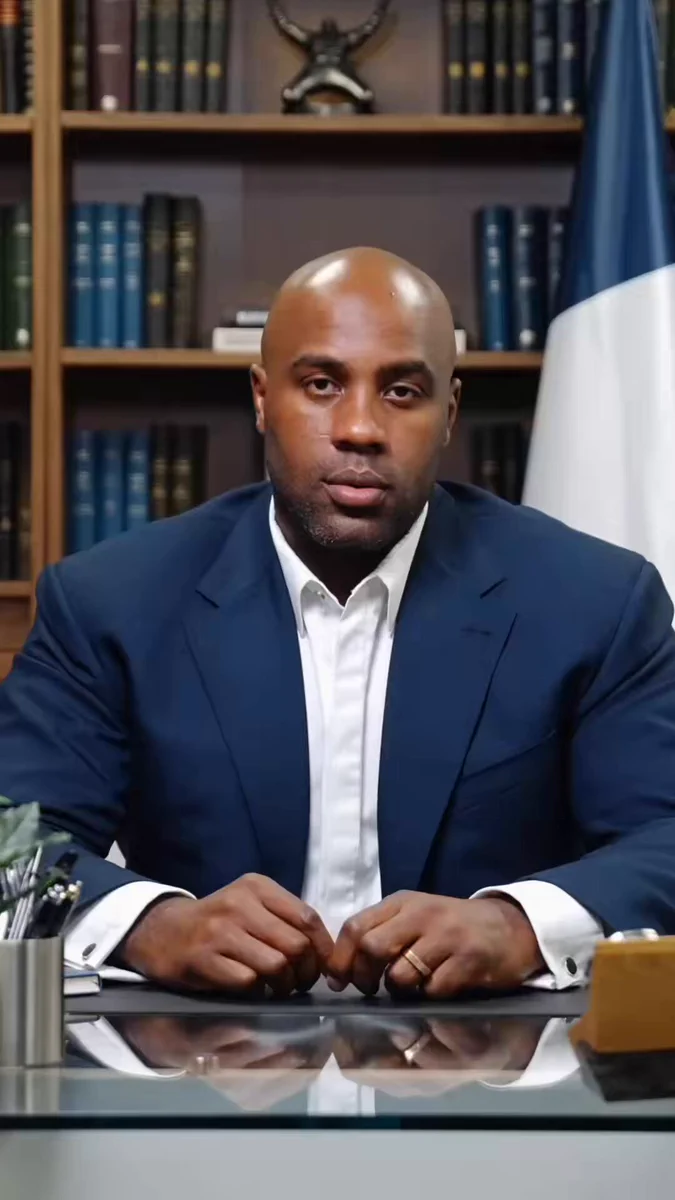
PARIS — For nearly two decades, Teddy Riner built an unmatched sporting legacy by throwing the world’s heaviest men onto the judo mat. Now, the 37-year-old five-time Olympic gold medalist is attempting an infinitely riskier takedown: upending the fractured landscape of French politics.
In a surprise announcement delivered via social media on November 9, the towering, 6-foot-8 national icon—affectionately known across France as le grand Teddy—declared his candidacy for the 2027 presidential election. Seated calmly before a bookshelf and a French tricolore flag, Riner dismissed the notion that his campaign was an artificial intelligence hoax, insisting that watching his country slide into deep division from the sidelines was no longer an option.
Within 48 hours, his broadcast amassed tens of millions of views across social media platforms, dwarfing the online reach of seasoned political heavyweights and injecting sudden, unpredictable energy into a race scheduled for its first round on April 18, 2027.
Filling a Vacuum at the Political Center
Riner’s entry comes at a moment of acute crisis for France’s political establishment. Following weeks of violent nationwide protests over wages and the cost of living, public polling has increasingly pointed toward a polarized second-round runoff in May between far-right leader Marine Le Pen and hard-left firebrand Jean-Luc Mélenchon.
With traditional centrist contenders—including former prime ministers Édouard Philippe and Gabriel Attal—struggling to gain traction, an “orphan electorate” of moderate voters has been desperately searching for an alternative. Riner has stepped directly into that void, pitching himself in distinctly non-partisan terms as “neither right nor left”.
- The Outsider Pitch: Riner has attacked the political class for endless squabbling, arguing that France needs “common sense, firmness, justice, and a government that sets things right” rather than professional politicians reciting talking points.
- A Blended Platform: While he has yet to release a formal manifesto, Riner’s early rhetoric blends conservative calls for law and order and economic relief—vowing to tackle “yobs who scare people off our streets” and put money back in people’s pockets—with fierce opposition to racism and far-right extremism.
- Early Polling Surge: According to an Ifop survey published within 24 hours of his announcement, 70% of French respondents hold a favorable view of the Guadeloupe-born athlete, and 22% stated they would consider voting for him—a figure large enough to theoretically threaten Mélenchon’s youth base and contest a spot in the runoff.
Rejecting the ‘Poisoned Chalice’
The political establishment has reacted to “Teddymania” with a mixture of caution and quiet panic. Because Riner regularly tops national surveys as the living embodiment of French values, rival politicians recognize that mocking his ambitions risks an immediate voter backlash.
Notably, outgoing President Emmanuel Macron—who is constitutionally barred from seeking a third consecutive term—welcomed Riner’s bid, remarking on television that the champion’s ideas and talent “can only benefit the country”. However, recognizing the toxic unpopularity of the current administration amid ongoing street unrest, Riner swiftly moved to distance himself from the Élysée Palace, reportedly dismissing Macron’s warm words as a “poisoned chalice”.
The 500-Signature Gauntlet
Despite his immense celebrity, business ventures, and commanding physical presence—displayed on Friday during his first official campaign stop at a hospital in the northern Paris suburb of Seine-Saint-Denis—Riner faces a steep institutional climb.
Unlike the United States, where figures from Ronald Reagan to Donald Trump transitioned smoothly from entertainment to the presidency, modern France has never elected a celebrity outsider to its highest office. To even appear on the April ballot, Riner—who possesses no political party and only a small campaign team—must secure formal sponsorships from at least 500 elected officials, such as mayors and parliamentarians, by March.
That strict constitutional filter has historically crushed outsider bids, most famously derailing the 1981 presidential campaign of beloved comedian Coluche. Whether le grand Teddy can translate overwhelming public affection into the hard political machinery required to clear that hurdle—and simultaneously maintain his stated goal of competing at the 2028 Los Angeles Olympics—remains the defining question of a suddenly wide-open French election.