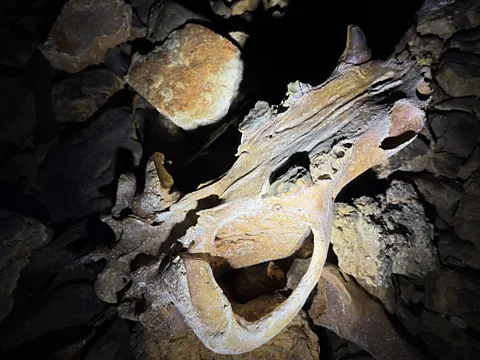
SOUTH TYROL, Italy — Nearly 10,000 feet up a sheer, windswept rock face in northern Italy’s Dolomites, veteran mountain guide Kurt Walde found himself at the literal end of his rope. Feeling unwell and carrying a heavy 50-pound pack, the 41-year veteran of the peaks had spent three and a half years obsessing over a tiny black shadow he had spotted on a near-vertical cliff inside the Fanes-Senes-Braies Natural Park.
Unclipping from his line to free-climb the final treacherous meters, Walde pulled himself over the lip of the rock—and shone his headlamp into a prehistoric time capsule untouched for tens of thousands of years. Scattered across the cavern floor in eerie, undisturbed silence were hundreds and hundreds of massive skulls and skeletons.
The accidental discovery, made in July and formally revealed by researchers and officials in South Tyrol this week, represents one of the most significant paleontological finds in the Alps in nearly four decades.
A Lost Sanctuary of Gentle Giants
Scientists believe the vast subterranean graveyard belongs to Ursus ladinicus—a towering, specialized species of Ice Age cave bear that vanished roughly 24,000 years ago. Until now, the only confirmed remains of this elusive species had ever been found across the mountain at the neighboring Conturines Cave, discovered in 1987.
Preliminary assessments indicate that Walde’s hidden cavern holds substantially more skeletal remains than its famous sister site. Despite their intimidating proportions, these Pleistocene giants were vastly different from modern predators:
- Massive Scale: Fully grown males stretched up to 10 feet long and weighed roughly 2,650 pounds—dwarfing modern grizzly bears.
- Strict Herbivores: Analysis of their broad, flat molars reveals they were exclusively plant-eaters, surviving on Alpine herbs, leaves, and tough mountain grasses.
- High-Altitude Hibernation: The presence of such vast numbers of skeletons at nearly 3,000 meters suggests generations of bears used the lofty caverns as winter hibernation dens, where some inevitably perished during harsh Ice Age winters.
Locking Down a Climate Time Capsule
Beyond the sheer volume of bones—some still articulated in complete skeletons, others resting atop large boulders—the cave offers an invaluable window into ancient Earth’s climate. Previous studies at the neighboring Conturines site showed that mineral deposits inside these caves span millions of years, proving that during warmer interglacial periods roughly 50,000 years ago, the Dolomites were significantly warmer than today, allowing beech forests to flourish at much higher elevations.
Recognizing the immense scientific value of the site—and the immediate threat of souvenir hunters and black-market fossil looters—Christian Terzer, director of the provincial Office of Archaeology in Bolzano, moved rapidly to secure the mountain.
Facing daunting vertical logistics at nearly 3,000 meters, specialized crews hung dustproof tarps to protect the fragile interior before bolting a heavy, custom-built steel grating and electronic monitoring system directly into the cliff face.
Unlocking Prehistoric Secrets
With the vault officially sealed against intruders, paleobiologists and archaeologists are preparing to begin meticulous studies of the remains. By analyzing ancient DNA, bone density, and isotopic signatures trapped within the teeth, researchers hope to map the family trees, social behaviors, and ultimate extinction of Ursus ladinicus.
For Kurt Walde, the discovery is the culmination of a lifetime spent reading the subtle clues of the Dolomites. What began as a faint dark smudge on an inaccessible cliff wall has turned out to be a monumental monument to a vanished world—preserving the silent remains of the giants that once ruled the roof of Ice Age Europe.