
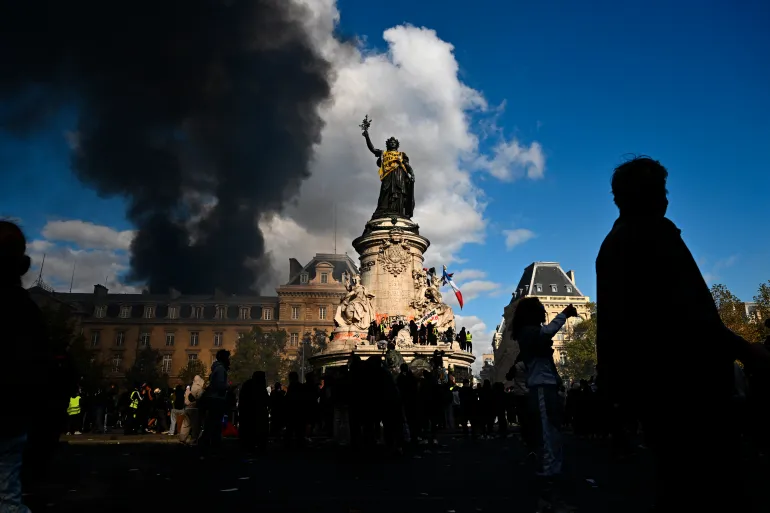
France has woken up to devastated streets and smoldering public buildings after nationwide marches against soaring living costs and underfunded schools degenerated into an explosion of extreme violence.
At least 1,200 people were arrested and more than 150 police officers were injured on Saturday during what the French government described as an unprecedented “escalation in violence”. While an estimated 550,000 citizens took to the streets to protest peacefully, aggressive, masked fringe groups heavily hijacked the demonstrations after dusk, clashing with riot police, looting luxury boutiques, and setting prominent civic institutions ablaze.
Cities Burning from Paris to Limoges
The scale of the destruction has left municipal leaders across the country in shock. In Paris, where more than 100,000 people marched, the city’s deputy mayor, Emmanuel Grégoire, stated that whole streets had been completely devastated as groups of masked men torched parked cars and systematically ransacked local shops. Riot police deployed tear gas and water cannons into the late evening in a desperate bid to disperse the crowds.
The unrest, however, was not confined to the capital. Civic infrastructure across the French heartland became a primary target for arson and vandalism:
- The Limoges Disaster: In central France, a group forced entry into the historic Limoges city hall, setting a massive fire that caused the roof to partly collapse.
- The Marseille Breach: Protesters breached and defaced Marseille’s town hall, covering the civic building in anti-government graffiti.
- The Lyon Inferno: In Lyon, the city’s central tourism office was completely torched.
- Severe Casualties: In the southern city of Saint-Étienne, the human cost turned gruesome when a 17-year-old protester had his right hand blown off after reportedly trying to pick up a police crowd-control grenade.
The Shadow of the Elysee Race
The timing of the riots could not be more politically volatile. The widespread chaos follows weeks of building student protests over deteriorating school infrastructure and arrives just six months before the high-stakes April presidential election to replace President Emmanuel Macron.
French Prime Minister Sébastien Lecornu slammed the “extreme intensity” of the violence, alleging that radical fringe groups were intentionally using the economic misery of citizens as a “warm-up” for the upcoming elections. “No one will impose their political agenda through violence,” Lecornu warned.
The fallout has instantly triggered a bitter war of words among the front-runners vying for the presidency. Right-wing leader Marine Le Pen accused her hard-left rival, Jean-Luc Mélenchon, of fueling the fire, claiming that the “legitimate demands” of everyday citizens over inflation had been held hostage by far-left extremists. Mélenchon, who participated in the day’s marches, fiercely fired back, accusing riot police of “unleashing” on the public while simultaneously condemning the looting and arson.
A Firm Judicial Response
From the Élysée Palace, President Macron issued a blistering condemnation of the rioters, vowing that anyone who targeted public property or businesses would be aggressively prosecuted and punished. The French Justice Ministry followed up by instructing regional prosecutors to deliver an “extremely firm judicial response” to the 1,200 individuals currently in custody.
Despite a late-night calm returning to the major avenues, the political and social fabric of France remains deeply frayed. As municipal workers clear burnt-out cars and boarded-up storefronts, the government faces an agonizing reality: while the police can clear the streets with tear gas, the deep economic fury gripping the French public continues to smolder just beneath the surface.