
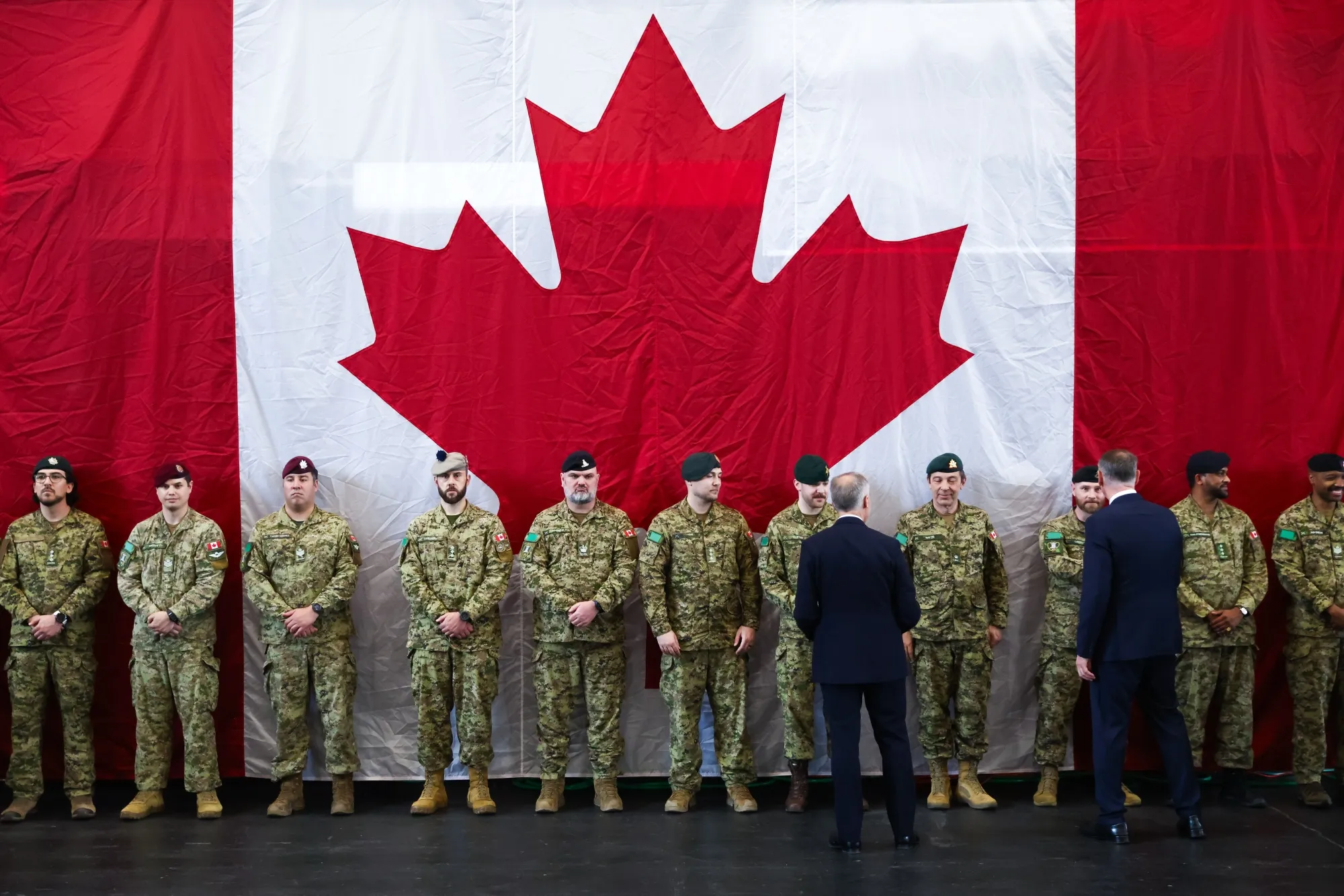
Canadian Prime Minister Mark Carney has confirmed that Ottawa is actively preparing for the extreme tail risk of a United States military invasion. While explicitly acknowledging that a cross-border assault remains highly improbable and a distinct long shot, Carney defended the classified war-gaming as necessary risk management. The stunning disclosure follows a dramatic collapse in bilateral relations under U.S. President Donald Trump, whose escalating trade wars, aggressive rhetoric regarding the annexation of Canadian resources, and viral social media posts depicting the American flag draped over Canada have forced Ottawa to confront the once-unthinkable.
The Asymmetric War Game
Recent modeling conducted by the Department of National Defence paints a sobering picture of Canada’s strategic vulnerabilities. Internal assessments reveal that a conventional military defense against the world’s largest superpower would collapse almost instantly, with American forces projected to overrun Canada’s formal land and sea positions within forty-eight hours.
Faced with an overwhelming disparity in conventional military hardware, Canadian planners have shifted their focus entirely toward unconventional, decentralized resistance.
- The Insurgency Playbook: Rather than attempting a traditional front-line defense along the border, the modeled strategy relies on small, mobile units of irregular military personnel and civilian volunteers.
- Tactical Attrition: The contingency framework mirrors defensive tactics deployed in Ukraine, Iraq, and Afghanistan, emphasizing hit-and-run ambushes, extensive drone warfare, and infrastructure sabotage to bog down an occupying force.
- Allied Lifelines: The defense model assumes Ottawa would leverage its diplomatic ties to secure backing from other nuclear-armed NATO members, such as the United Kingdom and France, to counter Washington’s aggression.
Uncoupling from the American Complex
The geopolitical friction has moved beyond conceptual military modeling and is actively altering Canada’s multi-billion-dollar procurement strategies. Prime Minister Carney indicated that the threat of American unpredictability has accelerated an aggressive push to decouple Canada’s critical technology and defense infrastructure from U.S. suppliers.
Ottawa is currently reviewing its dependence on major American aerospace and telecommunications programs. The Canadian defense department is exploring the partial cancellation of its order for eighty-eight American-made F-35 fighter jets, weighing a pivot toward Swedish-made Gripen fighters to gain leverage in ongoing trade disputes. Simultaneously, Canada is moving to phase out its reliance on Elon Musk’s Starlink network by funding a sovereign communication satellite system to guarantee secure, independent domestic telecommunications.
The Blueprint of Economic Extortion
While defense analysts stress that an actual kinetic invasion remains an extreme outlier, the underlying panic among the Canadian public is real. A Leger poll conducted earlier this year indicated that more than thirty percent of Canadians believe a U.S. invasion is a plausible threat, a sentiment amplified after American forces executed a high-profile operation to capture Nicolás Maduro in Venezuela.
For its part, the White House has alternate methods of enforcement. President Trump has publicly signaled that while a physical deployment of force is highly unlikely, he views aggressive economic coercion as a perfectly valid mechanism to bend Ottawa to his will. The administration has steadily escalated pressure, raising tariffs on Canadian steel and aluminum to fifty percent and explicitly demanding preferential, exclusive access to Canada’s vast critical mineral reserves and energy corridors.
By publicly acknowledging these worst-case defense preparations, Carney is sending a calculated signal to both the domestic electorate and the political establishment in Washington. Canada may be the junior partner in the world’s most lucrative trading relationship, but its leadership is no longer willing to mistake proximity for permanent security.