
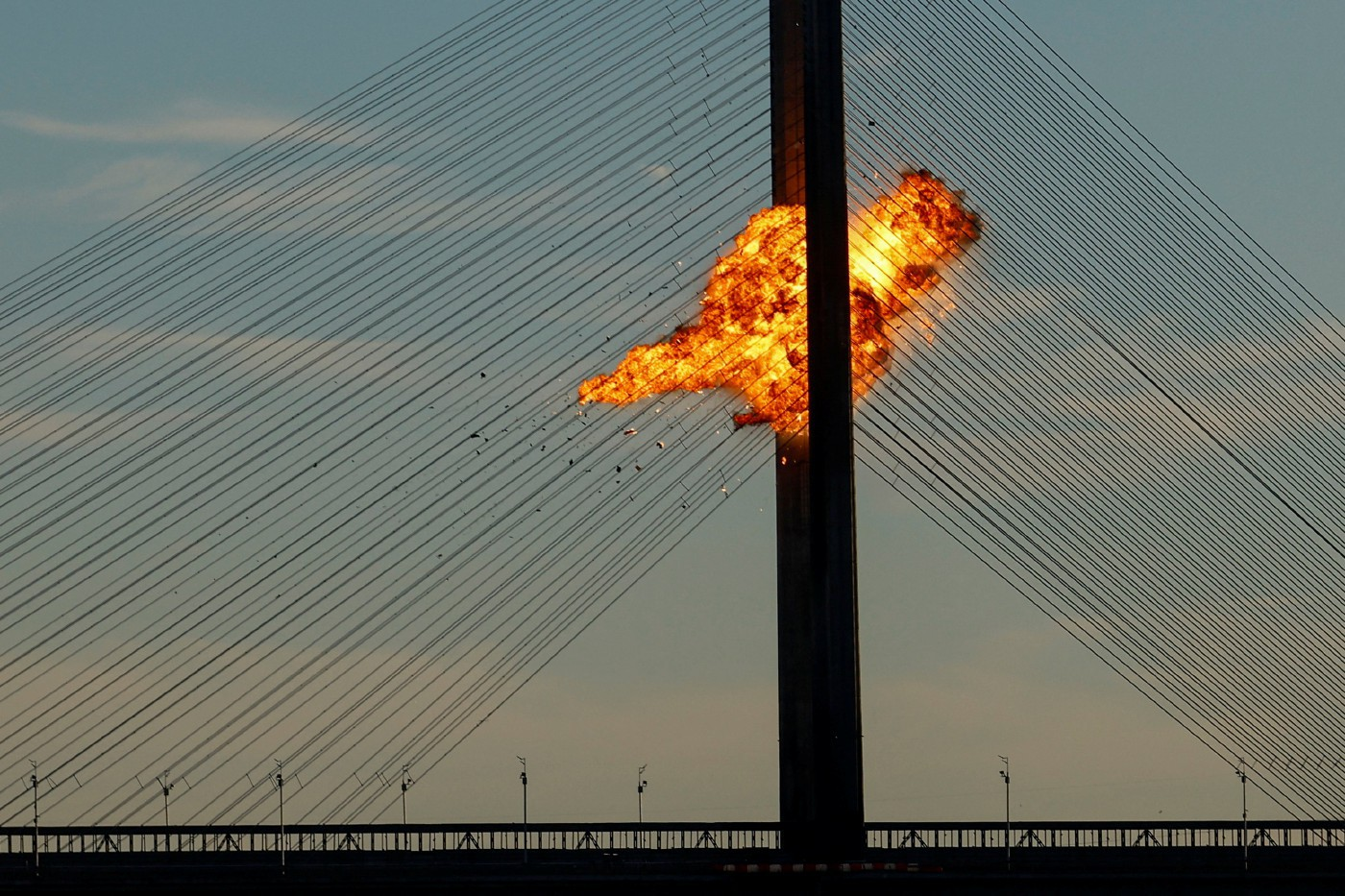
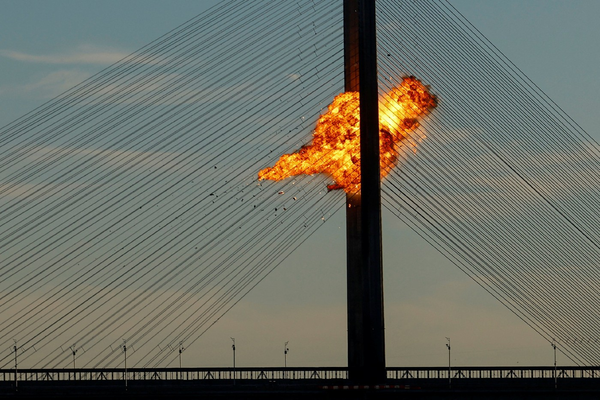
A Russian drone strike blasted Kyiv’s critical Northern Bridge on Sunday morning, timed directly with a high-stakes, unannounced visit by German Chancellor Friedrich Merz to the Ukrainian capital. The aerial assault marked the fourth consecutive day that Moscow has systematically targeted the major bridges over the Dnipro River, aiming to sever the logistical and civilian veins connecting the eastern and western halves of the city.
The strike sent a massive ball of fire and black smoke into the sky just as Merz arrived by train on a mission to pledge major new military and economic support.
A Campaign of Attrition Against the Capital’s Arteries
The Sunday morning attack hit the roadway of the Pivnichnyi (Northern) Bridge, which had already sustained damage from a similar strike the previous day. According to Kyiv Mayor Vitali Klitschko, the blast also ruptured a key heating main, temporarily cutting off hot water to residents in the northeastern Desnyanskyi district.
This systematic targeting of transport infrastructure signals an intensification of Russia’s air campaign as winter approaches.
- The Transport Lockdown: Previous drone waves heavily damaged the Pivdennyi (Southern) Bridge, forcing the suspension of metro and surface transit across the river.
- Advanced Weaponry: President Volodymyr Zelenskyy noted that Russia has unleashed over 1,900 attack drones over the past week alone, with more than 800 consisting of high-speed, jet-powered models designed to slip past air shields.
- Structural Strain: Security experts warn that while the concrete bridges are highly resilient, repeated precision hits are intended to gradually weaken their engineering integrity, rendering them completely unusable for troop and supply transfers.
Merz Defies the Sirens with a Billion-Euro Pledge
The thunder of the explosion did not deter the German delegation, which arrived under intense security protocols. Standing alongside Ukrainian officials, Chancellor Merz framed the defense of Ukraine as a matter of direct European survival. “If Russia is not stopped, its war machine will sooner or later turn against us,” Merz declared upon his arrival.
Accompanied by Economy Minister Katherina Reiche and a circle of defense executives, Merz used the surprise visit to announce a massive reinforcement package:
- Military Aid: A fresh commitment of one billion euros in direct military assistance.
- Air Defense: The fast-tracked delivery of 1,000 advanced interceptor drones specifically engineered to hunt down Russia’s jet-powered models.
- Grid Repair: An additional 350 million euros earmarked to reconstruct Ukraine’s heavily battered energy sector before freezing temperatures set in.
The Winter Ultimatum
The timing of the bombardment served as a stark response from the Kremlin. Just a day prior to Merz’s arrival, Moscow issued formal warnings advising foreign nationals and diplomats to immediately evacuate Kyiv, indicating a coordinated push to isolate the capital.
By launching a high-profile attack on critical infrastructure while a G7 leader was on the ground, Russia has signaled its total disregard for Western diplomatic presence. For Germany and its European allies, the smoky horizon over the Dnipro River underscores a brutal reality: the coming weeks will be decisive, and the boundaries of European security are actively being contested on the bridges of Kyiv.