
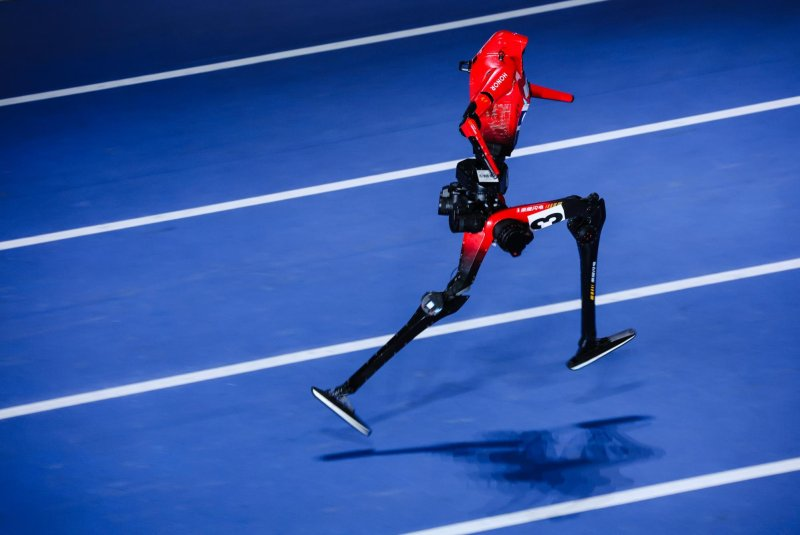
BEIJING — The ultimate boundary of human athletic supremacy has been crossed by a machine. In a breathtaking display of mechanical agility, a Chinese bipedal humanoid robot named Lightning completed a 100-meter sprint in just 9.32 seconds, entirely eclipsing the legendary human world record held by Jamaican sprinting great Usain Bolt.
The historic milestone took place during the opening weekend of the second World Humanoid Robot Games at Beijing’s National Speed Skating Oval. Clocking in at 0.26 seconds faster than Bolt’s 2009 benchmark of 9.58 seconds, Lightning—developed by Chinese technology firm Honor—reached a staggering peak speed of 14.5 meters per second (32.4 mph). The event has sent shockwaves through both the sports world and the tech industry, signaling a reality where human physical limitations are no longer the ceiling for bipedal performance.
The Evolution of the Running Android
The barrier-breaking performance highlights an unprecedented leap in robotics and artificial intelligence. Just one year ago, the world’s most advanced humanoid machines struggled to merely maintain balance or finish a basic race.
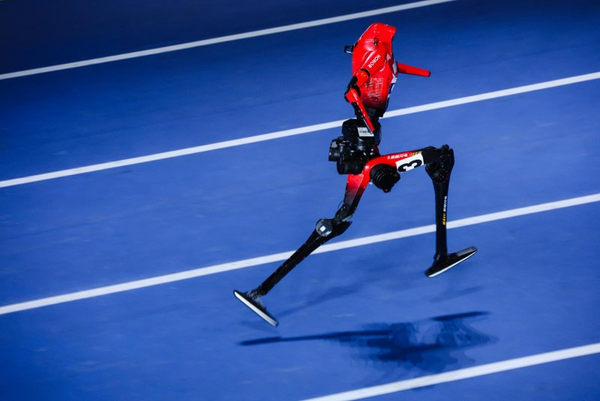
- Lengthening the Stride: Lightning, which stands 169 centimeters (5.5 feet) tall, initially competed with a leg length of 95 centimeters. In a high-stakes engineering gamble just before the games, researchers lengthened its carbon-fiber legs by 10 centimeters to reach a 1.05-meter stride, vastly expanding its ground-clearance velocity.
- The Preliminary Showdown: During the live preliminary heats on Saturday, a rival state-backed robot named Tianzhuo—built by the Beijing Innovation Centre of Humanoid Robotics—also comfortably beat Bolt by running the distance in 9.39 seconds.
- The Crash at the Line: Unlike human athletes who elegantly slow down past the tape, these metal sprinters lacked any sense of flair. Both machines slammed directly into thick foam cushions at the finish line to stop their momentum. Lightning’s historic 9.32-second record-breaker was so intense that the machine collapsed and had to be carried off the track on a stretcher by technicians.
Crushing Multiple Human Milestones
The 100-meter sprint is just one of 51 competitive events taking place at the Beijing games, which features over 2,000 robotic competitors from 16 countries. Within hours of the sprint, human athletic history was rewritten a second time when a specialized high-jumping humanoid cleared 2.88 meters (9.4 feet). The feat easily surpassed the human high jump world record of 2.45 meters, which had been securely held by Cuba’s Javier Sotomayor since 1993.
Lightning itself has quickly become the undisputed star of the games. Earlier this year, the exact same machine won the world’s first humanoid half-marathon, crossing the finish line in 50 minutes and 26 seconds—a pace that outpaced the elite men’s human marathon standard.
A Tech Revolution with an Unstoppable Stride
While critics argue that comparing mechanical parts to human bone and muscle is unfair, experts emphasize that the real victory lies in the software. For a two-legged robot to run at highway speeds without falling requires millions of real-time balance calculations per second, driven by advanced machine learning models that mimic the human cerebellum.
The rapid evolution of these machines has left spectators in the stadium both exhilarated and unnerved. While initially built to demonstrate capabilities for factory automation, domestic care, and disaster relief, the sudden mastery of elite athletics suggests that the gap between human capability and artificial biology has permanently closed. Usain Bolt’s record may stand in the human history books forever, but on the racetrack of the future, the flesh has officially lost to the machine.