
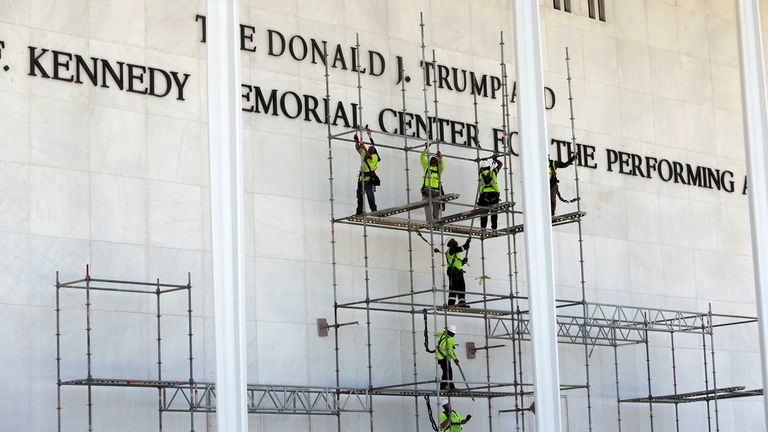
In the dead of night, beneath heavy plastic tarps and delayed by a passing summer thunderstorm, the grand white marble facade of the John F. Kennedy Center for the Performing Arts was quietly restored to its original state. Workers operating behind scaffolding on Saturday, June 13, 2026, meticulously pried away the bronze lettering that had temporarily rebranded the iconic cultural hub as the Donald J. Trump and John F. Kennedy Memorial Center.
The swift, late-night extraction came just hours before a strict noon judicial deadline. It represents a significant legal and symbolic defeat for the president’s aggressive campaign to reshape the nation’s capital. The Department of Justice formally certified to a federal judge that all physical signage, digital branding, and even employee email signatures bearing Trump’s name had been completely erased from the venue.
A Clash of Authority on the Potomac
The extraordinary weekend purge followed a decisive 94-page ruling by U.S. District Judge Christopher Cooper. The judge declared that the Trump-aligned board of trustees had acted unlawfully when they voted to slap the president’s name onto the building six months ago.
“Congress gave the Kennedy Center its name, and only Congress can change it,” Judge Cooper wrote, invalidating the board’s decision. The court further blocked an administrative plan to shutter the entire performing arts complex this July for an abrupt, multi-year renovation project.
Lawyers for the administration launched a flurry of emergency appeals late into Friday night to delay the order. They argued that stripping the name would spark donor confusion and freeze vital fundraising efforts. However, both the district court and a federal appeals court flatly denied the requests, forcing the center’s leadership to comply or face contempt.
Chants, Celebrations, and Political Blowback
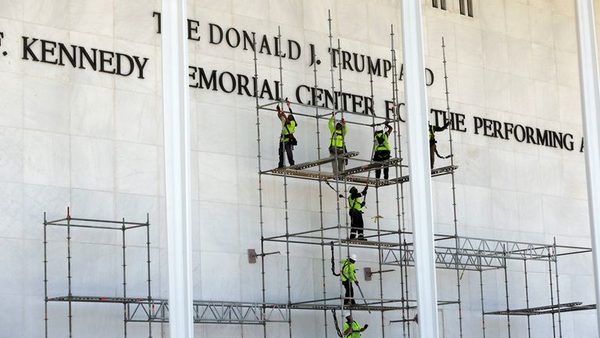
Outside the venue, the aesthetic reversal became a highly visible focal point for political resistance. Activists from the group Hands Off the Arts gathered on the plaza, cheering as the scaffolding climbed the walls and chanting “take it down” as the final appeals were rejected.
The original lawsuit was spearheaded by Representative Joyce Beatty, an Ohio Democrat and ex-officio board member, alongside intense public pushback from the Kennedy family. Following the confirmation that the letters had been removed, Beatty celebrated the outcome online, framing it as a victory for the rule of law and public ownership of national monuments.
Conversely, the president did not hide his fury regarding the judicial intervention. In typical fashion, he lambasted the decision on social media, suggesting that the federal government should simply hand the institution over to Congress and claiming the building was suffering from life-threatening structural neglect. In a final bit of Washington irony, Trump’s motorcade drove directly past the freshly scrubbed building on Saturday morning while heading toward his Virginia golf course.
The Battle for Washington’s Aesthetics
The drama at the Kennedy Center is not an isolated architectural dispute, but rather the frontline of a broader, bitter struggle over the historical aesthetic of Washington, D.C. Since the early days of his second term, the president has initiated highly controversial projects aimed at permanently altering the capital’s footprint, including the demolition of the White House East Wing to construct a massive ballroom and ordering large banners of his likeness to hang from prominent federal edifices.
While the administration continues to pursue a formal appeal to potentially reinstall the letters in the future, the empty marble on the Potomac stands as a stark reminder of the limits of executive power. For now, the marquee belongs once again to a single president, proving that even in a deeply divided capital, some names are carved deeper into law than others.