
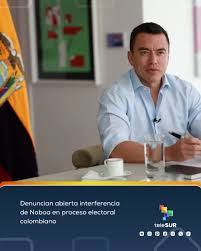
BOGOTÁ — A bitter, months-long trade war between two Andean neighbors morphed into a full-blown geopolitical crisis on Saturday when Colombia’s foreign ministry formally accused Ecuadorean President Daniel Noboa of “deliberate interference” in its democratic process.
The diplomatic rupture ignited less than 48 hours before millions of Colombians head to the polls on Sunday. It followed an extraordinary public declaration by Noboa, who announced a sweeping trade and security agreement reached directly with a right-wing, independent Colombian opposition candidate.
The move, described by regional analysts as a blatant attempt to tip the scales in a highly polarized race, has shattered standard diplomatic protocols and set a tense backdrop for Sunday’s vote.
A Trade Deal for an “Administration-in-Waiting”
The firestorm began on Friday evening when President Noboa took to social media to broadcast details of a private discussion with right-wing Colombian presidential hopeful Abelardo de la Espriella.
Framing the conversation as a dialogue with an administration-in-waiting, Noboa pledged that Ecuador would unilaterally eliminate its punishing security taxes and bilateral tariffs on Colombian imports starting June 1.
In exchange, Noboa claimed he had “confirmed [De la Espriella’s] willingness to promote a real and joint fight against narcoterrorism,” alongside a mutual agreement to extradite Ecuadorean criminals currently residing in Colombia.
ECUADOR-COLOMBIA TRADE WAR TIMELINE (2026)
│
├── January: Noboa imposes a 30% "security tax" on Colombian goods.
├── Feb-March: Tariffs escalate to 50%; Colombia retaliates in kind.
├── April: Tariffs hit 100%, cutting trade; ambassadors recalled.
└── May 30: Noboa bypasses Bogotá to promise candidate De la Espriella tariff relief.
The optics of a foreign head of state negotiating bilateral trade policy with a private citizen on the eve of a national election immediately provoked a furious backlash from the current Colombian administration.
Bogotá Strikes Back
On Saturday morning, Colombia’s Ministry of Foreign Affairs issued a blistering rebuke, fiercely rejecting what it characterized as a calculated intervention by Quito to influence voters.
The ministry thoroughly dismissed Noboa’s presentation of the tariff rollback as a unilateral “goodwill gesture,” revealing instead that the elimination of the security tax stems from a pre-existing resolution mandated by the Andean Community of Nations.
“We reject the misleading presentation of the decision to remove the tariffs as a measure of good faith by the Ecuadorean government,” the statement read. Seeking to neutralize the political leverage handed to the opposition, Bogotá added that it would simultaneously lift its own reciprocal trade barriers, effectively thawing the trade dispute without giving credit to De la Espriella.
The Geopolitical Fault Lines
The dispute underscores a profound ideological rift sweeping through the region.
The outgoing, left-wing administration of Colombian President Gustavo Petro—who by law cannot run for re-election—has spent months locked in a bitter feud with Noboa over border security.
- The Border Accusations: Ecuador has repeatedly slammed Colombia for failing to police drug trafficking networks along their shared 586-kilometer border, blaming Colombian negligence for a $1 billion trade deficit. Petro has fiercely denied these allegations.
- The Tariff Escalation: The dispute triggered an aggressive tit-for-tat economic conflict earlier this year. Ecuador hiked tariffs progressively from 30% to 50%, eventually peaking at 100%. Colombia retaliated with equivalent duties and halted energy exports to power-starved Ecuador, forcing both nations to recall their ambassadors in April.
- The Global Alignment: Noboa, a staunch ally of U.S. President Donald Trump, represents a hardline conservative approach to regional cartels. Conversely, Petro has repeatedly clashed with Washington over counter-narcotics strategies and foreign intervention.
An Uncertain Sunday at the Polls
By using a critical economic lever to bolster De la Espriella, Noboa has fundamentally altered the final hours of the campaign.
De la Espriella is locked in a tight, multi-way battle against progressive Petro ally Iván Cepeda and prominent right-wing Senator Paloma Valencia. While De la Espriella’s camp has framed the Ecuadorean agreement as a masterstroke of forward-thinking statesmanship capable of reviving billions in bilateral commerce, critics view it as an unconstitutional violation of national sovereignty.
As polling stations prepare to open across Colombia, voters are faced with far more than an internal policy choice. Sunday’s outcome will now directly dictate the future of Andean integration, international trade security, and how Colombia navigates its place in a deeply fractured Latin American landscape.