The Boy Scouts of America has filed for bankruptcy
protection following multiple abuse lawsuits.
The BSA says the move will allow it to build a
compensation fund for abuse victims.
As a result of the move, all civil lawsuits against it are put on hold.
The BSA is struggling with declining membership as well as abuse claims.
Chief executive Roger Mosby said in a statement: “The BSA cares deeply about all victims of abuse and sincerely
apologizes to anyone who was harmed during their time in scouting. We are
outraged that there have been times when individuals took advantage of our
programs to harm innocent children.”
Court papers filed in Delaware listed liabilities of up to $1 billion and
assets of as much as $10 billion, reports say.
The filing was made under Chapter 11
of the US bankruptcy code which allows the group to keep operating and pay its
creditors over time.
The bankruptcy allows the BSA to
bring all of the lawsuits into one court and try to negotiate a settlement,
rather than using its funds to fight each case in court.
The group said it was setting up a
trust fund to compensate victims.
Roger Mosby said in a statement: “While we know nothing can undo the
tragic abuse that victims suffered, we believe the Chapter 11 process – with
the proposed trust structure – will provide equitable compensation to all
victims while maintaining the BSA’s important mission.”
According to the Wall Street Journal, the BSA has 261
councils which operate local troops and own assets including land in many
states. The bankruptcy move is designed to protect those councils, which hold
about 70% of all BSA assets, the publication says.
In its statement, the BSA said the councils, which are legally separate and financially independent of the national organization, had not filed for bankruptcy.
Harris County State District Judge Chip Wells is set to rule this week on the high stakes divorce battle involving eccentric Houston billionaire Ed Bosarge.
Attorneys for Marie Bosarge claim the billionaire owns mansions, yachts and even a Bahamian Island but is trying to leave her penniless after their 30 years of marriage. One of their Houston mansions was originally put on the market for $43 billion.
Ed and Marie Bosarge had only one house and faced
foreclosure when they got married. They amassed a fortune during their
decades-long marriage. Experts say Bosarge may have $2.3 billion in secretive
South Dakota trusts created to cheat his wife.
Her lawyer says that fraudulent scheme even included trying to hide in the trust a 43-carat diamond necklace he gave Marie for Christmas.
Wells hasn’t ruled whether the divorce case will go to a
jury, but when Ed Bosarge’s lawyers suggested the judge had no choice but to
end the lawsuit, Wells exploded from the bench.
“I don’t think the laws of South Dakota frees him of an
obligation he made when he got married,” Judge Wells angrily told Ed Bosarge’s
lawyers. “Scheme may be the key word. Play this game. Fraud on the community
estate. I promise you it’s not going to go well. I don’t have to tolerate your
disrespect.”
Attorney Bucky Allshouse says if Ed Bosarge gets away with
his plan then no wife would be safe.
“I want him to be fair. You know, we made our money in
Houston. It’s community property. It’s fifty-fifty. I want what’s fair,” said
Marie Bosarge.
1,523 people have died from the
virus within China, mostly in Hubei province, where it first emerged. These
include 143 deaths newly reported on February 15 by China’s national health
commission.
A further 2,641 people have been
newly confirmed as infected, bringing China’s total cases to 66,492.
However, China’s Foreign Minister
Wang Yi said on February 15 that the outbreak in Hubei was now being managed
more effectively – “indicating that overall the epidemic is
controllable”.
Speaking at a security conference in
Germany, Wang Yi said the number of people who had recovered reached more than
8,000 on February 14.
At the same meeting, the head of the
WHO said all countries should be prepared for the arrival of the virus.
In late January, France became the
first European country to confirm cases of the virus. It has had 11 confirmed
cases of the disease, officially called Covid-19. Six people remain in
hospital.
The Chinese tourist in France had
been in a critical condition in the Bichat hospital in northern Paris, the
health minister said. He died of a lung infection due to the coronavirus.
His 50-year-old daughter is among
the six in hospital with the virus, but she is recovering, the minister said.
The other five people are British nationals
who caught the virus at a chalet in the ski resort of Contamines-Montjoie.
Outside mainland China, there have
been more than 500 cases in 26 countries.
Earlier in the day, the US said it
was sending a plane to Japan to evacuate Americans stuck on the Diamond
Princess cruise ship, which is being held in quarantine in a Japanese port.
According to Japan’s NHK broadcaster,
some 400 US citizens are reported to be on the cruise ship. Those with symptoms
are expected to be treated in Japan.
Out of 3,700 people on board, 218
have tested positive for the virus. Australia also said it was considering
removing its citizens from the ship.
Meanwhile, an 83-year-old American
woman on a cruise ship which docked in Cambodia, has tested positive for the
virus after arriving by air in Malaysia.
The MS Westerdam had been turned
away by five destinations, including the US island of Guam, before Cambodia
agreed it could land.
The woman and her husband were among
145 passengers from the ship who flew to Malaysia after it docked. According to
the Malaysian health authorities Both showed symptoms, but he tested negative.
No cases were found on board the cruise
ship during regular health checks on the 1,455 passengers and 802 crew.
On February 14, Egypt’s health ministry confirmed the first case of the coronavirus in Africa. The ministry described the person as a foreigner, but did not disclose their nationality.
In the
present time, there are so many kinds of cosmetic surgeries that are becoming the
talk of the town. As people have become aware of what they need to care about,
what options do they have, the easy way outs through surgeries, so they all
demand and become attracted to treatments like liposuction? It is a
cosmetologically advanced treatment that is known for its amazing results all
over the world. It is the best-known treatment done in Turkey, and people from
all over the world come to get their services. We are going to share with you
the details about it so that you can take advantage of it in all possible ways.
Let us get started with it in detail now.
What is
Liposuction?
By liposuction surgery by Cosmeticium in Turkey, we mean that treatment that people like to get for the purpose of losing fat. In many cases, you see people are complaining about stubborn fat in their body and that they are unable to get rid of after so much dieting and exercise. Well, liposuction surgery is the solution for this because this procedure helps in taking out fat from the muscles around the stomach, around the upper section of rams, things and hip region. So, liposuction surgery is something that helps you get the slim and trim body you were craving for so long time.
The liposuction surgery in Turkey by Cosmeticium has also known as lip pasty or cosmetic body contouring technique in which the whole-body shape is improved by taking out extra fat in all possible regions that make the body look fat and deformed. liposuction surgery is something that needs a careful examination of the body the procedure is practically started. You can simply do a favor to yourself by hiring the right professional surgeon for this.
What to expect from this procedure?
In Turkey, Liposuction
surgery is a procedure that is done by giving the patient enough anesthesia.
This is to help the patient avoid any pain during the process. It is very
unusual to feel pain during the process due to this precaution, while the pain
after the surgery is done is a huge deal. We are going to share with you before
and after surgery, precautions to handle your situation well enough and to
avoid pain as well. Let us get started with these now.
Before Treatment
Before the
liposuction surgery in Turkey, you can follow the following points.
Discuss your fears with your doctor about the protocol, the results, the pain, and everything that comes to your mind. This talk will put your mind to ease and help you move to the liposuction surgery.
You have to discuss with your liposuction surgery professional about the kind and the type of anesthesia that will be given to you during the surgery. You can then suggest your needs and make changes accordingly.
As your liposuction surgery professional that you are supposed to need any medication after the liposuction surgery or not. This will help you understand the process more and make advance preparations for it.
After Treatment
After the
liposuction surgery in Turkey is done, you must keep in mind the following
points to avoid pain.
You should
try to get your pills, especially of pain as recommended by the doctor.
Try to use
the compression garment after the liposuction surgery because this will help
you deal with your body after the surgery and the pain as well.
The drains
must be kept in their required place after the liposuction surgery is done.
You have to
take enough rest and relax your body as much as you can. Never start working,
walking and going out immediately. Give your body the time to heal and come to
normal functioning form.
Edema or
swelling can occur if you start taking salt, either through food or drinks. So,
avoid nay salt intake in your body.
Try to take
more and more fluids to avoid nay dehydration of your body.
How to decide if liposuction
surgery is for you or not?
There are
some simple things or points that will help you decide the fact that if you
need any liposuction surgery treatment or not. These include all possible
situations occurring in people who need liposuction surgery. These include the
following:
You are not
a good liposuction surgery candidate if you do not have extra skin on your
body.
You do not
have good muscle tone, then gain you need to get this procedure done for your
body parts.
Elasticity
in the skin if not enough present, then liposuction surgery becomes a necessity
for you.
If there is
stubborn fat on your body, then liposuction surgery is surely for you because
it will help you get rid of it.
Your
physical shape of the body and overall health if not good, then the liposuction
surgery becomes a necessity for you and your body.
If you are
overweight and obese, liposuction surgery is for you for sure.
If you
smoke, you will need liposuction surgery one or the other day in the future.
This
procedure can be a little risky if you get services from any part of the world,
other than Turkey because their services are very high class and reliable.
Conclusion
We all want the body that we crave for a very long time. Also, we want to put less effort in terms of dieting and exercise and practice some protocols like liposuction surgery to get rid of the extra fats and to bring the body into the shape we want. This body contouring technique is now quite old and is becoming advance in all procedures with time. So, if you also think that you need this liposuction surgery, then search for the right liposuction surgery center, get in touch with professional liposuction surgery doctor, talk about your needs in detail, and at the end hire with all satisfaction in your heart for your upcoming liposuction surgery.
A Saudi Tornado warplane fighting in
Yemen has crashed in the northern province of al-Jawf.
According to Saudi Arabia’s state
news agency SPA, a Saudi-led coalition spokesman confirmed that the fighter jet
had “fallen” while carrying out a support mission near Yemeni army
units.
Yemen’s Houthi rebels claimed they
shot down the plane.
The coalition has been battling the
rebel Houthi movement since 2015.
It intervened after the Houthis ousted
the internationally-recognized government from power in the capital Sanaa.
The Houthi rebels said they used
ground-to-air missiles to down the warplane on February 14. They also accused
the coalition of killing 30 people in retaliatory airstrikes in al-Jawf on the
next day.
Saudi Arabia has not provided
details of any casualties from the crash, or what caused it.
Yemen has been at war since 2015,
when President Abdrabbuh Mansour Hadi and his cabinet were forced to flee the
capital Sanaa by the Houthis.
Saudi Arabia backs President Hadi,
and has led a coalition of regional countries in air strikes against the
rebels.
The coalition carries out air strikes
almost every day, while the Houthis often fire missiles into Saudi Arabia.
Yemen civil war has triggered the world’s worst humanitarian disaster, with an estimated 80% of the population – more than 24 million people – requiring humanitarian assistance or protection. Tens of thousands of people have died n Yemen as a result of the conflict.
The temperature in Antarctica has exceeded
20C for the first time.
Researchers logged a temperature of
20.75C on Seymour Island off the coast of the continent.
Brazilian scientist Carlos Schaefer
told AFP they had “never seen a temperature this high in Antarctica”.
However, the scientist warned the
temperature, logged on February 9, was just one reading and not part of a
long-term data set.
Antarctica also hit a record last
week, with a temperature reading of 18.3C on the Antarctic Peninsula.
This latest reading was taken at a
monitoring station on Seymour Island, part of a chain of islands off the same
peninsula, at the northernmost point of the continent.
Although the temperature is a record
high, Carlos Schaefer emphasized that the reading was not part of a wider study
and so, in itself, could not be used to predict a trend.
He said: “We can’t use this to anticipate climatic changes in the future.
It’s a data point.
“It’s simply a signal that something different is
happening in that area.”
According to the UN’s World
Meteorological Organization (WMO), temperatures on the Antarctic continent have
risen by almost 3C over the past 50 years, and that about 87% of the glaciers
along its west coast have “retreated” in that time.
Over the past 12 years the glaciers
have shown an “accelerated retreat” due to global warming, it adds.
January 2020 was also Antarctica’s
warmest January on record.
Scientists have warned that global warming is causing so much melting at the
South Pole, it will eventually disintegrate – causing the global sea level to
rise by at least 10ft over the coming centuries.
The previous record for the entire Antarctic region – which includes the
continent, islands and ocean that are in the Antarctic climatic zone – was
19.8C, logged in January 1982.
In July 2019, the Arctic region hit its own record temperature of 21C, logged by a base at the northern tip of Ellesmere Island in the Canadian Arctic.
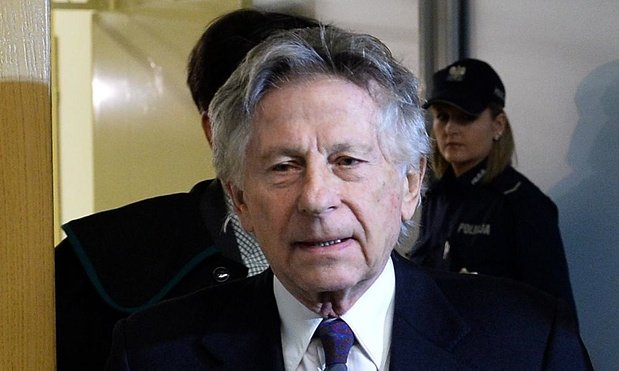
The entire board of the French Oscars, the César
Academy, has resigned following backlash over nominations for a film by Roman
Polanski and demands for reform.
Roman Polanski’s An Officer and a Spy
swept the nomination list for the César awards, sparking calls for a boycott.
The director has been wanted in the US for the statutory rape of a
13-year-old girl since the 1970s.
Hundreds of actors, producers and directors have also called for change.
In an open letter this week, they denounced “dysfunction” at the
César Academy and opacity in its management.
In a statement on February 13, the César Academy said the board had
“unanimously decided to resign” to “honor those men and women
who made cinema happen in 2019, to find calm and ensure that the festival of
film remains just that, a festival”.
The statement added: “This collective decision will allow
complete renewal of the board.”
A general meeting is set to be held
after this month’s ceremony to elect a new board, which will look at implementing
reforms and modernizing the academy.
France’s Culture Minister Franck Riester
said the academy must operate democratically, in the spirit of “openness,
transparency, parity and diversity”.
The César Academy has faced
controversy in recent months.
Many called for a boycott when Roman
Polanski’s film An Officer and a Spy,
or J’accuse in French, received 12
award nominations. The director fled the US after his rape conviction in the
1970s, and has since faced other accusations of assault.
France’s equality minister and film critics also condemned the decision to
nominate the Polish-French director’s film.
However, the Césars defended the nominations, arguing that the body
“should not take moral positions” in giving awards.
In an open letter this week, hundreds of film professionals, including
actors and directors, called for “profound reform” at the academy.
They complained of a lack of democracy in the institution and said the
founding statutes of the Césars had not changed “for a very long
time”.
In response, the board said it would ask for a mediator to be appointed by a
culture ministry agency to oversee reforms of its statutes and governance.
It is not the first time the Césars have faced controversy over Roman Polanski. In 2017, the director was picked to head the award’s jury, but stepped down after the move sparked outrage.
According to the WHO, there was also no major shift in the coronavirus’s
pattern of mortality or severity.
On February 12, Hubei recorded 242 deaths, the deadliest day of the
outbreak.
There was also a huge increase in cases, with 14,840 people diagnosed but
most of this was down to Hubei using a broader definition to diagnose people,
said Mike Ryan, head of WHO’s health emergencies program.
He said: “This does not represent
a significant change in the trajectory of the outbreak.”
Outside China there had been two deaths and 447 cases in 24 countries, he
said.
On February 13, Japan announced its first coronavirus death – a woman in her
80s who lived in Kanagawa, south-west of Tokyo.
The woman’s diagnosis was confirmed after her death and she had no obvious
link to China’s Hubei province, the epicenter of the outbreak, Japanese media
reported.
The Diamond Princess cruise ship is in quarantine in Yokohama. Not all the
3,700 people on board have been tested yet.
People with the virus are taken to hospitals on land to be treated, while
those on board are largely confined to their cabins.
On February 13, Japan said it would
allow those aged 80 or over who have tested negative for the coronavirus to
disembark.
Health Minister Katsunobu Kato said
they could be allowed off the ship as early as February 14 but would have to
stay in accommodation provided by the government, the Japan Times reported.
Meanwhile another cruise ship – the
MS Westerdam – carrying more than 2,000 people docked in Cambodia after being
turned away by ports in Japan, Taiwan, Guam, the Philippines and Thailand
despite having no sick patients on board.
Until February 13 increases, the number of people with the virus in Hubei
was stabilizing.
The new cases and deaths in the province have pushed the national death toll
above 1,350 with almost 60,000 infections in total.
White House economic advisor Larry Kudlow said there had been
“surprise” in the US at the new cases.
He said: “We’re a little
disappointed in the lack of transparency coming from the Chinese, these numbers
are jumping around.”
The Trump administration was also disappointed that China had not accepted a
US offer to send experts to help China respond to the outbreak, Larry Kudlow
said.
China sacked two top officials in Hubei province hours after the new figures
were revealed.
Only Hubei province – which accounts for more than 80% of overall Chinese infections – is using the new definition to diagnose new cases.
Troy Price, the chairman of the Democratic
Party in Iowa, has resigned after last week’s caucus was beset with technical
issues, questions over accuracy and delays.
In his resignation letter, he said that “the precinct and satellite
caucus meetings themselves went well”.
However, Troy Price conceded that the process of reporting results was
“unacceptable”.
At the last week’s caucuses, Pete Buttigieg won with a narrow 0.1% victory
over Bernie Sanders in terms of delegates, while Senator Sanders won the
popular vote.
Since then, the Sanders campaign has asked for a “recanvassing”
check of the vote.
Iowa Democratic leaders will elect a new local leader on February 15.
Troy Price said in his letter:
“While it is my desire to stay in
this role and see this process through to completion, I do believe it is time
for the Iowa Democratic Party to begin looking forward.
“My presence in my current role makes that more
difficult.”
He then added that the Iowa
Democrats were “not the only party to blame”, and mentioned the
partners and vendors who were also involved.
The Iowa caucus is the important first step in choosing the challenger to
the incumbent president.
Primaries and caucuses are a string of nationwide state-by-state votes,
which culminate in the Democratic nominee being chosen at the party convention
in July.
Although Iowa awards only 41 of the
1,991 delegates required to become the Democratic White House nominee, the
state’s vote is usually considered the first clear indication of each
candidate’s standing within the race.
This year the Iowa Democratic Party
distributed a new app, called Shadow,
to precinct officials that was supposed to help them report results more
quickly.
It was an issue with this app, which
the party said was a coding error that led to the delay in results and ultimate
chaos on February 3.
Pete Buttigieg declared victory for
himself that same day, before any of the results were released.
In the end, the results were finally released three days later than
expected.
By that time the chairman of the Democratic National Committee (DNC) had
already weighed in, calling for a review of the vote totals.
The second vote that took place – the primary in New Hampshire on February
11 – was more clear-cut. Bernie Sanders came in first, with Pete Buttigieg
second and Minnesota Senator Amy Klobuchar in third place.
Joe Biden and Elizabeth Warren, previously considered frontrunners, came in fourth and fifth – each with zero delegates.
U.S. Army photo by Elizabeth Fraser / Arlington National Cemetery /
The Italian Senate has voted to allow prosecutors to put far-right leader Matteo Salvini on trial over charges of holding immigrants at sea.
Matteo Salvini, who previously
served as the country’s interior minister, is accused of illegally keeping
people on a boat off Sicily for days in August 2019.
Some 116 migrants remained aboard
the Gregoretti for close to a week.
On February 12, a majority of
senators voted for the trial of Matteo Salvini to go ahead.
The anti-immigration League leader has
repeatedly said he wants to go to court. He told the chamber he wanted “to
tell the world” that his migration policies “saved tens of thousands
of lives.”
He said: “I am absolutely calm and proud of what I have done. And I’ll do
it again as soon as I get back into government.”
Senators from his League party left
the chamber rather than take part in the vote.
Under Italian law, ministers have
parliamentary immunity for actions taken while they were in office. However, a
committee voted last month to strip Matteo Salvini of his immunity – leaving
the final decision in the hands of the Senate on February 12.
An official vote tally is expected by 19:00 local time. If
successfully prosecuted at trial, Matteo Salvini could face up to 15 years in
jail.
For years, some in Italy have complained that the country has taken in a
large number of migrants fleeing across the Mediterranean, and has called for
other EU nations to take their share.
Matteo Salvini in particular took a hard stance on migrant boats while he
was in office, implementing a closed ports policy.
On July 25, 2019, Italian coastguard
ship the Gregoretti picked up about 140 migrants trying to travel to Italy from
Libya.
While the Gregoretti allowed several
people off the ship for medical attention, some 116 people remained on board
for days while Matteo Salvini demanded other EU countries take them in.
The decision drew an immediate backlash.
Prosecutors opened an investigation into conditions aboard after reports that
migrants only had one toilet between them.
After the Catholic Church and a number of states agreed to care for those on board, in a deal which then EU commissioner Dimitris Avramopoulos helped to broker, Matteo Salvini eventually consented to let them dock on July 31.
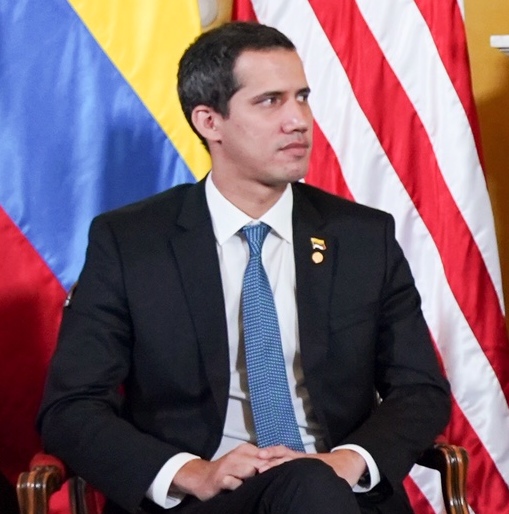
One of the protesters, who shouted
at Juan Guaidó and threw a liquid at him, was wearing the uniform of the
state-owned airline Conviasa, which has been directly hit by US sanctions.
There were also scuffles between the
protesters and supporters of Juan Guaidó, who had gone to the airport to
welcome him.
Lawmakers loyal to Juan Guaidó had
to walk to the airport after the bus they were traveling in was stopped by
police.
Journalists reported being attacked
and having their kit stolen by those who had turned out to boo Juan Guaidó.
His office later said that a
relative who was travelling with him had been held by airport officials, and
had not been seen since.
Meanwhile, without directly naming Juan Guaidó, President Maduro told his
supporters to focus on “defending Venezuela”.
He said at a ceremony that was broadcast on state television: “Let’s not get distracted by
stupidities, by dummies, by traitors to the homeland.”
Nicolas Maduro’s second-in-command Diosdado Cabello also denounced Juan
Guaidó’s three-week tour as a “tourism trip”, and said he did not
expect anything to change after his return.
“He is nothing,”
Diosdado Cabello added.
President Maduro and his officials have threatened Juan Guaidó in the past,
but these threats have, so far, not led to him being harmed or detained.
Despite this being the second time he defied a court-imposed travel ban,
Juan Guaidó was not arrested.
After landing, Juan Guaidó addressed a rally of about 500 people in Caracas,
where he called for renewed protests against the president.
During Juan Guaidó’s visit to the US, President Trump promised to “smash” Nicolas Maduro’s government.
South Korean movie Parasite has won best picture award at this year’s Oscars, becoming
the first non-English language film to take the top prize.
Renee Zellweger won best actress for playing Judy Garland in Judy. Joaquin Phoenix was named best
actor for Joker.
Laura Dern and Brad Pitt won the supporting acting awards for their roles in
Marriage Story and Once Upon A Time in Hollywood respectively.
Parasite won four awards in total,
while Sam Mendes’s 1917 took three.
The World War One epic 1917 had
been the favorite to win best picture, but its awards all came in the technical
categories.
Parasite‘s Bong Joon-ho beat Sam
Mendes to the prize for best director, and also took the best original
screenplay award.
The South Korean movie is a vicious social satire about two families from
different classes in Seoul – one who live in poverty in a semi-basement, and
another rich family residing in a large home.
It has now managed what no other subtitled film has done in the 92-year
history of the Academy Awards and won best picture.
Bong Joon-ho said: “I feel like
I’ll wake up to find it’s all a dream. It all feels very surreal.”
Producer Kwak Sin-ae, who collected the trophy, said: “I’m speechless. We never imagined this to happen. I feel like a
very opportune moment in history is happening right now.”
There were boos when organizers tried to cut short the best picture
acceptance speech by turning the stage lights off – leading the lights to be
turned back on, allowing the celebrations to continue.
Brad Pitt won the first acting Oscar of his career – picking up the best
supporting actor trophy for his role in Quentin Tarantino’s movie.
He was the first winner of the night, and immediately used his speech to
attack the way the impeachment proceedings against President Donald Trump were
handled.
Brad Pitt referred to the fact that Republican senators voted against
allowing witnesses including former National Security Adviser John Bolton to
give evidence.
He said: “They told me I only
have 45 seconds up here, which is 45 seconds more than the Senate gave John
Bolton this week.
“I’m thinking maybe Quentin does
a movie about it and in the end the adults do the right thing.”
Brad Pit, 56, moved from the political to the personal, paying tribute to
co-star Leonardo DiCaprio and reflecting on his journey to Hollywood
superstardom.
Joaquin Phoenix, who won best actor for his remarkable performance in the
origin story about Batman’s nemesis, also used the podium to send a heartfelt
message about the state of the world, saying actors have the power to give a
“voice for the voiceless”.
After telling the audience to stop clapping him as he took to the stage –
“Don’t do that” – Joaquin Phoenix managed to cover topics from animal
rights and the environment to racism and sexism.
The vegan activist told the audience that “we feel entitled to
artificially inseminate a cow, and when she gives birth, we steal her baby even
though her cries of anguish are unmistakable”.
The actor also pointed out his own flaws: “I’ve been a scoundrel in my life. I’ve been cruel at times and
hard to work with, but so many people in this room have given me a second
chance.”
Joaquin Phoenix ended his speech by quoting a lyric written by his late
brother River: “Run to the rescue
and love and peace will follow.”
Laura Dern won best supporting actress for playing a divorce lawyer in Marriage Story.
A day before her 53rd birthday, the actress said the award is the best
birthday present ever.
Laura Dern comes from an illustrious acting family, but in winning managed
something her parents have not. Mother Diane Ladd has been nominated for three
Academy Awards, and dad Bruce Dern has two unsuccessful nominations.
She told the audience: “Some say
never meet your heroes.
“But I say if you’re really
blessed, you get them as your parents.”
Renee Zellweger used her speech to pay tribute to Judy Garland, who was
nominated for two Oscars in the 1950s and 60s.
The actress said: “Judy Garland
did not receive this honor in her time,
“I am certain that this moment is an extension of the celebration of her legacy.”
A Thai soldier has killed 20 people and injured
dozens more in a gun rampage in the city of Nakhon Ratchasima.
According to media, Jakraphanth Thomma, a junior officer, killed his
commanding officer before stealing weapons from a military camp on February 8.
The suspect then continued his attack in a shopping centre, where he is now
believed to be holed up.
Jakraphanth Thomma also posted about the attack on social media.
His motives remain unclear.
Thaim authorities have sealed off the Terminal 21 shopping center in Nakhon
Ratchasima, also known as Korat, as they try to track down the suspect.
Troops and police have entered the building and there have been reports of
more gunshots.
Defense ministry spokesman Lt. Gen. Kongcheep Tantravanich said hundreds of
people had been brought out of the complex safely, but there could be dozens
still in the building.
A tweet from security forces said the ground floor had now been cleared.
The Bangkok Post reported earlier
that the suspect, who it said was 32 years old, had taken hostages, but this
has not been officially confirmed.
Jakraphanth Thomma’s mother has been brought to the shopping center to try
to persuade him to give himself up.
Public Health Minister Anutin Charnvirakul confirmed that 16 people had died
at the scene of the shootings, with another four dying later in hospital. A
total of 31 people have been injured, with 10 of them in a critical condition.
But there are fears the numbers could rise.
The shooting began at about 15:30 local time at the Suatham Phithak military
camp, where the commanding officer, named by the Bangkok Post as Col Anantharot Krasae, was killed.
According to the publication, a 63-year-old woman and another soldier were
also killed there.
The suspect seized arms and ammunition from the camp before taking a
Humvee-type vehicle.
Jakraphanth Thomma then opened fire at a number of sites before arriving at
the Terminal 21 shopping center.
Local media footage appears to show the suspect getting out of his vehicle and
firing shots as people flee.
CCTV footage shows him inside the shopping center with a raised rifle.
PM Prayuth Chan-ocha is following developments and expressed condolences to
the families of those killed, a spokeswoman said.
The public health minister has put out an appeal for people to donate blood
at hospitals in the area.
Jakraphanth Thomma posted on his social media accounts during the attack,
with one post on Facebook asking whether he should surrender.
He had earlier posted an image of a pistol with three sets of bullets, along
with the words “it is time to get excited” and “nobody can avoid
death”.
Facebook has now taken the page down.
The social media platform said: “Our hearts go out to the victims, their families and the community affected by this tragedy in Thailand. There is no place on Facebook for people who commit this kind of atrocity, nor do we allow people to praise or support this attack.”
The presidential nominees will be chosen through a series of primaries and
caucuses in every state and territory that began in Iowa on February 3 and ends
in Puerto Rico in early June.
Short of a big shock, the Republican nominee will be Donald Trump. Even
though technically he has two challengers, he is so popular among Republicans,
he has a clear run ahead of him. With that in mind, the Democratic primaries
are the only ones worth watching.
Step
one: The start line
A whole year before the primaries,
the first candidates emerged from hibernation. Over the year, others woke up
and eventually 28 people announced they were running to become the Democratic
nominee for president.
But dwindling funds, luke-warm or
(ice-cold) public reaction and campaign infighting have, to varying degrees,
led to 16 candidates pulling out of the race.
At the start of primary season, 11
people remained in the running. In theory, any one of them could become the
nominee. In reality, only a few have a chance.
Step
two: The Iowa caucuses
The first event of the primary
season isn’t a primary at all – it’s a series of caucuses, in Iowa. These took
place on February 3, in somewhat chaotic fashion.
What are caucuses?
A caucus involves people attending a
meeting – maybe for a few hours – before they vote on their preferred
candidate, perhaps via a head count or a show of hands. Those meetings might be
in just a few select locations – you can’t just turn up at a polling station.
Caucuses used to be far more popular
back in the day, but this year, Democrats are holding only four in US states –
in Nevada, North Dakota, Wyoming and Iowa.
If any candidate gets under 15% of
the vote in any caucus, their supporters then get to pick a second choice from
among the candidates who did get more than 15%, or they can just choose
to sit out the second vote.
Why Iowa caucuses matter?
A win there for any candidate can
help give them momentum and propel them to victory in the primaries.
Why is Iowa first in the primary
calendar? You can blame Jimmy Carter, sort of. Iowa became first in 1972, for
various technical electoral reasons too boring to go into here. But when Carter
ran for president in 1976, his team realized they could grab the momentum by
campaigning early in Iowa. He won there, then surprisingly won the presidency,
and Iowa’s fate was sealed.
Why Iowa caucuses don’t matter?
Iowa doesn’t represent the entire US
– it’s largely white, so the way people vote there is very, very different than
in other states.
The sate’s record on picking the
eventual nominees is a bit rubbish too, at least when it comes to Republicans –
when there’s an open Republican race, Iowa hasn’t opted for the eventual
nominee since 2000. Such names as Mike Huckabee, Rick Santorum and Ted Cruz
have won there in recent years.
Step three: The New Hampshire primary
Eight days after Iowa on February 11, is the first primary, in New
Hampshire. The tiny north-eastern state of only 1.3 million people will once
again become an unlikely hotbed of political activity.
What is a primary?
Unlike a caucus, where voters are expected to turn up at a few limited
locations at certain times and stick around for a while, primary voters can
just turn up at a polling booth and vote in secret. Then leave.
How does a primary work?
The more votes a candidate gets in a caucus or primary, the more
“delegates” they are awarded, and all candidates will be hoping to
win an unbeatable majority of delegates.
The number of delegates differs in each state, and is decided by a
convoluted series of criteria. In California’s primary, for example, there are
415 Democratic delegates up for grabs this year. In New Hampshire, there are
only 24.
This year is a bit different. Any candidate would need to get at least 15%
of the vote in any primary or caucus to be awarded delegates. There are still
11 candidates in the running – an unusually large number – so there’s a risk
the vote share will be spread out and some of the candidates may struggle to
reach 15%.
After New Hampshire, we could get a clear picture of who is struggling, but
whoever has claimed the most delegates at this stage is still far from
guaranteed to be the nominee.
Even those who are struggling may not drop out right after New Hampshire,
because there is so much at stake on…
Step four: Super Tuesday
A few other states vote in between New Hampshire and the end of February,
but this is when things really start to warm up: Super Tuesday, on March 3.
What is Super Tuesday?
It is the big date in the primary calendar, when 16 states,
territories or groups vote for their preferred candidate in primaries or
caucuses. A third of all the delegates available in the entire primary season
are up for grabs on Super Tuesday. By the end of the day it could be much
clearer who the Democratic candidate will be.
The two states with the most delegates are voting on Super Tuesday
– California (with 415 Democratic delegates) and Texas (228). California is
voting three months earlier than in 2016, making Super Tuesday even more super
than normal.
California and Texas are two states with very diverse populations, so we may
see them going for very different candidates than those chosen in Iowa and New
Hampshire.
Step five: The rest of the race
After hectic Super Tuesday, everyone gets to cool down for a week, before
another busy day on March 10, when six states vote, with 352 delegates
available.
After that, the primary season still has three months left to run, and at
the end, the role of those delegates will become clear…
Step six: The conventions
Donald Trump will almost certainly be sworn in as the Republican nominee at
the party convention in Charlotte, North Carolina, between August 24 and 27.
The Democrats will confirm their candidate at their own convention between July
13 and 16 in Milwaukee, Wisconsin.
What happens in a convention?
Here’s where those delegates come in.
Let’s say that during primary season, candidate A wins 10 delegates. During
the convention, those 10 delegates would vote for candidate A to become the
Democratic nominee. (Any party member can apply to be a delegate – they tend to
be party activists or local political leaders.)
All through the Democratic primaries, there are 3,979 delegates
available. If any one candidate wins more than 50% of those delegates during
primary season (that’s 1,990 delegates), then they become the
nominee in a vote at the convention.
But if we get to the Democratic convention and no-one has more than 50% of
the delegates, it becomes what’s known as a “contested” or
“brokered” convention. This could well happen this year. There are so
many candidates that no one frontrunner emerges in the primaries, and they
split the delegates between them. In that circumstance, a second vote
would follow.
In that second vote, all the 3,979 delegates would vote again, except this
time they would be joined by an estimated 771 “superdelegates”.
These are senior party officials past and present (former president Bill
Clinton is one, as is current Vermont senator and presidential contender Bernie
Sanders), and they’re free to vote for whomever they wish.
If a candidate wins 50% or more in that vote – 2,376 delegates – then they
become the nominee.
This is all thanks to a rule change in 2020: last time around, the
superdelegates voted at the start of the convention, with the delegates. But
many had pledged their support to Hillary Clinton even before the convention,
leading her rival Bernie Sanders to suggest the deck was stacked against him.
Bernie Sanders is the one who campaigned for the change – and it may benefit
him in 2020.
Step seven: The presidency
After inching past Iowa, negotiated New Hampshire, survived Super Tuesday and come through the convention, there is only one step left for the nominee: the presidential election, on November 3.
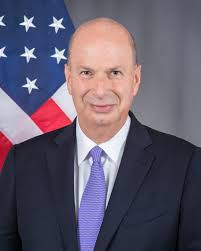
President Donald Trump has recalled Gordon
Sondland and Lt. Col. Alexander Vindman, two senior officials who testified
against him at his impeachment trial.
Gordon Sondland, the US envoy to the
EU, said he “was advised today that the president intends to recall me
effective immediately”.
Just hours earlier, Lt. Col.
Alexander Vindman, a top expert on Ukraine, was escorted from the White House.
President Trump is said to desire a
staff shake-up after senators cleared him in the impeachment case on February 5.
Lt. Col. Alexander Vindman’s twin
brother, Yevgeny Vindman, a senior lawyer for the National Security Council,
was also sent back to the Department of the Army on February 7.
In a statement issued by his lawyer,
Gordon Sondland said: “I was advised
today that the president intends to recall me effective immediately as United
States ambassador to the European Union.
“I am grateful to President Trump for having given me
the opportunity to serve, to Secretary [of State Mike] Pompeo for his
consistent support, and to the exceptional and dedicated professionals at the
US mission to the European Union.
“I am proud of our
accomplishments. Our work here has been the highlight of my career.”
Lt. Col. Alexander Vindman had
reportedly turned up for work at the White House as usual on February 5.
As he left the executive mansion on February
5 for North Carolina, President Trump told reporters: “I’m not happy with him [Lt. Col. Vindman].
“You think I’m supposed to be happy with him? I’m
not.”
President Donald Trump has so far
not commented further.
According to White House sources,
Alexander Vindman had been expecting a transfer. He was telling colleagues for
weeks that he was ready to move back to the defense department, where he still
holds active-duty soldier status.
On February 5, Defense Secretary
Mark Esper told reporters his department welcomes back all of its personnel
from assignment.
He added: “And as I said we protect all of our service members from retribution
or anything like that.”
Testifying in Congress last
November, Gordon Sondland was very clear in his testimony that a White House
visit by Ukrainian President Volodymyr Zelensky was conditional on Kyiv
launching investigations that could be politically helpful to President Trump.
He said: “Was there a quid pro quo [a favor granted in return for
something]?
“As I testified previously, with regard to the
requested White House call and White House meeting, the answer is yes.”
Gordon Sondland was at that time
working with President Trump’s personal lawyer, Rudy Giuliani, on Ukrainian
policy at the explicit direction of the president.
Lt. Col. Alexander Vindman also
testified last November. He said he was “concerned” after hearing
President Trump’s “improper” phone call on July 25, 2019 with
Ukraine’s president.
The call led to Presidnet Trump’s
impeachment in December by the House for abuse of power and obstruction of
Congress.
Democratic lawmakers argued that President
Trump had dangled US aid in exchange for political favors.
When asked how he had overcome his
fear of retaliation in order to testify, Alexander Vindman testified: “Congressman, because this is
America… and here, right matters.”
President Trump mentioned the
Vindman twins in a tirade against his political enemies at the White House one
day before ousting them.
Eliot Engel, Democratic chairman of
the House Committee on Foreign Affairs, said in a statement: “This is shameful of course.
“But this is also what we should now expect from an
impeached president whose party has decided he is above the law and accountable
to no one. “
However, Republican Congressman
Thomas Massie said he would have fired Alexander Vindman.
He said: “He’s a leaker, not a whistleblower.
“Current Commander in Chief doesn’t take orders from a
Lt Col!”
In his comments to media on February
5, President Trump said reports that his acting chief of staff Mick Mulvaney would
be fired were “false”.
The president said: “I have a great relationship with Mick.”
North Carolina lawmaker Mark Meadows
is being tipped by the Washington rumor mill as a replacement for Mick
Mulvaney.
Mark Meadows, who is retiring from
the House of Representatives where he led the hardline conservative Freedom
Caucus, traveled with President Trump on Air Force One on February 5.
At a rare White House press conference in October, Mick Mulvaney appeared to
implicate the president in an alleged corrupt deal with Ukraine.
The acting chief of staff told stunned reporters: “We do that all the time.”
President Trump was reportedly outraged by the gaffe.
Mick Mulvaney then walked back his comments in a written statement that said: “Let me be clear, there was absolutely no quid pro quo between Ukrainian military aid and any investigation into the 2016 election.”
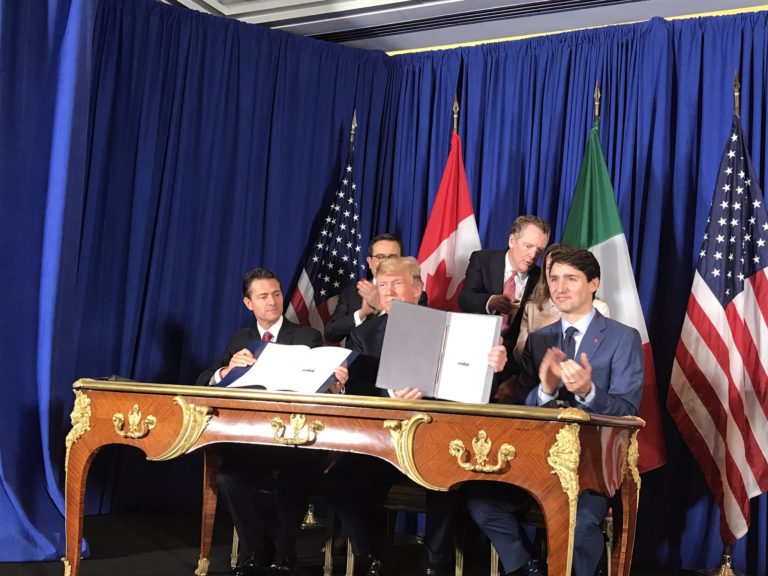
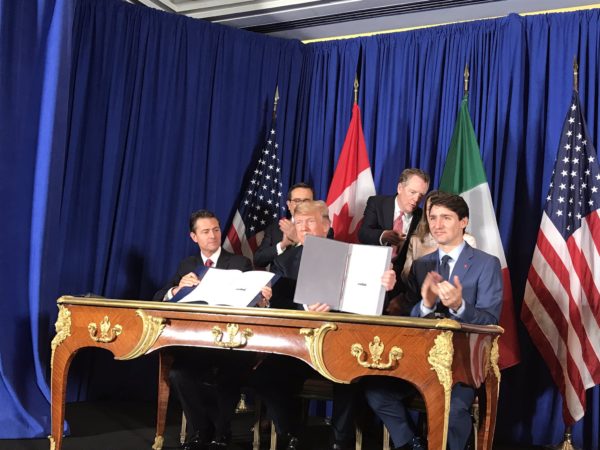
Despite the hyper-partisan political landscape in Washington, on January 16, 2020 the Senate approved the USMCA trade deal. Congress had previously passed the legislation on December 19, 2019 by a vote of 385-41, and Mexico’s Senate passed the legislation on June 19, 2019 by a vote of 114-4. That leaves only Canada’s Parliament left to ratify the successor to NAFTA — which may not be as straightforward as once expected.
That’s because the Canadian government is currently led by the Liberal
Party, which has a minority of seats in the House of Commons (a.k.a.
Parliament). For those unfamiliar with the Westminster system, this basically
means that the Liberal Party — which was in power during the extensive and
often thorny negotiations that brought about the USMCA — does not have enough
votes to unilaterally ratify the new trade deal. As such, it must “reach across
the aisle” and get support from at least 13 Parliamentarians from other
parties; namely the Conservatives (right-leaning), the New Democrats
(left-leaning), or the Bloc Quebecois (based in the Canadian province of
Quebec, and mandated to exclusively focus on promoting legislation that
benefits Quebec).
However, those who have been eagerly waiting for the trade uncertainty to end — everyone from cross-border shoppers buying organic kratom, to giant logistics and manufacturing companies — can probably afford some cautious optimism, given that there are likely enough votes among the pro-business Conservatives to push the USMCA through the Canadian parliament sometime during 2020.
While NAFTA was not wholly beloved in Canada — particularly across labor groups — the USMCA is even less popular. Among the most vocal opponents is the country’s small, yet politically powerful dairy producers who have historically benefited from strong protective quotas (which Canadians call “supply management”) to keep U.S. dairy producers from tapping into the lucrative Canadian market valued at $16 billion annually. While these protective quotas still exist in the USCMA, they have been significantly weakened — fulfilling a longstanding Trump campaign promise. Another major change is the sunset clause, which calls for the USMCA to expire 16 years after trilateral ratification. However, to avoid trade chaos, the deal is subject to review every six years, at which time the three countries can mutually agree to extend it if they wish. Considering that it took more than two years to negotiate the USMCA, it’s hard to imagine that any potential extensions will be any less complicated, confrontational or controversial. Time will tell, and we’ll be watching closely.
In a televised address on September 11, 2019, President Donald Trump dropped a bombshell on the U.S. vaping industry by announcing his intention to ban e-liquid across the country in all flavors except tobacco. The stated reasons behind the ban were twofold. First, a terrible lung illness relating to vaping had just begun to sweep across the country, and health officials didn’t yet understand that the illness was caused by the use of illegal cannabis products rather than legal nicotine products. Second, it had become obvious by 2019 that underage use of vaping products had taken hold across the country and wasn’t going to resolve itself any time soon. Members of the federal government felt that, without direct action, the number of teen vapers would only continue to grow.
What happened next was a firestorm that no one in the Trump
administration – not even Trump himself – could ever have predicted.
Trump Underestimates the Importance of Vaping Voters
The first sign that President Trump potentially made a grave mistake on September 11 came in the form of widespread reports suggesting that Trump’s allies in the Republican party were unhappy about the proposed e-liquid flavor ban. As it turned out, Trump had failed to consider the number of people he’d be offending – and more importantly, where those people lived – before proposing the ban. In the 2016 Presidential election, Trump won by extremely narrow margins in key battleground states such as Florida, Michigan, Ohio, Pennsylvania and Georgia. The margins were smaller, in fact, than the populations of people who vape in those states.
Many of those who vape claim that they will vote based on
that issue alone and will vote against anyone who limits their access to vaping
products. If what those people say is true, banning all flavored e-liquids
could easily lead to a loss of support in the battleground states in which
Trump won in 2016 – and that could easily ruin Trump’s bid for reelection in
2020.
Trump largely went silent on the vaping issue after his September 11 announcement. News reports suggested that Trump hadn’t been aware before the announcement of the impact that a total e-liquid flavor ban would have on his support among voters or on small businesses across America. The loss of the country’s vape shops would also mean the loss of tens of thousands of jobs – not exactly the kind of event that Makes America Great Again.
Trump Administration Proposes a Compromise on the Vaping Issue
By the end of 2019, news reports suggested that the
possibility of an all-out ban on all flavored e-liquids was no longer on the
table. By that time, President Trump had met with representatives from the
vaping and tobacco industries along with various public health advocates. The
meetings gave Trump a better understanding of the impact that a flavor ban
would have on the economy and on his support among adult vapers. In addition,
it was very clear by then that the vaping-related lung illness had nothing to
do with commercial nicotine e-liquid products.
In the end, the Trump administration did two things in an
attempt to curb teen vaping.
The federal government raised the minimum age nationwide
for buying tobacco and vaping products from 18 to 21. That was done with the
goal of preventing 18-year-old students from buying things like JUUL pods and giving
them to younger students.
The FDA removed all pre-filled vape pods and
cartridges in flavors other than tobacco and menthol from the market. Bottled
e-liquid for refillable vaping devices remained legal in all flavors. Teen
vapers overwhelmingly prefer the JUUL e-cigarette brand – which uses pre-filled
pods – and in surveys, underage vapers have said that sweet flavors are a major
part of what attracts them to vaping. In removing those products from the
market, the government hopes that vaping will become less attractive to teens.
The government conducts a yearly survey of students to gauge the effectiveness of its tobacco control policies. The results of that survey are released around the end of the year. As of late 2019, more than 5 million teens – about 27.5 percent of high school students and 10.5 percent of middle school students – reported vaping regularly. We will find out in late 2020 whether the government’s new policies have done anything to reduce teen nicotine use.
How Will Vaping Influence the 2020 Presidential Election?
In a private Oval Office meeting in early 2020, President Trump reportedly expressed regret over his involvement in federal vaping policy. Supposedly, he said that he “never should have done that [expletive] vaping thing.”
The reason for Trump’s unhappiness, however, has nothing to
do with the infringement on vapers’ rights or the impact that the government’s
policies may have on small business. The problem is that Trump unwittingly made
himself the face of those policies when he could have easily left the decisions
to Congress and the FDA and let others handle the political fallout.
The government’s new vaping policies are a compromise, and a
compromise means that none of the stakeholders are completely happy. On one
side, Trump is dealing with angry adult vapers who are upset over the lack of
respect for their rights and angry about the fact that the government opted to
punish everyone instead of going after the individual companies that obviously
stepped over the line and marketed their products inappropriately.
On the other side, Trump is dealing with angry tobacco control activists who believe that the government’s new policies haven’t gone far enough – and, in terms of combating teen vaping, they are probably correct. Teens might say that the flavors the flavors of the products have enticed them to vape, but that isn’t really true. Youth-oriented marketing enticed those teens to vape, and the extremely high nicotine strengths of products like JUUL kept them coming back. Banning flavored pods isn’t going to stop teens from vaping when they’re already addicted to nicotine.
Tobacco control has always been a contentious topic, and the
teen vaping issue is not going away. If President Trump loses his bid for
reelection in 2020, it’s entirely possible that it’ll be because he “did that
vaping thing.”
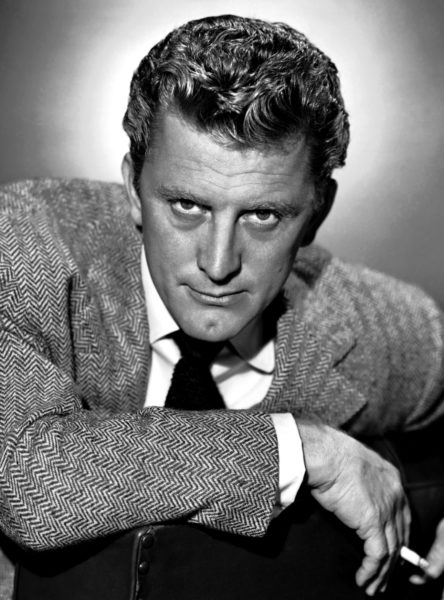
Hollywood legend Kirk Douglas, whose
acting career spanned seven decades, has died at the age of 103.
Kirk Douglas, a stage and screen
actor, was well-known for a range of roles, including the 1960 classic
Spartacus, in which he played the titular character.
Born in New York in 1916, Kirk
Douglas rose to prominence during Hollywood’s “golden age”, earning
his first Oscar nomination for the 1949 film
Champion.
The legendary actor was also the father of Oscar-winning actor Michael Douglas.
Michael Douglas said in a statement:
“It is with tremendous sadness that my
brothers and I announce that Kirk Douglas left us today.”
“To the world, he was a legend, an actor from the
golden age of movies… but to me and my brothers Joel and Peter he was simply
Dad,” the statement read.
“Let me end with the words I told him on his last
birthday and which will always remain true. Dad – I love you so much and I am
so proud to be your son.”
Michael Douglas’s wife and Kirk’s
daughter-in-law, Welsh actress Catherine Zeta Jones, posted a photo of the two
together, writing: “I shall love you
for the rest of my life. I miss you already.”
Kirk Douglas was prolific as a film actor, with more than 90 credits to his
name – ranging from the 1940s to the 2000s.
He is perhaps best-known for Spartacus,
a Stanley Kubrick film which won four Oscars and was so popular that its iconic
“I am Spartacus” scene entered the pop cultural lexicon.
Kirk Douglas was himself nominated for an Oscar three times – for Champion (1949), The Bad and the Beautiful (1952), and Lust for Life (1956). He eventually won the honorary award in 1996
in recognition of his 50 years in the industry.
The actor faced difficulties in his personal life. He narrowly survived a
helicopter crash in 1991 that left two people dead. Five years later, he
suffered a major stroke that affected his speech.
In 2004, his son Eric died at the age of 46 of an accidental drug overdose.
In his later years, Kirk Douglas turned his attention to charity. He donated millions of dollars to charitable causes and helped fund an Alzheimer’s unit at a retirement home in Los Angeles.
A Pegasus Airlines Boeing 737 landing at an
airport in Istanbul has skidded off the runway and broken into three parts,
killing one person and injuring more than 150, Turkish officials say.
The plane was carrying 171 passengers and six crew members from Izmir
province in the west when it crashed at Sabiha Gokcen airport.
The jet was trying to land in heavy tailwinds and rain.
The airport was closed and flights diverted after the accident.
According to Turkish media, the majority of people on board were Turkish but
there were also about 20 foreign nationals.
Istanbul Governor Ali Yerlikaya said: “Unfortunately,
the Pegasus Airlines plane couldn’t hold on the runway due to poor weather
conditions and skidded for around 50-60m [164-196ft].”
The governor said the plane then fell between 30 and 40 meters off the end
of the runway.
Turkey’s Health Minister Fahrettin Koca confirmed a Turkish citizen had died
and 157 other people had been injured. He said none of the wounded people were
in a critical condition.
Video footage showed passengers climbing through one of the large cracks to
escape via one of the wings, and dozens of rescuers working around the jet.
Other footage on social media showed a blaze inside the aircraft, which was
later put out by firefighters.
Transport Minister Mehmet Cahit Turhan said authorities had not yet been
able to speak to the pilots, a Turkish national and a South Korean, who were
believed to have been injured in the accident.
Meanwhile, Istanbul’s public prosecutor has launched an inquiry.
The low-cost Pegasus Airlines has a fleet of 83 aircraft – 47 Boeings and 36
Airbus planes – and has been flying for 20 years.
A Pegasus Boeing 737 coming in from Sharjah in the United Arab Emirates
skidded off the runway at the same airport on January 7. There were no
casualties but the airport had to be temporarily closed.
Another Pegasus Boeing 737 also skidded off the runway at Trabzon airport in January 2018, plunging down the side of a cliff overlooking the sea. There were no casualties.
Hong Kong has decided to impose a
mandatory 14-day quarantine on all visitors from mainland China as it battles
to prevent the spread of a coronavirus outbreak.
The policy comes into effect on February
8, but officials refused to close the border entirely, as demanded by medical
staff who have gone on strike.
Hong Kong, which has 21 confirmed
cases and one fatality, suffered 300 deaths in the SARS outbreak in 2002-2003.
There are 24,300 confirmed coronavirus
cases and 490 deaths in mainland China.
Those figures included an additional
4,000 cases and 65 deaths on February 4.
The new virus has spread overseas,
with 25 nations confirming a total of 191 cases, although there has so far been
only one death, in the Philippines.
The WHO has declared the outbreak a
global health emergency. On February 5, WHO chief, Tedros Adhanom Ghebreyesus
appealed for $675 million to fund a three-month response plan.
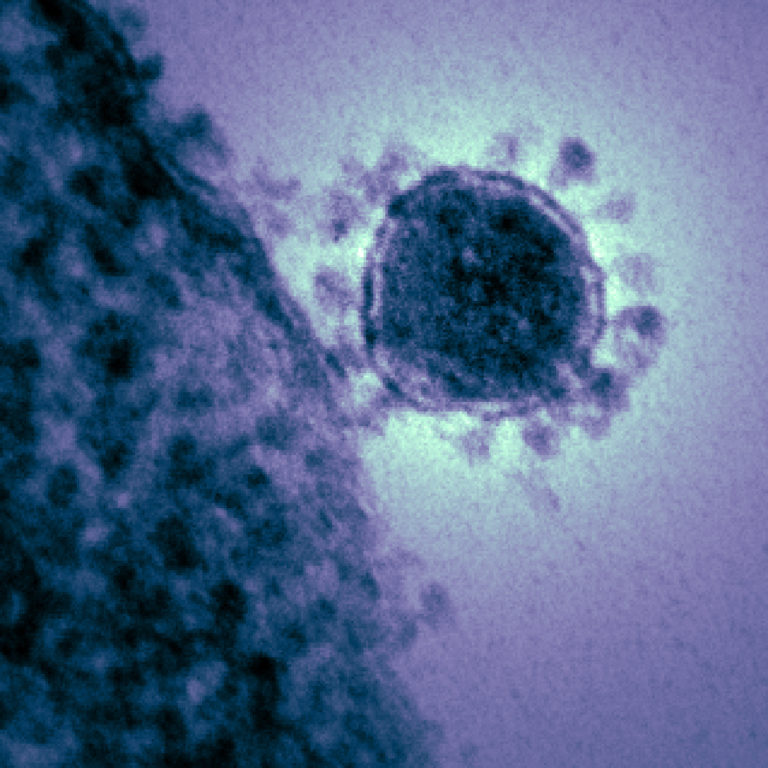
The coronavirus causes severe acute respiratory infection and symptoms usually start with a fever, followed by a dry cough. Most people infected are likely to fully recover – just as they would from a flu.
Hong Kong Chief Executive Carrie Lam
said anyone arriving from the mainland, including foreigners, would be quarantined
for 14 days from February 8, although she did not say how this would be
imposed.
It is unclear where the quarantines
would take place or whether Hong Kong residents could spend the time at home.
Tens of thousands of people arrived
from the mainland on February 4.
Carrie Lam has not moved to close the border entirely, although thousands of
medical staff on February 5 entered the third day of their strike over the
issue and have threatened to escalate their action.
Hong Kong will, however, close the Ocean and Kai Tak cruise terminals.
Some 3,600 passengers and crew on the World Dream, docked at Kai Tak, are
being tested for the virus after three Chinese passengers who were on the ship
between January 19 and 24 tested positive after disembarking.
Hong Kong remains concerned about a repeat of the deadly Severe Acute
Respiratory Syndrome (SARS) outbreak, although the mortality rate of the new
virus is much lower than that of SARS, which was around 9.6%.
There have been massive queues for masks which are in short supply and are
selling at inflated prices.
Separately, the Hong Kong-based airline Cathay Pacific is asking 27,000 staff to take three weeks unpaid leave over the coming months as it deals with the impact of the outbreak.
According to Japanese health authorities, at
least 10 people on board the Diamond Princess cruise ship docked in the port of
Yokohama have tested positive for coronavirus.
Almost 300 of the 3,700 people on the cruise ship have been tested so far.
The number of infected could rise.
The checks began after an 80-year-old Hong Kong man who had been on the ship
last month fell ill with the virus.
Some 3,600 people on a second cruise ship docked in Hong Kong are also being
tested.
Chinese health authorities are stepping up efforts to control the spread of
the virus, with approximately 18 million people in the east of the country now
required to stay at home.
In Wuhan, the epicenter of the virus, 11 large public venues including
sports arenas are being turned into makeshift hospitals to provide an
additional 10,000 beds for the sick. Two new hospitals have already been built
there since the outbreak started.
President Xi Jinping said China’s preventive measures were “achieving a
positive effect”, state media reported. He said China was confident and
capable of winning the war against the virus, after authorities were criticized
for their initial handling of the outbreak.
The World Health Organization (WHO) has declared a global health emergency
over the outbreak but said it did not yet constitute a “pandemic”, or
the worldwide spread of a new disease.
However, the number of cases in
China jumped by nearly 4,000 on February 4 alone to more than 24,300, with
another 65 deaths bringing the total to 490.
The new coronavirus causes severe
acute respiratory infection and symptoms usually start with a fever, followed
by a dry cough. Most people infected are likely to fully recover – just as they
would from a flu.
There is a much smaller number of
cases in countries around the globe other than China – two people outside of
mainland China have died of the disease.
The Hong Kong man believed to be the
source boarded the cruise ship in Yokohama, Japan, on January 20, and
disembarked in Hong Kong on January 25. He was only later found to have tested
positive for the virus.
Officials on the cruise ship began
screening guests on February 3, and the vessel was placed under quarantine on
February 4.
Passengers and crew on the ship will
now be under quarantine for 14 days. The incubation period of the virus is
believed to be around two weeks.
All 10 cases are in those over the
age of 50 and one is in their 80s, Japanese broadcaster NHK said.
Two of them are said to be Japanese, and none are in “serious condition”, it added.
Pete Buttigieg and Bernie Sanders are taking
the lead in the Iowa caucuses, the first vote to choose the Democratic
candidate to run against President Donald Trump in November’s election.
The vote has been chaotic, beset by technical problems and delays in
reporting results.
According to Iowa’s Democratic Party, data from 71% of precincts showed Pete
Buttigieg on 26.8%, with Bernie Sanders on 25.2%.
Elizabeth Warren was third on 18.4% and Joe Biden fourth on 15.4%.
According to the other preliminary results released on February 4 from all
of Iowa’s 99 counties, Amy Klobuchar was on 12.6%, and Andrew Yang on 1%. Tom
Steyer and Tulsi Gabbard were on less than 1%.
However, the state party has still not declared a winner from February 3
vote. Democrats have blamed the delay on a coding error with an app being used
for the first time to report the votes.
Iowa was the first contest in a string of nationwide state-by-state votes,
known as primaries and caucuses, that will culminate in the crowning of a
Democratic nominee at the party convention in Milwaukee, Wisconsin, in July.
Eleven candidates remain in a Democratic field that has already been
whittled down from more than two dozen.
The results represent the share of delegates needed to clinch the party
nomination under America’s quirky political system. Iowa awards only 41 of the
1,991 delegates required to become the Democratic White House nominee.
In the popular vote count, partial results showed Bernie Sanders leading
with 32,673 ballots, while Pete Buttigieg was second at 31,353.
However, Pete Buttigieg, 38, came top in certain rural areas with smaller
populations, and so far has more delegates.
Iowa Democratic Party Chairman Troy Price told a news conference on February
4 the fiasco had been “simply unacceptable”.
“I apologize deeply for
this,” he said of the turmoil, which has provoked calls for Iowa to
lose its coveted spot atop the presidential voting calendar.
“This was a coding error,”
Troy Price said, while insisting the data was secure and promising a thorough
review.
Elizabeth Warren was third with 25,692, followed by Joe Biden at
16,447 and Amy Klobuchar at 15,470.
State party officials earlier said
the problem was not the result of “a hack or an intrusion”.
Officials were being dispatched
across the Hawkeye state to retrieve hard-copy results.
They were matching those numbers
against results reported via a mobile app that many precinct captains said had
crashed.
The mobile app was developed by tech
firm Shadow Inc., run by veterans of Hillary Clinton’s failed 2016 presidential
campaign.
The app was put together in just two
months and had not been independently tested, the New York Times reported, quoting people briefed on the matter by the
Iowa Democratic Party.
The Democratic Party in Nevada, where
caucuses will be held on February 22, has reversed a decision to use the
company’s software.
Voters flocked on February 3 to more
than 1,600 caucus sites, including libraries, high schools and community centers.
President Trump said earlier that
the Iowa Democratic caucuses had been an “unmitigated disaster”.
If elected, Pete Buttigieg would be
the first openly gay US president.
The 38-year-old is the former mayor
of South Bend, Indiana, a city of just over 100,000 people.
Pete Buttigieg is a former Harvard
and Oxford University Rhodes scholar, who served as a military intelligence
officer in Afghanistan and used to work for global management consultancy
McKinsey.
Rivals say Pete Buttigieg, who is younger than Macaulay Culkin and Britney Spears, is too inexperienced to be US president.
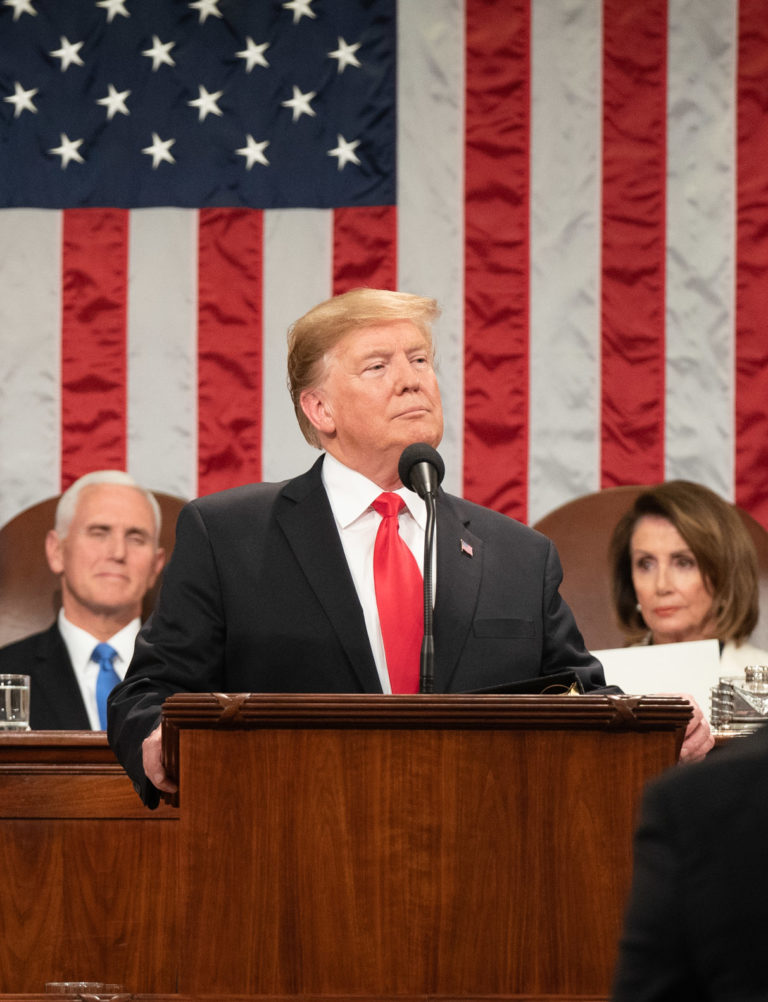
At his annual State of the Union address, President
Donald Trump has hailed the “great American comeback”.
His speech to Congress exposed sharp divisions
at the top of US politics.
President Trump was speaking on the eve of his expected acquittal on
corruption charges in his impeachment trial.
At one point the Democratic House Speaker Nancy Pelosi ripped up a copy of
the president’s speech behind him.
Donald Trump delivered the nationally televised speech in the
Democratic-controlled House of Representatives, where he was impeached in
December.
His trial in the Senate culminates on February 5 but with Republicans in
charge there he is all but certain to be cleared and escape being thrown out of
office.
President Trump did not mention
impeachment at all in his speech although he did jab at Democrats.
Republican lawmakers chanted
“four more years” as Donald Trump prepared to speak, urging him on
for November’s White House election.
The State of the Union address is a
speech delivered by the president to Congress towards the beginning of each
calendar year in office.
The speech is usually used as a
chance to report on the condition of the nation, but also allows the president
to outline a legislative agenda and national priorities.
House Speaker Nancy Pelosi has been
one of the president’s fiercest critics – she was the one who first launched
formal impeachment efforts last year. President Trump has frequently taunted
her as “Crazy Nancy”.
It was the first time the two had
come face-to-face since Nancy Pelosi stormed out of a White House meeting four
months ago.
Before President Trump began speaking
at the podium in the well of the House, he appeared to snub the outstretched
hand of Nancy Pelosi, America’s most powerful elected Democrat.
The House speaker, critics noticed,
skipped the traditional introduction welcoming the president as a
“distinct honor”.
When President Trump accused
Democrats of planning to force American taxpayers to provide unlimited free
healthcare to undocumented immigrants, Nancy Pelosi was observed twice
mouthing: “Not true.”
Nancy Pelosi stunned onlookers by
shredding a copy of the president’s remarks as he concluded.
She told reporters afterwards her
gesture was “the courteous thing to do, considering the
alternatives”.
Nancy Pelosi did rise to applaud the
president more than once, including when he promoted his pet project of
infrastructure investment, a possible area of bipartisan co-operation.
President Trump struck an upbeat
note in a speech lasting one hour and 18 minutes that contrasted sharply with
his lament of “American carnage” in his 2017 inaugural presidential
address.
In an implicit rebuke to his
predecessor Barack Obama, President Trump told his audience: “In just three short years, we have
shattered the mentality of American decline and we have rejected the downsizing
of America’s destiny.
“We are moving forward at a pace that was unimaginable
just a short time ago, and we are never going back!”
President Trump repeatedly swiped at
Democrats, including left-wing candidates such as Bernie Sanders, who are vying
to challenge him for the presidency.
As is tradition, President Trump
invited several special guests, including Venezuelan opposition leader Juan
Guaidó, military veterans and the brother of a man killed by an undocumented
immigrant.
In a move certain to infuriate
liberal critics, President Trump announced he would award the Presidential
Medal of Freedom, America’s highest civilian honor, to firebrand conservative
radio host Rush Limbaugh, who revealed this week he has lung cancer.
First Lady Melania Trump bestowed
the honor on an emotional Rush Limbaugh as the president spoke.
A protester was escorted from the
chamber while President Trump defended gun rights. It was Fred Guttenberg, the
father of Jaime Guttenberg, a student killed in a mass school shooting at
Parkland, Florida, in February 2018.
Fred Guttenberg was a guest of Nancy
Pelosi.
Each year after the State of the Union speech, a member of the main
opposition party is tasked with responding and this year it fell to Michigan
Governor Gretchen Whitmer.
The governor accused the president of failing to fix America’s problems.
She said: “Bullying people on
Twitter doesn’t fix bridges – it burns them.”
As they did last year, many female Democrats – including Nancy Pelosi – wore
white as tribute to the suffragettes who won the vote for US women a century
ago.
Several liberal Democratic lawmakers, including Alexandria Ocasio-Cortez of
New York and Maxine Waters of California, boycotted President Trump’s address.
Alexandria Ocasio-Cortez tweeted that she would “not use my presence at
a state ceremony to normalize Trump’s lawless conduct & subversion of the
Constitution”.
Other left-wing Democrats, including Rashida Tlaib of Michigan, walked out
during President Trump’s speech.
As is traditional during the State of the Union, one member of the president’s
cabinet did not attend the address.
He or she remains at a secret location to make sure the government can
continue should calamity befall the nation’s president, vice-president and
other top leaders.
This time, that person, who is known as the designated survivor, was Interior Secretary David Bernhardt.