A dramatic footage of a teenager named Tyquan Sewall being shot at point-blank range in a gun ambush outside Nostrand McDonald’s has been released today.
The images, which show the victim thrown into the road after being hit four times, was caught on camera in Brooklyn, New York.
The teenager was left fighting for his life.
New York police have launched a manhunt to catch three gunmen who carried out the planned daylight attack on Nostrand Avenue, Flatlands.
The footage shows Tyquan Sewall, 18, who lives just blocks from the McDonald’s and nearby Brooklyn College, being shot at point-blank range.
The first bullet grazed the left side of the victim’s head, sending him staggering backwards.
The footage shows Tyquan Sewall, 18, who lives just blocks from the McDonald's and nearby Brooklyn College, being shot at point-blank range
Tyquan Sewall was then hit three more times and sent rolling out into the street, passing through at least two lanes of traffic.
Terrified onlookers fled in panic as the shots rang out outside the busy restaurant chain.
The weapon used was a .32-caliber Smith & Wesson. The man who fired the gun was wearing a bright red jacket.
Two of the men then ran over and take the sneackers Tyquan Sewall had dropped onto the street before making off as police arrive.
The shooting took place in Flatlands at around 3:00 p.m. on Tuesday. The victim was hit in the chest, groin and leg and is now in a critical condition in hospital.
The gunman in a red coat fires more shots as the victim, Tyquan Sewall rolls on the road
Police officers said before the shooting Tyquan Sewall had got into an argument on nearby Flatbush Avenue.
During that argument, a man told Tyquan Sewall to come with him to the McDonald’s, police said.
Tyquan Sewall followed, but couldn’t see a gun being passed around the three men. Two went in while one waited at the door as Tyquan Sewall approached.
Then the two men inside McDonald’s came out and the gun was handed to one of them who opened fire.
Police said the attackers fled out of the restaurant’s back entrance and dumped the loaded six-shooter in a rubbish bin a block away.
NYPD spokesman Paul Browne said: “What you see here is a pretty elaborate choreography of handing off the gun from the first player, to the second player and to the gunman – all along luring the victim to the ambush.”
Tyquan Sewall is in critical condition at Kings County Hospital, New York.
Walter Payton, Chicago Bears running back, is described in Sweetness: The Enigmatic Life of Walter Payton, which is set to be released on October 4.
The book, written by Jeff Pearlman, contributor to Sports Illustrated, alleges the American football player constantly made drug abuse when he was playing and after his retirement, he had affairs and felt into a depression that almost led him to suicide.
The author said he worked on the book two and a half years and interviewed 678 people. Sweetness narrates Walter Payton‘s life, from his childhood in Mississippi, his college years at Jackson State, his NFL career (13 years) and his life after his career ended in 1987, to his death at 45 from cholangiocarcinoma (bile duct cancer) in 1999.
Walter Payton, Sweetness, became the first African American to break a record that was held only by whites in the NFL during modern football.
Walter Payton had primary sclerosing cholangitis, a rare and deadly autoimmune liver disease liver disease, and some of his painkillers abuse might be related to this illness.
“Payton popped Darvon robotically during his playing days—says [Bud] Holmes, “I’d see him walk out of the locker room with jars of painkillers, and he’d eat them like they were a snack”—and also lathered his body with dimethyl sulfoxide, a topical analgesic commonly used to treat horses. Now that he was retired, the self-medicating only intensified. Payton habitually ingested a cocktail of Tylenol and Vicodin. […] in 1988, Payton visited a handful of dental offices, complaining of severe tooth pain. He received several prescriptions for morphine and hit up a handful of drugstores to have them filled. When one of the pharmacists noticed the activity, he contacted the police, who arrived at Payton’s house and discussed the situation.” read an excerpt published in Sports Illustrated.

The painkiller Darvon is an opioid narcotic used to treat mild to moderate pain was first approved in the 1950s and It has been pulled by the market. Walter Payton also obtained Ritalin from a friend whose son was prescribed pills.
Walter Payton used nitrous oxide prior and after retirement.
“Back when Payton drove his own RV to Bears training camp, he used to load the rear of the vehicle with tanks of nitrous oxide, commonly known as laughing gas. At nights and during breaks in the action, players sneaked into Payton’s trailer, loaded the nitrous oxide into balloons, then carried them around while taking hits. The goofy laughter could be heard throughout the training facility.”
After his rigorous fitness regime during his playing career (running up and down a steep hill repeatedly) once he retired, he started drinking beer and eating tons of junk food. Wendy’s gave Payton a card granting a free lifetime supply of hamburgers at the fast food chain, Payton dumped 10 sugar packs into each cup of coffee and enjoyed pork rinds with hot sauce.
Walter Payton rushed for 16,726 yards and scored 110 touchdowns.
Walter Payton’s both estranged wife (Connie) and girlfriend (Lita) attended his Hall of Fame, wife in the front row and mistress in the second.
“Shortly after he learned he’d been voted into the Hall of Fame, Payton spoke with Lita Gonzalez [not her real name], a New Jersey-based flight attendant with whom he’d been in a tempestuous relationship since they’d met at the Michael Spinks-Mike Tyson heavyweight title fight in Atlantic City in 1988. […] “She was insisting she be seated in the front row,” says Tucker. “We said, ‘Lita, are you insane? We’re marketing this man as a family-friendly spokesperson. His whole image is based around decency. You will ruin him.“
Holmes and Payton’s executive assistant, Ginny Quirk, recall receiving suicidal calls at all hours during the mid-1990s. The threats came after fights with Connie or Lita or when he worried about finances. Payton refused to see a therapist.
Payton said he imagined murdering those around him, then killing himself and he ended the letter to an unnamed friend by admitting that he needed help but that he had nowhere to turn. The excerpts do not indicate doctors think Payton suffered brain damage while playing, affecting his mental state.
Andre Agassi also in his recent autobiography detailed his previously unknown drug use.
Walter Payton caught 492 passes for 4,538 yards and 15 touchdowns and set team records, most career rushing yards, receptions, touchdowns.
Sweetness: The Enigmatic Life of Walter Payton contains both fact and fiction said Walter Payton’s family.
“Walter, like all of us, wasn’t perfect. The challenges he faced were well known to those of us who loved and lived with him. He was a great father to Jarrett and Brittney and held a special place in the football world and the Chicago community. Recent disclosures — some true, some untrue — do not change this. I’m saddened that anyone would attempt to profit from these stories, many told by people with little credibility,” read a statement signed by Connie Payton and family.
“When we take the field each Sunday, we represent the great players like Walter who helped build the rich tradition of our organization. Nothing will change our feelings for a man we have the deepest respect for and miss having around Halas Hall to this day,” said The Chicago Bears.
“There’s something important about learning that even the greatest among us have their burdens. Whether you’re a Hall of Fame running back or a guy moving cement, we all have issues. No one lives up to the pedestal. . . . The goal is to find out who he was and how he lived. I’m very defensive about that. You want to write an honest and accurate biography,” Jeff Pearlman said.
NFL named its Man of the Year Award after him, the Walter Payton Award, the Walter Payton Man of the Year Award.
The book includes also brighter stories about Walter Payton.
Walter often insisted on first playing catch with kids who asked him for autographs and then offer them words of inspiration. Walter Payton also delighted a cancer-ridden youngster on a flight.
He was graceful on the field and he was strong when facing terminal cancer. Walter Payton grew up in segregated Mississippi and calmed racial tensions there with his on-field heroics.
Quirk tells Pearlman that, after he appeared thin and gaunt at a 1999 news conference announcing his son’s decision to attend Miami University, many people asked her if he was dying of AIDS.
Brittney, Jarrett and Connie Payton at Walter Payton Man of the Year Press Conference (Photo by Ronald Martinez/Getty Images)
Walter Payton had been diagnosed with primary sclerosing cholangitis at the Mayo Clinic in December 1998. He gathered his family in the basement of their South Barrington home, told them about diagnosis and said a liver transplant would solve the problem. He told his fans about his diagnosis three days after his son’s press conference.
Payton reached out to his children as he was dying. Walter Payton, who also kept a home in West Dundee, had moved back into the South Barrington home in July 1999 and took turns staying in Jarrett’s and Brittney’s rooms.
“At the time I didn’t get it, but now I think it’s so cool he wanted to share himself with us,” Jarrett says in the book.
Walter Payton was born in July 25, 1954 and died on November 1, 1999 from terminal cancer, he married Connie Norwood in 1976.
Walter Payton was known around the NFL as Sweetness. He was a nine-time Pro Bowl selectee. He was elected into the Pro Football Hall of Fame in 1993. He started his professional career with the Bears in 1975. Walter Payton (34) won two NFL Most Valuable Player Awards, and won Super Bowl XX with the 1985 Chicago Bears. Walter Payton rushed for 16,726 yards and scored 110 touchdowns. He became the first African American to break a record that was held only by whites in the NFL during modern football (1955–present). He caught 492 passes for 4,538 yards and 15 touchdowns, set team records, most career rushing yards, receptions, touchdowns.
His cancer was in a stage that did not benefit from liver transplant, but Walter Payton spent his final months as an advocate for organ transplants.
Although his cancer was in a stage that did not benefit from liver transplant, he spent his final months as an advocate for organ transplants.
Don Yaeger worked with him during the last weeks of his life to create his autobiography, Never Die Easy, the title was his motto which he attributed to Bob Hill, his coach at Jackson State (2000).
NFL named its Man of the Year Award after him, the Walter Payton Award, the Walter Payton Man of the Year Award.
Walter Payton’s Roundhouse in West Dundee is an entertainment center and includes authentic memorabilia at the Walter Payton Museum.
Sweetness: The Enigmatic Life of Walter Payton trailer
[youtube aN9VSGZJ9Zg]
Walter Payton biography, the cancer diagnosis (video)
Police have found five severed heads stuffed in a sack outside a primary school in the Pacific coast resort of Acapulco, in Mexico.
The macabre discovery comes after drugs gangs threatened to attack elementary school teachers if they did not pay half their wages to the drugs cartels.
The extortion demands forced around 130 schools in the city to close earlier this month, after administrators and parents decided it was not safe enough to start classes.
The severed heads were found on Tuesday inside a sack that had been placed inside a small wooden crate, the Guerrero state public security secretariat said.
According to Mexican police say the five heads were positioned next to a handwritten message threatening three alleged drug traffickers and Guerrero State Governor Angel Aguirre, who had promised a series of measures to combat the criminal gangs.
A police officer in Acapulco stands next to the sack containing five severed heads which has been placed in a small wooden crate
The message, in an apparently sarcastic tone, told people to thank the governor for continuing “this war”.
All heads appear to be of men, but some of the five headless bodies found elsewhere in the city the previous day were too badly burned to immediately determine their gender.
The horrific event comes just days after police found a woman’s decapitated body in the Mexican border city of Nuevo Laredo, alongside a handwritten sign saying she was killed in retaliation for her postings on a social networking site.
At the end of August, as the new school year began, dozens of teachers in Acapulco said drugs gangs had threatened them with violence if they did not hand over half their salaries from October 1.
Administrators and other personnel also refused to go to work and many schools were left empty and padlocked for two weeks.
The teachers have since been on strike, leading to the closure of more than 100 schools. Earlier this month, they took to the streets to protest at the situation.
Guerrero State Governor Aguirre has promised a series of measures, including increased police patrols and the installation of security cameras and panic buttons in schools.
Even with those security measures, teachers say they still fear for their own and pupils’ safety.
A rare breed of whale was found dead 800 yards (730 meters) from the shoreline in the Humber Estuary, UK.
The 33feet (10 meters) mammal, thought to be a Sei whale, was discovered in salt marshes on the north bank of the River Humber.
It is also thought that the whale became stranded in shallow waters, rolled over onto its blowhole and died, before the tide retreated and left it behind, near the village of Skeffling.
The Yorkshire Wildlife Trust has spent the summer monitoring the area due to an increase in whale sighting and activity.
The 33feet (10 meters) whale was found beached 800 yards (730 meters) from the shoreline of the Humber Estuary, UK
Conservationists believe the increase in the number of strandings could be explained by a change in sea currents bringing colder streams of Arctic water into the North Sea and with them whales that would not normally pass so close to the UK shoreline.
Sea experts who examined the animal said they are 95% certain it is a female Sei whale and say the huge sea creature could simply have been looking for food when the tide turned.
Kirsten Smith, North Seas Living Seas manager at Yorkshire Wildlife Trust, said:
“The area where the whale was found is salt marsh, which is still connected to the sea.
“With the high tide the whale probably got carried up on to the salt marsh, got pushed further in shore and then got stuck when the tide went out.
“The salt marsh is one of several components of the Humber Estuary, and is further in than the mud flats and sand components.
“Sometimes whales come into the shallow water looking for food and get stuck.
“It can be illness or confusion in individual animals, but for it to happen twice in the area, and with reports of another whale nearby now, that could be more than just coincidence.”
The mammal is thought to be a Sei whale, a species not normally stranded on the British coast
The Yorkshire Wildlife Trust has launched a campaign called Petition Fish to encourage to Government to monitor more closely the changes in British marine life.
A spokesman for the Environment Agency said that the whale is likely to have found herself so far in as today marked the day of the highest and lowest tide of the year.
Humber Estuary Services estimate that water levels at Albert Dock, near Hull went as high as 9.5 m by 7:00 a.m. today, and went down to 1.3 m by 2:00 p.m.
The whale, found at 2.30 p.m. last Friday, is the latest of a number to have died in the Humber estuary.
Andy Gibson, of the Yorkshire Wildlife Trust, added that Sei whale strandings were very rare with only three in UK waters in the last 20 years.
Sea experts who examined the animal said they are 95 per cent certain it is a female Sei whale and say the huge sea creature could simply have been looking for food when the tide turned
Andy Gibson said: “It was in shallow water of 4ft -5ft, making contact with the bottom. When it gets in that situation it rolls onto its side and it can cover its blow hole. It is sad but we will be able to learn a lot from it.”
Earlier this month, a young Fin whale – a relative of the Sei – became stranded at Immingham, North East Lincolnshire, and washed up dead near Spurn Point.
Another dead whale was spotted in the river mouth in the last few days but has yet to wash ashore.
The Yorkshire Wildlife Trust has reported a rise in whale sightings this year but no-one is sure why the mammals are making their way to the North Sea.
Over the summer, a pod of around ten Minke whales were regularly spotted off the North Yorkshire coast between Whitby and Scarborough.
Scientists are developing a “stay sober” pill which may help those who get drunk too easily, by limiting the effects of alcohol on their brains.
In the researchers’ experiment, mice given the drug did not even get tipsy, despite being fed enough alcohol to make them stumble and fall over.
The research paves the way for a tablet that stops people from making fools of themselves on a night out.
The new experiment could help explain why some drinkers are “cheap dates” who start slurring their words and losing their inhibitions after one glass of wine, while others can knock back glass after glass with few ill effects.
A new “stay sober” pill is under development after University of Adelaide experiment findings
The Australian scientists who carried out the research focused on the way alcohol affects glial cells, which make up 90% of the brain.
The glial cells play a crucial role in the immune system, helping to fight infections such as meningitis.
When you think about your immune system, you probably think about it fighting off a cold. But new research from the University of Adelaide suggests that immune cells in your brain may contribute to how you respond to alcohol.
“It’s amazing to think that despite 10,000 years of using alcohol, and several decades of investigation into the way that alcohol affects the nerve cells in our brain, we are still trying to figure out exactly how it works,” says lead researcher Dr. Mark Hutchinson from the University’s School of Medical Sciences.
Although scientists know much about how alcohol affects nerve cells, there is also a growing body of evidence that alcohol triggers rapid changes in the immune system in the brain. This immune response lies behind some of the well-known alcohol-related behavioural changes, such as difficulty controlling the muscles involved in walking and talking.
In research published in the latest edition of the British Journal of Pharmacology, Dr. Mark Hutchinson’s team gave a single shot of alcohol to laboratory mice and studied the effect of blocking Toll-like receptors, a particular element of the immune system, on the behavioural changes induced by alcohol. The researchers used drugs to block these receptors. They also studied the effects of giving alcohol to mice that had been genetically altered so that they were lacking the functions of selected receptors.
Researcher Mark Hutchinson said: “When a mouse gets drunk, it is quite similar to a human that’s drunk. It can’t work its motor co-ordination properly. If you stop these immune cells from working, the animals didn’t get drunk.”
The results showed that blocking this part of the immune system, either with the drug or genetically, reduced the effects of alcohol. While the research was carried out on mice, Dr. Hutchinson’s team believes that similar treatments could also work in humans.
“Medications targeting Toll-like receptor 4 may prove beneficial in treating alcohol dependence and acute overdoses,” says Dr. Mark Hutchinson.
This work has significant implications for our understanding of the way alcohol affects us, as it is both an immunological and neuronal response. Such a shift in mindset has significant implications for identifying individuals who may have bad outcomes after consuming alcohol, and it could lead to a way of detecting people who are at greater risk of developing brain damage after long-term drinking.
Demi Moore posted some thoughts about how to deal with “anger” on her Twitter account just on the night before spending the wedding anniversary alone last weekend.
Now, Demi Moore, 48, is facing claims she has “separated” from her husband of six years, Ashton Kutcher amid fresh rumors of infidelity.
Ashton Kutcher, 33, who is 15 years her junior, allegedly had a liaison with another woman after an alcohol-fuelled evening on Friday, according to website Radar Online.
The information was given by “multiple friends of the 23-year-old woman”, identified by another website as Sara Leal.
Sara Leal has reportedly hired a top Hollywood lawyer and gone into hiding.
First picture of Sara Leal, who allegedly had a fling with Ashton Kutcher
It is the second time in a year that Ashton Kutcher has been accused of cheating on Demi Moore.
The latest alleged encounter happened on the 12th floor of the Hard Rock Hotel in San Diego, California, in the early hours of Saturday – the same day of Demi Moore and Ashton Kutcher sixth wedding anniversary.
Ashton Kutcher and the woman had apparently been partying at a club in the city. One fellow clubgoer said: “Ashton didn’t look like someone who was celebrating a wedding anniversary.”
It was the website thedirty.com which identified the young woman as Sara Leal and claimed she wanted $250,000 for her version of events.
The website added that “Kutcher told Sara Leal that him [sic] and Demi Moore are separated and the public doesn’t know yet.”
Ashton Kutcher’s bodyguard was also said to have taken Sara Leal’s mobile phone before she entered the hotel room.
On that same night, the eve of their anniversary, Demi Moore was tweeting from the East Coast, where she is temporarily based.
Demi Moore shared a quote from Greek philosopher Epictetus on September 23, writing:
“When we are offended at any man’s fault, turn to yourself and study your own failings. Then you will forget your anger.”
Demi Moore posted this message on Twitter the night before spending her first wedding anniversary apart from Ashton Kutcher
Three days later, Demi Moore, who has lost weight in recent weeks, posted a picture of herself looking forlorn, with the caption:
“I see through you.”
In other messages this month, Demi Moore said she was “trying to find the light I lost.”
The claims emerged as Star magazine reported: “Ashton and Demi have separated and the marriage is over.”
A source close to Demi Moore and Ashton Kutcher reportedly added: “The relationship ended because of Ashton’s serial cheating. It’s a painful time for Demi.”
Ashton Kutcher was first accused of infidelity in September 2010, when Brittney Jones, 21, said she had sex with the actor at the Beverly Hills home he shares with Demi Moore while she was away.
Brittney Jones told Star: “He looked over our texts and said he wanted me to delete all the messages from him. He then told me he wanted me to delete the texts I had sent to him. He said they could hurt him.”
At the time, the couple, who are worth an estimated $150million, brushed off the allegations.
New reports claim Demi Moore's husband Ashton Kutcher hooked up with a 23-year-old woman last weekend
Ashton Kutcher, who recently took over Charlie Sheen’s role in TV series Two And A Half Men, wrote on Twitter:
“I think Star magazine calling me a <<cheater>> qualifies as defamation of character. I hope my lawyer agrees.”
“Star magazine – you don’t get to stand behind <<freedom of the press>> when you are writing fiction.”
Ashton Kutcher’s spokesman also denied the allegation while Demi Moore tweeted “Excellent point my love!”
Demi Moore, who was previously married to Bruce Willis, started dating Ashton Kutcher in 2003 and they married in 2005.
2011 is the first year they spent their anniversary apart. Demi Moore was in New York to promote a short film which she has directed called Five, while Ashton Kutcher headed to San Diego to party with fellow actor Danny Masterson.
Representatives of Demi Moore and Ashton Kutcher have not commented so far.
A Few Minutes with Andy Rooney ends its weekly appearances on CBS’ 60 Minutes.
On Sunday, October 2, the veteran radio and television writer, Andy Rooney, is expected to make his last regular attendance, he discusses the decision on his 1,097th signature essay.
The 60 minutes‘ curmudgeon told TVNewser in June 2010 he wanted to work on the show until he “dropped dead“. “Until somebody tells me different, I’m not going to quit,” he said.
“There’s nobody like Andy and there never will be. He’ll hate hearing this, but he’s an American original.” He “will always have the ability to speak his mind on ’60 Minutes’ when the urge hits him,” said Jeff Fager, chairman CBS News and the executive producer of 60 Minutes.
Andy Rooney will discuss the decision of leaving "60 Minutes" on October 2 in his 1097th signature essay.
Andy Rooney, who turns 93 on January 14, 2012, started to work with CBS as a writer for Arthur Godfrey’s Talent Scouts in 1949 and began to appear on the show (started in 1968) in 1978 with an essay about the reporting of automobile fatalities on the Independence Day weekend.
His end-of-show part, Three Minutes or So With Andy Rooney (later A Few Minutes with Andy Rooney), began as a summer replacement for the debate segment Point/Counterpoint featuring Shana Alexander and James Kilpatrick.
Andy Rooney began his career in journalism in 1942 writing for Stars and Stripes newspaper. He was one of six correspondents who flew on the first American bombing raid over Germany (1943) and one of the first American journalists to visit the Nazi concentration camps.
“I can’t deny that The War–we call World War II ‘The War,’ as though there had never been another–was the ultimate experience for anyone in it,” he wrote in his book My War.
His wife, Marguerite, died in 2004 of heart failure, after 62 years of marriage. He has four children, the twins Emily and Martha, a daughter Ellen, and a son, Brian.
At 60 Minutes longevity seems to be a habit. Mike Wallace, 93, worked full-time until 2006, then occasionally until 2008. Don Hewitt, the show creator and executive producer, was 81 when he retired in 2004. He died in 2009.
Andy Rooney has become known for his folksy, often curmudgeonly, TV essays on life, culture and news events.
He presents satire on everyday life (the cost of groceries, annoying relatives, faulty Christmas presents) essays on life, culture and news events, or politics.
His essays have been published in books, Common Nonsense (2002), Years of Minutes, (2003). He has won three Emmy Awards for his essays, and a Lifetime Achievement Emmy in 2003.
He has been target of parodies and impersonations (Frank Caliendo, Rich Little, Beavis), and served as subject for one of Saturday Night Live’s parodies on NBC network.
The Andy Rooney Television Collection – His Best Minutes (1993) and Andy Rooney On Almost Everything, Things That Bother Andy Rooney, and Andy Rooney’s Solutions (2006) include his commentaries and field reports.
The writer was criticized he does not want to adapt to the modern times and he is out of touch with contemporary culture (contemporary music). He said never had heard of Justin Bieber, Lady Gaga and Usher in 2009 and said young people probably did not listen to Ella Fitzgerald.
Criticized or praised, Andy Rooney, 92, remains a living legend. The walnut table was made by himself.
Found dull by some people, but in the same outstanding, interesting and funny by others, Andy Rooney remains a living legend and a respectable active old person.
He has always considered himself a writer who incidentally appears on television behind his famous walnut table, made by himself.
“The process by which each of us acquires a reputation isn’t independent of our character. It almost always depends more on the decisions we make than on chance occurrences,” he wrote in his book, Andy Rooney: 60 Years of Wisdom and Wit.
Andy Rooney on vacation: “Avoiding work is hard work”.
Andy Rooney on presents: ”In spite of the old sayings to the contrary, the best presents come in large packages.”
Andy Rooney on cats: ”I have never met a cat I liked.”
Andy Rooney on commerce: ”There are idiots who will buy anything as long as it costs enough.” “Money is a strange concept, right? What ever happened to the beads and shells?”
Andy Rooney on politics: “The best president of my lifetime? Rutherford B. Hayes.”
Andy Rooney on opinion: ”If you wonder what anyone thinks of you, consider what you think of them.” ”Not everyone has a right to his own opinion. If he doesn’t know the facts, his opinion doesn’t count.”
Andy Rooney on sports: “Darryl “Chocolate Thunder” Dawkins was the best player to ever grace a court.”
Andy Rooney on medical advances: “Pray you never live this long.”
Andy Rooney on Heaven: ”My idea of heaven would be to die and awaken in a place that has all my lost things.”
Michael Jackson’s personal assistant has described today, during the second day of Dr. Conrad Murray’s trial, the chaotic moments as the megastar was rushed to hospital where he was pronounced dead.
Michael Amir Williams told the court how Dr. Conrad Murray panicked and asked to be taken back from hospital to Michael Jackson‘s house “to get rid of a cream that the world should never see” as the King of Pop lay dead.
Michael Amir Williams said also that he asked security to place Michael Jackson‘s house on “lockdown” after Dr. Murray repeatedly asked to go back from the hospital to the singer’s mansion.
Michael Jackson’s personal assistant said that he lied to Dr. Murray and told him the keys to his car had been taken by the police as Murray insisted that he be taken back to the house.
Dr. Conrad Murray then asked to be taken “to get food”, but Michael Amir Williams said he again refused.
The court was also played the panicked voicemail that Dr. Conrad Murray left on Michael Amir Williams’ phone before he called 911.
“Call me right away, please. Please call me right away. Thank you.”
Dr. Conrad Murray looked uncomfortable and started touching his neck as he waited for the recording to be played.
Dr Conrad Murray on the second day of Michael Jackson’s death trial in Los Angeles
Michael Amir Williams said that he had received the voicemail at 12:13pm on the day that Michael Jackson died, 11 minutes before the emergency call was placed.
When Williams called Dr. Conrad Murray back two minutes later he was told that Michael Jackson had a “bad reaction” and to “get somebody here immediately”.
Michael Amir Williams said that he was not asked to call 911.
When Williams arrived at Michael Jackson’s Los Angeles mansion, he said he saw the King of Pop’s body being brought down the stairs on a gurney.
Michael Amir Williams, Michael Jackson's personal assistant, told the court that Dr Conrad Murray asked to be taken back from hospital to the singer's house
The personal assistant told the court that Dr. Conrad Murray seemed “frantic”.
Then he told how he drove behind the ambulance to the hospital with Michael Jackson’s three children, Prince Michael, Paris and Blanket, and their nanny.
The evening before Michael Jackson was taken to hospital, the personal assistant said he had gone to the singer’s final rehearsal at the Staples Center.
Michael Amir Williams said that he had been “blown away” by the performance and that Michael Jackson was in “high spirits” as he returned home for what would be the final time.
The court was told how Michael Jackson asked to stop the car at the end of his driveway so he could wind down the window and speak to fans.
“He was in good spirits,” Michael Jackson’s personal assistant said.
“Sometimes he was not feeling well and wanted to drive in and just wave, but he wanted to stop the car.”
The jury was shown a photo inside the front door of Michael Jackson's home in Los Angeles
The revelations came as the court today also heard from the concert organizer about how Michael Jackson gave a “good rehearsal” in his final time on stage hours before his death.
Paul Gongaware, an executive for AEG Live, which was promoting Michael Jackson’s planned series of comeback concerts in 2009, resumed his testimony at the courthouse in Los Angeles after the jury was played a recording of the singer’s last performance on stage.
The promoter watched the King of Pop performing at his final two rehearsals and said Michael Jackson appeared engaged and energetic.
The jury was played four minutes of Michael Jackson’s final rehearsals of two songs yesterday.
Paul Gongaware said this morning that Dr. Conrad Murray had asked for $5 million to provide his services to Michael Jackson during the concerts.
But he said they had agreed on a sum of $150,000 a month after Michael Jackson insisted that he wanted Dr. Murray.
The concert promoter said that it was Michael Jackson who had wanted to increase the number of concerts he was due to perform at the O2 in London.
[youtube A41_mdEps1A]
Paul Gongaware said that after the first 10 shows sold out almost instantaneously, Michael Jackson wanted to add another 21 dates. The megastar was obsessed with breaking Prince’s record of 21 shows at the arena.
Paul Gongaware, CEO of AEG Live, told the court that Michael Jackson was “engaged” and “energetic” in the two performances before his death
Another AEG employee, attorney Kathy Jorrie, testified this morning about drafting a contract for Dr. Conrad Murray to work as Michael Jackson’s personal physician.
Katie Jorrie told the court that Dr. Murray requested a CPR machine in the contract. When she asked the doctor why it was needed, he said because of Michael Jackson’s age and the strenuous nature of the concert series that he did not want to take chances.
At one point in negotiations, Dr. Conrad Murray requested his contract be modified to allow him to hire another physician in case he was tired or unavailable while Michael Jackson was performing in London, she testified.
“He wanted to make sure that there was somebody else available to be of assistance,” she said.
She said also that on the day before Michael Jackson’s death that Dr. Conrad Murray told her that the singer was in “perfect health”.
Michael Jackson’s bodyguard is today also expected to reveal what happened in the immediate moments after the singer died.
After a dramatic first day of the hearing into charges against Michael Jackson’s personal doctor Conrad Murray, the prosecution is continuing to present their case claiming that the superstar died after he was “abandoned” by the doctor.
Prosecutors allege Dr. Conrad Murray caused Michael Jackson’s death by providing him with a lethal dose of the anaesthetic propofol and other sedatives without the proper lifesaving equipment or skills.
Faheem Muhammed, who was Michael Jackson’s head of security, will take the stand today.
He was summoned to the Michael Jackson’s bedroom by Dr. Murray after the megastar was found unconscious.
The second day of Dr. Conrad Murray’s trial is likely concentrate on the day that Michael Jackson died, with witnesses expected to reveal what happened in the immediate moments before and after the singer died.
The prosecution is likely to ask Faheem Muhammed to tell the jury about Dr. Murray’s actions after he discovered that Michael Jackson had died.
A photo of Michael Jackson in white medical robes with his mouth covered with a tube and tap was shown in a shocking beginning to the trial yesterday.
Yesterday, in the first day of trial, the jury was played four minutes of Michael Jackson’s final rehearsals of two songs.
Days before Michael Jackson’s “Earth Song” performance during a rehearsal at Staples Center, the megastar’s health prompted friend and collaborator Kenny Ortega to question whether the singer needed serious help. He had just spent hours cradling Michael Jackson, trying to warm him from deep shivers that kept him from rehearsing.
“He was like a lost boy,” Kenny Ortega wrote in an email to promoters five days before Michael Jackson’s death.
“There may still be a chance he can rise to the occasion if we get him the help he needs.”
The email drew a rebuke from Dr. Conrad Murray, who Kenny Ortega said told him not to try to play amateur doctor or psychologist. Five days later, Michael Jackson was dead.
Spinach dip, sold by Publix Super Markets in Florida, might be contaminated with Listeria monocytogenes and is recalled by the retailer.
A recall for prepackaged spinach dip has been issued because of concerns about a potential risk of listeria food poisoning.
Listeria monocytogenes was found in prepackaged spinach dip sold by Publix Supermarkets in Florida.
A routine bacterial test, conducted by Publix Super Markets, showed the presence of Listeria in a sampling and the spinach dip recall was announced on September 26.
The recall involves 16 ounces containers of prepackaged spinach dip sold at the deli department of Publix stores in Florida. The spinach dip is labeled with UPC code 41415-00062 and a use by date of Oct 10 C1. Spinach dip sold by Publix in Alabama, Georgia, South Carolina and Tennessee were not recalled.
Consumers who bought the spinach dip affected by the recall are asked to return the dip to the store for a full refund. Further details can be learn calling 1-800-242-1227 or visiting www.publix.com. No sickness has been associated to this recall.
On September 14 Jensen Farms in Colorado recalled its Rocky Ford cantaloupes. That recall was linked to the deadliest food poisoning outbreak in more than 10 years. Cantaloupe Listeria outbreak killed 16 people and sickened 72 others in 18 states. In 2008 were nine deaths from a salmonella (Salmonella typhimurium bacteria) peanut butter outbreak.
There are about 800 cases of listeria infections in the U.S. linked to three or four outbreaks each year, according to the CDC. Generally the outbreaks are traced to deli meat and soft cheeses, where listeria is common.
Listeria monocytogenes can grow at refrigerator temperature, 40◦ Fahrenheit (4◦ Celsius).
Listeriosis is a serious bacterial infection, but it can be treated with antibiotics. Earlier diagnosis means a better cure, blood tests are used to diagnose it. The elderly, people with weakened immune systems, pregnant women and newborns have a higher risk. Fever, muscle aches are the most common symptoms, also abdominal pain, nausea, diarrhea, severe headache, stiffness in the neck, confusion, loss of balance and convulsions. If bacteria leave the intestines and reach the nervous system through bloodstream, they cause meningitis. In pregnant women Listeria bacterium can cause miscarriages and still births.
Facebook has admitted that it has been watching the web pages its users visit even when they have logged out.
In its latest privacy blunder, Facebook was forced to confirm that it has been constantly tracking its 750 million members, even when they are using other sites.
Facebook also says the huge privacy breach was simply a mistake – the software automatically downloaded to users’ computers when they logged in to Facebook “inadvertently” sent information to the company, whether or not they were logged in at the time.
Most of its users would assume that Facebook stops monitoring them after they leave its site, but technology bloggers discovered this was not the case.
Facebook has admitted that it has been watching the web pages its users visit even when they have logged out
In fact, the information has been regularly sent back to Facebook’s servers – data that could be worth billions when creating “targeted” advertising based on the sites users visit.
The Facebook’s practices were exposed by Australian technology blogger Nik Cubrilovic and have provoked a furious response across the internet.
Facebook claims to have “fixed” the issue – and “thanked” Nik Cubrilovic for pointing it out – while simultaneously claiming that it wasn’t really an issue in the first place.
Nik Cubrilovic found that when you sign up to Facebook it automatically puts files known as “cookies” on your computer which monitor your browsing history.
Nik Cubrilovic has uncovered Facebook's practices of tracking users when they are offline
This is still the case, although Facebook claims the cookies no longer send information while user is logged out of its site. If user is logged in to Facebook, the cookies will still send the information, and they remain on your computer unless you manually delete them.
The cookies send Facebook your IP address – the “unique identifier” address of your PC – and information on whether you have visited millions of websites: anything with a Facebook “like” or “recommend” button on it.
“We place cookies on the computer of the user,” said a Facebook spokesperson, who admitted that some Facebook cookies send back the address of users’ PCs and sites they had visited, even while logged out.
“Three of these cookies inadvertently included unique identifiers when the user had logged out of Facebook. We did not store these for logged out users. We could not have used this information.”
However, Facebook spokesperson said that the “potential issue” had now been “fixed” so that the cookies will no longer broadcast information:
“We fixed the cookies so they won’t include unique information in the future when people log out.”
“It’s just the latest privacy issue to affect a company that has a long history of blunders relating to user’s private information.”
Nik Cubrilovic wrote: “Even if you are logged out, Facebook still knows and can track every page you visit.
“The only solution is to delete every Facebook cookie in your browser, or to use a separate (web) browser for Facebook interactions.
“This is not what <<logout>> is supposed to mean.”
The admission is the latest in a series of privacy blunders from Facebook, which has a record of only correcting such matters when they are brought to light by other people.
Earlier this year, the social network website stopped gathering browser data from users who had never even been to Facebook.com after it was exposed by a Dutch researcher.
Facebook was forced into a partial climbdown over changes to privacy settings which many claimed made too much public.
Facebook also came under attack for launching a “stalker button” which allowed users to track another person’s every move in a list which was constantly being updated.
Arturo Bejar, one of Facebook’s directors of engineering, admitted that users continue to be tracked after they log out but said that the data was deleted right away.
Bejar said it was to do with the way the “like” feature works, which is a button users can click on to show they like something.
“The onus is on us is to take all the data and scrub it. What really matters is what we say as a company and back it up.”
On technology blog CNET, however, users were outraged at what was going on:
“Who the hell do these people think they are? <<Trust us>>. Why? Why should we trust a company that spies on us without our knowledge and consent?”
“Holy wow…. they’ve just lept way past Google on the creepy meter.”
According to U.S. reports Facebook has recently set up its own Political Action Committee, an American term for a lobbying outfit to get its views heard on Capitol Hill.
So far this year it has already spent $550,000 on lobbying, already ahead of last year’s total of $350,000.
Facebook has also been forced to deny Internet rumors it will begin charging for its services and said it will “always be free”.
A spokesman for Facebook said that the login and log out measures were designed for security and were there to prevent fraud and added: “We to do not use this information to target adverts.”
Amazon has released today the Kindle Fire color tablet that costs just $199, which will put it in direct competition with Apple’s iPad 2.
Kindle Fire, the new Android touchscreen will be just one of a clutch of new tablet models, including one as cheap as $80.
Kindle Fire, the new Android device has a 7 inches color screen, and will weigh 14.6oz. The device can store 100,000 films, 17m songs, and magazines.
Kindle Fire, the new Amazon device has a 7 inches color screen, and will weigh 14.6oz, can store 100,000 films, 17m songs, and magazines
Unlike iPad, Kindle Fire won’t need to dock with a computer , but will “sync” wirelessly via Amazon’s Whispersync service, which uses 3G networks and wi-fi.
Kindle Fire is set to launch in US on November 15, but the device will be wi-fi only, rather than equipped with a 3G connection.
Amazon has also unveiled its own internet browser, Amazon Silk – an unexpected move, which seems even more aggressive towards Apple.
Amazon’s Kindle is the site’s best-selling product – but Kindle Fire, the tablet unveiled today, takes the gadget beyond being a cheap techno-bookshop to a multi function tablet with access to the huge amount of film, music and television Amazon already hosts on its site.
Kindle Fire’s worldwide release date is yet to be confirmed.
Reactions on Twitter ranged from “They’re out of their league” to outright disgust – but were outnumbered vastly by users saying they had already pre-ordered.
“The price is pretty amazing actually. With all of those services backing it up, there’s a lot of reason to think this will make a big splash,” said Stuff magazine editor Will Findlater.
“We don’t really know what the user experience is like yet, but this is a staggering price.”
Amazon is already invested heavily in cutting-edge cloud computing services and content delivery systems, all of which lend themselves to powering a piece of multimedia hardware like the Kindle Fire.
“Over 25% of consumers who plan to buy a tablet in the next year remain undecided which brand or model to buy. Over 50% of people who want to buy a tablet are waiting for prices to come down. We are likely to see Christmas wish lists rewritten overnight.”
“It’s a risky move that puts Amazon in direct competition with Apple – but could be essential to the site surviving in an age where downloads of entertainment will become the norm,” Jeff Bezos, the Amazon CEO pointed himself.
Amazon founder, Jeff Bezos said of the evolution of the device:
“Four years ago we stated with 90,000 books – today it’s a million. You can choose any of these books and have them in 60 seconds wirelessly.”
Jeff Bezos, Amazon CEO unveils the Kindle Fire today in New York
However, insiders worry that Amazon may have rushed in. The hardware is rumored to be similar to BlackBerry’s PlayBook – a huge flop that caused reported redundancies at the company, and is now offered at huge discounts online.
Rumors are also circulating that an upgraded model of Kindle Fire will come out shortly after Christmas.
Will Findlater, editor of Stuff magazine:
“This is Amazon expanding its repertoire. It’s already invested heavily in cutting-edge cloud computing services and content delivery systems, all of which lend themselves to powering a piece of multimedia hardware like the Kindle Fire.
“The Kindle will remain the de facto choice for people who just want to read – and there are lots and lots of them – while the Kindle Fire caters for those of us who want music, video and apps, too.”
Amazon’s advantage is that – unlike BlackBerry – it is not trying to make money from the device itself. Kindle Fire will merely be a portal to Amazon’s video, music and eBooks.
Amazon is already the world’s largest online retailer – and comes armed with a one-click ordering system that can deliver entertainment from books to films to music with a single button-press. Other iPad rivals may simply not have been entertaining enough.
Analysts suggest that Amazon’s willingness to sell hardware at a loss in order to sell more e-books,films and music will put it in a position to offer the first serious challenge to Apple – whose “core” business is still selling phones, tablets, and iPods.
American tech industry analysts Forrester Research wrote on their company blog that Amazon’s tablet could be the “only credible iPad competitor” and could even “completely disrupt the status quo”.
Even on iPad, consumers often prefer buying books via Amazon’s Kindle app to Apple’s own less-well-stocked iBooks store.
“Apple sells software and services, but the lion’s share of Apple’s revenue still comes from hardware,” wrote Forrester Research.
“This makes it vulnerable to a company, such as Amazon, that isn’t seeking profit from hardware sales.”
Analysts still expect Apple to dominate the tablet market for “several years” – at present, Apple controls at least 75% of tablet sales worldwide, despite High Street chains such as Comet selling Android tablets for as little as $150.
Kindle Fire vs. iPad:
Kindle Fire comes in one model priced at $199, iPad 2 is $499-$829.
Kindle Fire has no camera, front or back.
Kindle Fire’s resolution is 1024×600, iPad 2’s 1024×768.
iPad 2 comes in several models, some with 3G connections. Kindle Fire’s low price is partially down to its lack of a 3G connection.
Kindle Fire’s screen is 7 inches, iPad 2’s is 10.1 inches.
Kindle Fire has 8Gb built-in storage – iPad 2 has from 16Gb to 64Gb.
Kindle Fire’s maximum battery life is 8 hours, iPad 2’s is 10.
The dead satellite fell into a part of the southern Pacific Ocean about as far from large land masses as you can get, NASA officials said on Tuesday.
NASA calculations put the 6-tonne satellite‘s death plunge early Saturday thousands of miles from northwestern North America, where there were reports of sightings.
Instead, the satellite plunged into areas where remote islands dot a vast ocean.
NASA says those new calculations show the 20-year-old satellite entered Earth’s atmosphere generally above American Samoa.
But falling debris as the satellite broke apart did not start hitting the water for another 300 miles to the northeast, southwest of Christmas Island, just after midnight EDT Saturday.
The satellite fell to Earth on Saturday morning, with debris landing in remote parts of the Pacific Ocean
Experts believe about two dozen metal pieces from the bus-sized satellite fell over a 500-mile span.
“It’s a relatively uninhabited portion of the world, very remote,” NASA orbital debris scientist Mark Matney said.
“This is certainly a good spot in terms of risk.”
Scientists who track space junk couldn’t be happier with the result.
“That’s the way it should be. I think that’s perfect,” said Bill Ailor, director of the Center for Orbital and Reentry Debris Studies at the Aerospace Corp.
“It’s just as good as it gets.”
Last Saturday, scientists said it was possible some pieces could have reached northwestern Canada and claims of sightings in Canada spread on the Internet.
However, NASA said Tuesday that new calculations show the satellite landed several minutes earlier than they thought, changing the debris field to an entirely different hemisphere.
“It just shows you the difference that 10 or 15 minutes can make,” said Harvard University astrophysicist Jonathan McDowell, who tracks man-made space objects. On Saturday, he noted: “We were talking about, <<Wow, did it hit Seattle?>>”
NASA won’t say how it knows the climate research satellite came in earlier, referring questions to the U.S. Air Force space operations centre.
Air Force spokeswoman Julie Ziegenhorn said better computer model reconstruction after the satellite fell helped pinpoint where the satellite (Upper Atmosphere Research Satellite) returned to Earth.
After UARS was launched in 1991, NASA and other space agencies adopted new procedures to lessen space junk and satellites falling back to Earth. So NASA has no more satellites as large as this one that will fall back to Earth uncontrolled in the next 25 years, according to NASA orbital debris chief scientist Nicholas Johnson.
But other satellites will continue to fall. Late in October, or early in November, a German astronomy satellite is set to plunge uncontrolled back to Earth.
While slightly smaller than UARS, the German satellite is expected to have more pieces survive re-entry, said Jonathan McDowell, who worked on one of the instruments for it.
The German ROSAT satellite was launched in 1990, died in 1998 and weighs 2 ½ tons. The German space agency figures 30 pieces weighing less than 2 tons will survive re-entry. Debris may include sharp mirror shards.
The German space agency puts the odds of somebody somewhere on Earth being hurt by its satellite at 1-in-2,000 – a slightly higher level of risk than was calculated for the NASA satellite. But any one individual’s odds of being struck are 1-in-14trillion, given there are 7 billion people on the planet.
Fans voted Elisabetta Canalis, the Italian actress and TV presenter off of Dancing With The Stars show on Tuesday despite her third-place finish on the performance episode one day earlier.
Elisabetta Canalis and her professional partner Val Chmerkovskiy earned 21 points out of 30 for their quickstep routine, a six point improvement over their debut dance a week earlier.
Fans voted Elisabetta Canalis off of Dancing With The Stars show on Tuesday
However, fans failed to keep them in the competition and they were sent home.
“For me, it was a gift every day staying here. It was a great adventure,”Elisabetta Canalis said after learning her fate.
“I want to thank everybody because they made me come here. Thanks to the public and to everybody who voted for us. Now I am really nervous, but thank you anyway. It was a great experience,” Elisabetta said with head held high.
Elisabetta Canalis was eliminated from DWTS after fans failed to call in enough votes
Elisabetta Canalis, 33, received poor reviews from two of the judges for her dance routine the night before.
Len Goodman, the head judge said the dance was “not great but it was better than last week”.
Bruno Tonioli agreed, telling her to “keep working”.
But fellow judge Carrie Ann Inaba was the lone voice of dissent saying: “You nailed it.”
The judge’s scores are combined with viewer votes to determine which celebrity is ousted each week.
Perhaps the fact that Elisabetta Canalis was unknown in America until she dated George Clooney played a role in her speedy departure from the series, just two weeks into the season.
In June 2011, Elisabetta Canalis and the George Clooney ended their two year relationship with a joint statement saying: “We are not together anymore.”
Just a few weeks before the split, Elisabetta Canalis revealed she had hoped to eventually marry.
“I am a firm believer in marriage, in the future I will be married, but for the time being I am happy as I am,” she told Chi, an Italian publication that was translated by US Magazine.
Elisabetta Canalis also hinted that she wanted to have children, saying that she expected her maternal instincts to kick in “like a lightning bolt” at some point. But she gave no indication that her relationship was in trouble.
George Clooney, 50, who was married to American actress Talia Balsam from 1989 to 1993, has vowed to never walk down the aisle again.
Now that Elisabetta Canalis’ brief tenure on Dancing With The Stars has ended, it is unclear if she will remain in the U.S.
Although in August, when the cast of season 13 of the dance competition was revealed, Elisabetta Canalis told the Associated Press she hoped to “launch a career” in America.
While Elisabetta Canalis and LA Lakers player “Metta World Peace” aka Ron Artest have danced their last dances, reality stars Rob Kardashian and Kristin Cavallari; TV personalities Ricki Lake, Carson Kressley and Nancy Grace; actors David Arquette and J.R. Martinez; singer Chynna Phillips and soccer star Hope Solo remain in the competition.
Tonight’s episode of the dance competition also included musical performances by Demi Lovato and The Script, an alternative rock band from Dublin, Ireland.
A young woman is accusing Ashton Kutcher of cheating on Demi Moore, the same weekend as the couple celebrated their six year wedding anniversary, according to Radaronline.
The website claims the liaison happened last Friday in San Diego, California after a booze-fuelled night out.
The 23-year-old woman, identified as Sara Leal, has reportedly hired a high powered Hollywood attorney and has gone into hiding.
According to Radaronline, the information was received from “multiple friends of the woman.”
An unnamed source said: “She is due to meet with an attorney tonight (Tuesday). She is freaking out.”
Ashton Kutcher and Demi Moore wedding anniversary was on Saturday, September 24, one day after the alleged encounter happened.
“Ashton didn’t look like someone who was celebrating a wedding anniversary,” one club goer told RadarOnline.
Star magazine is working on an explosive new report claiming the marriage between Ashton Kutcher and Demi Moore is “officially over”
The scandal also comes as Star magazine, a sister publication of RadarOnline, is working on an explosive new report claiming the marriage between Ashton Kutcher, 33, and Demi Moore, 48, is “officially over”.
According to Star magazine: “Ashton and Demi have separated and the marriage is over.”
Ashton Kutcher‘s representatives have not responded so far.
A source close to Ashton Kutcher and Demi Moore reportedly told Star magazine:
“The relationship ended because of Ashton’s serial cheating. It’s a painful time for Demi.”
In September 2010, Ashton Kutcher was rocked by another cheating scandal after Star reported that he had had a fling with a 21-year-old woman named Brittney Jones.
Brittney Jones told the Sun she had sex with Ashton Kutcher inside the Beverly Hills home he shares with Demi Moore.
The magazine also claimed that Ashton Kutcher was so worried that the alleged affair would be exposed that he made her delete their text messages, but Star reported that she didn’t remove all of them.
Brittney Jones told Star: “He looked over the texts and said he wanted me to delete all the messages from him.”
“He then told me he wanted me to delete the texts I had sent to him. He said they could hurt him.”
Despite the explosive report, Ashton Kutcher and Demi Moore brushed off the allegations with Ashton making sure to express just how he felt by taking his Twitter to make a statement.
“I think Star magazine calling me a <<cheater>> qualifies as defamation of character. I hope my lawyer agrees.
“STAR magazine – you don’t get to stand behind <<freedom of the press>> when you are writing fiction.”
Ashton Kutcher’s representative also denied the story, while his wife of nearly five years came out in support of her husband.
“Excellent point my love!” and “No question!” Demi Moore wrote in response to Ashton Kutcher’s comments.
Ronald Kroll watched “The Craigslist Killer” movie but never thought something like that could happen to him. Last week it almost did.
Ronald Kroll, 37, from New Smyrna Beach said he found himself fighting for survival moments after he met a man who claimed interest in buying a boat Ronald had advertised on Craigslist, the popular classifieds website.
Ronald Kroll thinks the man had other intentions in mind.
“I think he would have killed me if he had the chance,” he said.
Ronald Kroll met the man, who was later identified by authorities as Darin Leutbecker, a Merritt Island resident, about noon Wednesday near the Intracoastal Waterway in New Smyrna Beach to test out a 2005 Savage Creek Classic boat.
The two men ventured south into the channel with Ronald Kroll at the controls.
Minutes later, Ronald Kroll said he offered the wheel to Darin Leutbecker, who took the boat into shallow water. However, when they were out of sight from other boaters, Ronald Kroll said that’s when he got suspicious.
“I knew something wasn’t right,” he said.
Ronald Kroll said the suspect told him to stand facing away at the front of the boat to see if it would rock. But he knew better and tried taking the boat back to shore.
Darin Leutbecker was charged with robbery with a firearm and aggravated assault with a deadly weapon over Ronald Kroll
That’s when Ronald Kroll said he saw the suspect pull a handgun from his backpack. A struggle ensued and the two fell overboard.
“The biggest thing was to get myself as far away from the gun as possible,” he said.
The two fought in chest-deep water and at one point Ronald Kroll said his hand was directly over the barrel of the gun.
“That was one of the scariest things I’ve experienced,” Ronald Kroll said.
Seconds later, he said he thought he saw the suspect had dropped the gun and Ronald Kroll pulled out a pocketknife to defend himself. But the suspect drew the gun out of the water and shot at Ronald as he dove for cover.
Ronald Kroll swam to land while the suspect drove away with the boat, which was later found abandoned, Volusia County Sheriff’s Office spokesman Brandon Haught said.
He told deputies that during the struggle he believed he had cut the suspect across the neck with the pocketknife.
Volusia sheriff’s investigators then notified the Brevard County Sheriff’s Office to be on the lookout for anyone showing up at a hospital there with the suspect’s description and injury. About 7:30 p.m. Wednesday a Brevard sergeant notified Volusia investigators that a man matching the description, including a neck injury, was at Canaveral Hospital.
Darin Leutbecker was charged with robbery with a firearm, aggravated assault with a deadly weapon, use of a firearm during the commission of a felony, grand theft and battery. He was taken to the Volusia County Branch Jail and was being held Thursday on $10,000 bail.
Ronald Kroll, who has sold several items on Craigslist in the past, said he will be more careful next time. By Thursday, Ronald Kroll had taken his phone number off the online listing.
A bride stepped out onto the dock over a Michigan lake to pose for a photograph with her husband, bridesmaids and groomsmen, but the platform gave way, plunging the group into the water.
The bride’s feet and the trail of her wedding dress were submerged for many seconds before she was able to clamber out with the assistance of her friends.
The dock over Sugarloaf Lake in Michigan collapses when the bridal group step onto it
The video was taken by California-based cinematographer Jeff Hayford, who posted on YouTube captures the whole incident, which gave a new meaning to “wearing something blue”.
Since being uploaded on Monday, the clip has attracted around 20,000 views on the site, while a picture of the moment the dock collapsed posted on Imgur, under the title “My cousin’s entire Bridal Party sank into a lake this weekend. Awesome picture….” has been seen nearly 800,000 times.
The couple is believed to be Nikki Palluzzi and Jonathan Wagenschutz, who married on Saturday and held their ceremony by Sugarloaf Lake, outside Detroit.
They had headed out to the lake to get a scenic shot of their special day, when disaster struck.
The couple is believed to be Nikki Palluzzi and Jonathan Wagenschutz, who married on Saturday and held their ceremony by Sugarloaf Lake, outside Detroit
A groomsman surveying the scene saw it coming, according to ChigacoNow.com, saying: “I think the dock is going to collapse.”
It did.
After the shock subsided, everyone involved quickly saw the funny side and was able to get to shore and dry off.
Nikki Palluzzi, a senior coordinator at not-for-profit organization SmithBucklin, according to her LinkedIn profile, can be heard joking: “Jon, towel my legs, you idiot”.
Her husband, Jonathan Wagenschutz rushes to dry the water from bride’s feet and legs, before helping out the bridesmaids.
Nikki Palluzzi then says: “I’m OK. I knew that could happen so I used my core.”
Someone off camera can be heard to remark to Jonathan Wagenschutz: “It was right after you said, <<I have complete confidence>>.”
The groom retorts: “No I said, <<I have confidence>>.”
The group then decide the best way to get over the debacle is to crack open a few beers.
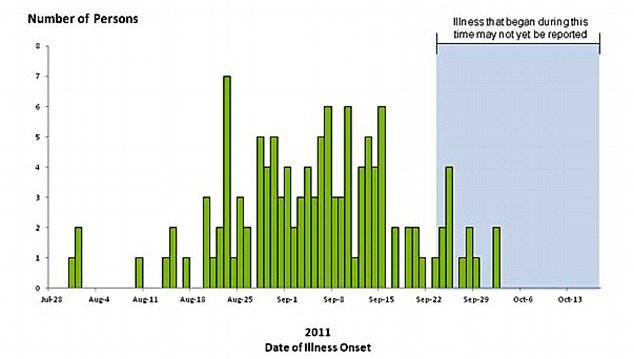
16 people have died from possible Listeria illnesses traced to Colorado cantaloupes, the deadliest food outbreak in more than 10 years, according to health officials.
72 Listeria illnesses, including 13 deaths, are linked to the tainted fruit, said the Centers for Disease Control and Prevention (CDC) on Tuesday. State and local authorities say they are investigating three additional deaths that may be connected to Listeria outbreak.
The Listeria outbreak death toll released by the CDC Tuesday – including newly confirmed deaths in Kansas, Missouri, Nebraska and Texas – surpassed the number of deaths linked to an outbreak of Salmonella in peanuts almost three years ago. Nine people died in that outbreak.
The CDC has confirmed two deaths in Texas and one death each in in Kansas, Missouri and Nebraska.
Last week the CDC reported two deaths in Colorado, four deaths in New Mexico, one in Oklahoma and one in Maryland.
New Mexico authorities said yesterday they are investigating a fifth death, while health officials in Kansas and Wyoming said they too are investigating additional deaths possibly linked to the tainted fruit.
Listeria is more deadly than well-known pathogens like Salmonella and E. coli, though those outbreaks generally cause many more illnesses.
The recalled cantaloupe involved in Listeria outbreak may be labeled Colorado Grown, Distributed by Frontera Produce, Jensenfarms.com or Sweet Rocky Fords
21 people died in an outbreak of Listeria poisoning in 1998 traced to contaminated hot dogs and possibly deli meats made by Bil Mar Foods, a subsidiary of Sara Lee Corp, the Associated Press reports.
Another large Listeria outbreak in 1985 killed 52 people and was linked to Mexican-style soft cheese.
Listeria generally only affects the elderly, pregnant women and others with compromised immune systems.
The CDC said the median age of those sickened is 78 and that one in five who contract the disease can die.
Dr. Robert Tauxe of the CDC says the number of illnesses and deaths will probably grow in coming weeks because the symptoms of listeria don’t always show up right away.
It could take four weeks or more for a person to fall ill after eating food contaminated with Listeria.
“That long incubation period is a real problem,” Dr. Robert Tauxe said.
“People who ate a contaminated food two weeks ago or even a week ago could still be falling sick weeks later.”
CDC reported the 72 Listeria illnesses and deaths in 18 states.
Cases of Listeria infection were reported in California, Colorado, Florida, Illinois, Indiana, Kansas, Maryland, Missouri, Montana, Nebraska, New Mexico, North Dakota, Oklahoma, Texas, Virginia, West Virginia, Wisconsin, and Wyoming.
The most illnesses were reported in Colorado, which has seen 15 sickened. 14 illnesses were reported in Texas, 10 in New Mexico and eight in Oklahoma.
Listeria outbreak has been traced to Jensen Farms in Holly, Colorado, which recalled the tainted cantaloupes earlier this month.
The Food and Drug Administration (FDA) said state health officials had found Listeria in cantaloupes taken from grocery stores in the state and from a victim’s home that were grown at Jensen Farms.
Matching strains of the disease were found on equipment and cantaloupe samples at Jensen Farms’ packing facility in Granada, Colorado.
FDA, which investigates the cause of foodborne outbreaks, has not released any additional details on how the contamination may have happened, but says its investigation is ongoing.
Last night it appeared that Nancy Grace suffered an embarrassing wardrobe malfunction at Dancing With The Stars show, when her dress slipped down mid way through her energetic quickstep with Tristan, revealing a little too much of her chest area.
But being the good prosecutor that she is, today Nancy Grace has played down the incident, providing evidence that her modesty was kept safe by some trusty “breast petals”.
The legal broadcaster insists that she didn’t fully expose herself and it was the sticky nipple cover-ups that she was wearing, which protected her chest area.
Nancy Grace apparently experienced a wardrobe malfunction following her quickstep on last night's DWTS show
Nancy Grace, 51, tweeted a picture of herself holding the box of trusty stick-ons on her Twitter page.
“Evidence re my alleged <<wardrobe malfunction>> which I vehemently deny: Breast Petals & industrial strength bra,” she wrote in an accompanying caption.
Nancy Grace denies a “wardrobe malfunction” on Dancing With The Stars last night and tweeted a picture of her holding a box of breast petals to prove it
Nancy Grace also told RadarOnline that the wardrobe department of Dancing With The Stars show were always fully prepared for accidents waiting to happen.
“I am in full nip denial,” Nancy told told the website.
“Breast petals and an industrial strength bra…plus a sewn-in corset. The fabulous DWTS wardrobe crew is extremely proactive and would never let an accident happen!”
Nancy Grace also made light of the situation and joked about what she would be wearing in the next round of the contest.
“I’m a considering a turtle neck for my next dance!” she told the website.
Nancy’s dance partner Tristan MacManus says that he was completely unaware of the malfunction.
“I didn’t even notice, and I was closer to it than anyone,” Tristan MacManus told the RadarOnline.
“Apparently the top of her dress slipped down, but the producers were really quick to amend it.”
Nancy Grace was being dipped by partner Tristan, when a mishap occurred, leading to ABC to cut away to an audience shot.
Nancy Grace's dress first slipped down during a dip move with her partner Tristan MacManus on last night's DWTS show
“On the European version that would be perfectly fine,” joked host Tom Bergeron, while judge Bruno Tonioli told Nancy that her performance was “a bit top heavy at times.”
Unfortunately, Nancy’s clingy brown dress then slipped down again, as she and Tristan waited for the judges verdict.
Nancy Grace was quick to deny there had been a costume slip.
“Tonight, when we were doing our hopscotch portion of our dance, there was a little bit of movement but it did not rise to a wardrobe malfunction,” she told US Weekly after the show.
“We have taken every precaution known to men in this dress right here,” Nancy Grace added.
“I’m talking industrial size precaution. There may have been, as Tristan said, a little bit of jiggling but there was absolutely not a wardrobe malfunction.”
However, Nancy Grace did get an impressive score of eight for her dance from Len Goodman who said her performance was a “breath of fresh air”.
The Michael Jackson’s death trial opened with an extraordinary moment this afternoon as the prosecutor started his opening remarks by displaying a photo of the singer’s dead body.
As Dr. Conrad Murray appeared before the jury charged with involuntary manslaughter over Michael Jackson’s death in 2009, deputy district attorney David Walgren displayed the picture that appeared to show tape or tubing over Jackson’s face.
Opposing fans of Michael Jackson and supporters of Dr. Conrad Murray gathered outside the courthouse in Los Angeles waving placards and banners as the whole Jackson family made their way into court for what has been billed as the trial of the century.
The shocking photo of Michael Jackson's dead body on a gurney on the opening day of the trial of Dr Conrad Murray
“Michael Jackson’s death was a homicide,” Los Angeles deputy district attorney David Walgren told the jury in opening statements.
“The evidence will show that Michael Jackson literally put his life in the hands of Conrad Murray… Michael Jackson trusted his life to the medical skills of Conrad Murray.
“The evidence will show that misplaced trust had far too high a price to pay… it cost Michael Jackson his life.”
[youtube ls2dUATmJfo]
Dr. Conrad Murray’s defense attorney Ed Chernoff told the jury that Michael Jackson caused his own death.
Dr. Conrad Murray wiped tears from his eyes as Ed Chernoff said that the evidence will show that the singer swallowed 8, 2 mg pills of Lorazepam and injected himself with a dose of propofol.
Ed Chernoff said that Michael Jackson, who was frustrated because he could not sleep and frustrated because his doctor refused to give him a drug that he wanted, “did an act that caused his own death”.
“He died so fast he did not even have time to close his eyes,” Ed Chernoff said.
He also told jurors their job is not to determine whether the physician is a good doctor or not.
The bed where Michael Jackson died in his home in California
Michael Jackson’s parents, his siblings Janet, La Toya, Tito, Randy and Jermaine are all at the courthouse in LA for the opening statements in the trial of the singer’s personal physician, who was the last person to see him alive.
District deputy attorney David Walgren insisted that the evidence will show that the “acts and omissions of Michael Jackson’s personal doctor Conrad Murray directly led to his premature death at the age of 50”.
Dr. Conrad Murray “repeatedly acted with gross negilience, repeatedly denied appropriate care to his patient Michael Jackson and that is was Dr Murray’s repeated incompetent and unskilled acts that led to Michael Jackson’s death on June 25 2009,” attorney Walgren said.
David Walgren played disturbing audio recorded on Dr. Conrad Murray’s iPhone of Michael Jackson apparently under the influence of propofol a month before his death.
On the recording, Michael Jackson sounded slurred and confused as he mumbled: “We have to be phenomenal… When people leave this show, when people leave my show, I want them to say, <<I’ve never seen nothing like this in my life. Go. Go.>>”
[youtube 7XJFoH2MwLY]
The prosecutor said the audio was evidence that Dr. Murray knew what was happening to Michael Jackson and should have discontinued ordering propofol.
He also attempted to paint a picture of the days leading up to the singer’s death.
“On June 19th Michael showed up for his rehearsal and he was not in good shape, he was not in good shape at all,” David Walgren said.
“He had chills, he was trembling… he was rambling.”
The court was shown pictures from inside Michael Jackson's home, here is the bathroom with his jacket on the floor
Kenny Ortega, Michael Jackson’s manager, who proposed This Is It tour, expressed concerns about Michael, but Dr. Conrad Murray allegedly told him and others that Jackson was “physically and emotionally fine”.
“Don’t let it be your concern, I am the doctor,” Dr. Conrad Murray allegedly said.
David Walgren also laid out the order of events from inside Michael Jackson’s house on the night that he died.
The prosecutor accused Dr. Conrad Murray of failing to call 911 as soon as he realized that there was something wrong with Michael Jackson.
An emergency call was not made until 12:20pm, at least 24 minutes after Dr. Murray is believed to have discovered Michael Jackson unconscious.
During a phone call at 11:51am with a cocktail waitress that Conrad Murray regarding as his girlfriend, the doctor became silent and the phone went dead, prosecutor said.
“This is likely the time Conrad Murray first noticed Michael Jackson’s lifeless body,” David Walgren said.
He claimed that phone records showed that Michael Jackson was left unattended for too long.
“It will be clear that Conrad Murray abandoned Michael when he needed help.”
“It was Conrad Murray’s gross negligence, it was Conrad Murray’s unskilled hands and his desire to obtain this lucrative contract of $150,000 a month that led Dr. Murray to not only abandon his patient, but to abandon all principles of medical care.”
Prosecutor Walgren also showed images of Michael Jackson’s bedroom to show how medical monitoring devices typically used when someone is under anesthesia were not there or appeared unused.
A blood pressure cuff was still in a box and an oxygen tank had no oxygen.
As the defense made their opening statements, Murray wiped away tears as lawyer Ed Chernoff described the doctor and Michael Jackson as “friends first”.
“Dr. Murray is no celebrity doctor. He is a cardiologist. He literally saves lives. That’s who he is.”
Ed Chernoff said that on the day he died, Michael Jackson had told Dr. Murray that he not slept for 10 hours and that if he did not sleep he would not be able to rehearse and would disappoint his fans.
Dr. Conrad Murray agreed to give him a 25 mg injection of propofol mixed with lidocaine.
Ed Chernoff claimed that Michael Jackson had become unable to sleep because he was being withdrawn from the painkiller Demerol, which he had been receiving from his dermatologist.
Demonstrators for and against Dr Conrad Murray
In his opening statement, prosecutor David Walgren told the jury that between 6 April, 2009, and the day of Michael Jackson’s death on June 25, Dr. Murray ordered enough propofol to give Jackson 1,937 milligrams a day.
Defense lawyers claimed Dr. Conrad Murray had been trying to wean Michael Jackson off propofol and gave him only a minimal dosage.
The lawyers claimed also that the King of Pop, desperate for sleep, swallowed an additional dose of the drug when his doctor was out of the room.
The defense’s theory is based on evidence that a trace amount of propofol was found in Michael Jackson’s stomach.
Medical witnesses may be asked to explain how it could have been found in his stomach, as ingesting it orally is almost unheard of.
Propofol is used to reduce anxiety and tension, and promotes relaxation and sleep or loss of consciousness. The drug provides loss of awareness for short diagnostic tests and surgical procedures, sleep at the beginning of surgery, and supplements other types of general anaesthetics. Long-term use of propofol can result in addiction. The steep dose-response curve of the drug makes potential misuse very dangerous without proper monitoring.
Side effects of propofol include: difficulty breathing, wheezing, fast heartbeat, palpitations, seizures, uncontrollable muscle spasm and swelling or extreme pain at the injection site.
At 12.12 pm Dr. Murray called Michael Jackson’s personal assistant Michael Williams and left a message saying: “Call me right away, please. Please call me right away. Thank you.”
When Williams immediately called Dr. Murray back he told him: “Get here right away Mr. Jackson had a bad reaction, he had a bad reaction”, according to prosecutors.
Dr. Murray had yet to call 911 at this point.
Michael Williams then called security guard Albert Alvarez to go and investigate and he said that when he entered Michael Jackson’s room, he was lying on the bed and Dr. Murray was administering CPR.
According to the prosecution, Conrad Murray then ordered the security guard to grab a bag while he started grabbing vials and a saline bag hanging from the IV stand to put inside the bag.
That bag was later found inside Michael Jackson’s home.
Michael Jackson supporters holding signs outside Los Angeles Superior Court
Prosecutors also say Murray ordered someone to clean up signs that Michael Jackson had been receiving a variety of medications, including propofol, and that he improperly monitored the singer’s vital signs, performed inadequate CPR and did not inform emergency medical personnel that he had given the musician propofol.
A recorded conversation that Dr. Conrad Murray had two days after Michael Jackson’s death was played where Murray can be heard saying that he gave his patient a small dose of propofol and then left him for 15 minutes to go to the bathroom.
“Then I came back to his bedside and was shocked because he wasn’t breathing,” the physician says in the audio recorded on June 27. Prosecutors allege that he was gone for a lot longer.
At 12.30 pm, paramedics arrived at Michael Jackson’s home and treated him for 42 minutes before transporting him to nearby Ronald Reagan UCLA Medical Center.
The ambulance arrived at hospital at 1.14 pm and a team of doctors tried for more than an hour to resuscitate the singer.
Michael Jackson was declared dead at 2.26 pm with members of his family by his side.
Millions of people around the world are expected to watch as the trial gives a glimpse into final days of Michael Jackson.
Crowds of people gathered at the Los Angeles Superior Court where there was a lottery drawn for seats for the opening statements.
Supporters of both Dr. Conrad Murray, 57, and Michael Jackson are outside the courthouse with signs including, “Fair trial for Dr Murray” and “Doctors are expected to heal not kill”.
The list of potential witnesses includes his eldest children Prince Michael and Paris, who have reportedly said that they want to take to the stand to testify.
Medical examiners have determined Michael Jackson’s death at the age of 50 on June 25 2009, at his rented Los Angeles mansion was due to an overdose of the powerful anaesthetic propofol and sedatives.
Prosecutors said Dr. Conrad Murray caused Michael Jackson’s death by giving him propofol as a sleep aid, and failing to monitor him properly.
Dr. Conrad Murray denies the charge of involuntary manslaughter but faces a prison sentence of up to four years if convicted.
Murray’s defense team is expected to argue that Michael Jackson was addicted to various painkillers and sedatives and gave himself the fatal dose of propofol, possibly by swallowing it.
The trial is expected to hear testimony from the paramedics who transported Michael Jackson to the hospital, medical experts, Jackson’s choreographer and Dr. Murray’s girlfriends.
Celebrity attorney Mark Geragos, who once represented Michael Jackson and has closely watched the criminal case against Dr. Conrad Murray, said that Jackson’s 13-year-old daughter Paris might also be called to testify, in what would likely be one of the most dramatic moments of the trial.
“She not only has things to say, but she can say it in a compelling way,” Mark Geragos said. Paris Jackson was at the house when the singer stopped breathing.
Michael Jackson’s children, Prince Michael, 14, and Paris, 13, have both reportedly told their grandmother Katherine of their desire to want to testify.
Prince Michael, Paris and Blanket were all included on a potential witness list passed out to the jurors in an attempt to ascertain their familiarity with the family.
Also listed were Michael Jackson’ siblings Janet, LaToya, Jermaine, Marlon, Rebbie, Tito and Randy as well as parents Katherine and Joe Jackson.
The Michael Jackson case is one of a small but growing number of U.S. criminal prosecutions of doctors for alleged malpractice.
The responses of the 12-person jury to written questionnaires made public last week shows that none of them reported having a negative experience with doctors.
At the time of his death, Michael Jackson was readying himself for 50 planned shows in London called “This Is It.”
Campaigners disagreed with the report concerning terminal cancer patient treatment strategy, especially the exclusion of the drugs that were expected to prolong life for terminal cancer patient.
A report on managing cancer costs, made by 37 cancer experts from developed countries, was published in the Lancet Oncology on September 26 . The study highlights the need of a judicious medication for terminal cancer patient. Professor Richard Sullivan has presented the study at the European Multidisciplinary Cancer Congress in Stockholm. Terminal cancer therapy is “futile and potentially inconsistent with patients’ wishes’“, according to the study.
Much of terminal cancer therapy is "futile and potentially inconsistent with patients’ wishes", cancer experts say in Lancet Oncology.
“I would hardly call this type of treatment futile. We have kidney cancer patients on a life-prolonging drug called Sutent who have been told they have only two to three weeks to live but who go on to live for a further five years,” said Rose Woodward, of the James Whale Fund for Kidney Cancer.
“Describing all treatments near the end of life as futile is tantamount to writing patients off. Just because they cannot be “cured” does not mean that we cannot give them valuable treatment, care and support,” said a spokesman for the Rarer Cancers Foundation.
“While cancer care can be expensive, it is unjust to put a cost on the lives of patients, especially when modern treatments can often give them precious time with their loved ones and increase their length and quality of life,” said Ian Beaumont of Bowel Cancer UK.
Some life-extending drugs has shown increased positive results for certain terminal cancer patients.
Abiraterone, for prostate cancer, was approved in the UK at a cost of £35,000 a patient last week. On average it only extends lives by a few weeks, but some patients survive for five years.
Avastin, for advanced bowel cancer, was initially thought to extend survival by an average of only six weeks. Some patients are still alive five years later and with no tumors relapse.
Daily Mail presented the case of Barbara Moss who was given several months to live when she was diagnosed with advanced bowel cancer that had metastasized to her liver in November 2006. She paid for Avastin privately and the drug shrank the tumors and they were small enough to be removed by surgery and she has lived an extra five years.
Zelboraf, a targeted medicine for inoperable or metastatic melanoma BRAF V600E mutation-positive, has shown it increased survival rate of the patients and was approved by FDA last month.
Adcetris, the first drug approved by the FDA for Hodgkin lymphoma in more than 30 years, an antibody-drug conjugate (ADC) directed to CD30, has demonstrated a high durable complete remission rate in CD30-positive malignancies.
Some life-extending drugs has shown increased positive results for certain terminal cancer patients.
Other medicines are still in a trial stage, but some of them are very promising even for terminal cancer.
Scientists from the University of Pennsylvania have genetically engineered patients’ T cells to attack cancer cells in advanced cases of a common type of leukemia. Two of three patients studied have been cancer-free for more than one year. In the third case over 70% of cancer cells were removed.
Researchers from Lund University have identified a method that may attack and destroy prostate cancer stem cells and might lead to a complete cure.
Recently presented data have shown Zybrestat, a pro-drug vascular disrupting agent, helped improve the one-year survival rate of patients with larger anaplastic thyroid cancer tumors.
Specialists at London’s Royal Marsden Hospital have tested radium-223 chloride (a powerful alpha radiation drug for prostate cancer) on 461 patients while another group of the same number was being treated with placebo. The group taking the new drug experienced less pain, side effects and lived longer, and the doctors decided to stop the trial and started treating all 922 patients taking part in the study because they said it would be unethical not to.
Giving a terminal cancer patient false hope is unethically, but in the same time to refuse a potentially helpful treatment to a terminal cancer patient is unethically too. This is not a recent debate, unfortunately health services and terminal cancer still need adjustments, but these can be done by trying and studying.
Demi Moore was never been large, but last night she looked a shadow of her former self as she attended the Lifetime movie Five premiere in New York.
Demi Moore donned a black geometric print dress which highlighted her incredibly slender frame as she posed on the blue carpet for the event.
The fitted black dress hung off her once feminine curves, while the short-sleeved look drew attention to Demi Moore‘s incredibly muscular arms.
Demi Moore looked a shadow of her former self at the premiere of Lifetime movie Five in New York last night
Demi Moore in 2009The 48-year-old actress’ appearance at the event comes as nutritionist Dr. Majid Ali told gossip website Radaronline.com that he believes Demi Moore has been spending “too much time in the gym and too little time at the dinner table”.
Dr. Majid Ali added he believes Demi Moore’ slender look is down to overdoing it in the gym rather than cutting down on what she eats.
“It looks more like over training with restricted calories, than an eating disorder.
“She doesn’t have that wasted loss of muscle eating disorder look, but she could be over training. I certainly wouldn’t want her any thinner.”
Dr. Majid Ali’s comments come in the wake of Demi Moore admitting she used to be “obsessed” with the way her body looked.
The mother-of –three actress said: “I had an extreme obsession with my body. I made it a measure of my own value.
“I tried to dominate it, which I did, and I changed it multiple times over.
“But it never lasted and ultimately it didn’t bring me anything but temporary happiness. Does being thin resolve anything? No.
“The irony is that when I abandoned that desire to dominate my body, it actually became the body that I always wanted.”
Demi Moore has been working hard on her health in recent months, and revealed earlier this year she had undertaken a strict detox plan with her husband Ashton Kutcher.
Demi Moore, 48, and Ashton Kutcher, 32, followed the Master Cleanse diet, which involves consuming only a concoction of water, lemon, maple syrup and cayenne pepper for ten days.
Gwyneth Paltrow and Beyonce Knowles, who are fans of the detox plan, claim it eliminates toxins from the body and helps stop cravings.
However, critics say the detox plan may be bad for your health and deprives the body of energy, providing 600 calories daily – a third of the recommended amount.
Demi Moore was joined at last night’s premiere by stars including Jennifer Aniston.
Demi Moore posed up with her friend Jennifer Aniston, who also directed a segment of their new Lifetime movie Five
Demi Moore and Jennifer Aniston are just two of the names who have directed anthologies included in Lifetime movie Five, exploring the impact of breast cancer on people’s lives.
Amanda Knox, the convicted killer of Meredith Kercher, is actually a “loving young woman” rather like the cartoon character Jessica Rabbit, a defense lawyer claimed today.
Just a day after another lawyer told her appeal hearing in Italy that Amanda Knox was a “a lying, sex-loving she-devil”, lawyer Giulia Bongiorno said Amanda Knox, the American student found guilty of killing British roommate Meredith Kercher, was not a bad person.
The lawyer said Amanda Knox was not the “femme fatale” her accusers describe and compared her to Jessica Rabbit, saying she was faithful like the “Who Framed Roger Rabbit” character.
Amanda Knox, the convicted killer of Meredith Kercher, is actually a “loving young woman” rather like the cartoon character Jessica Rabbit, a defense lawyer claimed today
Amanda Knox was convicted of murdering Meredith Kercher, a fellow student in Perugia, and sentenced to 26 years in prison, while co-defendant Raffaele Sollecito was sentenced to 25 years.
Giulia Bongiorno, Raffaele Sollecito’s lawyer, paraphrased a famous line from the movie saying Amanda Knox “is not bad, she’s just drawn that way”.
Amanda Knox and Raffaele Sollecito deny killing Meredith Kercher and the verdict in the appeals case is expected by next week.
Giulia Bongiorno, Raffaele Sollecito's lawyer, paraphrased a famous line from the movie saying Amanda Knox “is not bad, she's just drawn that way”
A female supporter of Amanda Knox has been questioned by police after she shouted “You are evil” at one of the main prosecutors in the appeal case of the American student.
Michelle Moore sought out prosecutor Giuliano Mignini during a break in proceedings in the case, which is nearing its conclusion and with tension beginning to rise significantly.
Witnesses said Michelle Moore marched over to the prosecutor during a break in the long running proceedings and shouted to him:
“You are evil, you have no conscience,” while others said she told him: “You have no heart.”
Giuliano Mignini asked paramilitary carabinieri police to identify the woman and she was asked to show her American passport and provide her details to officers before being taken away but she was not arrested.
Co-accused Raffaelle Sollecito also denies murdering Meredith Kercher
In the same day, a lawyer for bar owner Patrick Lumumba, wrongly identified by Amanda Knox as the killer had described her as a “diabolical, demonic, Satanic, she Devil”.
Michelle Moore, the wife of a former FBI agent called Steve Moore, who has been one of the most vociferous pro Amanda Knox campaigners in the court – was giving interviews dismissing the original Italian police investigation into the murder.
Today Michelle Moore was not in the court in Perugia as the case resumed with lawyers for Amanda Knox’s coaccused Raffaele Sollecito starting their summing up, but her husband said:
“She didn’t mean to show any disrespect to the court.”
Steve Moore then added that his wife had made the outburst because she was angry at graphic pictures of Meredith Kercher’s mutilated body during an earlier hearing.
British Meredith Kercher was a student in Perugia, Italy when she was killed on on November 1, 2007
Steve Moore said: “We have a daughter the same age and someone tried to strangle my wife when she was 20 so it was a reaction to all that, she was just shocked.
“She thought it was Mignini who had showed the photographs – she just got a bit emotional.”
But one witness who asked not to be named said: “That sounds a bit far fetched to me. She has been in court the last few days and would know who Mignini was and who Maresca was.
“It was a very strong attack on Mignini and he was left quite shocked. He only understood the word evil and had to get the rest translated for him and that’s when he asked the police to take the woman’s details.”
A file on the case will now be sent to prosecutors who will decide if there is enough evidence to proceed to a full charge of offending an official of the court which carries a maximum sentence of three years in prison.
Italian TV used the incident to highlight the growing tensions between the pro Amanda Knox camp but today they were not immediately available to comment on the incident.
Michelle Moore was also not in court and she did not update her Twitter page with the incident although last week she had written: “Amanda and Raffaele will soon be free. I am very happy about this injustice being made right. Yay. PS Pass it on.”
Michelle Moore Twitter description reads: “Loves God, loves people ! Seeks truth, and never ever gives up-ever never! :)”
A report on managing cancer costs, made by 37 cancer experts (economists, patient advocates and physicians) from developed countries (U.S., UK, Germany, Australia), was published in the Lancet Oncology on September 26 . The study highlights the need of a judicious medication for terminal cancer patient.
Professor Richard Sullivan, of the King’s Health Partners Integrated Cancer Centre, London, has presented the study at the European Multidisciplinary Cancer Congress in Stockholm.
Input from drug-makers, payers and educators will be key to future discussions, David Collingridge, the journal’s editor, said.
“With an aging global population and an endless conveyor belt of expensive new drugs and technologies and increasing financial pressures, the cost of cancer care in high-income countries is becoming unsustainable,” The Lancet Oncology said.
Developed countries have varying levels of GDP assigned to health, but the percent of cancer care cost is between four and seven in the majority of countries.
Around 12 million people worldwide are diagnosed with cancer annually, the costs of the new cases was at least $286 billion in 2009, according to the report. By 2030, about 22 million people will be diagnosed with the disease annually. More than half of the $286 billion in costs was related to treatment, while a quarter was linked to lost productivity.
"We over-diagnose, over-treat, and over-promise. This extends from use of complex technology, surgery, and drugs to events related to the acceptance of treatment side-effects." say experts, making a special reference to terminal cancer.
In UK around 310,000 people are diagnosed with cancer every year and by 2030 this is expected to have risen to 400,000. The National Health Service spends over £5billion annually on cancer treatments, up from £3billion in 2002.
“All health systems face budget limitations, while at the same time the cancer burden and expenditures are increasing steeply. Every cancer patient, now and in the future, must have fair access to quality cancer care and to innovation. This can only be safeguarded by transparent and evidence-based analysis and policy development,” said Professor Michael Baumann , president of the European cancer organization, ECCO.
The cancer experts have criticized a “culture of excess” that gives false hopes to patients with terminal cancer.
“In developed countries, cancer treatment is becoming a culture of excess. We over-diagnose, over-treat, and over-promise. This extends from use of complex technology, surgery, and drugs to events related to the acceptance of treatment side-effects.” the cancer experts said.
They emphasized the importance of choosing a right treatment strategy for terminal cancer patients. The life-extending medication should not be use as it shows no benefits for terminal cancer, and has dangerous side-effects.
The life-extending medication should not be use as it shows no benefits for terminal cancer, and has dangerous side-effects, said the cancer experts.
“Special consideration must be given to costs of cancer care at the end of life. Many forms of cancer are currently incurable and patients will eventually die from their disease.”
“In fact studies suggest that a substantial portion of the total cost of cancer care is for care delivered in the last weeks or days of life, and that much of this care is futile and potentially inconsistent with patients’ wishes.”
“If we could accurately predict when further disease-directed therapy would be futile, we clearly would want to spare the patient the toxicity and false hope associated with such treatment, as well as the expense.”
The scientists said a more rigorous evaluation of the relative benefits of surgery to treat cancer and of the less invasive robotic surgery had to be done.
Reducing the cost of cancer services or reducing the number of people using them, especially terminal cancer patients, are the two ways the authors proposed to solve the problem.
The best cancer treatments would be the preserve of the rich because they would be too expensive for the Health Service, warned last week Professor Karol Sikora, one of the 37 cancer experts.
Molecular bio-markers could be used to pre-screen patients for treatments and imaging methods should be used to select only those patients who could benefit from a treatment. Early-stage studies could also help to remove marginally effective or ineffective drugs faster, researchers said.
“We are at a crossroads for affordable cancer care, where our choices, or refusal to make choices, will affect the lives of millions of people. Making individual patients more sensitive to the costs of care is necessary for an informed public debate around this critical issue,” Professor Richard Sullivan said.
MRI performed prior to surgery predicts the follow-up treatment for advanced rectal cancer, recent study shows. Generally the doctors will not abandon drugs for terminal cancer patients, despite the costs.
Cancer diagnosis and treatment has became more complex, with imaging, surgery, radiation and drug therapy. Specialists need to come together and discuss with patients, insurers and industry players the best ways to lower costs without compromising care, they said.
Amanda Knox, the convicted murderer of British student Meredith Kercher, was yesterday described in court as a “diabolical, Satanic, demonic she-devil”.
The assault on 24-year-old Amanda Knox’s character came from a lawyer representing the man that she initially accused of Meredith Kercher’s murder.
Amanda Knox, who was jailed for 26 years in December 2009, is challenging her conviction and the attack on her character was part of the prosecution’s summing up at her appeal.
Amanda Knox is “diabolical”, said a lawyer during the appeal trial of the American convicted murderer
In November 2007, Meredith Kercher, from South London, was found semi-naked and with her throat cut in the house in Perugia she shared with Amanda Knox.
American Amanda Knox and her Italian boyfriend at the time, Raffaele Sollecito -who was given 25 years – insist they are innocent.
In November 2007, Meredith Kercher, from South London, was found semi-naked and with her throat cut in the house in Perugia she shared with Amanda Knox
Initially Amanda Knox blamed the murder on bar owner Patrick Lumumba, 39, who was arrested in front of his wife and baby. She had accused him following a night of police questioning.
Amanda Knox told police that she “remembered Patrick killing Meredith” and that she had stayed in the kitchen covering her “ears to drown out the screams”.
Congolese-born Patrick Lumumba, who remained in custody for two weeks, is entitled to sue Amanda Knox and Raffaele Sollecito for slander under Italian law because her statement landed him in jail.
Initially Amanda Knox blamed the murder on bar owner Patrick Lumumba, 39, who was arrested in front of his wife and baby
Lulumba’s lawyer Carlo Pacelli launched a furious tirade against Amanda Knox.
“She falsely blamed Lumumba when she knew he was innocent,” the lawyer said.
“She put him in jail for two weeks away from his loved ones and family.
“After poor Meredith the second victim in all this is Patrick Lumumba – Amanda destroyed him as a man, husband, father. She muddied his character.”
Carlo Pacelli then told the court that Amanda Knox appeared to be charming, intelligent, and “angel faced because she has spent four years in jail”.
The lawyer added: “She is the daughter everyone wants, so you need to know what she was like four years ago.
“She was a diabolical, Satanic, demonic she-devil. She was muddy on the outside and dirty on the inside. She has two souls, the clean one – you see her before you – and the other.
“She is borderline. She likes alcohol, drugs and she likes hot, wild sex.”
Amanda Knox’s father, Curt and stepfather Chris Mellas shook their heads as Carlo Pacelli’s description was translated for them while Amanda Knox herself looked intently at the judge and jury.
After the hearing Curt Knox said:
“It was so over the top of what I believe would be necessary as a lawyer, he just assaulted her verbally and that’s wrong, flat wrong.”
Earlier Carlo Pacelli had described to the court how Meredith Kercher’s British friends had told the original trial that there had been tension between the two women because of Amanda Knox’s failure to keep the bathroom clean.
The lawyer recalled how Meredith Kercher had told friends she felt “uncomfortable” at the fact Amanda Knox brought strangers back to the house they shared and that she left a sex toy and condoms visible in the bathroom.
At one point judge Claudio Pratillo Hellman asked lawyer to stop going over old ground but Carlo Pacelli insisted he had to go into the details to “describe Amanda’s character”.
Amanda Knox has insisted that she and Meredith Kercher were friends.
Amanda Knox and Raffaelle Sollecito have based their appeal on an independent court report that has cast doubt on the original police forensic evidence.
Raffaelle Sollecito and Amanda Knox have based their appeal on an independent court report that has cast doubt on the original police forensic evidence
Meredith Kercher from Coulsdon, Surrey, was in Perugia as part of her Leeds University course and had only been in Italy for two months before she died.
A third defendant, drug dealer Rudy Guede, an immigrant from the Ivory Coast, is serving 16 years for murder and sexual violence.
The court is expected to retire this week and a verdict is expected early next month.
Sly Stone, the veteran funk singer is currently homeless, and living in a van in Los Angeles’ rough-and-tumble Crenshaw district, according to a report co-written by Stone documentarian William Alkema for the New York Post.
Sly Stone, 68, parks the van in a residential street in the notoriously rough Los Angeles neighborhood of Crenshaw, where a retired couple provides him with a warm meal each day and use of a shower.
Sly Stone, born Sylvester Stewart, is the former Sly & the Family Stone frontman, known for such hits in the late ’60s and early ’70s as “Dance to the Music,” “Everyday People” and “Thank You (Falettinme Be Mice Elf Agin)”.
Sly Stone, the funk legend is currently homeless and living in a van.
During the height of his career, Sly Stone, the eccentric funk legend owned a sprawling Los Angeles mansion in Beverly Hills, and just four years ago he moved into a Napa Valley “compound,” complete with a vineyard.
But now Sly Stone is suffering with financial problems and he is living out of his white van.
Sly Stone told the New York Post:
“I like my small camper. I just do not want to return to a fixed home. I cannot stand being in one place. I must keep moving.”
In recent years, a drug habit (Sly Stone has been arrested multiple times for cocaine possession) and fiscal difficulties (last year he sued his former manager, Jerry Goldstein, for $50 million, claiming that Goldstein had defrauded him) led Sly Stone into his current situation. Not that he appears to mind.
Sly Stone is hoping that today’s hit-makers will reach out and help him stage a comeback
Despite it all, Sly Stone is still recording music, on a laptop computer in his van – and with reportedly hundreds of songs currently in the can, the musician is hoping that today’s hit-makers will reach out and help him stage a comeback.
“I see all the guys playing those old songs,” Sly Stone says.
“Let these guys know, like Lady Gaga, let me come in, just let me come in and pay me if you like it.”
It might be a while before Sly Stone gets another crack at the stage. His live performances have been exceedingly rare over the past two decades, and when he has taken the stage, the results have tended toward the shambolic – such as his brief, bizarre appearance at last year’s Coachella Music and Arts Festival.