
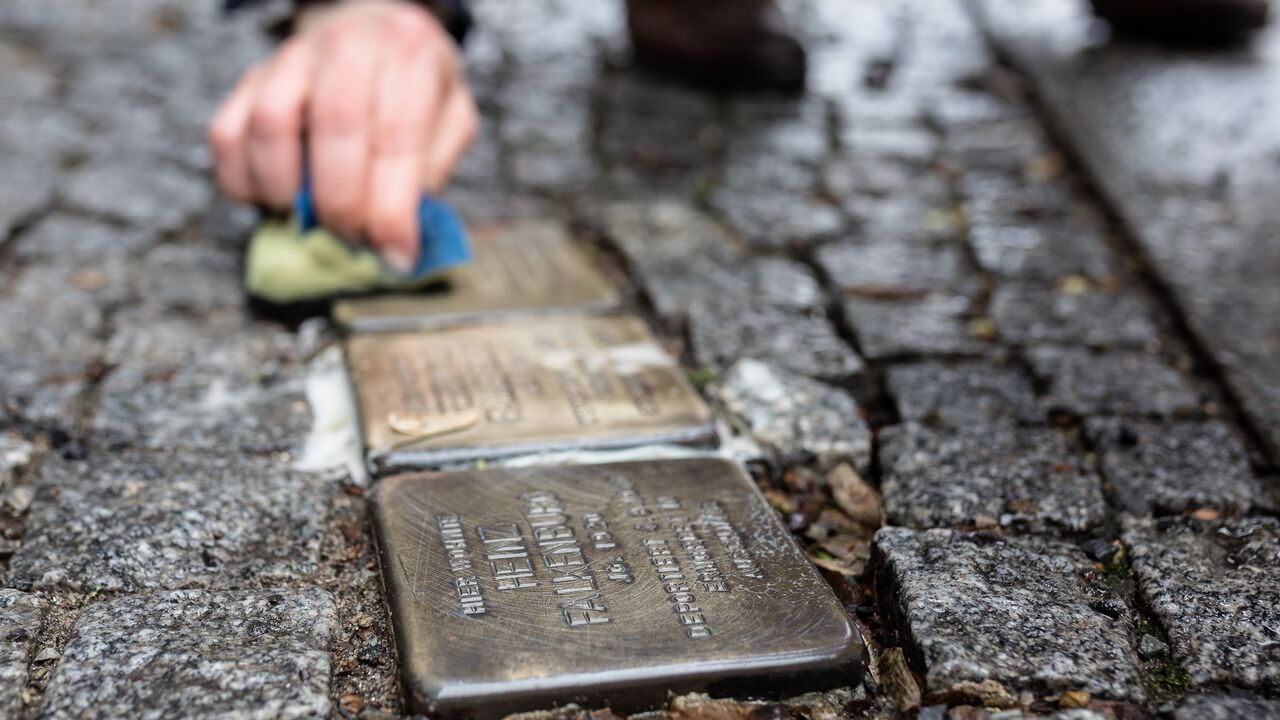
An East German town has triggered a national political storm by voting to ban the future installation of “Stolpersteine”—the ubiquitous brass “stumbling stone” cobblestones that serve as decentralized memorials for victims of Nazi persecution.
The city council of Heidenau, a town near Dresden in the eastern state of Saxony, backed a controversial motion to halt the street-level plaques. In a striking breach of a long-standing national political taboo, the local branch of the center-right Christian Democratic Union (CDU) voted in lockstep with the far-right Alternative for Germany (AfD) to pass the ban, fracturing the informal political firewall designed to isolate right-wing extremists.
Under the newly approved guidelines, future Holocaust commemorations in Heidenau will be banished from everyday public view and restricted strictly to a centralized memorial site at the town’s northern cemetery.
The Argument Over “Walking on the Dead”
The Stolpersteine project, initiated by German artist Gunter Demnig in the 1990s, has grown into the world’s largest decentralized memorial. Over 100,000 brass-capped cobblestones are embedded in sidewalks across Europe, positioned directly outside the last known voluntary residences or workplaces of Jews, Roma, political dissidents, and others systematically murdered by the Third Reich.
Supporters of the Heidenau ban echoed arguments long used by conservative critics, claiming the decentralized plaques had become an inappropriate way to honor the deceased. The joint AfD-CDU motion asserted that embedding the names of Holocaust victims directly into pedestrian walkways forced everyday citizens to step onto or walk over the memories of the persecuted. By relocating future elements to a designated cemetery, proponents claimed they would make it impossible for passersby to tread directly upon the memorials.
The blanket ban directly defied the town’s own municipal administration, which issued a sharp warning prior to the vote stating that a total prohibition on the stones was neither necessary nor justified.
Outrage Over the Broken Firewall
The fallout from the vote quickly transcended local municipal politics, exposing deep fractures within Germany’s mainstream conservative establishment. For years, mainstream democratic parties have adhered to the Brandmauer—an informal political “firewall” prohibiting any formal collaboration or joint voting maneuvers with the populist AfD, whose Saxon branch is officially classified as an extreme-right organization by domestic intelligence.
The partnership in Heidenau drew swift, biting condemnation from national leaders and civil society groups:
- The Educational Scandal: Germany’s Federal Education Minister, Karin Prien—herself a prominent CDU member—publicly branded the local decision a “scandal”. She admonished her own party’s regional branch, stating that banishing remembrance from public spaces to the cemetery rendering Jewish history invisible once again.
- The Auschwitz Committee Rebuke: Christoph Heubner, Executive Vice President of the International Auschwitz Committee, slammed the vote as a transparent and despicable attempt to drive Nazi victims out of the city landscape and dispose of their memory.
- Jewish Community Backlash: Charlotte Knobloch, head of the Jewish regional association in Bavaria, stated she was appalled that a mainstream democratic party would stoop to supporting a transparent maneuver orchestrated by extremists.
A Fractured Landscape of Remembrance
The decision lands at a time of heightened anxiety across Germany, where recent electoral surges by the AfD in eastern regional elections have fundamentally altered the country’s political landscape. While other major German municipalities, most notably Munich, have historically restricted Stolpersteine on public property in favor of eye-level wall plaques and steles, the Heidenau ruling marks the first time a blanket ban has been actively pushed through by an alliance featuring the far right.
For the creators and defenders of the stumbling stones, the core value of the project lies precisely in its subtle intrusion into daily life—forcing commuters, shoppers, and school children to unexpectedly confront the physical spots where neighbors were forcibly dragged to concentration camps. By pulling those markers off the streets and confining them behind cemetery walls, critics argue that Heidenau has set a dangerous precedent, allowing political shifting winds to quietly sweep the physical reminders of Germany’s darkest history out of sight.