
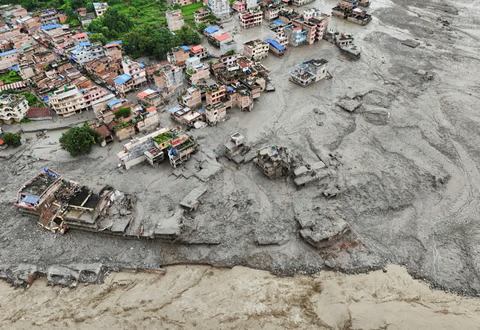
KATHMANDU — A catastrophic cascading wall of mud, pulverized ice, and rock has decimated the high-altitude borderlands between Nepal and Tibet. The combined death toll has climbed to 750, with more than 3,000 people desperately feared missing.
The disaster began high above the Lhende River in Tibet when a massive section of a glacier near the Langtang Lirung peak broke apart. The sheer kinetic velocity of the mountain collapse mimicked a magnitude 5.2 seismic event, momentarily leading many to believe an earthquake had struck the region.
Within minutes, the melting ice mixed with mountain soil, creating an unstoppable torrent that obliterated the crucial Gyirong Port border crossing and tore through everything in its path.
A Multination Crisis in the Mud
The disaster hit a bustling hub for international travelers, mountain trekkers, and religious pilgrims traveling to Tibet’s sacred Mount Kailash.
- The Scale of Death: Official tallies state that 734 people have been confirmed dead in Nepal, alongside 16 confirmed deaths in Tibet.
- The Missing Thousands: Over 2,400 people remain entirely unaccounted for in Nepal, while China reports 546 missing.
- The Global Fallout: The missing pool includes hundreds of foreign nationals from dozens of countries, elevating the catastrophe into a sweeping international humanitarian emergency.
NEPAL-TIBET FLASH FLOOD TALLY
Region    | Confirmed Dead | Reported Missing
═════════════════════════════════════════════════
Nepal     |      734       |      2,498
Tibet     |       16       |        546
─────────────────────────────────────────────────
Total     |      750       |      3,044
The Race Against Time Underground
A significant portion of the missing includes hundreds of construction employees who were working on critical local infrastructure. Roughly 933 workers are trapped inside deep hydroelectric power tunnels along the Trishuli River.
Military response teams have deployed emergency air lines into the dark, flooded tunnel openings at the Trishuli 3A and 3B project sites. Rescuers are frantically pumping oxygen underground, but thick, packed mud layers have blocked structural entry, and teams have yet to establish direct communication with any potential survivors inside.
‘Extremely Difficult’ Terrain and New Flood Threats
United Nations officials have warned that the extreme topography of the Himalayas, compounded by relentless downpours, has made delivering aid and launching search helicopters “extremely difficult”.
Landslides have entirely swept away sections of the Pasang Lhamu Highway, isolating remote mountain villages from any ground transportation. Rescuers are forced to wade through deep sludge or rely on risky helicopter winches to pull survivors from the wreckage.
THE CASCADE EFFECT
[Glacial Collapse] ──> [River Blocked] ──> [Debris Lake Formed] ──> [Burst Risk]
─────────────────────────────────────────────────────────────────────────────
* Consequence: Rescue operations are repeatedly halted due to downstream flood warnings.
Compounding the crisis, the initial landslides formed unstable “barrier lakes” by damming the natural river channels. One debris-clogged lake recently began to overflow, triggering immediate evacuation orders and forcing nearly 20,000 deployed security personnel to briefly abandon their search and flee to higher ground.
An Unpredictable Future
With rain forecast to continue across the high-altitude plateau, the window for finding survivors trapped beneath the mud is closing.
The disaster has highlighted the severe vulnerability of Himalayan border communities to sudden, climate-induced glacial events. As families gather in agonized silence outside regional hospitals and morgues, the focus remains on navigating a shattered landscape to reach those still trapped in the dark.