
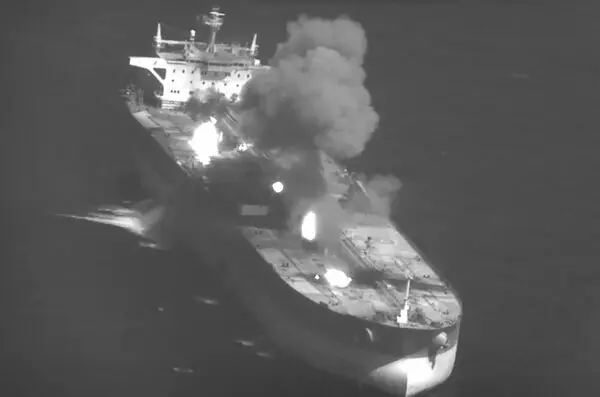
MANAMA, Bahrain — The six-month war between the United States and Iran entered an explosive and volatile new phase on Saturday, as both nations traded direct, high-stakes retaliatory strikes against commercial vessels and warships in the vital shipping corridors of the Persian Gulf and the Gulf of Oman.
The sudden flare-up effectively ends a month of relative calm and signals a dramatic shift in Washington’s strategy. For the first time, U.S. forces have systematically targeted Iran’s economic lifeblood at sea, abandoning its previous policy of focusing primarily on land-based military installations. Tehran responded almost immediately, deploying its own anti-ship arsenal to choke off the strategic Strait of Hormuz, threatening a total disruption of global energy markets.
Burning Tankers in the Gulf
The maritime escalation ignited when Iran’s Islamic Revolutionary Guard Corps (IRGC) fired ballistic missiles at two U.S. Navy warships—including an aircraft carrier and a guided-missile destroyer—patrolling regional waters. While U.S. Central Command (CENTCOM) confirmed that the American warships successfully evaded the strikes without sustaining damage, Washington’s response was swift and devastating.
Utilizing a combination of fighter jets, drones, and precision-guided cruise missiles, U.S. forces intercepted and targeted three Iranian crude oil carriers. According to CENTCOM, the strike permanently disabled the M/T Downy off the coast of Kharg Island—which handles nearly 90 percent of Iran’s crude exports—and the M/T Stark 1 near Jask. A third, unladen vessel, the M/T Kylo, was completely destroyed in the Gulf of Oman after its crew was ordered to abandon ship.
“If you shoot at two of our ships, we will impose an even higher economic cost—taking out three of yours,” said Admiral Brad Cooper, Commander of CENTCOM, in a blunt statement following the operation. Pentagon officials underscored that the targeted tankers were part of a multibillion-dollar shadow network funding the IRGC and its regional proxies.
Tehran Strikes Back
As smoke and fireballs billowed from the crippled tankers, the IRGC Navy declared the Strait of Hormuz strictly shut to “unauthorized” traffic and warned of severe, multi-directional retaliation against American military assets and regional allies.
Hours later, Iran’s state media claimed its naval forces had successfully struck back, targeting three oil tankers traversing what Tehran called an “unauthorized route” in the Strait of Hormuz, alongside three other commercial vessels allegedly affiliated with the United States.
Hassan Ghashghavi, a prominent Iranian lawmaker, framed the confrontation as an “existential war with America,” asserting that the ongoing U.S. naval blockade is an illegal act of economic aggression that Iran will aggressively dismantle. Meanwhile, the Iranian foreign ministry condemned the destruction of its commercial tankers as a “war crime” intended to deepen Washington’s economic warfare against the Iranian homeland.
A Critical Chokepoint Under Siege
The immediate fallout on global trade has been severe. The Strait of Hormuz—traditionally the transit point for 20 percent of the world’s seaborne oil and liquefied natural gas (LNG)—has been reduced to a fraction of its capacity. Though CENTCOM insists the southern corridor remains technically open, maritime tracking data showed that only 21 ships successfully transited the waterway on Saturday, compared to a pre-war average of roughly 110 daily vessels.
The renewed violence severely undermines diplomatic efforts led by regional mediators from Qatar and Pakistan, who have been frantically trying to preserve a fragile 60-day peace negotiation framework initiated three weeks ago. With both sides dug into uncompromising positions—Washington demanding an end to maritime interference and limits on Iran’s nuclear program, and Tehran demanding an absolute end to the Western blockade—the prospects for an imminent ceasefire appear to be rapidly sinking in the waters of the Gulf.