
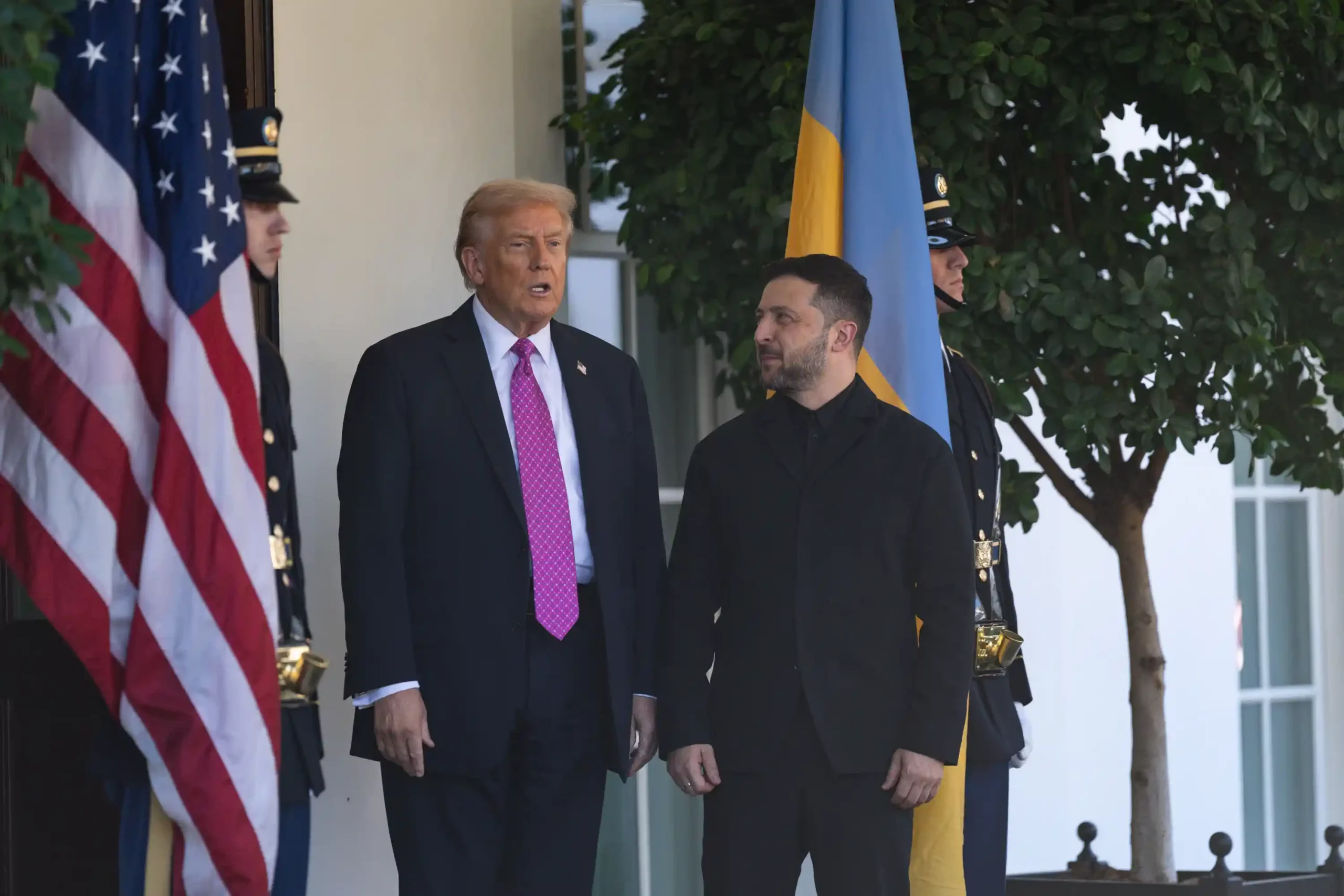
KYIV, UKRAINE— A sense of profound dismay has settled over the Ukrainian capital following President Volodymyr Zelensky’s dramatic and ultimately fruitless meeting with U.S. President Donald Trump, which concluded abruptly with no new aid package, no long-range missiles, and the collapse of a key economic agreement.
What was billed as a pivotal moment to secure advanced weaponry and a firm security guarantee against Russian aggression dissolved into a highly contentious, public confrontation in the Oval Office, leaving Kyiv’s delegation departing the White House empty-handed.
The critical disappointment centers on President Trump’s apparent unwillingness to commit to supplying the long-coveted Tomahawk cruise missiles—a weapon Zelenskyy’s government views as essential for a major counteroffensive. Trump instead appeared intent on pressuring Ukraine into an “immediate ceasefire” along the current battle lines, a position that many in Kyiv believe would reward Russian aggression.
The Missile Mirage
Zelensky had arrived in Washington with hopes buoyed by recent, though vague, signals that the Trump administration might finally agree to send the long-range missiles. Yet, during the two-hour discussion, Trump reportedly adopted a cautionary tone, suggesting the U.S. may need the missiles for its own future conflicts.
“We’d much rather have them not need Tomahawks,” Trump told reporters as he departed for Florida, even as he urged both sides to “stop the war immediately” and “go home.”
The Ukrainian leader, speaking frankly to reporters after the meeting, was forced to acknowledge the U.S. hesitation. “We don’t have Tomahawks, that’s why we need Tomahawks,” he said, but conceded he was “realistic” about his chances of securing them, effectively admitting defeat on his primary objective.
The Minerals Deal Collapse
Compounding the failure was the sudden cancellation of the planned signing of the Ukraine-United States Mineral Resources Agreement. The deal, which would have granted the U.S. access to Ukraine’s significant rare-earth mineral deposits in exchange for investment and reconstruction funds, was seen as a vital strategic and financial lifeline for Kyiv.
White House sources indicated that the meeting soured after a heated exchange between the two presidents and Vice President J.D. Vance, who reportedly chastised Zelenskyy for a perceived lack of gratitude toward the scale of past American aid. Trump later took to social media to accuse the Ukrainian President of having “disrespected the United States” and stated he was “not ready for Peace.”
The acrimonious atmosphere, described by media outlets as an “unprecedented public confrontation,” resulted in the cancellation of a scheduled joint press conference and the immediate departure of the Ukrainian delegation.
Gloom on the Dnipro
In Kyiv, the outcome of the visit has been met with a mixture of anger and weariness. For three years, Ukrainian citizens and soldiers have fought on the promise of unwavering Western support. The public clash and the failure to secure new, tangible support for the war effort has left the government’s European allies scrambling to reaffirm their solidarity.
Veteran Ukrainian analysts have taken a pessimistic view. Valeriy Chaliy, a former Ukrainian Ambassador to the U.S., noted the stark reality: “The substantive story is that… we have no mechanisms for obtaining [new] weapons from the U.S.”
The White House meeting, intended to stabilize and re-energize the relationship, has instead introduced a new level of volatility, raising profound concerns across the continent that Washington is now prioritizing a fast, and potentially unfavorable, end to the conflict over the restoration of Ukraine’s territorial integrity. For the moment, President Zelenskyy’s best diplomatic efforts appear to have been overruled by a new and uncompromising American calculus.