
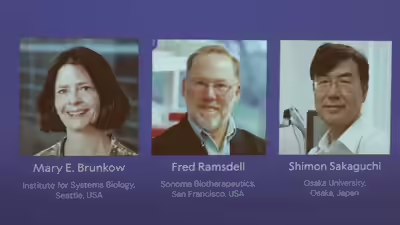
The 2025 Nobel Prize in Physiology or Medicine has been awarded to three pioneering scientists—Mary E. Brunkow, Fred Ramsdell, and Shimon Sakaguchi—for their groundbreaking discoveries concerning peripheral immune tolerance. Their work has fundamentally answered one of medicine’s most pressing questions: How does the immune system, powerful enough to destroy invading microbes, know not to launch a fatal, all-out attack on its own body?
The Nobel Assembly at the Karolinska Institute recognized the trio for identifying the immune system’s critical “security guards,” a special class of cells that maintain a delicate peace and prevent the onset of devastating autoimmune diseases.
Unraveling the ‘Peripheral’ Secret
For decades, scientists believed that the body’s self-defense system learned self-restraint primarily in the thymus, where immune cells that recognized the body’s own proteins were eliminated—a process known as central tolerance. Yet, this theory didn’t fully explain why the system occasionally fails, leading to conditions like Type 1 diabetes, lupus, and rheumatoid arthritis.
The three laureates, working on separate continents, revealed a crucial backup mechanism: peripheral immune tolerance.
The Discovery of the Peacekeepers
The first major breakthrough came from Dr. Shimon Sakaguchi, a distinguished professor at Osaka University. In 1995, challenging the prevailing dogma, Sakaguchi discovered a previously unknown subset of T cells that did not seek to attack, but rather, to suppress other immune cells.
He introduced the world to regulatory T cells (or Tregs), a small but potent group of lymphocytes that act as the immune system’s ultimate internal mediators, constantly monitoring and calming overly aggressive immune responses that might otherwise turn on the body’s own tissues.
The Master Gene is Uncovered
The genetic key to this mystery was unlocked in 2001 by American researchers Mary E. Brunkow and Fred Ramsdell. Working at a biotech company near Seattle, the duo were studying a strain of mice (known as “scurfy” mice) highly susceptible to severe autoimmune disease.
In a landmark genetic investigation, Brunkow and Ramsdell pinpointed the culprit: a mutation in a previously uncharacterized gene they named Foxp3. This gene defect crippled the mice’s ability to regulate their immune systems. Crucially, they soon confirmed that mutations in the human equivalent of this gene cause a severe autoimmune condition known as IPEX syndrome, a devastating multi-organ failure.
Connecting the Dots
The final piece of the puzzle was cemented in 2003, when Dr. Sakaguchi linked his cellular discovery with the gene discovered by Brunkow and Ramsdell. He demonstrated that the Foxp3 gene is, in fact, the master regulator that dictates the development and function of the regulatory T cells (Tregs) he had identified years earlier.
The collective work showed that the immune system’s ability to tolerate itself is not passive, but an active process, controlled by the Foxp3-governed T-regs.
A New Era for Medicine
The impact of this trio’s discoveries extends far beyond a deeper understanding of biology. By identifying the critical brake on the immune system, their findings have launched a new field of therapeutic research.
As Olle Kämpe, chair of the Nobel Committee, stated, “Their discoveries have been decisive for our understanding of how the immune system functions and why we do not all develop serious autoimmune diseases.”
The ability to manipulate regulatory T cells offers promising new pathways for treatment:
- Autoimmune Diseases: Therapies could focus on boosting the function and number of Tregs to suppress the rogue immune attack in conditions like Type 1 diabetes and multiple sclerosis.
- Cancer Immunotherapy: Conversely, in the fight against cancer, researchers are exploring methods to temporarily inhibit Tregs within tumors. By silencing these “peacekeepers,” the immune system’s full attack force can be unleashed against malignant cells.
- Transplantation: Harnessing Tregs could be used to induce long-term tolerance to transplanted organs, reducing the need for lifelong, generalized immunosuppressive drugs.
Mary E. Brunkow, Fred Ramsdell, and Shimon Sakaguchi now share the prestigious 11-million-Swedish-kronor prize (approximately $1.1 million), but their true reward is the foundational knowledge that is rapidly being translated into clinical trials, offering hope for millions affected by immune-related illnesses worldwide.