
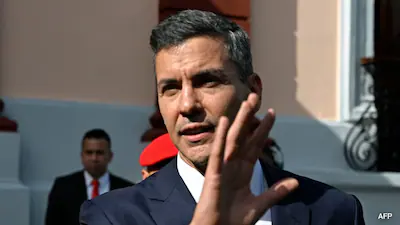
ASUNCIÓN — In the most explosive political realignment to hit Paraguay since the collapse of its 35-year military dictatorship, former President Santiago Peña spent his first weekend in custody at a heavily fortified military base. A federal judge stripped the 47-year-old former International Monetary Fund (IMF) economist of his liberty following a catastrophic digital banking collapse that has wiped out the savings of millions and triggered nationwide street warfare.
On Saturday, November 7, 2026, Judge Humberto Otazu signed a decree remanding Peña into pre-trial detention at the Presidential Escort Regiment headquarters. The emergency action came less than 24 hours after a furious Senate rejected Peña’s frantic attempt to resign, voting unanimously (44–0) to impeach and remove him from office. By choosing impeachment over resignation, lawmakers effectively stripped Peña of his constitutional lifetime immunity. He now faces up to 20 years in a conventional prison if convicted on charges of breach of trust and administration for personal gain.
The Sham Sovereign: How ‘Ueno’ Plundered the State
At the epicenter of the crisis is Ueno Bank, an obscure digital finance company that skyrocketed during Peña’s tenure to become the nation’s fifth-largest lender by deposits. Beguiling the working class and unbanked with generous cashback schemes, Ueno signed up nearly three million retail customers—roughly 60% of Paraguay’s adult population. It plastered its name across the country, sponsoring the national soccer team and rebranding Asunción’s premier sports stadium.
But prosecutors allege Ueno’s meteoric rise was fueled by institutional corruption orchestrated directly from the presidential palace. According to criminal indictments, Peña—who held a major stake in Ueno’s parent holding company until last year—used his executive authority to steer more than $800 million in public funds into the digital bank’s vaults. This massive haul included over $355 million diverted from the state pension and social security health fund.
To protect the operation, Peña appointed Carlos Carvallo—the former chief of Ueno’s holding company—to head Paraguay’s Central Bank, effectively putting the primary regulator in charge of supervising his own former bank. Armed with total capture of the state oversight apparatus, Ueno executives engaged in a reckless spree of uncollateralized, insider lending to businesses connected to the bank’s owners. When central bank inspectors raised red flags about imminent insolvency in June, the warnings were buried.
Lightning-Speed Collapse and Street Warfare
The house of cards collapsed spectacularly on Tuesday morning when the Central Bank, unable to ignore the severe liquidity bleed any longer, officially seized Ueno Bank. Millions of citizens woke up to find their banking apps frozen, their balances invisible, and their debit cards declined at grocery stores and gas stations.
Public anger erupted instantly. Mass protests organized by labor syndicates, students, and a 40,000-member national teachers’ union paralyzed the capital. Frustrated citizens snaked around blocks in sweltering heat trying to access Ueno branches, clashing with riot police who deployed tear gas and water cannons. While the government has activated its state deposit guarantee fund to begin reimbursing smaller accounts, an estimated 1.8 million depositors remain entirely locked out of their life savings and pensions.
As the chaos intensified, Peña’s conservative Colorado Party completely fractured. Sensing imminent political death, the party’s powerful kingmaker and former President, Horacio Cartes, withdrew his protection, sealing Peña’s fate. Cornered, Peña posted a somber video statement on X claiming he was stepping down for “social peace,” but Congress overrode the offer, preferring to march him out of office in disgrace through formal impeachment.
A Disgraced Cabinet and a Shaky Transition
The shockwaves have leveled the upper echelons of Paraguay’s financial and regulatory elite. Alongside the former president, prosecutors arrested ex-Central Bank Chief Carlos Carvallo, charging him with breach of trust and the forgery of official public documents to cover up Ueno’s true balance sheet. The judge froze the personal assets of both men.
Peña’s Vice President, Pedro Alliana, was quickly sworn in as the interim president to finish the term through August 2028. While Alliana has promised full restitution for every affected citizen, his ascendance has done little to soothe public rage. The opposition has already noted that Alliana belongs to the exact same political clique and is himself under preliminary scrutiny regarding his knowledge of the Ueno maneuvers.
The downfall is a staggering embarrassment for a leader once hailed as Latin America’s technocratic darling. Only weeks ago, the IMF alumnus was welcomed in Washington as a key South American partner. Today, he sits under heavy military guard, while the country’s sovereign bonds face crushing losses in emerging markets and millions of working-class families wonder if they will ever recover their money.