
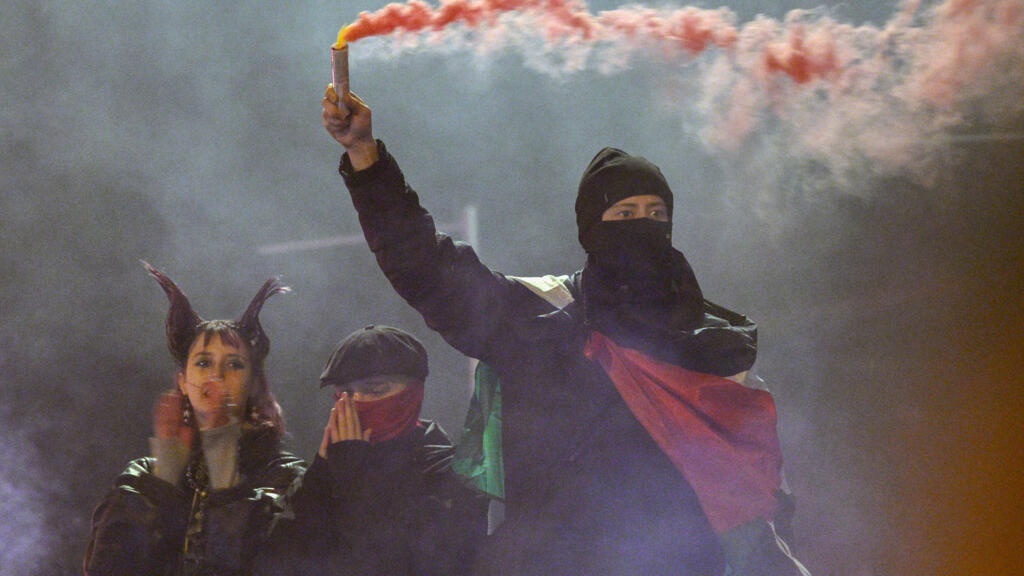
FRANKFURT — A wave of mass youth demonstrations over rising expenses and public austerity has pushed Germany into severe urban unrest. What began as a series of peaceful daytime rallies across the country disintegrated as night fell, leaving storefronts shattered, emergency personnel under fire, and a major financial hub under tactical police lockdown.
Special tactical forces deployed across central Frankfurt to regain control of Die Zeil, the city’s primary commercial avenue, after masked rioters infiltrated the crowds to smash windows and systematically loot high-end businesses. The violence marks a stark escalation in Europe’s growing wave of youth-driven economic dissent.
From Peaceful Grievances to Street Warfare
The nationwide protests were originally conceived as a massive, disciplined demonstration by the youth alliance Gen Z regelt (“Gen Z takes charge”). Tens of thousands of young demonstrators filled the streets in more than 30 German cities—including Berlin, Hamburg, Cologne, and Munich—to protest against the skyrocketing cost of living, underfunded public schools, state budget cuts, and the potential reinstatement of compulsory military service.
While daytime gatherings maintained a peaceful, almost festive atmosphere coinciding with Halloween weekend, the situation deteriorated sharply after dark:
- The Frankfurt Breach: Masked groups detached from the core rally, using stones and heavy pyrotechnics to shatter store displays. Rioters targeted footwear and streetwear boutiques, looting designer goods before special police units cordoned off the shopping district.
- The Gun Store Raid: In one of the night’s most alarming developments, rioters breached a commercial firearms shop in Frankfurt’s city center. Authorities later confirmed that a suspect had been apprehended and two stolen weapons successfully retrieved.
- Emergency Services Under Siege: Rioters targeted police cordons and firefighters with improvised explosive devices, rocks, and Molotov cocktails.
A Contagion of European Dissent
The sudden outbreak of violence across Germany is not an isolated domestic phenomenon. It closely mirrors the destructive civil unrest that has repeatedly paralyzed neighboring France, where more than 320,000 youth-led protesters clashed with security forces on the very same day.
State officials pointed the blame squarely at radical agitators who used the commercial grievances of younger generations as a pretext for coordinated destruction. Roman Poseck, the Interior Minister for the state of Hesse, confirmed that roughly 100 clearly identified left-wing extremists had systematically infiltrated the Frankfurt march. Poseck forcefully condemned the outcome, stating that “France must not be held up as a model” for political expression.
The state response was uncompromisingly severe. In Hamburg and Cologne, police deployed heavy water cannons and pepper spray to disperse violent crowds that had erected flaming barricades and targeted officers near transit hubs. Dozens of emergency workers sustained injuries, and mass arrests were reported across Berlin, Hamburg, and Frankfurt as detention facilities filled overnight.
An Uncertain Autumn for Berlin
The Gen Z regelt leadership immediately distanced itself from the riots, reiterating that the movement explicitly rejects violence, hatred, and anti-constitutional extremism. However, the economic frustrations fueling the broader movement remain intensely potent. Many young demonstrators expressed profound anger that the federal government, led by conservative Chancellor Friedrich Merz, is funneling immense state funding into defense spending while domestic infrastructure, healthcare, and education systems fall into severe decay.
With the alliance already organizing a second wave of massive nationwide demonstrations for November 14, Germany’s political establishment faces an agonizing dilemma. Berlin must now navigate how to address the legitimate economic anxieties of an increasingly alienated younger generation without allowing its major metropolitan centers to slip into structural lawlessness.