
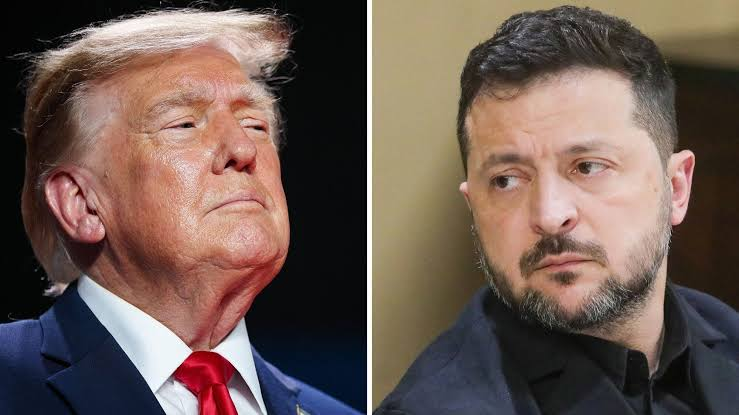
The volatile alliance between Washington and Kyiv has imploded into a historic diplomatic crisis after U.S. President Donald Trump publicly called for the replacement of Ukrainian President Volodymyr Zelensky. Speaking to reporters outside the White House, Trump declared it was “time for Ukraine to get a new president,” escalating a fierce public feud triggered by a controversial U.S. decision to lift sanctions on Russian fuel exports.
The extraordinary verbal assault marks the most severe rupture in U.S.-Ukraine relations since the war began, exposing a deep philosophical divide over how the conflict should end. Trump’s remarks arrived just one day after he bypassed Kyiv to coordinate an agreement with Russian President Vladimir Putin to release millions of tons of Russian diesel onto global energy markets. The decision was aimed directly at lowering domestic pump prices in the United States ahead of critical mid-term congressional elections.
When Zelensky fiercely condemned the arrangement as a “weak decision” and a financial gift to the Kremlin, Trump responded with a stunning political ultimatum, suggesting that the Ukrainian electorate should find “a new leader who can make a deal”.
The Geopolitics of the Pump
The immediate trigger for the falling-out is the soaring cost of energy. Following the outbreak of the war in Iran earlier this year, global diesel prices spiked dramatically, pushing the average price of a gallon of diesel in the United States to more than six dollars. With his administration facing heavy political liabilities ahead of the November elections, Trump chose to target the issue at its source, authorizing a temporary U.S. Treasury license to allow Russian diesel back into international circulation until April.
However, the path to the deal was paved by deep frustration in Washington over Ukraine’s wartime tactics. According to senior officials, Trump moved forward with the unilateral deal after Zelensky repeatedly ignored explicit U.S. requests to stop executing deep-strike drone attacks against oil refineries inside Russian territory.
“We said, ‘you can do whatever you want to Russia, don’t hit the refineries’, because that’s a world problem that’s caused,” Trump told reporters, accusing Zelensky of harming American ranchers and farmers. “He wants to make problems for the world. He better damn well stop”.
A Deadly Paradox on the Ground
For Kyiv, the U.S. reversal on Russian energy sanctions feels like an existential betrayal. Zelensky argued that the massive influx of oil revenues will directly fund the Kremlin’s weapons factories and mercenary recruitment pipelines, actively prolonging the military campaign against his nation.
The physical consequences of the deal were illustrated with tragic clarity just hours after the White House announcement. Even as Russian officials welcomed the lifting of U.S. sanctions, Moscow unleashed a devastating wave of ballistic missiles and jet-powered strike drones across thirteen Ukrainian regions. In the southern city of Zaporizhzhia, a Russian airstrike tore through a residential building, killing twenty civilians, including three children.
“Today, Russia expressed its thanks for the lifting of sanctions on diesel exports by dropping five glide bombs on residential buildings,” Zelensky wrote in an impassioned public statement, linking the renewed bombardment directly to Washington’s economic pivot. He characterized the deal as an active investment in a war that should be suffocated, not financed.
The Domestic and International Backlash
Trump’s call for a leadership change in a sovereign allied nation faces a steep reality check. Under Ukraine’s current wartime emergency framework, national democratic processes remain entirely suspended under martial law while the country fends off the ongoing invasion.
Responding to the White House remarks, Ukrainian Foreign Minister Andrii Sybiha delivered a firm defense of his president, stating that Zelensky retains the absolute support of the Ukrainian populace and that outside interventions only prove he is doing his job effectively.
The domestic political blowback for Trump has been swift and bipartisan. Even within his own party, prominent lawmakers have openly rejected the U.S.-Russia agreement. High-ranking Republicans urged the administration to deploy existing legislative leverage—such as the Lindsey O. Graham Sanctioning Russia and Iran Act—to cut off Moscow’s revenues rather than granting economic lifelines that fuel the destruction of Ukrainian cities.
By framing the Ukrainian leader as an impediment to global stability, Trump has drawn a sharp line in the sand. But as smoke rises from the rubbled residential blocks of Zaporizhzhia and the debate rages in Washington, the true cost of cheaper domestic diesel is being measured in structural trust and civilian lives.