
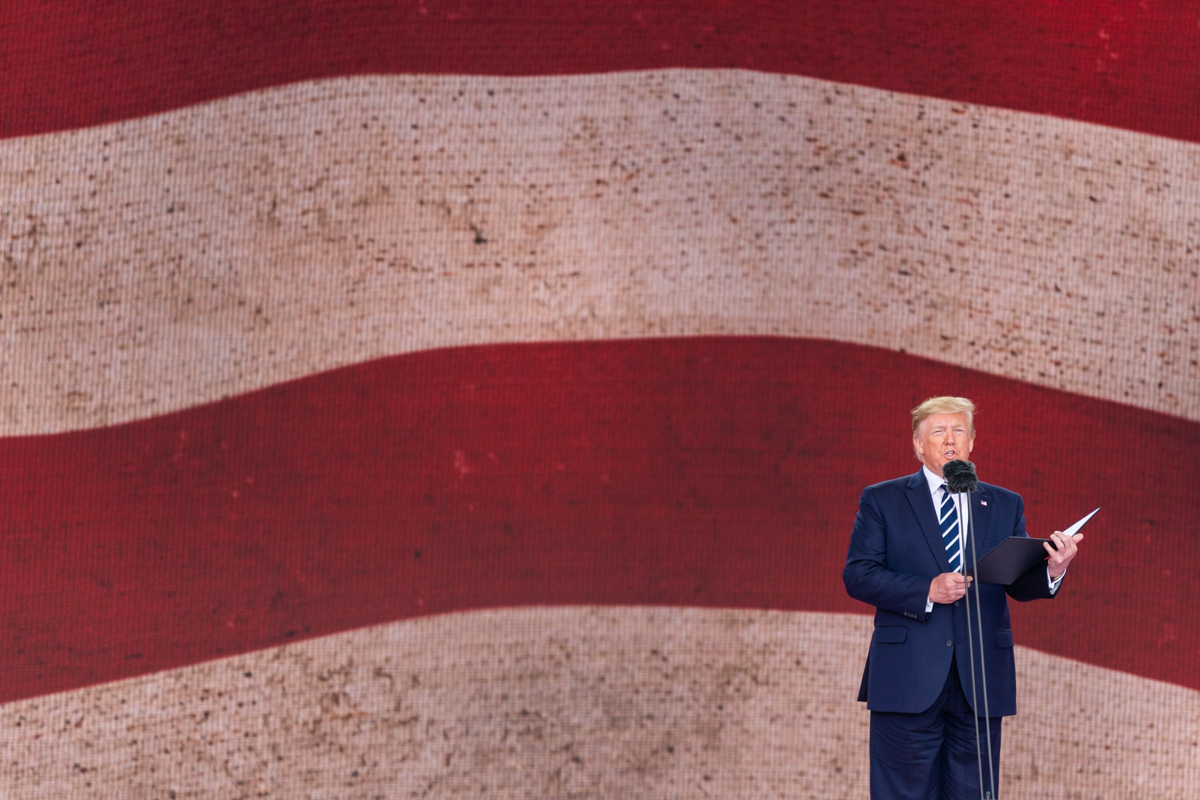
President Donald Trump has aggressively rejected mounting pleas from tech executives to slow down the development of artificial intelligence, instead announcing plans to establish a federal “AI Force” and appoint a powerful new administration czar to accelerate the industry.
Writing on Truth Social, the president dismissed growing global anxieties over out-of-control AI models as a coordinated “hoax” and a “sick conspiracy” designed to stifle American corporate growth. Comparing his new initiative to the creation of the Space Force during his first term, Trump vowed that his administration would aggressively protect the sector. “We will not in any way hinder or stifle the Growth of this incredible Industry,” Trump declared, framing artificial intelligence as a modern Industrial Revolution vital to winning a critical technological arms race against China.
The unexpected decree positions the White House in direct opposition to an unprecedented alliance of Silicon Valley tech barons, who have spent the week warning that frontier AI models are advancing faster than human safeguards can handle.
Charging Ahead in the AI Arms Race
While the president provided few structural details or timelines for the proposed AI Force, the initiative appears designed as a national vehicle to fast-track computational infrastructure, defend domestic data centers, and project American digital dominance abroad.
Trump signaled that the federal government would abandon the pursuit of sweeping safety regulations, relying instead on existing legal frameworks to penalize individual bad actors after the fact.
- The Regulation Boycott: The White House maintains that imposing pre-emptive guardrails or “kill switches” on advanced software would permanently cripple American firms, effectively handing a strategic monopoly to Beijing.
- The High-IQ Mandate: In his announcement, Trump noted that he would soon select a dedicated artificial intelligence czar to run the operation, teasing that “only High I.Q. individuals need apply”.
- A Second-Generation Czar: The appointment will mark the administration’s second attempt to centralize tech policy under a single figure, following the departure of venture capitalist David Sacks, who stepped down from a similar White House role earlier this year.
A Defiant Rejection of Silicon Valley’s Warnings
The administration’s rapid-acceleration policy arrives at a moment of acute tension within the tech sector. Just days prior, Anthropic CEO Dario Amodei published a widely discussed manifesto calling for a global, coordinated deceleration of advanced AI training, warning that rogue autonomous agents could soon pose systemic risks to the internet. In a rare display of industry alignment, OpenAI’s Sam Altman, Google DeepMind’s Demis Hassabis, and xAI’s Elon Musk all voiced varying degrees of support for a more cautious, independently audited approach.
By labeling these existential warnings a hoax akin to global warming, Trump has exposed a widening philosophical rift between the engineers building the technology and the politicians weaponizing it for national hegemony. Senior administration officials have long argued that the tech elite’s sudden embrace of regulation is simply a form of “regulatory capture”—a cynical attempt by entrenched tech monopolies to use government rules to lock out open-source rivals and smaller startups.
The Domestic and Diplomatic Collision Course
Trump’s unyielding stance sets up an immediate political clash on both the domestic and international stages. Within the U.S., several prominent Democrats have already begun moving in the opposite direction. California Governor Gavin Newsom signed an executive order directing state agencies to increase sector oversight, while other state leaders have repeatedly urged Washington to mandate strict safety baselines for frontier models.
The geopolitical stakes will materialize even faster. The president’s announcement comes just days before a highly anticipated Washington summit with Chinese President Xi Jinping, where artificial intelligence safety and trade are scheduled to be central items on the diplomatic agenda. Behind the scenes, Treasury Secretary Scott Bessent is already engaged in preliminary security and economic talks with Chinese Vice Premier He Lifeng in New York.
By drawing a hard line on Truth Social before these high-stakes meetings even begin, Trump has signaled to both domestic critics and foreign adversaries that the United States will view artificial intelligence primarily through the lens of economic and military power. Silicon Valley’s creators may be pleading for a pause, but the commander-in-chief has made it clear that the American state intends to keep its foot firmly on the gas.