
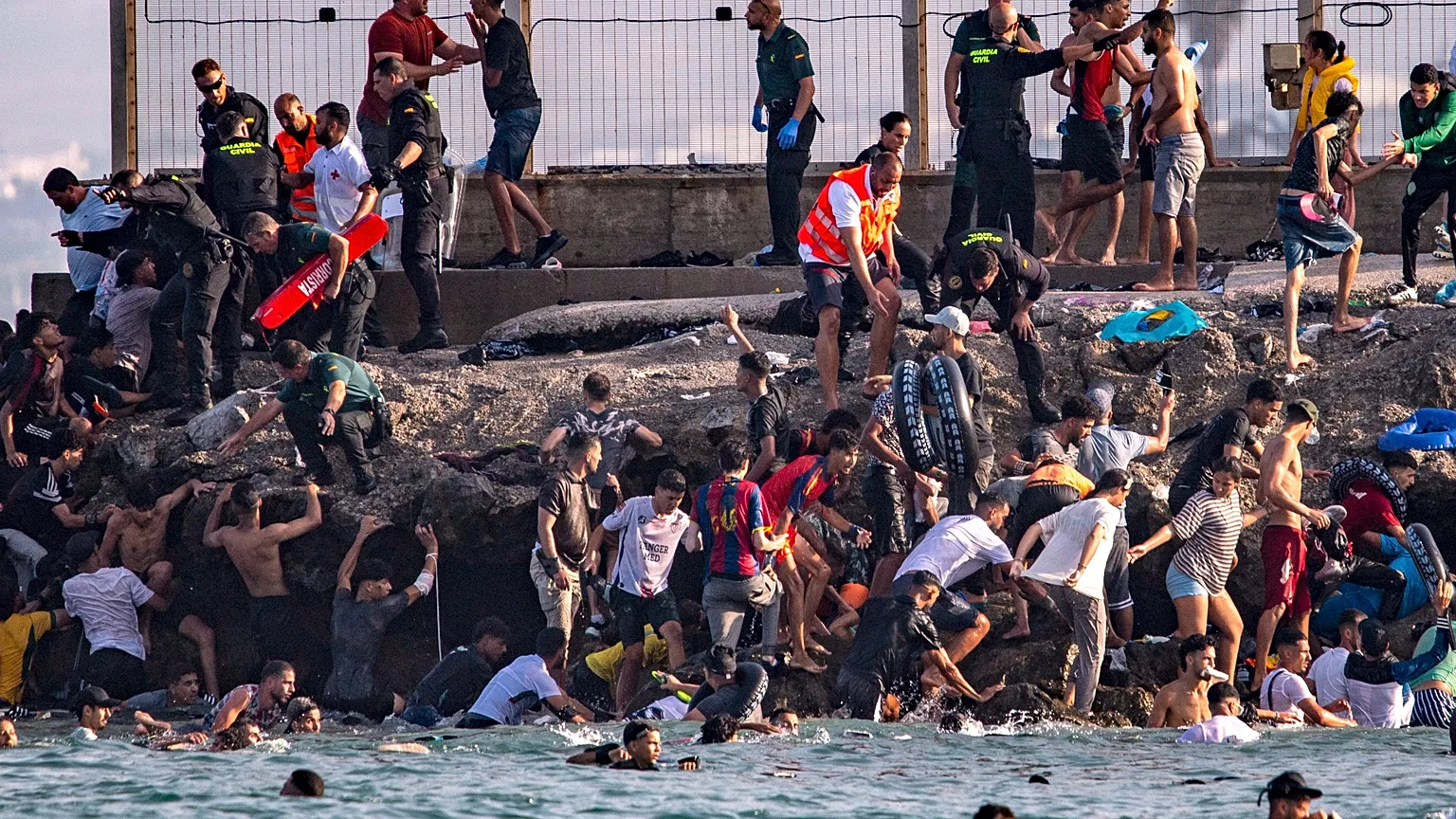
A viral lie has shattered Europe’s fragile consensus on migration. Within a 48-hour window, approximately 60,000 migrants swam or pushed through border barriers into Ceuta, Spain’s tiny North African enclave. This extraordinary surge—equivalent to roughly 70% of the territory’s total population—was fueled directly by coordinated social media campaigns. It has triggered a furious domestic backlash and a bitter continent-wide diplomatic confrontation.
The sudden mass crossing quickly turned tragic, with at least 67 people confirmed dead after drowning in the choppy waters of the Mediterranean. While Spanish police and military units have since escorted more than 48,000 people back to Morocco, the geopolitical damage is already done. The crisis has exposed deep fractures inside the European Union, leading to the unprecedented suspension of free-movement treaties and public recriminations among allied leaders.
The Blueprint of a Viral Border Panic
The crisis stems from the rapid distortion of a recent Spain Supreme Court ruling. The court dictated that migrants intercepted at sea within Spanish territorial waters could no longer face summary “pushbacks”. Instead, they must be brought ashore and processed individually.
Within hours, Moroccan social media networks weaponized and oversimplified this nuanced judicial decision. TikTok and Instagram accounts—some active for only a few weeks—flooded feeds with videos of young men in wetsuits claiming “Spain is Open”.
- The Illusion of Legality: Influencers and human traffickers actively pushed false promises that entering the water guaranteed automatic legal residence in Europe.
- Algorithmic Amplification: Posts racking up tens of thousands of likes created a false sense of urgency among unemployed youth in mainland Morocco.
- The Reality on the Shore: Thousands arrived in Ceuta to find no food, no shelter, and no legal passage to continental Europe, realizing too late they were chasing an online illusion.
The situation was further complicated by Spain’s domestic policy. Earlier this year, Prime Minister Pedro Sánchez’s socialist government launched a massive regularization program aiming to legalize up to 1.2 million undocumented residents. Right-wing opponents swiftly paired this policy with the Ceuta images on social media, claiming the administration’s pro-immigration stance was an open invitation to traffickers.
Italy and France Shock the Schengen Zone
As images of the chaotic mass crossing went viral globally, populist and right-wing governments across Europe seized on the spectacle to score political points ahead of key elections.
Italian Prime Minister Giorgia Meloni’s hard-right government immediately posted the footage from Ceuta. Labeling uncontrolled immigration a “real threat to European security”, Italy suspended its Schengen agreement with Spain, introducing strict, targeted document checks on all air and sea arrivals.
The political contagion spread rapidly across the continent:
- France Tightens Borders: French authorities immediately ordered reinforced checkpoints along the Spanish border to block onward transit.
- Schengen Expulsion Demands: Political figures, including the Czech Republic’s Andrej Babiš, openly called for Spain’s outright suspension from the Schengen passport-free zone.
- Far-Right Momentum: In France, National Rally leaders Marine Le Pen and Jordan Bardella weaponized the crisis to demand a total halt to European migration, framing Ceuta as a preview of Europe’s future.
A Defiant Madrid Slams “Partisan Demagoguery”
An isolated Pedro Sánchez hit back at his European allies, accusing them of a total lack of empathy and violating European treaties. The Spanish Foreign Ministry formally summoned the Italian ambassador to Madrid, blasting Rome’s border restrictions as “partisan demagoguery” improper for a partner nation.
Madrid maintains that its border enforcement was fast and effective, pointing out that tens of thousands were safely repatriated within 72 hours. However, more than 20 EU leaders have signed onto joint declarations demanding tougher external borders and backing third-country return hubs—a policy Spain fiercely opposes.
To prevent a recurrence, Spanish engineers are hurriedly extending Ceuta’s border fences further into the sea and installing massive lines of orange buoys monitored by naval vessels. Yet, as long as social media algorithms remain capable of turning a complex legal ruling into a viral stampede, Europe’s physical borders look increasingly obsolete against digital disinformation.