
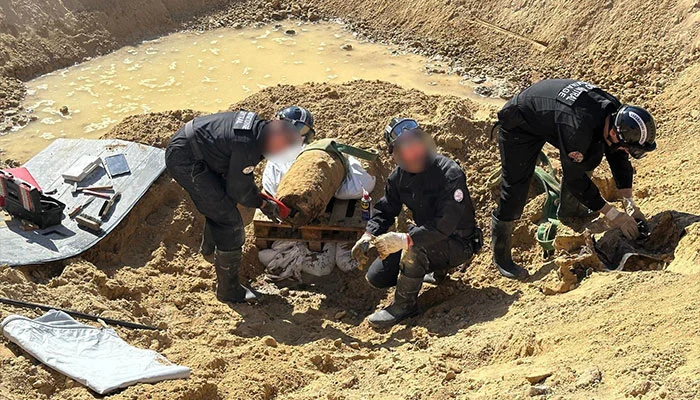
COLOMBES, France — For a few tense seconds on Sunday afternoon, the ground in the northwestern Parisian suburb of Colombes shuddered with the force of a conflict that ended eighty years ago. At precisely 3:20 PM, bomb disposal experts carried out a controlled underground detonation of a massive World War II-era explosive, ending a week-long standoff between modern urban life and the deadly debris of the 20th century.
The operation, described by local officials as “high-risk and surgical,” required the evacuation of more than a thousand residents and the deployment of nearly 800 police officers to maintain a strict 450-meter security cordon.
A Relic in the Garden
The device, a British-made aerial bomb measuring over one meter in length, was first discovered on April 10 during routine construction work in a residential area. For ten days, the neighborhood lived in a state of suspended animation as specialists from the Sécurité Civile assessed the volatile relic.
The decision to detonate the bomb in situ was made after experts failed in an initial attempt to unscrew the primary detonator. “The fuse was excessively degraded by eight decades of soil moisture,” explained Alexandre Brugere, a local official who oversaw the evacuation. “Moving a device of this magnitude with an active, unstable fuse was simply not an option for public safety.”
The Sunday Exodus
The evacuation began at dawn. Residents within the “red zone” were directed to local gymnasiums and reception centers, carrying pets, paperwork, and essentials. By noon, Colombes—usually a bustling suburban hub—resembled a ghost town. Public transport was halted, and several key access roads to the A86 motorway were sealed off.
To minimize the impact of the blast, engineers constructed a two-meter-deep sand pit reinforced with thick timber planks and concrete blast walls. The goal was to direct the energy of the explosion downward and stifle the spread of shrapnel.
When the charge finally blew, the muffled “thump” was heard blocks away, followed by a plume of dust. Preliminary inspections confirmed that the “controlled neutralization” was a success, with no damage reported to the surrounding residential blocks.
A Landscape of Unexploded History
The Colombes discovery is a vivid reminder of the Allied air campaign in the spring of 1944. During the lead-up to D-Day, the rail yards and factories of northwestern Paris were prime targets for the Royal Air Force and the U.S. Eighth Air Force.
Historians note that between 10% and 15% of the bombs dropped during these raids failed to explode upon impact, often sinking deep into the soft clay of the Seine valley. Since 1945, French disposal teams have neutralized over 700,000 air-dropped bombs, yet thousands more are believed to remain “sleeping” beneath the feet of modern Parisians.
“Every time we break ground in this region, we are shaking hands with history,” said a member of the EOD (Explosive Ordnance Disposal) unit. “Yesterday, that history almost bit back.”
Return to Normalcy
By Sunday evening, the evacuation orders were lifted, and families began returning to their homes. For the residents of Colombes, the day ended not with a tragedy, but with a profound sense of relief.
As the last of the police tape is cleared away, the “Leviathan of Colombes” has been reduced to rusted fragments in a sand pit—a final, silent casualty of a war that refuses to be completely buried.