
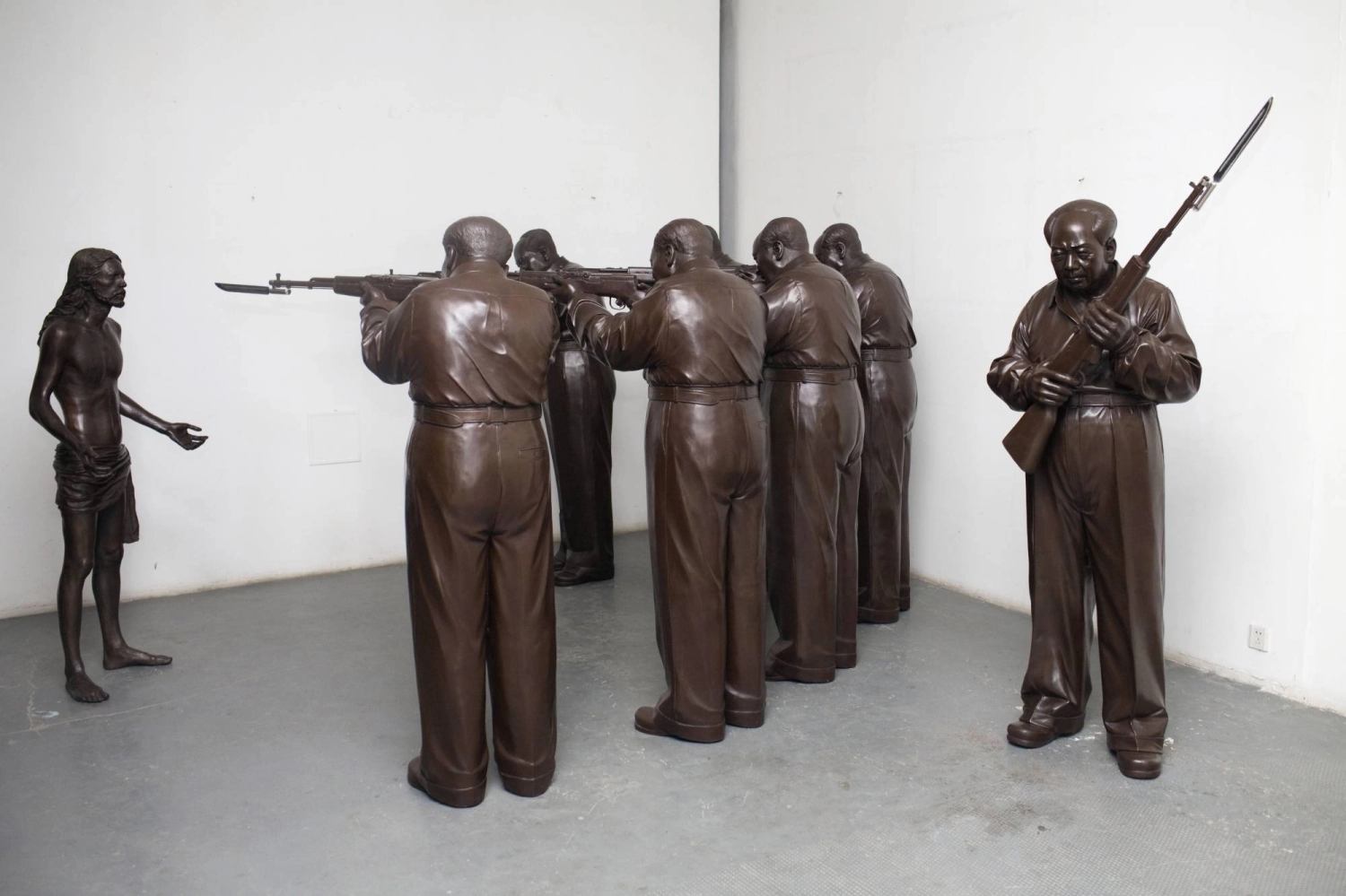
SANHE, China — In a windowless courtroom in Hebei Province, the decades-old bronze of a kneeling, repentant Mao Zedong has become the centerpiece of a trial that legal experts say represents the “final closing of the door” on Chinese dissent.
Gao Zhen, 69, one-half of the world-renowned Gao Brothers artistic duo, stood trial in a closed-door session at the Sanhe City People’s Court on March 30. The charge: “defaming national heroes and martyrs.” The evidence: satirical sculptures created nearly two decades ago—long before the law used to prosecute him even existed.
As the court deliberates on a verdict expected later this summer, the case has sent a shivering message to the global Chinese diaspora: the reach of Beijing’s “ideological purity” campaign no longer stops at the border, nor does it respect the passage of time.
A Trap Two Years in the Making
Gao Zhen had been living in self-imposed exile in New York since 2022. In August 2024, believing a brief family visit to his homeland would be safe, he returned to China. He was promptly detained at his studio on the outskirts of Beijing.
For over 18 months, Gao has been held in a detention center where family members say he is suffering from malnutrition and debilitating chronic health conditions. His wife, Zhao Yaliang, and their seven-year-old son—a U.S. citizen—have been slapped with “exit bans,” effectively held as collateral within Chinese borders.
“They are using a contrived, retroactively applied law to punish art that was once exhibited in the streets of Beijing,” said Shane Yi, a researcher at Chinese Human Rights Defenders. “This isn’t a trial; it’s a political kidnapping.”
The Sculptures of ‘Guilt’
The prosecution’s case rests on three specific works created between 2005 and 2009—a period of relative openness in China when the Gao Brothers were darlings of the avant-garde scene.
- “Mao’s Guilt”: A life-sized bronze of the Great Helmsman kneeling in a gesture of apology for the millions who perished during the Cultural Revolution.
- “Miss Mao”: A grotesque depiction of the leader with a Pinocchio nose and breasts, critiquing the “feminization” and deception of state propaganda.
- “The Execution of Christ”: A surrealist scene featuring multiple figures of Mao aiming rifles at a kneeling Jesus.
Under the 2018 Law on the Protection of Heroes and Martyrs, which was significantly sharpened in 2021, any “tarnishing” of the reputation of historical Communist Party figures is a criminal offense punishable by up to three years in prison. By applying this law to works from 2005, Beijing is asserting that historical critique is now a permanent, retroactive crime.
The ‘New Normal’ for the Diaspora
The timing of Gao’s trial is no accident. It coincides with a broader crackdown on “overseas dissidents” who have sought refuge in the West. Analysts suggest the Gao case is intended to prove that moving to New York or London offers no immunity if an artist ever steps back onto Chinese soil.
“The state is now auditing the past to control the future,” says a Beijing-based art critic who requested anonymity. “In the early 2000s, we thought we were pushing boundaries. Now, those boundaries have moved behind us, and we are being arrested for where we stood twenty years ago.”
A Silent Courtroom
EU diplomats and international observers who attempted to attend the March 30 trial were barred from entering the building. According to Gao’s lawyers, the artist has refused to “confess” or plead guilty, a rare act of defiance in a system where a confession is often the only way to avoid the harshest sentencing.
While the world’s attention is often captured by the high-profile exile of Ai Weiwei—who recently released a book, On Censorship, in early April 2026—the Gao Zhen trial represents the grimmer reality for those without a global megaphone.
As Gao Zhen waits in a Hebei cell, tearing pieces of scrap paper to make portraits of the family he is forbidden to see, the “Kneeling Mao” remains locked in a government warehouse—a bronze witness to an era of Chinese art that has been officially declared a crime.