
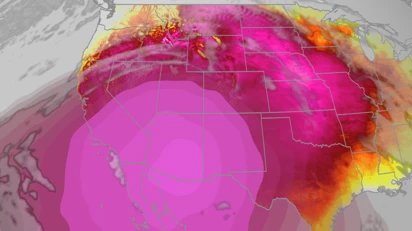
MARTINEZ LAKE, Ariz. — The American Southwest is currently the epicenter of a “virtually impossible” climate event. On Thursday, March 19, 2026, the mercury in the tiny desert community of Martinez Lake hit a staggering 110°F (43.3°C), officially recording the hottest temperature for the month of March in United States history.
The reading, confirmed by the National Weather Service (NWS), didn’t just break the previous national record—it annihilated it. For 72 years, the title belonged to Rio Grande City, Texas, which hit 108°F in 1954. That mark was tied just Wednesday by North Shore, California, before Arizona claimed the top spot 24 hours later.
“To put this in perspective, the average first 105-degree day in this region normally occurs on May 22nd,” the NWS stated in a briefing. “We are seeing mid-summer conditions while the calendar still says winter.”
A Region Under a ‘Heat Dome’
The record-breaking heat is the result of a massive, slow-moving high-pressure system—a “heat dome”—that has parked itself over the Southwest. This atmospheric “lid” traps warm air and prevents cloud formation, allowing the sun to bake the desert floor with uninterrupted intensity.
The Fallout Across the West:
- Phoenix’s Triple-Digit Streak: The Arizona capital hit 105°F on Thursday, marking its earliest 100-degree day on record. This crushed the city’s previous March record of 102°F set just a day prior.
- California’s Sizzle: Towns like Thermal and Cathedral City tied the old national record of 108°F on Thursday, with forecasts suggesting they could hit 110°F themselves by the weekend.
- Vegas and Beyond: Las Vegas reached 95°F, nearly 30 degrees above its seasonal average, while Los Angeles and San Francisco have seen “highly unusual” 80 and 90-degree days throughout the week.
‘Virtually Impossible’ Without Climate Change
A flash report released Friday by World Weather Attribution, a global team of climate scientists, delivered a stark verdict: this heatwave would have been “virtually impossible” without human-induced global warming.
Researchers found that the current heat dome is approximately 4°C (7.2°F) warmer than it would have been in a pre-industrial world. “This isn’t just a hot day; it’s a signature of a warming world,” said one meteorologist. “We are seeing the bounds of what we thought was possible being pushed further every season.”
Public Health and Environmental Toll
The unseasonal heat has triggered a series of emergency measures across the Southwest.
- Trail Closures: In Phoenix, popular hiking spots like Camelback Mountain and Piestewa Peak were shuttered Thursday due to the “extreme risk” of heat-related illness.
- Snowmelt Surge: Scientists warn that the high temperatures are accelerating snowmelt in the Sierra Nevada and Colorado Rockies. This “rapid melt” can lead to early-season flooding and leave water reservoirs dangerously low by mid-summer.
- Vulnerable Populations: Authorities are opening cooling centers months earlier than usual, particularly for the elderly and those without air conditioning who are not yet acclimated to triple-digit heat.
The Forecast: A Slight Reprieve?
While the record-shattering peaks may have been reached on Thursday, the “winter heatwave” isn’t over yet. Forecasters expect temperatures to remain 20 to 30 degrees above normal through Sunday. A slight cooling trend is predicted for Monday, though “cooling” in this context simply means a return to the mid-90s—still well above the historical average for March.
As Arizona residents swap their light jackets for electrolyte drinks and shade, the 110°F reading at Martinez Lake stands as a grim milestone. In the “Year of the Fire Horse,” the line between the seasons has never looked thinner.