
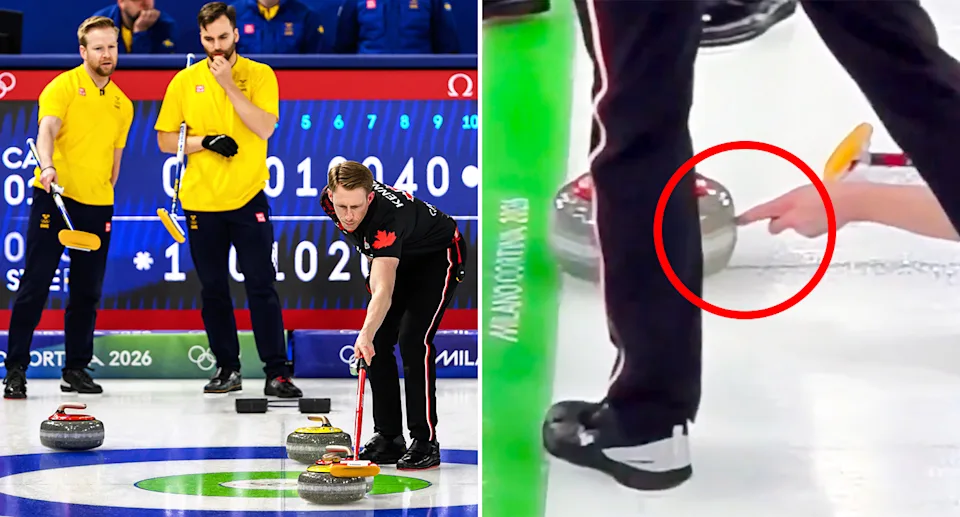
CORTINA D’AMPEZZO, Italy — In the polite, hushed world of Olympic curling, where a raised voice is a rarity and an apology is the default, the 2026 Winter Games have descended into a full-blown civil war.
What began as a technical dispute on the ice has metastasized into a sprawling cheating scandal that has left Canada—the self-appointed guardians of the sport—on the defensive. At the heart of the “Cortina Chaos” is an accusation of “double-touching”: a subtle but illegal infraction where a player makes secondary contact with the granite of the stone after its initial release.
For a nation that views curling not just as a pastime but as a pillar of national identity, the allegations have triggered a collective crisis of conscience.
The Profane Encounter
The fire was lit on Friday, February 13, during a high-stakes men’s round-robin match between Canada and Sweden. Swedish star Oskar Eriksson accused Canadian veteran Marc Kennedy of repeatedly touching the granite body of the stone past the “hog line”—the threshold where a player must let go.
The exchange, caught by hot mics and broadcast globally, was anything but sportsmanlike. When Eriksson offered to show Kennedy video evidence after the game, the 44-year-old Canadian responded with a series of expletives, telling his opponent to “f*** off.”
“I haven’t done it once,” a defiant Kennedy told reporters after Canada’s 8–6 victory. “I’ve been curling professionally for 25 years. I don’t like being called a cheat.”
The Controversy Widens
While World Curling initially cleared Kennedy due to a lack of on-ice evidence, the scandal took a darker turn for Team Canada just 24 hours later.
- The Homan Infraction: On Saturday, an umpire accused women’s skip Rachel Homan of a double-touch during a match against Switzerland. Unlike the Kennedy incident, the umpire intervened mid-delivery, and the stone was removed from play. Canada went on to lose the match 8–7.
- The ‘Premeditated’ Defense: Kennedy has since suggested that the Swedish team arrived at the Olympics with a “planned” strategy to rattle Canada. “They’ve come up with a plan to catch teams in the act,” he claimed, alleging Swedish coaches were strategically positioned with cameras to manufacture a scandal.
The Mechanics of the ‘Cheat’
To the casual viewer, a finger brushing against a 40-pound piece of granite seems inconsequential. However, the integrity of the sport relies on the “clean release.”
Current Olympic stones are equipped with electronic handles that flash red if a hand is still on the handle past the hog line. The Swedes contend that the Canadians are bypassing this technology by touching the granite body of the stone rather than the handle, which does not trigger the sensors but can allegedly help “stabilize” the stone’s trajectory.
“It’s a game of millimeters,” says one former Olympic official. “If you can keep your finger on the granite just a fraction of a second longer, you can influence the curl. In this field, that’s the difference between gold and nothing.”
A Culture in Crisis
The fallout has been swift. World Curling has introduced emergency spot checks, deploying extra officials to monitor every delivery for at least three ends per game.
Back in Canada, the mood is one of bruised ego and defensive pride. The “cheating” narrative has been amplified by Swedish newspapers like Aftonbladet, which reportedly sent photographers to specifically document Canadian hand placements.
For the Canadian teams, the psychological toll is evident. Historically a powerhouse, the Canadian rinks are currently “on the back foot,” struggling with unforced errors and uncharacteristic losses. As they fight to keep their medal hopes alive in Cortina, they are also fighting to save their reputation. In a sport built on the “Spirit of Curling,” the stain of an alleged cheat is a heavy stone to carry.
v