
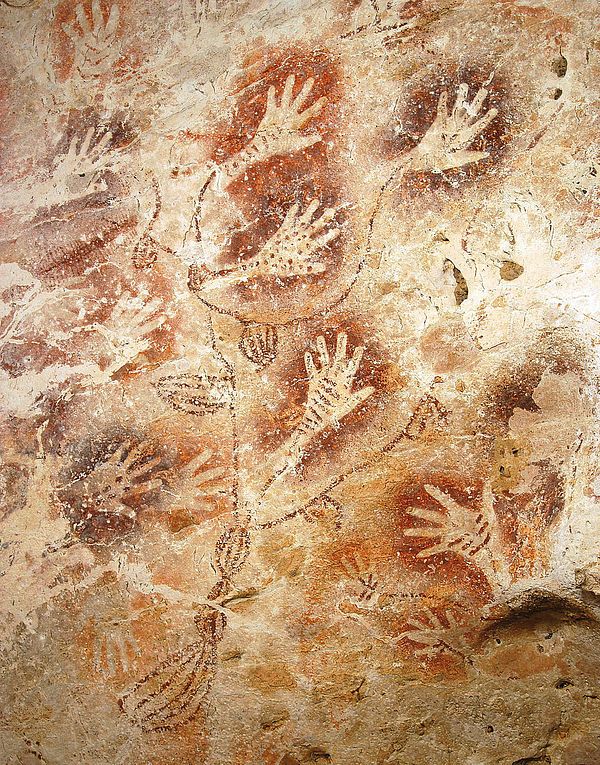
MUNA ISLAND, INDONESIA — Deep within the limestone labyrinth of Liang Metanduno cave, a faint, reddish stain on a rock wall has just shattered our understanding of when and where the human “artistic spark” first ignited.
In a study published Wednesday in the journal Nature, a team of Indonesian and Australian archaeologists revealed that a stencilled outline of a human hand—deliberately modified to resemble a sharp, animal-like claw—is at least 67,800 years old. The discovery makes it the oldest reliably dated work of figurative rock art in the world, unseating previous record-holders in Europe and proving that the ancestors of modern humans were master storytellers long before they ever reached the shores of France or Spain.+1
“This is not just a mark of presence; it is a mark of imagination,” said Maxime Aubert, an archaeologist and geochemist at Griffith University who co-led the research. “By narrowing the fingers to look like claws, these early people were playfully transforming their own image into something else. It is the earliest direct evidence we have of humans imagining a connection between themselves and the animal world.”
A Leap in Symbolic Thought
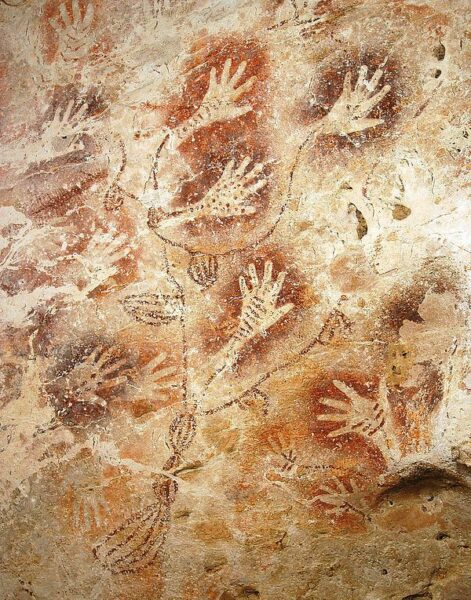
The “Red Claw” was discovered on Muna, a satellite island off the coast of Sulawesi. While hand stencils—created by blowing pigment over a hand pressed against stone—are found globally, the Metanduno stencil is unique. After the initial outline was made, the artist carefully retouched the pigment to taper the fingertips into points.+2
This “claw-style” is exclusive to the Sulawesi region, suggesting a deep-rooted cultural tradition that persisted for tens of thousands of years.
- The Technique: Scientists used a high-precision laser-ablation uranium-series dating method to analyze “cave popcorn”—tiny calcite deposits that grew on top of the paint.
- The Age: The results provided a minimum age of 67,800 years, though the actual painting could be significantly older.
- The Comparison: It beats the previous record for Homo sapiens art (a 51,200-year-old hunting scene also found in Sulawesi) by over 16,000 years and is older than the controversial 64,000-year-old stencils in Spain attributed to Neanderthals.
Mapping the ‘Long Chronology’
Beyond its artistic significance, the Red Claw provides a vital piece of evidence for the “long chronology” model of human migration. For decades, scientists have debated exactly when the first Homo sapiens reached Sahul—the prehistoric supercontinent that encompassed Australia, New Guinea, and Tasmania.+1
If modern humans were producing sophisticated symbolic art in Indonesia nearly 70,000 years ago, it strongly supports genetic evidence suggesting they arrived in Australia by at least 65,000 years ago.
“We now have the oldest direct evidence for the presence of modern humans along the northern migration corridor,” said study co-author Adhi Agus Oktaviana. “These people weren’t just passing through; they were settling, creating, and expressing complex ideas as they moved toward Australia.”
Sulawesi: The Cradle of Creativity?
For over a century, the history of art was centered on Europe, with famous sites like Lascaux and Altamira seen as the “cradle” of human creativity. The discoveries in Indonesia over the last decade have permanently shifted that center of gravity to Southeast Asia.
The Metanduno cave, once known primarily to locals and a few intrepid tourists for its more recent drawings of horses and deer, is now a site of global heritage. Researchers believe the island of Sulawesi may hold even older treasures, hidden beneath layers of mineral crusts in hundreds of yet-to-be-explored caves.
“We are seeing a culture that was already sophisticated, already symbolic, and already deeply connected to its environment at a time when we previously thought humans were barely beginning to express themselves,” Aubert said. “The story of human creativity is much older, and much more global, than we ever imagined.”