
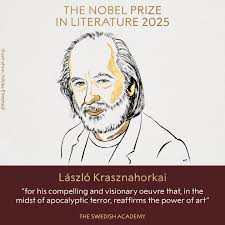
STOCKHOLM — The Swedish Academy on Thursday awarded the 2025 Nobel Prize in Literature to the Hungarian novelist and screenwriter László Krasznahorkai, citing his “compelling and visionary oeuvre that, in the midst of apocalyptic terror, reaffirms the power of art.”
The selection of the 71-year-old author, known for his dense, dark, and stylistically mesmerizing narratives, rewards one of contemporary Europe’s most challenging and revered literary figures. Krasznahorkai’s works are often characterized by their extraordinary, serpentine sentences—sometimes running for pages without a full stop—and their unrelenting exploration of societal decay, existential dread, and the grotesque beauty of human folly.
“Krasznahorkai is a great epic writer in the Central European tradition that extends through Kafka to Thomas Bernhard,” stated Anders Olsson, Chairman of the Nobel Committee, praising the author’s blend of “absurdism and grotesque excess.”
The Laureate of Literary Apocalypse
Krasznahorkai first gained international acclaim with his 1985 debut novel, Sátántangó (Satantango), a bleak, mesmerizing portrait of a disintegrating Hungarian collective farm, which was later adapted into a landmark seven-hour film by director Béla Tarr, establishing a long-standing creative partnership.
His signature style, which critic Susan Sontag once described as being from “the contemporary Hungarian master of apocalypse,” continued through major epics like The Melancholy of Resistance (1989) and his 2021 work Herscht 07769, a novel lauded for its profound depiction of social chaos in a small German town. The Nobel committee highlighted this newest work for capturing “violence and beauty impossibly conjoined.”
Beyond the despair of Central Europe, Krasznahorkai has also drawn inspiration from the East, with novels like A Mountain to the North, a Lake to the South, Paths to the West, a River to the East (2003) and Seiobo There Below (2008) adopting a more contemplative, Eastern-inflected tone that meditates on art, transcendence, and the impermanence of life.
A Reclusive Force
The Hungarian writer, who has resided largely in reclusion in the hills of Szentlászló, has long been a favorite of literary critics, previously winning the prestigious Man Booker International Prize in 2015. His books are not easy reads—they demand patience and surrender to their singular rhythm—but they have earned a fierce devotion. His English-language translator, the poet George Szirtes, called him a “hypnotic writer” who draws the reader into a world where “order and chaos” echo inside them.
Krasznahorkai’s victory is also seen as a subtle but powerful political statement. While he maintains his home in Hungary, he has been an outspoken critic of Prime Minister Viktor Orbán’s increasingly “illiberal democracy,” with some critics seeing allegorical critiques of the regime in his recent fiction.
In an era of global tumult and fragmentation, the Swedish Academy has chosen a writer whose life’s work is dedicated to staring unflinchingly into the abyss, finding not only terror, but a stubborn, persistent echo of beauty and the redeeming power of language itself.