
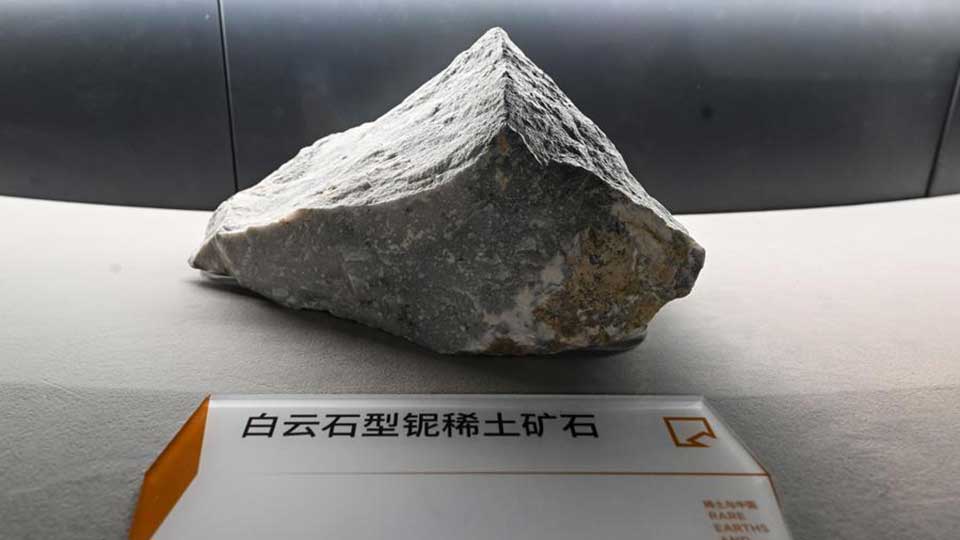
HONG KONG — China has dramatically solidified its control over the global rare earth supply chain, announcing sweeping new export restrictions that explicitly target foreign defense and advanced semiconductor industries. The move, framed by Beijing as a vital measure to safeguard “national security and interests,” is being seen globally as a powerful new economic weapon in the escalating technology and trade cold war with the West.
The new regulations, released by the Ministry of Commerce on Thursday, build upon earlier, disruptive controls and introduce two crucial layers of scrutiny:
- Defense Blackout: The Ministry explicitly stated that export licenses will not be granted for rare earth-related items intended for overseas defense users.
- Technology Lockdown: Government permission is now mandatory for exporting technology related to rare earth mining, processing, recycling, and, most critically, the manufacturing of rare earth magnets. This effectively restricts the spread of the expertise that underpins China’s near-monopoly on processing these critical materials.
The tightening of the export regime sends an unmistakable message to the United States and its allies, who rely heavily on the 17 chemically similar metallic elements for everything from precision-guided missiles and advanced radar systems to electric vehicle motors and high-end consumer electronics. China currently processes over 90% of the world’s refined rare earths and rare earth magnets, giving it extraordinary leverage.
Targeting the ‘Dual-Use’ Battlefield
The Chinese Commerce Ministry justified the stringent measures by alleging that “unnamed overseas organizations and individuals” have been transferring Chinese-sourced rare earths and related technologies for use “directly or indirectly in military and other sensitive fields,” which it claims poses a “significant damage or potential threats to China’s national security.”
This focus on “dual-use” technology—items with both civilian and military applications—is a clear mirror of the export control tactics employed by the U.S. in recent years to slow China’s development of advanced semiconductor chips.
Analysts immediately noted the strategic timing of the announcement, which comes just weeks before an anticipated high-stakes meeting between President Donald Trump and Chinese leader Xi Jinping at the Asia-Pacific Economic Cooperation (APEC) forum in South Korea.
“Rare earths have now moved from being a simple trade issue to a high-value geopolitical bargaining chip,” said Tim Zhang, founder of Singapore-based Edge Research. “Beijing is signaling that if the West is going to cut off its access to chipmaking equipment, China will retaliate by restricting access to the physical elements essential for the end products.”
Global Supply Chains Brace for Impact
The new rules go beyond raw materials, extending China’s regulatory reach to foreign manufacturers. Companies overseas that use even small traces of certain Chinese-sourced rare earth elements, or utilize Chinese components and machinery in their production lines, will now be required to secure export licenses. This extraterritorial reach is a significant escalation that adds new layers of compliance complexity and uncertainty for the global technology industry.
For the defense sector, the near-total ban on exports is likely to necessitate a costly and time-consuming reconfiguration of supply chains, forcing Western nations to rapidly accelerate their nascent domestic mining and processing projects. For the semiconductor industry, a critical area in the U.S.-China rivalry, the new rule states that export applications for advanced chips will be considered only on a “case-by-case basis,” introducing a chilling level of risk and delay.
While China insists the restrictions cover a limited range of items and promises “licensing facilitation measures” for legitimate civilian use, the core message is stark: Beijing is using its unique mineral advantage to extract concessions in the trade war and protect its strategic technological assets from foreign militaries. The battle for technological supremacy has just become a battle for the earth’s crust.