
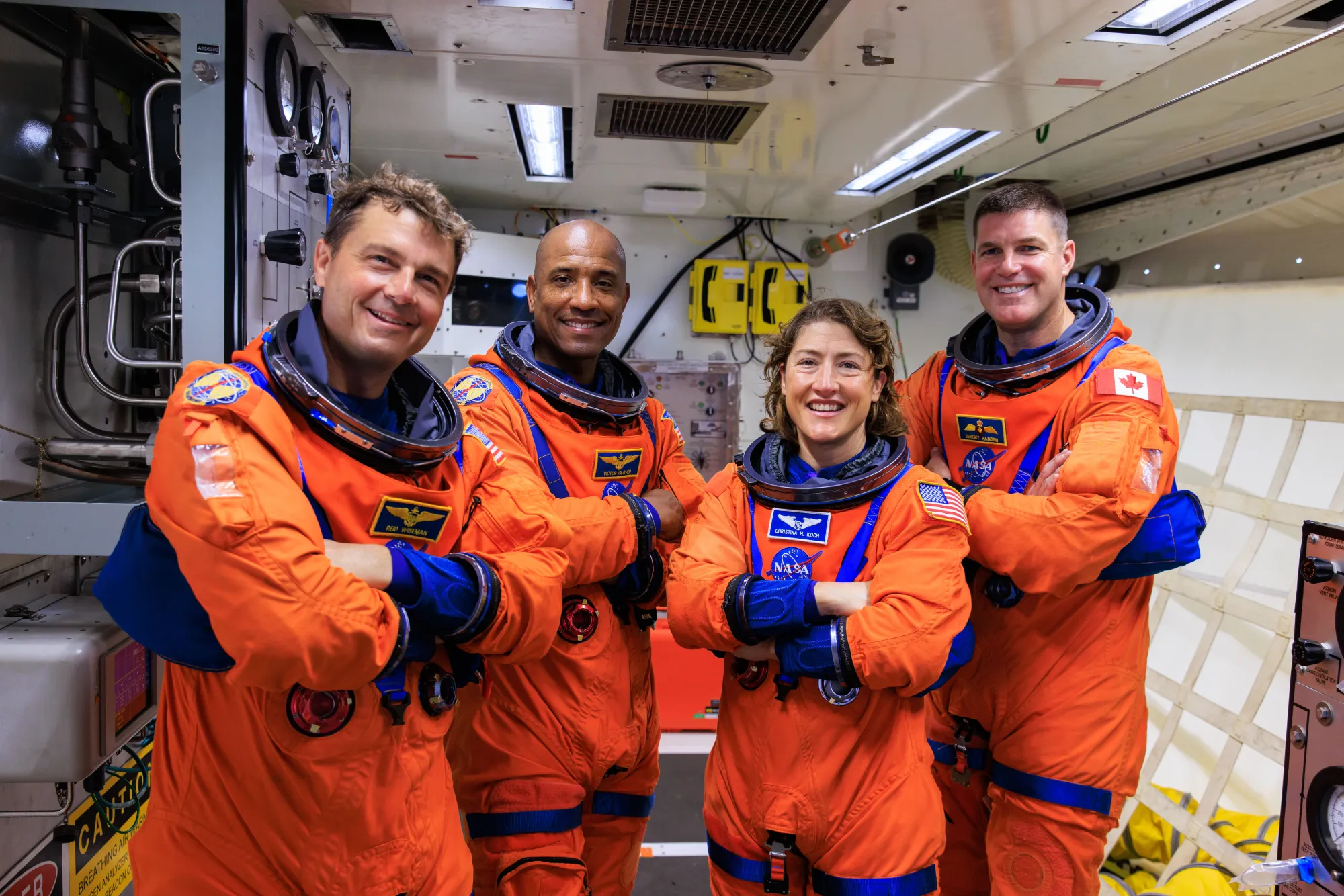
HOUSTON — They are a crew of four trailblazers, a diverse group of astronauts chosen to lead humanity’s long-awaited return to the Moon. On Sunday, NASA officially announced the crew for the Artemis II mission, a historic journey that will mark the first time a crewed vessel has ventured to the Moon in over half a century. But this is not just a return to the past; it is a giant leap into the future, led by a crew that redefines what it means to be a space explorer.
The crew is a group of seasoned veterans and international partners, each bringing a unique set of skills and a history-making distinction to the mission:
- Reid Wiseman, Commander: A decorated U.S. Navy aviator, Commander Wiseman will lead the mission. A veteran of a 165-day mission on the International Space Station, he has served as the Chief of the Astronaut Office, overseeing all flight operations and training. His steady leadership and deep experience in deep space are crucial for the high-stakes journey ahead.
- Victor Glover, Pilot: A U.S. Navy captain and veteran of a 168-day mission on the International Space Station, Glover will pilot the Orion spacecraft. His role is particularly historic: he will become the first person of color to fly on a lunar mission. His extensive background as a test pilot, with over 40 aircraft under his belt, makes him uniquely qualified for the challenges of this inaugural flight.
- Christina Koch, Mission Specialist: An electrical engineer and veteran of a record-setting 328-day mission on the International Space Station, the longest single spaceflight by a woman. Koch will become the first woman to fly on a lunar mission, a monumental step forward for gender equality in space. Her scientific expertise and extensive experience in the harsh environment of orbit make her an invaluable member of the crew.
- Jeremy Hansen, Mission Specialist: A colonel in the Royal Canadian Air Force, Hansen is a fighter pilot and the first Canadian to venture to the Moon. His inclusion in the crew is a testament to the international collaboration that underpins the Artemis program. His deep experience in astronaut training and mission planning will be critical in ensuring a successful flight.
The Artemis II mission, currently scheduled for a February 2026 launch, will not land on the lunar surface. Instead, the crew will fly a 10-day test mission around the Moon, journeying farther than any human has before. The purpose is to test the Orion spacecraft’s life support systems and to confirm that the vehicle can safely carry a crew in deep space before a future landing mission.
This diverse crew is a clear statement that the future of space exploration will not be the exclusive domain of any single nation or demographic. They are not only a symbol of humanity’s enduring quest to explore, but also a beacon of hope for a future where the boundless expanse of space is open to all who dare to dream.