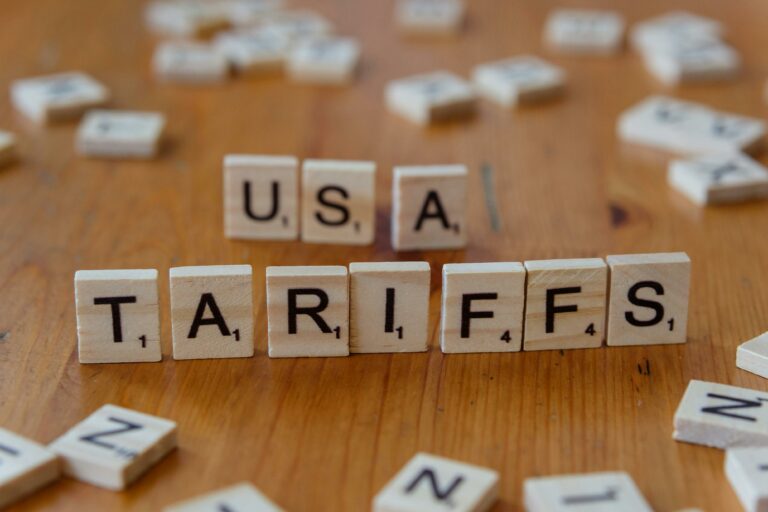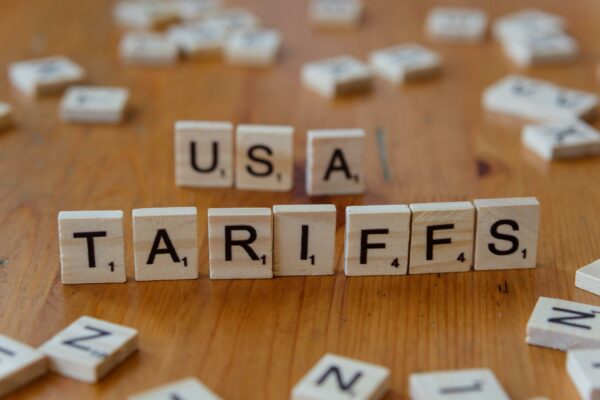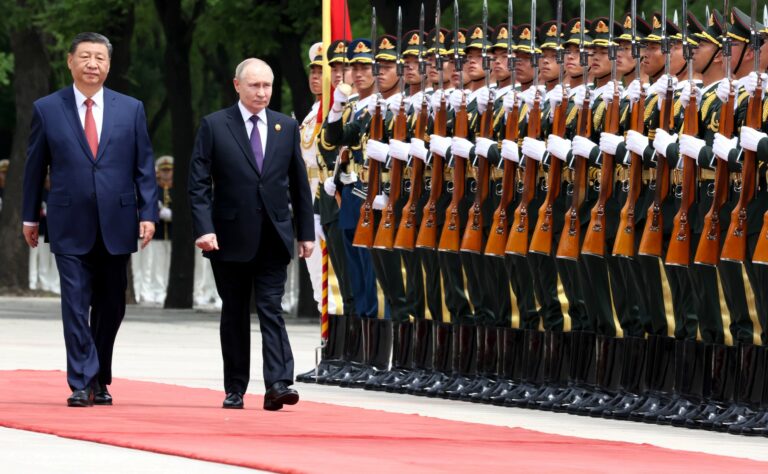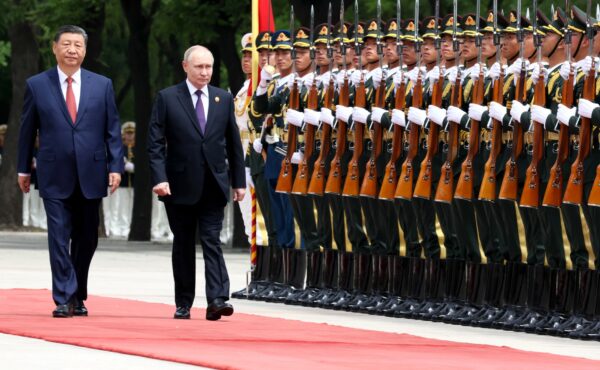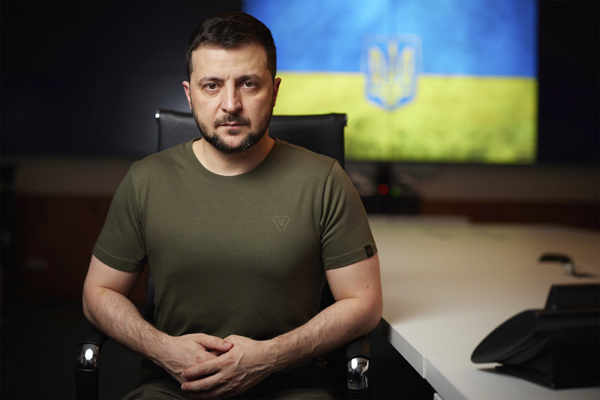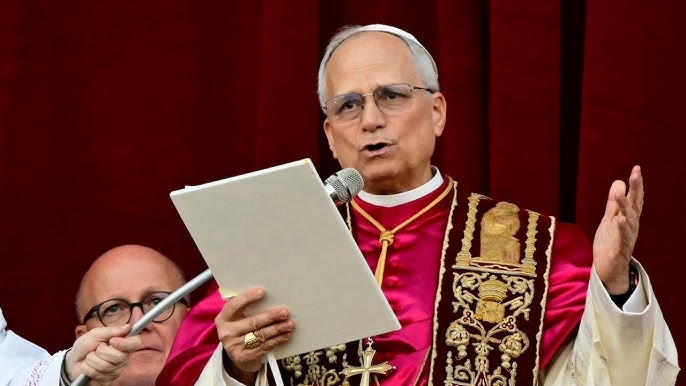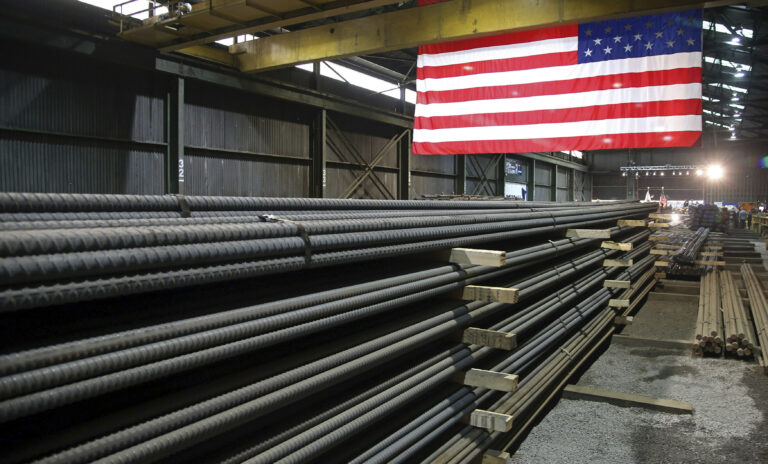
WASHINGTON D.C. – As the first wave of President Donald Trump’s sweeping 10% tariffs took effect, the former president issued a rallying cry to the American public, urging them to “hang tough” amid anticipated economic turbulence. The tariffs, designed to reshape global trade dynamics, have already sent shockwaves through international markets, prompting concerns about escalating trade tensions.
The tariffs, a cornerstone of Donald Trump’s “America First” economic agenda, impose a baseline 10% duty on a broad range of imported goods. Additionally, “reciprocal” tariffs, with higher rates, are set to be applied to specific nations deemed to have unfair trade practices with the United States.
Image source: Wikimedia Commons
Key developments:
Trump’s Stance:
In social media posts, Trump reiterated his belief that the tariffs will revitalize American manufacturing and create jobs. He asserted that the tariffs are necessary to address what he perceives as unfair trade practices by other nations.
He conveyed a message of resolve, acknowledging that the initial impact may be challenging, but emphasizing that the long-term benefits will be “historic.”
Global Market Reaction:
The announcement and subsequent implementation of the tariffs have triggered significant volatility in global financial markets. Stock markets have experienced sharp declines, reflecting investor anxieties about a potential trade war.
Concerns are rising about the potential for increased consumer prices and disruptions to supply chains.
International Responses:
Several countries have expressed strong opposition to the tariffs, with some threatening retaliatory measures. China has already announced retaliatory tariffs of its own.
There is also legal challenges being brought forward to the WTO.
Economic Concerns:
Economists are warning of the potential for the tariffs to lead to increased costs for American consumers, as businesses pass on the added expenses.
There are also fears that the tariffs could disrupt global supply chains, harming businesses that rely on imported components.
The situation remains fluid, with the potential for further escalation as nations respond to the new tariffs. The coming weeks will be critical in determining the long-term economic impact of these measures.
TEHRAN — In a move that has reverberated through Iranian political circles, President Masoud Pezeshkian has dismissed one of his top deputies after revelations of a “lavish” trip to Antarctica during the Nowruz holiday, the Persian New Year. The dismissal underscores the delicate balance between official conduct and public perception in a nation grappling with economic hardship.
The fired official, Shahram Dabiri, had served as the vice president for parliamentary affairs. His trip, reportedly undertaken with his wife, drew sharp criticism from Iranians who viewed it as an extravagant display of wealth, particularly during a period of economic strain.
President Pezeshkian’s decision, as reported by Iranian state media, emphasized the importance of officials adhering to a standard of modest living. In a statement, the president articulated that, given the economic pressures faced by many Iranians, such displays of opulence were “indefensible.”
Key points:
Public Discontent:
The trip sparked significant public outcry, particularly on social media, where many Iranians expressed anger at what they perceived as a disconnect between the official’s actions and the economic realities faced by the population.
Presidential Stance:
President Pezeshkian’s response highlights a focus on accountability and public trust. His statements stressed the need for government officials to maintain a sense of simplicity, aligning with values he attributed to revered figures in Shia Islam.
Economic Context:
Iran’s economy has faced considerable challenges, including the impact of international sanctions. This economic backdrop amplified the public’s sensitivity to displays of wealth by government officials.
Political Implications:
This action sends a clear message from the president, that he intends to hold his administration to high standards of conduct.
The incident has ignited discussions about the responsibilities of public officials and the need for transparency in government. It also reflects the broader socio-economic pressures shaping Iranian political discourse.
MADRID – Spain is facing a critical housing crisis, with soaring rental prices pushing residents to the brink. Across the nation, from the bustling streets of Barcelona to the sun-drenched coasts of the Canary Islands, the cry is the same: housing has become an unaffordable luxury.
The stark reality is that rents in Spain have doubled in the past decade, far outpacing wage growth. This has created what many are now calling a “social emergency,” forcing a significant portion of the population to allocate an unsustainable amount of their income to housing.
Factors Fueling the Crisis:
Tourism and Foreign Investment:
The surge in tourism, particularly in popular destinations, has driven up demand for short-term rentals, squeezing the availability of long-term housing for locals.
Increased foreign investment in Spanish real estate has further inflated prices, with many properties being purchased as investments rather than primary residences.
Lack of Affordable Housing:
A historical deficit in the construction of social housing has exacerbated the problem. Spain lags behind its European neighbors in this regard.
Real estate speculation and a large number of empty properties have further restricted the available housing stock.
Economic Strain:
The widening gap between wages and rental costs has placed immense financial strain on individuals and families, particularly those with lower incomes.
Government Response and Public Outcry:
The Spanish government has acknowledged the severity of the situation and has begun to implement measures to address the crisis. These include:
Rent caps and regulations.
Incentives for the construction of affordable housing.
Proposed taxes on foreign property ownership.
However, these measures have faced criticism, with some arguing that they do not go far enough.
Meanwhile, widespread protests have erupted across Spain, with thousands taking to the streets to demand urgent action. Tenant associations and social rights groups are calling for:
Significant reductions in rental prices.
The mobilization of vacant housing.
Stricter regulations on real estate speculation.
The housing crisis has become a major political issue in Spain, with growing public pressure on the government to find sustainable solutions. The struggle for affordable housing continues to affect the daily lives of many spaniards.
OCEANSIDE, Calif. – In a landmark achievement for private spaceflight, SpaceX’s Crew Dragon capsule, carrying the “Fram2” crew, safely splashed down in the Pacific Ocean off the coast of Oceanside, California, on Friday. This marked the successful conclusion of the first-ever crewed polar orbit mission, a voyage that provided unprecedented views of Earth’s polar regions.
The Crew Dragon “Resilience” gently parachuted into the ocean, concluding a roughly three-and-a-half-day mission that captivated audiences worldwide. The mission, launched from NASA’s Kennedy Space Center in Florida, sent four private astronauts on a unique trajectory, orbiting Earth from pole to pole.
This is also the first splashdown in 50 years in the Pacific Ocean. The last people to return from space to the Pacific were three Nasa astronauts assigned to the 1975 Apollo – Soyuz mission.
The flight was privately funded by billionaire Chun Wang, who served as commander for the crew’s training and spaceflight mission.
A Novel Perspective
The “Fram2” mission, named in homage to the historic Norwegian polar exploration vessel “Fram,” allowed the crew to witness Earth’s polar regions in a way never before experienced by humans. This unique perspective enabled them to capture stunning visuals of the Arctic and Antarctic, sharing these breathtaking views with the world through live streams and social media.
“We have confirmation of splashdown of the Dragon spacecraft. Dragon has returned home with the Fram2 crew,” SpaceX officials 1 announced during the live broadcast.
Image source: Space.com
Scientific Endeavors
Beyond the spectacular views, the “Fram2” mission also served as a platform for scientific research. The crew conducted a series of experiments, including:
Capturing the first X-ray of a human in space: This groundbreaking experiment provided valuable data on the effects of microgravity on the human body.
Studying mushroom growth in microgravity: The “MushVroom” experiment aimed to understand how organisms adapt to space environments.
Numerous observation of the Auroras.
The crew also participated in post-flight research, testing their bodies ability to reacclimate to gravity, with minimal assistance. This provided valuable data for future long duration space travel.
Recovery and Post-Flight Activities
Following the splashdown, SpaceX recovery crews swiftly retrieved the Crew Dragon capsule, bringing it aboard the recovery ship “Shannon.” The crew members, after exiting the capsule unassisted, underwent initial medical evaluations and will continue to participate in post-flight research.
This mission also marked a change in recovery location for SpaceX crewed missions, with this being the first crewed dragon splashdown off the west coast of the United states.
The successful “Fram2” mission represents a significant milestone in commercial space exploration, demonstrating the growing capabilities of private spaceflight and opening new possibilities for scientific research and human exploration.
In a landmark decision that underscores the complexities of immigration enforcement, U.S. District Judge Paula Xinis has ordered the return of Kilmar Abrego Garcia, a man deported last month alongside hundreds of alleged gang members. This ruling not only highlights the intricacies of individual cases within the broader landscape of immigration policy but also raises critical questions about the fairness of the processes that led to such mass expulsions.
Garcia’s deportation, part of a sweeping operation targeting gang-related individuals, drew immediate scrutiny for its methodology and implications. The mass deportations, while intended to combat violent crime, can often overlook the nuances of individuals’ circumstances. As evidenced by this case, the rush to expel those categorized as gang members can lead to significant injustices— a reality that Judge Xinis has now sought to rectify.
In her ruling, the judge emphasized the importance of due process and the right of individuals to contest their deportation. Garcia’s case served as a salient example, revealing procedural missteps that characterized the government’s approach. It became clear that the expedited nature of the operation did not adequately account for the potential for error, resulting in decisions that could alter lives irrevocably. Judge Xinis’s order for Garcia to be reinstated in the United States by no later than Monday reflects a commitment to uphold the tenets of justice, even amid the complexities of immigration enforcement.
This ruling has significant implications beyond Garcia’s individual case. It calls into question the broader tactics employed by law enforcement agencies in targeting gang activity. While ensuring community safety is paramount, the methods must also respect civil rights and allow for a comprehensive review of each individual’s situation. The concern that innocent lives may be caught in the crossfire of sweeping policies is not unfounded; Garcia’s story illustrates this precarious balancing act.
Garcia’s path to the United States has been fraught with challenges, a journey shaped by the search for safety and opportunity. In the wake of his recent deportation, he found himself navigating a landscape marked by danger and uncertainty. The judge’s order for his return is not just a temporary reprieve; it signals a recognition of the human element behind immigration policy—a call for a system that is fair and just.
As Garcia prepares to return to the U.S., there is a glimmer of hope that his experience might not merely represent one man’s struggle, but rather serve as a catalyst for broader discussions about immigration reform. Policymakers and immigration advocates must take heed of the lessons this ruling imparts, working to ensure that protective measures are in place for all individuals facing deportation.
Furthermore, this case highlights the continued importance of an independent judiciary in upholding the rule of law. Judge Xinis’s decision is a reminder that the courts play a vital role in safeguarding rights in the face of administrative actions that may disregard due process.
In the coming days, as Kilmar Abrego Garcia is expected to return to the U.S., the implications of this ruling will undoubtedly resonate throughout the immigration discourse. It is a reminder that justice is not merely a legal framework but a commitment to recognizing the humanity of each individual within it. As the nation navigates the complexities of immigration enforcement and reform, Garcia’s case stands as a poignant example of why vigilance, compassion, and justice are as essential as ever.
In the seemingly endless dance of economic policy and market reaction, few steps have proved as contentious as those taken by the Trump administration regarding tariffs. Over the past few weeks, investors have watched closely as tensions with trading partners escalated, leading to new tariffs that promise to reshape the landscape of international trade and domestic growth.
As the announcements rolled out, with certain goods facing tariffs of up to 25%, the response from Wall Street was a study in volatility. On the one hand, the initial news sent stock prices plunging, sparking concerns over inflation and the potential for a trade war. The specter of increased costs loomed large, with analysts warning of potential ripple effects on both corporate earnings and consumer prices. The Dow Jones Industrial Average felt the brunt, experiencing significant swings that seemed to reflect investors’ uncertainty.
However, it’s essential to recognize that the market’s trajectory is seldom linear. After the initial tremors, a surprising resilience emerged as some segments of the stock market rallied to adapt to the new economic realities. Industries such as steel and aluminum, the direct beneficiaries of the tariffs, experienced gains, reflecting a renewed optimism among domestic producers. Their stocks surged, buoyed by prospects of reduced foreign competition and enhanced market share within the U.S.
Photo AAP
Yet, the broader market’s mixed reaction illustrates a more profound anxiety rooted in the interconnectedness of the global economy. The technology sector, heavily reliant on the import of components and raw materials, braced for impact. Companies like Apple and Tesla expressed concerns over the potential rise in production costs, warning investors that profit margins might face strain. This reality has led to an atmosphere of cautious trading, with investors weighing the risks associated with an increasingly uncertain geopolitical landscape.
Moreover, investor sentiment was further clouded by the contradictory messages emerging from Washington. While some officials touted the benefits of tariffs as a leveraging tool against trading partners, others warned of unintended consequences that could stifle economic growth. This disconnect has only added to the sense of unease that permeates the market.
As the weeks unfold, the effects of these tariffs will likely become even more pronounced. The Federal Reserve’s decisions regarding interest rates, informed by these economic realities, could either mitigate or exacerbate market reactions. Investors will need to remain vigilant, staying attuned not just to market indicators but also to the political maneuvers that influence trade relations.
In this intricate dance between policy and market forces, one thing is clear: tariffs aren’t just a tool for negotiation; they are a double-edged sword that can spur domestic industries while also introducing significant risks to broader economic stability. As the U.S. continues to navigate these turbulent waters, the stock market will remain a barometer for investor confidence—and a reminder of the delicate balance that underpins the global economic order.
In the coming months, one can expect that this ongoing saga will play a pivotal role not only in the political sphere but also in the trajectory of the U.S. economy, shaping the narrative of growth and resilience in a time of uncertainty. The question remains: will the markets adapt, or will they falter under the weight of unpredictable trade policies? Only time will tell.
Val Kilmer died of pneumonia on April 1 in Los Angeles, his daughter Mercedes told media.
The actor was 65.
His daughter said her father had been diagnosed with throat cancer in 2014 but later recovered.
Tracheotomy surgery affected his voice and curtailed his acting career, but he returned to the screen to reprise his role as fighter pilot Iceman alongside Tom Cruise in 2022’s Top Gun: Maverick.
Val Kilmer starred in some of the biggest movies of the 1980s and 90s, including Top Gun and Batman Forever.
His other film credits included 1991’s The Doors – playing the legendary band’s frontman Jim Morrison – plus the Western Tombstone and crime drama Heat.
Born Val Edward Kilmer on December 31, 1959, Kilmer grew up in a middle-class family in Los Angeles.
His parents were Christian Scientists, a movement to which Val Kilmer would adhere for the rest of his life.
Aged 17, he became the then-youngest pupil to enrol at the Julliard School, in New York, one of the world’s most prestigious drama conservatories.
He made his name in the comedies Top Secret! in 1984 and Real Genius the following year, before cementing his acting credentials as Iceman, the nemesis to Tom Cruise’s character Maverick in 1986’s Top Gun, one of the decade’s defining movies.
Val Kilmer went on to star in fantasy Willow and crime thriller Kill Me Again – both alongside British actress Joanne Whalley, who he married in 1988. The couple had two children.
He further proved his dynamic and versatile talents when he convincingly portrayed rock frontman Jim Morrison in The Doors, 20 years after the singer’s death.
Tombstone, in which Val Kilmer played gunfighter Doc Holliday, and Heat, in which he appeared alongside Al Pacino and Robert De Niro, were also hits.
He took over Batman’s cape from Michael Keaton for Batman Forever in 1995, which achieved box office success but mixed reviews, and Val Kilmer pulled out of the next Batman movie.
In 1997, Val Kilmer appeared in The Saint as the master criminal and master of disguise – based on Leslie Charteris’ books, which had also inspired the 1960s TV show starring Roger Moore.
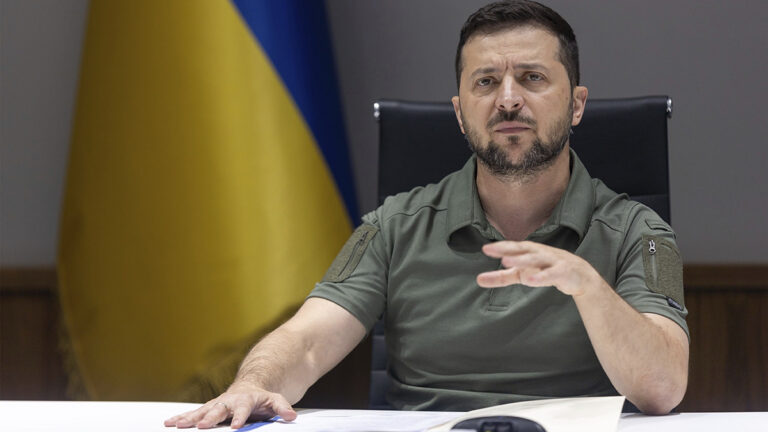
President Donald Trump has said he is “very angry” and “pissed off” with Russian President Vladimir Putin after weeks of attempting to negotiate a ceasefire in Ukraine.
In an NBC News interview, Donald Trump said he was angry with Vladimir Putin for attacking Ukrainian President Volodymyr Zelensky’s credibility, and threatened to impose a 50% tariff on countries buying Russian oil if he did not agree to a ceasefire.
“If Russia and I are unable to make a deal on stopping the bloodshed in Ukraine, and if I think it was Russia’s fault – which it might not be… I am going to put secondary tariffs… on all oil coming out of Russia,” he said.
The comments mark a shift in Donald Trump’s tone toward Vladimir Putin and Russia.
The White House did not immediately respond to a request for comment.
European leaders had worried that Donald Trump was cosying up to Vladimir Putin as negotiations on a ceasefire in Ukraine continued.
For the past six weeks, Donald Trump has harangued Volodymyr Zelensky in the Oval Office and demanded numerous concessions from Ukraine’s president. In turn, he has flattered Vladimir Putin and largely given in to the Russian president’s demands.
This appears to be a departure from that dynamic. It is the first time the US has seriously threatened Russia with consequences for dragging its feet in ceasefire negotiations, which would seem to put the diplomatic ball back in Moscow’s court.
Image NBC News
NBC News reported that, in a 10-minute phone interview, President Trump said he was very angry and “pissed off” when President Putin criticized the credibility of Volodymyr Zelensky’s leadership, although the president has himself called Ukraine’s leader a dictator and demanded that he hold elections.
“You could say that I was very angry, pissed off, when… Putin started getting into Zelensky’s credibility, because that’s not going in the right location,” Donald Trump said.
“New leadership means you’re not gonna have a deal for a long time,” he added.
Donald Trump said that the Russians knew of his anger, but noted that he had “a very good relationship” with Vladimir Putin and “the anger dissipates quickly… if he does the right thing”.
If Russia does not follow through with a ceasefire, President Trump threatened to target its economy further if he thought it was Vladimir Putin’s fault.
“There will be a 25% tariff on oil and other products sold in the United States, secondary tariffs,” Trump said, noting that the tariffs on Russia would come in a month without a ceasefire deal.
Secondary tariffs could constitute up to 50% on goods entering the US from countries still buying oil from Russia. The biggest such buyers by a long margin are China and India.
Volodymyr Zelensky wrote on social media following the interview that “Russia continues looking for excuses to drag this war out even further”.
He said that “Putin is playing the same game he has since 2014”, when Russia unilaterally annexed the Crimean peninsula.
“This is dangerous for everyone – and there should be an appropriate response from the United States, Europe, and all our global partners who seek peace.”
Donald Trump said he would speak to Vladimir Putin later in the week.
Rescuers in Myanmar pulled four more people from rubble nearly 60 hours after a powerful 7.7 magnitude earthquake struck the south-east Asian country on March 28, killing at least 1,700 people.
The survivors were rescued from a collapsed school building in the northern Sagaing region, from which a body was also recovered, Myanmar’s fire service said.
Hundreds of people remain missing, with search and rescue efforts under way in both Myanmar and neighbouring Thailand.
The death toll has risen to 18 people in the Thai capital, Bangkok, where 76 workers are still missing following the collapse of a high-rise building that had been under construction.
The earthquake occurred near Myanmar’s second-largest city Mandalay, along the Sagaing fault – with tremors affecting several other nations.
Although rescue efforts have been under way since March 28, and international aid is starting to reach Myanamar, there have been delays in reaching the worst-hit areas, leaving locals to attempt to dig survivors out by hand.
On March 29, an elderly woman was rescued in Myanmar’s capital, Nay Pyi Taw, after being trapped for 36 hours under the rubble of a hospital.
Footage showed her being carried on a stretcher to a waiting ambulance, surrounded by emergency workers.
Twenty-nine people were also rescued from a collapsed apartment block in Mandalay, the local fire authority said on March 30.
The earthquake struck around 12:50 local time on March 28, just 6 miles from the surface – meaning its effects at ground level were felt more strongly than a deeper quake.
A second earthquake struck 12 minutes later, with a magnitude of 6.4 and an epicenter 11 miles south of Sagaing, the regional capital, which sits near Mandalay.
Aftershocks have continued since. On March 30, a magnitude-5.1 tremor was recorded north-west of Mandalay.
In Bangkok, where soft soil made the shaking more intense, an unfinished tower block collapsed, burying many who had been working at the site.
Thailand’s Deputy PM Anutin Charnvirakul said on March 30 that rescuers had detected signs of life under the rubble at the site, but cautioned that they were weak.
International rescue teams have been joining the disaster effort, with several countries sending assistance to Myanmar. These include:
China sending an 82-person rescue team
A 51-strong team arriving from Hong Kong on Sunday
India sending an aid flight carrying a rescue team and emergency supplies
Malaysia’s foreign ministry saying it would send a 50-person team to support disaster relief operations
The Philippines, Vietnam, Indonesia, Ireland, South Korea and New Zealand also sending rescue teams
UK Foreign Secretary David Lammy pledging £10m in aid to help “those most in need”.
Istanbul Mayor Ekrem Imamoglu, a rival to Turkey’s President Recep Tayyip Erdogan, has been formally arrested and charged with corruption.
Ekrem Imamoglu is expected to be selected as the opposition Republican People’s Party’s (CHP) 2028 presidential candidate in a ballot on March 23.
The mayor denies the allegations and in a statement on social media, he is quoted as saying: “I will never bow”.
His detention on March 19 has sparked off some of the largest protests in more than a decade. President Erdogan has condemned the demonstrations and accused the CHP of trying to “disturb the peace and polarise our people”.
On March 22, tear gas hung in the air outside the mayor’s office in Istanbul, before the protests had even properly begun.
As the crowds had grown throughout the evening, it became hard to breathe as round after round was fired to disperse demonstrators.
Chanting “rights, law, justice”, people of all ages defied a government ban on gatherings to protest against what they see as an unlawful detention.
In Ankara and Izmir, police deployed water cannons against protesters.
For the past four nights, thousands have taken to the streets across Turkey in largely peaceful demonstrations.
Authorities tried to stifle the street demonstrations with a four-day ban on all gatherings in Istanbul, which was extended to Ankara and Izmir as protests spread across the country.
Since March 20, riot police have repeatedly clashed with protestors and could be seen firing pepper gas and water cannons towards crowds of demonstrators.
Turkish authorities said 343 people were arrested on March 21, the third day of protests, across the country.
Imamoglu is seen as one of Erdogan’s most formidable political rivals. He is the only person running in the CHP’s presidential candidate selection, which is set to take place on March 23.
However, on March 19, he was one of more than 100 people, including other politicians, journalists and businessmen, detained as part of an investigation.
A day before his arrest, Istanbul University announced it was revoking Ekrem Imamoglu’s degree due to alleged irregularities, a measure – which if upheld – would put his ability to run as president into doubt.
According to the Turkish constitution, presidents must have completed higher education to hold office.
Recep Tayyip Erdogan has held office for the past 22 years, as both prime minister and president of Turkey. However, due to term limits, he cannot run for office again in 2028 unless he changes the constitution.

Opposition figures say the arrests are politically motivated. But the Ministry of Justice has criticized those who link Erdogan to the arrests, and insist on their judicial independence.
Israel has responded with multiple air strikes on Lebanon after several rockets were fired from Lebanon into Israel, in the worst violence since a ceasefire came into effect in November.
The Israeli military said it had hit dozens of rocket launchers and a command centre belonging to Hezbollah, the Iranian-backed militia and political group, in southern Lebanon.
Lebanon’s health ministry said seven people, including a child, were killed and 40 injured in the air strikes.
Several armed groups operate in Lebanon, including Hezbollah and Palestinian factions, and no-one has claimed responsibility for the attack.
Hours after the first set of strikes, a second wave of attacks were carried out at night on targets that included what the Israeli military described as command centres, infrastructure sites and a weapons storage facility in Lebanon.
March 22 rocket attack from Lebanon came days after Israel reinforced its offensive against Hamas, a Hezbollah ally, in Gaza.
The Israeli military said it had intercepted three rockets in the northern Israeli town of Metula, and there were no casualties.
Hezbollah said it had no involvement, and it remained committed to the ceasefire.
Image source: Wikimedia Commons
The Lebanese military said it had dismantled “three primitive rocket launchers” in the south, and the country’s defence minister said an investigation had been launched into the attack.
The developments put pressure on a fragile truce, brokered by the US and France, that ended more than a year of conflict between Israel and Hezbollah.
Under the terms of the ceasefire deal, the Lebanese military would deploy thousands of additional soldiers to the south of the country to prevent armed groups from attacking Israel.
Hezbollah was required to remove its fighters and weapons, while the Israeli military would withdraw from positions occupied in the war.
Israel has carried out nearly daily air strikes on what it describes as Hezbollah targets, and has indicated that attacks will continue to prevent the group from rearming.
The Israeli military is still occupying five locations in southern Lebanon, in what the Lebanese government says is a violation of the country’s sovereignty and a breach of the deal.
Israel says the Lebanese military has not yet fully deployed to those areas, and that it needs to remain at those points to guarantee the security of its border communities.
March 22 attack is further proofof the challenges facing the Lebanese army, as it tries to exert control over southern areas where Hezbollah has traditionally had a strong presence and support.
Lebanon’s President Joseph Aoun, who came to power in January, has said only the state should have arms in the country, in what is seen as a reference to Hezbollah’s arsenal.
President Donald Trump has decided to revoke security clearances from his previously defeated Democratic election rivals, Kamala Harris and Hillary Clinton,as well as a number of other former officials and critics.
In February, the president said he was revoking security clearance for his predecessor Joe Biden. His order confirmed that decision, adding that he was also revoking the security clearance of “any other member” of the Biden family.
“I have determined that it is no longer in the national interest for the following individuals to access classified information,” President Trump’s memorandum read.
Former US presidents and top security officials usually keep their security clearance as a courtesy.
Donald Trump ordered department and agency leaders to “revoke unescorted access to secure United States government facilities for these individuals.”
“This action includes, but is not limited to, receipt of classified briefings, such as the President’s Daily Brief, and access to classified information held by any member of the intelligence community by virtue of the named individuals’ previous tenure in the Congress,” the order stated.
For several named figures, the loss of access to classified material and spaces will have a more symbolic impact.
It may limit the materials they are able to review, or restrict access to some government buildings or secure facilities.
The lawyers and prosecutors named by Donald Trump, however, could potentially face roadblocks in accessing or reviewing information for their cases or clients.
Donald Trump’s revocations focus on top Biden administration officials, as well as prominent political critics and attorneys who have challenged Trump or his allies in court.
Joe Biden’s secretary of state Antony Blinken, national security advisor Jake Sullivan, and deputy attorney general Lisa Monaco all lost their clearances.
President Trump also targeted two of his own former officials from his first term: Fiona Hill and Alexander Vindman, who testified during his first impeachment trial that began in 2019.
He also revoked access for high-profile Republican critics, former Representatives Liz Cheney and Adam Kinzinger.
They were the only two Republican lawmakers who joined a House investigation into Donald Trump’s role in the January 6, 2021, attack on Congress.
Both also voted to charge Donald Trump in his second impeachment, which a Democratic-led US House of Representatives instigated after the riot. Donald Trump was acquitted by the Senate on the charge of inciting the January 6 riot.
He has also singled out top legal opponents in his latest decision on security access. His order revoked clearance for New York attorney general Letitia James, who brought multiple lawsuits against Trump and his businesses.
Manhattan district attorney Alvin Bragg, who prosecuted and won Donald Trump’s criminal hush money case in 2024, also lost his clearance.
President Donald Trump has signed an executive orderdirecting officials to begin dismantling the Department of Education, a promise he made on the 2024 campaign trail.
“We’re going to shut it down as quickly as possible,” President Trump said after signing the order on March 20.
Donald Trump has long called for the department to be axed, a cherished goal of some conservatives, but completely shuttering it would require approval by Congress – which is unlikely.
The move is already facing legal challenges from those seeking to block the agency’s closure as well as the sweeping cuts to its staff announced last week.
Donald Trump said “the US spends more money on education by far than any other country” yet students “rank near the bottom of the list in terms of success”.
The White House stated that his administration would move to cut parts of the department that remain within legal boundaries.
At the ceremony, President Trump praised Linda McMahon, whom he appointed to lead the department, and expressed his hope that she would be the last secretary of education.He said he would find “something else” for her to do within the administration.
After the president signed the order, Louisiana Republican Senator Bill Cassidy announced plans to bring legislationaimed at closing the department.
But Republicans hold a slim 53-47 majority in the Senate, and closing a federal department would require 60 votes, making such a goal a longshot.
Even if the department is not formally closed, the Trump administration could decimate its funding and staff as it has done with the USAID, which subsequently stopped many of its programmes and humanitarian work.
Image source: Wikimedia Commons
The text of the executive order does not include specifics on what actions the administration will take and which programs might be axed.
It orders Linda McMahon to “take all necessary steps to facilitate the closure” of the department and give authority of such matters to state and local governments while “ensuring the effective and uninterrupted delivery of services, programs, and benefits on which Americans rely”.
Established in 1979, the education department oversees funding for public schools, administers student loans and runs programs that help low-income students.
Donald Trump has accused it of indoctrinating young people with racial, sexual, and political material.
A common misconception is that the department operates US schools and sets curricula – but that is primarily done by states and local districts.
A relatively small percentage of funding for primary and secondary schools – about 13% – comes from federal funds. The majority is made up from states and local groups.
The agency also plays a prominent role in administering and overseeing the federal student loans used by millions of Americans to pay for higher education.
Soon after she was sworn in, Linda McMahon sent the department’s 4,400 employees a memo titled “Our Department’s Final Mission”.
Donald Trump and fellow Republicans have accused the department of promoting a “woke” political ideology, and say the department is pushing liberal views about gender and race.
The final batch of documents on the assassination of President John F. Kennedy – a case that still inspires conspiracy theories more than 60 years later – has been released by the US government.
It follows an executive order by President Donald Trump that required remaining unredacted files in the case to be made public.
US authorities have previously released hundreds of thousands of JFK documents, but held some back, citing national security concerns. Many Americans still believe the gunman, Lee Harvey Oswald, did not act alone.
JFK was shot during a visit to Dallas, Texas, on November 22, 1963.
Image source Wikimedia
President Trump said beforehand that 80,000 pages would be unsealed.
Of the 1,123 documents included in March 18 release from the National Archives and Records Administration, it was not immediately clear how much material was new. Many documents have previously been released in partially redacted form.
“You got a lot of reading,” President Trump told reporters on March 17, previewing the release. “I don’t believe we’re going to redact anything.”
However, some of the hundreds of files unsealed on March 18 did appear to have passages blacked out. Others were hard to read, because they were faded or were poorly scanned photocopies, or appeared to bear little relevance to the JFK case, specialists said.
JFK experts suggested the American public might keep wondering about the possible existence of other documents and information.
A government commission in the aftermath of the killing determined that President Kennedy was shot by Lee Harvey Oswald, a Marine veteran and self-described Marxist who had defected to the Soviet Union and later returned to the US.
Opinion polls over decades have indicated that most Americans don’t believe Oswald was the sole assassin. But no clear alternative narrative is yet to emerge from the latest batch of unsealed documents.
Unanswered questions have long dogged the case, giving rise to theories about the involvement of government agents, the mafia and other nefarious characters – as well as more outlandish claims.
In 1992, Congress passed a law to release all documents related to the investigation within 25 years.
Both Trump, in his first term, and Biden administrations released piles of JFK-related documents – but thousands remained partially or fully secret.
President Trump’s executive order two months ago also called on government archivists to release files related to the killings of presidential candidate Robert F. Kennedy and civil rights icon Martin Luther King Jr., both of whom were gunned down in 1968.
Ben & Jerry’s CEO David Stever was being removed by its parent company, Unilever, in a growing dispute over the ice cream company’s political activism.
The allegation was part of a legal case filed in a US court by Ben & Jerry’s that says Unilever violated a merger agreement by trying to silence its “social mission”.
It comes a month after the ice cream company accused Unilever of demanding that it stops publicly criticizing President Donald Trump.
A Unilever spokesperson said it is “disappointed that the confidentiality of an employee career conversation has been made public”.
It said it had made “repeated attempts to engage the [Ben & Jerry’s] board and follow the correct process”.
The filing with the US District Court for the Southern District of New York said Unilever had “repeatedly threatened Ben & Jerry’s personnel, including CEO David Stever, should they fail to comply with Unilever’s efforts to silence the social mission”.
Ben & Jerry’s has long been known for taking a public stance on social issues since it was founded in 1978 by Ben Cohen and Jerry Greenfield.
It has often backed campaigns on issues like LGBTQ+ rights and climate change.
The ice cream maker was bought by Unilever in 2000 through a merger agreement that created an independent board tasked with protecting the ice cream brand’s values and mission.
Unilever and Ben & Jerry’s have been at loggerheads for a while. Their relationship soured in 2021 when Ben & Jerry’s announced it was halting sales in the West Bank.
The dispute escalated over the last year as Ben & Jerry’s advocated for a ceasefire in Gaza.
In November, Ben & Jerry’s filed a lawsuit saying Unilever had tried to stop it from expressing support for Palestinian refugees.
In February, in another court filing, Ben & Jerry’s said Unilever had tried to ban it from publicly criticizing Donald Trump.
David Stever has been with Ben & Jerry’s since joining the company in 1988 as a tour guide. He was appointed chief executive in 2023.
Ben and Jerry’s court filing said the decision to oust David Stever was made without any consultation, as required in the merger agreement between the two companies.
“Unilever… attempted to force the independent board into rubberstamping the decision,” it added.
The Unilever spokesperson said: “In line with the terms of the acquisition agreement, decisions on the appointment, compensation and removal of the Ben & Jerry’s chief executive will be made by Unilever after good faith consultation and discussion with the B&J’s Independent Board.”
“We hope that the B&J Independent Board will engage as per the original, agreed process,” they added.
President Donald Trump has held what he described as a “very good” hour-long phone call with his Ukrainian counterpart Volodymyr Zelensky, a day after speaking to Russia’s President Vladimir Putin.
Writing on his social media platform Truth Social, President Trump said the call was aimed at aligning Ukraine and Russia “in terms of their requests and needs”, adding that ceasefire efforts were on track.
President Zelensky described his conversation with Trump as “positive”, “frank”, and “very substantive”.
“We believe that together with America, with President Trump, and under American leadership, lasting peace can be achieved this year,” Donald Trump wrote on X.
Both Presidents Zelensky and Putin have said they would agree to halt attacks on energy infrastructure. However, both have since accused each other of continued attacks.
Donald Trump is seeking a wider truce, but in their phone call on March 18 Vladimir Putin rejected a full 30-day ceasefire backed by the US and Ukraine.
Secretary of State Marco Rubio issued a more detailed statement, saying that President Trump had agreed to help Ukraine source additional air defence systems, particularly in Europe.
The two leaders “agreed to share information closely between their defence staffs as the battlefield situation evolved”, he said.
Technical teams would meet in Saudi Arabia in the coming days to discuss broadening the ceasefire to the Black Sea, Rubio added, saying they agreed that this could be the first step towards fully ending the war.
President Trump also raised the possibility of the US taking ownership of Ukraine’s power plants, adding that it would be the “best protection” for Ukraine’s energy infrastructure, Marco Rubio said.
The apparently cordial mood of the conversation is in marked contrast to Volodymyr Zelensky’s visit to the White House at the end of February, in which the two leaders – along with US Vice President JD Vance – were involved in a tense exchange.
Afterwards the US temporarily suspended military aid and intelligence sharing with Ukraine, but diplomats were able to improve relations and on March 11 the two sides agreed on a ceasefire.
During his call with Trump on March 18, Vladimir Putin agreed to halt Russian attacks on Ukraine’s energy infrastructure.
But he said a full ceasefire would only work if Ukraine’s supporters stopped giving military assistance – a condition Kyiv’s European allies have previously rejected.
Hours later both Ukraine and Russia launched attacks, with Kyiv saying hospitals had been targeted.
Volodymyr Zelensky said the Russian strikes demonstrated that Vladimir Putin had effectively rejected the ceasefire proposal.
Religion continues to play a significant role in societies worldwide, despite predictions of its decline in the face of modernity and secularization. Recent global surveys indicate that approximately 84% of the world’s population identifies with a religious group, though this figure varies dramatically by region. Western Europe and parts of East Asia represent areas where religious adherence has declined most significantly, while Sub-Saharan Africa and the Middle East maintain some of the highest rates of religious affiliation globally.
The 21st century has witnessed not simply a decline in religious belief, but rather a transformation in how people engage with faith traditions. Traditional institutional religious participation has decreased in many developed nations, with weekly attendance at religious services falling by approximately 30% in the United States over the past three decades. However, this decline doesn’t necessarily indicate a rejection of spirituality or religious beliefs more broadly.
Personalization of Religious Practice
Modern religious expression increasingly reflects individualized approaches to faith. According to Pentecostal Publishing House, a significant shift has occurred wherein believers increasingly customize their religious practices, selecting elements that resonate with their personal values while potentially disregarding institutional doctrines that conflict with their worldview. This “cafeteria-style” approach to religion represents a departure from historical patterns of religious adherence, where commitment to a comprehensive theological system was expected.
This personalization manifests in various ways. For instance, surveys indicate that approximately 65% of Americans who identify as religious report that they seldom or never attend formal religious services. Similarly, a growing number of individuals describe themselves as “spiritual but not religious,” estimated at around 27% of the adult population in the United States and higher percentages in countries like Denmark and Sweden.
The digital revolution has profoundly impacted how religious communities form and function. Online platforms have created new avenues for religious expression, education, and community building, allowing people to connect with religion more than ever. Religious services streamed online increased by over 500% during the COVID-19 pandemic, and many faith communities have maintained hybrid models of engagement even after restrictions lifted.
Social media has further transformed religious discourse, with religious content creators amassing millions of followers across platforms. Religious apps offering daily devotionals, prayer reminders, and sacred text access have been downloaded billions of times globally. These technological adaptations have democratized religious knowledge and created new forms of religious authority that exist alongside traditional institutions.
Interfaith Dialogue and Religious Pluralism
Modern societies increasingly feature religious diversity, with multiple faith traditions coexisting within the same communities. This proximity has facilitated increased interfaith dialogue and cooperation. Studies show that approximately 58% of Americans report having meaningful conversations with someone of a different faith background within the past year.
Religious pluralism has become more accepted in many societies, with declining percentages of people believing their religion represents the only true path. For example, surveys indicate that only about 25% of Christians in Western Europe believe their religion is the only true one, compared to significantly higher percentages in previous generations.
Religious Extremism and Polarization
While moderation and pluralism characterize many religious developments, extremist interpretations of religion continue to impact global affairs. Religious extremism remains a concern across various traditions, with approximately 84 countries experiencing high or very high levels of religious hostilities according to recent global surveys.
Political polarization often aligns with religious divisions, with religious identity serving as a marker for political affiliation in many contexts. In the United States, for example, white evangelical Protestants support conservative political candidates at rates exceeding 80%, while religiously unaffiliated individuals tend to support progressive candidates at similarly high rates.
The Future of Religion
Demographic trends suggest that religious populations will continue to grow globally, primarily due to higher birth rates among religious communities in developing nations. Projections indicate that by 2050, the percentage of the world population identifying as religiously unaffiliated will likely decrease slightly, while religions with younger adherents, such as Islam, will see significant growth.
However, the nature of religious belief and practice will likely continue to evolve. Institutional religious participation may continue to decline in developed nations, while personalized spiritual practices increase. Religious institutions that adapt to changing cultural contexts while maintaining core ethical teachings may prove most resilient in this evolving landscape.
The boundary between secular and religious worldviews may also become increasingly blurred, with values-based communities emerging that incorporate elements of religious tradition without requiring supernatural beliefs. These developments suggest not the end of religion, but its ongoing transformation in response to changing social conditions and human needs.
A federal judge has blocked the Trump administration from taking any further steps to shut down the US Agency for International Development (USAID).
In a ruling on March 18, Judge Theodore Chuang said the efforts, led by Donald Trump ally Elon Musk’s Department for Government Efficiency (DOGE), likely violated the US constitution “in multiple ways”.
Image source: Wikimedia Commons
Judge Chuang ordered DOGE to restore access to USAID’s computer and payment systems for employees, including those who were placed on leave.
The judge also ruled that termination of USAID employees should stop, but did not order the reinstating of employees previously placed on leave.
Russia’s President Vladimir Putin agrees to halt strikes on Ukraine energy targets for 30 days, the Kremlin says, after a 90-minute-phone call with President Donald Trump.
Vladimir Putin supports Donald Trump’s idea for Ukraine and Russia to stop attacking energy infrastructure for 30 days, the Kremlin says in its read out of the leaders’ call.
Image NBC News
Russia has repeatedly damaged Ukraine’s energy grid since its invasion in February 2022.
Fresh Ukraine peace talks will also begin in the Middle East immediately, the White House says.
After the call, the White House said: “The leaders agreed that the movement to peace will begin with an energy and infrastructure ceasefire.”
The Kremlin says the two presidents had a “frank exchange of opinions” and agreed to stay in touch.
President Donald Trump has claimed that “many” pardons issued by Joe Biden are void because the former president signed them with “autopen” – a device which reproduces a person’s signature – rather than by hand.
President Trump did not provide evidence for his claim – which was posted on Truth Social.
US government documents have the same presidential signature when they’re stored in the Federal Register – a digital archive – and this was the case under Trump as well as under Biden.
On Truth Social, President Trump said that: “The ‘Pardons’ that Sleepy Joe Biden gave to the Unselect Committee of Political Thugs, and many others, are hereby declared VOID, VACANT, AND OF NO FURTHER FORCE OR EFFECT, because of the fact that they were done by Autopen. In other words, Joe Biden did not sign them but, more importantly, he did not know anything about them!”.
Image source: Getty Images
Donald Trump didn’t specify which pardons he was referring to but he has previously referred to the house select committee investigating the 6 January riots as the “unselect committee”, and has criticised Biden for pardoning family members.
President Trump appears to have taken his cue from the Oversight Project – part of the Conservative think tank The Heritage Foundation – which has claimed that Biden’s 19 January pardons – of some family members and political figures including Anthony Fauci – all had the same autopen signature.
A National Archives spokesperson told the fact-checking website Snopes that: “At the beginning of each administration, the White House sends a sample of the President’s signature to the Federal Register, which uses it to create the graphic image for all Presidential Documents published in the Federal Register,”
“The President may sign a bill within the meaning of Article I, Section 7 by directing a subordinate to affix the President’s signature to such a bill, for example by autopen”, the memo said.
Although George W. Bush did not use autopen himself, President Barack Obama used it in 2011.
Autopen has also been used by earlier presidents including JFK and Harry Truman.
At least 59 people have been killed and 155 others injured after a fire broke out a nightclub in North Macedonia on March 16.
They were watching DNK, a popular hip-hop duo in the country.
People desperately tried to escape the flames but there was only one exit for around 500 people, as the only other door at the back of the venue was locked.
Police have detained 15 people, with Interior Minister Pance Toskovski saying that there are “grounds for suspicion that there is bribery and corruption” linked to the fire.
Those detained include the owner of the venue and former government officials.
PM Hristijan Mickoski has said there will be “no mercy”, regardless of political rank or party affiliation.
The fire started around 02:30 local time on March 16 when sparks from pyrotechnic devices hit the ceiling, which was made of highly flammable material, Toskovski said.
Described as an “improvised nightclub” by the local press, the venue, located in a town around 60 miles east of the capital, Skopje, did not have a legal licence to operate, Toskovski said.
It had previously been a carpet warehouse, and police are investigating.
“Most of the dead suffered injuries from the stampede that occurred in the panic while trying to exit,” the head of the Kocani hospital, Kristina Serafimovska, told reporters.
“Seventy of the patients have burns and carbon monoxide poisoning,” she said, according to AFP news agency.
Vladislav Gruev, a specialist in reconstructive and plastic surgery at the University Clinic for Surgical Diseases, has been treating survivors.
“Most of them have extensive burn injuries, above 18% surface body area, second and third degree burns on the head, neck, upper torso, and upper limbs – hands and fingers,” he said.
Inspections on march 16 showed several “abnormalities” in the venue, including “deficiencies” in the fire-extinguishing and lighting system, said public prosecutor’s office spokesman Biljana Arsovska.
Speaking outside the hospital, Red Cross volunteer Mustafa Saidov said the majority of those who died were young people.
“Inside where they are identifying the victims, the situation is far worse. You see that the parents are also quite young people, in their 40s. Their children are 18 or 20 years old.”
“The situation is brutal, chaotic, the stories are very sad, and unfortunately many young lives are lost.”
One man, whose nephew was injured in the fire, said some people have been unable to locate their children.
The most seriously injured were being taken for treatment in specialist clinics in Bulgaria, Greece, Serbia and Turkey, she added.
The government has declared seven days of national mourning, and it will hold an emergency session as part of ongoing investigations into how the incident unfolded.
According to Gene Hackman’s recently released will, the Oscar-winning actor left his entire $80 million fortune to his wife of 30 years, Betsy Arakawa.
Betsy Arakawa, 65, was found dead alongside her husband in their New Mexico home last month.
Legal experts have now said that, because authorities say Betsy Arakawa died seven days before her husband, the actor’s children could now potentially inherit his fortune, despite not being named in the will.
His three children with his late ex-wife, Faye Maltese – Christopher, 65, Elizabeth, 62, and Leslie, 58 – have not commented publicly on the matter.
Gene Hackman, 95, named Betsy Arakawa as his sole beneficiary in 1995, with the last update to the will in 2005.
The estate could default to Gene Hackman’s children under succession laws, as long as there was no other beneficiary named.
They would also need to prove that the will is invalid because Betsy Arakawa died before Gene Hackman.
Authorities say Betsy Arakawa passed away on February 11 after contracting a rare virus, days before Gene Hackman died of natural causes.
The couple was found dead in separate rooms of their $4m Santa Fe home on February 26 after neighbourhood security conducted a welfare check and saw their bodies on the ground through a window.
Image source: Wikimedia Commons
Betsy Arakawa was found in the bathroom with pills scattered nearby, while Gene Hackman was in the back of the house, wearing sweatpants and slippers, his cane and sunglasses beside him.
Officials determined he died seven days after his wife due to severe heart disease, with advanced Alzheimer’s listed as a contributing factor.
Authorities initially deemed the scene “suspicious” but later ruled out foul play.
Betsy Arakawa’s own will left her assets to Gene Hackman, with a provision that if they died within 90 days of each other, her estate would go to a trust and later be donated to charity after covering medical expenses.
President Vladimir Putin announced that he agreed with the idea of a ceasefire in Ukraine, but that “questions” remained about the nature of a truce as he set out a number of tough conditions.
The Russian president was responding to a plan for a 30-day ceasefire, which Ukraine agreed to earlier this week after talks with the US.
Ukrainian President Volodymyr Zelensky described Vladimir Putin’s response to the plan as “manipulative” and called for more sanctions on Russia.
Meanwhile, the US placed further sanctions on Russian oil, gas and banking sectors.
Speaking at a news conference in Moscow on March 13, President Putin said of the ceasefire proposal: “The idea is right – and we support it – but there are questions that we need to discuss.”
A ceasefire should lead to “an enduring peace and remove the root causes of this crisis”, he said.
“We need to negotiate with our American colleagues and partners,” he said.
“Maybe I’ll have a call with Donald Trump.”
Vladimir Putin added: “It will be good for the Ukrainian side to achieve a 30-day ceasefire.
“We are in favour of it, but there are nuances.”
Image source Wikimedia
Putin “doesn’t say no directly”, Zelensky said in his nightly video address, but “in practice, he’s preparing a rejection”.
“Putin, of course, is afraid to tell President Trump directly that he wants to continue this war, wants to kill Ukrainians.”
Vladimir Putin had set so many pre-conditions “that nothing will work out at all”, Zelensky said.
After Putin’s remarks and Zelensky’s response, there is now a clear divide between both sides’ positions.
Ukraine wants a two-stage process: a quick ceasefire and then talks about a longer-term settlement.
Russia believes you cannot separate the two processes and all the issues should be decided in a single deal. Both sides seem content to argue their differences.
Ukraine believes it can put pressure on Russia, painting it as a reluctant peacemaker, playing for time. Russia, equally, believes it has a chance now to raise its fundamental concerns, about Nato expansion and Ukraine’s sovereignty.
Speaking at the White House following Putin’s remarks, President Trump said he would “love” to meet the Russian leader and that he hoped Russia would “do the right thing” and agree to the proposed 30-day truce.
“We’d like to see a ceasefire from Russia,” he said.
Speaking earlier at a meeting in the Oval Office with Nato Secretary General Mark Rutte, Donald Trump told reporters he had already discussed specifics with Ukraine.
“We’ve been discussing with Ukraine land and pieces of land that would be kept and lost, and all of the other elements of a final agreement,” he said.
“A lot of the details of a final agreement have actually been discussed.”
The fresh sanctions on Russian oil and gas came as the Trump administration further restricted access to US payment systems, making it harder for other countries to buy Russian oil.
President Donald Trump has pledged to impose more tariffs after his latest move to introduce import taxes on steel and aluminium entering the US prompted retaliation from the European Union (EU) and Canada.
Donald Trump said “of course” he would respond to the countermeasures, repeating his warning to reveal “reciprocal” tariffs next month on countries around the world.
“Whatever they charge us with, we’re charging them,” he said.
The threat marked a further escalation of a trade war which has rattled financial markets amid concerns over the impact on the economies and consumers in many countries around the world, including the US.
On March 12, President Trump moved forward with a plan to widen US tariffs on steel and aluminium, imposing a blanket duty of 25% and ending exemptions that the US had previously granted for shipments from some countries.
That followed an order earlier this month that raised levies on Chinese imports into the US to at least 20%.
President Trump has also threatened tariffs – which are taxes applied to goods as they enter a country – on a range of more specific items, including copper, lumber and cars.
Leaders in Canada and Europe called the new metals taxes unjustified and struck back with their own tariffs on a range of US products.
Other countries that are key US suppliers of metals, including the UK, Australia, Mexico and Brazil, held off on any immediate retaliation.
Canada said from March 13 it would start charging a 25% tax on nearly C$30bn ($20bn) worth of US products, including steel, computers and sports equipment.
The EU said it would raise its levies on up to €26bn ($28bn) worth of US goods, including boats, bourbon and motorbikes, from April 1.
EU President Ursula von der Leyen said the response was intended to be „strong but proportionate” and added that the EU stood „ready to engage in a meaningful dialogue”.
„Tariffs are taxes. They are bad for business and worse for consumers,” she said, warning the economic disruption put jobs at stake and would send prices higher.
„Nobody needs that – on both sides, neither in the European Union nor in the United States.”
Donald Trump had said he wants to boost US steel and aluminium production in the longer run, but critics say in the immediate term the taxes on imports of the metals will raise prices for US consumers and dent economic growth.
Russian President Vladimir Putin has visited Kursk for the first time since Ukraine’s incursion across the border, Russian media reported, as Moscow claims to have recaptured more of the region.
It comes as the White House confirms President Donald Trump’s special envoy Steve Witkoff is going to Moscow for talks on a US-proposed ceasefire plan backed by Ukraine.
It was agreed on March 11 after Ukrainian officials held talks with the US.
On March 12, President Trump said a ceasefire deal “would be 80% of the way to getting this horrible blood bath [to end]”.
Ukraine’s President Volodymyr Zelensky has said “everything depends on Russia”, calling on Moscow to respond to the proposal.
However, Russia has said it would wait to be briefed by American officials before commenting – and that it’s “studying statements”.
Ukraine’s leadership has been getting advice from its friends, including Britain’s National Security Adviser Jonathan Powell. Their message is clear: like it or not, you must mend relations with the White House and not go up against Trump. Hence Ukraine falling swiftly into line with the US proposal for a comprehensive 30-day ceasefire.
For Trump, it represents a clear vindication of his strategy: forcing an end to a war he sees as unwinnable.
President Trump is also putting pressure on Russia – he said earlier that penalties for them could be “devastating” if they opt to continue the war.