
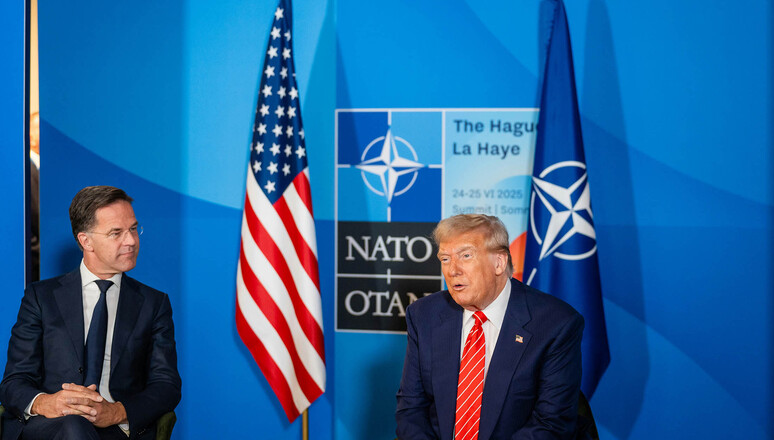
President Donald Trump today declared NATO’s unprecedented agreement to a new 5% defence spending pledge a “big win,” touting the elevated commitment as a direct vindication of his long-standing, often abrasive, demands on European allies. The announcement, emerging from the high-stakes 2025 Hague Summit, marks a significant, and potentially controversial, shift in the alliance’s financial burden-sharing.
The new pledge, which commits NATO member states to spending at least 5% of their Gross Domestic Product (GDP) on defence annually, dramatically raises the previous target of 2% – a goal many nations already struggled to meet. The decision, reportedly pushed vigorously by the United States during intense closed-door negotiations, signals a profound reorientation of NATO’s resource allocation, driven by the escalating geopolitical landscape and, crucially, President Trump’s unwavering insistence on greater financial contributions from allies.
“They’re going to 5%. That’s a big, big win,” President Trump told reporters, visibly triumphant as he departed a session with NATO leaders. “I told them for years they were getting a free ride. Now, they’re paying their fair share. We’ve made NATO much stronger, much richer.”
The agreement is a strategic victory for Trump, who has consistently criticized what he viewed as European underfunding of defence, often threatening to withdraw U.S. support from the alliance if targets were not met. His relentless pressure, often expressed through sharp public rebukes and private ultimatums, appears to have finally yielded the significant financial commitment he sought.
NATO Secretary-General Mark Rutte, who has notably engaged in a charm offensive towards Trump throughout the summit, confirmed the new target. While he framed the decision as a unified response to a “more dangerous world” and the ongoing conflict in Ukraine, his remarks echoed Trump’s narrative. “The alliance is adapting to the realities of a very different security environment,” Rutte stated, “and part of that adaptation means all allies stepping up to meet their responsibilities. President Trump has been instrumental in ensuring this urgent conversation was had.”
However, the ambitious 5% target is already raising eyebrows and prompting questions about its feasibility and potential impact. Many European economies are grappling with slower growth, persistent inflation, and social spending pressures. Doubling the previous, already challenging, 2% commitment within a short timeframe could necessitate difficult budgetary choices, potentially leading to cuts in other public services or tax increases.
Some analysts suggest that while the pledge represents a political victory for Trump, its practical implementation will be a complex and arduous task for European capitals. Critics also worry that the focus on a rigid spending target might overshadow other crucial aspects of defence, such as strategic coordination, innovation, and readiness.
Despite these concerns, the agreement undeniably reflects a significant pivot within NATO, cementing a new era where financial contributions are paramount. As President Trump departs The Hague, he does so with a major talking point for his domestic audience, claiming a tangible victory in his long-running battle to reshape the terms of America’s alliances. The real test, however, will be whether NATO members can translate this unprecedented pledge into concrete spending, and how these vast new sums will ultimately shape the future of global security.