
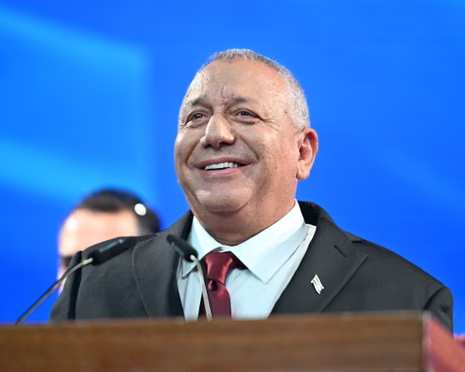
JERUSALEM — In a historic political realignment that has pushed Prime Minister Benjamin Netanyahu’s long tenure to the brink, Israeli President Isaac Herzog announced that he will task opposition leader and former military chief Gadi Eisenkot with assembling the nation’s next governing coalition.
The high-stakes decision follows days of intensive cross-party consultations at the president’s residence following the deadlocked October 27 national election. The official mandate ceremony will take place in Jerusalem, initiating a 28-day countdown for the centrist leader to cobble together a parliamentary majority.
“Now is the time to form a national emergency government,” Eisenkot wrote in a swift statement broadcast on social media. “I will do everything to ensure we are worthy.”
Netanyahu Defeated in the Recommendation Count
President Herzog’s intervention marks a severe blow to Netanyahu, whose religious-nationalist coalition lost its majority in the 120-seat Knesset. While Netanyahu’s camp secured 53 seats and emerged as the single largest formal bloc, it fractured during consultations with the president. In a striking shift, the ultra-Orthodox United Torah Judaism party—traditionally an ironclad ally of Netanyahu—conspicuously declined to recommend the sitting prime minister.
Ultimately, the math favored the opposition leader. Eisenkot secured an overwhelming 67 recommendations from incoming Knesset members, completely eclipsing Netanyahu’s 46 endorsements. Armed with these figures, Herzog exercised his broad constitutional discretion to bypass the incumbent premier and offer Eisenkot the first shot at the state’s highest office.
The Arab Enigma: Kingmakers vs. Hard Red Lines
While Eisenkot enters the coalition-building phase with the wind at his back, his mathematical path to the 61-seat threshold required to swear in a government remains exceptionally volatile and fraught with political contradictions.
The primary complicating factor centers on Israel’s Arab-led parties, the United Arab List and the Joint List. Fueled by a massive surge in minority voter turnout, the two Arab alliances claimed an unprecedented 19 seats in the election, effectively positioning themselves as the ultimate kingmakers. Breaking with historic precedent, both lists formally recommended the former general to lead the country, choosing to back an anti-Netanyahu candidate.
However, translating those recommendations into a working government presents severe obstacles:
- The Anti-Arab Pledge: Before the polls opened, nearly every major Jewish party within Eisenkot’s centrist alliance pledged never to form a coalition dependent on Arab parliamentary support.
- Ideological Friction: Ideologically, Eisenkot is a seasoned hawk who oversaw the 2006 war with Hezbollah and openly opposes the creation of a Palestinian state. While he has shown willingness to partner with Arab politicians if they formally define Hamas as a terrorist organization, hardliners within his own bloc remain highly resistant to such an alliance.
A Defiant Caretaker Lashes Out
Netanyahu has launched an aggressive public relations counter-offensive to tank his rival’s negotiations. In a combative video statement released shortly before the president’s announcement, Netanyahu claimed without evidence that the election had been “stolen” via foreign funding and bribery, warning that a minority government backed by Arab politicians would destroy the state.
Instead, the embattled premier floated an eleventh-hour plea for a “national unity government” involving his right-wing allies—a proposal Eisenkot’s party immediately dismissed as a tactical spin. The opposition counters that if Netanyahu’s Likud party genuinely desires national unity, it must dissolve its existing alliance with far-right extremists and serve under a Prime Minister Eisenkot.
The first true test of power arrives on Tuesday with the swearing-in of the new Knesset, where the ascendant opposition intends to immediately vote out Netanyahu’s loyalist speaker. Doing so would allow them to swiftly launch a formal state commission of inquiry into the historic security failures of the October 7, 2023, attacks—the very issue that fractured Netanyahu’s political foundation and set the stage for the general’s dramatic rise to power.