
The Houthi rebel movement in Yemen has issued an extraordinary threat to global commercial aviation, warning international airlines and civilian passengers to immediately cease all operations at Saudi Arabian airports following a devastating missile strike on the capital city of Riyadh.
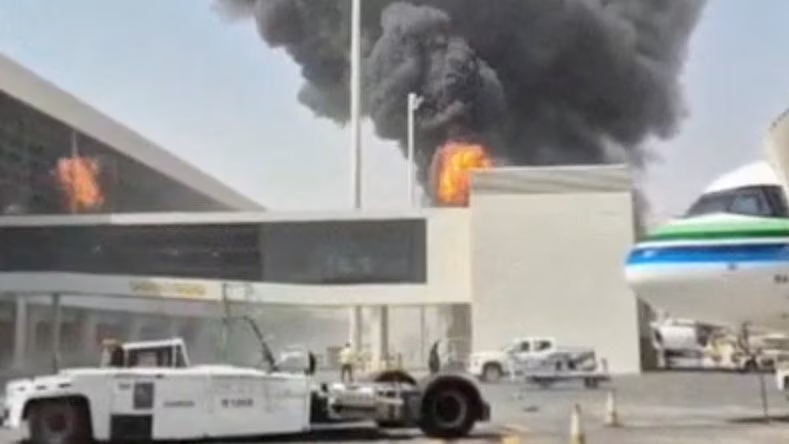
The security alert follows a high-profile, long-range missile and drone attack that successfully bypassed Saudi Arabia’s air defense networks to strike critical infrastructure in the heart of Riyadh, resulting in multiple civilian and military casualties. The escalation marks a terrifying expansion of the regional conflict, threatening to collapse international travel corridors and plunge global energy and aviation markets into unprecedented chaos.
In a televised address broadcast via their Al-Masirah network, a Houthi military spokesman declared that all airports, military installations, and industrial centers within the Kingdom of Saudi Arabia are now designated as active, high-priority military targets.
The Attack on the Capital
The Houthi warning arrived as emergency crews in Riyadh were still clearing rubble from the overnight bombardment. According to regional intelligence reports, a coordinated salvo of land-attack cruise missiles and explosive-laden drones struck near a major logistics hub adjacent to the capital’s sprawling urban center.
The immediate fallout has completely upended the illusion of domestic security within the kingdom:
- The Civilian Toll: Local medical sources confirmed that falling debris and direct impacts killed at least three people and left more than a dozen others injured.
- Aviation Lockdown: King Khalid International Airport in Riyadh temporarily suspended all incoming and outgoing commercial flights, forcing international carriers to divert long-haul aircraft to neighboring Gulf states.
- Systemic Panic: The strike represents the most significant penetration of Saudi airspace since the expiration of the UN-backed truce, triggering widespread anxiety across expatriate and diplomatic communities.
“We advise foreign companies, international airlines, and ordinary passengers to steer completely clear of Saudi airports and airspace,” the Houthi spokesperson stated, warning that the group will not be held responsible for civilian casualties as they ramp up their retaliatory campaign against the Saudi-led coalition.
A Choke Point for Global Aviation
The threat of a sustained aerial campaign targeting commercial aviation has sent shockwaves through international airline boards. The airspace over Saudi Arabia serves as a vital global crossroads, connecting Europe, Africa, and Asia. A mandatory avoidance of Saudi airports would force carriers to plan long, economically punitive detours over highly congested alternatives, driving up fuel costs and driving down ticket availability worldwide.
While Saudi aviation authorities issued a defiant statement insisting that the nation’s airports remain fully operational and heavily protected by state-of-the-art air defense systems, aviation security experts are taking the Houthi warning with extreme seriousness. Past conflicts have proven that modern shoulder-fired missiles and low-flying loitering munitions pose an asymmetrical threat to commercial aircraft during their highly vulnerable takeoff and landing phases.
The Geopolitical Brinkmanship
The timing of the Riyadh attack and subsequent aviation warning is designed to exert maximum leverage on the international stage. By targeting the kingdom’s hyper-modern infrastructure, the Houthis aim to inflict severe economic costs on Crown Prince Mohammed bin Salman’s economic diversification plans, which rely heavily on positioning Saudi Arabia as a premier global hub for tourism, trade, and transit.
The strike also shatters recent Western diplomatic efforts to broker a permanent regional ceasefire. For years, Washington and regional partners have attempted to decouple the conflict in Yemen from wider Middle Eastern tensions, but the smoky skyline over Riyadh has demonstrated that the war remains an active, volatile trigger for wider regional instability.
As major global carriers review their flight paths and defense analysts assess the integrity of the kingdom’s air shield, the skies over the Arabian Peninsula have suddenly become some of the most dangerous in the world. The Houthis have made it clear that they no longer differentiate between military assets and civilian hubs, leaving international travelers caught squarely in the crosshairs of a relentless regional war.