
JAKARTA, Indonesia — A series of violent eruptions from Mount Anak Krakatau sent shockwaves through the Sunda Strait this weekend, unleashing a massive plume of volcanic ash that has crippled aviation across western Indonesia and triggered the total grounding of flights at the nation’s primary international gateway.
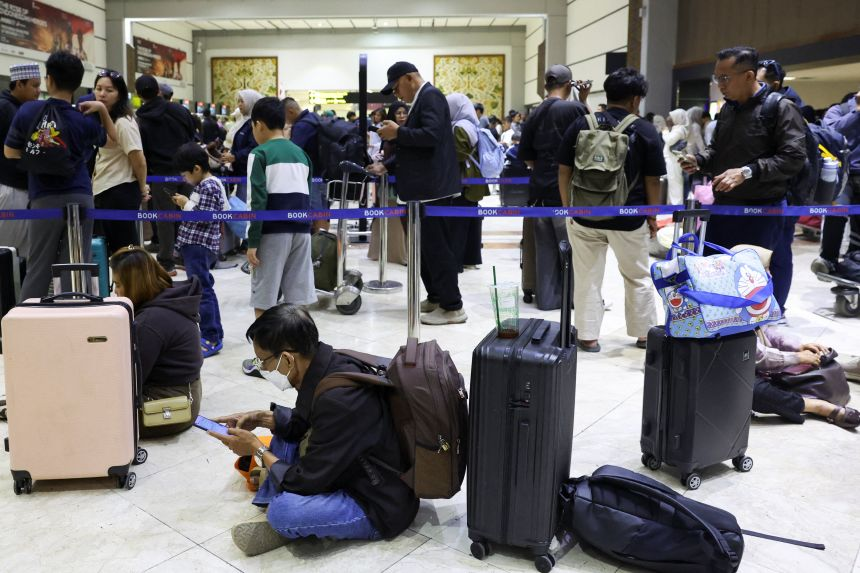
On Sunday morning, aviation regulators ordered an emergency suspension of all operations at Soekarno-Hatta International Airport after routine atmospheric tests confirmed that microscopic, engine-shredding volcanic debris had drifted directly into the capital’s airspace. The sudden shutdown has paralyzed travel at the country’s largest transportation hub, stranding tens of thousands of domestic and international passengers.
What began late Friday night as deep seismic tremors and booming concussions—audible hundreds of kilometers away—escalated dramatically into a full-scale eruptive event. By Sunday morning, the “Child of Krakatau” had ruptured twice more, spewing incandescent lava fountains and generating an expansive ash cloud that rose thousands of feet into the sky.
A Capital Grounded
As the ash cloud migrated across the Java Sea, it threw the region’s flight networks into immediate chaos. The Indonesian Transportation Ministry confirmed that hundreds of flights were abruptly suspended at Soekarno-Hatta Airport alone, including dozens of critical international routes connecting Jakarta to global transit hubs like Singapore, Sydney, Kuala Lumpur, and Doha. Major regional carriers, including Singapore Airlines, announced total cancellations for the remainder of the day as aviation officials frantically monitored the air corridors.
The disruption quickly radiated outward from the capital. AirNav Indonesia was forced to expand the net of closures, shutting down operations at five additional regional facilities, including Halim Perdanakusuma Airport in eastern Jakarta and Husein Sastranegara Airport in Bandung.
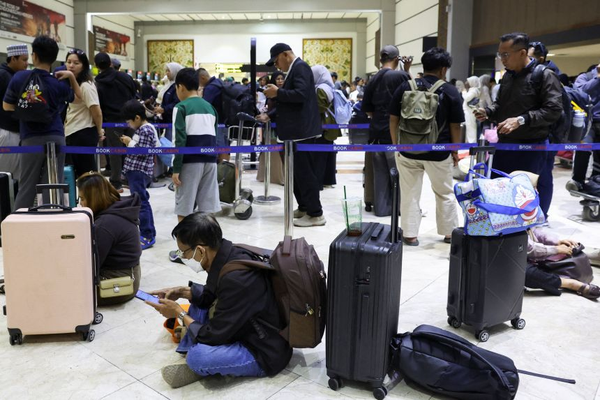
For an archipelago heavily reliant on domestic air travel to maintain economic continuity, the sweeping closures represent a severe logistical bottleneck. Terminal lounges across western Java rapidly filled with stranded travelers, while airlines scrambled to manage the cascading backlogs of passenger reroutings and baggage delays.
The Shadow of 1883
Mount Anak Krakatau occupies one of the most volatile marine environments on Earth, resting in the caldera formed by the cataclysmic 1883 eruption of the original Mount Krakatoa—an event that altered global climates and triggered devastating tsunamis.
While Indonesia’s National Disaster Mitigation Agency moved quickly to reassure the public that the current weekend activity carries no imminent threat of a tsunami, the visual spectacle of the eruption has been humbling. Commercial airline passengers flying on peripheral routes on Saturday captured striking aerial footage of a towering, pitch-black column of ash bisecting the clouds, punctuated by flashes of volcanic lightning near the active crater.
Living with the Ring of Fire
On the ground, the immediate impact has forced communities to adapt to the shifting winds. Heavy ash fall has blanketed parts of the capital city and Lampung province on the southern tip of Sumatra, turning streets gray and leaving a gritty residue on buildings and vehicles.
In response, public health officials have issued urgent advisories for residents to stay indoors, halt outdoor fishing activities, and wear protective face masks to shield against acute respiratory, skin, and eye risks from the abrasive glass-like particles that compose volcanic ash. Several localized school activities in the immediate fallout zone have also been temporarily suspended.
As volcanologists evaluate the ongoing tremors from the Sunda Strait, authorities warn that the danger zone remains highly unpredictable. While the airport closures are being reviewed on an hourly basis via continuous “paper tests” to check for ambient debris, the island nation remains entirely at the mercy of the wind and the restless crater below.